Henry Hub natural gas spot price analysis: Bullish signals emerge January 2025
In recent months, natural gas markets have become increasingly complex, with our Trading Co-Pilot platform identifying several significant developments affecting the Henry Hub natural gas spot price, pointing towards a generally bullish outlook. Many will think this optimism premature given recent volatility, yet ultimately, the data suggests a compelling story unfolding.

Market evolution and current dynamics 

Of course, the past week has shown notable demand surges, with our platform tracking several major infrastructure developments. In particular, Kinder Morgan’s new pipeline approval and ongoing exploration activities by ExxonMobil and Qatar Energy have emerged as significant positive indicators. It may well be true that these developments alone don’t guarantee Henry Hub natural gas spot price increases, but in contrast with previous market cycles, the infrastructure buildout comes at a crucial juncture.

Supply-demand complexities

Suffice to say, there is more than one way to skin a cat when it comes to analysing market dynamics, but clearly, the current situation presents a scathing challenge to traditional approaches. The EIA has been asserting rising wholesale power prices due to increased demand, and with it being recently reported that there’s been a significant drop in oil and gas rig counts, this actually strengthens the bullish case. 

Many are now believing that perhaps fears that production constraints might limit market growth have been overblown with the baton soon picked up again by major infrastructure projects. Though it is still early days, but the Transco pipeline approval reinstatement and new drilling activities in Cyprus suggest robust development pipeline. This will not be the same as previous infrastructure cycles – instead, we’re seeing more strategic, targeted expansions.

Weather patterns and market response

Thus far this Winter, weather has played a key role in Henry Hub natural gas spot price movements. In part, Goldman Sachs’ raised forecast for US gas prices reflects this reality, aligning with our platform’s detection of weather-related sentiment shifts. Rather, it is more like a perfect storm of factors affecting the Henry Hub natural gas spot price, as temperature forecasts increasingly drive market sentiment.

Our Trading Co-Pilot has detected a notable correlation between weather forecast updates and immediate price reactions, with even minor temperature revisions triggering significant market moves. This heightened sensitivity to weather patterns suggests that traders are positioning themselves more reactively to meteorological data than in previous seasons, creating both risks and opportunities for market participants.

Market implications and trading strategy 

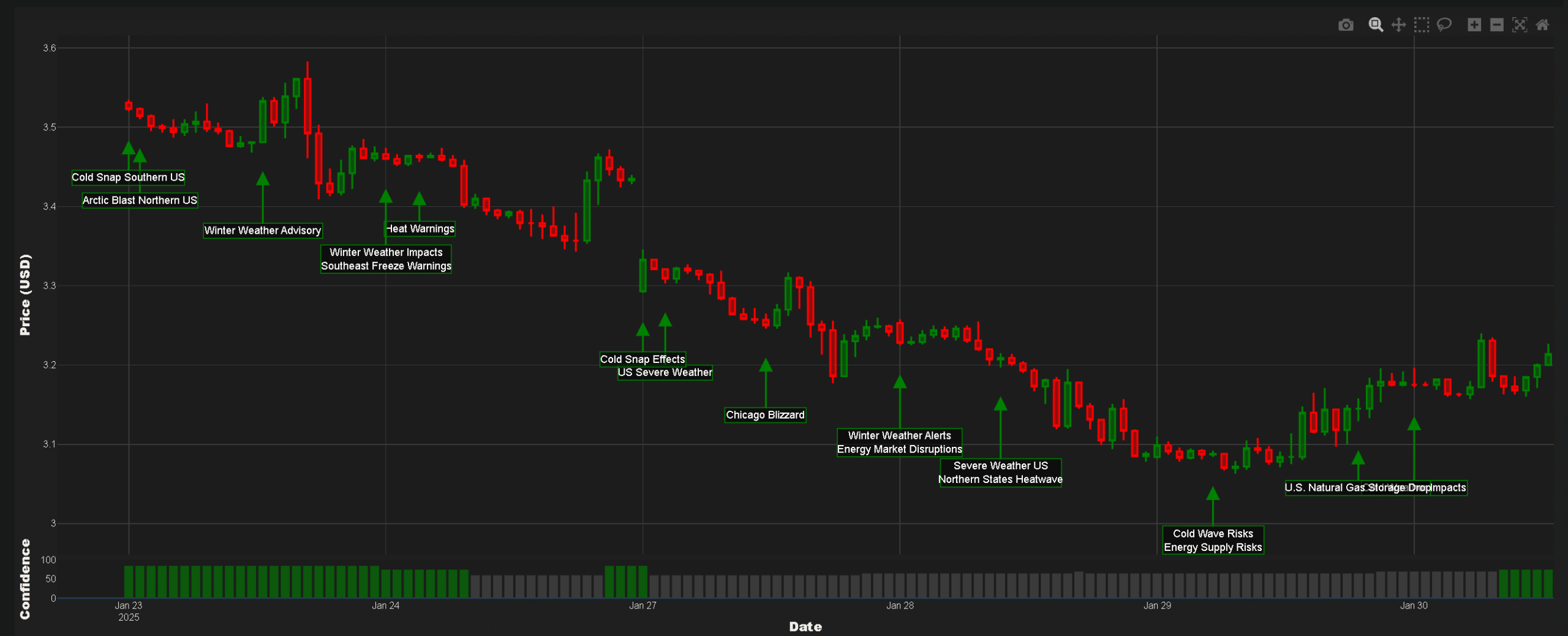
So the question is, what does this all mean for traders? At its core, our Trading Co-Pilot‘s analysis suggests a favourable risk-reward setup for the Henry Hub natural gas spot price. So we will soon see whether the market validates this view, but with current prices at 3.17, our Trading Co-Pilot’s recommended strategy balances prudent risk management with upside potential.

In short, this is a problem too complex for simple solutions, and is also a reflection of how complex global market dynamics have once again come back to the fore, – particularly with strengthening European gas markets suggesting a tightening supply environment. Ultimately, what is needed is careful monitoring of our identified timeline triggers. Thankfully, this is made easily accessible through our Trading Co-Pilot, exemplified by the chart above, with our platform continuing to monitor these developments in real-time, providing our users with actionable insights as market conditions evolve and careful analysis of multiple data streams.

We help traders navigate complex market dynamics 

Our Trading Co-Pilot platform delivers real-time insights across commodities markets, processing over 10,000 articles daily to identify market-moving events before they impact prices. Through advanced geolocation filtering, comprehensive sentiment tracking, and real-time event detection, we provide traders with the tools they need to make informed decisions in rapidly evolving markets.

If you’re interested in seeing how our market intelligence platform can enhance your trading strategy, we’d be delighted to show you a personalised demonstration of our capabilities for enterprise clients. Email enquiries@permutable.ai to schedule your enterprise demo, subject to approval or fill out the form below to learn more about how we’re transforming market intelligence for enterprise traders

Find out more


Crude oil trading: Analysing market dynamics for early 2025

As we step into 2025, the oil markets continue to surprise even the most seasoned of traders. Let’s briefly look at the complex web of factors driving crude oil prices with insights taken from our Trading Co-Pilot in what promises to be another volatile year for energy markets.

Current market dynamics 

Recent developments in the Crude Oil trading market indicate a decidedly bullish sentiment for Brent Crude. In terms of price action, we’re seeing consistent breaks above key resistance levels. The same applies to trading volumes, which have increased significantly since the start of the year.

And this is why traders are paying particularly close attention to inventory levels. Not long ago, U.S. crude stocks reported a dramatic fall of over 4 million barrels. According to sources within major trading houses, this substantial drawdown suggests a tightening supply situation that typically supports higher prices.

Geopolitical landscape

Everyone we speak to in the industry acknowledges the impact of current geopolitical tensions. Needless to say, the Israeli strikes against Yemen‘s Houthis have created significant supply disruption concerns. Except that this isn’t the only geopolitical factor in play.

The other element in the mix? Russian oil production has hit a 20-year low. We need to declare that this development alone would be significant enough to move markets. So when it emerged that Chinese factory activity was simultaneously showing signs of recovery, the bullish case became even stronger.

Supply and demand dynamics 

The trouble is – as we are all now well aware of – supply chain disruptions are becoming increasingly common. The good news is that market adaptation mechanisms are improving. It is claimed that oversupply concerns for 2025 could dampen price growth, and if it is the case that demand forecasts weaken, we might see some price corrections.

In this light, the Chinese economic recovery becomes even more crucial. How this will play out remains to be seen with some analysts erring on the side of caution, but there’s still plenty of evidence that demand growth will remain robust. Ultimately, this concern has three components for crude oil trading: economic growth rates, energy transition policies, and geopolitical stability.

Technical analysis and price movements 

And the bad news is that all of this is likely to create increased volatility. To address this, traders will need robust analytical frameworks and would do well to employ trading tech like our Trading Co-Pilot to help them navigate the path ahead. We would go so far as to say that if they don’t make progress on this front, they may very well find themselves struggling to navigate price swings that 2025 will likely bring.

Technical indicators are showing strong bullish momentum but there is no doubting the complexity of current market conditions. You can make the argument that traditional technical analysis alone won’t be sufficient in today’s environment.

Market sentiment and trader positioning 

The hardest part in all of this is distinguishing between genuine market signals and noise. Of course, there are things that can be done to improve signal quality, but the game changer will be integrated AI-driven analysis of the kind that we are bringing to traders already using our Trading Co-Pilot . For the avoidance of doubt, this doesn’t mean removing human judgment from the equation.

Then there is the challenge of increasing market fragmentation. The question is whether traditional trading strategies can keep pace with market evolution without embracing the latest tech tools.

Crude oil trading: Future outlook 

As for price projections, you can’t argue with the fact that supply-side constraints remain significant. Everywhere you look, there are signs of market transformation. In a way, this makes traditional forecasting models less reliable.

And while it’s true that we can be reasonably confident about certain trends with the present outlook for oil prices suggesting continued upward pressure, at least in the short term.  However, if experience tells us anything it’s that markets can change rapidly and nothing is guaranteed.

Crude oil trading: Strategic considerations 

And what of those who put forward the argument that oil markets have become too complex to analyse effectively? We say that quite simply, to reclaim strength in this area, traders must embrace new analytical tools – such as that of our Trading Co-Pilot. And then, we must also acknowledge that traditional trading approaches may need updating.

This is not to say that fundamental analysis has lost its value. Not at all. It’s just that the truth is more complicated, and there are several areas where traditional and modern approaches can complement each other by fusing the analytical power of AI and human-decision making capabilities.

Crude oil trading market dynamics for 2025: Final thoughts 

Last but not least, we must consider the broader context. Imagine too the potential impact of unexpected geopolitical events. If narratives shape politics, then we must be prepared for anything. We live in an age of highly volatile geopolitics, and oil markets reflect this reality.

Our analysis, powered by insights from our Trading Co-Pilot, suggests maintaining a cautiously bullish stance on oil prices for early 2025, while remaining alert to rapidly changing market conditions. The combination of technical indicators, fundamental factors, and geopolitical tensions supports this position, though careful risk management remains essential.

Harness the power of AI for crude oil trading in 2025

In today’s volatile energy markets, staying ahead requires more than just traditional trading tools. That’s why we’re offering qualified enterprise trading teams a unique opportunity: a complimentary one-month trial of our Trading Co-Pilot platform, the same technology already being used by some of the world’s leading energy trading houses.

During your trial period, you’ll gain complete access to our comprehensive suite of trading tools, including real-time market analysis, AI-powered trading agents specifically calibrated for energy markets, advanced volatility monitoring, and comprehensive social media sentiment analysis. Our platform seamlessly integrates with your existing trading infrastructure, while our technical team provides dedicated support to ensure you ensure the platform’s capabilities for your specific trading needs.

Join the growing number of major energy trading houses who are transforming their approach to market analysis and trading decisions. Whether you’re managing long-term positions or navigating daily market volatility, our Trading Co-Pilot provides the insights and analysis you need to trade with greater confidence and precision. Simply email enquiries@permutable.ai to request your free enterprise trial – subject to approval – or fill in the form below to get in touch.

Request free trial


DISCLAIMER

The information provided in this article is for informational purposes only and should not be considered as financial or investment advice. While the market insights presented are derived from our Trading Co-Pilot platform’s analysis, they represent a point-in-time assessment and should not be relied upon as the sole basis for any trading decisions. Markets are inherently risky, and past performance is not indicative of future results. We recommend consulting with qualified financial advisors for guidance tailored to your specific circumstances.

Is gold a good investment for 2025?

As markets reopen today for the new year, many will be asking the question “is gold a good investment for 2025?“. Well, there was a time when investing in gold was straightforward – buy during uncertainty, sell during stability. However today, the landscape has fundamentally changed. It is a volatile market where prices are predicted by unpredictable and ever-moving forces, making traditional investment strategies increasingly complex. The questions around whether gold is a good investment have become more nuanced, and will be one to watch in terms of commodity trading trends for 2025.

The struggle to make sense of gold’s place in a modern portfolio has intensified as digital assets like crypto and new investment vehhttps://permutable.ai/why-is-the-price-of-gold-going-up/icles compete for safe-haven status. Ultimately, this evolution in thinking about whether gold is a good investment reflects broader changes in global financial markets. In this article, we’ll answer the questions is gold a good investment for 2025 with insights from our Trading Co-Pilot. So read on to find out whether the gold rally is set to continue.

Is gold a good investment for 2025? Market dynamics and current trends 

First, we’re seeing unprecedented central bank buying that’s reshaping market fundamentals. The ambition here is clear: countries are diversifying away from traditional reserve currencies. This activity will include continued accumulation through 2025, with central banks already having purchased record amounts in recent years.

Second, retail investor interest has surged amid economic uncertainties. Together with institutional buying, this has created a robust support level for gold prices. As shown with recent market data, the correlation between economic uncertainty and gold’s appeal as a safe-haven asset remains strong, suggesting gold is a good investment for those seeking portfolio stability.

Is gold a good investment for 2025? The role of global economic factors

There isn’t any doubt about it: monetary policy decisions continue to influence gold prices significantly. As per our Trading Co-Pilot‘s analysis, the Federal Reserve’s stance on interest rates will remain a crucial driver through 2025. The consequence of potential rate cuts could provide substantial support for gold prices, as lower rates typically make gold a more attractive investment.

Either way, inflation concerns persist across major economies. It appears that once again, investors are turning to gold as an inflation hedge. The revelation that several major economies are struggling to meet their inflation targets provides additional support for considering whether gold is a good investment for wealth preservation.

Is gold a good investment for 2025? Geopolitical influences

And then there is the questions about the impact of global tensions on investment decisions. No more so than now, with multiple geopolitical hotspots creating market uncertainty. That is an echo of historical patterns where gold has traditionally performed well during periods of international tension.

And guess what, the complexity of current geopolitical relationships suggests these tensions won’t resolve quickly. This is nothing new in the gold market, but the interconnectedness of modern financial systems means that geopolitical events have more immediate and pronounced effects on whether gold is a good investment than ever before.

Is gold a good investment for 2025? Technical analysis and price movements 

The risk for investors lies in timing their entry points, with technical indicators suggesting key support levels around $2,040. Which explains why professional traders are closely monitoring price action near these levels. Instead of relying solely on technical analysis, successful investors are increasingly incorporating multiple data points into their decision-making process.

Later, these technical levels may prove crucial in determining whether gold is a good investment for short-term traders. Despite recent volatility, the overall trend remains supportive, with higher lows establishing a robust price floor. Yet look at the volume patterns: they suggest institutional investors continue to accumulate during price dips.

Is gold a good investment for 2025? Final thoughts 

The consequence of current market conditions suggests a balanced approach to gold investment. But the alleged risks of gold investment – such as its lack of yield – need to be weighed against its portfolio diversification benefits and historical role as a store of value.

From our point of view, gold’s trajectory in 2025 depends heavily on several key macroeconomic factors. Now that the fragility of traditional financial systems has been exposed through recent banking sector stresses, gold’s appeal as a safe-haven asset has strengthened. Little wonder that investment flows into gold-backed ETFs have remained steady.

Over and over again, market cycles have demonstrated gold’s resilience during periods of economic uncertainty. Given that historical performance patterns often rhyme, if not repeat, our analysis suggests maintaining some gold exposure could be prudent. But the alleged simplicity of gold investment decisions masks the complexity of timing and position sizing.

Despite short-term price fluctuations, the fundamental case for gold remains strong. It’s plain to see that economic uncertainties could persist through 2025, potentially supporting gold prices. However, investors should remember that position sizing and timing are the linchpin of any successful gold investment strategy.

Navigate gold markets with confidence 

Want to enhance your precious metals trading strategy with AI-driven insights? We’re offering qualified enterprise trading teams a complimentary one-month trial of our Trading Co-Pilot platform. Experience how leading trading houses are using our advanced AI analytics to identify opportunities and manage risk in the gold market. Our platform provides real-time market analysis, predictive insights, and comprehensive sentiment analysis specifically calibrated for precious metals trading.

Request your enterprise trial today by emailing enquiries@permutable.ai or filling in the form below. Available for qualified enterprise trading teams. Subject to approval.

Request one-month trial


DISCLAIMER

The information contained in this article is for informational purposes only and should not be considered as financial or investment advice. While the insights presented are derived from our Trading Co-Pilot platform’s analysis of market data, they represent a point-in-time assessment and should not be relied upon as the sole basis for any investment decisions. Markets are inherently risky, and past performance is not indicative of future results. The price of gold and other precious metals can be volatile and can be affected by numerous factors outside of our control.

Trading in precious metals carries significant risk, and you should carefully consider your investment objectives, level of experience, and risk appetite before making any investment decisions. We recommend consulting with qualified financial advisors who can provide guidance tailored to your specific circumstances. Permutable AI and its employees do not accept any liability for any loss or damage, including without limitation to, any loss of profit, which may arise directly or indirectly from use of or reliance on such information.

Commodities trading: Navigating the commodity market in 2024 – trends & insights

Navigating the intricate landscape of predicting the commodities trading for 2024 and beyond involves a delicate dance amidst a complex interplay of economic, geopolitical, and environmental factors. The commodities market, known for its volatility and sensitivity to global dynamics, requires a nuanced understanding of current trends and expert insights to gain a glimpse into the potential outlook for various commodity categories.

In this unpredictable terrain, uncertainties cast shadows over the future, demanding a comprehensive analysis that considers not only traditional economic indicators but also the ripple effects of geopolitical events and the ever-evolving environmental landscape. The ability to foresee trends and anticipate shifts in commodity prices has never been more crucial, especially in an era where markets are increasingly interconnected, and the impact of one event can reverberate across the globe.

As we delve into the forecasting of commodities trading for 2024, it becomes evident that traditional approaches must be augmented by insights drawn from diverse sources. The intricate dance of supply and demand, influenced by factors ranging from political decisions and climate change policies to technological advancements, paints a canvas where predicting market trajectories requires a blend of analytical precision and a keen eye for emerging trends.

This exploration will not only unravel the potential trends in traditional commodities trading but will also shed light on how emerging factors, such as advancements in technology, changes in consumer behaviour, and global efforts towards renewable energy, might reshape the landscape. The integration of these elements into the fabric of commodities trading underscores the need for a comprehensive and forward-looking approach to predicting market dynamics in 2024.

Base metals: A mix of challenges and opportunities

Overall perspective: The base metals market presents a mixed bag of challenges and opportunities in 2024. Notably, nickel faces a bearish outlook, primarily due to increased Indonesian production. On the flip side, copper and other industrial metals may experience positive momentum, driven by potential infrastructure spending initiatives.

Key influencing factors: Several key factors will shape the base metals market. Global economic growth, particularly in major industrial nations, will be a significant determinant. The level of construction activity in China, a major consumer of base metals, and the ongoing transition to clean energy will also play crucial roles in shaping the outlook.

Precious metals: Bullish momentum amid economic dynamics

Market outlook: Precious metals, including gold and silver, are poised for a bullish trend in 2024. This optimistic outlook is rooted in expectations of subdued inflation and central banks adopting more accommodative monetary policies. Consequently, gold and silver prices may surge, potentially reaching new highs.

Key drivers: The trajectory of interest rates, investor sentiment towards safe-haven assets, and geopolitical tensions will serve as pivotal factors influencing precious metal markets. As global economic dynamics evolve, these metals are likely to maintain their allure as safe-haven investments.

Energy: Navigating volatility and geopolitical factors

Oil market dynamics: The oil market is expected to face continued volatility in 2024. The potential for both upside and downside movements will be influenced by factors such as economic recovery, recessionary fears, decisions by the OPEC+ alliance on production levels, and ongoing geopolitical concerns.

Natural gas outlook: Natural gas prices are anticipated to remain volatile and elevated, primarily due to supply constraints and the persistent conflict in Ukraine. The war has disrupted energy supplies, contributing to sustained pressures on natural gas prices.

Agriculture: Bullish trends fueled by disruptions and weather

Overall agricultural outlook: The agriculture sector is anticipated to witness bullish trends, particularly in the early months of 2024. Factors such as supply chain disruptions and weather-related concerns are expected to drive price increases in commodities like sugar and grains.

Key agricultural factors: Weather patterns, crop yields, and the dynamics of global trade will be pivotal in determining specific trends within the agriculture sector. As climate conditions evolve, strategic decisions in response to changing agricultural landscapes will be crucial.

Additional considerations: Trends beyond traditional factors

The green transition: Investments in commodities linked to clean energy technologies, such as lithium and cobalt, are projected to experience steady growth. Government policies supporting green initiatives and the increasing demand for electric vehicles contribute to the optimism surrounding these commodities.

Technological advancements: The incorporation of artificial intelligence  and big data in commodities trading and analysis is a noteworthy trend. This integration enhances efficiency and opens new avenues for investment opportunities, reflecting the broader influence of technology on traditional markets.

A cautionary approach: Diversification and research

In navigating the commodities trading landscape of 2024, a cautious approach with a focus on diversification is recommended. Thorough research, an understanding of specific market dynamics, and seeking professional guidance are crucial steps before making any investment decisions. While informed predictions offer valuable insights, unforeseen events can disrupt even the most well-founded expectations. Staying informed and adapting strategies as market conditions evolve will be imperative for investors.

How Permutable AI can empower commodities trading  

In the volatile landscape of 2024, investors are seeking innovative tools to gain a competitive edge. This is where Permutable AI steps in, offering technology-driven solutions that harness the power of artificial intelligence to navigate the erratic nature of the commodities market.

AI unleashing hidden patternsCommodities trading requires a keen understanding of various variables, and AI algorithms excel in processing vast amounts of data to unveil hidden patterns and correlations. Permutable AI’s technology dives deep into historical market trends, global economic indicators, geopolitical events, and environmental factors, extracting valuable insights that might elude traditional analysis. By deciphering complex data sets, the AI can provide a nuanced understanding of commodity movements, enabling investors to make informed decisions.

Real-time analysis for dynamic markets: Commodities trading and the market is known for its rapid changes, influenced by global events and economic shifts. Permutable AI’s real-time analysis capabilities ensure that investors receive up-to-the-minute insights into market fluctuations. This empowers them to make agile decisions, responding promptly to changing conditions and seizing opportunities that may arise amidst the dynamic nature of commodity prices.

Tailored recommendations for diversification: No two commodities are alike, and the factors influencing their prices can vary significantly. Permutable AI employs sophisticated models to personalise recommendations based on an investor’s risk tolerance, financial goals, and unique investment constraints. By tailoring suggestions to individual preferences, the AI ensures that portfolios are diversified strategically, mitigating risks associated with the volatile commodities market.

Proactive risk management: The commodities market is inherently risky, and effective risk management is crucial for investors. Permutable AI’s technology goes beyond providing insights; it actively contributes to risk management strategies. By identifying potential risks and offering proactive solutions, the AI helps investors navigate the market with greater confidence and resilience.

Adaptability in unpredictable environments: One of the standout features of our AI trading provision is its adaptability in unpredictable environments. The commodities market is susceptible to sudden shifts influenced by unforeseen events. Permutable AI’s technology is designed to adapt swiftly, ensuring that investors remain agile and responsive to emerging trends or unexpected developments, thereby minimising the impact of market surprises.

Ethical and transparent AI use: In the responsible deployment of AI, Permutable AI prioritises ethical considerations and transparency. Our technology is designed to provide clear insights into its decision-making processes, fostering trust among investors. This explainability and commitment to ethical AI ensures that investors can confidently leverage technology as a valuable tool in their decision-making processes.

As we navigate the complexities of the commodities trading in 2024, at Permutable AI, we’re here as a strategic partner for investors seeking a data-driven and technology-enabled approach. From unveiling hidden patterns to real-time analysis, tailored recommendations, proactive risk management, and adaptability in unpredictable environments, Permutable AI empowers investors to navigate the volatile commodities market with confidence and foresight. To find out more, why not get in touch with us by filling in the contact form below – we’d love to hear from you. Until then, be sure to keep up to date with our latest summary of commodity trading trends for 2025.

Get in touch