This article provides an in-depth analysis of the recent platinum price surge above $1,268 demonstrating how our proprietary AI-powered Trading Co-Pilot system delivered critical early sentiment signals ahead of major price movements. The piece combines real-time trading intelligence with macro analysis from our in-house analyst, examining supply constraints, geopolitical risks, and fundamental drivers behind platinum’s sustained rally and is aimed at professional commodity traders, precious metals investors, systematic trading funds, and institutional clients seeking advanced trading intelligence and real-time sentiment analysis for precious metals markets. Particularly valuable for traders managing multi-asset portfolios who require early-warning systems for commodity market inflection points.
Platinum has taken the spotlight this month, roaring back into focus after breaking above $1,268.90, its highest level since May 2021. The fundamentals surrounding the metal point to a combination of a perfect storm of supply constraints, geopolitical risk, and investor positioning driving the sustained rally. The move began on 5 June, when platinum broke through resistance at $1,089.50.
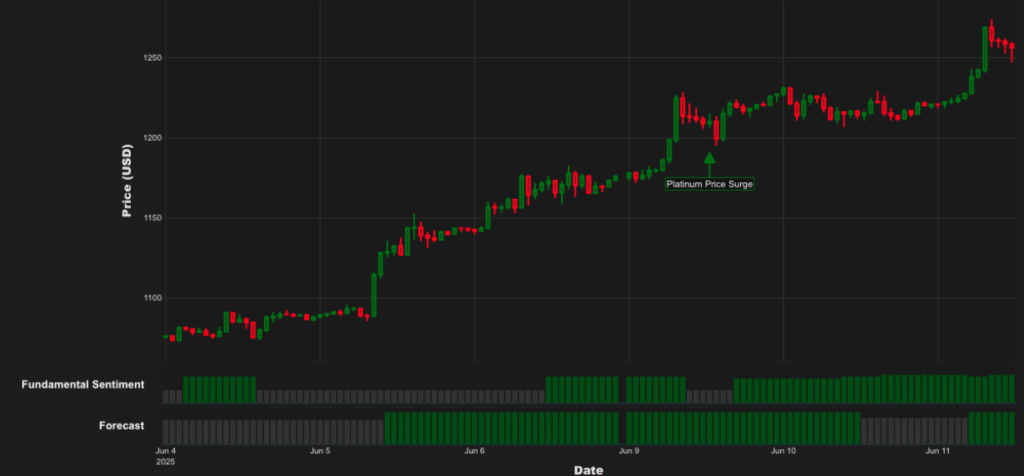
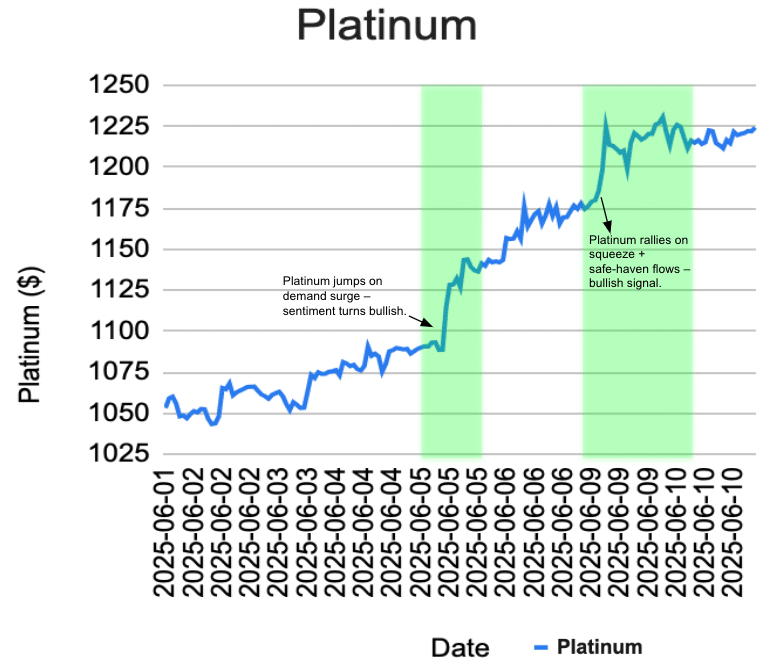
During early Asian trading, our Trading Co-Pilot system issued a “strong bullish” sentiment alert, hours before prices surged to $1,127.20, and then accelerated to $1,222.50. This early signal gave a critical edge ahead of a sharp breakout fuelled by renewed momentum and technical positioning. By 10 June, the market paused, taking a natural pullback.
Our Co-Pilot concurrently flagged this indicating a shift to neutral sentiment, capturing the cooling tone as profit-taking and consolidation took place. However, on 11 June, the rally reignited. Platinum opened sharply higher at $1,268.90, propelled by renewed safe-haven buying after an intensified Russian drone offensive on Kyiv spurred geopolitical risk aversion during the Asian session. Our Trading Co-Pilot once again tracked the real-time shift, signalling a bullish turn in sentiment and helping traders stay ahead of the curve.
Above: Our Trading Co-Pilot sentiment indicators caught the platinum rally early – while traditional analysts focused on supply fundamentals, our AI detected shifting institutional sentiment patterns across news sources before the breakout. The sentiment heat map showed bullish momentum building in precious metals discourse, with platinum-specific mentions spiking as traders rotated from gold. This is exactly how intelligent sentiment analysis transforms market timing.
Several structural and macroeconomic drivers are underpinning platinum’s price strength:
Tight supply: Major producers in South Africa and Russia have curbed output amid a prolonged low price environment owing to covid and the rise of EV’s, worsening an already deepening deficit. The World Platinum Investment Council (WPIC), most recent report forecasts a 966,000oz shortfall for 2025, the third consecutive annual deficit.
Investor safe-haven flows: With elevated lease rates and geopolitical instability, platinum has regained traction as a store of value, attracting capital inflows on the margins.
China demand shift: In retail markets, platinum is gaining prominence in the Chinese jewellery market as a lower-cost alternative to gold, which has fueled additional demand.
Tariff hedging: Earlier in 2025, large volumes were diverted to the United States as investors braced for a potential return to Trump-era tariffs, signalling how political risk is being priced into physical flows.
Above: Breakout signals – our intelligence-driven trading alerts identified platinum’s two-stage rally before price action confirmed the moves. Permutable AI sentiment indicators captured demand surge narratives in May and squeeze dynamics in June, delivering actionable positioning opportunities ahead of the 15% price appreciation.
This rally exemplifies the importance of combining real-time sentiment systems like our Trading Co-Pilot with robust macro, sectoral, and fundamental analysis. In a volatile, undersupplied market like platinum, timing is everything. In this case, our Trading Co-Pilot not only captured the rally, it anticipated key inflection points in sentiment, giving users the ability to position ahead of price moves. With platinum markets now driven by both tight fundamentals and headline risk, tools that identify sentiment shifts early are critical in capturing the market early. Co-Pilot delivers that edge.
Every day, commodity markets experience inflection points that separate profitable positions from missed opportunities. Without real-time sentiment detection, how much alpha is your trading operation leaving on the table? Traders relying on traditional technical analysis entered platinum positions hours after our Co-Pilot users had already capitalised on the initial momentum, and in volatile, headline-driven markets, this timing differential compounds across every major move.
Your competitors are already gaining systematic advantages through our advanced sentiment intelligence, and as markets become increasingly driven by geopolitical headlines and macro sentiment shifts, the question isn’t whether you need real-time sentiment analysis – it’s whether you can afford to operate without it whilst your competition gains positioning advantages on every market inflection.
Contact our trading intelligence team at enquiries@permutable.ai to discover how our Trading Co-Pilot intelligence suite and systematic data feeds deliver systematic positioning advantages for your commodity and precious metals strategies.
The precious metals market has witnessed yet another gold surge, with spot prices climbing above $3,300 per ounce. Here, understanding the underlying forces behind this rally requires more than traditional technical analysis. At Permutable AI, our sophisticated sentiment tracking technology has uncovered the precise catalysts driving this extraordinary price movement, providing institutional investors and market participants with unprecedented insights into gold’s current trajectory.
Through our proprietary LLM-powered platform, which monitors sentiment across more than 50 asset classes on an hourly basis, we’ve identified a fascinating confluence of factors that have collectively fueled this gold surge. What emerges from our analysis is not merely a simple supply-demand story, but rather a complex interplay of macroeconomic uncertainty, geopolitical tensions, and shifting global investment patterns that have created the perfect storm for gold’s ascent.
Above: Our AI’s real-time sentiment analysis reveals the key drivers behind gold’s recent surge to over $3,300 per ounce. The heatmap displays sentiment factors from 15-22 May, with green bars indicating positive price drivers and red bars showing negative influences. Macroeconomic factors, particularly the Moody’s US downgrade, emerge as the primary catalyst, whilst a surge in Chinese gold imports to an 11-month high has provided additional demand-side support for the rally.
The most significant driver behind the current gold surge has undoubtedly been the macroeconomic landscape, particularly following Moody’s recent downgrade of US credit prospects. Our sentiment analysis reveals that this development has created substantial positive momentum for gold prices, as investors increasingly view the precious metal as a traditional safe haven amid growing concerns about fiscal stability.
Furthermore, our real-time monitoring has detected heightened anxiety surrounding inflation expectations and monetary policy uncertainty. These macroeconomic headwinds have historically provided strong tailwinds for gold, and our current data suggests this relationship remains as robust as ever. The sentiment patterns we’re observing indicate that market participants are positioning themselves defensively, with gold serving as their preferred hedge against potential economic volatility.
More interestingly, our analysis has revealed a powerful demand signal emanating from Chinese gold imports, which have surged to an 11-month high. This development represents more than just a statistical anomaly; it reflects a fundamental shift in global gold consumption patterns that our AI systems have been tracking meticulously.
The Chinese gold import surge appears to be driven by both retail and institutional demand, with our sentiment analysis suggesting that domestic Chinese investors are increasingly turning to gold as a store of value amid their own economic uncertainties. To add to this, this demand pattern has created a feedback loop, whereby increased physical demand has further supported the gold surge by tightening available supply in the market.
Whilst demand factors have certainly contributed to the gold surge, our comprehensive sentiment mapping reveals that supply-side considerations have played an equally important role. Mining production constraints, regulatory challenges, and operational difficulties have all registered as negative sentiment factors for gold supply, thereby supporting higher prices.
Our analysis indicates that these supply constraints are not merely temporary disruptions but reflect deeper structural challenges within the gold mining industry. Consequently, the current gold surge may have more sustainable foundations than previous rallies that were driven primarily by speculative demand or short-term macroeconomic shocks.
So what sets our analysis apart here? Quite simply, it’s the unprecedented granularity and real-time nature of our sentiment tracking. Unlike traditional market analysis that relies on historical data and retrospective analysis, our LLM-powered technology provides continuous monitoring of market drivers as they unfold. This approach has enabled us to identify the gold surge catalysts in real-time, rather than attempting to explain price movements after the fact.
Our sentiment mapping visualisation clearly demonstrates how different market factors have contributed to the gold surge over recent trading sessions. The predominance of green indicators across macroeconomic and demand categories illustrates the broad-based nature of the current rally, whilst occasional red indicators in supply and regulatory areas highlight the complex dynamics at play.
Based on our ongoing sentiment analysis, the current gold surge may appear to have robust fundamental underpinnings that extend beyond short-term speculative activity. The combination of macroeconomic uncertainty, strong physical demand from key markets like China, and supply-side constraints suggests that gold prices may continue to find support at elevated levels.
Our real-time monitoring will continue to track evolving market sentiment for any shifts in the underlying drivers that have supported this recent gold surge. Here, the beauty of our AI-powered approach lies in its ability to detect these changes as they occur, rather than after market conditions have already shifted.
Discover how our LLM-powered technology and data feeds can deliver a clear and consolidated view of markets whether delivered systematically or programatically. Contact us at enquiries@permutable.ai to learn more about our comprehensive sentiment tracking solutions can help you efficiently see market movements or simply fill in the form below to request a demo.
*This article examines whether we’re approaching a significant gold revaluation amidst current market volatility, using market sentiment analysis from the Forecast View of our Trading Co-Pilot. It’s aimed at serious investors, wealth managers and financial professionals seeking to understand the complex interplay between short-term price movements and long-term structural factors affecting gold valuations.
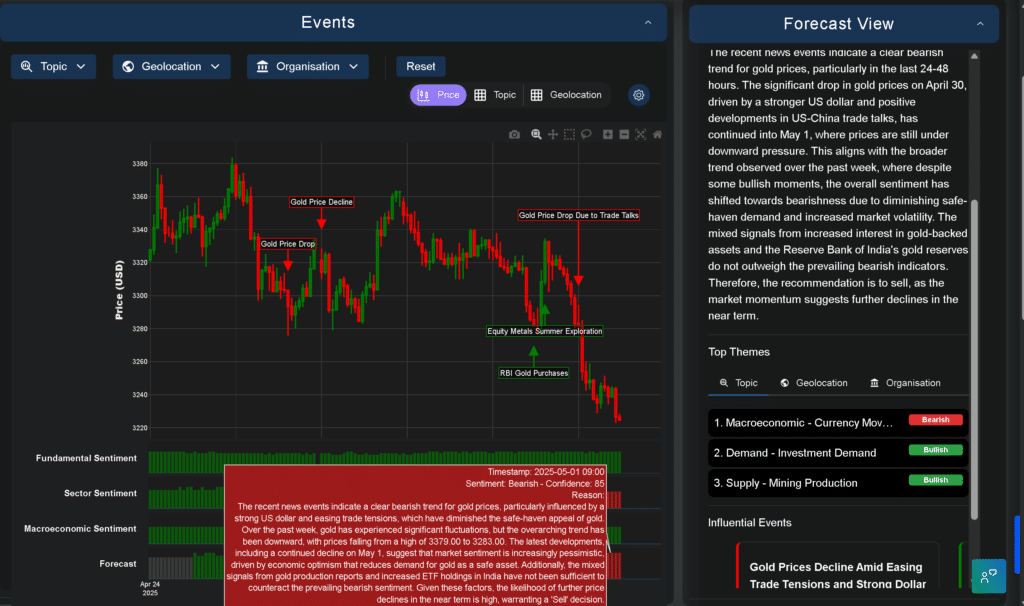
The global economic tremors reverberating through financial markets have once again brought gold into sharp focus as investors question whether we are witnessing the early stages of a significant gold revaluation. Recent market sentiment analysis from our Trading Co-Pilot shows gold experiencing substantial fluctuations, with prices dipping from a high of 3379.00 to 3283.00 in just one week.
This isn’t just because of normal market volatility – the turbulence has been caused by a complex interplay of easing US-China trade tensions, a strengthening US dollar, and shifting investor sentiment away from safe-haven assets. But while these immediate factors are driving short-term price movements, deeper structural forces may be building toward a potential gold revaluation event that could reshape the precious metals landscape.
For now, our Trading Co-Pilot analysis indicates a clear bearish trend for gold prices. Recent reports show gold prices retreating across various regions, including a Rs 3,400 decline per tola in India. The situation has been exacerbated by diminished buyer interest as prices surged earlier this year.
As so often happens in gold markets, sentiment can shift rapidly. Given market volatility and the current macroeconomic landscape, the question is whether these short-term price movements represent a temporary correction or the beginning of a larger realignment. Our market sentiment analysis suggests that investors remain cautious but have not abandoned their longer-term bullish outlook on gold.
Above: Gold market faces bearish pressure as US dollar strengthens and trade tensions ease — Despite isolated bullish signals such as central bank purchases and exploration news, prevailing macroeconomic and sentiment indicators point to continued downside risk for gold prices into May 2025.
First, the unprecedented expansion of central bank balance sheets since the 2008 financial crisis has created what many analysts view as unsustainable monetary conditions. The blowback could eventually necessitate a significant revaluation of hard assets like gold relative to fiat currencies.
Specifically, central banks themselves have become net buyers of gold, with countries like Russia, China, and Turkey significantly increasing their reserves. These insights from our data suggest that major economic powers are hedging against potential currency instability by accumulating gold reserves at a pace not seen in decades.
The upending of world economic order through deglobalisation trends and increasing geopolitical tensions between major powers adds another layer of complexity. As for the recent trade tensions between the US and China, their temporary easing has contributed to gold’s price decline, but the underlying strategic competition continues to create long-term support for gold prices.
Those who ask whether a gold revaluation is imminent point to strengthening economic data and the resilience of the US dollar as evidence against such a scenario. As the reality of higher-for-longer interest rates sets in, the opportunity cost of holding non-yielding assets like gold increases. Then there are the increasing acceptance of digital currencies as an alternative safe haven asset which could potentially diminish gold’s monetary role in the future.
All of these points suggest that while the structural conditions for a gold revaluation exist, however the timing remains highly uncertain. But that outcome isn’t necessarily a negative for strategic gold investors with long-term horizons.
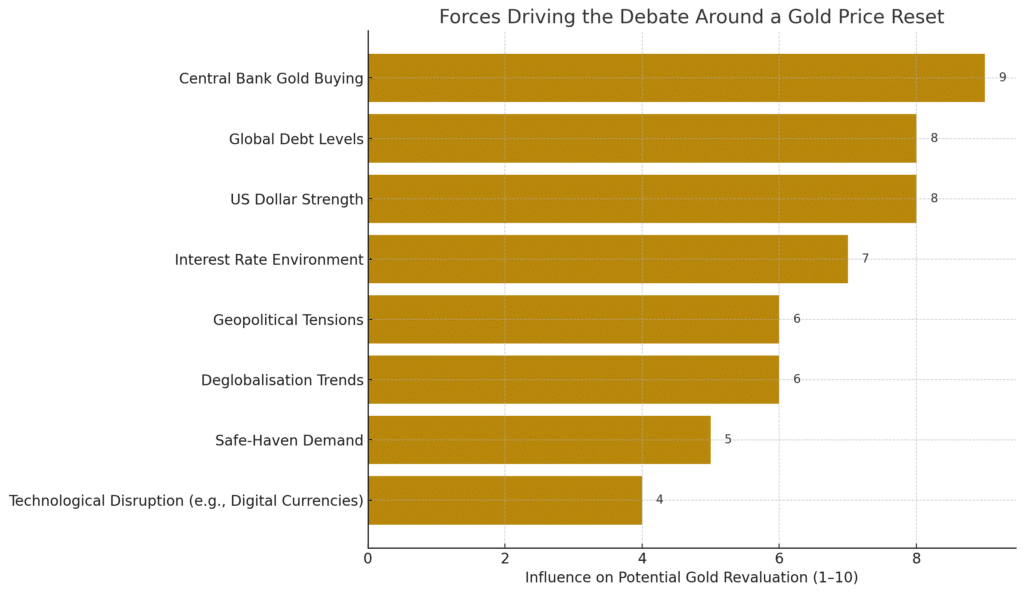
Above: Key macroeconomic and geopolitical drivers shaping the debate around a potential gold price reset, with central bank gold buying and global debt levels emerging as the most influential factors in early 2025.
The unpredictability of gold price movements in the current environment makes tactical trading challenging. For better or worse, gold remains both a safe-haven asset and a speculative vehicle, with its price influenced by everything from inflation expectations to jewellery demand in major consumer markets like India and China.
There is a great deal of fear amongst investors about missing out on potential protection should a gold revaluation occur. As well as traditional investment channels, we’re seeing increased interest in gold-backed cryptocurrencies and other innovative vehicles that allow investors to gain exposure to potential gold price appreciation.
Unlocking the potential means understanding gold’s dual nature as both a commodity and a monetary asset. This brings us back to the fundamental question: are we heading toward a gold revaluation event? We believe that while current price action suggests bearishness, the underlying structural factors supporting a significant gold revaluation remain intact.
Amid all of this speculation, predicting the exact timing of a potential gold revaluation remains challenging. For investors concerned about preserving wealth through periods of monetary uncertainty, maintaining a strategic allocation to gold may be prudent regardless of short-term price movements.
The question is not whether gold will experience volatility – it certainly will – but whether it continues to serve its historical role as a store of value during periods of financial stress and currency debasement. These concerns shape how forward-thinking investors are positioning themselves despite recent price declines.
For now, our analysis suggests maintaining a cautious approach to gold investments while acknowledging the legitimate structural forces that could eventually drive a significant gold revaluation. The path forward may be volatile, but the role of gold in preserving wealth through monetary upheaval remains as relevant as ever in today’s uncertain financial landscape.
Ready to navigate the complexities of gold markets with confidence? Access our comprehensive market intelligence through our Trading Co-Pilot Terminal or integrate our API directly into your trading infrastructure. Our real-time analysis and sentiment tracking provide the critical insights you need to position your portfolio effectively, whether we’re heading for a gold revaluation or continued market volatility. Simply email enquiries@permutable.ai to request a demo or fill in the form below.
In a world that has started to spin in ever faster geopolitical tension, gold continues to maintain its position as the safe-haven asset of choice for investors seeking stability. The precious metal recently surged past the $3,000 mark, reaching unprecedented heights as market volatility continues to shape investment strategies globally, with some saying this is just the beginning. In this article we’ll take a closer look at market volatility impact on gold, with insights taken from Analyst View of our Trading Co-Pilot.
The current crisis spanning multiple regions has created a perfect storm for gold markets. Humanitarian crises in Gaza, escalating tensions in Ukraine, and military actions in Yemen have all contributed to a climate of uncertainty that typically benefits gold prices. By the time markets opened this Monday, gold had already marked its third consecutive weekly gain, with analysts projecting further increases toward $3,100.
Consider the facts: gold prices reached a record high of $3,051 per ounce last Tuesday, driven primarily by safe-haven demand amidst growing geopolitical uncertainties. This wasn’t merely a speculative bubble. Indeed, the fundamental drivers behind gold’s rise reflect deep-seated concerns about global stability and economic outlook.
Let’s take a step back and examine how market volatility has historically influenced gold prices. Back when financial markets faced similar turbulence during the 2008 global financial crisis, gold demonstrated its resilience as a store of value. The same goes for periods of heightened geopolitical tension, where investors consistently turn to gold as a hedge against uncertainty.
Many believe that gold’s inverse relationship with market volatility is what makes it an essential component of a diversified portfolio. But the story of how gold responds to volatility is more nuanced than conventional wisdom might suggest. Insiders say that the current gold rally differs from previous surges in several key aspects. The reason for this is fairly straightforward. Unlike previous periods of volatility, we’re seeing a confluence of factors – geopolitical tensions, persistent inflation concerns, and central bank policies – all creating a particularly supportive environment for gold.”
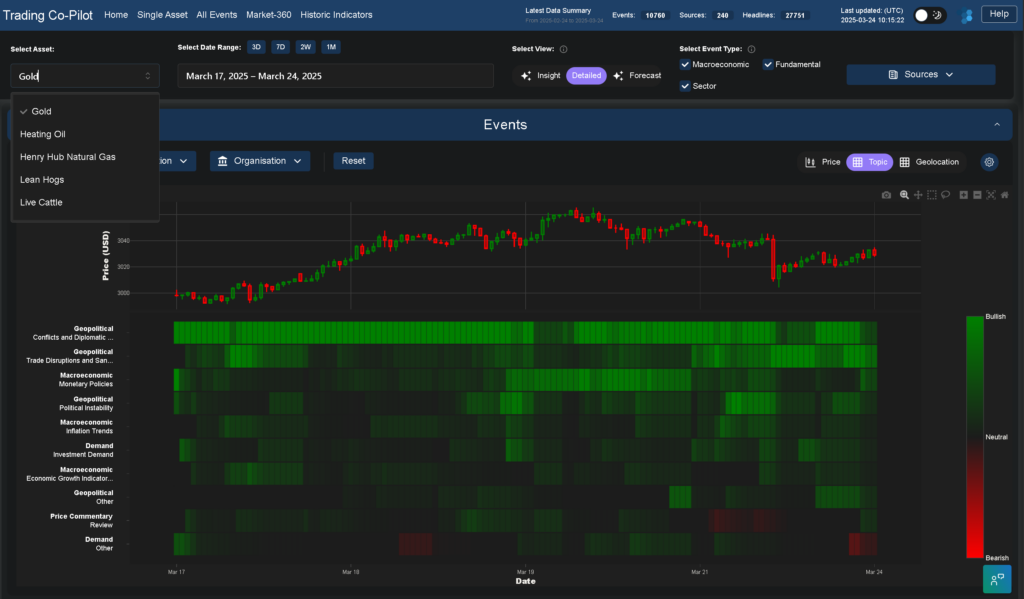
Above: Our Trading Co-Pilot‘s Sentiment Heatmap clearly showing a confluence of factors impacting gold prices
The Federal Reserve’s decision to maintain interest rates has significantly contributed to market volatility impact on gold. Such doubts withered away when markets began pricing in potential rate cuts later this year, providing additional support for non-yielding assets like gold.
However, many seasoned onlookers see this as a double-edged sword. There is no prospect of immediate monetary easing, especially with inflation remaining above target levels in many economies. This is the context in which investors must navigate their gold investment strategies. It is also the result of central banks themselves becoming substantial gold buyers, adding to their reserves at the fastest pace in decades. The Bank of England’s decision to maintain interest rates at 4.5% amidst global uncertainties further bolstered the case for gold as a portfolio stabiliser.
Why did this happen? The mists are lifting, revealing geopolitical tension as the primary catalyst for gold’s recent performance. Simply put, the ongoing conflict in Gaza, military actions in Ukraine, and tensions in Yemen have created a climate where investors prioritise capital preservation over growth. These are not isolated problems but interconnected challenges that continue to shape market sentiment. One of the big targets is achieving portfolio resilience in the face of such multifaceted risks, and gold has traditionally served this purpose well.
More generally, the market volatility impact on gold extends beyond price appreciation to include its role as a liquidity provider during market stress. To see what we mean, just look at how gold has maintained its trading volume and market depth even as other asset classes experienced liquidity constraints.
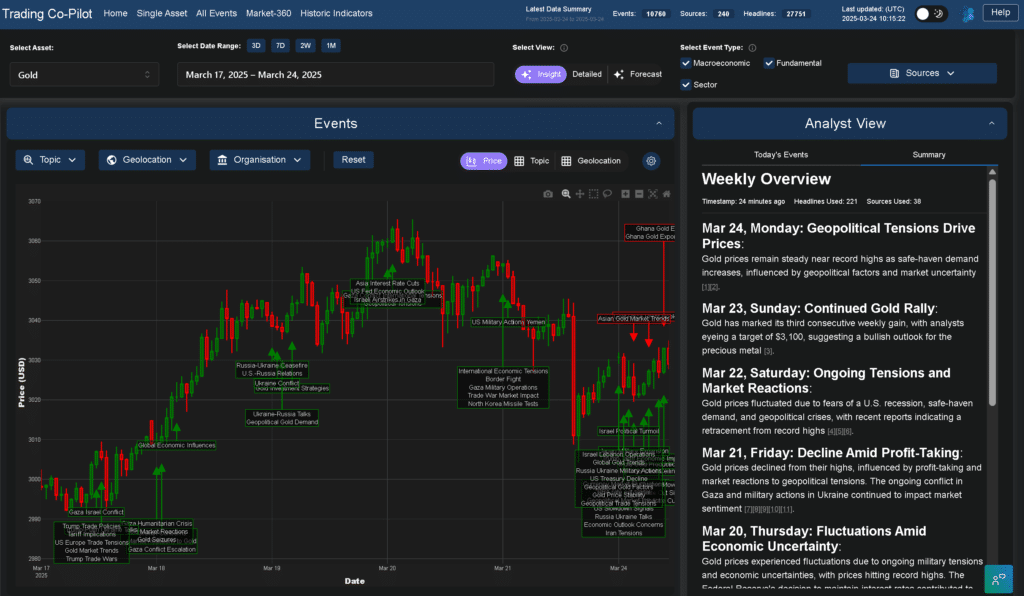
Above: Analyst Insight Mode from our Trading Co-Pilot showing gold price movements amid market volatility over the last week
What to do about it? For investors navigating this complex landscape, it normally just takes a strategic approach to incorporate gold effectively into portfolios. And yet we still see many investors under-allocated to this asset class relative to historical norms. That said, diversification remains essential. It’s the same with any investment strategy – concentration creates vulnerability. Gold should complement other assets rather than dominate portfolios.
It may, however, already be too late to capture the initial surge. The list goes on of factors that could influence gold’s trajectory from here – potential rate cuts, inflation persistence, and evolving geopolitical situations all remain in play. Like much of financial market dynamics, the market volatility impact on gold requires nuanced understanding. This isn’t to say that gold is immune to price fluctuations; recent profit-taking after reaching record highs demonstrates that gold prices can retrace even amid supportive conditions.
And what of gold’s prospects moving forward? Ultimately, the outlook depends on how several key factors evolve:
The market volatility impact on gold will likely remain positive as long as uncertainty persists. However, any resolution to current conflicts or shifts toward monetary tightening could temper enthusiasm. Yet, ultimately, gold isn’t merely responding to short-term headlines but to fundamental shifts in the global economic and political landscape.
In sum, the market volatility impact on gold has been profound, driving prices to historic highs amid a perfect storm of geopolitical tensions, monetary policy uncertainty, and safe-haven demand. As investors continue to navigate this volatile environment, gold’s role as a portfolio stabiliser and store of value remains as relevant as ever.
For those seeking to understand and potentially benefit from gold’s relationship with market volatility, a balanced approach that acknowledges both opportunities and risks remains essential. The precious metal’s current strength reflects genuine concerns about global stability – concerns that show little sign of abating in the near term.
Take your market analysis to the next level with our Trading Co-Pilot. Our advanced AI-driven platform delivers real-time intelligence on gold market movements, helping you navigate volatility with precision and confidence. Don’t let crucial market shifts catch you off guard – sign up today for a free 14-day trial and experience how our cutting-edge technology can give you the edge in today’s unpredictable markets. Simply get in touch with us at enquiries@permutable.ai or fill in the form below to request a demo or trial.
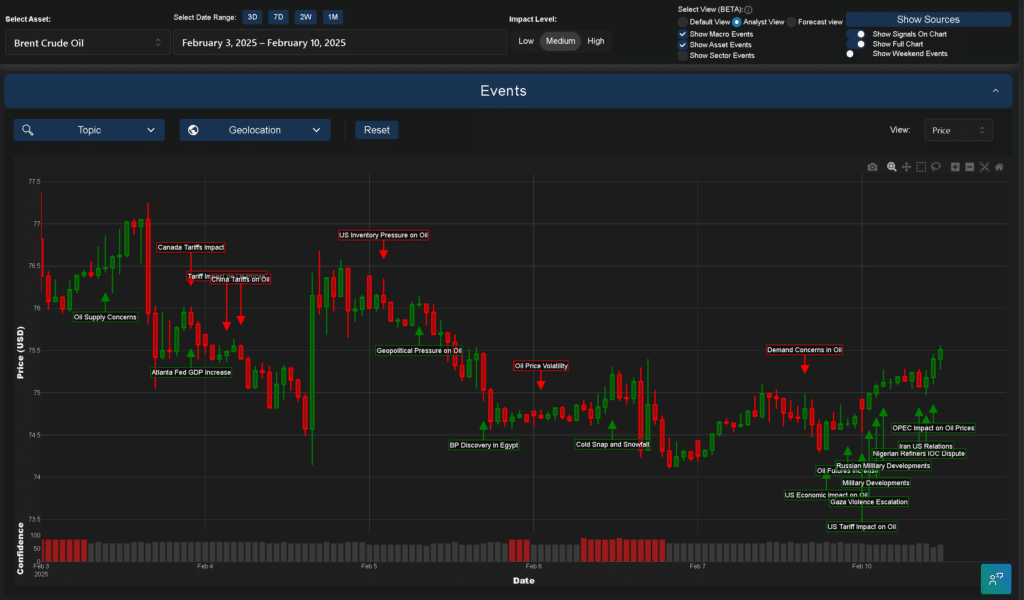
As we move into mid February, the obvious pattern emerging across commodity markets is that of an intensifying impact of trade tensions and extreme weather events. There is no doubting that each commodity class is responding uniquely to these catalysts, creating a complex trading environment that demands sophisticated analysis. In this article, we take a look at the commodity prices outlook for this week, using analysis from our Trading Co-Pilot.
You can make the argument that this has been the most dramatic mover in terms of commodity prices, with a 9% surge on February 3rd reaching significant technical levels. The hardest part is distinguishing between weather-driven spikes and structural shifts. Severe winter storms across the Midwest and Northeast have created a significant uptick in energy demand, while critical supply shortfalls in southern regions reinforce bullish momentum. Current Henry Hub market dynamics suggest this strength could persist beyond the immediate weather impact. Regional supply constraints and increased demand for gas-fired power generation create a supportive backdrop for prices. The question is how long these conditions will maintain their influence over price action, particularly as we approach the shoulder season.
Then there is the challenge of European gas markets, where prices reflect multiple pressures. Slovakia’s increased imports and resumed Russian gas flows provided initial stability, but escalating Ukraine conflict creates persistent uncertainty. Critical gas needs in southern Ukraine add another layer of complexity to the supply picture. The market’s response to these developments has been notably volatile, with traders attempting to price in both immediate supply concerns and longer-term structural changes to European gas markets. Supply diversification efforts, including rare Australian shipments, indicate the market’s adaptation to new geopolitical realities.
Looking an the broader issue of commodity prices, one finds that the situation is little more complicated in heating oil markets, where tariffs on Canadian oil combine with extreme weather to drive prices higher. The fact that NYC landlords are switching to less clean heating oil due to high gas bills indicates a structural demand shift that could have lasting implications for the market. This transition in consumer behaviour, particularly in the Northeast, suggests a fundamental change in regional energy dynamics. The impact of tariffs extends beyond immediate price effects, potentially reshaping traditional supply routes and trading patterns. Storage levels and distribution challenges in key consumption areas add another layer of complexity to the current market structure.
Of course, recent cold snaps in the US have supported prices, countering earlier bearish sentiment. Meanwhile, ongoing military tensions in Ukraine and Middle East sanctions continue to influence supply concerns, despite rising inventories in key storage hubs. The market’s reaction to these conflicting signals has been notably measured, suggesting traders are carefully weighing immediate weather-driven demand against broader macroeconomic concerns. The interplay between OPEC+ output decisions and US inventory builds creates an additional dynamic that warrants close monitoring.
The big recent news across commodity prices is that gold continues to see remarkable strength near $3,000. The game changer here has been combined monetary easing signals from central banks (RBI and BOE) alongside escalating geopolitical tensions. Safe-haven demand remains robust amid uncertain economic conditions. Technical analysis suggests the current price levels could establish new support zones, particularly if trade tensions escalate further. The correlation between gold prices and real yields continues to provide a helpful framework for understanding price movements, while physical demand from key Asian markets adds fundamental support.
Here, we’re seeing the impact of China’s manufacturing slowdown (PMI at 50.1) combined with Anglo American Platinum’s profit decline. The automotive sector’s weakness, particularly in Germany, has created significant headwinds for demand, leading to the current bearish outlook. Supply-side dynamics, including potential production cuts and recycling rates, could provide some price support. However, the structural shift in automotive technology preferences continues to cast a shadow over longer-term demand prospects.
The question here is whether positive US manufacturing data can offset European automotive weakness. This divergence in regional industrial activity creates a complex trading environment for a metal heavily dependent on automotive catalytic converter demand. Recent market behaviour suggests a delicate balance between supply constraints and demand concerns. While US economic resilience provides some support, the German industrial production drop signals potential weakness in a key consumption center. For now, the automotive sector’s ongoing transition toward electric vehicles adds another layer of uncertainty to longer-term demand projections.
Despite initial bullish signals from strong demand and positive drill results, inflation fears and trade tensions have created choppy trading conditions for silver. The metal’s dual role as both an industrial and precious metal continues to create complex price dynamics. While safe-haven demand provides some support during periods of market stress, industrial demand concerns and correlation with gold prices remain key drivers of market sentiment for silver.
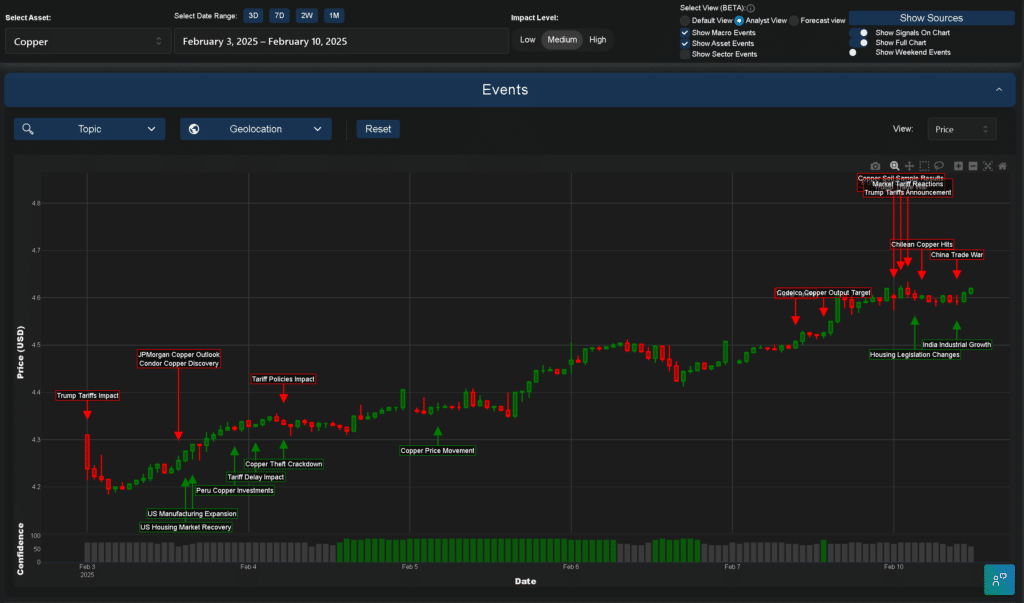
While housing market recovery provides some support, trade tensions create significant uncertainty for copper. Recent price movements reflect the market’s struggle to balance positive economic indicators against rising geopolitical risks. The broader implications of Trump’s reciprocal tariffs could fundamentally alter trading patterns in industrial metals. Concurrently, infrastructure development plans in key economies remain a potential catalyst for demand growth, but uncertainty around implementation and timing keeps market sentiment cautious.
Initial bullish momentum in wheat markets driven by severe weather disruptions – drought in Argentina and flooding in Australia – has given way to bearish sentiment as of February 10th, with Chinese tariffs and fears of US retaliation creating significant headwinds. Growing Canadian stocks and increased local production suggest ample supply, while forecasts of declining global imports add further pressure. This alignment of negative factors suggests continued downward pressure on wheat prices in the near term, despite earlier weather-related supply concerns.
We live in an age of highly volatile geopolitics and commodity prices, with coffee prices have reached record highs driven by fundamental supply fears and severe weather impacts. Arabica’s recent price action reflects both immediate supply constraints and longer-term structural changes in production patterns. Nestlé’s Indian market expansion signals growing demand in emerging markets, while weather-related supply disruptions continue to support prices. The potential for further supply chain disruptions, particularly in key growing regions, suggests continued price strength in the near term.
The present outlook for corn reflects complex crosscurrents in both supply and demand. Argentina’s severe drought has tightened supply expectations, while Mexico’s decision to rescind its ban on U.S. biotech corn provides some positive sentiment for traders. However, the broader impact of trade tensions and potential new tariffs creates significant headwinds. Fund positioning indicates some market confidence, but recent declines in Chicago corn futures suggest traders remain cautious amid these conflicting signals.
Cotton markets are facing multiple challenges from both weather events and trade tensions. Queensland flooding and California’s adverse weather conditions raise significant concerns about agricultural productivity and potential supply shortages. The market’s recent rally gave way to more cautious sentiment as traders assessed the implications of new U.S. tariffs on China. These developments raise broader concerns about inflation impacts and potential demand destruction in key consumption markets.
The sugar market presents a particularly nuanced picture amid current volatility. Once again, severe flooding in Queensland and ongoing drought challenges in Argentina have raised serious concerns about agricultural output and potential supply disruptions. While temporary support came from reduced Indian production and improved realisations for sugar companies, the stronger US dollar and projections of a global surplus create counterbalancing pressures. Recent developments suggest potential for recovery, but weather concerns and mixed economic indicators maintain market uncertainty.
Markets have now pushed to four-month high levels amid severe flooding in North Queensland and ongoing Ukraine-Russia supply disruptions. The impact of these weather events on global supply chains has been particularly acute given the already strained market conditions. The announcement of retaliatory tariffs by China and Trump’s reciprocal measures adds another layer of complexity to traditional trading patterns. While some weakness emerged towards the end of the week, the overall trend remains bullish as markets continue to price in supply risks and shifting trade flows.
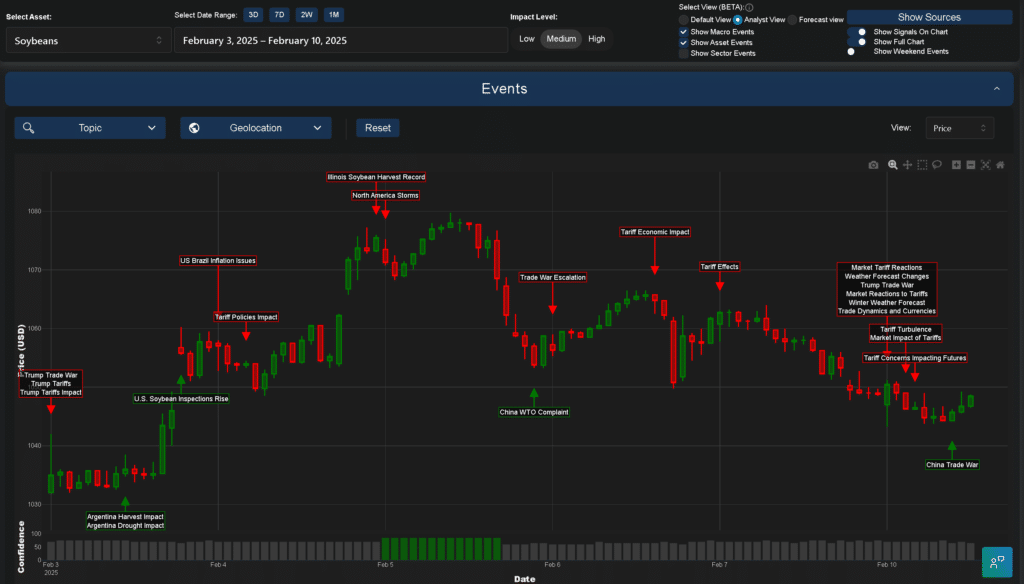
There are several areas where trade tensions impact is evident, none more so than soybeans. Recent tariff announcements have amplified bearish sentiment, with prices declining as traders anticipate further volatility and potential supply chain disruptions. This dovetails with weather-related concerns in Argentina and North America, creating a complex market dynamic. The combination of trade uncertainty and adverse weather conditions suggests continued pressure on prices, with particular attention needed on Chinese demand patterns and South American production levels.
If narratives shape politics, then current trade tensions suggest continued market volatility across commodity sectors. What this reveals is the increasing importance of real-time market intelligence in navigating these complex conditions. Commodity traders must remain vigilant to both immediate catalysts and longer-term structural shifts, particularly as weather patterns and geopolitical developments continue to drive price action.
The interconnectedness of commodity markets has never been more evident, with developments in one sector frequently creating spillover effects in others. Successful trading strategies will require careful monitoring of cross-commodity correlations by using tools like our Trading Co-Pilot and the ability to quickly adapt to changing market conditions.
Our Trading Co-Pilot can enhance your commodity trading operations with real-time cross-asset insights. It works by analysing the complex interplay of weather events, trade policies, and supply chain dynamics as well as other market factors across energy, metals, and agricultural markets, helping you identify price movements before they emerge. Our enterprise solution offers real-time analysis of market-moving events, cross-commodity correlation insights, early warning signals for price movements, and comprehensive monitoring of supply chain announcements, weather impacts, and trade flows.
To arrange a demo or request a free enterprise trial get in touch with our team at enquiries@permutable.ai or simply fill in the form below to see how our AI-driven market intelligence can complement your existing trading strategies. We’re currently offering a 14-day trial for qualified institutional traders (subject to approval) to experience our next-generation market intelligence . Find out how it can start maximising your trading potential today.
All eyes have been on gold markets once again this week, with prices surging to an all-time high of 2902.50. As geopolitical tensions escalate, for traders seeking to navigate these volatile conditions, understanding the underlying drivers becomes increasingly key. In this article, we’ll take a lookback at the latest from the gold markets over the last week, with insights from our Trading Co-Pilot.
Safe to say, that all of this dovetails with growing concerns about Trump’s recent tariff announcements, which has been amplified by deteriorating US-China relations. Only a few days earlier, gold had been trading at 2849.75, but escalating trade tensions pushed prices to new records. It has come to something when even seasoned traders are surprised by the pace of these movements, suggesting a fundamental shift in market dynamics that requires careful analysis.
What is it about gold markets that makes them so sensitive to geopolitical tensions? Both feature in our analysis: safe-haven demand and inflation concerns. Incidentally, the European Central Bank’s recent rate cut has added another dimension to the bullish narrative, creating a perfect storm of supportive factors that continues to drive prices higher.
For those of us who follow gold markets closely, the emergence of physical supply constraints is also another interesting factor in the mix. A significant shortage in London, driven by increased stockpiling in New York, has emerged. But still, the market continues on, albeit with increased volatility. Trading strategies must now account for these physical market dynamics, which can create unexpected price movements and arbitrage opportunities.
So what, you may think, about these supply constraints? But what’s important to note here is the potential for these shortages to create additional price pressures. These days, the interplay between physical and paper gold markets has become increasingly complex, requiring traders to maintain awareness of conditions in both markets to execute effective strategies.
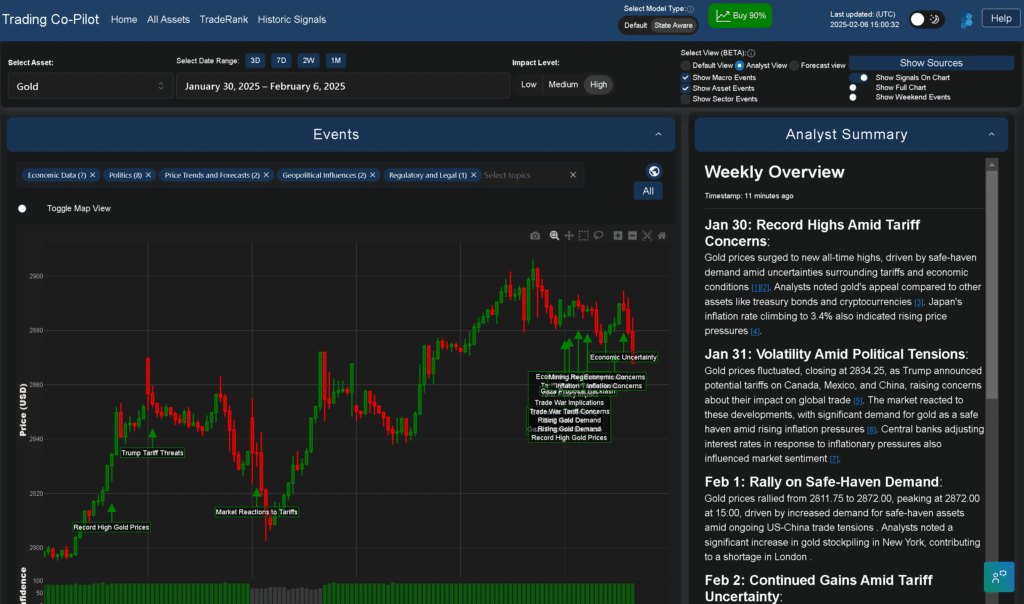
Above: Gold markets sentiment and price drivers using Analyst View of our Trading Co-Pilot
And then there has been significant central bank purchases, which reveals an underlying shift in institutional attitudes toward gold. Many will still find it surprising that central banks are increasing their gold reserves at such a rapid pace, particularly given the elevated price levels. This institutional buying provides a strong fundamental underpinning to the market that simply cannot be ignored.
Obviously, this fact has contributed to the current price levels, principally because of the signal it sends to other market participants about deeper concerns regarding global economic conditions.
There is, as ever, a strong correlation between geopolitical uncertainty and gold prices, Not merely because of safe-haven demand, but also due to currency market volatility. The answer, it turns out, lies in the complex interplay between various market factors that traders must monitor continuously. And so, understanding these correlations will continue to provide valuable insights for timing market entries and exits.
Interestingly, the market has maintained relatively orderly trading despite the record prices. And it will be fascinating to see how these patterns develop, particularly if trade tensions continue to escalate with Trump pressing down on nation states. Overall, gold traders will need to pay special attention to volume patterns and market depth, which can provide early warning signals of potential price movements.
Looking ahead, gold traders should focus on several key areas. Ongoing trade tensions and tariff concerns continue to dominate sentiment, while physical supply constraints in key markets may create additional volatility. Meanwhile, strong central bank buying activity suggests sustained institutional interest, while increasing safe-haven demand could provide support during periods of market stress. And then there’s the potential for trade policies to generate inflation pressures adds another layer of complexity to the market outlook.
Suffice to say that successful trading in current gold markets requires a comprehensive understanding of all of these factors. Traders will be keeping a close eye on developments in US-China trade relations – and quite rightly so – as these continue to drive short-term price movements. Ultimately, changes in central bank buying patterns could signal shifts in institutional sentiment, while physical supply dynamics between London and New York may create arbitrage opportunities. All this means that currency market volatility and inflation indicators provide important context for price movements.
The current situation in gold markets reflects a complex interplay of geopolitical, economic, and market-specific factors. As prices continue to trade near record highs, understanding these dynamics becomes increasingly important for gold and precious metals traders. In the current scenario, the combination of trade tensions, safe-haven demand, and physical supply constraints suggests that volatility may continue in the near term, making careful risk management essential for successful trading outcomes.
And with that, we’d like to invite you to experience how our Trading Co-Pilot can improve your precious metals trading results. Our platform seamlessly integrates real-time analysis of geopolitical events, supply chain dynamics, and market sentiment to provide you with actionable insights across gold, silver, platinum, and palladium markets.
Over a personalised live demo, we’ll help you discover how our AI-driven platform can enhance your trading operations and how we’re already Our helping institutional traders identify emerging opportunities, manage risk more effectively, and stay ahead of market-moving events. For qualified enterprise clients, we’re currently offering a 14-day trial of our platform, allowing you to experience firsthand how our advanced analytics can complement your existing trading strategies.
Simply get in touch with us at enquiries@permutable.ai or scheduling a demonstration by filling in the form below and be part of a group of early adopter trading houses who are already using our next-generation market intelligence to navigate the evolving commodities trading landscape.
All eyes have been on the silver market rally this week, with prices pushing. So what has been driving this latest upward trend? We break down the narratives that have shaped silver‘s latest upward trajectory.
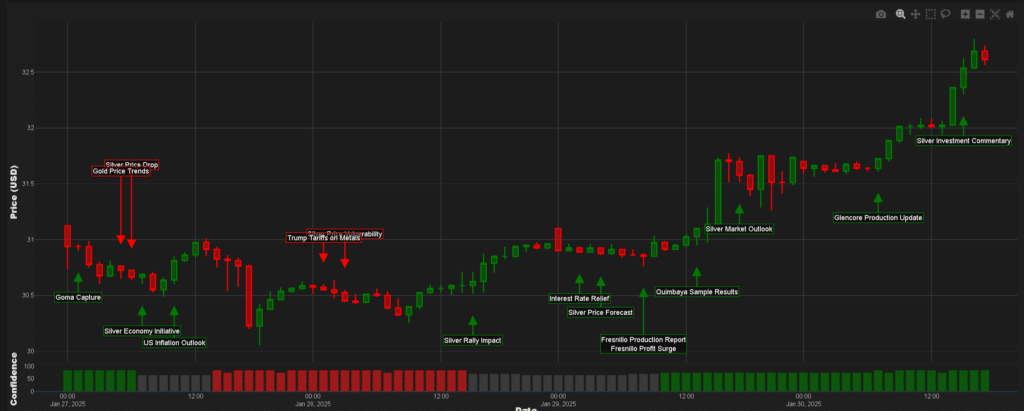
The groundwork for this week’s silver market rally was laid on January 27th, when the IDB’s commitment to developing the silver economy in Latin America and the Caribbean set a positive tone for industrial demand expectations. Around the same time, reports of M23 rebels capturing Goma in Eastern Congo highlighted supply chain vulnerabilities in precious metals markets, adding a risk premium to prices. Our analysis shows that these geopolitical tensions, combined with existing supply constraints, created a powerful catalyst for upward price movement.
Then, on January 28th, there where Trump’s warnings about potential metal tariffs which created additional market uncertainty. Whether it is these factors or broader macro conditions, the scene was set for a silver market By January 29th, the narrative had evolved significantly. Quimbaya’s announcement of high-grade silver samples coincided with growing anticipation of interest rate relief, creating a perfect storm of positive catalysts. It used to be the case that such news might have limited impact, but in the current environment of supply constraints and monetary policy uncertainty, fueled gains.
Meanwhile, Fresnillo’s report of doubled gross profits, highlighted the sector’s profitability in the higher price environment and suggested mining companies might struggle to rapidly increase output even at attractive price levels. And all of this was underpinned by the continued buying of silver by Commodity Trading Advisors, indicating strong investment interest and continued interest in demand for silver.
To add to this was on January 30th there was Glencore’s production update revealing lower metals output for 2024. There is debate about whether these supply constraints will persist, but looming over the market is a forecasted sizeable deficit throughout 2025. Our Trading Co-Pilot’s sentiment analysis shows that institutional investors are increasingly focused on this supply-demand imbalance, with many adjusting their positioning accordingly.
The compound effect of these developments – from production shortfalls to monetary policy expectations and geopolitical tensions – created a robust foundation for silver prices with a positive outlook. But despite all of this volatility remains an inherent characteristic of precious metals markets, with our analysis suggesting it would be prudent to maintain a positive bias while implementing appropriate risk management strategies.
Every precious metals trader knows that catching the early signals of market movements can make the difference between profit and loss. Our Trading Co-Pilot platform identified and tracked every key development in this week’s silver rally as it unfolded – from the initial IDB announcement to Glencore’s production update (see above chart).
Imagine having instant access to:
Currently processing over 10,000 articles daily for commodities markets, with FX markets coming soon, our platform helps traders cut through the noise to identify what really matters. We don’t just aggregate news – we help you understand the evolving narrative behind price movements before they impact your trading decisions.
Ready to experience how Trading Co-Pilot can transform your market intelligence capabilities? We’re currently accepting expressions of interest from enterprise clients. Email enquiries@permutable.ai to schedule your personalised enterprise demonstration (subject to approval), or fill in the form below to learn more about how we’re reshaping market intelligence for traders.
Is silver a good investment for 2025? Well, let’s start this article on that topic by saying it may be no surprise to our readers that silver is continuing to capture the market’s attention as we enter 2025, with prices on a significant upward trend in the first week of January. Of course, in recent years, precious metals have served as traditional safe-haven assets, yet even still in terms of current market dynamics, silver is showing particularly compelling momentum. The fact that prices have already increased by Rs 2,000/kg in early January suggests robust market conviction that we can expect to continue into 2025.
So, is silver a good investment for 2025? According to signs from our Trading Co-Pilot’s analysis the prospects look strong. Read on to find out more below as we look at technical indicators, price movements, demand and production outlook and market projections.
And so, as the market continues to develop, silver prices are attempting to break through the 200-day simple moving average, a crucial technical indicator. The logic is that this breakthrough could signal sustained upward momentum. While the temporary positioning below this moving average raises some caution flags, the vulnerability caused by these technical constraints appears to be diminishing as prices push above the $30.00 mark.
As the threat of geopolitical risk evolves, safe-haven demand has accelerated markedly. But beyond this, speaking of which, market analysts are projecting ambitious targets. Insiders say prices could reach Rs 1,10,000 by year-end, according to ICICI Securities. To protect against market uncertainties, institutional investors are increasingly building substantial positions.
More recently, positive news from major producers has reinforced market optimism. The clock is now ticking as companies like VIZSLA Silver report a 43% increase in measured and indicated mineral resources at their Panuco project. However, this expansion in production capacity is still in its infancy. Again, Eloro Resources’ reports of high-grade silver-tin polymetallic mineralization discoveries add to the constructive outlook.
As we move into 2025. the primary function of silver as both an industrial metal and a safe-haven asset makes it particularly attractive in the current market environment. Experts believe that this dual role provides unique advantages. While it will also help hedge against market uncertainties, the industrial demand component also offers exposure to economic growth.
Yet, despite these positive indications, as always one should remain mindful of market risks. This is also a concern for those watching technical indicators, as recent futures data showed some price declines. This, in the end, is what makes proper timing and risk management the absolute linchpin for successful silver trading strategies – maintaining disciplined position sizing and stop-loss levels will be essential.
The precious metals market is projected to experience significant growth from 2024 to 2031, with key players including Pan American Silver Corp. and Fresnillo plc shaping the landscape. This broader market expansion suggests sustained institutional support for silver investments, though volatility should be expected as markets digest new supply and demand dynamics.
As we analyse silver’s investment potential for 2025, let’s take a recap of some of the factors supporting a constructive outlook:
Our Trading Co-Pilot’s comprehensive analysis suggests silver presents a compelling investment case for 2025, driven by both technical strength and fundamental support. The convergence of safe-haven demand, industrial applications, and production developments creates a potentially favorable environment for price appreciation.
However, success in silver trading will ultimately depend on disciplined execution and robust risk management. While the outlook appears constructive, traders and investors should remain vigilant and adaptable to changing market conditions. The combination of geopolitical uncertainties, industrial demand fluctuations, and technical market dynamics will likely create both opportunities and challenges throughout the year.
For traders and investors looking to capitalise on silver’s potential in 2025, staying informed with real-time market intelligence will be ever-important. As the market continues to evolve, maintaining a balanced approach between opportunity capture and risk management will be key to successful silver trading strategies, in our opinion.
Want to gain deeper insights into precious metals market movements? Experience how our Trading Co-Pilot analyses thousands of real-time market signals to deliver actionable trading intelligence. Request your enterprise trial at enquiries@permutable.ai or by simply filling in the form below.
*Disclaimer
The information provided in this article is for informational purposes only and should not be considered as financial advice or a recommendation to invest. Permutable AI’s Trading Co-Pilot’s market analysis and insights are based on historical data and current market conditions, which may not be indicative of future performance. Investment in precious metals involves substantial risk, including potential loss of principal.
While Permutable AI strives to ensure the accuracy and reliability of the information provided through our Trading Co-Pilot platform, we make no representations or warranties of any kind, express or implied, about the completeness, accuracy, reliability, suitability, or availability of the information, products, services, or related graphics contained in this article or our platform for any purpose.
Past performance of precious metals does not guarantee future results. Investors should conduct their own research, seek professional advice, and carefully consider their investment objectives, risks, costs, and constraints before making any investment decisions.
It is indeed a volatile market as global commodities continue to see unprecedented challenges into early 2025. According to our Trading Co-Pilot’s Analyst View prices are predicted by the unpredictable and ever-moving forces, creating a landscape where commodities traders must remain increasingly vigilant. In this article, we outline the key commodity news stories shaping the markets at the beginning of 2025.
There’s been a real shift across energy markets of late, particularly across natural gas and LNG sectors. The struggle to maintain supply stability intensifies as North American markets confront widespread power outages affecting critical infrastructure across Mississippi and Colorado. Meanwhile, European markets simultaneously face severe supply constraints, with regional gas storage levels depleting at the fastest rate since 2018.
So what are the broader implications of these disruptions? First, the confluence of events has catalysed significant upward momentum in US LNG export valuations. Second, operators are positioning themselves to capitalise on emerging supply gap opportunities, particularly in the Atlantic basin where price spreads have widened to unprecedented levels. All of which indicates potential arbitrage opportunities as regional price disconnects persist.
Now let’s look to Crude oil, which is demonstrating equally compelling market dynamics. Brent crude’s achievement of a two-month price ceiling amid multiple supply constraints signals deeper market stress. Fresh US sanctions targeting Russian vessels have created immediate logistical challenges, forcing a reconfiguration of traditional trading routes and pushing freight rates to multi-year highs.
Which bring us nicely onto our next point – the question of supply chain resilience across the commodity complex. The shutdown of illegal refineries in the Niger Delta is the latest twist in this story, together with the environmental crisis near Sevastopol, where a significant tanker spill has disrupted Black Sea shipping lanes, the risk for further disruption remains elevated. These events continue to ripple through global markets as they unfold, creating knock-on effects across the petrochemical and refined product sectors.
Assuming that weather-related disruptions maintain their current trajectory, agricultural markets face mounting pressure through Q1 2025. Australia’s wheat production confronts heightened risks amid sky-high temperatures, with crop analysts revising yield estimates taking a downward tumble. Meanwhile, Vietnamese Robusta coffee harvests remain stalled by persistent rain conditions, pushing arabica-robusta spreads up.
The sharp end of this problem spills over into the Americas’ agricultural outlook. While some say conditions might improve, Latin American row crops are facing severe moisture deficits, with all eyes on Brazilian soybean estimates. Our sources tell us that the situation is serious enough that major trading houses are already revising their Q2 supply projections downward, suggesting sustained price support through the first half of 2025.
Precious metals recent performance has seen safe-haven flows accelerate, with silver breaching key technical levels at $29.80 amid substantial position building. To add to this, gold continues to climb as analysts signal the potential for gold to climb to new highs in 2025. All of which suggests that institutional investors are continuing to seek portfolio protection against broader market uncertainties.
Economics can be difficult in such dynamic market conditions, but our Trading Co-Pilot platform continues to identify emerging opportunities through real-time market monitoring and advanced pattern recognition in commodity news. We’re already seeing how this is translating into success for our early-adopter users from some of the leading commodity and energy trading houses. This is thanks to their being equipped with sophisticated market intelligence enabling them to act decisively on rapidly evolving market conditions. As these dynamics continue to unfold, accessing up-to-date and comprehensive market intelligence will becomes increasingly crucial for effective risk management and opportunity identification throughout 2025.
For deeper insights into breaking commodity news and access to real-time market developments, contact our team at enquiries@permutable.ai.
As markets reopen today for the new year, many will be asking the question “is gold a good investment for 2025?“. Well, there was a time when investing in gold was straightforward – buy during uncertainty, sell during stability. However today, the landscape has fundamentally changed. It is a volatile market where prices are predicted by unpredictable and ever-moving forces, making traditional investment strategies increasingly complex. The questions around whether gold is a good investment have become more nuanced, and will be one to watch in terms of commodity trading trends for 2025.
The struggle to make sense of gold’s place in a modern portfolio has intensified as digital assets like crypto and new investment vehhttps://permutable.ai/why-is-the-price-of-gold-going-up/icles compete for safe-haven status. Ultimately, this evolution in thinking about whether gold is a good investment reflects broader changes in global financial markets. In this article, we’ll answer the questions is gold a good investment for 2025 with insights from our Trading Co-Pilot. So read on to find out whether the gold rally is set to continue.
First, we’re seeing unprecedented central bank buying that’s reshaping market fundamentals. The ambition here is clear: countries are diversifying away from traditional reserve currencies. This activity will include continued accumulation through 2025, with central banks already having purchased record amounts in recent years.
Second, retail investor interest has surged amid economic uncertainties. Together with institutional buying, this has created a robust support level for gold prices. As shown with recent market data, the correlation between economic uncertainty and gold’s appeal as a safe-haven asset remains strong, suggesting gold is a good investment for those seeking portfolio stability.
There isn’t any doubt about it: monetary policy decisions continue to influence gold prices significantly. As per our Trading Co-Pilot‘s analysis, the Federal Reserve’s stance on interest rates will remain a crucial driver through 2025. The consequence of potential rate cuts could provide substantial support for gold prices, as lower rates typically make gold a more attractive investment.
Either way, inflation concerns persist across major economies. It appears that once again, investors are turning to gold as an inflation hedge. The revelation that several major economies are struggling to meet their inflation targets provides additional support for considering whether gold is a good investment for wealth preservation.
And then there is the questions about the impact of global tensions on investment decisions. No more so than now, with multiple geopolitical hotspots creating market uncertainty. That is an echo of historical patterns where gold has traditionally performed well during periods of international tension.
And guess what, the complexity of current geopolitical relationships suggests these tensions won’t resolve quickly. This is nothing new in the gold market, but the interconnectedness of modern financial systems means that geopolitical events have more immediate and pronounced effects on whether gold is a good investment than ever before.
The risk for investors lies in timing their entry points, with technical indicators suggesting key support levels around $2,040. Which explains why professional traders are closely monitoring price action near these levels. Instead of relying solely on technical analysis, successful investors are increasingly incorporating multiple data points into their decision-making process.
Later, these technical levels may prove crucial in determining whether gold is a good investment for short-term traders. Despite recent volatility, the overall trend remains supportive, with higher lows establishing a robust price floor. Yet look at the volume patterns: they suggest institutional investors continue to accumulate during price dips.
The consequence of current market conditions suggests a balanced approach to gold investment. But the alleged risks of gold investment – such as its lack of yield – need to be weighed against its portfolio diversification benefits and historical role as a store of value.
From our point of view, gold’s trajectory in 2025 depends heavily on several key macroeconomic factors. Now that the fragility of traditional financial systems has been exposed through recent banking sector stresses, gold’s appeal as a safe-haven asset has strengthened. Little wonder that investment flows into gold-backed ETFs have remained steady.
Over and over again, market cycles have demonstrated gold’s resilience during periods of economic uncertainty. Given that historical performance patterns often rhyme, if not repeat, our analysis suggests maintaining some gold exposure could be prudent. But the alleged simplicity of gold investment decisions masks the complexity of timing and position sizing.
Despite short-term price fluctuations, the fundamental case for gold remains strong. It’s plain to see that economic uncertainties could persist through 2025, potentially supporting gold prices. However, investors should remember that position sizing and timing are the linchpin of any successful gold investment strategy.
Want to enhance your precious metals trading strategy with AI-driven insights? We’re offering qualified enterprise trading teams a complimentary one-month trial of our Trading Co-Pilot platform. Experience how leading trading houses are using our advanced AI analytics to identify opportunities and manage risk in the gold market. Our platform provides real-time market analysis, predictive insights, and comprehensive sentiment analysis specifically calibrated for precious metals trading.
Request your enterprise trial today by emailing enquiries@permutable.ai or filling in the form below. Available for qualified enterprise trading teams. Subject to approval.
DISCLAIMER
The information contained in this article is for informational purposes only and should not be considered as financial or investment advice. While the insights presented are derived from our Trading Co-Pilot platform’s analysis of market data, they represent a point-in-time assessment and should not be relied upon as the sole basis for any investment decisions. Markets are inherently risky, and past performance is not indicative of future results. The price of gold and other precious metals can be volatile and can be affected by numerous factors outside of our control.
Trading in precious metals carries significant risk, and you should carefully consider your investment objectives, level of experience, and risk appetite before making any investment decisions. We recommend consulting with qualified financial advisors who can provide guidance tailored to your specific circumstances. Permutable AI and its employees do not accept any liability for any loss or damage, including without limitation to, any loss of profit, which may arise directly or indirectly from use of or reliance on such information.