At Permutable AI, we’re constantly pushing the boundaries of what’s possible in trading technology. Today, we’re thrilled to announce a substantial upgrade to our Trading Co-Pilot platform, with a particular focus on enhanced AI market sentiment analysis capabilities that will transform how institutional traders navigate commodity markets. Our latest release introduces five key improvements designed to give traders the edge in today’s volatile markets. Most notably, our AI market sentiment analysis engine has been completely updated to deliver even more powerful insights into market movements.
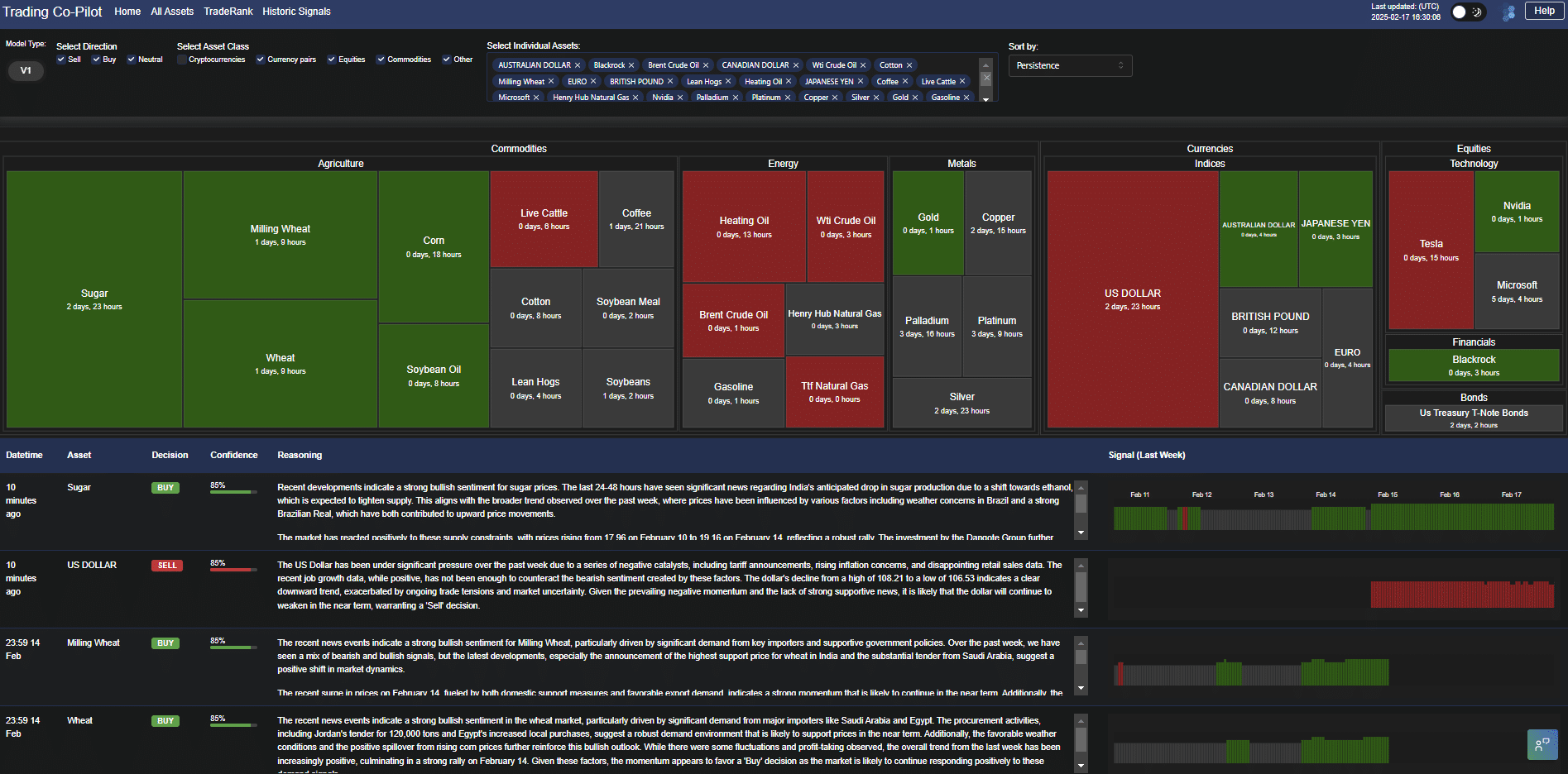
The first thing users will notice is dramatically improved page loading times. In the fast-paced world of commodities trading, every minute counts, and our enhanced platform now delivers critical AI market sentiment analysis faster than ever before. But increased speed is just the beginning. The cornerstone of this update is our new signal heatmap feature (see visual above), which leverages our proprietary AI market sentiment analysis algorithms to visualise trends across multiple assets simultaneously.
This proves particularly valuable for identifying sector-wide momentum shifts, spotting divergences between correlated assets, and recognising early pattern formations before they become obvious. As a matter of fact, early users report that the combination of faster performance and comprehensive heatmap visualisation has significantly improved their ability to act decisively on emerging opportunities.
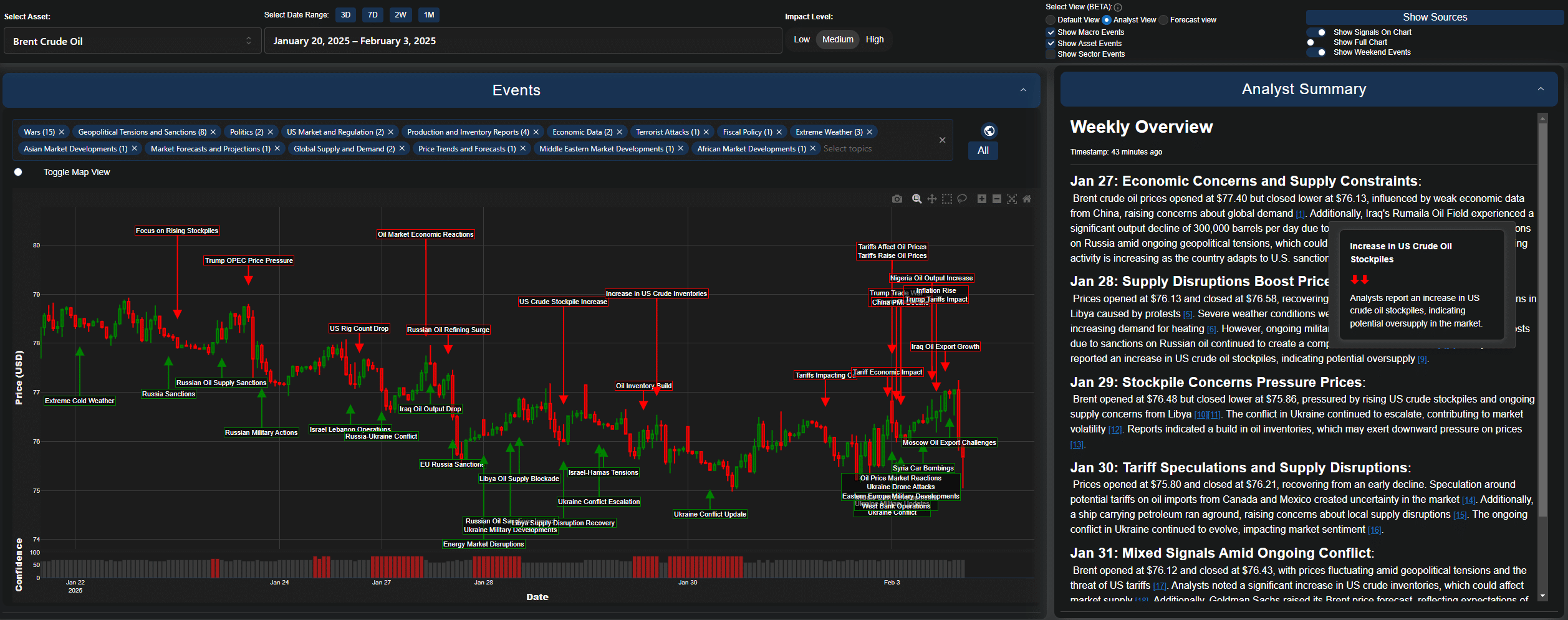
Another groundbreaking addition is our enhanced Analyst View feature. This powerful tool aggregates and interprets market events through our AI market sentiment analysis engine, enabling traders to compare market sentiment across different time frames, confirm emerging trends with relevant news updates, and anticipate regime shifts before they impact pricing. To add to this, all events are now contextualised with historical data, providing crucial perspective on how current market movements compare to previous patterns.
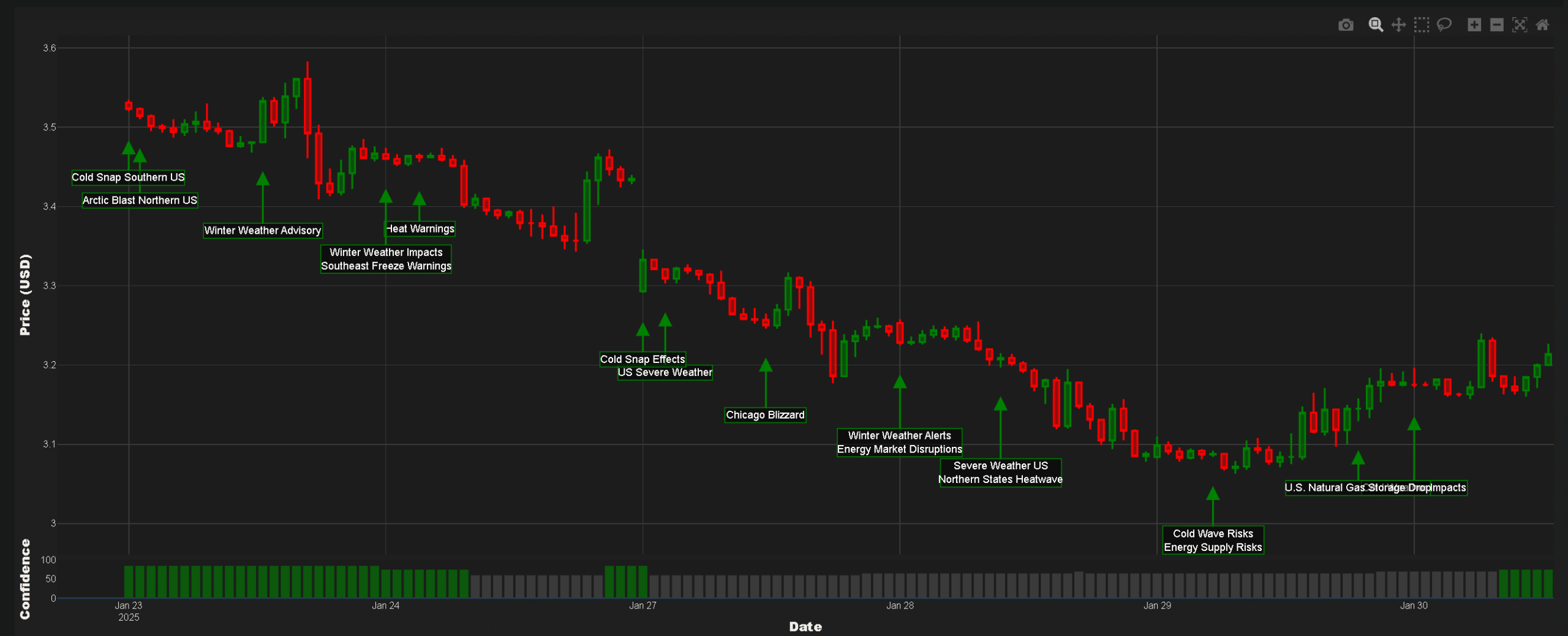
Above: Severe weather Henry Hub drivers
Speaking of historical perspective, we’ve introduced a powerful feature that displays the historical confidence levels of our AI market sentiment analysis model. This transparency allows traders to evaluate the historical accuracy of signals, identify market conditions where our AI market sentiment analysis excels, and make more informed decisions about position sizing based on signal strength. In essence, this feature adds a critical dimension to trading decisions by quantifying the certainty behind each recommendation.
Last but certainly not least, our platform now delivers comprehensive macro sentiment views across major currencies and market segments. As part of our FX market intelligence roll out, our AI market sentiment analysis now extends to the US Dollar, Euro, British Pound, Japanese Yen, and numerous other instruments.
This holistic perspective enables commodity traders to better understand how currency movements and broader market dynamics might impact specific positions. Given the interconnected nature of global markets, this expansion of our AI market sentiment analysis capabilities represents a significant leap forward in comprehensive trading intelligence.
Above: Inflation and trade tension effecting US Dollar concern
These enhancements to our AI-powered trading insights represent an exciting step forward in our ambition to provide the most sophisticated AI market sentiment analysis tools in the industry. By combining faster performance, visual heatmaps, comprehensive analyst views, historical context, and global macro perspectives, we’re providing institutional commodity traders with an unprecedented advantage. The platform updates are available now. To experience these capabilities firsthand, schedule a demonstration with our team today by emailing enquiries@permutable.ai or filling in the form below.
Energy markets are becoming increasingly complex to navigate and as they continue to evolve, those who are able to stay ahead of increasingly volatile market dynamics will be, in our opinion, those who embrace AI-powered trading insights for energy markets. While the AI race continues to develop at a unprecedented rate – within energy markets particularly – technological strides are already fundamentally changing how traders operate. And all this is thanks to AI’s ability to process vast amounts of market data in real-time, offering powerful visibility into market movements, correlations and emerging patterns.
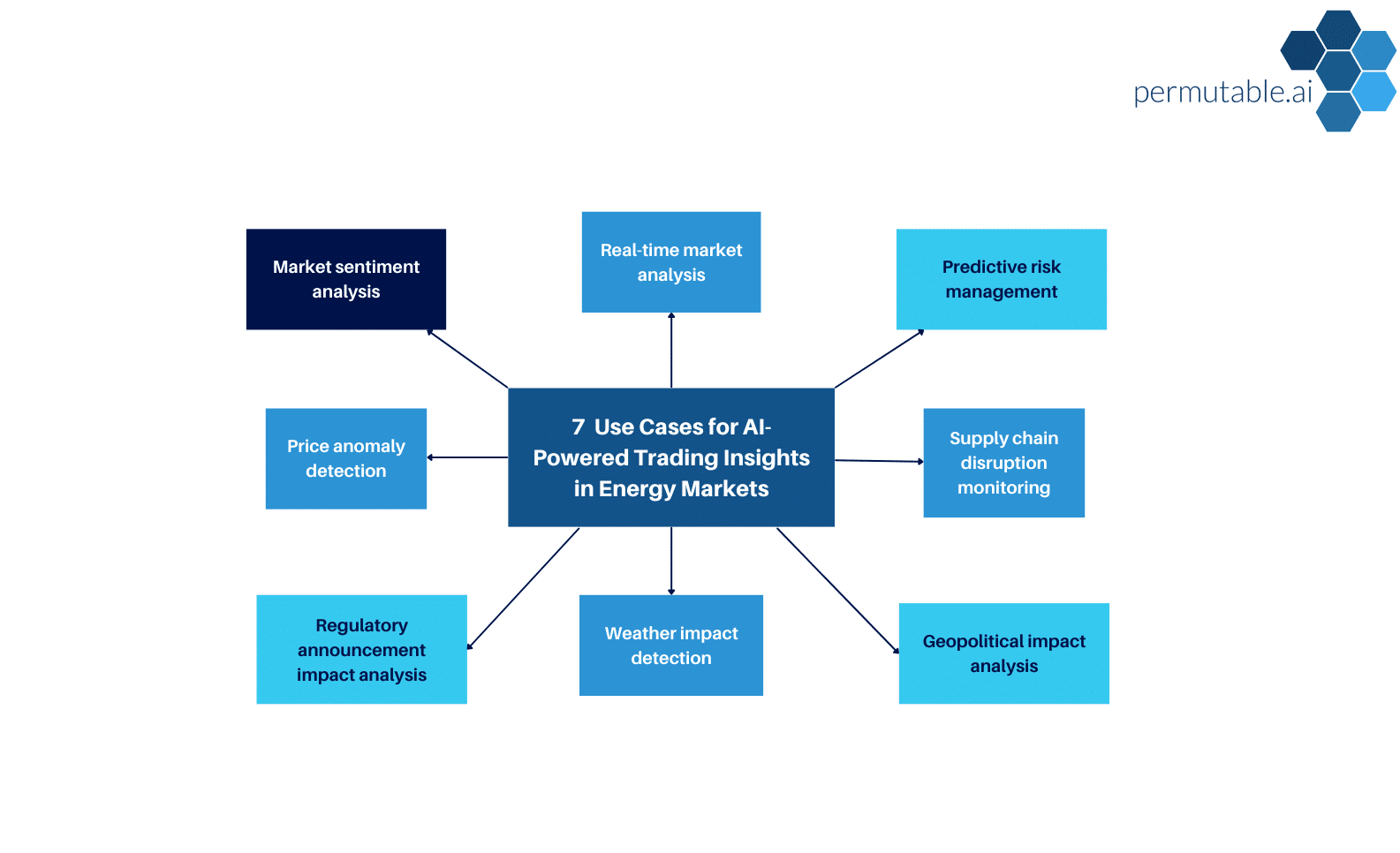
In this article we’ll take a brief look at some use cases of our AI-powered trading insights in energy markets, looking at how these can be using to predict price movements, reduce trading risk and unearth trade ideas.
We think on of the most powerful applications of AI-powered trading insights in energy markets is in their ability to provide a 360 degree market view by simultaneously process multiple data streams. As an example, our Trading Co-Pilot platform analyses price movements, geopolitical events, and supply-demand dynamics in real-time, providing energy traders with comprehensive market intelligence, spotting trends before they become mainstream. Perhaps the most powerful aspect of this is that this analysis happens at a speed and scale impossible for even the best human traders and team of analysts to match.
Coming back to the critical aspect of trading risk management, our AI-powered insights offer a powerful approach to risk assessment. Indeed, we’ve seen even the most experienced traders benefit from our system’s ability to identify potential risks before they materially impact the market. Here, the hard truth is that the vast majority of traditional risk management systems simply cannot match this predictive capability that our system is able to offer.
At this point, it’s worth noting how our AI-powered trading insights for energy markets provide crucial early warnings about supply chain disruptions. For example, our platform continuously monitors news on global shipping movements, refinery operations, and production facilities, instantly alerting traders to potential disruptions reported on in the news and how that could impact market sentiment and dynamics. That said, this real-time monitoring capability represents just one aspect of our broader value proposition.
Perhaps then, we had better move onto just how vital it has become to understand how geopolitical events affect energy markets. Perhaps there is no guarantee, of course, that every political development will impact prices, but our AI systems excel at reducing noise and identifying which events truly matter. Contrary to common notions, not all political developments carry equal weight in energy markets. And it is our AI’s ability to decipher the most important events in terms of market impact through years of meticulously training which can provide some of the most powerful market insights available to energy traders.
How, then, does one incorporate weather patterns and their impacts into trading decisions? Well, our AI-powered trading insights for energy markets can process complex meteorological news, related sentiment and its potential impact on energy demand and supply. Even though energy traders now have access to more weather data than ever, the hard truth is that making sense of its impact on energy markets alongside a myriad of other market moving factors can be challenging to sat the least. However, the good news is that this is made light work of through our sophisticated AI analysis and the safe pair of hands it provides.
At the same time, regulatory announcements can dramatically shift market dynamics. Here, our AI systems not only monitor these announcements in real-time but also assess their potential market impact before it materialises. This means traders using our system are given early indication and advance warning of how specific regulatory changes might affect different aspects of the energy markets as stories unfold, from production quotas to environmental compliance requirements and everything in-between.
The vast majority of traditional trading systems struggle to effectively capture market sentiment and this is something our Trading Co-Pilot excels. Our AI-powered trading insights in energy markets provide analysis on various sentiment indicators, from social media to news reports, providing a comprehensive view of market psychology. Here, what truly sets our platform apart is its ability to contextualise sentiment data within broader market movements. For example, our AI systems can distinguish between temporary market noise and genuine sentiment shifts that could impact trading decisions. Perhaps more importantly, it’s able to analyse sentiment across multiple timeframes, from intraday movements to longer-term trends.
While appreciating the complexity of energy markets, identifying price anomalies and market dislocations becomes increasingly key. Our AI-powered trading insights for energy markets excel at surfacing unusual price movements and market behaviour patterns that might indicate trading opportunities. For example, our Trading Co-Pilot platform can identify price disparities across different energy products and geographical regions, spotting potential arbitrage opportunities before they become widely apparent. The vast majority of these opportunities require quick action, making our real-time alerting capability particularly valuable.
We are already seeing validation of our AI-powered trading insights from those energy trading houses who have already adopted them into their trading strategies. And so we know that, for energy markets, this represents more than just technological advancement. Instead, we believe that what we’re witnessing is a fundamental shift in how energy trading desks are operating. Some might say that this transformation is just beginning and in some ways it is – but we also believe the benefits are already clear.
To sum up, it’s clear to see that the starting point for successful energy trading has shifted to embracing these technological advances while maintaining human oversight. And as we continue to see rapid technological change, we know that the key to success for energy trading desks will lie in their ability to combine AI capabilities like ours, alongside human expertise.
Ready to transform your energy trading strategies with advanced AI analytics? Our Trading Co-Pilot is already helping leading energy firms navigate market complexity with unprecedented confidence and precision. And so, we would like to invite you to experience firsthand how our platform can enhance your trading operations through a personalised demonstration.
Qualified organisations can access a complimentary enterprise trial, where you’ll discover how our AI-powered platform delivers real-time market intelligence, identifies emerging opportunities before they become apparent, provides early warning of market-moving events, and offers sophisticated sentiment analysis and price anomaly detection.
Contact us today at enquiries@permutable.ai to arrange a personalised demo or request a free enterprise trial, or simply fill in the form below.
Understanding the factors affecting coffee prices has never been more key, especially as we look at the recent coffee market rally when coffee prices began their ascent towards 400 USD. According to our Trading Co-Pilot’s analysis, multiple interconnected factors drove this surge, creating a complex web of market influences that continues to shape the coffee trading landscape. Understanding these dynamics offers valuable insights for commodity traders, producers, and industry stakeholders alike. In this article we’ll take a closer look at the events that led to this historic milestone.
This year has brought unprecedented weather challenges to major coffee-producing regions. The trail of blood between severe weather events and price volatility has never been more apparent. A record heat wave across key growing areas marked a turning point in market sentiment, pushing prices above key resistance levels, whilst drought conditions in Brazil, the world’s largest producer, exacerbated supply concerns. Traders monitoring these weather patterns will have found significant predictive value in tracking regional climate anomalies.
For the initiated, these weather patterns represent more than temporary disruptions amongst the factors affecting coffee prices. Whether it is these factors or longer-term climate change impacts, the coffee market faces structural challenges that could reshape pricing dynamics for years to come. Around the same time, flooding in parts of South America further complicated the supply picture, creating opportunities for traders who could accurately forecast weather impacts on production.
The rivalry between major coffee-producing nations has intensified amid supply constraints, emerging as another crucial factor affecting coffee prices. In contrast to previous years, trade policies have taken centre stage. This is not a new revelation, but the impact of Trump-era tariffs and immigration policies looming over the market has added new complexities to coffee trading, requiring stakeholders to develop more sophisticated risk management strategies.
For some, this represents a fundamental shift in how coffee supply chains operate. The narrative picked up momentum when labour shortages began affecting harvesting operations. And there it sat, creating a bottleneck in the supply chain that rippled through to prices, offering opportunities for traders who could anticipate these disruptions.
Despite the challenges on the supply side, demand has played an equally key role among factors affecting coffee prices. Sometimes the problem lies in the changing consumption patterns across different markets. There is debate about whether these shifts represent temporary or structural changes in coffee consumption habits, with important implications for long-term price trends.
It is viewed as a potential game-changer that developing markets are showing increased appetite for premium coffee varieties. Will this last? Sentiment around coffee consumption remains strong, particularly in emerging markets where coffee culture continues to evolve, creating new opportunities for market participants.
Then there is what some would regard as the core issue: agricultural productivity as a factor affecting coffee prices. It is an experience that included both technological advances and setbacks. In the past few years, we have had a real-life experiment in how climate change affects coffee farming practices. And this is the other thing about modern coffee production: sustainability has become inseparable from pricing discussions, influencing investment decisions and risk assessments.
There may be something in that old saying about commodity prices and dollar strength. As we write, currency fluctuations continue to influence coffee trading patterns. There is the good, the bad, and the ugly about how exchange rates affect producer revenues and market pricing, making currency risk management an essential skill for market participants.
Both are on the radar screens of traders: inflation concerns and monetary policy shifts. It used to be the case that coffee prices moved primarily on supply-demand fundamentals. Anyway, despite all this, macroeconomic factors now play an increasingly important role, requiring a more sophisticated approach to market analysis.
These factors affecting coffee prices provide several key insights for market participants. To recap:
Analysing the factors affecting coffee prices requires a holistic understanding of multiple variables. From weather events to geopolitical tensions, from supply chain disruptions to changing consumption patterns, the coffee market continues to evolve in response to both traditional and emerging influences. Understanding and monitoring these dynamics whilst developing appropriate risk management strategies is crucial for success in today’s coffee trading environment.
Discover how our Trading Co-Pilot can improve your commodity trading operations by incorporating sophisticated coffee market insights into your portfolio. Our advanced platform seamlessly integrates real-time analysis of weather events, supply chain disruptions, and market sentiment, providing you with the competitive edge needed in today’s complex trading environment. By combining our coffee asset insights with your existing commodity strategies, you’ll unlock powerful cross-market correlation opportunities and gain access to early warning signals that can enhance your decision-making process.
We invite you to experience these capabilities firsthand through a personalised demo tailored to your institution’s specific trading requirements where we’ll show you how our AI-driven market intelligence can complement your existing operations and strengthen your risk management framework. For qualified institutional traders, we’re currently offering a 14-day trial to demonstrate the full potential of our platform in your trading environment.
Take the first step towards maximising your trading potential by contacting our enterprise team at enquiries@permutable.ai or fill in the form below to schedule your demo and join the leading trading houses already leveraging our next-generation market intelligence to stay ahead in the evolving commodity trading landscape.
We’re thrilled to announce a new update to our market intelligence platform Trading Co-Pilot with the launch of our enhanced Analyst View. Powered by sophisticated GenAI agents, this development represents a significant leap forward in how traders interact with market data, combining advanced geolocation capabilities with our proven AI analysis systems.
With the roll out of our Analyst View, our newly enhanced Trading Co-Pilot will now feature advanced geolocation filtering, enabling traders to focus on specific countries and regions of interest. This geographical precision, combined with our new map toggle feature, provides immediate spatial context for market-moving developments, helping traders visualise and understand global events more effectively than ever before.
The roll out represents the culmination of extensive laboratory testing and refinement of our large language models. We’ve developed a robust system that delivers consistently accurate analyst reporting, backed by our proprietary global event knowledge map. This ensures that our Trading Co-Pilot market intelligence platform outputs are always precise and representative of the assets we cover, helping to provide traders with the insights they need to improve their trading performance.
Our enhanced Analyst View effectively replaces what previously required teams of analysts, processing over 10,000 articles daily and distilling them into actionable insights for improved trading performance. By combining GenAI agents with geolocation capabilities, the roll out of Analyst View on our market intelligence platform provides each trader with their own AI analyst that works 24/7, processing thousands of market events in real-time.
In today’s increasingly volatile markets, the difference between profit and loss often comes down to how quickly traders can identify and act on market-moving events in commodity markets. Our enhanced Analyst View addresses this challenge head-on, helping traders improve their performance by cutting through market noise and highlighting truly significant developments.
By processing thousands of events in real-time and identifying complex correlations between market movements, our platform helps traders stay ahead of market shifts and make more informed decisions. This is particularly crucial in periods of high volatility, where the ability to quickly understand and act on market-moving events can significantly impact trading outcomes. Our system’s ability to detect early warning signals and track evolving market narratives gives traders a crucial edge in managing risk and identifying opportunities.
To summarise, our new Analyst View will provide our users with:
Wilson Chan, our CEO, commented: “Every trader knows the challenge of processing vast amounts of market information while making split-second decisions. Our extensive testing shows that our AI technology can help traders cut through the noise and spot opportunities faster. Our Trading Co-Pilot‘s enhanced Analyst View, backed by our proprietary global event knowledge map, essentially gives each trader their own 24/7 analyst, processing thousands of market events in real-time to help improve trading performance and decision-making.”
Talya Stone, CMO, added: “We’re extremely excited to roll out the feature – in the first instance – to our existing trading clients. Our enhanced Analyst View is doing what previously required teams of analysts – processing over 10,000 articles daily and distilling them into actionable insights, fundamentally changing how traders interact with market data. We’re particularly excited to bring these capabilities to traders across other planned assets as we roll them out in the coming months.”
This release marks just the beginning of our expanded capabilities. Whilst initially focused on commodities markets, we’re building a foundation that will support cross-asset analysis as we expand our coverage in the coming months. Our upgraded Trading Co-Pilot featuring the new Analyst View is available now to our enterprise clients in the commodities sector. This release maintains our commitment to providing exclusive, high-value market intelligence that retains its alpha-generating potential.
Looking ahead, our team is working hard behind the scenes with the sole goal of pushing the boundaries of the type of data and insights we’re able to surface through our market intelligence platform. As we continue to expand our capabilities and asset coverage, we’re excited to work with our clients in shaping the future of trading intelligence.
For more information about accessing our enhanced Trading Co-Pilot platform or to schedule a demo, please contact enquiries@permutable.ai or simply fill in the form below.
In recent months, natural gas markets have become increasingly complex, with our Trading Co-Pilot platform identifying several significant developments affecting the Henry Hub natural gas spot price, pointing towards a generally bullish outlook. Many will think this optimism premature given recent volatility, yet ultimately, the data suggests a compelling story unfolding.
Of course, the past week has shown notable demand surges, with our platform tracking several major infrastructure developments. In particular, Kinder Morgan’s new pipeline approval and ongoing exploration activities by ExxonMobil and Qatar Energy have emerged as significant positive indicators. It may well be true that these developments alone don’t guarantee Henry Hub natural gas spot price increases, but in contrast with previous market cycles, the infrastructure buildout comes at a crucial juncture.
Suffice to say, there is more than one way to skin a cat when it comes to analysing market dynamics, but clearly, the current situation presents a scathing challenge to traditional approaches. The EIA has been asserting rising wholesale power prices due to increased demand, and with it being recently reported that there’s been a significant drop in oil and gas rig counts, this actually strengthens the bullish case.
Many are now believing that perhaps fears that production constraints might limit market growth have been overblown with the baton soon picked up again by major infrastructure projects. Though it is still early days, but the Transco pipeline approval reinstatement and new drilling activities in Cyprus suggest robust development pipeline. This will not be the same as previous infrastructure cycles – instead, we’re seeing more strategic, targeted expansions.
Thus far this Winter, weather has played a key role in Henry Hub natural gas spot price movements. In part, Goldman Sachs’ raised forecast for US gas prices reflects this reality, aligning with our platform’s detection of weather-related sentiment shifts. Rather, it is more like a perfect storm of factors affecting the Henry Hub natural gas spot price, as temperature forecasts increasingly drive market sentiment.
Our Trading Co-Pilot has detected a notable correlation between weather forecast updates and immediate price reactions, with even minor temperature revisions triggering significant market moves. This heightened sensitivity to weather patterns suggests that traders are positioning themselves more reactively to meteorological data than in previous seasons, creating both risks and opportunities for market participants.
So the question is, what does this all mean for traders? At its core, our Trading Co-Pilot‘s analysis suggests a favourable risk-reward setup for the Henry Hub natural gas spot price. So we will soon see whether the market validates this view, but with current prices at 3.17, our Trading Co-Pilot’s recommended strategy balances prudent risk management with upside potential.
In short, this is a problem too complex for simple solutions, and is also a reflection of how complex global market dynamics have once again come back to the fore, – particularly with strengthening European gas markets suggesting a tightening supply environment. Ultimately, what is needed is careful monitoring of our identified timeline triggers. Thankfully, this is made easily accessible through our Trading Co-Pilot, exemplified by the chart above, with our platform continuing to monitor these developments in real-time, providing our users with actionable insights as market conditions evolve and careful analysis of multiple data streams.
Our Trading Co-Pilot platform delivers real-time insights across commodities markets, processing over 10,000 articles daily to identify market-moving events before they impact prices. Through advanced geolocation filtering, comprehensive sentiment tracking, and real-time event detection, we provide traders with the tools they need to make informed decisions in rapidly evolving markets.
If you’re interested in seeing how our market intelligence platform can enhance your trading strategy, we’d be delighted to show you a personalised demonstration of our capabilities for enterprise clients. Email enquiries@permutable.ai to schedule your enterprise demo, subject to approval or fill out the form below to learn more about how we’re transforming market intelligence for enterprise traders
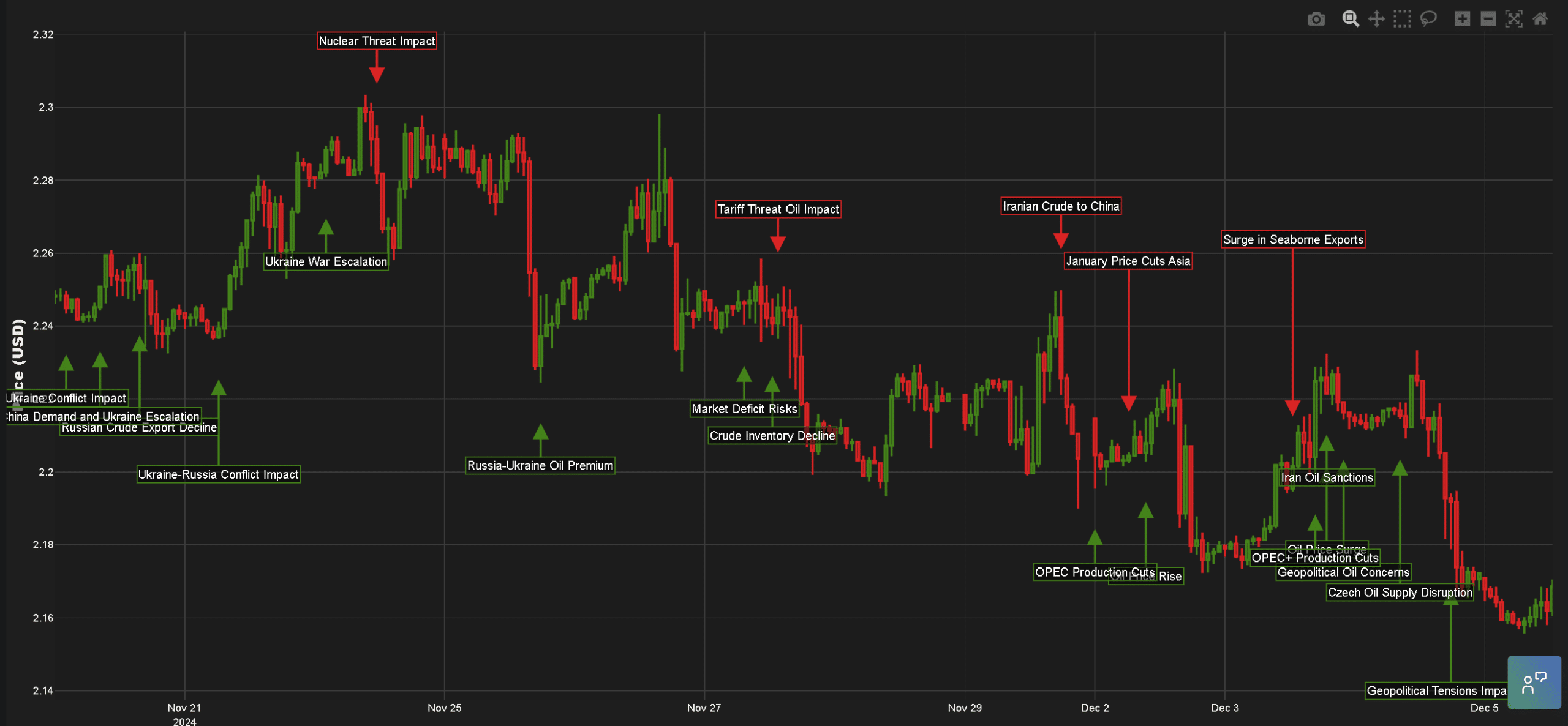
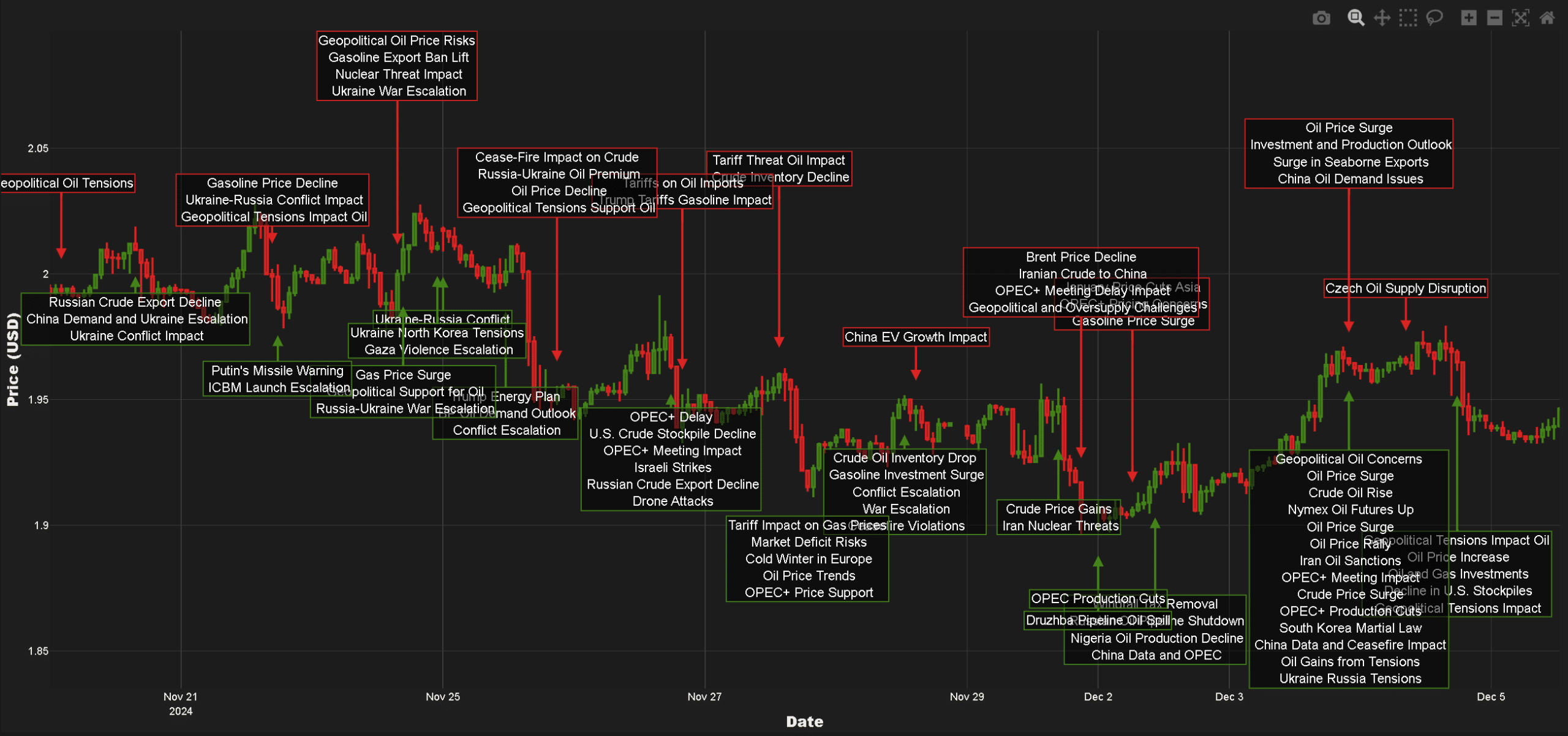
It is not hard to see across Natural Gas price news that the natural gas market has emerged as a critical bellwether for global energy security, with its prices reflecting everything from geopolitical tensions to severe weather events. In this article, we’ll use insights from our Trading Co-Pilot to demonstrate the growing interconnectedness of global natural gas markets that makes the recent price movements across TTF and Henry Hub particularly fascinating. Our analysis of recent Natural Gas price news against price movements reveals a complex interplay between geopolitical tensions and extreme weather events, creating distinct yet related patterns in European and American natural gas pricing.
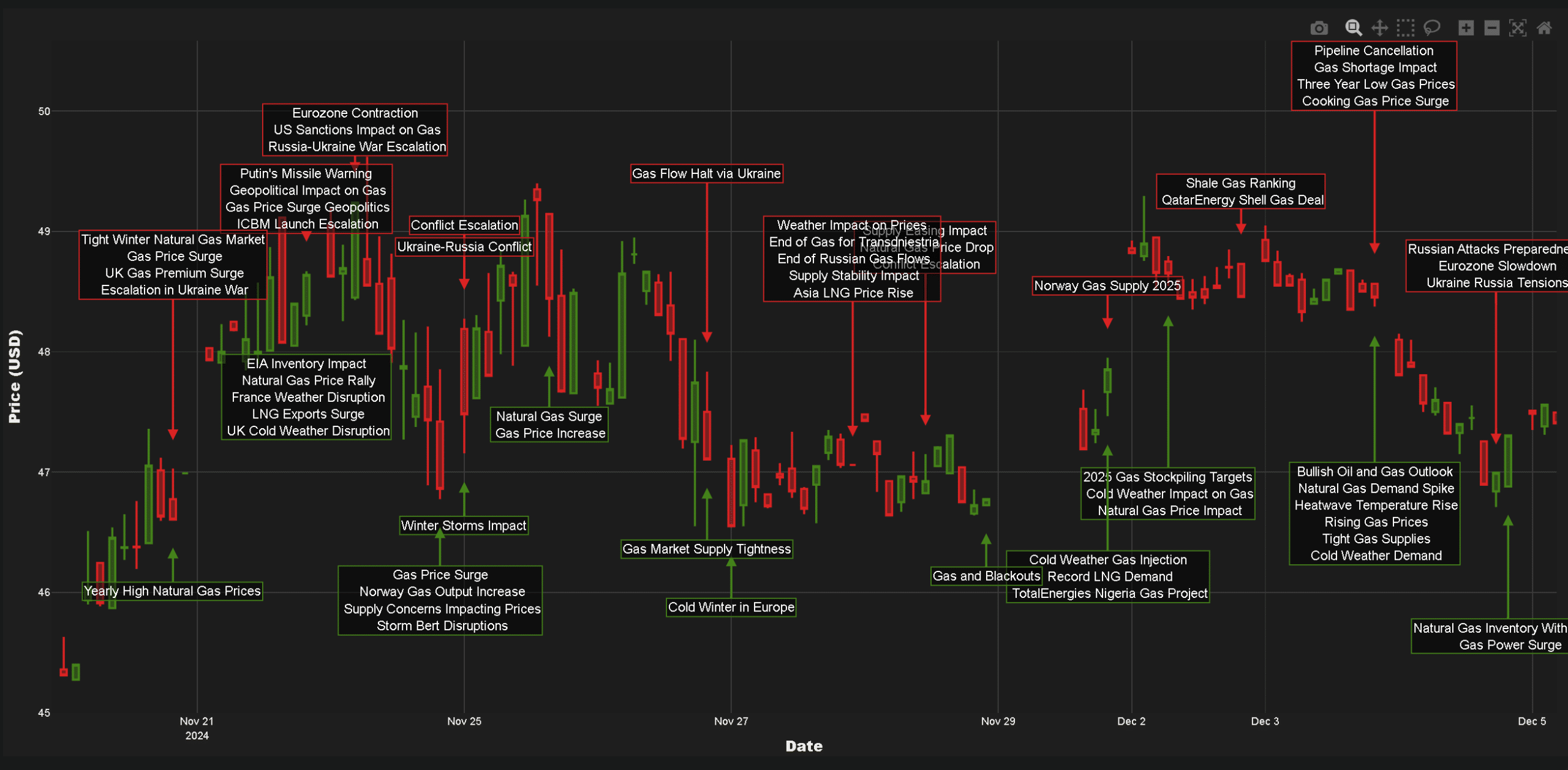
Above: Natural gas price news – European natural gas TTF analysis November 2024 insights taken from our Trading Co-Pilot
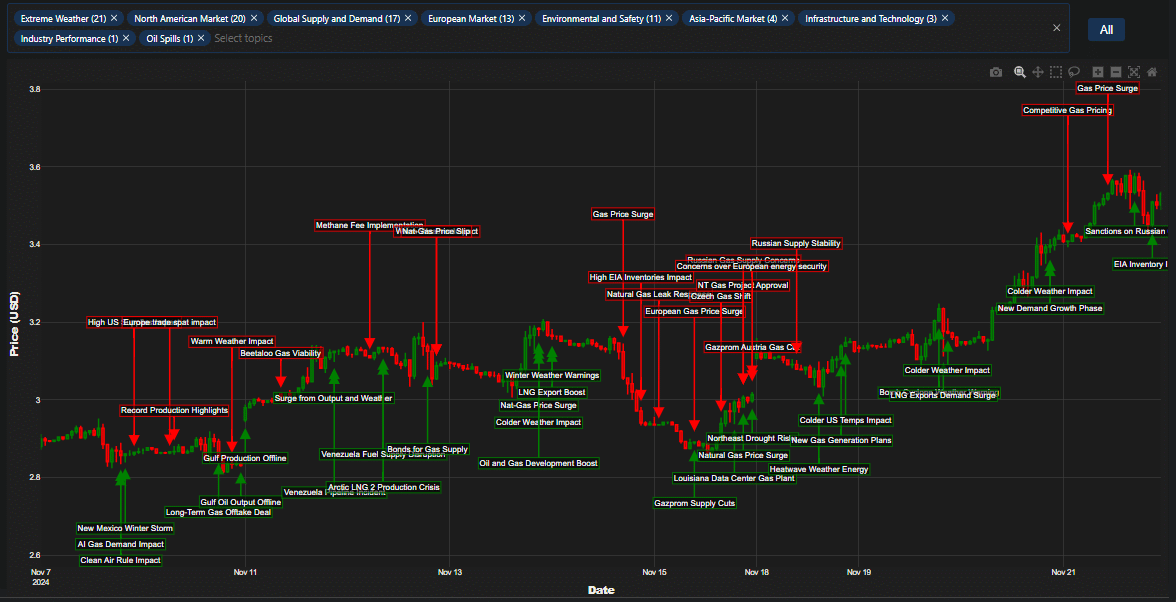
Natural gas price news – US natural gas Henry Hub analysis November 2024 insights taken from our Trading Co-Pilot
Let’s start with the obvious – the direct link between weather and Natural Gas prices. From the above chart, it’s clear that Henry Hub prices show notable sensitivity to domestic weather patterns, as evidenced by the sharp responses to events like storm Rafael and the Thanksgiving winter storms. Meanwhile, the TTF market demonstrates a more pronounced reaction to geopolitical developments. Even though both markets operate independently, their price movements increasingly show correlation during major global events.
The key here appears to be the timing and severity of weather-related disruptions. What began as a relatively stable pricing environment in early November quickly transformed as multiple weather systems struck key consumption regions. Meanwhile, the escalating situation in Ukraine created additional pressure on European gas prices. This is hardly surprising, with TTF showing particular vulnerability to news of missile warnings and conflict escalation.
To add insult to injury, the markets are also worried about supply security, particularly in Europe, and quite rightly so. And if anyone ought to be concerned, it’s the industrial users facing potential supply disruptions during peak demand periods. Yet with some arguing that some of these concerns appear overblown it will be interesting to see how things truly play out across both regions.
Another big problem is the asymmetric impact of weather events. Although initially localised, weather disruptions like the recent Bomb Cyclone weather warning in the US created ripple effects across global natural gas markets. Which brings us back to the ticking time bomb of winter supply security, particularly in regions dependent on natural gas for both heating and power generation.
As elsewhere, it’s clear that the situation has been made considerably worse by infrastructure constraints. Natural gas price news across both markets reflects these limitations, with price spikes occurring during periods of high demand and limited transportation capacity. It’s a uncomfortable fact that thanks to political and economic pressures, infrastructure development hasn’t kept pace with growing demand in key regions.
It’s easy to see from the above how the interconnected nature of these markets means that significant events in either region can create global ripple effects. The data essentially shows that while local weather patterns primarily drive short-term price movements, geopolitical events can fundamentally alter the pricing landscape, particularly in the more politically sensitive European market.
If you found the above insights and analysis valuable, why not access our real-time insights and granular market data through our Trading Co-Pilot and Commodities API? With comprehensive coverage of both TTF and Henry Hub markets, you’ll have the real-time insights needed to navigate these complex market dynamics. Contact us today to learn how our solutions can enhance your trading and risk management strategies by emailing enquiries@permutable.ai or filling in the form below to request your personalised demo.
Following the successful roll out of new assets across TTF Natural Gas and gasoline, we are pleased to announce that we have now also expanded our Trading Co-Pilot and Commodities API coverage to include heating oil price insights.
At a time when heating oil prices are showing complex seasonal patterns, this strategic expansion introduces specialised AI analytics designed for the unique challenges of price forecasting in the heating oil market. The new functionality harnesses our advanced machine learning algorithms to decode market dynamics during periods when heating oil prices traditionally experience their highest volatility.
Understanding heating oil prices can be a complex task,” explains Wilson Chan, CEO of Permutable AI. Seasonal demand swings, weather dependencies, and complex storage dynamics create a market environment where traditional analysis of heating oil prices falls short. Our AI technology has already transformed crude oil trading, and now we’re bringing that same revolutionary approach to the heating oil sector, where early testing has revealed previously undetected correlations between regional temperature variations, storage patterns, and price movements.”
Our enhanced Trading Co-Pilot introduces heating oil-specific price insights covers real-time news analysis and insights on:
“Initial feedback from early adopters has been very positive,” comments Talya Stone, CMO at Permutable AI. “Traders are particularly impressed with our platform’s ability to identify subtle market signals that traditional analysis often misses, especially during periods of high volatility.”
Our expansion into providing real-time heating oil price insights through our Trading Co-Pilot and API reinforces our commitment to providing cutting-edge GenAI energy trading solutions, with additional commodity assets scheduled for rollout throughout 2025. This latest addition to our platform is part of our ongoing dedication to delivering disruptive trading technology across the energy sector.
Read more about use cases or for a personalised demonstration of our Trading Co-Pilot and Commodities API across this asset including a walk-through of our results, contact our team at enquiries@permutable.ai or complete the form below.
In a wave of new asset roll outs, we are pleased to announce the addition of gasoline markets coverage to our Trading Co-Pilot and API. The launch of our gasoline markets coverage on our Trading Co-Pilot platform and Commodities API comes at a time when fuel product prices are experiencing increasing volatility. This expansion delivers sophisticated AI-driven insights for gasoline markets, enabling traders to track price movements through our proprietary multi-threaded analysis system. This launch marks the first in a series of new asset deployments planned ahead of 2025.
“Gasoline markets require a high level of analytical precision,” says Wilson Chan, CEO of Permutable AI. “Our AI technology has proven its worth in oil trading with several energy trading houses already signed up as early-adopters now seeing its value, and we’re now bringing that same level of opportunity to gasoline markets. Early testing shows our platform identifying correlations between weather patterns, geopolitical events, and price movements that traditional analysis often misses.”
“We have already seen how our actionable intelligence has been adding value across oil markets. We’ve been seeing significant uptake from major energy trading houses who value our ability to cut through market noise and deliver precise, actionable insights and now we’re looking forward to be delivering that across gasoline markets also”, commented Talya Stone, CMO.
This expansion – alongside the roll out of additional assets this quarter including heating oil and TTF Natural Gas – comes at an exciting time as we continue to strengthen our position as a leading provider of AI-driven trading intelligence across energy markets, with further asset launches planned into 2025.
For more information about gasoline markets results, coverage, use cases or to schedule a demo to learn how using our Trading Co-Pilot and API can support your trading strategies, contact our team at enquiries@permutable.ai or reach out using the form below.
In a wave of new asset roll outs, we are pleased to announce the addition of TTF Natural Gas to our Trading Co-Pilot and API. The launch of our comprehensive European Natural Gas coverage on our Trading Co-Pilot platform and Commodities API comes at a time when European Natural Gas prices are experiencing increasing volatility.
This expansion delivers sophisticated AI-driven insights for TTF Natural Gas, enabling traders to track price movements through our proprietary multi-threaded analysis system. This launch marks the first in a series of new asset deployments planned ahead of 2025.
“European Natural Gas markets require a high level of analytical precision,” says Wilson Chan, CEO of Permutable AI. “Our AI technology has proven its worth in oil trading with several energy trading houses already signed up as early-adopters now seeing its value, and we’re now bringing that same level of opportunity to gas markets. Early testing shows our platform identifying correlations between weather patterns, geopolitical events, and price movements that traditional analysis often misses.”
“We have already seen how our actionable intelligence has been adding value across oil markets. We’ve been seeing significant uptake from major energy trading houses who value our ability to cut through market noise and deliver precise, actionable insights and now we’re looking forward to be delivering that across European gas markets also”, commented Talya Stone, CMO. “
This expansion – alongside the roll out of additional assets this quarter including heating oil and gasoline – comes at an exciting time as we continue to strengthen our position as a leading provider of AI-driven trading intelligence across energy markets, with further asset launches planned into 2025.
For more information about European Natural Gas coverage, use cases or to schedule a demo to learn how using our Trading Co-Pilot and API can support your trading strategies, contact our team at enquiries@permutable.ai or reach out using the form below.
In these uncertain times, Henry Hub natural gas prices have demonstrated remarkable volatility throughout November 2024. This particular situation feeds on geopolitical instability and shifting fundamental factors that continue to reshape the market landscape. In this article, we’ll take a closer look at the seven key factors that have been impacting Henry Hub Natural Gas prices over the last month.
Indeed, there are of course parallels with previous seasonal patterns, as weather remains a dominant force in U.S. Natural Gas prices. Which is why the market responded so obviously to early winter weather warnings and subsequent temperature forecasts. The snag is that weather impacts have become increasingly unpredictable, with both warm and cold weather events triggering significant price movements.
If you believe the old adage that supply drives the market, recent events certainly support this view. Ahead of the winter season, we’ve observed several critical supply-side developments. Gulf production offline events and Venezuela fuel supply concerns have created upward pressure on Henry Hub Natural Gas prices.
It is the pinning of all its hopes on new infrastructure developments that characterises the market’s longer-term outlook. Rather than merely reacting to short-term supply disruptions, traders will be closely monitoring developments across the sector.
The expansion of LNG export facilities has emerged as a crucial factor, while Natural Gas leak incidents have introduced unexpected volatility. Meanwhile, oil and gas development boosts have provided some stability, while the impact of new facilities like the Louisiana Meta data centre gas plant applications has also been one to watch.
4. Geopolitical influences
Given that it is still working its way through various international tensions, the U.S. Natural Gas market remains highly sensitive to global events. At which point when sanctions and supply stability concerns enter the equation, we typically see increased volatility in U.S. Natural Gas prices.
The recent news events surrounding Russian supply stability and European energy security have created ripple effects across global gas markets, with Henry Hub prices increasingly responding to international supply disruptions. Insiders say this interconnectivity is only set to deepen as LNG export capacity expands and cross-continental gas flows become more fluid.
5. Demand patterns and market evolution
For the avoidance of any doubt, we’re witnessing a significant shift in consumption patterns. Thereby, new demand growth phases and LNG export demand increases have become crucial price drivers.
Meanwhile, the emergence of new data centres and their substantial energy requirements has added another layer of complexity to demand forecasting while the transition of power generation from coal to Natural Gas continues to reshape baseline demand expectations, creating a more nuanced and sophisticated market environment.
div]:bg-bg-300 [&_.ignore-pre-bg>div]:bg-transparent [&_pre]:-mr-4 md:[&_pre]:-mr-9″ style=”box-sizing: border-box; border-image: initial; –tw-border-spacing-x: 0; –tw-border-spacing-y: 0; –tw-translate-x: 0; –tw-translate-y: 0; –tw-rotate: 0; –tw-skew-x: 0; –tw-skew-y: 0; –tw-scale-x: 1; –tw-scale-y: 1; –tw-scroll-snap-strictness: proximity; –tw-ring-offset-width: 0px; –tw-ring-offset-color: #fff; –tw-ring-color: hsl(var(–accent-secondary-100)/1); –tw-ring-offset-shadow: 0 0 #0000; –tw-ring-shadow: 0 0 #0000; –tw-shadow: 0 0 #0000; –tw-shadow-colored: 0 0 #0000; outline-color: hsl(var(–accent-main-100)); position: relative; padding-right: 2.25rem; line-height: 1.65rem; font-family: var(–font-claude-message); border: 0px solid hsl(var(–border-100));”>
_*]:min-w-0″ style=”box-sizing: border-box; border-image: initial; –tw-border-spacing-x: 0; –tw-border-spacing-y: 0; –tw-translate-x: 0; –tw-translate-y: 0; –tw-rotate: 0; –tw-skew-x: 0; –tw-skew-y: 0; –tw-scale-x: 1; –tw-scale-y: 1; –tw-scroll-snap-strictness: proximity; –tw-ring-offset-width: 0px; –tw-ring-offset-color: #fff; –tw-ring-color: hsl(var(–accent-secondary-100)/1); –tw-ring-offset-shadow: 0 0 #0000; –tw-ring-shadow: 0 0 #0000; –tw-shadow: 0 0 #0000; –tw-shadow-colored: 0 0 #0000; outline-color: hsl(var(–accent-main-100)); display: grid; grid-template-columns: repeat(1, minmax(0px, 1fr)); gap: 0.625rem; border: 0px solid hsl(var(–border-100));”>
Insiders say that environmental regulations continue to shape market dynamics. But we need to understand that initiatives like the Clean Air Rule impact and methane fee implementation are likely to have longer-term implications for Henry Hub Natural Gas prices.
The push towards stricter emissions standards is accelerating infrastructure upgrades across the industry, adding new cost considerations to production economics. Additionally, the growing emphasis on certified low-emission gas could create a two-tier market, potentially affecting price discovery mechanisms and trading patterns.
So let us finish this analysis with two thoughts about the market’s direction. First, the combination of weather sensitivity and supply constraints suggests continued volatility in U.S. Natural Gas prices ahead. Second, the growing influence of global factors on Henry Hub natural gas prices indicates an increasingly interconnected market. The development of new pricing mechanisms and risk management tools will become increasingly crucial as market participants adapt to this evolving landscape. Furthermore, the integration of real-time data analytics and artificial intelligence in trading decisions is likely to transform how market participants interpret and react to price signals.
In short, while individual factors can drive short-term price movements, it’s important to remember that it is the interaction between these various elements that shapes the broader market trajectory. As we progress through the winter season, monitoring these key drivers will be crucial for understanding price dynamics in the natural gas market.#
In today’s volatile Natural Gas markets, capturing real-time intelligence is nothing short of essential. Our Trading Co-Pilot and GenAI Commodities API are transforming how traders navigate Henry Hub price movements, processing thousands of market events instantly to deliver actionable insights and directional signals.
We’re currently offering select traders and institutions early access to our platform and GenAI Commodities API, which is already being used by leading early-adopter energy trading houses to detect price-moving events the moment they happen. Beyond merely aggregating news, our AI-powered system generates instant buy/sell signals by analysing complex market events and their potential impact on Natural Gas prices.
Whether you’re looking to enhance your existing trading infrastructure or seeking a comprehensive market intelligence solution, we’d be delighted to show you how our platform can integrate seamlessly into your workflow. Request a personalised demo to see firsthand how we track real-time events affecting Henry Hub, or start with a free trial of our Trading Co-Pilot to experience the competitive edge of AI-powered market intelligence.
Why not get in touch with our team today – we’d love to hear from you and show you our tech’s capabilities. Simply drop us a line to enquiries@permutable.ai or fill in the form below to get in touch. Early access spots are limited – ensure you’re equipped with the next generation of trading intelligence.