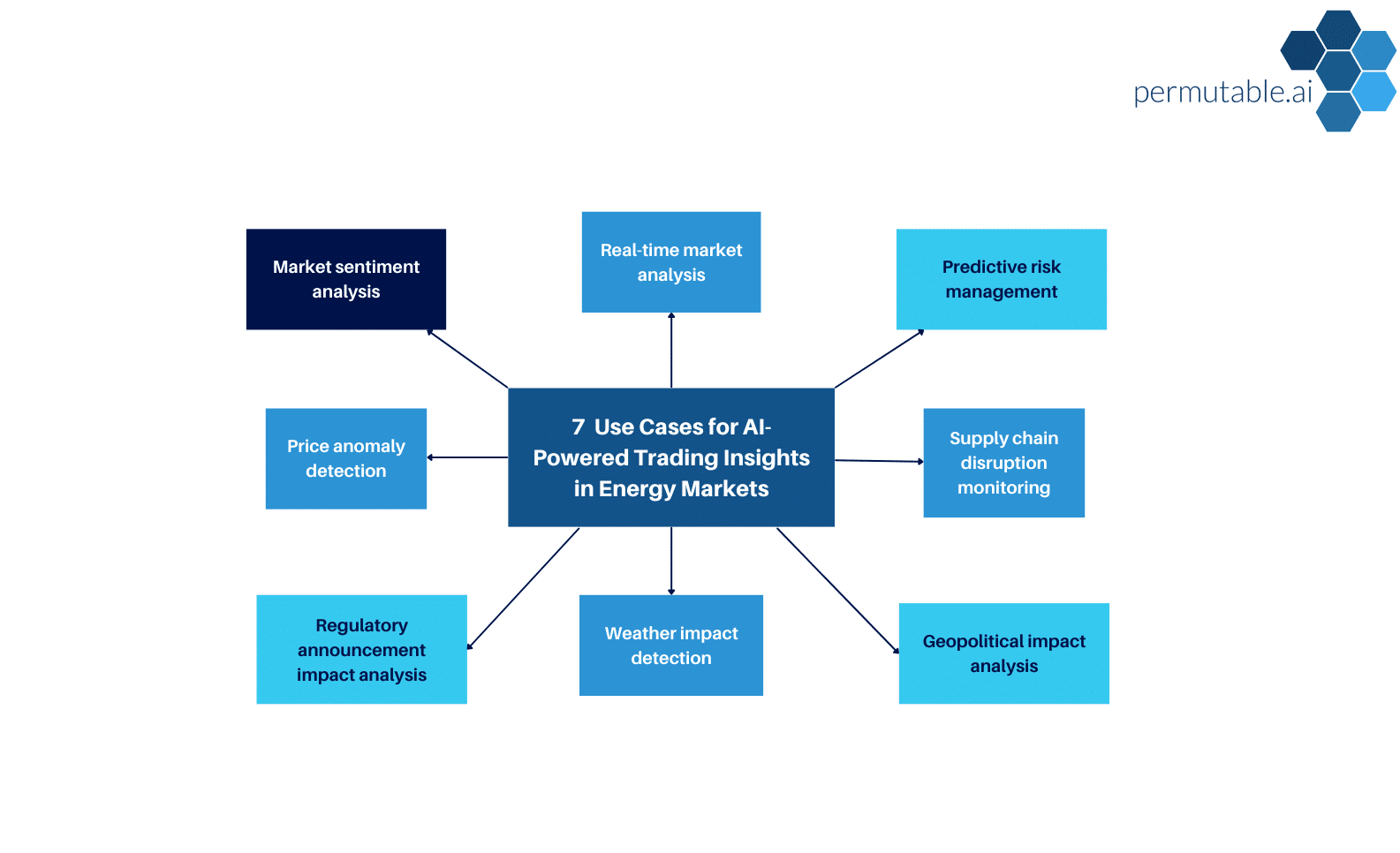
8 use cases for our AI-powered trading insights in energy markets
Energy markets are becoming increasingly complex to navigate and as they continue to evolve, those who are able to stay ahead of increasingly volatile market dynamics will be, in our opinion, those who embrace AI-powered trading insights for energy markets. While the AI race continues to develop at a unprecedented rate – within energy markets particularly – technological strides are already fundamentally changing how traders operate. And all this is thanks to AI’s ability to process vast amounts of market data in real-time, offering powerful visibility into market movements, correlations and emerging patterns. 

In this article we’ll take a brief look at some use cases of our AI-powered trading insights in energy markets, looking at how these can be using to predict price movements, reduce trading risk and unearth trade ideas.

1. Real-time market analysis

We think on of the most powerful applications of AI-powered trading insights in energy markets is in their ability to provide a 360 degree market view by simultaneously process multiple data streams. As an example, our Trading Co-Pilot platform analyses price movements, geopolitical events, and supply-demand dynamics in real-time, providing energy traders with comprehensive market intelligence, spotting trends before they become mainstream. Perhaps the most powerful aspect of this is that this analysis happens at a speed and scale impossible for even the best human traders and team of analysts to match.

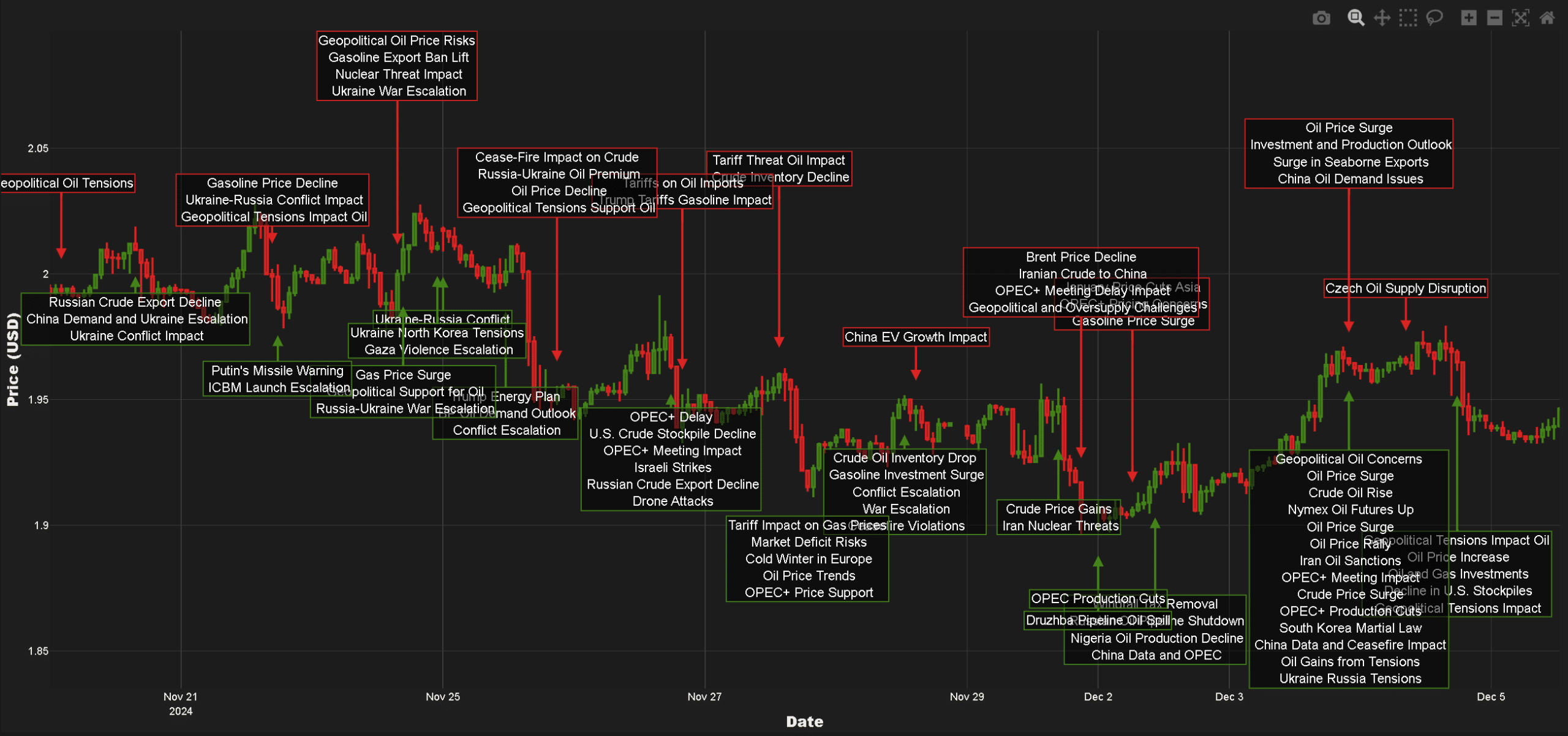
Brent Crude Oil

2. Predictive risk management

Coming back to the critical aspect of trading risk management, our AI-powered insights offer a powerful approach to risk assessment. Indeed, we’ve seen even the most experienced traders benefit from our system’s ability to identify potential risks before they materially impact the market. Here, the hard truth is that the vast majority of traditional risk management systems simply cannot match this predictive capability that our system is able to offer.

3. Supply chain disruption monitoring 

At this point, it’s worth noting how our AI-powered trading insights for energy markets provide crucial early warnings about supply chain disruptions. For example, our platform continuously monitors news on global shipping movements, refinery operations, and production facilities, instantly alerting traders to potential disruptions reported on in the news and how that could impact market sentiment and dynamics. That said, this real-time monitoring capability represents just one aspect of our broader value proposition.

4. Geopolitical impact analysis

Perhaps then, we had better move onto just how vital it has become to understand how geopolitical events affect energy markets. Perhaps there is no guarantee, of course, that every political development will impact prices, but our AI systems excel at reducing noise and identifying which events truly matter. Contrary to common notions, not all political developments carry equal weight in energy markets. And it is our AI’s ability to decipher the most important events in terms of market impact through years of meticulously training which can provide some of the most powerful market insights available to energy traders. 

5. Weather pattern integration

How, then, does one incorporate weather patterns and their impacts into trading decisions? Well, our AI-powered trading insights for energy markets can process complex meteorological news, related sentiment and its potential impact on energy demand and supply. Even though energy traders now have access to more weather data than ever, the hard truth is that making sense of its impact on energy markets alongside a myriad of other market moving factors can be challenging to sat the least. However, the good news is that this is made light work of through our sophisticated AI analysis and the safe pair of hands it provides.

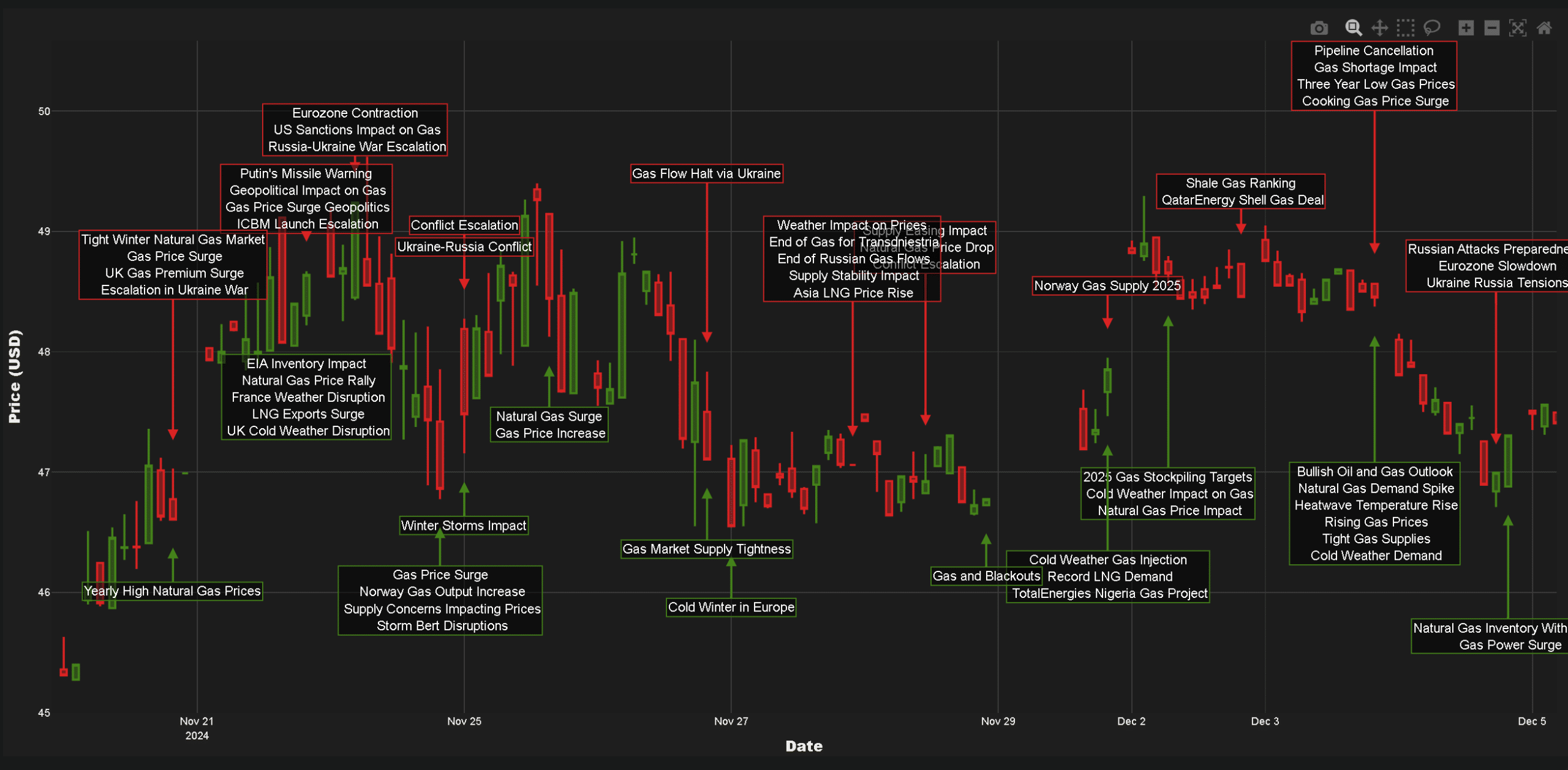
AI-Powered Trading Insights in Energy Markets European Gas

6. Regulatory compliance monitoring

At the same time, regulatory announcements can dramatically shift market dynamics. Here, our AI systems not only monitor these announcements in real-time but also assess their potential market impact before it materialises. This means traders using our system are given early indication and advance warning of how specific regulatory changes might affect different aspects of the energy markets as stories unfold, from production quotas to environmental compliance requirements and everything in-between.

7. Market sentiment analysis

The vast majority of traditional trading systems struggle to effectively capture market sentiment and this is something our Trading Co-Pilot excels.  Our AI-powered trading insights in energy markets provide analysis on various sentiment indicators, from social media to news reports, providing a comprehensive view of market psychology. Here, what truly sets our platform apart is its ability to contextualise sentiment data within broader market movements. For example, our AI systems can distinguish between temporary market noise and genuine sentiment shifts that could impact trading decisions. Perhaps more importantly, it’s able to analyse sentiment across multiple timeframes, from intraday movements to longer-term trends.

8. Price anomaly detection and market dislocation

While appreciating the complexity of energy markets, identifying price anomalies and market dislocations becomes increasingly key. Our AI-powered trading insights for energy markets excel at surfacing unusual price movements and market behaviour patterns that might indicate trading opportunities. For example, our Trading Co-Pilot platform can identify price disparities across different energy products and geographical regions, spotting potential arbitrage opportunities before they become widely apparent. The vast majority of these opportunities require quick action, making our real-time alerting capability particularly valuable. 

We are already seeing validation of our AI-powered trading insights from those energy trading houses who have already adopted them into their trading strategies. And so we know that, for energy markets, this represents more than just technological advancement. Instead, we believe that what we’re witnessing is a fundamental shift in how energy trading desks are operating. Some might say that this transformation is just beginning and in some ways it is – but we also believe the benefits are already clear.

To sum up, it’s clear to see that the starting point for successful energy trading has shifted to embracing these technological advances while maintaining human oversight.  And as we continue to see rapid technological change, we know that the key to success for energy trading desks will lie in their ability to combine AI capabilities like ours, alongside human expertise.

Experience the advantage of AI-powered trading insights in energy markets

Ready to transform your energy trading strategies with advanced AI analytics? Our Trading Co-Pilot is already helping leading energy firms navigate market complexity with unprecedented confidence and precision. And so, we would like to invite you to experience firsthand how our platform can enhance your trading operations through a personalised demonstration. 

Qualified organisations can access a complimentary enterprise trial, where you’ll discover how our AI-powered platform delivers real-time market intelligence, identifies emerging opportunities before they become apparent, provides early warning of market-moving events, and offers sophisticated sentiment analysis and price anomaly detection.

Contact us today at enquiries@permutable.ai to arrange a personalised demo or request a free enterprise trial, or simply fill in the form below. 

Request demo/enterprise trial


Market volatility: 7 ways AI-driven commodity intelligence is transforming risk management

Let’s start with the obvious challenge facing hedge funds and trading houses today – which is that of  unprecedented levels of market volatility.  In the current landscape, there is no doubting that traditional risk management approaches are struggling to keep pace with today’s rapidly evolving markets. With commodity markets that have never been more complex, the hardest part is managing the confluence of factors – from wars and supply chain disruptions to OPEC decisions and extreme weather events – that can trigger sudden price movements. Of course, there are things that can be done to mitigate these risks, but the game changer we believe will be how AI-driven solutions can process and act on real-time commodity intelligence.

Beyond historical data to real-time commodity intelligence and predictive analytics

For the avoidance of doubt, it’s fair to say that traditional models relying solely on historical data and delayed market reports increasingly fall short. Ultimately, the speed of modern markets demands more sophisticated approaches to risk management which can capture sudden market shifts before they impact portfolio values.

Which begs the question – how to move from reactive to proactive risk management? When it comes to traditional approaches, you can’t argue with the fact that they remain important foundational tools. However, everywhere you look, markets are moving faster than human analysts can process. All of which makes AI-driven trading solutions not just beneficial but essential for modern risk management, thanks to their ability to identify potential market movements before they occur. The present outlook for trading technology suggests increased reliance on real-time commodity intelligence to track geopolitical, macroeconomic, and environmental factors.

Enter custom alerts and risk monitoring

If experience tells us anything it’s that early warning systems are crucial. Moving beyond traditional monitoring approaches which are no by and large insufficient, to reclaim strength in this area, traders need sophisticated alert systems covering everything from OPEC production cuts to supply chain bottlenecks.  What is absolutely clear is that the benefits far outweigh the costs both in real-terms and also as per the time and effort it takes to integrate them into already existing systems, with several key areas where AI solutions provide clear advantages:

Real-time risk assessment

In periods of extreme market volatility, traditional risk metrics often lag behind price movements. By processing market data every 15 minutes, our Trading Co-Pilot provides an instant assessment of portfolio risk exposure. Our system analyses multiple data streams simultaneously, from price movements to news flow, helping traders identify emerging risks before they impact positions.

Predictive analytics for volatility management

Beyond simple trend analysis, today’s AI systems are able to identify complex patterns across multiple data sources. In times of market volatility, they can detect subtle signals that precede major moves, from changes in trading volume patterns to shifts in market sentiment, allows trading houses to anticipate potential market movements rather than merely reacting to them. As seen in our recent crude oil tracking module, our system detected early signals of price movements related to Middle East tensions, allowing traders to adjust positions ahead of market shifts.

Custom alert systems

Modern alert systems are key for managing market volatility, going far beyond simple price triggers. They monitor multiple factors simultaneously – from weather patterns affecting commodity production to geopolitical developments that could impact prices. These systems can be customised to specific portfolio needs and risk tolerances. Our Trading Co-Pilot  provides customised alerts on major market events, from OPEC production cuts to supply chain bottlenecks. For instance, our system recently helped traders navigate coffee market volatility by providing early warnings about weather-related supply disruptions in key growing regions.

Market sentiment analysis

During periods of high market volatility, AI systems can process vast amounts of news, social media, and market commentary in real-time. They can detect subtle shifts in market sentiment before they manifest in price movements. This includes analysis of corporate communications, regulatory statements, and expert commentary that might signal emerging trends. As an example, our own Trading Co-Pilot processes over 500 million articles from verified sources, including Reuters, Bloomberg, and WSJ, providing real-time sentiment analysis during periods of high market volatility. Recently, our platform recently helped traders navigate gold market movements by identifying shifting sentiment patterns ahead of central bank decisions.

Supply chain monitoring

With market volatility increasingly driven by supply chain disruptions, comprehensive monitoring is essential. AI systems track everything from news concerning port congestion and shipping routes to alerts on production disruptions and inventory levels, helping identify potential issues before they impact market prices. And it is this that recently helped energy traders using our commodity intelligence anticipate European gas price movements by monitoring critical supply developments in key regions.

Weather impact tracking

In volatile commodity markets, weather patterns can significantly impact prices. Advanced AI systems are able to monitor news on global weather patterns and assess their potential market impact. This includes tracking extreme weather events, seasonal patterns, and long-term climate trends that could affect production and demand. Permutable’s platform incorporates weather pattern analysis into its trading signals, particularly crucial for agricultural and energy commodities. And here again, our Trading Co-Pilot’s analysis of extreme weather events helped traders navigate volatility in natural gas markets during severe winter storms.

Geopolitical risk assessment

In today’s highly volatile markets, geopolitical events can have immediate price impacts. AI systems are able to monitor global developments, assess their potential market impact, and help firms adjust their risk exposure accordingly – all in real-time. And yes, this includes analysis of trade policies, sanctions, political stability, and international relations. A recent use case for our commodity intelligence can be seen here in the surfacing of early warnings about trade policy impacts on soybean markets and the analysis of effects of geopolitical tensions on oil prices.

We think you’ll agree the potential for AI in navigating market volatility and strengthening risk management strategies through real-time commodity intelligence is extremely powerful. But perhaps what is perhaps even more powerful is where this technology can take us in future. We live in an age of highly volatile geopolitics, making sophisticated risk management through granular and real-time commodity intelligence more crucial than ever, and we believe that the future of trading will belong to those who can effectively combine human expertise with AI-driven analysis. 

Experience the advantage of AI-driven commodity intelligence

Discover how our Trading Co-Pilot can enhance your trading operations with comprehensive commodity intelligence updated every 15 minutes. Our platform processes vast amounts of data across energy, metals, and agricultural markets, helping you identify opportunities and manage risk in today’s volatile environment. From real-time sentiment analysis to early warning signals for market movements, our solution provides the insights you need to stay ahead of rapidly evolving markets.

Contact our team at enquiries@permutable.ai or schedule your personalised demo or fill in the form below to see how our AI-driven commodity intelligence can complement your existing trading strategies. We’re currently offering a 14-day trial for qualified institutional traders. Let us show you how combining human expertise with advanced AI analytics can transform your approach to market volatility.

Request demo


AI agents for trading: We lift the lid on the next big tech breakthrough for 2025

There is now broad consensus that artificial intelligence is transforming financial markets. We all know that the acceleration of AI technology shows no signs of abating, with the compound effects already becoming apparent in how traders interact with market data. We will soon be releasing our latest update to our Trading Co-Pilot platform  which will centre around the integration of sophisticated AI agents for trading, specifically designed for commodity market analysis. And with that in mind, we wanted to provide some context around AI agents for trading specifically in this article for the uninitiated. 

Why AI agents matter

To explain it in the most simple way, AI agents – autonomous software entities capable of perceiving their environment and taking independent actions – can process and analyse information at scales impossible for human analysts. With regards to AI agents for trading, these enable a range of factors, from market sentiment to price movements, to be monitored and interpreted simultaneously across multiple commodities and regions. 

In recent weeks, our development team has been fine-tuning these agent networks to work in unison, creating the next generation of trading market intelligence. For us, the landmark moment came when our agents began demonstrating not only the ability to analyse but also synthesize complex market narratives, making it – we believe – one of the most significant breakthroughs in automated market analysis.

AI agents for trading: Orchestrating intelligence networks

All of this has been achieved through carefully orchestrated agent networks that collaborate to deliver comprehensive market insights. This contrasts with traditional AI approaches that often operate in isolation. Of course, the real innovation lies in how these agents communicate and build upon each other’s insights, creating a more nuanced understanding of market dynamics. What is particularly powerful in this is how AI agents can identify subtle market patterns that might escape human attention.

AI agents for trading: A new frontier in real-time market intelligence

As markets become increasingly complex, attention is now turning to how these systems can provide traders with actionable intelligence in real-time. The answer will fall to the sophisticated agent networks that can process vast amounts of market data while maintaining context and relevance. So far, one of the most powerful applications we have been working on is the integration with social media platforms, particularly Twitter/X where this connection allows traders to to tap into real-time market sentiment and breaking news, providing immediate insights into market-moving events.

Our upcoming update will introduce Analyst Agents and Trading Agents, designed to provide traders with a comprehensive edge. Our Analyst Agents will deliver a distilled summary of events, craft a story narrative of the asset’s trajectory, and update insights every hour to keep traders informed in real time. Meanwhile, our Trading Agents will continuously review hundreds of recent events, incorporating price movements, sentiment, and market dynamics to make data-driven market predictions. With this, each forecast will be accompanied by a clear rationale, statistically significant signals, and tested performance for practical deployment. Imagine now how powerful this can be when integrating these enhanced signals into your trading strategy to achieve improved decision-making and execution.

From theory to practice 

The practical applications of these agent networks are already showing promising results in testings. Soon, traders using our platform will be able to benefit from automated market summaries that distill complex data into clear insights, predictive analytics powered by multi-agent analysis, real-time monitoring of market-moving events, contextual understanding of market dynamics, and risk-aware trading recommendations.

As we continue to develop and refine our AI agent networks, we remain focused on practical applications that deliver real value to traders. The next frontier involves enhanced inter-agent communication protocols, deeper integration with market data sources, more sophisticated pattern recognition capabilities, advanced risk management features, and improved natural language processing – all of which we plan to productise and roll out in future updates.

Shaping the future of AI agents for trading

At Permutable AI, we believe the future of trading lies in the synergy between human expertise and AI agent networks. As the volume and complexity of market data continues to grow exponentially, these intelligent systems will become essential for processing, analysing, and deriving actionable insights in real time.

However, we are steadfast in our vision that AI should augment, not replace human traders. By equipping traders with the most advanced tools that enhance decision-making, we’re working to empower them in their role while leveraging the power of AI to navigate volatile markets with confidence and precision. Ultimately, through the integration of AI agents into our human-centric trading technologies, we’re shaping the  future of commodity trading intelligence Together – driving innovation, unlocking opportunities, and redefining what’s possible in global trading.

Stay ahead in trading innovation

Follow our LinkedIn page for our latest update announcements to be the first to hear of our roll outs.  Want to be part of the next wave testing our technology? Get in touch today to explore how you can integrate our tools or work with us to build your own. Simply email enquiries@permutable.ai or fill in the form below.

Get in touch


Gasoline markets added to Trading Co-Pilot and Commodities API extending coverage to fuel products

In a wave of new asset roll outs, we are pleased to announce the addition of gasoline markets coverage to our Trading Co-Pilot and API. The launch of our gasoline markets coverage on our Trading Co-Pilot platform and Commodities API comes at a time when fuel product prices are experiencing increasing volatility. This expansion delivers sophisticated AI-driven insights for gasoline markets, enabling traders to track price movements through our proprietary multi-threaded analysis system. This launch marks the first in a series of new asset deployments planned ahead of 2025.

“Gasoline markets require a high level of analytical precision,” says Wilson Chan, CEO of Permutable AI. “Our AI technology has proven its worth in oil trading with several energy trading houses already signed up as early-adopters now seeing its value, and we’re now bringing that same level of opportunity to gasoline markets. Early testing shows our platform identifying correlations between weather patterns, geopolitical events, and price movements that traditional analysis often misses.”

Our enhanced Trading Co-Pilot features:

“We have already seen how our actionable intelligence has been adding value across oil markets. We’ve been seeing significant uptake from major energy trading houses who value our ability to cut through market noise and deliver precise, actionable insights and now we’re looking forward to be delivering that across gasoline markets also”, commented Talya Stone, CMO.

The platform’s gasoline markets coverage includes:

  • 15-minute market updates
  • Geopolitical risk assessment
  • Inventory level analysis
  • Seasonal demand pattern tracking
  • Cross-commodity correlations
  • Supply-demand dynamics

This expansion – alongside the roll out of additional assets this quarter including heating oil and TTF Natural Gas – comes at an exciting time as we continue to strengthen our position as a leading provider of AI-driven trading intelligence across energy markets, with further asset launches planned into 2025.

For more information about gasoline markets results, coverage, use cases or to schedule a demo to learn how using our Trading Co-Pilot and API can support your trading strategies, contact our team at enquiries@permutable.ai or reach out using the form below.

Get in touch


TTF Natural Gas added to Trading Co-Pilot and API extending coverage to European Natural Gas prices

In a wave of new asset roll outs, we are pleased to announce the addition of TTF Natural Gas to our Trading Co-Pilot and API.  The launch of our comprehensive European Natural Gas coverage on our Trading Co-Pilot platform and Commodities API comes at a time when European Natural Gas prices are experiencing increasing volatility.

This expansion delivers sophisticated AI-driven insights for TTF Natural Gas, enabling traders to track price movements through our proprietary multi-threaded analysis system. This launch marks the first in a series of new asset deployments planned ahead of 2025.

“European Natural Gas markets require a high level of analytical precision,” says Wilson Chan, CEO of Permutable AI. “Our AI technology has proven its worth in oil trading with several energy trading houses already signed up as early-adopters now seeing its value, and we’re now bringing that same level of opportunity to gas markets. Early testing shows our platform identifying correlations between weather patterns, geopolitical events, and price movements that traditional analysis often misses.”

Our enhanced Trading Co-Pilot features:

“We have already seen how our actionable intelligence has been adding value across oil markets. We’ve been seeing significant uptake from major energy trading houses who value our ability to cut through market noise and deliver precise, actionable insights and now we’re looking forward to be delivering that across European gas markets also”, commented Talya Stone, CMO. “

The platform’s natural gas coverage includes:

  • 15-minute market updates
  • Geopolitical risk assessment
  • Storage level analysis
  • Weather pattern impact tracking
  • Cross-commodity correlations
  • Supply-demand dynamics

This expansion – alongside the roll out of additional assets this quarter including heating oil and gasoline – comes at an exciting time as we continue to strengthen our position as a leading provider of AI-driven trading intelligence across energy markets, with further asset launches planned into 2025.

For more information about European Natural Gas coverage, use cases or to schedule a demo to learn how using our Trading Co-Pilot and API can support your trading strategies, contact our team at enquiries@permutable.ai or reach out using the form below.

Get in touch


Why is trading hard? We reveal the reasons

Here’s a hard truth: trading, in our view, represents one of the most challenging activities in the financial sector. Initially, the uninitiated among us may view trading as a straightforward path to wealth. But while the mechanics of placing trades might seem simple, the reality is that trading is hard in ways that most never anticipate. Why is trading hard? Here, we lay down the reasons warts and all in this article:

Why is trading hard? The information overload challenge

In stark contrast to popular belief, trading isn’t just about following price charts. So what is it actually about then? Each day, traders must process information from a seemingly endless number of news sources. To put this in context, our Trading Co-Pilot processes over 120,000 sources, across 20,000 news articles EVERY HOUR – something that only a team of analysts working 24/7 could possibly dream of achieving. The crisis in information management means that answering the question “why is trading hard” starts with understanding this overwhelming data deluge and the challenges it presents. 

Why is trading hard: Real-time complexity

All of which suggests a deeper challenge: at any given moment, there could be in the region of 20-50 significant events affecting an asset’s price. As with most things in markets, context is crucial. For example, interpreting whether geopolitical events like Israel’s response to Iran will impact Crude prices requires deep understanding of multiple factors. This method applies across all asset classes, demonstrating why trading is hard even for seasoned professionals.

Why is trading hard: The human element

And so then, what about a trader’s potential to beat the market? Here’s another inconvenient truth – the majority of traders fail to outperform market indices. Much of that is due to the cognitive demands of processing vast quantities of information while managing emotional responses to market movements. This isn’t just because of psychological factors – it’s the same story on dealing with conflicting data points and market narratives.

The data processing paradox

The loss of trust in traditional trading methods isn’t surprising when you consider the scale of modern market complexity. Today, even the most experienced traders can face what we call the “analysis paralysis paradox” – where more information often leads to poorer decision-making. You get a sense that something’s fundamentally broken when entire teams of analysts and economists struggle to process market events effectively. 

As with most things in trading, the solution isn’t necessarily more data – it’s better data processing. What we’ve found is that successful traders don’t just need access to information; they need intelligent systems that can contextualise and prioritise it. This means understanding which 20-50 events truly matter among the thousands that don’t and are just noise, all in real-time.

Beyond traditional analysis

Just as notably, the evolving nature of market dynamics has transformed what effective trading looks like. Initially, technical and fundamental analysis seemed sufficient. But look how markets have changed – in this scenario of interconnected global events, traditional approaches often fall short. For now, the most successful traders are those who can harness both human insight and technological capabilities. The concern for people relying solely on conventional methods is that they’re fighting yesterday’s battles with outdated tools. 

All of these points highlight why modern trading requires a fundamentally different approach. That sounds daunting, but it’s precisely why we’ve developed our Trading Co-Pilot to bridge this gap, transforming vast datasets into actionable insights. These remarkable patterns we’ve observed in successful trading operations all point to one conclusion: the future belongs to those who can effectively combine human expertise with AI-powered analysis.

The solution 

And so, despite this complexity, there’s hope. The keys to managing these challenges lie in combining human expertise with advanced technology. And yet perhaps the most exciting development is how AI can now surface critical events as they happen, providing contextual insights into potential price impacts. What we’ve found is that unlocking the potential means leveraging AI to process billions of historical events and real-time data points. The result of this is our Trading Co-Pilot which scans:

  • 120,000 sources daily
  • 1.2 billion historical events
  • 10 years of complete news archives

As long as we rely on human analysis alone, the fundamental reasons why trading is hard will persist. Which brings us the solution: our Trading Co-Pilot, which provides comprehensive, real-time market analysis through an intuitive interface, transforming complex data into actionable insights. The loss of trust in traditional analysis methods has created an opportunity for innovation. As markets grow more complex, the question isn’t whether to embrace AI-powered solutions – it’s how quickly you can integrate them into your trading strategy.

Want to transform your trading process? Discover how our AI-powered Trading Co-Pilot and newly release API for commodities trading can help you navigate market complexity with confidence:

  • Email enquiries@permutable.ai for immediate access
  • Complete the form below for a personalised demo
  • Experience the power of real-time, contextual market insights

Request a demo


How to trade with artificial intelligence in 2024: Insights from Permutable AI

At first glance, learning how to trade with artificial intelligence might seem like something out of a science fiction novel. Dip beneath the surface though, and you’ll find that AI-powered trading is not only real but rapidly becoming the norm in financial markets. At Permutable AI, we’ve been at the forefront of this revolution, and we’re excited to share our insights on how to trade with artificial intelligence effectively.

Understanding why the question “how to trade with artificial intelligence” is on everyone’s lips 

Let’s start with the issue of why understanding how to trade with artificial intelligence is gaining such momentum. The obvious point here is that financial markets are incredibly complex, with countless variables affecting asset prices at any given moment. It’s inevitable that human traders, no matter how skilled, will miss important signals or struggle to process information quickly enough. This creates a big problem for traditional trading methods.

But also, the sheer volume of data available today is overwhelming. This is where AI shines. By leveraging machine learning algorithms, AI can process vast amounts of data in real-time, identifying patterns and trends that would be impossible for a human to spot. Not only that, but AI can do this round the clock, without fatigue or emotion clouding its judgment.

How to trade with artificial intelligence: Key considerations 

So, how do you actually trade with artificial intelligence? There are two questions you need to consider:

  1. What type of AI trading system should you use?
  2. How can you integrate AI into your existing trading strategy?

We’ll unpack this below…..

Types of AI trading systems

When exploring how to trade with artificial intelligence, it’s important to start with the different approaches available. Broadly speaking, there are three main categories:

  1. Rule-based systems: These use pre-defined rules to make trading decisions. While not as sophisticated as other AI methods, they can be effective for certain strategies.
  2. Machine Learning models: These learn from historical data to make predictions about future market movements. They can adapt to changing market conditions over time.
  3. Deep Learning systems: These use neural networks to process complex, unstructured data like news articles or social media sentiment. They’re particularly good at identifying hidden patterns in data.

At Permutable AI, we believe that a combination of these approaches often yields the best results when learning how to trade with artificial intelligence. Our philosophy has always been to use the right tool for the job, rather than trying to force a one-size-fits-all solution.

Implementing AI trading: Challenges and solutions

So now the question you are all wanting to ask us…..how hard is it to implement AI trading? Well hey, it’s certainly not a walk in the park, but it’s also not as daunting as you might think. The first major development in how to trade with artificial intelligence is choosing the right platform or tools. There are numerous ready-made solutions available – including our very own Trading Co-Pilot.

But now, let’s remember that AI is not a magic bullet. The problem is, many traders expect AI to instantly boost their profits without any effort on their part. A bigger game changer is achieving a deep understanding of how to trade with artificial intelligence and how it can complement your trading strategy and human expertise. This is exactly how we use our own Trading Co-Pilot in-house and very much where we see the strongest results. 


Trading Co-Pilot

How to trade with artificial intelligence: Starting small

If you plan to incorporate AI into your trading, you may want to start small. There is some low hanging fruit in areas like market sentiment analysis, again – which is all packaged up and available to you through our Trading Co-Pilot, including AI-driven buy/sell directionals.  From there, you can gradually expand the role of AI in your trading process.

Beware the regulatory landscape

Meanwhile, it’s crucial to keep an eye on regulatory developments. The world is taking notice of AI trading, and regulations are evolving rapidly. Fortunately, at Permutable AI, we stay on top of these changes and design our systems to be compliant with the latest regulations – so you’re very much in a safe pair of hands with us. 

Overcoming fears and misconceptions

Yet the reality is that learning how to trade with artificial intelligence is not without its challenges. A frisson of fear often runs through traditional traders when they first encounter AI systems, and this is to be expected. Of course, there is worry about job displacement or losing control over their trading strategies. These are not idle concerns, but we believe they’re outweighed by the potential benefits of AI being used in collaboration with human expertise, which is very much the basis on which our Trading Co-Pilot has been designed and developed. An often cited rule of thumb is to treat AI as a tool, not a replacement for human judgment. The idea is that you can leverage AI’s strengths while still maintaining control over your overall trading strategy.

Addressing scepticism

Against all that, a sceptic might say that markets are too unpredictable for AI to be truly effective. However, we would say that this is precisely why AI is so powerful in the context of increasingly volatile markets. Take our Trading Co-Pilot for example – it can process and analyse far more information than a human ever could, identifying subtle patterns and correlations and ultimately, providing sound trading strategies and ideas – all in real-time. 

The democratisation of advanced trading techniques

The bigger picture, though, is that AI is transforming the entire financial landscape. Central to that revolution is the democratisation of advanced trading techniques. Tools and strategies that were once the preserve of large institutions are now accessible to individual traders. From AI trading algorithms that execute trades at lightning speed to AI-guided investing that helps novice investors make informed decisions, the applications of AI in stock market analysis are vast and growing. 

Many wonder, “Can AI pick stocks?” or “Is AI stock trading real?”. Well good news folks, because the answer here is a resounding yes! Artificial intelligence stock analysis has become increasingly sophisticated, with AI-powered investing platforms and apps offering everything from basic stock recommendations to complex portfolio management (again see our buy/sell directionals as part of our Trading Co-Pilot). 

For those asking how to use AI to invest in stocks or how to start trading with AI, there are numerous options available. Free AI investing apps provide a low-risk entry point, whilst more advanced artificial intelligence trading tools offer comprehensive tools for seasoned traders. The best AI investment apps combine powerful algorithms with user-friendly interfaces, making it easier than ever to harness the power of AI for investing. Whether you’re using AI to pick stocks or relying on stock market AI analysis for deeper insights, it’s clear that AI is transforming the investment landscape.

Getting started with AI trading

When all is said and done, the most important question is: how can you get started with AI trading? Here are a few steps we recommend:

  1. Educate yourself: Learn about different AI techniques and how they apply to trading. Understanding the basics will help you make informed decisions.
  2. Start with a specific problem: Rather than trying to automate your entire trading strategy, focus on a particular aspect where AI could add value.
  3. Use backtesting: Test your AI models on historical data before risking real money. This will help you refine your approach and build confidence.
  4. Monitor and adjust: AI models need ongoing monitoring and adjustment. Markets change, and your AI needs to adapt accordingly.
  5. Stay compliant: Ensure your AI trading activities comply with all relevant regulations.

The future of AI trading

In the wake of recent market volatility, many traders are coming out of a brutal period looking for new approaches. AI trading offers a promising path forward. But it’s not just about using AI to make more money. It’s about making more informed, data-driven decisions. At Permutable AI, we’re excited about the future of AI trading and our Trading Co-Pilot is the glimpse of the future, right here in the present. To find out more request a demo or free trial below.

Your trading is about to take off

Schedule a free enterprise demo to see how our Trading Co-Pilot can help you make smarter trading decisions, faster. 


contact us

how to trade with artificial intelligence

Trends in AI trading investment: Insights from Permutable AI

At Permutable AI, we’ve been at the forefront of R&D in AI trading investment for years, and have witnessed firsthand the rapid evolution of this sector. Ever since the introduction of machine learning algorithms in financial markets, the landscape has been changing at an unprecedented pace. All this means that investors and financial institutions must adapt quickly or risk being left behind.

Initially, AI in trading was primarily used for high-frequency trading and basic pattern recognition. Now, for many firms, it’s become an integral part of their entire investment strategy. What we’ve found is that AI isn’t just enhancing existing strategies; it’s creating entirely new approaches to market analysis and prediction.

The crisis in traditional investment strategies, exacerbated by global economic uncertainties, has accelerated the adoption of AI trading investment. Yet even now, we’re only scratching the surface of what’s possible. Let’s briefly look at some of the key trends we’re seeing in the industry.

Trends in AI trading investment

Advanced Natural Language Processing (NLP)

One of the most exciting developments is the use of NLP to analyse news, social media, and even company reports. It’s the same story on financial forums and in earnings calls transcripts. AI can now interpret sentiment and extract relevant information at a scale and speed impossible for human analysts.

Reinforcement learning

Increasingly, we’re seeing the application of reinforcement learning in trading algorithms. This method applies a reward-based system to teach AI how to make decisions in complex, dynamic environments like financial markets. Despite this being a relatively new approach, the results are promising.

Alternative data analysis

The keys to successful AI trading investment often lie in unexpected places. In the very near future, we can expect to see more AI systems incorporating alternative data sources such as satellite imagery and even weather patterns to gain a competitive edge.

Explainable AI

At Permutable, we know that explainability in our AI systems is crucial – especially for our clients who are increasingly relying on our trading tools to get ahead. As AI trading investment becomes more prevalent, there’s a growing demand for transparency. Explainable AI, which allows us to understand how AI models make decisions, is becoming crucial. The point here is that regulatory bodies and investors alike want to understand the logic behind AI-driven trades.

Federated learning

This approach allows multiple entities to train AI models without sharing sensitive data. It’s particularly relevant in the financial sector where data privacy is paramount. And this is why we believe federated learning will play a significant role in the future of AI trading investment.

Overarching AI trading investment trends 

Almost everyone we speak to in the industry agrees that AI is transforming investment strategies. However, it’s not without its challenges. The trouble is, as AI systems become more complex, they also become more difficult to manage and understand. Of course, this has lead to a sense of foreboding among some traditional investors who fear being left behind by this technological revolution.

And the bad news is that all of this is likely to accelerate in the coming years. To address this, we at Permutable AI are focusing on developing AI systems that are not only powerful but also intuitive and user-friendly – as exemplified in our flagship product – our Trading Co-Pilot

What actually is going on here? At its core, AI trading investment is about leveraging vast amounts of data and computational power to make more informed, timely, and profitable investment decisions. But it’s also about managing risk in an increasingly volatile global market.

This concern has three components:

  1. Data quality and quantity: AI models are only as good as the data they’re trained on. Ensuring access to high-quality, diverse data sets is crucial.
  2. Model interpretability: As mentioned earlier, there’s a growing need for explainable AI in finance.
  3. Regulatory compliance: As AI trading investment evolves, so too must the regulatory framework surrounding it.

So far, so predictable, you might think. And yet perhaps the most exciting aspect of AI trading investment is its potential to open up new markets and opportunities. For when you look again at emerging markets or previously overlooked asset classes, AI can provide insights that were previously impossible to obtain.


AI trading investment

A new era in the financial markets 

According to our sources in the industry, we’re on the cusp of a new era in finance, and we’re inclined to agree with this. It is claimed that AI will not just augment human decision-making, but in many cases, surpass it. And if it is the case that AI can consistently outperform human traders, what does this mean for the future of investment?

In this light, it’s clear that AI trading investment is not just a trend, but a fundamental shift in how we approach trading and investing. There’s plenty of evidence that firms embracing this technology are gaining a significant competitive advantage. Just as notably, those slow to adopt are finding themselves increasingly left behind.

The good news is that the barriers to entry for AI trading investment are lower than ever. With cloud computing and open-source AI tools, even smaller firms can leverage these powerful technologies. It also helps that there’s a growing ecosystem of AI-focused fintech companies providing specialised tools and services.

So there it is: AI trading investment is not just the future of trading and investing; it’s rapidly becoming its present. At Permutable AI, we’re excited to be part of this revolution, driving innovation and helping our clients navigate this new landscape with our Trading Co-Pilot which combines real-time news aggregation, asset and macro insights and actionable directional tips. The same applies to investors, traders, and financial institutions across the UK and beyond.

Your trading is about to take off

Schedule a free enterprise demo to see how our Trading Co-Pilot can help you make smarter trading decisions, faster. 


contact us

how to trade with artificial intelligence

GenAI vs. non-GenAI market analysis: A comparative analysis 2024 edition

For decades, the success of financial world has been built the foundations of intuition and experience. Analysts would work round the clock, poring over data, searching for clues, and making educated guesses. Sure, it was a time-consuming, and nobody could deny that is was a laborious process, but that was the way things were done. Then, the fourth revolution came along and it changed everything. Now, here we are, writing this article about GenAI vs. non-GenAI market analysis

The rise of the machines

The financial industry has been on a relentless pursuit of efficiency and accuracy for as long as we can remember. Then along came AI, particularly generative AI and blew everything out of the water.  It supercharged everything, changing the playing field dramatically. Many say it is hard to compete with a machine that can process vast datasets in seconds, identifying patterns and correlations that would take humans years. At least, that’s what our sources tell us.  

Initially, the financial world were seduced by the promise of AI as a panacea for all market ills. It seems logical that if machines cam outperform humans at chess and then they could certainly conquer the complexities of finance in a way that a human possibly couldn’t. It sounds compelling, yet is it the whole picture? 

The limitations of logic

AI is undeniably powerful, but it’s a tool, not a mind. It can crunch numbers and identify trends, but one thing that is important to remember is that it lacks the ability to understand the nuances of human behaviour, the impact of geopolitical intelligence that perhaps has been gleaned from feet on the ground, or the intangible qualities that drive market sentiment. While we firmly believer that AI is an invaluable asset, it’s also essential to understand its limitations. It’s a tool to be used as a collaborative partner, not a oracle to be blindly followed. You can read more about our opinion on this in our article about whether AI will replace traders

The human edge

There’s a reason why experienced traders and investors continue to hold court in an increasingly automated world. One of the key reasons for a human trader’s success is their ability to see the bigger picture, understand context, and make decisions based on intuition as well as data.  But imagine that human-based skill set couple with AI to enhance insights, allowing unhindered focus. 

Now, this brings us on to our next point – the concept of hybrid intelligence. This is where the real magic happens in our view but it requires smart use. At Permutable, we strongly believe that by combining the strengths of humans and machines, we can create a powerful synergy. We have already seen the potential for collaboration here whilst testing our own Co-Pilot in house – and we can tell you, it’s very exciting indeed. In simple terms, AI provides the raw material and data-driven insights, whilst humans bring the context, creativity, and critical thinking – all together in a perfectly symbiotic relationship.

Looking ahead

Needless to say, all this means we need to approach this exciting transition with a balanced perspective. Of course, we all know that AI is a powerful tool, but make no mistake – it’s not a replacement for human judgment. The key takeaway here – in our opinion –  is that the future of trading and investment lies in a balanced blend of technology and human expertise. One thing is for certain is that as the industry feels its way through these new advancements in technology, we will all need to be incredibly aware of the ethical implications of AI. As the technology becomes more sophisticated, questions about bias, transparency, and accountability will become increasingly important, and so they should be. 

Pros and cons of GenAI vs. traditional market analysis

Let’s examine the strengths and weaknesses of both traditional market analysis methods and the emerging GenAI approach. Each has its merits and drawbacks, and understanding these can help us make informed decisions about which tools to employ in various scenarios.

Traditional market analysis:

Pros:

  1. Proven track record – these methods have stood the test of time, demonstrating reliability across various market conditions.
  2. Human expertise – there’s immense value in the years of experience and intuition that seasoned analysts bring to the table.
  3. Transparency: The methodologies are well-documented and easily interpretable, which is crucial for stakeholder trust.
  4. Regulatory compliance – these approaches are well-established and generally accepted by regulatory bodies.

Cons:

  1. Time-intensive – let’s face it, thorough analysis takes time – often more than we’d like.
  2. Data processing limitations – that fact there’s only so much information the human brain can process efficiently is grounded in science.
  3. Human bias – we’re not infallible. Personal biases can sometimes creep into our analysis, skewing results.
  4. Pattern recognition challenges –  complex, non-linear patterns can be difficult for humans to identify consistently.

Now, let’s turn our attention to GenAI market analysis:

GenAI market analysis

Pros:

  1. Data processing power – these systems can crunch numbers and financial news at a mind-boggling pace, handling vast datasets with ease.
  2. Advanced pattern recognition –  GenAI excels at identifying intricate correlations that might elude human analysts.
  3. Real-time adaptability: It can quickly incorporate new information, providing up-to-the-minute insights.
  4. Novel perspectives – GenAI often generates unexpected insights, potentially opening new avenues for strategy.

Cons:

  1. The black box problem – explaining how GenAI reaches its conclusions can be challenging, which may erode trust.
  2. Bias amplification – if the training data is biased, the AI’s output will reflect and potentially magnify those biases.
  3. Regulatory uncertainty – the rapidly evolving nature of GenAI presents challenges for regulators trying to keep pace.
  4. Data dependency – the quality of GenAI analysis is intrinsically tied to the quality and relevance of its input data.

In the end, it’s not necessarily about choosing one approach over the other. In our opinion, the most effective strategy well likely be a hybrid approach, leveraging the strengths of both traditional and GenAI methods. The central idea that by combining human expertise with AI’s processing power, we can potentially achieve more comprehensive and insightful market analysis than ever before, is hard to argue with. When all is said and done, the future of market analysis is likely to be a fascinating blend of human intuition and artificial intelligence.

Find out more

Ready to experience the future of trading? Discover our cutting-edge trading co-pilot.  Our innovative solution combines the best of both worlds: AI’s unparalleled data processing capabilities and your seasoned market intuition. Take the next step in your trading evolution and contact us at enquiries@permutable.ai to find out more or fill in the form below to schedule a demo and see firsthand how we’re transforming the world of  trading. 


Harnessing AI to mitigate geopolitical risks 2024 and maximize investments

In today’s interconnected world, understanding and managing geopolitical risks is crucial for investors looking to maximize returns. Geopolitical risks, such as political instability, trade disputes, and regulatory changes, can have a significant impact on financial markets and investment opportunities. This is where strategic intelligence comes into play. Strategic intelligence involves gathering and analyzing information about geopolitical risks and using that information to make informed investment decisions. With advances in artificial intelligence, investors now have powerful tools at their disposal to harness the power of strategic intelligence and mitigate geopolitical risks.

Understanding geopolitical risks and their impact on investments

Geopolitical risks can disrupt financial markets and create uncertainties for investors. Political instability, such as regime changes or civil unrest, can lead to economic instability and market volatility. Trade disputes between countries can result in tariffs and barriers to trade, affecting companies’ profitability and market performance. Regulatory changes and policies can also impact specific industries or sectors, creating investment opportunities or risks. It is essential for investors to understand these risks and their potential impact on their investment portfolios.

The role of market intelligence in mitigating risks

Market intelligence plays a vital role in identifying and mitigating geopolitical risks. Market intelligence involves gathering and analyzing information about market trends, economic indicators, and competitor analysis. By monitoring global market trends and economic indicators, investors can identify potential risks and opportunities in different regions and sectors. Competitor analysis helps investors understand the competitive landscape and make informed investment decisions. With the help of AI-powered market intelligence tools, investors can process vast amounts of data and gain insights into market trends, giving them a competitive edge in mitigating risks.

Leveraging AI in trading and investment decision-making

Artificial intelligence has revolutionized trading and investment decision-making. AI algorithms can analyze massive amounts of data, including historical market data, news articles, and social media sentiment, to identify patterns and make predictions. This predictive analytics enables investors to identify profitable investment opportunities and make informed trading decisions. AI-powered trading platforms can execute trades automatically based on predefined strategies, reducing human error and emotional biases. By leveraging AI in trading and investment decision-making, investors can improve their chances of maximizing returns and mitigating risks.

The benefits of strategic intelligence in financial markets

Strategic intelligence, powered by AI, brings several benefits to financial markets. Firstly, it enables investors to make data-driven decisions based on comprehensive market analysis and predictive analytics. This reduces the reliance on gut feelings and emotions, leading to more informed and objective decision-making. Secondly, strategic intelligence helps investors identify investment opportunities in different regions and sectors, diversifying their portfolios and reducing risk. Thirdly, it provides investors with a competitive advantage by enabling them to stay ahead of market trends and make timely investment decisions. Overall, strategic intelligence enhances investors’ ability to navigate complex financial markets and maximize their investments.

AI-driven investment strategies for maximizing returns

AI-driven investment strategies are becoming increasingly popular among investors. These strategies utilize AI algorithms to analyze market data, identify patterns, and execute trades automatically. One such strategy is trend following, where AI algorithms identify trends in market data and invest in assets that are expected to continue rising in value. Another strategy is mean reversion, where AI algorithms identify assets that have deviated from their historical average and invest in them, expecting them to revert to the mean. These AI-driven investment strategies aim to maximize returns by taking advantage of market trends and inefficiencies.

Predictive analytics and its role in identifying profitable investments

Predictive analytics, powered by AI, plays a crucial role in identifying profitable investments. By analyzing historical market data and identifying patterns, AI algorithms can make predictions about future market movements. These predictions help investors identify investment opportunities and make informed decisions. For example, predictive analytics can identify undervalued stocks or sectors that are expected to outperform in the future. It can also predict market trends and identify assets that are likely to experience significant price movements. By incorporating predictive analytics into their investment strategies, investors can increase their chances of making profitable investments.

Using AI to manage market volatility and risk

Market volatility and risk are inherent in financial markets. However, AI can help investors manage these risks more effectively. AI algorithms can analyze market data in real-time and make automatic adjustments to investment portfolios based on predefined risk management strategies. For example, if market volatility exceeds a certain threshold, AI algorithms can automatically reduce exposure to high-risk assets and increase exposure to low-risk assets. This dynamic risk management helps investors protect their portfolios during volatile market conditions and minimize potential losses.

Incorporating economic indicators and market analysis into strategic decision-making

Economic indicators and market analysis are essential components of strategic decision-making. Economic indicators, such as GDP growth rates, inflation rates, and interest rates, provide insights into the overall health of an economy and its potential impact on financial markets. Market analysis involves analyzing market trends, competitor analysis, and industry analysis to identify investment opportunities and risks. By incorporating economic indicators and market analysis into strategic decision-making, investors can make informed decisions and adapt their investment strategies to changing market conditions.

Global investment strategies with AI-enhanced trading

AI-enhanced trading enables investors to implement global investment strategies more effectively. AI algorithms can analyze market data from different regions and identify investment opportunities across the globe. This allows investors to diversify their portfolios and take advantage of global market trends. For example, AI algorithms can identify emerging markets or sectors that are expected to experience significant growth and invest in them. By leveraging AI-enhanced trading, investors can access global investment opportunities and maximize their returns.

The competitive advantage of AI in finance

AI provides a competitive advantage in finance by enabling investors to process vast amounts of data and gain insights that were previously inaccessible. AI algorithms can analyze market data, news articles, social media sentiment, and other relevant information to identify patterns and make predictions. This gives investors a competitive edge by enabling them to make informed decisions based on comprehensive analysis. Additionally, AI-powered trading platforms can execute trades automatically, reducing response times and minimizing human error. The competitive advantage of AI in finance is evident in its ability to improve decision-making, enhance trading strategies, and maximize returns.

AI-driven risk mitigation techniques

AI-driven risk mitigation techniques help investors manage and mitigate risks effectively. AI algorithms can analyze market data, news articles, and social media sentiment to identify potential risks and alert investors in real-time. For example, AI algorithms can detect sudden changes in market sentiment or news that may impact specific stocks or sectors. By receiving timely alerts, investors can take proactive measures to mitigate risks and protect their portfolios. Additionally, AI algorithms can provide insights into portfolio diversification and risk management strategies, helping investors optimize their risk-return profile.

Harnessing the power of strategic intelligence for profitable investments

As our clients are already experiencing, strategic intelligence, powered by AI, has the potential to revolutionize the way investors navigate financial markets and manage geopolitical risks. By leveraging AI tools and techniques, investors can gather and analyze vast amounts of data, identify investment opportunities, and make informed decisions. Strategic intelligence helps investors understand geopolitical risks, manage market volatility, and optimize their risk-return profiles. With AI-driven investment strategies, investors can maximize their returns and gain a competitive advantage in financial markets – even in the most volatile times by mitigating geopolitical risks and achieving profitable investments.

Unlock the power of strategic intelligence with Permutable AI

Ready to see how AI-driven geopolitical risk intelligence can transform your decision-making? Contact us for a demo of our AI-driven news sentiment analysis which is available through our Trading Co-Pilot subscription, or to request a free trial. You can also access top-line geopolitical insights through our Real-Time Geopolitical Insights & AI Market Sentiment Analysis Dashboard which is publicly available to view. 

Request demo