Permutable previews the physical asset intelligence underpinning its forthcoming Global Commodity Sentiment Indices release. This article explains how mapping commodity news to individual refineries, pipelines, terminals and other infrastructure can distinguish materially different supply events. It is aimed at commodity traders, quantitative researchers, macro investors and data teams seeking more precise, traceable signals from global news across physical commodity markets.
A run of negative supply headlines will tell you that pressure is building around a commodity, however what it will not necessarily tell you is what has caused it.
A temporary outage at a small regional refinery, disruption to a major export terminal and scheduled maintenance on a pipeline can all register as negative supply events. Though from a market perspective, they are not equivalent.
The asset’s location and its role within the wider supply chain are key. News-derived context on capacity, ownership and operating status can then help assess whether an event is locally significant or may have wider implications for physical availability and pricing.
This is one of the areas we have been working on for the forthcoming release of Permutable’s Global Commodity Sentiment Indices.

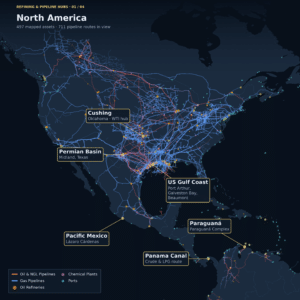
Above: North America map of refineries, chemical plants and pipeline networks tracked by Permutable’s Global Commodity Sentiment Indices
Commodity reporting does not always describe an asset consistently. For instance, a refinery might be referred to by its formal name in one article, by its operator in another and simply by its location elsewhere. A single outage can therefore appear to be several separate events unless those references are resolved to the same facility.
The physical asset layer we are building at Permutable is intended to address this. It connects reporting to named refineries, chemical plants, pipelines, ports, LNG and coal terminals, power and gas infrastructure, and extraction and storage sites.
An article can then be linked to the facility it concerns rather than being classified only under a broad topic such as crude supply, refining disruption or gas infrastructure.
The asset information is publicly sourced. Therein, the work lies in resolving different references to the same facility and connecting that facility to the commodities, companies, events and markets around it.
Consider two refinery outages. Both may be classified as negative for crude supply, but that classification leaves several questions unanswered.
How much capacity is affected? Is the outage planned or unexpected? Does the refinery serve a major trading hub? Are alternative routes or facilities available? Has the event affected production, processing, storage or transport?
Facility-level information does not answer every one of these questions on its own, but it does provide the structure needed to investigate them properly.
It also makes it easier to follow an event as it develops. The first report may describe an operational problem. Later coverage might confirm the scale of the outage, identify the units affected or provide an expected restart date. Resolving those reports to the same asset produces a more coherent picture than treating each headline as an isolated signal.
For market analysts, the useful question is not simply whether supply sentiment is positive or negative, but more so whether the change can be traced to infrastructure with enough physical significance to affect the market.

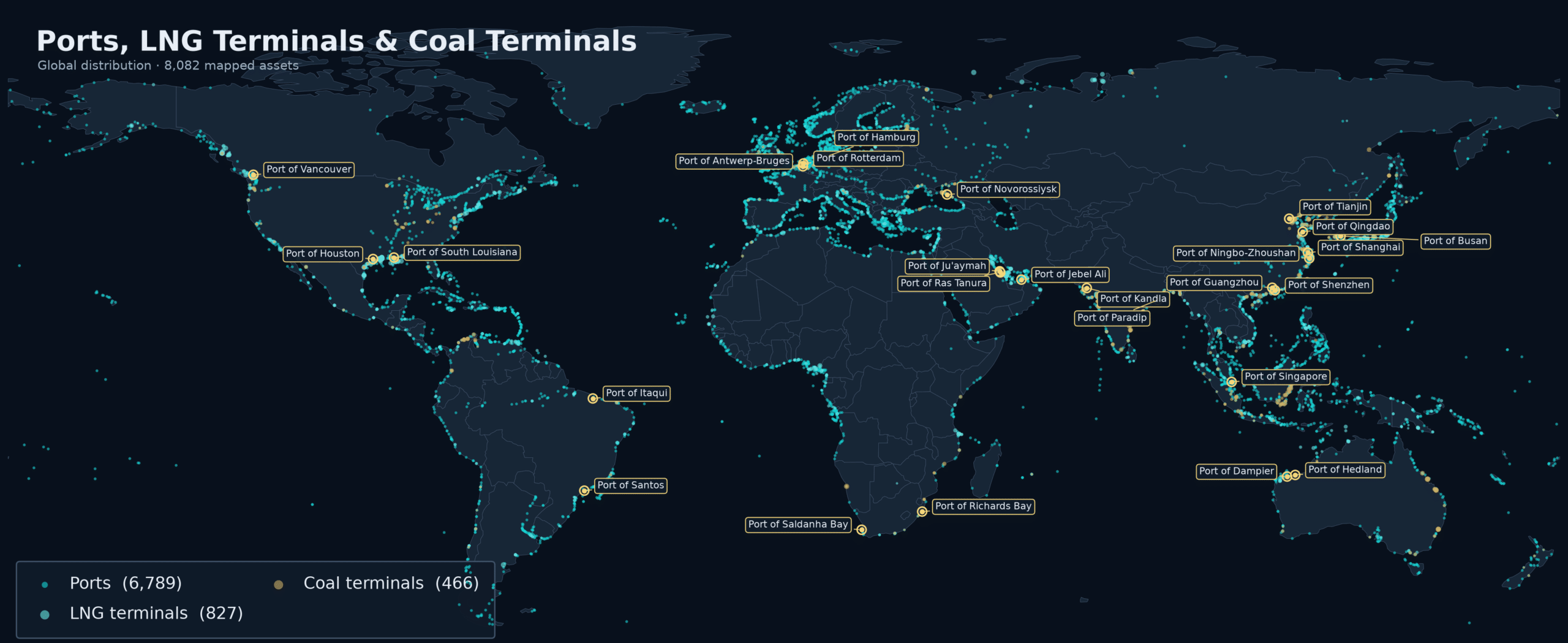
Above: Global coverage of shipping ports, LNG terminals and coal terminals, powered by Permutable’s Global Commodity Sentiment Indices

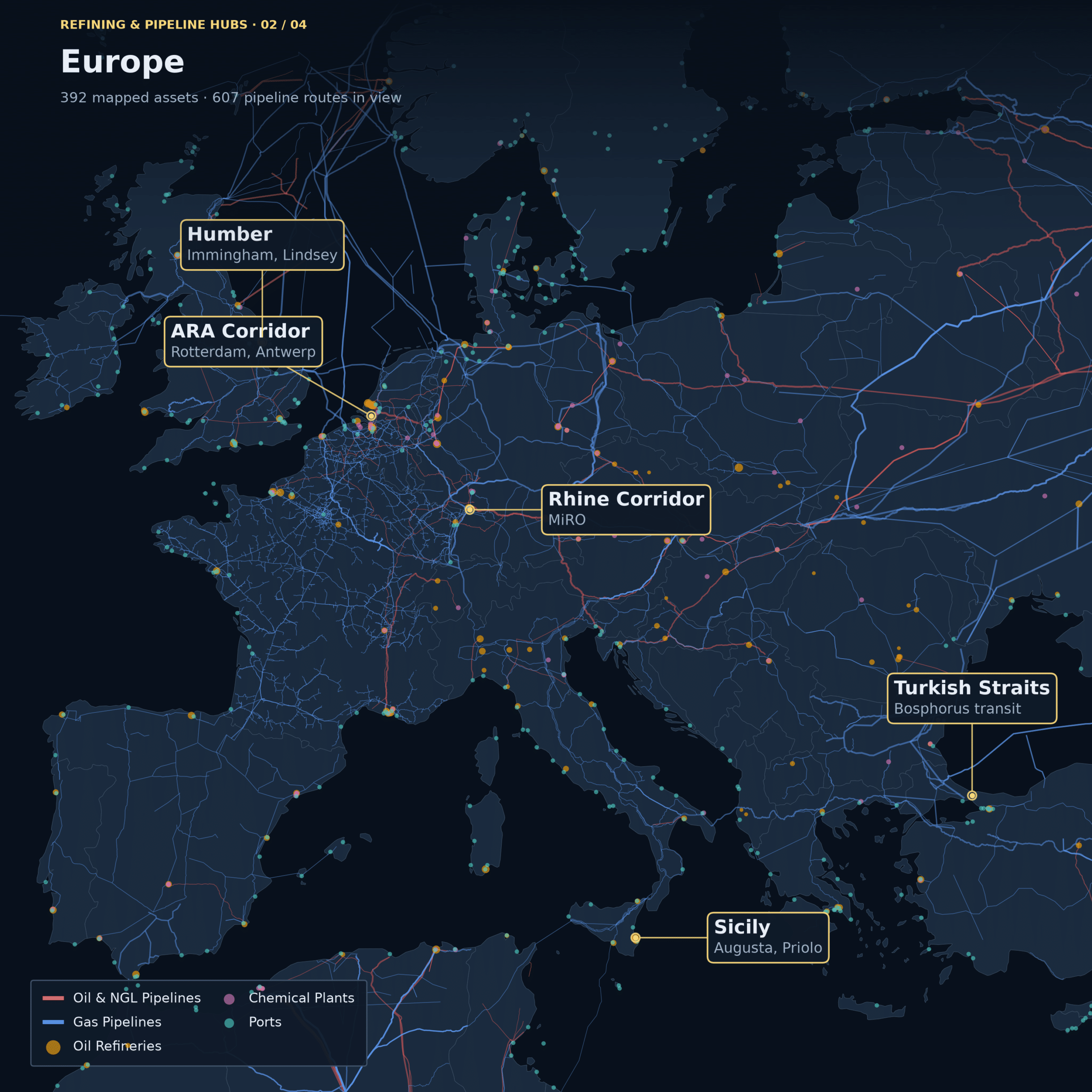
Above: European power and gas infrastructure mapped at regional detail, powered by Permutable’s Global Commodity Sentiment Indices
Physical asset intelligence is not a substitute for shipping data, satellite imagery, inventory figures, benchmark prices or fundamental market research.
It provides a different view: how events involving specific assets are being reported, how the narrative around them is changing and whether attention is spreading across sources and markets.
This can be useful when the physical consequences of an event are not yet fully known. News often develops before its complete effect appears in flow, production or inventory data. Linking that reporting to the relevant infrastructure gives researchers a more precise starting point for assessing what may follow.
It also improves the interpretation of sentiment data. A rise in negative supply sentiment becomes more informative when it can be attributed to a specific pipeline, refinery or export terminal rather than an undifferentiated group of headlines.
Permutable’s Global Commodity Sentiment Indices use a graph-backed architecture connecting sources, entities, events, commodities and markets. Physical assets fit naturally into that structure because they often sit between the reported event and the benchmark that may ultimately be affected.
The new layer is being built to connect reporting with the infrastructure involved, establish what that infrastructure produces, processes, stores or transports, and map it to the relevant part of the commodity market.
It will form part of the forthcoming Global Commodity Sentiment Indices release, alongside broader coverage of physical trade routes and supply chains and updates to our entity-resolution, relevance, topic and sentiment models.
We will be sharing more from the work ahead of the release.
At Permutable, we provide source-traceable commodity sentiment and narrative intelligence across energy, metals and agriculture, with point-in-time data designed for institutional research and systematic analysis.
Explore Permutable’s commodity intelligence or contact our team to discuss access to the Global Commodity Sentiment Indices forthcoming release.
What commodity intelligence does Permutable provide?
Permutable provides source-traceable narrative and sentiment intelligence across commodity markets, connecting reporting with entities, events and physical infrastructure.
What is being added to Global Commodity Sentiment Indices in the upcoming release?
The upcoming release will introduce wider coverage of physical assets, trade routes and supply chains, alongside updates to Permutable’s entity-resolution, relevance, topic and sentiment models.
Who is it designed for?
The platform is designed for institutional commodity teams, energy traders, macro desks, quantitative researchers and data teams examining how global events feed into physical commodity markets.
Permutable has begun building a multi-agent economic simulator to test how shocks propagate through markets and the wider economy. Using reconstructed point-in-time information, autonomous agents will respond to changing conditions and one another without access to future outcomes. Initial experiments will examine monetary policy, inflation, commodity and geopolitical shocks, with potential applications in institutional scenario analysis and rigorous stress testing.
Permutable has begun building a multi-agent economic simulation environment designed to test whether autonomous AI agents can reproduce how shocks propagate through markets and the wider economy.
Rather than asking a single model to forecast an economic variable or asset price, the project will place multiple agents inside a controlled environment where they can respond independently to changing information, market conditions and one another.
The first experiments will replay historical economic and market episodes using only information that would have been available at the time. This will allow our R&D team to compare simulated decisions and outcomes with what subsequently happened in the real world.
Our initial work will focus on areas including monetary-policy changes, inflation shocks, commodity disruptions and geopolitical events.
The central research question is deliberately demanding: can a system produce a useful economic outcome without having access to the outcome it is supposed to predict?
“If you want to claim that an AI system can simulate an economy, it has to be able to predict something it does not already know,” said Wilson Chan, Founder and CEO of Permutable.
“That means reconstructing the information environment properly, preventing future information from leaking into the simulation and understanding why agents behaved as they did. An accurate answer produced with hindsight is not a simulation.”
Economic forecasting typically attempts to estimate a particular outcome: inflation, growth, interest rates, asset prices or some combination of these. At Permutable, we plan to test a different approach using agentic AI.
Within the proposed environment, individual agents can represent different types of economic or market participants, each operating with a defined information set and responding according to its own objectives.
A change in the oil price, for example, may initially affect inflation expectations. Those expectations can influence central-bank policy, currencies, corporate costs, household spending and investor positioning. Each reaction can in turn affect the behaviour of other participants.
Our aim is to examine whether these second- and third-order effects can emerge from interactions between agents rather than being explicitly supplied to the model in advance, making the work closer to an experimental environment than a conventional prediction engine.
“Most market models start with the variables we think matter and then estimate the relationship between them,” Chan said. “We want to test what happens when different participants are allowed to react to the same information independently. The interesting question is whether a credible path from shock to outcome emerges from those interactions.”
A central problem in testing AI against historical markets is data leakage.
Modern language models may have been exposed during training to information about events they are subsequently asked to predict. Historical datasets can also be unintentionally revised using information that became available only later.
This is why we plan to build the simulation around our existing point-in-time data infrastructure which processes information from more than 250,000 sources a day across more than 70 languages, with macroeconomic coverage spanning more than 95 countries and historical datasets extending back more than a decade.
For each historical simulation, agents will be restricted to information available at that point in time.
The environment is intended to record the information each agent received, the decisions it made and the sequence of interactions that followed.
This provides a basis for assessing not just whether a simulation arrived at a broadly correct outcome, but whether it arrived there through a plausible economic process.
We plan to evaluate the simulation using controlled historical experiments.
For each episode, agents will operate using reconstructed point-in-time information sets. Their behaviour and resulting market or economic outcomes will then be compared with subsequent real-world developments.
The research will assess several questions:
We expect validation to be one of the hardest parts of the programme. Additionally, we do not regard a simulation reaching the correct end result as sufficient evidence that it has modelled the underlying economic process successfully.
“The path matters as much as the destination,” Chan said. “If oil moves, we need to understand which agents changed their behaviour, what information caused them to change it and how those decisions affected other parts of the system. Otherwise you simply have another black-box forecast.”
If the approach proves robust, we believe multi-agent simulation could complement existing tools used by investors and financial institutions for scenario analysis, stress testing and macroeconomic research.
A portfolio manager could, for example, examine how different groups of market participants respond to an unexpected central-bank decision.
A commodity investor could explore how a disruption to energy supply feeds through to inflation expectations, currencies, rates and corporate margins.
A risk team could test how different assumptions about consumer, corporate or policymaker behaviour alter the transmission of the same initial shock.
The system could also allow researchers to compare scenarios rather than rely on a single projected path. Rather than replacing conventional economic models, quantitative research or human judgement, the aim is to investigate whether it can provide an additional way of studying complex systems where interactions between participants are themselves important to the outcome.
The programme will be developed incrementally. The first phase will concentrate on tightly defined historical experiments using Permutable’s existing macroeconomic, commodities, FX, policy and market-intelligence datasets.
Later work will expand the number and variety of agents, introduce more complex interactions between economies and asset classes, and test whether results remain stable across different market regimes.
The long-term objective is not to claim that a synthetic economy can predict the future with certainty but to determine whether AI can provide a controlled environment in which researchers can test how different parts of the economic system might respond when conditions change – and then compare those simulations rigorously with what actually happens.
“The world economy is too complex to reduce to a single model or forecast,” Chan said. “But if we can build an environment where different actors respond independently, where every piece of information is controlled point-in-time and where every decision can be inspected, we may have a new way of studying how markets and economies behave under stress.”
If you are interested in how point-in-time multi-agent simulation could be applied to market scenarios, stress testing or macroeconomic research, we would welcome a conversation. Contact us at enquiries@permutable.ai to learn more or explore potential research collaboration.
A multi-agent economic simulator is a controlled environment in which autonomous agents represent different market or economic participants. Each agent responds independently to new information, changing conditions and the behaviour of other agents. The aim is to observe whether wider economic outcomes emerge from those interactions rather than being supplied to the system in advance.
A conventional forecast generally estimates a defined outcome, such as inflation, growth, interest rates or an asset price. Our approach focuses on the path between an initial shock and its consequences. It tests whether independently acting agents can reproduce the decisions, feedback loops and second-order effects through which that shock moves across markets and the economy.
Point-in-time data helps prevent agents from using information that was not available when a historical event occurred. For each experiment, we will reconstruct the information environment as it existed at the time. This allows us to distinguish genuine simulation from an apparently accurate result produced using hindsight, revised data or knowledge embedded in later information.
Agents may represent participants such as central banks, investors, companies, consumers or commodity-market actors. Each will operate with a defined objective and information set. The precise mix will depend on the experiment, allowing us to examine how different assumptions about behaviour alter the transmission of the same economic or market shock.
Our initial experiments will focus on tightly defined historical episodes involving monetary-policy changes, inflation shocks, commodity disruptions and geopolitical events. These provide observable real-world outcomes against which we can compare the agents’ decisions, the sequence of interactions and the resulting market or economic response.
Reaching the correct end result will not be enough. We will assess whether agents acted on information they could genuinely have known, whether plausible second-order effects emerged, whether results remain robust when assumptions change and whether the decision chain is economically interpretable. The path to the outcome matters as much as the outcome itself.
That is one of the central risks the research is designed to address. Language models may have encountered historical events during training, while economic datasets may contain subsequent revisions. We will use point-in-time controls, restricted information sets, alternative assumptions and comparative tests to examine whether results reflect credible agent behaviour rather than information leakage or memorised outcomes.
If the approach proves robust, it could complement existing scenario analysis, stress testing and macroeconomic research. Investors could examine how different participants might respond to a policy surprise, commodity disruption or geopolitical shock. Risk teams could compare several possible transmission paths instead of relying on one projected outcome or a fixed set of behavioural assumptions.
No. We see it as an additional research environment rather than a replacement for economic models, quantitative analysis or human judgement. Its potential value lies in studying systems where interactions between participants materially affect the outcome and in making the assumptions and decision chains behind a simulated scenario easier to inspect.
The programme will be developed in phases. We will begin with controlled historical experiments using our existing macroeconomic, commodity, FX, policy and market-intelligence datasets. Later phases will introduce a wider variety of agents, more complex interactions between markets and economies, and testing across different economic and market regimes.
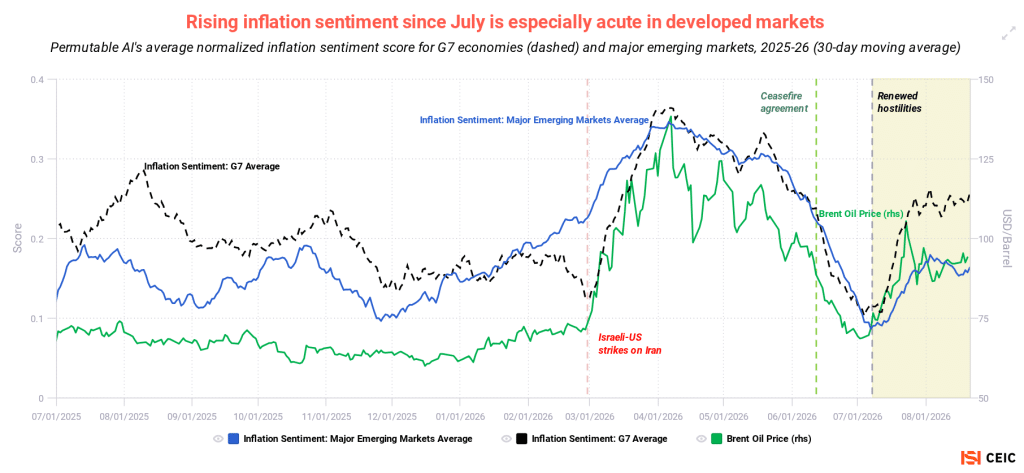
New CEIC analysis uses Permutable’s inflation sentiment data across 95 countries to examine why inflation concerns are rising more sharply across developed markets than emerging economies. The findings show how high-frequency inflation data can provide an earlier view of changing price pressures alongside official CPI and conventional macroeconomic indicators.
New analysis from CEIC has used Permutable’s inflation sentiment data to identify a growing divergence in inflation concerns between developed and emerging markets.
The research examines how inflation expectations and underlying price-pressure narratives have shifted as renewed hostilities in the Middle East have increased uncertainty around global energy markets.
Using Permutable’s high-frequency Sentiment Score derived from our Global Macro Sentiment Indices across 95 countries, the analysis shows that inflation concerns have risen particularly sharply across developed economies.
Inflation sentiment increased significantly during July, with concerns across much of the G7 returning towards levels last seen in April and May. Japan and Canada were notable exceptions. Emerging markets, by contrast, have shown greater resilience.
CEIC points to several factors behind the divergence. In some economies, fuel-subsidy programmes have limited the extent to which higher energy costs have been passed directly to consumers. More broadly, stronger macroeconomic fundamentals, lower relative post-pandemic debt pressures and the compression of inflation and interest-rate differentials between emerging and developed markets have left some EM economies better positioned to absorb external price shocks than during previous cycles.

Permutable’s inflation sentiment data is designed to capture changes in the underlying information environment around prices in real time, rather than waiting for backward-looking official releases.
The dataset forms part of Permutable’s Global Macro Sentiment Indices, which track changes in macroeconomic narratives across 95 countries using multilingual, point-in-time data.
For investors, the value is seeing when the transmission of a global shock is uneven. A rise in oil prices, for example, does not necessarily imply the same inflation trajectory across economies. Fiscal policy, subsidies, currency moves, domestic demand and the credibility of monetary policy can all affect how quickly – and how strongly – external price pressures feed into the domestic economy.
High-frequency sentiment measures can therefore provide an additional layer alongside CPI, market-implied inflation expectations and conventional economic indicators when assessing where inflation risks are beginning to build.
The latest CEIC research follows earlier analysis incorporating Permutable data into its assessment of global macroeconomic conditions – see Alternative Inflation Metrics Raise Concerns Even As Central Banks Stand Pat.
For Permutable, the continued use of the dataset by external research providers demonstrates how high-frequency, point-in-time alternative data can complement established economic datasets when analysing changes in inflation, growth and monetary-policy expectations.
The full CEIC analysis is available through ISI Markets.
Permutable has strengthened its London team with the appointments of James Hamer and Radmehr (Rad) Shiadeh, adding further experience across commodities, applied machine learning, data engineering and production software as we continue to scale our award-winning market intelligence capabilities.
The two appointments come as we continue to build out the team behind Permutable’s real-time macro, commodities and geopolitical intelligence. As our platform grows, so does the need for engineers who can work with complex data at scale while maintaining the reliability, traceability and point-in-time integrity required for institutional use.
James joins Permutable from LSEG (London Stock Exchange Group), bringing experience from within the institutional commodities and financial-data ecosystem.
His background also combines geoscience with applied machine learning techniques to complex seismic datasets.
That combination is particularly relevant to the problems we are working on at Permutable: finding meaningful patterns within large, noisy datasets while retaining the context needed to understand what those signals actually mean.
James will work alongside the team as we continue to deepen our commodities and macro intelligence capabilities.
Rad joins Permutable as a Software Engineer from Curve Analytics, where he spent 18 months building production data and software systems across LLM orchestration, distributed pipelines and cloud infrastructure.
His work at Curve included building an asynchronous distributed LLM and NLP orchestration service for multi-step entity resolution, classification and RAG-based verification, with a focus on reducing hallucinations and improving reliability at scale as well as
building and maintaining backend services and APIs across AWS.
That combination maps closely to the engineering challenges at the core of Permutable: ingesting large volumes of information in real time, enriching it with LLM-based systems, preserving data quality and lineage, and making sure the output remains correct and observable as the platform scales.
At Permutable, Rad will work across the data and backend infrastructure supporting our intelligence platform, including real-time ingestion, distributed processing and LLM-powered enrichment.
Commenting on the appointments, Wilson Chan, Founder and CEO of Permutable, said:
“As we scale Permutable, the engineering challenge is not simply about processing more data or adding more models. The systems have to remain reliable, observable and correct as complexity increases. James and Rad bring very complementary experience to that problem. James combines market and commodities exposure with applied machine learning, while Rad has already worked directly on distributed data pipelines, LLM orchestration and production infrastructure. Both strengthen the foundations of what we are building.”
The appointments form part of Permutable’s continued investment in its London team across engineering, AI, data and market intelligence.
Our focus remains on building systems that understand information as it becomes available, preserve what was actually knowable at each point in time, and turn that into intelligence that institutional teams can research, test and use.
We’re actively growing the team across engineering, AI and market intelligence, so if you’re interested in what we’re building, take a look at the current opportunities on our careers page.
Permutable will attend the Eagle Alpha Alternative Data Conference in New York on 10 September 2026. The article examines how institutional investors are moving from alternative data discovery towards explainable, point-in-time, production-ready intelligence, and outlines how Permutable supports macro, commodity, currencies and geopolitical research. It is aimed at hedge funds, asset managers, banks, quantitative researchers and institutional data teams globally.
We are pleased to announce that Permutable will attend the Eagle Alpha Alternative Data Conference in New York on 10 September 2026, joining institutional investors, hedge funds, asset managers, quantitative researchers and data teams assessing how alternative data is being used in investment research and production workflows.
Hosted by A-Team Group, the conference brings together data buyers and providers around the practical use of alternative data. The 2026 agenda includes macro quant strategies, forecasting intelligence, emerging risk signals, AI infrastructure, agentic financial workflows and the continued evolution of alternative datasets.
For Permutable, those themes sit directly within the problem at the centre of our work: how to turn fast-moving global information into structured, testable and explainable market intelligence.
The institutional alternative data market has matured. Today, the question is no longer simply whether a new dataset is interesting but whether it is timely, point-in-time correct, historically consistent, explainable and practical to integrate.
A novel signal has limited value if a research team cannot determine what drove it, recreate the historical state visible at the time, or carry the same data structure from backtest into production. Institutional users need ways to organise fragmented information into signals that can be compared across markets, regimes and time.
This is particularly relevant in macro, commodities and geopolitical risk, where market-relevant information rarely arrives through a single channel. Inflation expectations may shift through local reporting, company commentary and policy language before confirmation in official data. Commodity risk can build through logistics, sanctions, weather, production commentary or geopolitical developments before those forces are fully reflected in price.
Alternative data becomes useful when those fragments can be structured consistently enough to test.
At Permutable, we convert global information flows into structured, source-linked intelligence across macroeconomics, commodities, currencies and geopolitical risk. The aim is not to replace traditional market or economic data, but to provide an additional information layer that helps investors measure how narratives, expectations and risk conditions are changing.
Our Global Macro Sentiment Indices produce hourly, point-in-time signals across more than 95 economies and 70 macro topics, with more than 11 years of historical data. The framework separates domestic and international information flows and provides directional and semantic signal layers, allowing researchers to examine not simply whether sentiment moved, but where the change came from and which economic themes contributed to it.
The same principle extends into commodities, FX and geopolitical intelligence. Rather than treating global news as an undifferentiated stream, our Intelligence Engine structures information around markets, entities, topics and drivers, with traceability to underlying sources.
For systematic teams, this can provide a feature layer, regime indicator, confirmation signal or risk overlay. For discretionary teams, it offers a way to monitor changes in market narratives at a scale difficult to replicate manually.
The difference between an interesting dataset and an investable one often comes down to infrastructure and methodology. Institutional users should be able to answer a small number of basic questions:
These questions become more important as investment firms incorporate machine learning, large language models and agentic systems into their workflows. Automation can increase processing speed, but it does not remove the need for lineage, reproducibility or controls around the underlying data.
For that reason, we see explainability and point-in-time integrity as core infrastructure requirements rather than optional product features.
At Permutable, we see the next phase of alternative data as increasingly connected to intelligence infrastructure rather than standalone datasets.
Investment teams already operate with large volumes of conventional data. However, the challenge is often understanding what is changing between formal data releases, which narratives are gaining importance, how local and international interpretations differ and whether developments in one market are beginning to transmit into another.
Structured narrative and sentiment data can provide that additional layer. Used correctly, it can help researchers identify questions worth investigating, test whether an emerging narrative has historically contained information, compare conditions across markets and monitor whether an established investment thesis is beginning to change.
The value lies in providing structure around information that would otherwise remain fragmented.
Eagle Alpha’s upcoming Alternative Data Conference takes place in New York on 10 September 2026 and is designed around both data discovery and the practical deployment of alternative datasets within investment organisations.
Permutable will be attending to meet hedge funds, asset managers, banks, quantitative researchers and institutional data teams exploring new sources of macro, commodity, currencies and geopolitical intelligence.
For firms evaluating alternative data, we will be available to discuss dataset coverage, point-in-time history, API integration, source traceability, backtesting and specific research or production use cases.
If you are attending Eagle Alpha New York and would like to discuss how Permutable’s data could fit into your investment, research or risk workflow, contact our team to arrange a meeting during the conference.
Permutable has been selected to join the latest TotalEnergies On Accelerator cohort, recognising its AI market intelligence platform for energy, commodity and macroeconomic markets. The programme brings together innovative startups and one of the world’s leading energy companies to explore technologies that can support the future energy landscape.
We are delighted to announce that Permutable has been selected to join the latest cohort of the TotalEnergies On Accelerator, a global innovation programme supporting high-potential startups developing technologies that can help shape the future of energy.
Permutable’s selection recognises our work in applying artificial intelligence and machine learning to transform global news and information flows into transparent, actionable and explainable AI market intelligence.
Energy, commodity and macroeconomic markets are now influenced by a wider range of variables than ever before. Geopolitical developments, supply disruptions, policy shifts, macroeconomic pressure, trade flows, sanctions, weather events and changing demand expectations can all influence price formation and market behaviour. At the same time, the volume of information available to market participants has increased dramatically, making it harder to identify what is material, what is noise and what is changing in real time.
Our Intelligence Engine has been designed to address this challenge by converting unstructured global news flow into structured intelligence that can be analysed, tested and integrated into institutional workflows. By combining large-scale multilingual data processing with proprietary AI models, sentiment analytics and point-in-time methodology, we help our clients monitor market narratives as they evolve.
Energy and commodity markets are increasingly shaped by fast-moving news, geopolitical developments, supply disruptions, trade dynamics and macroeconomic uncertainty. This is where AI market intelligence can provide an additional layer of context, helping institutional teams identify which signals matter and how market narratives are shifting.
Traditional market data remains essential, but it often reflects what has already happened. News, policy commentary, regional reporting and cross-market narratives can provide earlier indications of emerging risks and changing sentiment. However, this information is often fragmented across sources, languages and geographies.
At Permutable, we address this challenge by converting unstructured news flow into structured, point-in-time intelligence. This enables organisations to better understand emerging risks, market narratives and changing sentiment across energy, commodity and macroeconomic markets.
The result is an additional layer of contextual intelligence that can support research, monitoring, risk identification and investment analysis. Rather than replacing existing market data, our technology is designed to complement it by helping users understand the drivers behind market movement.
Permutable’s Intelligence Engine is the foundation of our AI market intelligence capability, continuously analyses thousands of news articles across multiple languages, regions and source types. It classifies information into commodity, macroeconomic and geopolitical themes before transforming those signals into structured, explainable outputs.
These outputs can be delivered through APIs, dashboards and data feeds, allowing institutional teams to integrate Permutable’s intelligence into their existing research, trading, risk and data workflows.
A key part of our approach is transparency. Our platform is built to help users understand not only that a signal has changed, but also what is contributing to that change. This is particularly important in energy and commodity markets, where the same price movement may be driven by different combinations of geopolitical risk, supply pressure, demand expectations, policy developments or macroeconomic sentiment.
Our AI market intelligence supports market monitoring, investment analysis, research workflows and systematic decision-making across energy and commodity markets while our point-in-time structure also enables users to analyse how narratives evolved historically, supporting backtesting, research validation and signal development.
Wilson Chan, Founder and CEO of Permutable, said: “We’re delighted to be joining the TotalEnergies On Accelerator at a time when energy markets are becoming more interconnected, more volatile and increasingly influenced by global information flows.
“We believe AI has an important role to play in helping organisations understand not just what is happening, but why markets are moving. Our focus has always been on building transparent intelligence that converts unstructured global news into decision-ready insights.
“Working alongside TotalEnergies gives us the opportunity to demonstrate how explainable AI can support earlier risk identification, deeper market understanding and more confident decision-making across the energy sector.”
Participation in the TotalEnergies On Accelerator aligns closely with Permutable’s long-term vision of building institutional-grade intelligence infrastructure for energy, commodity and macroeconomic markets.
The programme provides an opportunity to explore how Permutable’s technology can support real-world energy market use cases, from monitoring emerging risks and regional supply dynamics to identifying shifts in policy sentiment, commodity narratives and macroeconomic pressure.
For Permutable, this recognition comes at a time of continued product development and market momentum as we work to make complex global information more usable for institutional teams that need to make decisions in uncertain and fast-moving environments.
The future of energy markets will require better tools for understanding complexity. As energy systems evolve and markets become more interconnected, decision-makers will need to interpret a broader set of signals across policy, supply chains, geopolitics, macroeconomic conditions and regional market developments.
Permutable’s technology is designed to support this shift by providing a structured intelligence layer that helps analysts, traders, researchers and strategic teams identify changes in market conditions before they become fully reflected in conventional datasets.
This is especially relevant in energy and commodity markets, where early understanding of narrative shifts can support better risk monitoring, more informed research and more confident decision-making.
Building on our recent recognition as Hedgeweek’s Technology Provider of the Year: Innovation, participation in the TotalEnergies On Accelerator represents another important milestone in Permutable’s growth and its commitment to developing practical AI solutions for one of the world’s most strategically important industries.
As part of the cohort, Permutable looks forward to engaging with TotalEnergies and the wider accelerator ecosystem to explore how our AI-native market intelligence can support the future of energy decision-making.
This announcement introduces the Permutable Global Macro Sentiment Indices, a new suite of point-in-time macro sentiment indicators for institutional investors, macro strategists, FX and rates desks, sovereign-risk analysts and systematic researchers. The indices help teams track inflation, policy, FX, fiscal and political-risk narratives across countries before official data, consensus forecasts or market pricing fully reflect the shift.
We are pleased to announce the official launch of the Permutable Global Macro Sentiment Indices (GMSI), a new suite of macro sentiment indicators designed to help quantitative investors, systematic researchers, macro strategists and risk teams measure how economic narratives form before they are fully reflected in official data or market pricing.
The launch comes at a time when institutional investors are seeking earlier visibility into the information layer shaping inflation expectations, monetary policy risk, FX pressure, fiscal credibility, labour-market stress and geopolitical uncertainty.
Traditional macroeconomic releases remain essential, but they often arrive after market expectations have already begun to adjust. The Permutable Global Macro Sentiment Indices are designed to help investors identify where macro pressure is building before those shifts appear in official releases, consensus forecasts or asset pricing.
GMSI converts real-time global news coverage into structured, country-level macro sentiment signals across key economic themes, including inflation, growth, monetary policy, fiscal policy, trade, labour markets, financial markets, exogenous shocks, FX vulnerability and geopolitical risk.
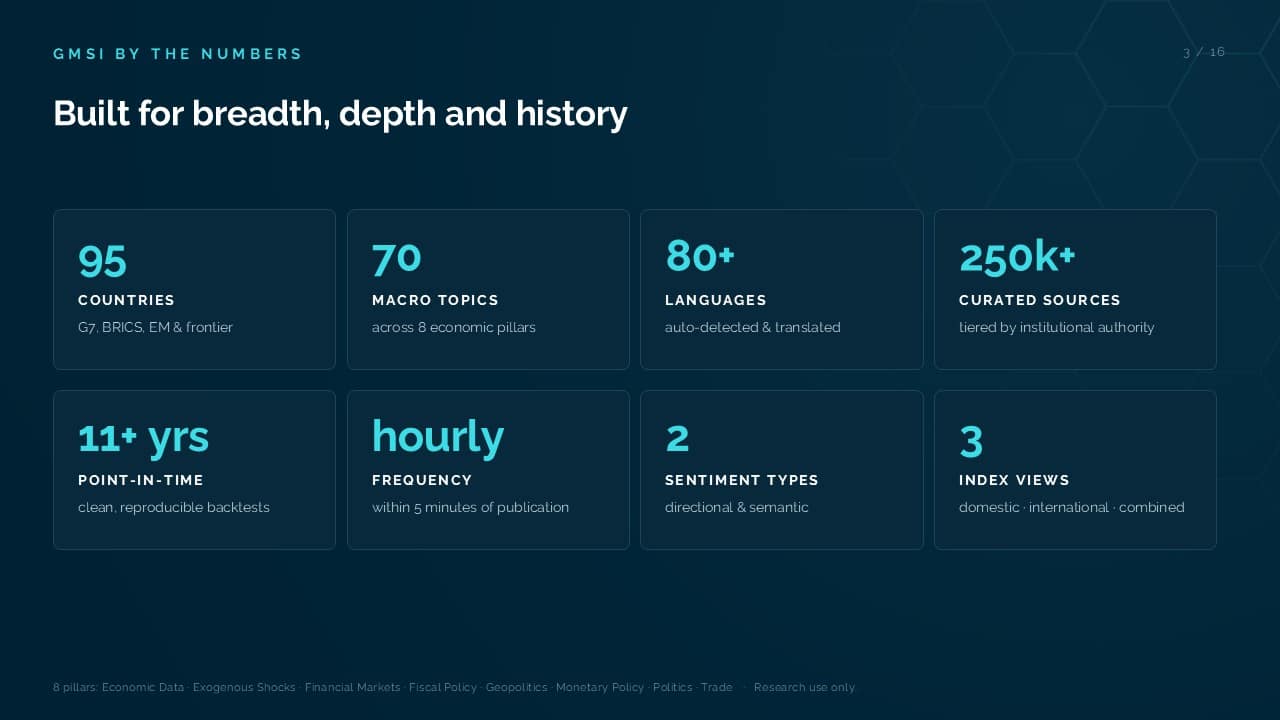
The dataset spans 90+ countries, 70+ macro indicators, 250,000 curated sources and 80+ languages, providing institutional investors with a broader view of the narratives shaping economic expectations across developed, emerging and frontier markets.
“Macro investors have always faced a timing problem,” said Wilson Chan, Founder and CEO of Permutable. “The economy often starts changing before official data confirms it. Inflation pressure, policy credibility, FX stress and political risk first appear in the language of markets, policymakers and local reporting.”
“We have built the Permutable Global Macro Sentiment Indices to make that layer measurable, providing a framework for mapping how macro pressure forms, travels and diverges across the global information environment. By separating domestic narratives from international perception, and by structuring the data point-in-time, we are giving investors a way to see what locals may be seeing before the world prices it in.”
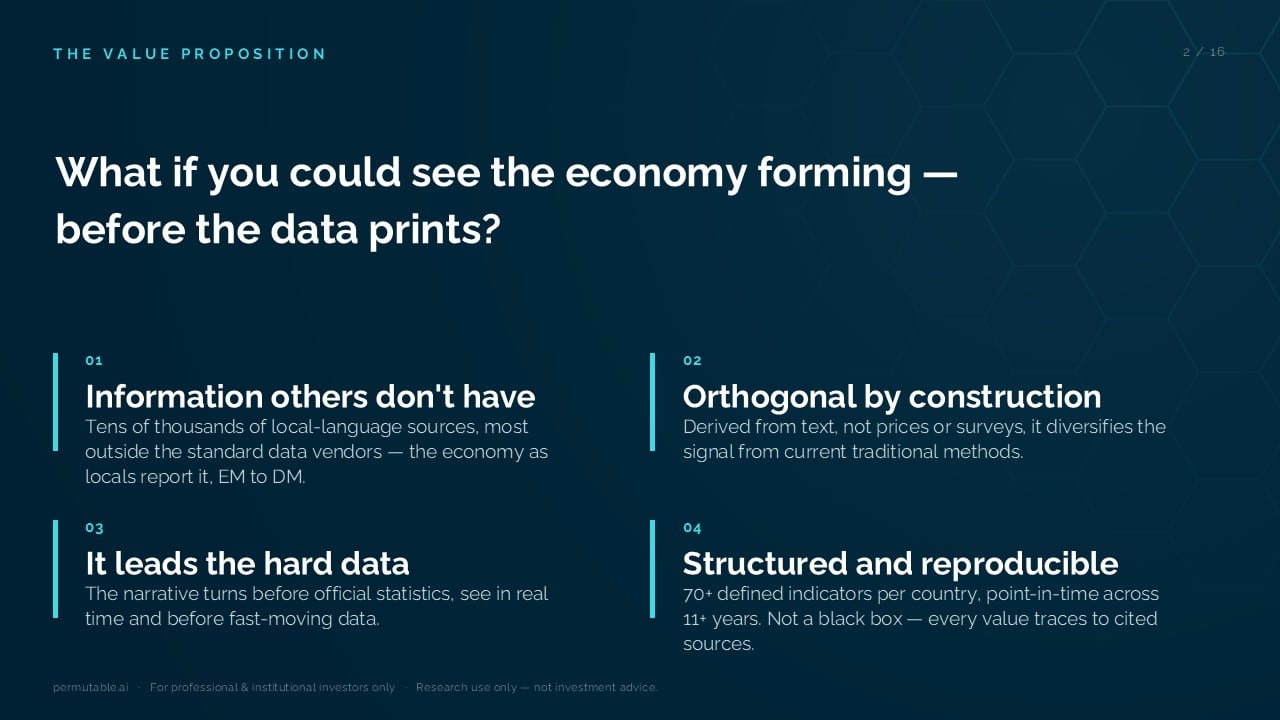
Permutable Global Macro Sentiment Indices have been designed to provide an information layer that is structurally different from traditional macro data.
Rather than relying on market prices, surveys or official releases, GMSI is derived from global narrative flow. This makes it an orthogonal signal source for investment teams seeking to diversify their macro research inputs and identify pressure before it appears in conventional datasets.
The indices are built on more than 11 years of point-in-time history, enabling investors to analyse how macro narratives evolved before previous inflation, policy, FX and sovereign-risk events. Signals are updated hourly, with live data designed to reflect new information as it enters the global information environment.
GMSI represents a significant redevelopment of our award-winning macro sentiment infrastructure.
The framework is powered by a proprietary model trained on Permutable’s source universe and developed specifically for macroeconomic signal extraction. Development used a chronological train-test methodology across approximately 20 million headlines spanning 2015 to 2020, with outputs validated by in-house economists during the training process.
A central challenge in macroeconomic analysis is that financial news rarely carries a single meaning. One article may simultaneously affect inflation expectations, fiscal credibility, monetary policy assumptions, growth sentiment and political-risk perception.
The architecture behind GMSI was designed to classify these overlapping macroeconomic themes with greater precision, enabling country-level signal extraction across domains including inflation, growth, monetary policy, fiscal policy, trade, labour markets, financial markets, FX vulnerability and political risk.
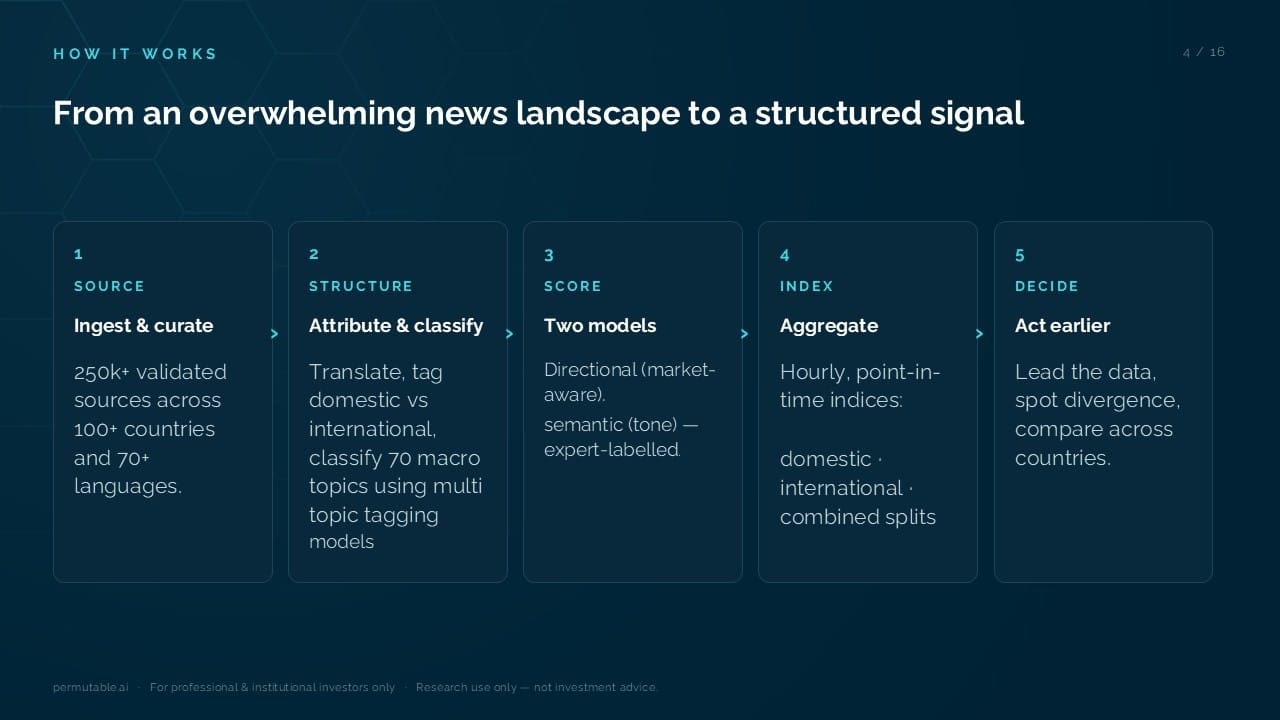
The Permutable Global Macro Sentiment Indices incorporate two complementary sentiment methodologies: directional sentiment and semantic sentiment.
Directional sentiment measures whether news flow is supportive, adverse or mixed for a given macroeconomic theme. It is designed to capture the economic direction of the signal, for example whether inflation pressure is rising, policy tone is tightening or fiscal risk is increasing.
Semantic sentiment captures the tone and market interpretation of the reporting. It assesses whether the language surrounding a macro development is optimistic, cautious, alarming or deteriorating.
This distinction matters because macro news is not always directionally simple. A headline about rising inflation may be directionally positive for inflation pressure while semantically negative in tone. By separating these two readings, GMSI helps investors understand both what is happening and how it is being framed.
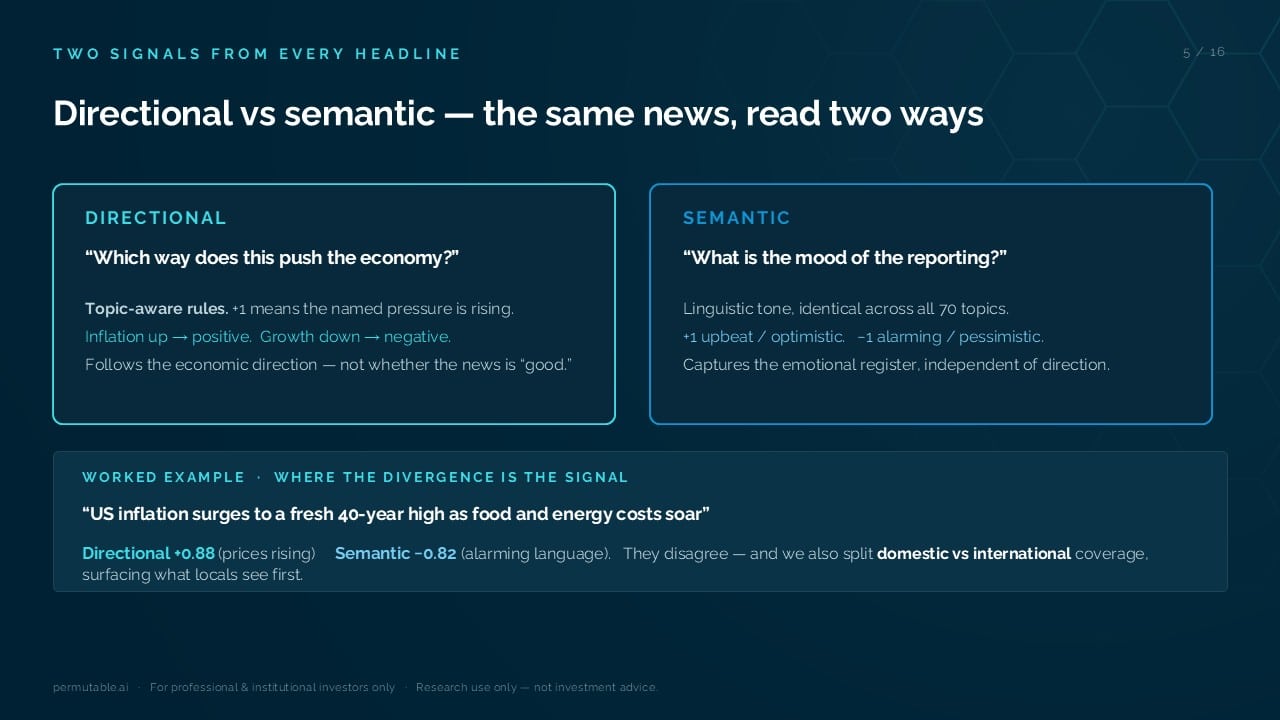
The launch marks a substantial expansion in global source coverage.
While many sentiment and alternative data products remain concentrated in English-language news, GMSI incorporates validated local and international sources across developed, emerging and frontier markets. Coverage includes meaningful depth across ASEAN, Latin America, Eastern Europe and Sub-Saharan Africa, where domestic reporting often carries early information value.
Our final source universe was selected from a wider pool of global publications and reviewed country by country by Permutable’s economists and analysts. This process was designed to remove aggregators, identify relevant macroeconomic publications and strengthen domestic source coverage.
We believe this broader source base gives investors earlier visibility into local economic developments that may not yet be reflected in international reporting, consensus forecasts or market pricing.
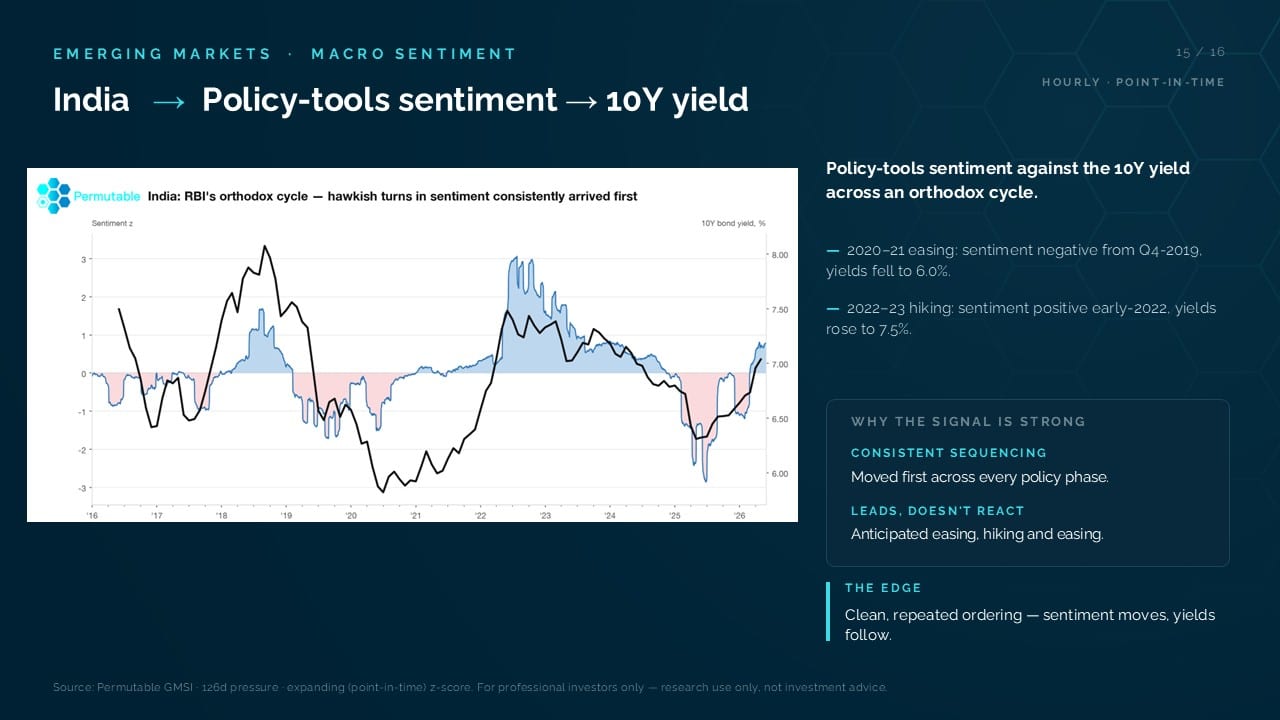
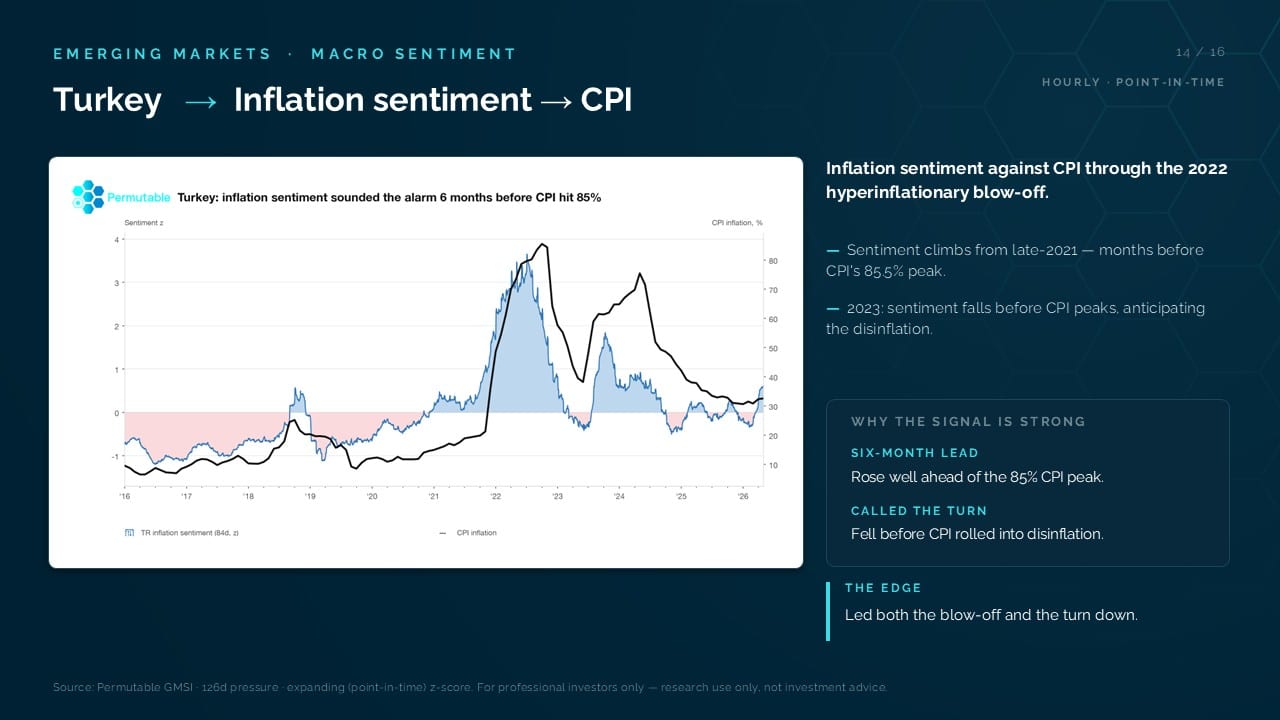
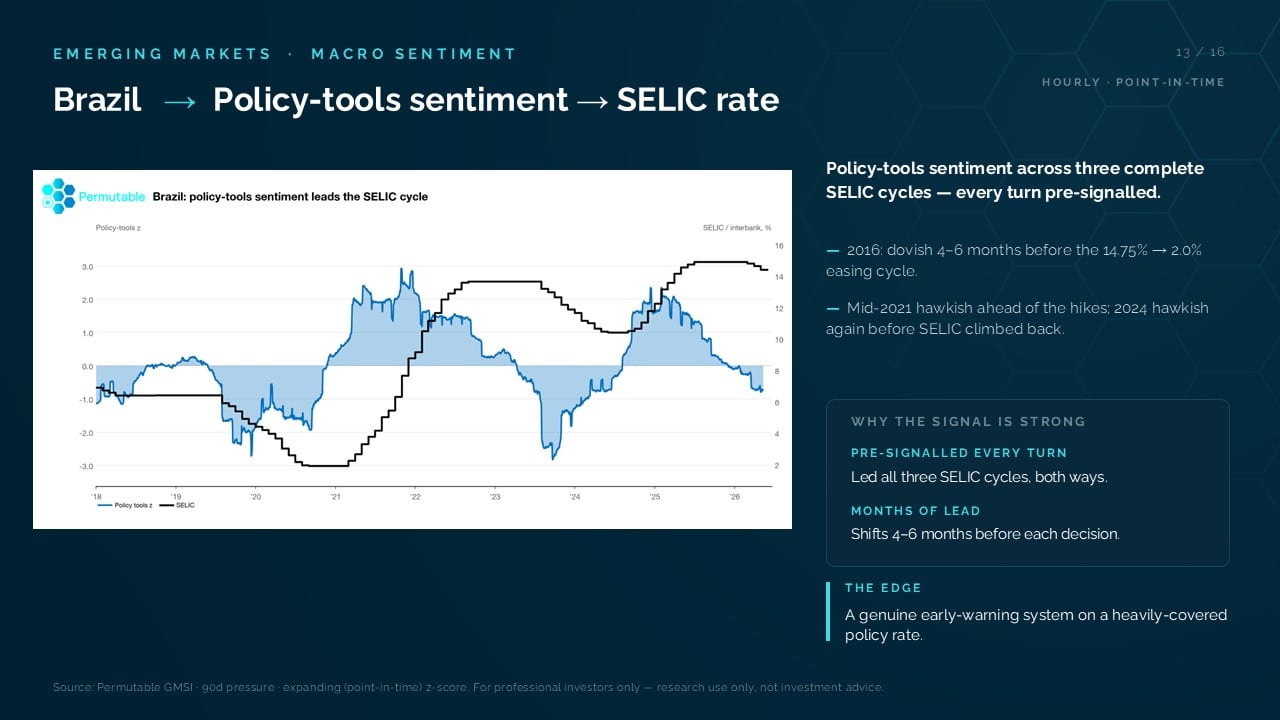
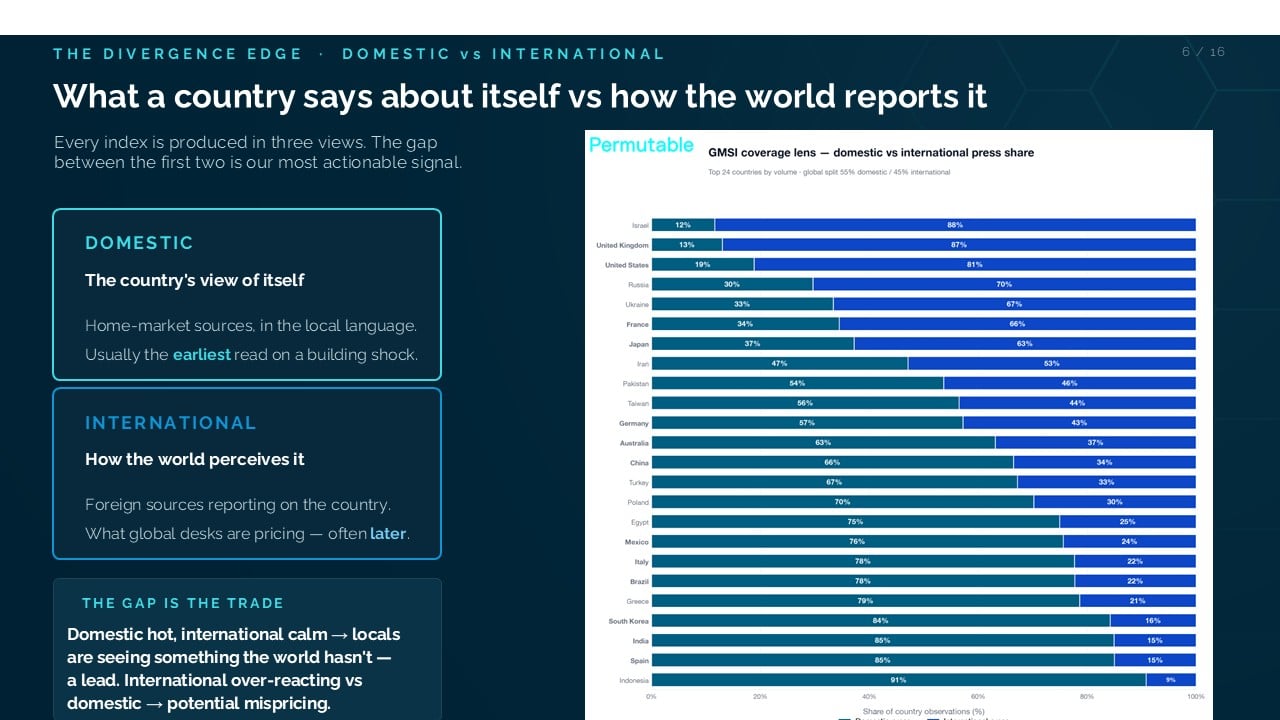
One of the most important features of the Permutable Global Macro Sentiment Indices is the separation of domestic and international sentiment signals.
Rather than aggregating all news coverage into a single country score, GMSI maintains three views: domestic, international and combined.
The domestic view captures how a country is reporting on itself, often in local language and through local sources. The international view captures how the rest of the world is characterising that country’s macro risk.
The divergence between these layers can be particularly valuable. Domestic pressure may build before international coverage reacts, creating an early signal. Conversely, international coverage may overstate or misread local conditions, creating potential divergence between global perception and domestic reality.
This distinction is especially relevant for emerging-market investors, sovereign-risk analysts, FX teams and macro strategists. Local inflation pressure, fiscal strain or policy credibility concerns may appear domestically before they become visible to global desks. International narratives may then amplify those risks once they become relevant for FX, rates, commodities or sovereign spreads.
GMSI has been constructed for point-in-time use, supporting historical analysis, backtesting, model development and signal validation without look-ahead bias.
For discretionary macro teams, the dataset provides a structured view of how narratives evolved before major inflation, policy, FX or sovereign-risk shifts. For systematic researchers and quantitative investors, it provides machine-readable macro sentiment data that can be tested, transformed and integrated into existing research pipelines.
“Quantitative investment teams are increasingly looking beyond traditional datasets to identify differentiated sources of signal generation and risk insight,” said Michael Brisley, Chief Commercial Officer at Permutable.
“The value is not simply measuring sentiment. It is giving macro and systematic teams a testable signal for when inflation, policy, FX or fiscal narratives are becoming persistent enough to influence markets.”
“What makes GMSI different is the combination of thematic depth, geographic breadth, point-in-time construction and the ability to separate domestic and international narratives. Investors want to understand how macroeconomic pressure forms, travels and becomes relevant for markets.”
The Permutable Global Macro Sentiment Indices have been built for institutional teams that need to monitor macro pressure across countries, themes and asset classes, using the same award-winning infrastructure which recently saw Permutable named as Technology Provider of The Year: Innovation by Hedgeweek.
For macro portfolio managers and strategists, the indices can help track intensifying or easing narratives by country and topic. For FX and rates desks, they can help monitor policy and inflation turns, as well as domestic-versus-international divergence. For economists and forecasters, GMSI provides a point-in-time text signal to support nowcasting and forecasting work. For systematic teams, it provides an orthogonal feature set for model development, signal testing and cross-country comparison.
Core applications include:


Permutable Global Macro Sentiment Indices are available immediately to institutional clients through:
We also support access to ready-made hourly indices and underlying headline-level data for teams that require custom aggregation. Additional institutional delivery integrations are expected to follow.
As information plays an increasingly important role in market formation, we believe the ability to systematically measure macroeconomic narratives will become a core component of modern investment research, risk management and systematic macro workflows.
See how macro pressure forms, travels and diverges before it reaches official data or market consensus. Request a walkthrough, test sample signals or speak to our team about API, Excel and custom index delivery. Contact enquiries@permutable.ai or book a demo.
The Permutable Global Macro Sentiment Indices are machine-readable macro sentiment indicators designed to track how inflation, growth, monetary policy, fiscal risk, trade, labour markets, FX vulnerability and geopolitical risk are evolving across global information sources.
GMSI is built for institutional investors, macro strategists, EM desks, FX and rates teams, sovereign-risk analysts, economists, systematic researchers and quantitative investment teams that need structured macro sentiment data for research, trading and risk workflows.
How are the Permutable Global Macro Sentiment Indices different from traditional macro data?
Traditional macro data is usually released after economic activity has already occurred. GMSI tracks the information environment forming around those economic conditions in real time, helping investors identify when the macro narrative is changing before official data confirms the move.
GMSI is designed specifically for macroeconomic signal extraction. It classifies overlapping macro themes, separates directional and semantic sentiment, and distinguishes domestic narratives from international perception rather than reducing news coverage to a single generic sentiment score.
Domestic sources may show inflation stress, policy credibility concerns or fiscal pressure before international coverage reacts. International sources may then amplify those risks once they become relevant for FX, rates or sovereign spreads. Separating these layers helps investors understand how local pressure becomes global market risk.
Yes. GMSI is constructed on a point-in-time basis, which supports historical analysis, backtesting, model development and signal validation without look-ahead bias.
GMSI covers 90+ countries, 70+ macro indicators, 250,000 curated sources and 80+ languages, with coverage across developed, emerging and frontier markets.
Institutional teams can access GMSI through API delivery, Excel integration, enterprise data feeds, real-time monitoring capabilities and historical point-in-time datasets for research and backtesting.
We are delighted to officially reveal a new brand identity and website developed in partnership with digital design agency Soak for the next phase of intelligence-led decision making. Permutable AI is now officially Permutable. The name change marks a new chapter for the company and reflects how our work has evolved. Artificial intelligence remains central to our solutions, but our purpose has always been broader: helping organisations make better decisions from complex global information.
Permutable transforms unstructured data into structured, explainable intelligence. We help institutional investors, enterprises and decision-makers monitor market narratives, understand emerging risks and identify opportunities across macroeconomics, commodities, geopolitics and global information flows. Our new brand identity and website have been created to reflect that wider vision.
When we started as Permutable AI, the name helped describe the technology behind the company. Today, our customers know us for something more specific: the intelligence we provide.
They use Permutable to understand what is happening in markets, why it matters and how signals are changing over time. That includes macroeconomic sentiment, commodities intelligence, event detection, geopolitical monitoring, narrative analysis and API-delivered data products. The move to Permutable gives us a simpler and clearer identity for the business we have become. It also reflects where we are heading: towards a broader intelligence platform for organisations that need timely, source-linked and decision-ready insight.
Markets are increasingly shaped by fast-moving information. A policy comment, supply-chain disruption, geopolitical event or shift in sentiment can quickly become relevant for investors, traders and risk teams. The challenge is not simply accessing more data. It is knowing which signals matter, how they connect and whether they are becoming market-relevant.
At Permutable, we help make those signals more visible. Our technology analyses large volumes of global information and turns them into structured intelligence that can be used across research, trading, risk monitoring and decision workflows.
This includes:
The new Permutable brand has been developed to better communicate what we do and who we serve. We worked closely with digital agency Soak on the development of our new website and brand experience. The result is a clearer expression of our role in the market: helping institutions turn global information flows into actionable intelligence. The change is about making our identity match the work we are already doing and the direction we are moving in.
The Permutable name and new visual identity is already being rolled out across our website, product documentation, client materials and digital channels.
“Permutable has always been about helping people understand complex systems more clearly. AI is a powerful part of that, but the real opportunity is bigger: building intelligence infrastructure that can help organisations see change earlier, understand risk in context and make better decisions in uncertain environments. Becoming Permutable reflects that ambition and the next phase of the company we are building.”
Wilson Chan, Founder and CEO, Permutable
“Our clients are not looking for technology for its own sake. They are looking for clarity: a better way to understand markets, spot risk, identify opportunity and act with confidence. The Permutable brand gives us a stronger platform to tell that story, and to reflect the scale of what we are building as intelligence becomes an increasingly important layer in decision-making.”
Talya Stone, Chief Marketing Officer, Permutable
This rebrand comes at an important moment for Permutable. We are continuing to expand our intelligence offerings across macroeconomic sentiment, commodities intelligence, market sentiment indices and next-generation AI-driven research tools with some big releases on the horizon.
Our forthcoming developments are focused on helping institutional teams identify narrative shifts, policy risks, geopolitical pressure and macro turning points with greater clarity. The aim is simple: to help our customers understand what is happening, why it matters and what may happen next.
Our new website is now live. Explore the new Permutable brand, our updated product pages and our latest thinking on market intelligence, macroeconomic sentiment, commodities sentiment and AI-powered decision support and let us know your feedback.
Permutable has won the Hedgeweek® European Awards 2026 Technology Provider of the Year: Innovation award. The announcement explains how the recognition reflects rising institutional demand for AI-native, narrative-driven market intelligence that interprets geopolitics, macro volatility and information flows in real time. It is aimed at hedge funds, trading teams, institutional investors and risk professionals.
We’re proud to share that Permutable has been named winner of the Hedgeweek® European Awards 2026 in the category of Technology Provider of the Year: Innovation. For us, the recognition reflects a broader shift taking place across institutional markets as investment firms increasingly look for new ways to interpret geopolitical developments, macro volatility and rapidly evolving information flows in real time.
Over the past year, we’ve seen growing demand from hedge funds, trading teams and institutional investors looking to move beyond static data workflows toward more contextual forms of intelligence. Markets are becoming increasingly interconnected, and information now moves across commodities, macroeconomics, geopolitics and financial markets faster than many traditional systems were designed to process.
In many cases, markets are repricing on headlines, policy rhetoric and narrative momentum before analysts even have time to update models. That environment is creating demand for technologies capable of helping firms identify which developments matter – and how those developments may propagate across connected markets.
At Permutable, we describe this as Narrative Propagation Intelligence: the ability to model how narratives spread across geopolitical, financial and macroeconomic systems, and how those information flows influence market behaviour in real time.
We believe innovation in institutional intelligence is no longer simply about faster access to information. Increasingly, it is about contextual awareness – helping firms understand relationships between geopolitics, macro events, asset-level sentiment and market behaviour as they develop.
For our clients, this increasingly means reducing the gap between information emergence and market interpretation. Whether monitoring geopolitical developments, supply chain disruptions, central bank rhetoric or sentiment shifts across commodities and macro markets, institutional teams are looking for ways to contextualise information faster and with greater clarity.
“Our clients are operating in environments where geopolitics, commodities, central bank policy and investor sentiment can all influence each other simultaneously,” said Michael Brisley, Chief Commercial Officer at Permutable. “The ability to connect those developments earlier – and understand the secondary effects across markets – is becoming increasingly valuable for both investment and risk teams.”
For us, the Hedgeweek award also reinforces our belief that institutional intelligence is moving toward AI-native systems capable of continuously interpreting relationships between information, markets and sentiment rather than simply delivering static datasets.
“We’re moving into a world where information itself has become a market force,” said, Wilson Chan, our Founder and CEO. “The firms that succeed over the next decade won’t simply have access to more data – they’ll be the ones capable of understanding how narratives spread across markets, geopolitics and macro systems in real time. We believe contextual AI will become a foundational layer of institutional decision-making.”
The challenge facing institutions today is no longer access to information, but understanding which developments actually matter and identifying the downstream effects those developments may trigger across connected markets.
As institutional markets continue to evolve, we believe technologies capable of contextualising geopolitical and macro information in real time will play an increasingly important role in helping firms navigate uncertainty, volatility and interconnected global risks. Winning the Hedgeweek® Technology Provider of the Year: Innovation Award is an exciting milestone for our team – but more importantly, we see it as validation that the industry is moving toward a new generation of contextual, narrative-driven market intelligence.
Permutable won Technology Provider of the Year: Innovation at the Hedgeweek® European Awards 2026. The award recognises Permutable’s work in AI-native market intelligence and its role in helping institutional investors interpret geopolitical developments, macro volatility, commodities sentiment and real-time information flows.
Permutable was recognised for innovation because our technology is designed to move beyond static data delivery. Our platform interprets how narratives, geopolitical events, macroeconomic developments and sentiment signals propagate across connected markets, helping institutional teams identify emerging risks and opportunities before they become consensus.
Narrative Propagation Intelligence is the modelling of how narratives spread across geopolitical, financial and macroeconomic systems, and how those information flows influence market behaviour in real time. For institutional investors, it helps explain how developments in one area, such as geopolitics or commodities, may create secondary effects across macro markets, risk assets and trading conditions.
Narrative-driven market intelligence helps hedge funds interpret market-moving information faster and with more context. Rather than monitoring headlines in isolation, it helps investment teams understand which narratives are strengthening, how they are spreading, which assets may be affected and whether sentiment shifts are likely to influence positioning, volatility or repricing.
Contextual AI is becoming important because institutional investors increasingly need to interpret complex relationships between events, narratives and markets in real time. Geopolitics, central bank policy, commodities, inflation expectations and investor sentiment can influence each other simultaneously, making static datasets and manual research workflows less effective on their own.
Institutional market intelligence is shifting from backward-looking datasets toward real-time, AI-native systems that interpret information flow as it develops. Instead of simply providing more data, modern intelligence systems help firms understand why markets are moving, how narratives are propagating and where cross-market risks or opportunities may be forming.
Permutable helps trading and risk teams reduce the gap between information emergence and market interpretation. Our technology is designed to identify relevant developments across geopolitics, macroeconomics, commodities and sentiment, then connect those developments to potential downstream effects across markets.
Permutable’s market intelligence is designed for hedge funds, trading teams, institutional investors, macro research desks, commodity market participants and risk professionals. These teams use our real-time intelligence to monitor emerging risks, interpret market narratives and support trading, research, portfolio management and risk oversight.
Narrative intelligence matters because markets increasingly respond to information before traditional data fully reflects changing conditions. Policy rhetoric, geopolitical events, supply chain disruption, commodity sentiment and macro narratives can all influence market expectations, volatility and asset pricing before they appear in official datasets.
The award reflects a wider shift toward contextual, AI-driven market intelligence in institutional finance. As markets become more interconnected and information moves faster, investment firms are likely to place greater value on systems that can interpret narrative flow, sentiment dynamics and cross-market relationships in real time.
This webinar explores how agentic AI is transforming the way investors, research teams and enterprises interpret global events and market-moving information. Wilson Chan, CEO of Permutable, will discuss how multi-agent AI systems can detect emerging narratives, assess market significance and generate actionable intelligence in real time. Designed for data buyers, investment professionals, quantitative researchers and decision-makers.
Artificial intelligence is rapidly changing how organisations process information. Yet despite advances in large language models and generative AI, many institutions continue to face the same underlying challenge: too much information, too little context.
For investors, traders, economists and risk teams, the issue is rarely a lack of data. Global news, research, economic releases and market commentary are generated continuously across thousands of sources and dozens of languages. The challenge is understanding which developments matter, how they connect to one another and what implications they may have for markets.
This challenge is becoming increasingly important as markets respond to information at a speed and scale that traditional research workflows struggle to match.
On 9 June 2026, Wilson Chan, CEO of Permutable AI, will discuss how a new generation of agentic AI systems is helping address this problem during the webinar, Beyond Automation: The Future of Agentic AI Workflows, hosted in partnership by Eagle Alpha and also featuring Sphinx AI.
The session will explore how multi-agent AI architectures are reshaping the way organisations monitor, interpret and act upon information in real time.
The financial industry has spent decades investing in better access to information. Market data became digitised. Research moved online. Alternative datasets emerged. More recently however, large language models have made information easier to search, summarise and retrieve. Yet information access alone does not create understanding.
In modern markets, narratives surrounding inflation, monetary policy, economic growth, trade, geopolitics and fiscal risk often begin forming long before they become visible in official data releases or widely accepted market consensus. By the time these developments are fully reflected in traditional indicators, much of the opportunity to act may already have passed.
This is where agentic AI introduces a fundamentally different approach.
Rather than operating as a passive tool that responds only when prompted, agentic systems can continuously monitor information environments, identify relevant developments, assess significance and generate contextual intelligence autonomously. For institutions operating in increasingly complex and fragmented information environments, this shift represents an important evolution in how intelligence is generated.
At Permutable, our focus has always been on helping organisations understand why markets are moving, not simply what is moving. Our AI-driven infrastructure analyses millions of articles, narratives, macroeconomic developments and market signals to identify emerging themes and assess their potential impact across commodities, currencies and broader macro markets.
As information volumes continue to grow, the next step is not simply processing more data. It is enabling specialised AI agents to work collaboratively to transform information into actionable intelligence.
During the webinar, our Founder & CEO Wilson Chan will explore how multi-agent architectures can be used to:
The objective is to augment decision-making by ensuring analysts and investors can focus their attention on the developments that matter most.
Financial markets have become increasingly information-driven. A geopolitical development in one region can quickly influence commodity prices, inflation expectations, monetary policy assumptions and investor sentiment elsewhere. The challenge lies in identifying these relationships quickly enough to support informed decision-making.
Traditional workflows often rely on analysts manually gathering information from multiple sources before interpreting its significance. Agentic AI however enables a more continuous process of observation, interpretation and contextualisation.
Instead of searching for information after an event occurs, organisations can move towards continuously monitoring evolving narratives and understanding how they may influence markets in real time. This distinction is becoming increasingly important for investment firms seeking differentiated sources of insight and competitive advantage.
The next phase of AI adoption in financial services is unlikely to be defined by better chatbots alone. It will be shaped by systems capable of continuously interpreting information, reasoning across multiple data sources and delivering intelligence that is contextual, explainable and actionable.
As information environments become more complex, organisations will increasingly require technology that can bridge the gap between raw information and decision-making. At Permutable, this underpins our ongoing work across narrative intelligence, macroeconomic signal generation and agentic AI research.
The webinar provides an opportunity to learn how these technologies are evolving and what they mean for the future of investment research, market intelligence and risk management.
Webinar: Beyond Automation: The Future of Agentic AI Workflows
Date: 9 June 2026
Time: 10:00AM Eastern Time 3:00 PM BST
Speaker: Wilson Chan, CEO, Permutable AI
The session is designed for data buyers, investment professionals, research teams and organisations exploring the future of AI-powered intelligence generation.
As markets become increasingly driven by information velocity rather than information scarcity, understanding how agentic AI can transform signal detection, narrative analysis and decision-making has never been more relevant.