Let’s start with a simple truth: predicting market trends and volatility has always been a bit of a dark art. For years, traders and investors have relied on a mix of experience, intuition, and traditional statistical models to navigate the choppy waters of financial markets. And it isn’t just about making profits; it’s about managing risk and maintaining stability in our global economic system. But then machine learning came along and changed everything.
You might say that we’ve been doing alright with the old methods. After all, markets have functioned for centuries without the aid of artificial intelligence since it came on the scene way back in the 1970s (see our lookback at the evolution of AI in financial markets for more on that) . Yet here’s the rub: as markets become increasingly complex and interconnected, traditional methods are struggling to keep pace. Enter machine learning, the x factor that’s changing the game of predicting market trends and volatility.
The problem isn’t that the old models of market analysis don’t work exactly; it’s that they’re not equipped to handle the sheer volume and velocity of data in today’s markets. Machine learning algorithms, on the other hand, thrive on big data. They can process vast amounts of information, identify patterns that humans might miss, and make predictions with a level of accuracy and timeliness that was once thought impossible.
You may say: but does machine learning really make that much of a difference in predicting market trends and volatility? The short answer is yes, and the evidence is compelling. Studies have shown – and we have also seen firsthand with our own work – that machine learning models consistently outperform traditional statistical methods in this arena. This striking difference hints at a fundamental shift in how we understand and interact with financial markets.
For starters, machine learning models can analyse a broader range of data sources when predicting market trends and volatility. They’re not limited to historical price and volume data; they can incorporate news sentiment, social media trends and macroeconomic indicators to gauge economic activity. This holistic approach provides a more finely-tuned understanding of the factors driving market dynamics.
Here’s something else we know to be true. Machine learning models are far better at capturing non-linear relationships in financial data. Traditional models often assume linear relationships between variables, which can lead to oversimplification. Machine learning algorithms, particularly deep learning models, can identify complex, non-linear patterns and in particular, relational patterns, that more accurately reflect the intricacies of real-world markets and the entities that comprise them.
Now let’s raise a bone of contention which is often cited in relation to the adaptability of these models. Financial markets are dynamic, with patterns and relationships that evolve over time. Machine learning models can be designed to continuously learn and adapt, and in our experience, must be constantly fine-tuned to ensure they remain relevant even as market conditions change. This adaptability is crucial in today’s fast-paced, ever-changing financial landscape.
Of course, it’s notable that machine learning isn’t just improving the accuracy of predicting market trends and volatility; it’s also changing how we think about these concepts. By identifying subtle patterns and correlations, these models are helping us develop a more granular understanding of market dynamics. And it is this deeper insight can lead to more effective risk management strategies and more efficient markets overall.
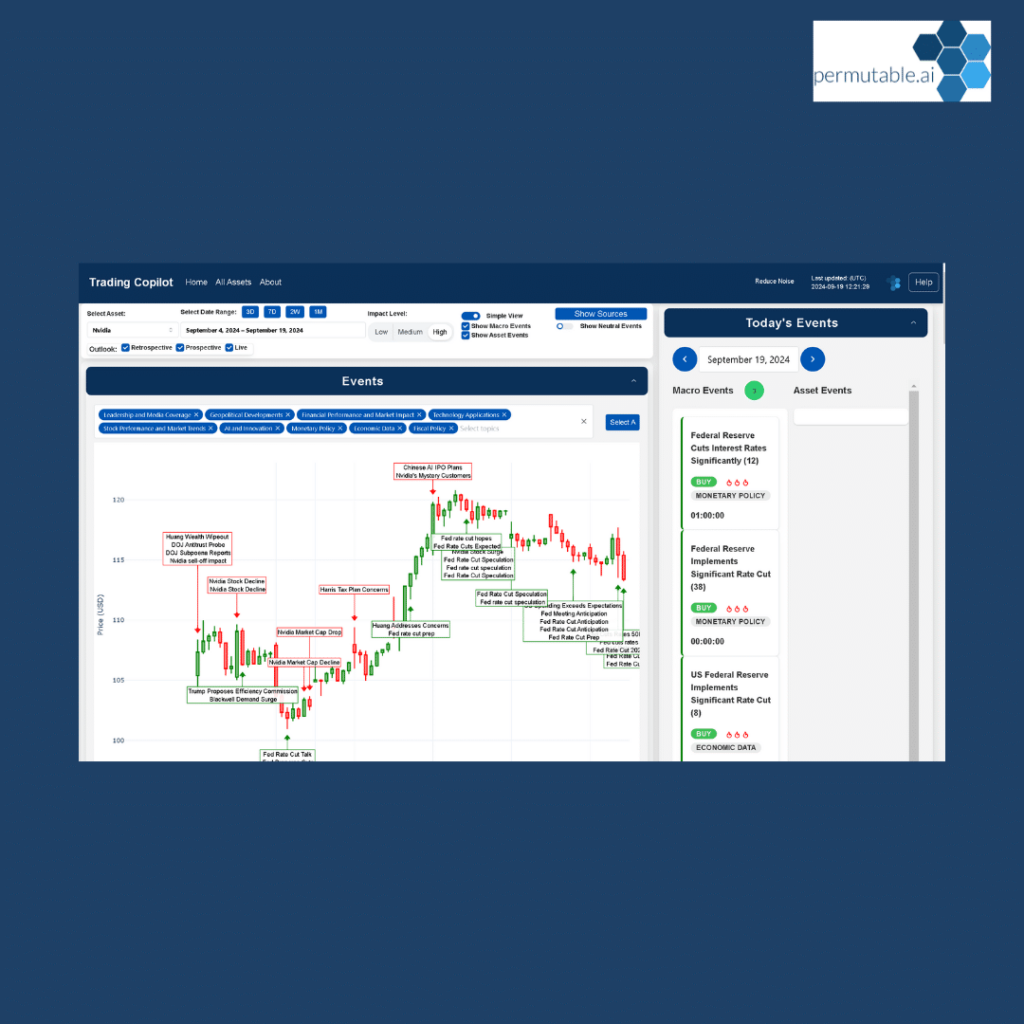
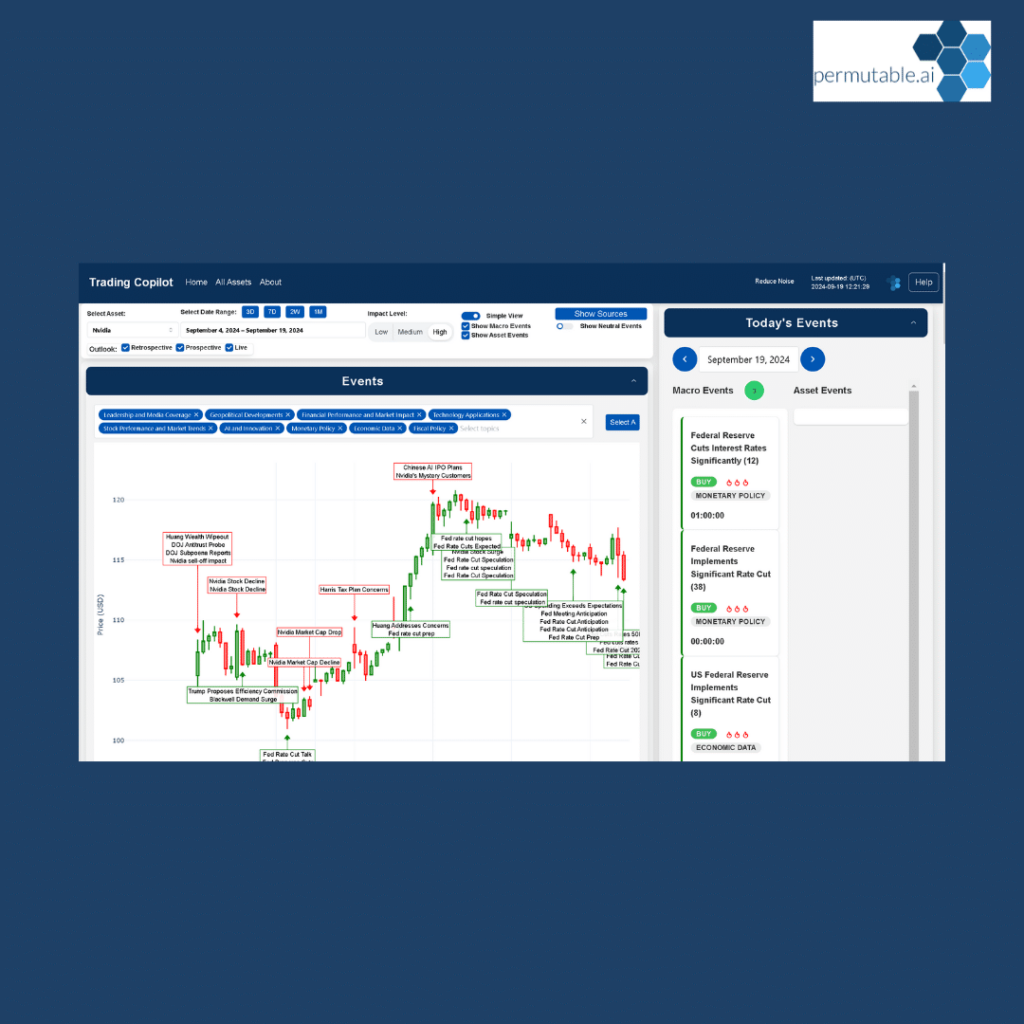
All of this signals that we’re on the cusp of a significant shift in financial market analysis. The integration of machine learning into predicting market trends – as demonstrated in our own Trading Co-Pilot – and volatility is not just an incremental improvement; it’s a significant step change that’s reshaping the field.
Nonetheless, it’s important to approach this technology with a balanced perspective. Machine learning is a powerful tool, but it’s not infallible. It’s important to remember that unless expertly trained and fine-tuned, models can be biased, overfitted, or simply wrong. The key is to use machine learning as a complement to human expertise, not a replacement for it.
We have seen time and time again how the hybrid approach can be undeniably powerful – in fact, we see this on a daily basis with our clients who are using our Trading Co-Pilot as well as throughout using it ourselves internally to execute trades. For instance, while machine learning models excel at identifying patterns in data, they lack the contextual understanding and intuition that experienced traders bring to the table. A model might flag a pattern as indicative of increased volatility, but a human analyst might recognise it as a temporary anomaly based on their broader understanding of market dynamics. It’s really when the two combine that the magic happens.
Again and again, we see the same pattern: the most effective approaches combine the strengths of machine learning with human insight. This hybrid approach allows us to leverage the processing power and pattern recognition capabilities of AI while still benefiting from human judgement and contextual understanding in predicting market trends and volatility.
In short, the role of machine learning in predicting market trends and volatility is nothing short of transformative. It’s providing us with new tools to understand and navigate the complexities of financial markets. As we look to the future, it’s clear that machine learning will play an increasingly important role in predicting market trends and volatility. One thing is cleat, those who can effectively harness this x factor will have a significant advantage.
Are you ready to embrace the future of predicting market trends? Permutable AI’s Trading Co-Pilot, powered by advanced machine learning, provides real-time insights and context-aware strategies. Harness AI to analyse global sentiment and market events, giving your firm the edge with more precise, risk-aware trading decisions. Contact us at enquiries@permutable.ai or via the form below to explore how our Trading Co-Pilot can transform your trading approach.
Get in touch to register your interest to see how our Trading Co-Pilot can help you make smarter trading decisions, faster.
At first glance, learning how to trade with artificial intelligence might seem like something out of a science fiction novel. Dip beneath the surface though, and you’ll find that AI-powered trading is not only real but rapidly becoming the norm in financial markets. At Permutable AI, we’ve been at the forefront of this revolution, and we’re excited to share our insights on how to trade with artificial intelligence effectively.
Let’s start with the issue of why understanding how to trade with artificial intelligence is gaining such momentum. The obvious point here is that financial markets are incredibly complex, with countless variables affecting asset prices at any given moment. It’s inevitable that human traders, no matter how skilled, will miss important signals or struggle to process information quickly enough. This creates a big problem for traditional trading methods.
But also, the sheer volume of data available today is overwhelming. This is where AI shines. By leveraging machine learning algorithms, AI can process vast amounts of data in real-time, identifying patterns and trends that would be impossible for a human to spot. Not only that, but AI can do this round the clock, without fatigue or emotion clouding its judgment.
So, how do you actually trade with artificial intelligence? There are two questions you need to consider:
We’ll unpack this below…..
When exploring how to trade with artificial intelligence, it’s important to start with the different approaches available. Broadly speaking, there are three main categories:
At Permutable AI, we believe that a combination of these approaches often yields the best results when learning how to trade with artificial intelligence. Our philosophy has always been to use the right tool for the job, rather than trying to force a one-size-fits-all solution.
So now the question you are all wanting to ask us…..how hard is it to implement AI trading? Well hey, it’s certainly not a walk in the park, but it’s also not as daunting as you might think. The first major development in how to trade with artificial intelligence is choosing the right platform or tools. There are numerous ready-made solutions available – including our very own Trading Co-Pilot.
But now, let’s remember that AI is not a magic bullet. The problem is, many traders expect AI to instantly boost their profits without any effort on their part. A bigger game changer is achieving a deep understanding of how to trade with artificial intelligence and how it can complement your trading strategy and human expertise. This is exactly how we use our own Trading Co-Pilot in-house and very much where we see the strongest results.
If you plan to incorporate AI into your trading, you may want to start small. There is some low hanging fruit in areas like market sentiment analysis, again – which is all packaged up and available to you through our Trading Co-Pilot, including AI-driven buy/sell directionals. From there, you can gradually expand the role of AI in your trading process.
Meanwhile, it’s crucial to keep an eye on regulatory developments. The world is taking notice of AI trading, and regulations are evolving rapidly. Fortunately, at Permutable AI, we stay on top of these changes and design our systems to be compliant with the latest regulations – so you’re very much in a safe pair of hands with us.
Yet the reality is that learning how to trade with artificial intelligence is not without its challenges. A frisson of fear often runs through traditional traders when they first encounter AI systems, and this is to be expected. Of course, there is worry about job displacement or losing control over their trading strategies. These are not idle concerns, but we believe they’re outweighed by the potential benefits of AI being used in collaboration with human expertise, which is very much the basis on which our Trading Co-Pilot has been designed and developed. An often cited rule of thumb is to treat AI as a tool, not a replacement for human judgment. The idea is that you can leverage AI’s strengths while still maintaining control over your overall trading strategy.
Against all that, a sceptic might say that markets are too unpredictable for AI to be truly effective. However, we would say that this is precisely why AI is so powerful in the context of increasingly volatile markets. Take our Trading Co-Pilot for example – it can process and analyse far more information than a human ever could, identifying subtle patterns and correlations and ultimately, providing sound trading strategies and ideas – all in real-time.
The bigger picture, though, is that AI is transforming the entire financial landscape. Central to that revolution is the democratisation of advanced trading techniques. Tools and strategies that were once the preserve of large institutions are now accessible to individual traders. From AI trading algorithms that execute trades at lightning speed to AI-guided investing that helps novice investors make informed decisions, the applications of AI in stock market analysis are vast and growing.
Many wonder, “Can AI pick stocks?” or “Is AI stock trading real?”. Well good news folks, because the answer here is a resounding yes! Artificial intelligence stock analysis has become increasingly sophisticated, with AI-powered investing platforms and apps offering everything from basic stock recommendations to complex portfolio management (again see our buy/sell directionals as part of our Trading Co-Pilot).
For those asking how to use AI to invest in stocks or how to start trading with AI, there are numerous options available. Free AI investing apps provide a low-risk entry point, whilst more advanced artificial intelligence trading tools offer comprehensive tools for seasoned traders. The best AI investment apps combine powerful algorithms with user-friendly interfaces, making it easier than ever to harness the power of AI for investing. Whether you’re using AI to pick stocks or relying on stock market AI analysis for deeper insights, it’s clear that AI is transforming the investment landscape.
When all is said and done, the most important question is: how can you get started with AI trading? Here are a few steps we recommend:
In the wake of recent market volatility, many traders are coming out of a brutal period looking for new approaches. AI trading offers a promising path forward. But it’s not just about using AI to make more money. It’s about making more informed, data-driven decisions. At Permutable AI, we’re excited about the future of AI trading and our Trading Co-Pilot is the glimpse of the future, right here in the present. To find out more request a demo or free trial below.
Schedule a free enterprise demo to see how our Trading Co-Pilot can help you make smarter trading decisions, faster.
In the heart of London’s financial district, a quiet revolution is underway. It’s not the usual suspects of Brexit fallout or regulatory shake-ups causing a stir this time. Instead, it’s the rise of Large Language Models in finance that’s got the Square Mile buzzing. These aren’t your garden-variety chatbots or simple automation tools. Large Language Models in finance, or LLMs for short, are sophisticated artificial intelligence systems that can understand and generate human-like text with uncanny accuracy. And they’re beginning to transform the way the City does business.
Imagine having team of Oxford graduates at your fingertips, ready to analyse any financial document you throw at them. Only these ‘graduates’ never sleep, never take holidays, and can process information at superhuman speeds. From Canary Wharf to the Bank of England, financial institutions are waking up to the potential of Large Language Models in finance. Here’s how they’re reshaping the landscape:
Remember those bleary-eyed analysts poring over spreadsheets into the small hours? Large Language Models in finance are making that image as outdated as pin-striped suits and bowler hats. These AI models can analyse vast troves of financial data in seconds, spotting trends and risks that might elude even the sharpest human minds. It’s not about replacing our analysts though. It’s about augmenting their capabilities, freeing people to focus on strategy and interpretation, rather than getting bogged down in data processing.
The days of cookie-cutter investment advice may be numbered. Large Language Models in finance are enabling a level of personalisation in wealth management that was once the preserve of the ultra-rich. For example, LLMs can facilitate bespoke investment strategies to clients with modest portfolios, by analysing a client’s financial history, goals, and risk tolerance, creating a truly tailored approach. It’s democratising high-end wealth management.
If you’ve ever found yourself shouting at an automated phone system, you’ll appreciate this next development. Large Language Models in finance are powering a new generation of customer service chatbots that can actually understand context and nuance. A virtual assistant can handle complex queries about derivatives trading as easily as it can guide a first-time investor through opening an ISA. It’s like having an army of expert customer service reps, available 24/7.
In the ongoing cat-and-mouse game between financial institutions and fraudsters, Large Language Models in finance are proving to be a powerful new weapon in the good guys’ arsenal. These models can spot patterns of suspicious behaviour that would be impossible for humans to detect manually helping providers to stay one step ahead of increasingly sophisticated financial criminals.
But it’s not all rosy in the garden of AI-powered finance. Concerns about data privacy, algorithmic bias, and the potential for AI to exacerbate market volatility are keeping regulators on their toes. We’re in uncharted waters and ultimately need to ensure that these powerful tools are used responsibly and don’t create new systemic risks. There’s also the question of job displacement. While many in the City insist that Large Language Models in finance will augment rather than replace human workers, others are less sanguine. Let’s not kid ourselves. If a machine can do in seconds what takes a human hours, some jobs are going to disappear. We need to be prepared for that and ensure workers are retrained for the AI age.
Despite the challenges, the momentum behind Large Language Models in finance seems unstoppable. From predicting market movements which is our speciality as Permutable AI, to automating regulatory compliance, these AI models are set to become as fundamental to the City as Bloomberg terminals. The reality is, we’re only scratching the surface of what’s possible. In a few years, we might see LLMs not just analysing financial data, but actively managing portfolios and even helping to shape monetary policy.
As the sun sets over St. Paul’s Cathedral, casting long shadows across the City’s gleaming towers, one thing is clear: the future of finance is speaking our language, and it’s got a lot to say. The question is, is the world ready to listen?
At Permutable AI we are leading the charge in investment strategies, using process driven trading to deliver results. Throughout 2024, we’ve been pushing the boundaries of what is possible in algorithmic trading and AI driven investment. Let’s get into how our approach to trading is changing the industry and creating edge for our clients.
At the core of Permutable AI’s advancements is our process driven trading system. Unlike traditional methods that rely heavily on human intuition our approach uses sophisticated algorithms, machine learning and big data analytics. This allows us to find patterns, assess risk and execute trades with a level of precision and speed that was not possible a few years ago.
Our proprietary AI algorithms are the foundation of our process driven trading strategy. These advanced systems can process vast amounts of data in real time, finding patterns and correlations that even the most experienced human traders would miss.
At Permutable AI we use real-time news sentiment analysis across economic, geopolitical and other key factors and variables giving us a clear 360 degree view of what is going in the world at any given point in time.
Our process driven trading systems are great at risk management. By continuously monitoring the market and adjusting positions in real time we can manage risk better than ever before. This was particularly valuable during Q2 2024 where volatile market conditions were being experienced.
While our technology is complex our mission is simple: to make sophisticated trading strategies available to more investors. We’re currently in the process of developing a user friendly Co-Pilot that can be used by both institutional and retail clients, giving access to our AI driven insights and buy/sell recommendations.
As we look to the future of fintech Permutable AI isn’t just looking to the future we’re actively building it. Our relentless pursuit of process driven trading is taking us closer towards a game changing level 4/5 trading system. Here’s how we’re refining our algorithms and pushing the boundaries of AI trading:
Our vision for the future of trading is a system that not only executes trades based on pre defined parameters but one that can adapt, learn and make complex decisions in real time without human intervention. We’re building a level 4/5 trading system that approaches true autonomy in markets.
Our next gen algorithms are designed to evolve with market conditions. They don’t just learn from historical data they adapt in real time to changing market dynamics so our strategies stay effective in uncharted territory.
We’re adding advanced risk models that consider not just market risk but also geopolitical, environmental and social risk. This holistic approach allows for a more detailed and accurate risk assessment for high level autonomous trading.
Expect to see more of this from us. We’re busy building predictive models that can process and analyse data at scale, enabling us to forecast market movement with a level of accuracy that was previously thought impossible.
We’re committed to excellence so we’re always refining and improving our algorithms. Here’s how we’re taking our process driven trading to the next level:
We’re using advanced deep reinforcement learning to train our algorithms to learn optimal trading strategies through trial and error in simulated market environments. This is helping us develop more robust and flexible trading strategies.
We’re moving beyond basic sentiment analysis. Our enhanced NLP models are being trained to understand context, and subtle implications in the media. This deeper understanding of market sentiment and news impact is giving our algorithms a more detailed view of market moving information.
On the horizon, we plan to use our refined algorithms to look at correlations across a wide range of asset classes including traditional securities, cryptocurrencies and even non-traditional assets like carbon credits. This broader view allows for more sophisticated portfolio management and risk mitigation strategies.
As we refine our algorithms and build our level 4/5 trading system we’re not just improving our technology we’re redefining trading. At Permutable AI the future of finance isn’t a distant dream it’s a reality we’re building today. Join us in shaping this future where AI meets the complexity of global markets and creates new opportunities for growth and success by emailing us at enquiries@permutable.ai to get on the waiting list for our Trading Co-Pilot or filling in the form below.
It seems that wherever you turn someone is talking about LLM (Large Language Models). Not long ago it was AI, ML, and NLP that were once the buzzwords du jour. But now these have been firmly replaced by LLMs. But what exactly are LLMs, and why can they be so powerful in the context of business transformation? In this article, we’ll explain all, so you can understand why the world has gone LLM-crazy, how LLMs are rapidly evolving, and how LLM use cases in business are transforming how companies operate across industries.
LMMs are effectively AI-powered systems, trained on massive datasets of text and code. These powerhouses are blurring the lines between human and machine capabilities. From generating marketing copy to analysing sentiment which is at the core of what we do at Permutable AI,, LLMs are proving their worth in a multitude of business applications.
In a nutshell, LLMs are complex algorithms trained on extremely large amounts of textual data – for example – books, articles, or even social media conversations. Once trained, they can understand the subtleties of language, identify patterns, and generate human-quality text formats. So far, easy to understand.
Now, what if we then imagined them as digital sponges? In this context, it’s even easier to understand because their main objective is to soak up information and learn how to use it in a way that mimics human communication. The most basic thing to understand here in our view is this – the more data they’re exposed to, the more sophisticated their abilities become.
Almost everyone we speak to is getting excited about the potential of LLMs and LLM use cases in business. So what exactly is the potential here? Let’s rattle through some use LLM use cases in business below:
Do you want to overcome writer’s block? This is a major point where Long Large Models come in handy. Enterprises across the board are using them for content creation, specifically to formulate product descriptions, blog articles and social media captions; they can also adapt their writing styles to fit with the brand voice so as to appeal to the target audience.
Could you picture a chatbot answering questions in your specific scenario properly for once? That is how Language Large Models are changing things in customer service with the incorporation of natural language conversational chatbots assisted by LLMs which can help troubleshoot simple problems as well as provide answers to more complex issues asked by humans.
Needing to get a handle of customer opinions which are currently plastered all over social media platforms and online review? Enter LLMs which are adept at making sense out of this huge volume of data within market research with the aim of identifying trends, sentiment, and other emerging topics relevant to a brand or product. As a result, marketers can use this information for making data-based decisions for marketing and product development.
In terms of identifying suspicious language patterns, LLMs are the real hero. This makes them vital in mitigating fraud around the world. Financial institutions have resorted to their use in examining emails, text messages, as well as internet based transactions for an indication of any form of fraud.
Risk managers can look into historical data on commodity prices and other assets, as well as accessing instant information about how various assets’ prices are fluctuating with time so as to predict possible price changes on stocks, bonds or currencies, which is one of our key offerings at Permutable AI.
By evaluating the financial data including credit history of a borrower a lender can determine whether it is likely that they will fail to pay back the loan. This is a huge advantage for banks or financial institutions when making a decision on whether to give a person credit or not depending on their probability of refunding it.
LLMS can be used to help companies anticipate potential disruptions that could arise due political instability, trade wars and natural calamities if they monitor these areas which is particularly important for companies and organisations involved in international trade. This is exactly how we use LLMs in our Geopolitical Risk Intelligence tools.
Of course, there are so many use cases but these are just a few we have chosen to highlight – others include trade finance risk management, cybersecurity risk management, inventory management, supplier monitoring – the list is extensive!
Although LLMs are very powerful, one needs to understand that they are tools and not humans. Human creativity or ethical decision-making cannot be replaced by them. It is imperative that businesses understand this fact when they plan how they want to use these tools in their companies.
But as these systems become more complex, the concern about whether it is ethically worthwhile to use them becomes more important than ever before. This is because biased training data will result in outputs which will also be biased. Monitoring for fairness and accuracy and refining these systems will be the key tasks that will have to be done on a regular basis.
It is imperative for organizations using LLMs for their activities to always ensure ethical usage since these models can present a real challenge if not correctly handled in tandem with human beings who use them both responsibly and legally, all under certain conditions.
In the modern world, these Large Language Models are acting as agents of change introducing a new way of writing, speaking and understanding one another and the business landscape. From enhancing efficiency in business processes to gaining deeper customer understanding, using LLMs are already changing the ways firms operate. One thing is certain – each generation of language models will disrupt the status quo and create a new one—quicker than most of us will ever be able to keep up.
At Permutable AI, we can help you seamlessly integrate LLMs into your operations with our AI transformation services. Want to explore how you can unlock the potential of these transformative AI tools? Contact us for a free consultation and discover how LLMs can accelerate your AI transformation journey.
Many companies grapple with the question: what sets you apart? This is a question our CMO Talya Stone is often asked when she is deep in conversation at the numerous conferences she attends. In this conversation, we sit down with Wilson Chan, CEO of Permutable AI, and Talya Stone, CMO, to explore what drives Permutable’s innovation in tech.
Talya: So Wilson, everyone always asks me this, so I’m posing it to you again, what is the secret source behind our cutting-edge innovations in technology?
Wilson: If you asked this question 20 years ago, the answer might have been something like, “We can’t tell you, it’s under wraps with intellectual property protection or patents.” Back then, a secret sauce might have involved access to exclusive data sets. But the reality today is vastly different. With the constant churn of innovations in technology, everyone has access to similar technologies and similar data. It’s no longer about having a unique piece of tech or a hidden data trove.
Wilson: I know what you’re thinking – well, if there’s no single hidden ingredient, what makes Permutable stand out in the noise of AI innovations in technology? For me, I believe it comes down to our team and the culture we’ve created. We’ve built a team of passionate individuals who are truly excited about the work they do. We strive to create an environment where work isn’t just a job, it’s a place where they can thrive and contribute their best to our technological advancements.
Talya: That’s a great point. For me, it’s not just about individual talent; it’s about creating a cohesive unit that fuels further innovations in tech.
Wilson: Don’t laugh but I like to compare it to being a film director. For instance, Quentin Tarantino doesn’t just hire good actors; he hires actors who will mesh well together. His genius lies in creating an environment where their combined talents create magic. Similarly, there’s no secret sauce here. It’s about nurturing the right people and fostering a culture that fuels collaboration and innovation in tech.
Talya: That is so true! I love how the collaborative spirit of our team is evident in everything we do at Permutable. It’s something I particularly love about our team. I also love how everyone comes from diverse backgrounds, each bringing their unique expertise to the table. It’s this cross-pollination of ideas which I think is one of the major drivers of our success in developing cutting-edge innovations in tech.
Wilson: Agreed! The bottom line is we’ve worked hard to encourage open communication and a “no bad ideas” environment. This allows everyone to feel comfortable sharing their thoughts, leading to unexpected breakthroughs in our technological advancements. It’s about empowering the team and trusting their instincts.
Talya: There’s a lot of hype around AI these days. How do you generally tend to navigate that hype and ensure our solutions deliver real value as innovations in technology?
Wilson: For me it’s all about problem solving and keeping everything centred around real-world problems. So for example, we don’t get caught up in the latest fads or buzzwords surrounding innovations in tech or what other people are doing. Instead, what we do is focus on developing solutions that address specific challenges faced by businesses today while delivering a tangible return on investment.
Talya: One thing that really strikes me about the way we work is how closely with our clients to understand their unique set of problems they’re facing and how we tailor our AI solutions accordingly. You really get a sense that it’s not a cookie-cutter-style approach.
Wilson: True, and another thing to add here is that at the end of the day, transparency and explainability are vital. We don’t operate as a black box. We explain how our AI works and empower our clients to understand the insights it generates. Sp this builds trust and creates the perfect basis for long-term partnerships, allowing them to leverage our innovations in technology effectively.
Talya: Looking to the future, what excites you most about the potential of AI as a key driver in innovation in tech?
Wilson: AI has the potential to revolutionise countless industries. But the reality is, we’re just scratching the surface of its capabilities. All this means is that it’s extremely exciting to be pushing the boundaries of what’s possible.
At Permutable AI our innovative solutions are driven by a passionate team and collaborative culture, and can help you tackle real-world challenges with real results. Contact us today to learn more about how our AI-driven data intelligence solutions can be tailored to your specific needs.
Artificial Intelligence has revolutionised the world of data analytics, transforming the way organisations collect, process, and derive insights from vast amounts of data. AI-powered data analytics companies have emerged as key players in this rapidly evolving landscape, offering innovative solutions that unlock the true potential of data for businesses across various industries.
These companies – including ourselves at Permutable AI – leverage the power of machine learning, natural language processing, and other AI technologies to deliver advanced analytics capabilities that go far beyond traditional data analysis methods. By automating complex tasks, identifying hidden patterns, and making accurate predictions, they enable organisations to make more informed decisions, optimise their operations, and gain a competitive edge.
In the era of big data, the volume, velocity, and variety of information available to businesses have grown exponentially. Traditional data analytics approaches often struggle to keep pace with this deluge of data, leading to missed opportunities and suboptimal decision-making. Here, AI bridges this gap, providing the necessary tools and expertise to harness the full power of data.
AI-powered analytics solutions can process and analyse vast datasets in real-time, uncovering insights that would be nearly impossible for human analysts to detect. By automating repetitive tasks and applying advanced algorithms, these companies can identify trends, predict future outcomes, and uncover hidden correlations that can drive strategic business decisions.
The integration of AI into data analytics has yielded a multitude of benefits for organisations across various sectors. These advantages are transforming how businesses operate, compete, and deliver value to their customers. We break down the key benefits here:
| Benefit | What It Means | How It Helps Organisations |
|---|---|---|
| Enhanced decision-making | AI analyses vast structured & unstructured data in real time, removing bias and revealing hidden correlations. | Enables data-driven decisions, nuanced risk assessment, and confidence-based forecasting in complex environments. |
| Improved efficiency | Automation streamlines data collection, cleaning, and processing while monitoring markets 24/7. | Reduces manual workload, cuts errors, and allows faster response to changing market or operational conditions. |
| Predictive capabilities | Machine learning identifies subtle historical patterns to forecast future events and trends. | Anticipates risks, detects opportunities early, and improves long-term strategic planning. |
| Personalised experiences | AI creates dynamic customer profiles, tailoring recommendations and interactions in real time. | Boosts satisfaction, loyalty, and engagement by delivering hyper-relevant, timely, and scalable experiences. |
| Competitive advantage | AI uncovers insights competitors miss, optimises processes, and forecasts market behaviours. | Delivers faster responses, accurate demand forecasts, sharper targeting, and even new business models. |
The AI data analytics landscape in 2025 is dominated by companies that have successfully integrated artificial intelligence capabilities into comprehensive data platforms. These organisations are shaping how businesses extract value from their data assets.
Tableau is a leading provider of visual analytics and business intelligence software, empowering organisations to explore, visualise, and share data insights. The company has established itself as a pioneer in making data analytics accessible to non-technical users through intuitive drag-and-drop interfaces and powerful visualisation capabilities.
The company’s AI-powered features, such as Explain Data and Ask Data, enable users to uncover hidden patterns and ask natural language questions to gain deeper understanding. Explain Data uses machine learning algorithms to automatically identify potential explanations for outliers and unexpected patterns in data, while Ask Data allows users to type questions in plain English and receive instant visualisations.
Tableau’s strength lies in its ability to connect to virtually any data source, from spreadsheets and databases to cloud services and big data platforms. The platform’s real-time collaboration features enable teams to share insights instantly, while advanced analytics capabilities including forecasting, clustering, and statistical modelling help organisations move beyond descriptive analytics to predictive insights.
Alteryx is a platform that combines data preparation, data blending, and advanced analytics capabilities to help organisations unlock the value of their data. The company has positioned itself as a leader in self-service data analytics, enabling business analysts to perform complex data transformations without requiring extensive technical expertise.
Its AI-driven automation and machine learning capabilities streamline the entire analytics workflow, enabling faster and more accurate insights. Alteryx’s assisted modelling features guide users through the process of building predictive models, while automated machine learning capabilities can identify the best algorithms and parameters for specific use cases.
The platform excels in data preparation, often the most time-consuming aspect of analytics projects. Alteryx can automatically detect data quality issues, suggest corrections, and perform complex data transformations through an intuitive visual workflow designer. This capability significantly reduces the time required to prepare data for analysis while improving the reliability of analytical outputs.
Databricks is a data and AI company that offers a unified analytics platform based on Apache Spark. Founded by the creators of Apache Spark, the company has built a comprehensive platform that combines data engineering, data science, and machine learning capabilities in a single collaborative environment.
Its AI-powered features, such as Delta Lake and MLflow, help organisations build and deploy machine learning models at scale, accelerating their data-driven decision-making. Delta Lake provides reliable data storage with ACID transaction support, while MLflow manages the complete machine learning lifecycle from experimentation to production deployment.
The platform’s strength lies in its ability to handle massive datasets and complex analytical workloads across cloud environments. Databricks offers automated cluster management, collaborative notebooks, and integrated version control, making it easier for data teams to work together on large-scale analytics projects. The platform’s support for multiple programming languages and frameworks provides flexibility for diverse analytical requirements.
Splunk specialises in real-time monitoring, analysis, and visualisation of machine data. The company has carved out a unique position in the market by focusing specifically on operational intelligence and security analytics, making it indispensable for IT operations and cybersecurity teams.
Its AI-powered capabilities, including anomaly detection and predictive analytics, enable organisations to identify and address issues before they become critical. Splunk’s machine learning toolkit can automatically detect unusual patterns in log data, network traffic, and system metrics, providing early warnings for potential security threats or operational problems.
The platform excels at ingesting and analysing massive volumes of unstructured machine data from diverse sources including servers, networks, applications, and IoT devices. Splunk’s real-time processing capabilities enable organisations to respond to incidents within minutes rather than hours or days, significantly reducing the impact of system failures or security breaches.
Palantir is a software company that provides data integration and analytics solutions for government agencies and large enterprises. The company specialises in handling complex, sensitive datasets and has built a reputation for solving challenging analytical problems in national security, healthcare, and financial services.
Its AI-driven platforms, such as Gotham and Foundry, help organisations make sense of complex, disparate data sources and uncover critical insights. Gotham focuses on government and defence applications, while Foundry serves commercial enterprises. Both platforms emphasise data integration, enabling organisations to combine information from multiple sources into coherent analytical frameworks.
Palantir’s approach emphasises human-AI collaboration, providing powerful tools that augment rather than replace human analysts. The platform’s ontology-based data modelling helps organisations understand complex relationships within their data, while advanced privacy and security controls ensure sensitive information remains protected throughout the analytical process.
SAS is a leading provider of analytics software and services, with a strong focus on AI-powered solutions. The company has over four decades of experience in statistical analysis and has successfully transitioned to become a major player in the AI and machine learning space.
The company’s AI and machine learning capabilities are integrated across its various analytical tools, empowering organisations to make data-driven decisions. SAS offers comprehensive solutions for every stage of the analytics lifecycle, from data management and preparation to advanced modelling and deployment.
SAS distinguishes itself through its emphasis on model governance, reliability, and interpretability. The platform provides extensive capabilities for model validation, monitoring, and compliance reporting, making it particularly valuable in highly regulated industries such as banking, healthcare, and insurance. SAS also offers industry-specific solutions that incorporate domain expertise and best practices.
IBM Watson Studio is a comprehensive platform that combines data science, machine learning, and deep learning capabilities to help organisations build and deploy AI-powered analytics solutions. The platform represents IBM’s significant investment in democratising AI and making advanced analytics accessible to broader audiences.
Its AI-driven features, such as AutoAI and Watson Machine Learning, streamline the entire analytics lifecycle. AutoAI automatically builds and evaluates multiple machine learning models, selecting the best performing options and explaining their decision-making processes. This capability enables organisations to develop sophisticated models without requiring extensive data science expertise.
Watson Studio integrates with IBM’s broader ecosystem of AI and cloud services, providing seamless access to natural language processing, computer vision, and other cognitive capabilities. The platform’s collaborative features enable data science teams to work together effectively, while enterprise-grade governance and security controls ensure analytical assets remain protected.
Microsoft Power BI is a suite of business analytics tools that enable organisations to visualise, analyse, and share data insights. The platform has gained significant market share by integrating seamlessly with Microsoft’s ecosystem of productivity and cloud services, making it a natural choice for organisations already using Office 365 and Azure.
Its AI-powered capabilities, including automated machine learning and natural language processing, help users uncover hidden patterns and make more informed decisions. Power BI’s Q&A feature allows users to ask questions in natural language and receive instant visualisations, while automated insights proactively identify interesting patterns in data.
The platform’s strength lies in its accessibility and ease of use, enabling business users to create sophisticated dashboards and reports without requiring technical expertise. Power BI’s integration with Excel, SharePoint, and Teams creates a seamless analytical workflow within familiar Microsoft environments, while cloud-based sharing and collaboration features ensure insights reach the right stakeholders.
Google Cloud Platform offers a range of AI-powered data analytics services, such as BigQuery, Cloud Dataflow, and Cloud Dataproc, that help organisations process and analyse large datasets at scale. Google leverages its expertise in search, machine learning, and distributed computing to provide cutting-edge analytics capabilities.
These services leverage Google’s expertise in machine learning and AI to deliver advanced analytics capabilities. BigQuery provides serverless, highly scalable data warehousing with built-in machine learning capabilities, while Cloud Dataflow offers stream and batch data processing. Cloud Dataproc provides managed Apache Spark and Hadoop services for big data workloads.
Google’s platform stands out for its ability to handle massive scale analytics workloads cost-effectively. The serverless architecture eliminates infrastructure management overhead, while pay-per-use pricing models ensure organisations only pay for resources they actually consume. Integration with Google’s AI and machine learning services provides access to pre-trained models and advanced analytical capabilities.
AWS is a leading cloud computing platform that provides a comprehensive suite of AI-powered data analytics services, including Amazon Athena, Amazon Redshift, and Amazon SageMaker. As the largest cloud provider globally, AWS offers the most extensive portfolio of analytics and AI services available in the market.
These services enable organisations to efficiently store, process, and derive insights from their data using cutting-edge AI and machine learning technologies. Amazon SageMaker provides a complete machine learning platform, while Athena offers serverless query capabilities for data stored in S3. Redshift provides high-performance data warehousing for complex analytical workloads.
AWS’s strength lies in its breadth of services and global infrastructure, enabling organisations to build sophisticated analytics solutions that scale globally. The platform’s extensive partner ecosystem and marketplace provide access to hundreds of specialised analytics tools and solutions, while comprehensive security and compliance capabilities ensure enterprise-grade data protection.
At Permutable AI, we are a data intelligence company revolutionising the industry with advanced machine learning algorithms, news sentiment analysis, and customisable data analytics solutions. We are at the forefront of financial market intelligence, providing real-time insights that enable superior investment decision-making.
By leveraging real-time AI-driven insights across world, macroeconomic and geopolitical factors, we empower organisations to unlock the full potential of data, driving data-driven decision-making and innovation. Our Trading Co-Pilot technology processes vast amounts of unstructured market data, transforming news, earnings calls, and regulatory filings into actionable trading intelligence.
With a focus on scalability and industry expertise, enabling businesses to stay ahead in today’s competitive landscape, transforming the way they harness data for insights and strategic growth. Our platform’s unique combination of large language models and financial domain expertise creates alpha-generating insights that traditional analytics approaches cannot match. Through comprehensive sentiment analysis, event detection, and predictive forecasting, we delivers the intelligent market analysis that institutional traders and asset managers require for superior performance in dynamic global markets.
Global full news source and sentiment data on natural disasters around the world from 2018 to present
Global full news source and sentiment data on political events around the world from 2018 to present
Global full news source and sentiment data on extreme weather heat around the world from 2018 to present
Global full news source and sentiment data on consumer spending around the world from 2018 to present
Global full news source and sentiment data on employment data around the world from 2018 to present
Global full news source and sentiment data on inflation data around the world from 2018 to present
Global full news source and sentiment data on gross domestic product around the world from 2018 to present
Global full news source and sentiment data on pandemic around the world from 2018 to present
Global full news source and sentiment data on extreme weather cold around the world from 2018 to present
Global full news source and sentiment data on wars around the world from 2018 to present
Global full news source and sentiment data on stimulus package around the world from 2018 to present
Global full news source and sentiment data on quantitative easing around the world from 2018 to present
Above: Permutable AI’s live real-time data feeds
| Company | Strengths | AI Features | Key Use Cases |
|---|---|---|---|
| Tableau | Accessible data visualisation, intuitive dashboards | Explain Data, Ask Data (NLP, ML) | Business intelligence, data exploration, real-time collaboration |
| Alteryx | Self-service analytics, strong in data prep | Assisted modelling, AutoML | Predictive modelling, fast data blending, workflow automation |
| Databricks | Scalable analytics, Apache Spark foundation | Delta Lake, MLflow | Machine learning lifecycle management, big data workloads, cloud environments |
| Splunk | Operational intelligence, security analytics | Anomaly detection, predictive monitoring | Cybersecurity, IT operations, incident response |
| Palantir | Complex data integration for sensitive sectors | Gotham, Foundry | Defence, healthcare, financial services |
| SAS | Advanced analytics, compliance, statistical modelling | Model validation, interpretability tools | Banking, insurance, healthcare, regulated industries |
| IBM Watson Studio | Enterprise AI + cloud ecosystem | AutoAI, Watson ML, NLP, computer vision | AI democratisation, collaborative ML modelling |
| Microsoft Power BI | Seamless Microsoft integration | Q&A natural language, automated insights | Dashboards, SME data analytics, reporting |
| Google Cloud | Scalable big data processing | BigQuery ML, Dataflow, pre-trained ML models | Large dataset analysis, cost-efficient analytics |
| AWS | Broadest AI + cloud portfolio | SageMaker, Athena, Redshift | Global-scale ML deployment, enterprise-grade analytics |
| Permutable AI | Real-time market intelligence, financial domain expertise | Trading Co-Pilot, sentiment analysis, forecasting | Commodities, forex, macro & geopolitical risk, institutional trading |
The rise of AI-powered data analytics companies has ushered in a new era of data-driven decision-making, transforming the way organisations collect, process, and derive insights from their data. By leveraging advanced AI technologies, these companies are empowering businesses across various industries to make more informed decisions, optimise their operations, and gain a competitive edge.
As the field of AI data analytics continues to evolve, organisations must stay attuned to the latest trends and technologies to ensure they are capitalising on the full potential of their data. By partnering with the leading AI data analytics companies, businesses can unlock new sources of data, enhance their predictive capabilities, and drive sustainable growth in an increasingly data-driven world.
Ready to unlock the power of AI data analytics for your organization? Get in touch with us today to request a demo of our cutting-edge solutions. Experience firsthand how our AI-driven platform can provide valuable insights into world events, macroeconomic trends, and geopolitical factors, empowering you to make informed decisions and stay ahead of the curve. Simply email us at enquiries@permutable.ai to find out how our data solutions can provide you with edge.
These companies use machine learning, NLP, and automation to analyse massive datasets, uncover insights, and make predictions beyond traditional analytics methods.
With exponential data growth, AI-driven analytics ensure businesses can process information in real time, detect hidden patterns, and respond to risks and opportunities faster than competitors.
Financial services, commodities trading, healthcare, retail, and cybersecurity are among the sectors seeing the largest benefits from AI-driven analytics.
Permutable AI specialises in market sentiment, geopolitical risk, and macroeconomic data for institutional traders and asset managers, offering real-time intelligence through its Trading Co-Pilot.
The ability to predict and act before markets or competitors react, thanks to faster processing, predictive models, and deeper contextual understanding.
The best depends on use case – Tableau and Power BI for accessibility, Databricks for big data, AWS for scalability, and Permutable AI for real-time financial market intelligence.
AI analytics improves decision-making accuracy, efficiency, predictive capabilities, and personalisation — while uncovering insights that traditional analytics miss.
Permutable AI leads in financial trading, offering AI-driven sentiment analysis, geopolitical feeds, and forecasting to give institutional clients a market edge.
Artificial Intelligence has rapidly transformed various industries, and the stock market is no exception. Through AI-driven insights, investors can now harness the power of advanced algorithms to make informed decisions and achieve higher returns. AI algorithms, such as those that we use to facilitate our work at Permutable AI, equipped with vast amounts of historical and real-time data, are revolutionizing stock market analysis by identifying patterns, forecasting market movements, and providing predictive stock market analysis.
AI algorithms have proven to be a game-changer in stock market analysis, as exemplified by the work we have been doing here at Permutable harnessing the power of our market intelligence. Traditional methods rely heavily on human analysis, which can be limited by biases and emotions. AI-driven insights, on the other hand, provide a data-driven approach that removes human subjectivity. Algorithms are able to analyze massive amounts of financial data, news articles, social media sentiment, and other relevant data sources to identify patterns that humans might miss.
By leveraging machine learning and deep learning techniques, AI algorithms continuously improve their performance over time. They can identify complex relationships and correlations that humans may not even be aware of. In light of these capabilities, AI-driven insights can enable investors to make more accurate predictions about stock market trends and make well-informed investment decisions in an era of data overload.
The use of AI-driven insights in investing offers several significant benefits. It allows investors to save time and effort by automating the analysis process. Algorithms can quickly analyze vast amounts of data, providing insights and recommendations in a fraction of the time it would take for a human analyst.
Our AI-driven insights also reduce the impact of human emotions and biases on investment decisions. Emotions like fear and greed can often cloud judgment and lead to poor investment choices. AI algorithms, being devoid of emotions, provide a rational and unbiased analysis, increasing the likelihood of making profitable investment decisions.
Building on this, our AI-driven insights enable investors to uncover hidden patterns and correlations in the stock market. For instance, these insights can help identify emerging trends, predict market movements, and discover undervalued stocks. By leveraging these patterns, investors can gain a competitive edge and seize investment opportunities that may have gone unnoticed by traditional analysis methods.
Predictive stock market analysis is a crucial aspect of AI-driven insights in investing. By analyzing historical data, market trends, and various other factors, our AI algorithms can make predictions about future stock market movements. As such, predictive analysis helps investors identify potential investment opportunities and make more informed decisions.
Our algorithms use advanced machine learning techniques to analyze historical data and identify patterns. By recognizing recurring patterns and trends, these algorithms can predict the future direction of the market with a certain level of accuracy.
Identifying patterns is a cornerstone of AI-driven investing. AI algorithms are designed to recognize patterns and trends in vast amounts of data. By identifying these patterns, investors can gain insights into potential market movements and make more informed investment decisions.
Patterns in stock market data can take various forms, such as price trends, volume patterns, or correlations between different stocks or sectors. AI algorithms excel at uncovering these patterns and can provide investors with valuable insights. For example, our algorithm might identify that whenever a certain economic indicator reaches a certain level, it is followed by a significant increase in stock prices. Armed with this knowledge, investors can adjust their investment strategies accordingly.
Identifying patterns also helps in risk management. By recognizing patterns associated with market downturns or stock price volatility, investors can take proactive measures to protect their investments. Consequently, this could involve adjusting portfolio allocations, implementing stop-loss orders, or diversifying holdings.
One of the key benefits of our AI-driven insights is the ability to forecast market movements. Our AI algorithms analyze vast amounts of historical data and market indicators to predict the future direction of the stock market. This forecasting capability enables investors to make timely investment decisions and potentially capitalize on market trends.
Forecasting market movements involves analyzing various factors, such as historical price data, economic indicators, news sentiment, and market trends. Our AI algorithms can identify correlations and patterns within these factors to predict the likelihood of future market movements. For example, if our algorithm detects a strong correlation between a particular economic indicator and stock prices, it can predict the potential impact of future changes in that indicator on the market.
However, while AI-driven insights offer numerous advantages, it is equally important to consider the limitations of AI-driven insights in investing. One challenge is the need for high-quality data. At Permutable AI, our algorithms heavily rely on high quality data to make accurate predictions and insights. If the data used is incomplete, inaccurate, or biased, it can negatively impact the performance of the algorithms. Therefore, ensuring data quality and reliability is crucial for successful AI-driven investing.
In tandem with this, it is important to acknowledge and address the potential lack of interpretability. AI algorithms often provide recommendations or predictions without clear explanations of the underlying rationale. To that end, At Permutable, we are constantly working to ensure the explainability of our algorithms – an fundamental consideration in the space. A lack of transparency can make it difficult for investors to fully understand and trust the insights provided. Bearing this in mind, investors may be hesitant to rely solely on AI-driven insights and may prefer a combination of human analysis and AI-driven recommendations.
It is also vital to acknowledge that AI algorithms are not immune to market volatility and unexpected events. On the one hand, algorithms can identify patterns and make predictions based on historical data. Conversely, they may struggle to accurately predict the impact of unforeseen events, such as economic crises or geopolitical developments. At Permutable, our systems are designed with the capability to adjust and learn from new, unexpected scenarios in real-time, thereby improving their predictive accuracy over time even when faced with novel or unforeseen circumstances.
By leveraging advanced machine learning techniques, such as reinforcement learning and adaptive neural networks, we continuously evolve our algorithms. This means that instead of relying solely on historical data, our systems can dynamically adjust the models based on new information, allowing them to better anticipate and react to sudden changes in the market or global political landscape.
We also incorporate elements of scenario analysis and simulation, testing and learn from a vast array of possible outcomes, including those that have never occurred before. By simulating different scenarios, our AI systems can develop a more nuanced understanding of potential future events and their impacts, thereby enhancing their predictive capabilities.
Looking forward, the future of intelligent investing lies in the continued development and use of AI-driven insights. As technology advances and algorithms become more sophisticated, the capabilities of AI-driven insights will only improve. Investors can expect AI algorithms to become even more accurate in predicting market movements and identifying investment opportunities.
Furthermore, advancements in natural language processing and sentiment analysis will enable AI algorithms to extract insights from news articles, social media, and other unstructured data sources. This will undoubtedly provide investors with a more comprehensive understanding of market sentiment and potential impacts on stock prices.
Expect the integration of AI-driven insights into investment strategies will become increasingly commonplace. By the same token, investors will increasingly rely on these insights to supplement their own analysis and decision-making process. However, it’s important to recognize that human judgment and expertise will still play a crucial role. In essence, AI-driven insights should be viewed as a tool to empower investors rather than a replacement for human intelligence.
In summary, AI-driven insights have the potential to revolutionize the way investors approach the stock market. By leveraging AI algorithms, investors can gain valuable insights, identify patterns, and make more informed investment decisions. The benefits of using AI-driven insights include time-saving, reduced emotional bias, and the ability to uncover hidden trends and correlations.
However, it’s important to understand the limitations and challenges of AI-driven insights. Ensuring data quality, interpreting insights, and accounting for market volatility are crucial considerations. One thing is certain, the future of intelligent investing will involve the continued integration of AI-driven insights into investment strategies, with human judgment and expertise playing a vital role.
Ready to unlock the full potential of the stock market through the power of advanced AI-driven insights? At Permutable AI, we’re at the cutting edge of transforming how investors approach the market, leveraging sophisticated algorithms to navigate through vast amounts of data, identify emerging trends, and provide predictive analysis that stands apart.
Whether you’re an individual investor seeking to maximise returns or a financial professional aiming to refine investment strategies, our tailored AI solutions are designed to meet your unique needs. Navigate the future of investing with insights that offer clarity in an era of information overload and enable decisions made with confidence and precision.
Get in touch with us today at enquiries@permutableai.com or fill in the form below to discover how we can assist in achieving higher returns and smarter investment strategies.
Permutable AI is thrilled to announce the launch of our Political Intelligence BETA testing program, marking a significant step towards redefining the landscape of political data intelligence analysis. With a mission to harness the transformative power of AI for positive global change, we are paving the way for cutting-edge innovations in political data intelligence.
Our Political Intelligence BETA Program offers an exclusive opportunity for participants to gain complimentary access to our state-of-the-art REAL TIME political data sentiment analysis tool. This two-week testing phase, slated to commence towards the end of May, promises to provide participants with unparalleled insights into global political trends and developments.
As we embark on this journey, we, as a team at Permutable AI, are delighted to express our enthusiasm for the launch of the BETA program. Wilson Chan, Permutable AI CEO comments, “At Permutable AI, we are committed to leveraging advanced AI technology to drive meaningful impact in the field of political data intelligence. “Our Political Intelligence BETA Program represents a significant milestone in our journey towards providing actionable insights for decision-makers worldwide.”
What you gain from joining our Political Data Intelligence BETA Program:
Explore real-time sentiment analysis covering economic factors, global elections, conflicts, political tensions, terrorism and national security —all through an impartial and unbiased lens.
Leverage our objective data to refine and enhance your strategic initiatives with actionable insights, equipping you with invaluable resources for your clients and stakeholders.
Stay ahead with early access to cutting-edge technology that provides a neutral perspective on critical issues. Gain the strategic advantage by leveraging timely and unbiased insights into global trends and developments.
Be among the first to experience the advantages of our advanced analytics. Early participants in our BETA Program gain unique insights that are not yet available to the broader market, providing an early mover advantage in strategic decision-making.
Talya Stone, our CMO, emphasizes the value of the program for participants, stating, “By participating in our BETA Program, individuals and organizations will have early access to cutting-edge technology that offers a neutral perspective on critical political issues. This early mover advantage can significantly enhance strategic decision-making and provide a competitive edge in today’s complex geopolitical landscape.”
Participants in the Political Intelligence BETA Program will gain access to unbiased real-time sentiment analysis covering economic factors, global elections, conflicts, political tensions, terrorism and national security. Our aim, as a team, is to empower participants to influence and shape strategic initiatives with actionable insights, ultimately equipping them with invaluable resources for their clients and stakeholders.
Could the necessity for traditional coding skills dwindle as AI advances? Will coding become obsolete? This provocative question has been at the forefront of discussions at Permutable also of late, especially following a keynote by Nvidia‘s CEO, Jensen Huang, at the World Government Summit in Dubai. There, Huang unveiled a future where AI could render coding universally accessible, echoing sentiments we’ve been nurturing at Permutable HQ. Will coding become obsolete? Here are seven compelling reasons why traditional coding might be heading towards obsolescence.
AI’s capabilities have grown exponentially, allowing it to undertake complex tasks that were once the sole domain of human coders. From generating code based on natural language inputs to identifying and fixing bugs autonomously, AI’s proficiency in coding tasks suggests a future where the demand for human coding skills diminishes.
NLP technologies have reached a point where they can understand and interpret human language with remarkable accuracy. Tools like OpenAI’s Codex can translate plain English instructions into functional code, making programming accessible to those without formal coding knowledge. This democratisation of coding could significantly reduce the need for traditional coding skills.
The rise of low-code and no-code platforms exemplifies the shift towards making software development more accessible. These platforms enable individuals to build applications through graphical user interfaces and simple logic, without delving into the complexities of code. This trend is empowering a new wave of creators, reducing reliance on conventional coding.
As machines take over the technical heavy lifting, the emphasis in tech roles is shifting towards soft skills like creativity, problem-solving, and emotional intelligence. The ability to conceptualise innovative solutions and manage AI-driven development processes is becoming more valuable than the ability to write code.
AI and machine learning algorithms are increasingly capable of identifying, diagnosing, and rectifying errors in software. This automation of debugging and testing processes not only speeds up development cycles but also reduces the need for in-depth coding knowledge among developers.
The development of customisable AI models, which can be trained to perform specific tasks without writing extensive code, is another factor driving the potential obsolescence of traditional coding. These models can be adapted to new tasks through training, rather than coding from scratch, streamlining the development process.
The tech industry is evolving towards more interdisciplinary roles, where knowledge of coding is just one of many skills. Professionals are expected to possess a blend of technical, analytical, and creative abilities, with a focus on leveraging technology like AI to achieve business objectives. This trend could reduce the singular focus on coding as the primary skill for tech professionals.
So will coding be obsolete? While these developments suggest a future where traditional coding skills may become less critical, it’s essential to recognise that coding will not vanish overnight. Instead, the nature of coding is evolving, and with it, the skills required to excel in the tech industry. Professionals can future-proof their careers by focusing on understanding AI and machine learning concepts, developing strong analytical skills, and cultivating the ability to work alongside intelligent systems.
The potential decline in the necessity for traditional coding does not signal the end of innovation but rather the beginning of a new chapter in technology development. As we embrace this new era, the focus will shift from writing code to conceptualising solutions and strategies that harness the power of AI to address complex challenges.
In conclusion, the trajectory of technology and AI suggests a transformative shift in the tech landscape, where the reliance on traditional coding may decrease. However, this shift also opens up new avenues for creativity, innovation, and interdisciplinary collaboration, marking an exciting phase of technological advancement and application. As the industry evolves, so too will the opportunities for those ready to adapt and thrive in this new environment.