Introducing our groundbreaking global macro and fundamental sentiment API for commodities

We’re excited to announce a major milestone in our mission to transform commodities trading. Today, we’re launching the world’s first Generative AI-powered API  for commodities trading desks.

Our API for commodities: A new era in trading intelligence

After years of dedicated research and development in applying GenAI and Large Language Models to commodities trading, we’ve created something truly unique. Our API is more than just a news aggregator – it’s a sophisticated system that processes thousands of articles in real-time, delivering deep market insights and trading signals that were previously impossible to obtain.

What sets our solution apart is its laser focus on the commodities sector. While other technology companies are only beginning to explore vertical-specific applications, we’ve already developed and deployed sophisticated GenAI technology tailored specifically for commodities trading. This specialised focus allows us to deliver insights with unprecedented precision and relevance.

Transformative features of our API for commodities trading

We believe our API for commodities represents a fundamental shift in how traders can interact with market data. Our system processes and analyses vast amounts of information instantaneously, offering a suite of powerful features:

Real-time market intelligence

Deep market understanding

  • Thematic insights on geopolitical and economic data
  • Cross-asset correlation analysis
  • Pattern recognition across multiple data sources
  • Historical trend analysis with predictive capabilities

Enterprise-grade infrastructure

  • Robust security with two-factor authentication
  • Scalable architecture supporting high-frequency requests
  • Reliable uptime with redundant systems
  • Comprehensive API support

Comprehensive market coverage

Our solution delivers detailed insights across major commodity sectors across:

Energy markets

Metals and mining

  • Precious metals trading signals
  • Industrial metals analysis
  • Mining sector developments
  • Supply chain insights

Agricultural markets

  • Crop yield predictions
  • Weather impact analysis
  • Global supply dynamics
  • Policy and trade impacts

A look at early adoption success of our API for commodities

The response from early adopters of our API for commodities trading has been extremely strong. Several of the world’s largest energy trading houses are already integrating our API into their trading infrastructure, validating our approach of building specifically for commodities trading rather than offering a general-purpose solution.

As our CEO Wilson Chan explains: “What we’re offering goes far beyond basic news aggregation – we’re providing wisdom and insight at a scale that’s never been possible before in commodities trading. The positive feedback from early adopters confirms that we’re addressing a crucial need in the market.”

Looking ahead

This launch represents just the beginning of our journey to transform commodities trading. We’re already working on additional features and capabilities that will further enhance our offering, including enhanced predictive analytics, additional asset class coverage, advanced customisation option and expanded historical data analysis among other developments.

Join the future of commodities trading

We’re now opening access to select qualified institutional clients, including commodity trading houses, energy trading firms, hedge funds and commodity trading advisors. Early access users will receive priority onboarding support, direct access to our development team, input into feature development and preferential pricing terms.

Get started

If you’re interested in being among the first to integrate our groundbreaking API for commodities into your trading infrastructure, we’d love to hear from you. Contact our team at enquiries@permutable.ai to schedule a demonstration and discuss how we can support your trading operations. The future of commodities trading is here, and we’re excited to be the ones bringing it to you. Visit our Trading Co-Pilot page to learn more or fill in the form below to request a Commodities API spec sheet.

Request Commodities API spec sheet


Top 10 crude oil news resources for commodity traders 2025

This article provides an overview of the best ways to monitor crude oil in the news today. Discover the most trusted crude oil news resources used by professional traders. Compare leading platforms like Bloomberg Energy, Reuters, and Platts, or save 90% of research time with Permutable AI’s Trading Co-Pilot’s AI-powered insights. Essential reading for commodity traders seeking market intelligence.

In 2025, crude oil markets remain as volatile as ever – shaped by ongoing geopolitical conflict, shifting OPEC strategies, and tightening global supply chains. At Permutable, we know from firsthand experience that real-time oil news analysis is now a competitive necessity, not a luxury. This guide highlights the top 10 news resources for commodity traders looking for oil in the news today and reveals how AI-powered tools like our Trading Co-Pilot are changing the face oil market intelligence.

Monitoring oil in the news today: real-time crude oil news intelligence, not just headlines

Before turning to traditional news terminals and media outlets, it is worth addressing how professional energy desks are increasingly consuming information today.

Manually scanning dozens of news sources, terminals and analyst notes is no longer sustainable. The crude oil market now reacts within minutes to refinery outages, pipeline disruptions, sanctions, OPEC commentary, shipping bottlenecks and geopolitical developments. By the time a trader has read and interpreted multiple articles, the move has often already happened.

This is why leading commodity teams are shifting away from “reading the news” and towards structured, real-time news intelligence.

Permutable AI’s Trading Co-Pilot intelligence layer acts as a continuous crude oil intelligence feed rather than another dashboard. Behind the scenes, it aggregates and analyses thousands of global energy, macroeconomic and geopolitical sources in real time, automatically extracting the events, entities and narratives most likely to move Brent, WTI and refined product markets.

Instead of presenting raw headlines, the system converts unstructured news into clear, actionable signals. Traders see what has changed, why it matters and which assets are exposed within seconds. The result is less time searching and more time making decisions.

In practice, this means the Co-Pilot removes the need to manually monitor dozens of feeds and dramatically reduces research time, while improving situational awareness across supply, demand and policy risks. For fast-moving energy markets, that speed advantage can be the difference between reacting to volatility and anticipating it.
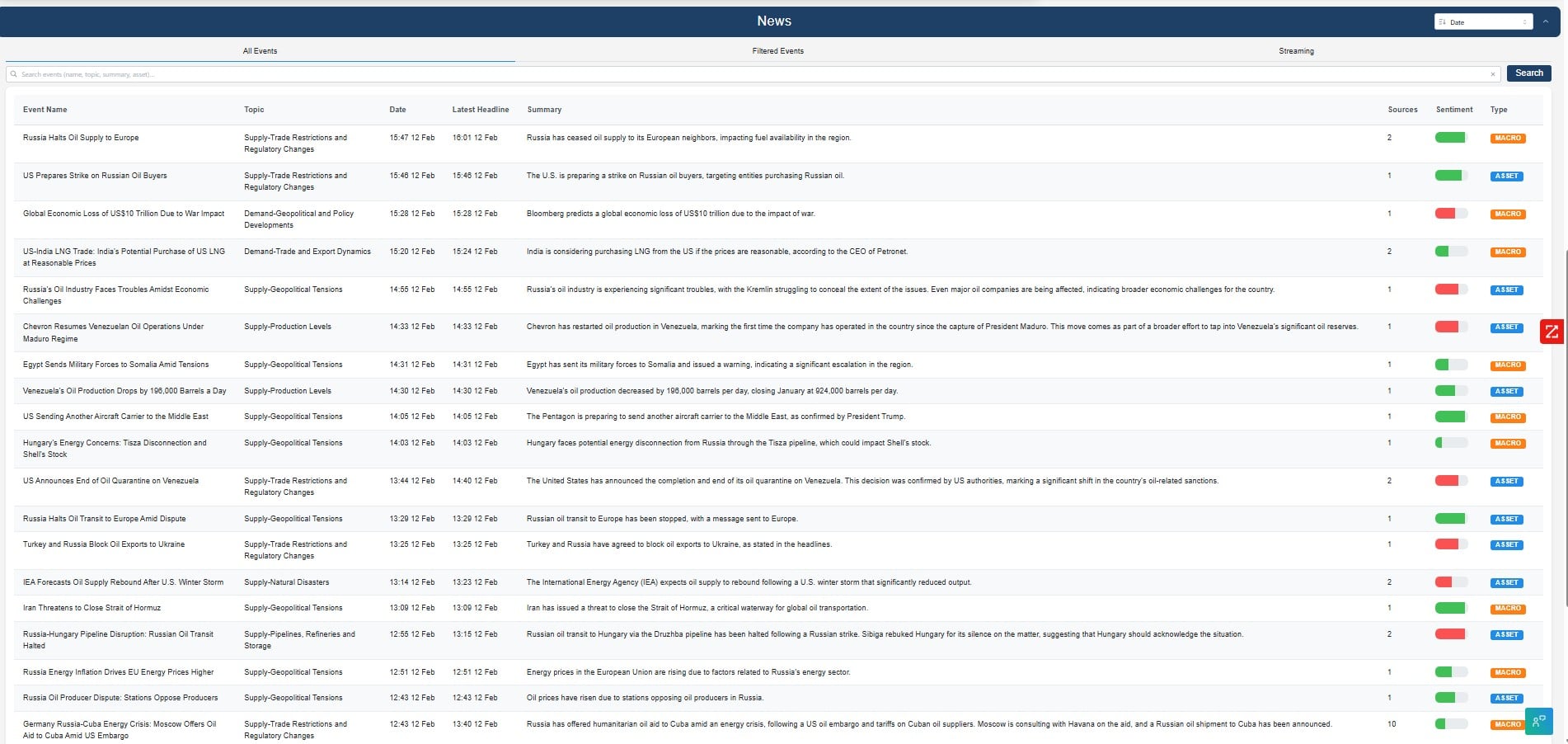
crude oil news intelligence

Top 10 crude oil news resources for keeping track of oil in the news today

1. Crude Oil Price

Crude Oil Price (https://www.crudeoilprice.com/) is a comprehensive news and analysis platform that provides real-time updates on crude oil prices, market trends, and industry developments. It offers in-depth articles, price charts, and expert commentary to help traders make informed decisions.

2. OilPrice.com

OilPrice.com (https://oilprice.com/) is a leading source for news and analysis on the global energy market. It covers a wide range of topics, including crude oil, natural gas, renewable energy, and geopolitical events that impact the energy industry.

3. Bloomberg Energy

Bloomberg Energy (https://www.bloomberg.com/energy) is a highly respected news source that provides up-to-the-minute coverage of the energy sector, including breaking news, market data, and expert analysis on crude oil and other commodities.

4. Reuters Energy

Reuters Energy (https://www.reuters.com/energy/) is the energy division of the renowned news agency Reuters, offering comprehensive and reliable news, data, and insights on the global energy markets, including crude oil.

5. Oil & Gas Journal

Oil & Gas Journal (https://www.ogj.com/) is a leading publication in the oil and gas industry, providing in-depth coverage of upstream, midstream, and downstream activities, as well as regulatory and policy developments that affect the crude oil market.

6. Energy Intelligence

Energy Intelligence (https://www.energyintel.com/) is a respected research and consulting firm that offers a range of news, analysis, and data products focused on the global energy industry, including the crude oil market.

7. Energy Information Administration (EIA)

The Energy Information Administration (EIA) (https://www.eia.gov/) is a statistical agency within the U.S. Department of Energy that provides authoritative and unbiased information on energy, including comprehensive data and analysis on crude oil production, consumption, and inventories.

8. Platts

Platts (https://www.spglobal.com/platts/en) is a leading provider of energy and commodities information, offering real-time news, price assessments, and analytics on the global crude oil and other energy markets.

9. Oil & Gas Financial Journal

Oil & Gas Financial Journal (https://www.ogfj.com/) specifically covers the financial aspects of the oil and gas industry, including investment trends, financing, and mergers and acquisitions related to the crude oil sector.

10. Energy Risk

Energy Risk (https://www.risk.net/energy-risk) is a renowned publication that provides in-depth analysis, news, and insights on the risks and opportunities in the global energy markets, including the crude oil industry.

Top 10 resources for monitoring crude oil in the news today

Source Coverage Focus Strengths Best For Free / Paid
Permutable AI AI-powered crude oil sentiment & pattern detection Real-time summarisation, predictive insights, cross-source correlation Professional traders, analysts, institutions Trial available / Enterprise pricing
Crude Oil Price Real-time prices & news Live price charts, news feeds Quick price checks, short-term traders Free
OilPrice.com Global energy market Broad geopolitical coverage, op-eds Macro outlook, energy investors Free (Premium available)
Bloomberg Energy Commodities, global markets Breaking news, institutional-grade data Professionals, macro traders Paid (limited free)
Reuters Energy Energy market news & analysis Reliable, fast, fact-based reporting Institutional traders, risk managers Free
Oil & Gas Journal Upstream/midstream/downstream Deep industry coverage, regulatory insights Sector specialists, analysts Paid
Energy Intelligence Global oil market intelligence Reports, forecasts, consulting Strategic planning, long-term outlook Paid (B2B focus)
EIA (U.S. Government) U.S. & global data Official stats, supply/demand reports Data-driven traders, researchers Free
Platts (S&P Global) Pricing, forecasts, analysis Industry-standard benchmarks, price assessments Institutional traders, pricing models Paid (Enterprise)
Oil & Gas Financial Journal Finance & M&A in energy sector Coverage of capital flows, investment trends Investors, equity analysts Free (limited)
Energy Risk Risk management & derivatives Analysis on energy trading, quant strategies Risk professionals, quant traders Paid

Use cases of our Trading Co-Pilot intelligence for monitoring oil in the news today and positioning

  • Geopolitical risk tracking: Our Trading Co-Pilot intelligence layer flagged early sentiment shifts around Russia–Ukraine oil transit negotiations, allowing traders to anticipate tightening supply impacts before major outlets published.

  • Macro correlation analysis: Identify correlations between Brent price swings and agriculture futures during Middle East shipping disruptions – an edge for traders handling cross-commodity portfolios.

  • OPEC+ event monitoring: By summarising policy statements across multiple languages and sources in real-time, our Trading Co-Pilot cuts through political commentary noise to deliver a probability-weighted forecast of quota changes.

Brent Crude

Our Trading Co-Pilot intelligence layer: Your edge for keeping track of oil in the news today and positioning edge

While we’ve outlined the industry’s most respected news sources, why spend hours monitoring ten different platforms when you can harness the power of our Trading Co-Pilot‘s News Intelligence? Our sophisticated plug and play tools continuously scans and analyses thousands of sources in real-time, transforming what would typically take 4-5 hours of daily research into precise, actionable insights delivered in minutes. 

By eliminating 80-90% of market noise, our AI-powered algorithms identify and prioritise only the most market-relevant information, providing you with clear story summarisations, projected market impact assessments, and probability-weighted directional forecasts. Join leading institutional traders who have already transformed their approach to market analysis – while others are still reading headlines, you’ll be executing informed trading decisions backed by institutional-grade intelligence. 

Request an institutional trial of Trading Co-Pilot and receive real-time AI-driven oil market insights tailored to your trading strategy. Simply email enquiries@permutable.ai and speak to our team today.

FAQ: Crude oil in the news today and AI market intelligence

Q1: Why can’t I just rely on Bloomberg or Reuters?

These outlets are excellent but limited in capability. Traders often spend hours filtering noise. Our Trading Co-Pilot filters and contextualises cross-source data into real-time, actionable intelligence.

Q2: Does Trading Co-Pilot replace news sources?

No – it amplifies and contextualises them. We integrate and analyse data from all high quality sources turning raw feeds into a coherent narrative with predictive signals.

Q3: How accurate are AI-driven insights for oil trading?

Our algorithms are trained on years of global macroeconomic and commodity market data. Clients typically report a significant increase in speed and confidence of trade execution.

Q4: Can I customise Trading Co-Pilot?

Yes – you can customise it around specific commodities, geo-locations or themes,  so you never miss a market-moving development.

Q5: Who uses Trading Co-Pilot?

Institutional traders, hedge funds, and commodity analysts seeking to reduce manual news monitoring and improve decision-making precision.

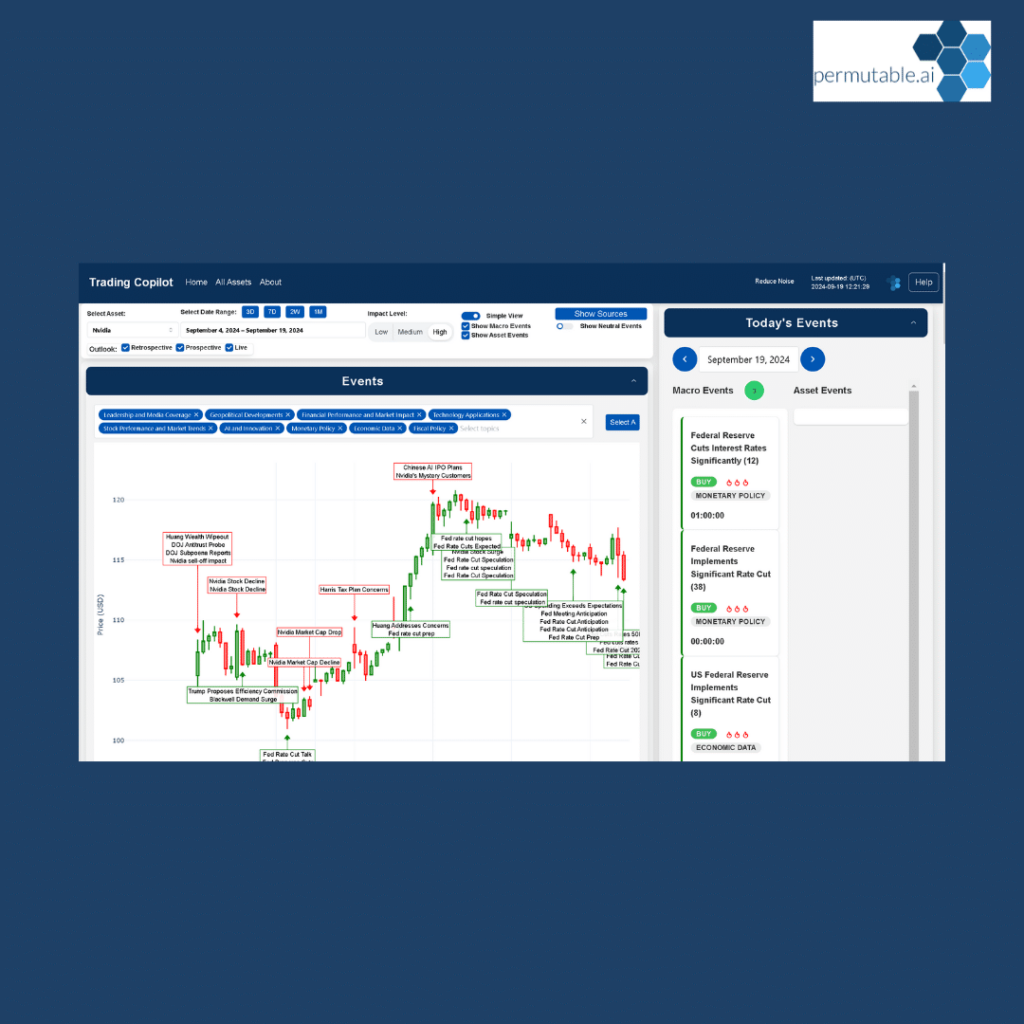
Trends in AI trading investment: Insights from Permutable AI

At Permutable AI, we’ve been at the forefront of R&D in AI trading investment for years, and have witnessed firsthand the rapid evolution of this sector. Ever since the introduction of machine learning algorithms in financial markets, the landscape has been changing at an unprecedented pace. All this means that investors and financial institutions must adapt quickly or risk being left behind.

Initially, AI in trading was primarily used for high-frequency trading and basic pattern recognition. Now, for many firms, it’s become an integral part of their entire investment strategy. What we’ve found is that AI isn’t just enhancing existing strategies; it’s creating entirely new approaches to market analysis and prediction.

The crisis in traditional investment strategies, exacerbated by global economic uncertainties, has accelerated the adoption of AI trading investment. Yet even now, we’re only scratching the surface of what’s possible. Let’s briefly look at some of the key trends we’re seeing in the industry.

Trends in AI trading investment

Advanced Natural Language Processing (NLP)

One of the most exciting developments is the use of NLP to analyse news, social media, and even company reports. It’s the same story on financial forums and in earnings calls transcripts. AI can now interpret sentiment and extract relevant information at a scale and speed impossible for human analysts.

Reinforcement learning

Increasingly, we’re seeing the application of reinforcement learning in trading algorithms. This method applies a reward-based system to teach AI how to make decisions in complex, dynamic environments like financial markets. Despite this being a relatively new approach, the results are promising.

Alternative data analysis

The keys to successful AI trading investment often lie in unexpected places. In the very near future, we can expect to see more AI systems incorporating alternative data sources such as satellite imagery and even weather patterns to gain a competitive edge.

Explainable AI

At Permutable, we know that explainability in our AI systems is crucial – especially for our clients who are increasingly relying on our trading tools to get ahead. As AI trading investment becomes more prevalent, there’s a growing demand for transparency. Explainable AI, which allows us to understand how AI models make decisions, is becoming crucial. The point here is that regulatory bodies and investors alike want to understand the logic behind AI-driven trades.

Federated learning

This approach allows multiple entities to train AI models without sharing sensitive data. It’s particularly relevant in the financial sector where data privacy is paramount. And this is why we believe federated learning will play a significant role in the future of AI trading investment.

Overarching AI trading investment trends 

Almost everyone we speak to in the industry agrees that AI is transforming investment strategies. However, it’s not without its challenges. The trouble is, as AI systems become more complex, they also become more difficult to manage and understand. Of course, this has lead to a sense of foreboding among some traditional investors who fear being left behind by this technological revolution.

And the bad news is that all of this is likely to accelerate in the coming years. To address this, we at Permutable AI are focusing on developing AI systems that are not only powerful but also intuitive and user-friendly – as exemplified in our flagship product – our Trading Co-Pilot

What actually is going on here? At its core, AI trading investment is about leveraging vast amounts of data and computational power to make more informed, timely, and profitable investment decisions. But it’s also about managing risk in an increasingly volatile global market.

This concern has three components:

  1. Data quality and quantity: AI models are only as good as the data they’re trained on. Ensuring access to high-quality, diverse data sets is crucial.
  2. Model interpretability: As mentioned earlier, there’s a growing need for explainable AI in finance.
  3. Regulatory compliance: As AI trading investment evolves, so too must the regulatory framework surrounding it.

So far, so predictable, you might think. And yet perhaps the most exciting aspect of AI trading investment is its potential to open up new markets and opportunities. For when you look again at emerging markets or previously overlooked asset classes, AI can provide insights that were previously impossible to obtain.


AI trading investment

A new era in the financial markets 

According to our sources in the industry, we’re on the cusp of a new era in finance, and we’re inclined to agree with this. It is claimed that AI will not just augment human decision-making, but in many cases, surpass it. And if it is the case that AI can consistently outperform human traders, what does this mean for the future of investment?

In this light, it’s clear that AI trading investment is not just a trend, but a fundamental shift in how we approach trading and investing. There’s plenty of evidence that firms embracing this technology are gaining a significant competitive advantage. Just as notably, those slow to adopt are finding themselves increasingly left behind.

The good news is that the barriers to entry for AI trading investment are lower than ever. With cloud computing and open-source AI tools, even smaller firms can leverage these powerful technologies. It also helps that there’s a growing ecosystem of AI-focused fintech companies providing specialised tools and services.

So there it is: AI trading investment is not just the future of trading and investing; it’s rapidly becoming its present. At Permutable AI, we’re excited to be part of this revolution, driving innovation and helping our clients navigate this new landscape with our Trading Co-Pilot which combines real-time news aggregation, asset and macro insights and actionable directional tips. The same applies to investors, traders, and financial institutions across the UK and beyond.

Your trading is about to take off

Schedule a free enterprise demo to see how our Trading Co-Pilot can help you make smarter trading decisions, faster. 


contact us

how to trade with artificial intelligence

The future of investing: AI-driven investment strategies and signals modeling

In finance, being ahead of the curve is not just an advantage, it’s a requirement. At Permutable AI, we’re at the leading edge of a digital future where AI and machine learning are changing the investment landscape in ways we couldn’t have imagined a decade ago. So we think we’re well placed to help you explore the world of AI-driven investment strategies and signals modeling. In this article, we’ll examine the latest developments, as well as how we’re changing the way investors approach the market through our own innovations and capabilities. 

An introduction to AI-driven investment strategies and signals modeling 

Those days are gone when investing was all about human intuition and manual research. Today, AI algorithms can process vast amounts of data in milliseconds and find patterns and trends that would take human analysts weeks or months to discover. At Permutable AI we believe AI-driven strategies are not a trend; they’re the future of investment management. Our algorithms can analyse sentiment around market data, economic indicators, geopolitical factors and other variables in real-time, giving our clients a deeper understanding of the market.

We also have a team of world-class data scientists and AI researchers working alongside those with background in the markets to develop more and more sophisticated models that can predict the market with greater and greater accuracy and give our clients an edge in their investment and trading decisions.

Investment strategies and signals modeling: Cracking the code

At the heart of many of our AI-driven strategies is signals modeling—a process of finding and interpreting various market signals to predict future trends. These signals can be traditional indicators like price movements and trading volumes. We like to think of our signals modeling as cracking the market’s code. We’re looking for patterns and correlations that aren’t obvious. For example we’ve found that specific combinations of currency movements, commodity prices and news sentiment can predict movements in certain stock sectors with high accuracy. 

The power of AI signals modeling is the ability to process and analyse these diverse data sources at speed and scale that’s impossible for human analysts. More than that, our machine learning algorithms get better and better with new data, theoretically getting more accurate over time.

Algorithmic trading for all 

While AI-driven strategies were once the preserve of large institutional investors we at Permutable AI are making this technology more and more accessible to all investors with the imminent launch of our Co-Pilot, allowing investors of all sizes to benefit from the same kind of quantitative analysis and algorithmic trading that was once the domain of the big players on Wall Street and the City.

We’re seeing the democratisation of sophisticated investment strategies and we’re proud to be at the forefront of it. In other words we’re working towards a future where every investor, no matter the size of their portfolio, has access to AI-driven investment tools tailored to their goals and risk tolerance.

AI-driven investment strategies and signals modeling: Challenges and caveats

But we’re aware that the rise of AI in investing isn’t without its challenges. One of the biggest is the risk that AI algorithms will exacerbate market volatility. If multiple large investors are using the same AI models it could lead to herd behaviour on a massive scale and amplify market moves. And then there’s the issue of transparency and explainability. Many AI models, especially those using deep learning, are what is termed as “black boxes”. At Permutable AI we’re committed to developing models that are powerful and transparent and explainable so our clients and regulators can understand the reasoning behind our AI-driven decisions.

Another concern is the human factor. While our AI can process huge amounts of data and find patterns we know the importance of emotional intelligence and understanding complex geopolitical situations, for example. So we absolutely advocate for AI-driven investment strategies and signals modeling that combine the power of AI with human insight and judgement. AI-driven investment strategies and signals modeling is not a replace all, but a collaborative partner. 

Next steps: How to integrate AI-driven investment strategies and signals modeling  

At Permutable AI we’re not just developing AI technology we’re helping our clients use it. Here are a few things we recommend:

Educate yourself

Number one – stay up to date with the latest AI and machine learning developments in finance. We publish resources and insights to help our clients stay informed so keep an eye on our blog where articles are published daily.

Start small

Begin by trying out AI-powered tools to get a feel for how they work and what they can do for your investment strategy – our Co-Pilot will be available to try out soon so watch this space!

Focus on your edge

Think about how AI can enhance your existing strategy rather than replace it. For example, our tools are great for data analysis and pattern recognition.

Stay human

Don’t underestimate the value of human judgement and emotional intelligence in investing (read more on that in our article about whether we think AI will replace traders). We believe the best strategies will combine our AI insights with human expertise.

Final thoughts and find out more

Looking ahead it’s clear that AI-driven strategies and signals modeling will be a big part of the future of investing. At Permutable AI we’re excited to be leading the charge, developing technology that makes investing more efficient, accessible and potentially more profitable for all investors. We approach this with a sense of excitement as well as responsibility. The future of investing isn’t human vs machine –  it’s about finding the right balance between AI and human wisdom. And that’s exactly what we do at Permutable AI.


Innovative uses of machine learning-driven market sentiment analysis in decoding financial markets in 2024

In the fast-paced world of financial markets, staying ahead of the game is crucial for investors and traders. One key factor that can greatly impact market movements is sentiment. Market sentiment, often driven by emotions and perceptions, plays a significant role in shaping the direction of financial markets. Traditionally, analyzing market sentiment has been a complex and time-consuming task, requiring extensive manual research and analysis. However, with the advent of machine learning, a new approach known as machine learning-driven market sentiment analysis has emerged as a powerful tool in decoding financial markets.

Understanding the importance of market sentiment in financial markets

Market sentiment refers to the overall attitude and emotion of market participants towards a particular asset, market, or industry. It can be driven by a variety of factors, including economic indicators, news events, geopolitical developments, and even social media trends. Understanding market sentiment is crucial for investors and traders as it can provide valuable insights into future market movements. Positive sentiment can drive prices higher, while negative sentiment can lead to market downturns. By analyzing market sentiment, investors can gain a competitive edge and make informed investment decisions.

How does machine learning-driven market sentiment analysis work?

Machine learning-driven sentiment analysis leverages the power of artificial intelligence and advanced algorithms to analyze vast amounts of data and extract sentiment-related insights. By training machine learning models on large datasets, algorithms can learn to identify patterns and detect sentiment from various sources such as news articles, social media posts, and financial reports. Textual data is processed using natural language processing techniques, enabling the models to understand the context and meaning of the text. The models then assign sentiment scores to each piece of data, indicating whether the sentiment is positive, negative, or neutral.

Benefits of using machine learning-driven market sentiment analysis in financial markets

The use of AI-driven sentiment analysis in financial markets offers several benefits. It provides a faster and more efficient way of analyzing market sentiment compared to traditional manual methods. By automating the process, machine learning algorithms can analyze vast amounts of data in real-time, providing investors with up-to-date insights and reducing the time required for decision-making. Machine learning-driven sentiment analysis also enables investors to capture sentiment from a wide range of sources, including news articles, and financial reports. This comprehensive approach allows for a more holistic view of market sentiment, enhancing the accuracy of predictions. Lastly, machine learning-driven sentiment analysis can help identify hidden patterns and correlations in market sentiment that may not be apparent to human analysts. This can lead to more accurate predictions and better investment outcomes.

Key challenges in implementing machine learning-driven market sentiment analysis

While machine learning-driven sentiment analysis holds great promise, there are several challenges that need to be addressed for successful implementation. One key challenge is the availability and quality of data. Machine learning models rely on large amounts of high-quality data to achieve accurate predictions. Obtaining such data can be challenging, particularly when it comes to financial markets where data can be fragmented and noisy. Another challenge is the interpretability of machine learning models. While these models can provide accurate predictions, understanding the reasoning behind these predictions can be difficult which is why explainability is so crucial. This lack of interpretability and explainability can make it challenging for investors to trust and act upon the insights provided by the models. Lastly, there is the challenge of model robustness and adaptability. Financial markets are dynamic and constantly changing, requiring machine learning models to continuously adapt and learn from new data. Ensuring the models remain robust and effective in different market conditions is a challenge that needs to be addressed.e

Best practices for leveraging machine learning-driven market sentiment analysis in financial markets

To leverage the power of machine learning-driven sentiment analysis effectively, several best practices should be followed. It is crucial to have a robust data collection and preprocessing pipeline. This involves gathering data from various sources, cleaning and preprocessing the data, and ensuring its quality and reliability. Secondly, it is essential to train machine learning models on diverse and representative datasets. This helps in capturing the nuances and complexities of market sentiment and improves the generalization capabilities of the models. Additionally, it is important to continuously monitor and evaluate the performance of the models. This involves regularly updating the models with new data, assessing their accuracy, and making necessary adjustments. Lastly, it is crucial to combine machine learning-driven sentiment analysis with other traditional and quantitative analysis techniques to gain a comprehensive understanding of the financial markets.

Future trends and developments in machine learning-driven market sentiment analysis

The field of machine learning-driven sentiment analysis is rapidly evolving, and several future trends and developments can be expected. There will be advancements in natural language processing techniques, enabling machine learning models to better understand and analyze complex textual data. This will lead to more accurate sentiment analysis and improved predictions. You can also expect increased integration of machine learning-driven sentiment analysis with other technologies such as blockchain and internet of things (IoT). This will enable the analysis of sentiment in real-time and provide more comprehensive insights. Lastly, expect a focus on addressing the challenges of transparency and interpretability in machine learning models. Efforts will be made to develop techniques that provide insights into the reasoning behind the predictions, enhancing trust and usability.

Harnessing the power of machine learning-driven market sentiment analysis in decoding financial markets

Machine learning-driven sentiment analysis has the potential to revolutionize the way financial markets are analyzed and understood. By leveraging the power of artificial intelligence and advanced algorithms, investors and traders can gain valuable insights into market sentiment and make more informed investment decisions. Despite the challenges that come with implementing machine learning-driven sentiment analysis, the benefits outweigh the drawbacks. By following best practices, using the right tools and technologies, and staying updated with future trends, the potential of machine learning-driven sentiment analysis in decoding financial markets with greater accuracy and efficiency is enormous.

Find out more

If you’re intrigued by the transformative potential of machine learning-driven market sentiment analysis and its capacity to revolutionize investment strategies in the fast-evolving financial markets, we invite you get in touch. Discover how we’re harnessing cutting-edge AI to unlock actionable insights and predictive analytics, guiding investors towards more informed decisions. For a closer look at our pioneering approaches and to explore collaborative opportunities, reach out to us directly by emailing enquiries@permutable.ai or by completing the contact form below. 


Loading