In this article, we examine how a wave of geopolitical developments has reshaped the landscape across global energy markets. From renewed pressure on Russian energy to the unveiling of a US-EU energy pact, the past week has marked a decisive shift in the drivers of oil and gas prices.
Against this backdrop, our Trading Co-Pilot identified a build-up of bullish momentum signals across Brent, WTI, and TTF. These signals emerged alongside regime shifts, where accelerating sentiment and converging macro risks pushed markets into a new phase of price action. What we see is a market increasingly driven by political risk, regulation, and diplomatic shifts, rather than by supply-demand fundamentals alone.
Our Trading Co-Pilot surfaces a series of high-conviction entry points, each aligned with shifts in sentiment and structural market changes. These signals anticipated sharp rallies across all three benchmarks, revealing how pricing dynamics have evolved in response to rising policy pressure. We break down the political, structural, and market forces behind the moves and assess the themes likely to define the path forward for energy markets.
Brent futures rose to $72.70, touching a five-week high, as sanctions risk eclipsed optimism around OPEC+ output increases. While the markets showed signs of stabilisation, the growing uncertainty around Russian-linked barrels spurred the swift price ascent.
Recent policy rhetoric revived the possibility of further sanctions targeting those involved in the transport and financing of Russian energy. Even in the absence of formal enforcement, the stern message alone introduced a reputational risk premium, increasing legal and financial exposure across energy markets.
In just a few days, the U.S. administration issued a series of high-impact policy threats:
New export tariffs aimed at India and China, increasing pressure on their Russian energy imports.
Broader signals of enforcement against Iranian-linked crude shipments.
This sudden squeeze on trade through renewed sanction pressure, has introduced significant uncertainty across Asian energy trade routes. The market quickly repriced geopolitical risk in energy markets, as the shift from rhetoric to enforcement came into the spotlight.
The US–EU energy pact formalised a structural shift away from Russian energy. While the strategic direction is now set, the timeline for execution remains constrained by infrastructure gaps, regulatory friction, and limited market coordination. Full implementation is expected by 2027, though delays remain likely.
Market views remain split. Some expect geopolitical tailwinds to keep prices elevated, driven by sustained policy risk. Others anticipate a correction as OPEC+ supply ramps up and macroeconomic pressures ease.
Our Trading Co-Pilot flagged the bullish momentum shift just as Brent cleared $71. The signal aligned with sanctions-driven sentiment, EU policy realignment, and OPEC+ output. Prices moved swiftly toward the $72–$73 range.

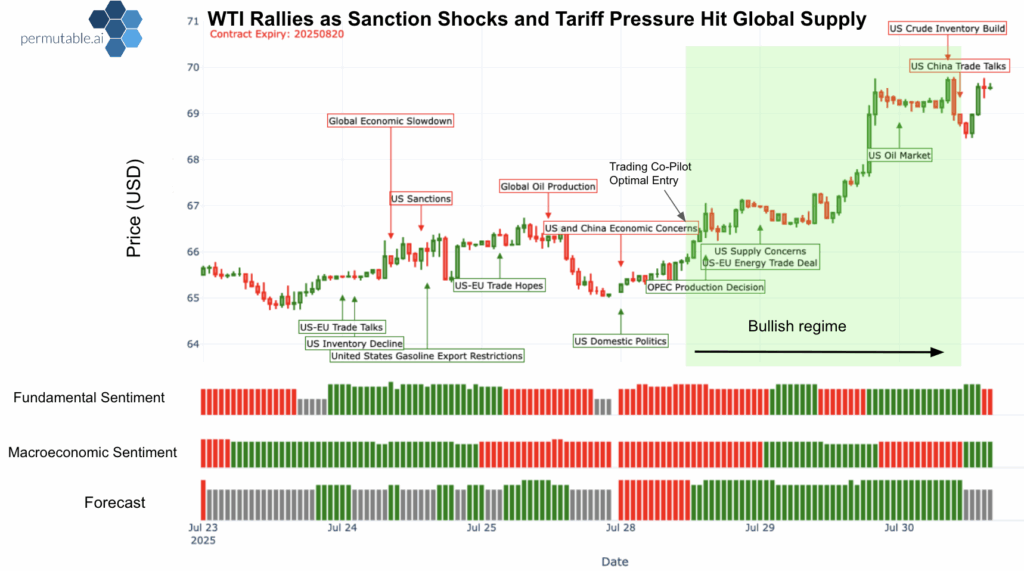
WTI crude held firm near $69 per barrel this week, as geopolitical risk in energy markets overshadowed a contradictory U.S. inventory picture. The rally was not driven solely by supply dynamics, but by a surge in regulatory pressure, including threats of secondary sanctions, renewed tariff pressure, and shifting trade alignments.

Our Trading Co-Pilot identified a bullish regime shift in WTI, marking the point where escalating policy risk and rising sentiment momentum converged. The signal preceded a sharp upward move, offering clients a well-timed entry as the market transitioned into a sustained rally.
While our Trading Co-Pilot’s bullish forecast reflects strong directional conviction, risks remain. Inventory build-ups and surging output confirmed by the EIA and API continue to place downward pressure on sentiment, and a proposed reintroduction of Venezuelan exports under Chevron waivers may temper further upside. Still, trade policy remains the dominant driver in the near term.
Dutch TTF gas prices rose from €32.10 to €34.90, driven by a combination of heatwave-related demand, short-term supply constraints, and speculative positioning. However, the rally appears increasingly detached from underlying fundamentals, with structural weakness continuing to weigh on the broader European gas market.
Extreme heat across Europe boosted short-term gas consumption and triggered speculative activity in power markets. Prices opened at €34.72 on 30 July, buoyed by headlines highlighting U.S.–EU LNG cooperation. Still, recent EIA data showed a drop in Dutch spot prices earlier in the month, reinforcing the view that the rally is regionally concentrated and sentiment-driven.
While these constraints triggered upward price pressure, they are cyclical rather than structural long-term supply weakness.

Our Trading Co-Pilot issued a timely entry just under €32.5 mark, detecting upbeat sentiment around weather risks, LNG bottlenecks, and regional supply pressures. The decisive signal positioned clients well ahead of TTF’s rebound towards €35.
Recent price action across Brent, WTI, and TTF reflects a market increasingly shaped by political risk, regulatory intervention, and shifting global alignments. As energy markets move further away from traditional fundamentals, traders must adapt to a more volatile, policy-sensitive environment.
This week’s rally across Brent, WTI, and TTF reflects a market increasingly driven by geopolitical risk in energy markets. Traders are no longer reacting solely to supply and demand data, but to policy shifts, enforcement threats, and macroeconomic volatility.
Our Trading Co-Pilot identified these inflection points in real time, blending sentiment analytics, macroeconomic filters, and policy signals into clear, actionable trade calls. Rather than relying on hindsight, our Trading Co-Pilot tracks evolving conditions as they unfold, enabling well-timed entries and exits with conviction. The result is enhanced clarity and precision in trade execution, cutting through market noise and volatility across global energy markets.
To request a demo or speak to one of our team, simply email enquiries@permutable.ai
This article provides a comprehensive analysis of the most critical breaking geo political issues 2025 at time of writing and their profound impact on global markets, providing institutional investors with strategic insights for navigating unprecedented political risk. It is aimed at institutional investors, portfolio and macro strategists, risk managers, commodities and energy traders, and global research teams seeking to anticipate and capitalise on geopolitical developments before they reach market consensus.
The landscape of global geopolitical risk has fundamentally shifted in 2025, presenting institutional investors with a complex web of interconnected tensions that demand sophisticated analytical capabilities and real-time intelligence. The rising wave of geo political issues are not merely isolated incidents but part of a broader realignment of global power structures that will continue to shape market dynamics for years to come. The traditional approach of reactive positioning – waiting for geopolitical events to unfold before adjusting portfolios – has proven increasingly inadequate in an environment where milliseconds can determine the difference between capturing alpha and experiencing significant losses.
For institutional investors, the challenge extends beyond simply identifying potential flashpoints to understanding their interconnected nature and cascading effects across multiple asset classes, regions, and time horizons. The sophisticated investor recognises that effective macro research in today’s environment requires not just awareness of these tensions but the ability to process vast streams of real-time intelligence, identify subtle shifts in sentiment and positioning, and translate these insights into actionable investment strategies before market consensus emerges.
The evolving trade relationship between the United States and China continues to represent one of the most significant geo political issues in 2025, with implications extending far beyond bilateral trade flows. The complexity of this relationship has deepened as both nations navigate technological competition, supply chain reorganisation, and strategic alliance building. For institutional investors, understanding these dynamics requires monitoring not only official government communications but also corporate earnings calls, supply chain disruptions, and shifting patterns in global manufacturing and technology investment.
The alliance dimension adds another layer of complexity, as US partnerships with Japan, South Korea, Australia, and European nations create ripple effects that impact everything from semiconductor markets to rare earth metal pricing. Importantly, sophisticated macro research capabilities enables investors to track sentiment shifts across multiple jurisdictions simultaneously, providing early warning signals for policy changes that may not be immediately apparent through traditional diplomatic channels. The ability to process and analyse these diverse information streams in real-time through technologies such as our provides powerful advantages for positioning in technology sector equities, emerging market currencies, and commodity futures.
The ongoing tensions between Iran and Israel have evolved into a broader regional confrontation with profound implications for global energy markets and Middle Eastern stability. The Strait of Hormuz, through which approximately 20% of global oil passes, remains a critical chokepoint that demands constant monitoring by energy traders and macro strategists. The sophistication required to analyse this situation extends beyond simple conflict monitoring to encompass complex supply chain analysis, regional alliance dynamics, and the potential for proxy conflicts across multiple theatres.
For institutional investors, the challenge lies in understanding how these regional tensions translate into global market impacts. Oil price volatility, safe-haven flows into precious metals and government bonds, and currency fluctuations in energy-dependent economies all require sophisticated analytical capabilities that can process information from diverse sources whilst identifying patterns and connections that may not be immediately apparent. It is here that real-time sentiment analysis of government communications, military positioning, and diplomatic initiatives provides distinct competitive advantage, providing crucial early warning signals for potential escalation or de-escalation scenarios.
The persistent tensions along the India-Pakistan border represent a significant source of regional instability with global implications for technology outsourcing, manufacturing supply chains, and emerging market investment flows. The nuclear dimension of this relationship adds layers of complexity that require sophisticated risk assessment capabilities beyond traditional geopolitical analysis. For institutional investors with exposure to South Asian markets, understanding these dynamics requires monitoring not only official government communications but also military movements, diplomatic initiatives, and public sentiment across both nations.
The economic implications extend far beyond the immediate region, with potential disruptions to global technology supply chains, pharmaceutical manufacturing, and textile production. Macro research capabilities that can track sentiment shifts in this context provide essential insights for investors seeking to position themselves appropriately in emerging market equities, currency markets, and sector-specific exposures that may be affected by escalating tensions.
The evolving relationship between Turkey and Israel, particularly in the context of Syrian developments, represents a complex geopolitical dynamic with implications for NATO cohesion, regional stability, and energy transit routes. The multifaceted nature of this situation requires advanced analytical capabilities that can process information from diverse sources whilst understanding the historical context and strategic implications of various policy positions.
For institutional investors, the challenge lies in understanding how these regional dynamics translate into broader market impacts. Currency volatility in the Turkish lira, implications for European energy security, and potential disruptions to trade routes all require sophisticated analytical frameworks that can identify subtle connections between seemingly unrelated developments. The ability to track sentiment across multiple stakeholders and jurisdictions provides obvious advantages for positioning in emerging market currencies, energy sector equities, and regional bond markets.
The emerging strategic coordination between China, Russia, Iran, and North Korea – otherwise known as “The Axis of Upheaval” – represents a concerning fundamental shift in global power dynamics with far-reaching implications for international trade, financial markets, and security architecture. Understanding this complex relationship requires analytical capabilities that can process information from diverse sources whilst identifying patterns and connections that may not be immediately apparent through traditional diplomatic channels.
For institutional investors, the implications extend across multiple asset classes and regions. Sanctions regimes, trade route disruptions, technology transfer restrictions, and commodity price volatility all require sophisticated risk assessment capabilities that can anticipate policy changes and market reactions before they are reflected in asset prices. Here, the ability to track sentiment and positioning across multiple jurisdictions provides essential early warning signals for potential market disruptions or investment opportunities.
The expansion of Chinese naval presence in the Tasman Sea represents a significant development with implications for regional security architecture, trade routes, and alliance dynamics between Australia, New Zealand, and their Pacific partners. Understanding the strategic implications of this development requires analytical capabilities that can process information from diverse sources whilst assessing the potential for escalation or accommodation.
For institutional investors, the implications extend beyond immediate regional concerns to encompass broader questions about global trade routes, commodity exports, and currency stability in the Pacific region. The ability to track sentiment and positioning across multiple stakeholders provides crucial insights for positioning in commodity markets, regional currencies, and sector-specific exposures that may be affected by evolving strategic dynamics.
The ongoing conflict in Ukraine continues to represent one of the most significant sources of geopolitical risk in 2025, with implications extending far beyond the immediate theatre of operations. The potential for proxy conflicts, alliance testing, and economic disruption requires sophisticated analytical capabilities that can process vast amounts of information whilst identifying patterns and connections across multiple dimensions of international relations.
For institutional investors, the challenge lies in understanding how this conflict continues to shape global markets through energy price volatility, supply chain disruptions, defence sector investment, and safe-haven flows. The ability to track sentiment and positioning across multiple stakeholders provides essential insights for positioning in energy markets, defence sector equities, and European regional investments alike that may be affected by evolving conflict dynamics.
The cumulative effect of these geo political issues in 2025 has created an environment of heightened market volatility that demands sophisticated risk management capabilities and strategic positioning. Traditional approaches to portfolio construction and risk assessment have proven inadequate in an environment where geopolitical developments can trigger rapid shifts in asset prices, currency values, and commodity markets within hours or even minutes of initial reports.
The interconnected nature of modern financial markets means that geopolitical developments in one region can quickly propagate across multiple asset classes and geographic regions. Central bank policy responses, safe-haven flows, and inflation expectations all become interconnected variables that require comprehensive analytical frameworks capable of processing vast amounts of information whilst identifying subtle patterns and relationships that may not be immediately apparent.
For institutional investors, the challenge extends beyond simply identifying potential risks to understanding their potential market impacts and developing appropriate hedging strategies. The ability to integrate real-time geopolitical intelligence into existing risk management frameworks provides crucial advantages for maintaining portfolio stability whilst identifying opportunities for alpha generation during periods of heightened volatility.
Our advanced geopolitical sentiment provides institutional investors with the sophisticated analytical capabilities required to navigate these complex dynamics effectively.
Above: Our real-time geopolitical and macro sentiment intelligence identified a bullish LNG regime before price momentum took off. From early entry post-project disruption to accurately tracking the market’s response to EU sanctions, pipeline expansions, and force majeure developments, Our system flagged the bullish shift in fundamentals and macro tone — well ahead of the crowd.
Our real-time sentiment analysis enables investors to track developments, providing early warning signals for potential escalation or de-escalation scenarios before they are reflected in market prices. Importantly, the integration of historical data spanning multiple years enables sophisticated backtesting and scenario analysis that can help investors understand how their strategies might perform under various geopolitical conditions.
Above: This chart reveals how our geopolitical sentiment data tracked a deepening negative tone surrounding Iran–Israel tensions before Brent crude broke out. With a clear sentiment trough marking the possible entry, investors using our signal analytics gained valuable early warning before the oil rally began to price in risk premium.
In terms of macro research, the ability to feed real-time sentiment data directly into trading algorithms and risk management systems represents a fundamental shift in how institutional investors can respond to evolving geopolitical conditions using our data. This integration enables dynamic adjustment of portfolio exposures based on real-time developments rather than static risk parameters or delayed market reactions.
Above: Our Political Tension Index captures 12 months of shifting geopolitical risk, from the US shutdown threat and Canada tariff war to the Trump-Musk fallout. The green zone highlights a brief diplomatic reprieve – rapidly followed by re-escalation. For institutional clients, this index offers a quantifiable edge in forecasting how political narratives translate into market volatility across FX, commodities, and safe-haven assets.
The bottom line here is that the top geo political issues 2025 weave a complex and delicate landscape of risk requiring sophisticated analytical capabilities that can process vast amounts of information whilst identifying actionable insights for institutional investors. Ultimately, the institutions that successfully leverage these advanced capabilities will find themselves with substantial competitive advantages in an increasingly complex global environment. Why? Simply because the future of geopolitical risk management lies not in replacing human expertise but in augmenting it with powerful analytical tools that can process information at scales and speeds that would be impossible through traditional methods.
As global tensions continue to evolve and intensify, the ability to anticipate and respond to geo political issues before they reach market consensus will become increasingly valuable for institutional investors seeking to maintain competitive advantages whilst managing portfolio risks effectively. The question for institutional investors is not whether to adopt these advanced capabilities but how quickly they can be integrated into existing investment processes to capture the substantial opportunities they represent.
Transform geopolitical chaos into alpha generation – discover how our real-time geopolitical intelligence turns breaking tensions into strategic advantage before they hit market consensus. Contact our enterprise team at enquiries@permutable.ai to see how institutional leaders are using our advanced analytics to navigate 2025’s most volatile geopolitical landscape.
In this article, we explore how shifts in monetary policy sentiment often lead Federal Reserve decisions. The chart tracks hawkish and dovish headline volumes from January 2018 to July 2025, mapped against the Fed Funds Rate. This timeline aligns with Chair Powell’s tenure, offering a focused view of how media tone and policy have interacted over key phases of the rate cycle.
This chart provides a long-range view of how monetary policy narratives evolve over time, and how they often lead, rather than follow, decisions by the Federal Reserve. It tracks the volume of hawkish and dovish sentiment in financial media, using keyword-filtered headlines as a proxy for tone, and overlays these shifts against the effective Fed Funds Rate from January 2018 to July 2025. Conveniently, the timeline aligns with Chair Powell’s tenure at the helm of Fed, offering a focused lens through which to observe how sentiment and policy have interacted throughout this period.
The Fed Funds Rate (black line, right axis) anchors these shifts in tone to the Fed’s actual policy moves, offering a benchmark against which sentiment dynamics can be assessed.
What emerges is more than a record of interest rate changes. It is a narrative map, where shifts in tone and transition often come before action. At times, sentiment appears to take the wheel before the Fed alters course.
Market sentiment volume refers to (in the case of our chart) how frequently monetary policy narratives, whether dovish or hawkish, appear in financial media coverage. It captures the number of times specific keywords and phrases aligned with each tone feature in headlines and articles.
This provides a gauge of the intensity and dominance of prevailing macroeconomic narratives. It measures not how a headline feels, but how often a particular policy narrative is repeated. This reveals the broader weight of coverage and serves as a valuable lens through which to assess market mood, media pressure and speculative momentum.
By tracking these volumes over time, we can observe how policy narratives build ahead of Federal Reserve monetary policy decisions. Shifts in market sentiment volume often precede market turns, acting as early signals of changing expectations. As such, it offers a forward-looking lens into market mood, speculative momentum, and media pressure around policy cycles.
In early 2020, dovish sentiment surged as the pandemic sent shockwaves through the global economy. With recession fears mounting, financial media turned sharply toward expectations of emergency support. That flurry of blue sentiment, visible in our chart as a steep spike, signalled widespread panic across markets and policy circles. The Fed’s rate cuts came swiftly, but the narrative turned before the decision landed. In moments of crisis, dovish tones move faster than policymakers, often capturing the urgency of a moment when intervention becomes all but inevitable.
By contrast, the 2022-2023 tightening cycle was a more measured build-up. Hawkish market sentiment steadily rose as inflation began to overshoot and labour markets showed persistent strength. Each inflation print nudged expectations higher. Every speech from Fed officials added fuel to the fire. This time, sentiment climbed with the data, supporting, rather than predicting, the Fed’s monetary policy path. By the time the central bank reached its terminal rate, the red bars had already begun to fade. The question was no longer how high rates would go, but how long they’d stay there.
These patterns are no coincidence. Hawkish market sentiment typically builds in anticipation, when inflation is rising, the economy is running hot, and markets brace for action. Dovish market sentiment, on the other hand, tends to spike at turning points, when cracks emerge, when financial stress becomes visible, and when the data begins to shift against the prevailing policy stance. It’s a reactive force, often loudest when confidence in the current path begins to erode.
This asymmetry mirrors how monetary policy itself behaves. Hikes are telegraphed. Cuts arrive suddenly, in response to pressure. The media picks up on this imbalance, amplifying signals that policy may need to change, especially when the costs of inaction begins to mount.
Fast forward to 2025, and a familiar pattern is returning. Despite the Fed holding rates steady at 4.25 – 4.50% through the first half of the year, dovish market sentiment has surged. This time, it’s not speculative noise, it reflects a growing mismatch between the Fed’s monetary policy stance and the evolving macro landscape.
Inflation has cooled from its highs, yet growth is slowing and cracks are emerging. Housing and construction are under pressure. Private sector hiring has nearly stalled. Consumer confidence is slipping. And yet, the Fed remains unmoved. The longer the pause persists, the louder the calls for a shift. Media coverage has grown increasingly urgent, reflecting fears that policy is now overly restrictive. Dovish sentiment isn’t just building, it’s broadening.
For the first time since the start of the tightening cycle, divisions inside the Fed are spilling into public view. Governor Waller has openly called for rate cuts, pointing to deteriorating labour data and brushing off inflation risks from tariffs. Michelle Bowman has sounded similar alarms. The once unified front of 2022 – 2023 has splintered into three camps: those urging patience, those pushing to pre-empt further weakness, and a cautious middle watching the data.
Overlaying all of this is a new complication – politics. President Trump has launched direct attacks on the Fed, demanding lower rates and publicly criticising Chair Powell. While the Fed’s independence remains intact in principle, the optics of political interference are fuelling market uncertainty. The tone of coverage has shifted accordingly. Dovish sentiment is no longer just a reaction to softening data – it’s being driven by the broader political climate.
The narrative shifts of 2025 have placed sentiment back at the centre of monetary policy analysis. While the Fed maintains its data-driven stance, it now faces mounting pressure, from weakening economic indicators, internal division, and intensifying political noise.
Dovish sentiment is rising fast, echoing concerns that the current policy stance may be too tight. US Inflation has cooled (CPI at 2.7%), unemployment has come down (4.1%), and the economy is experiencing a period of slower growth. At the same time, hawkish sentiment has faded, with fewer media calls for holding or tightening. This divergence between market narrative and central bank position is becoming harder to ignore.
Historically, tone has shifted before policy. The 2025 cycle may be no different. The sharp build-up in dovish sentiment is more than media speculation, it signals growing unease that the cost of inaction may now outweigh the risks of easing too early.
Despite political and media headlines for a rate cut, the Feds monetary policy stance is likely to keep rates on hold. Three key reasons underpin that stance:
The gap between sentiment and Fed action is widening. Whether the Fed eases, or the data forces its hand, will define the remainder of 2025.
Tracking real-time shifts in the sentiment and volume of dovish and hawkish policy narratives enables institutions to stay ahead of monetary policy pivots. By identifying changes in market tone, market sentiment volume offers a strategic edge across trading, research, and risk management.
Use as a behavioural signal across assets.
The ongoing tug of war between sentiment and policy reinforces the idea that narrative momentum can serve as a leading indicator. The rise in dovish tone across 2025 reflects more than economic signals. It suggests a collective call for change, driven by slowing inflation, weakening demand and rising global uncertainty. While the Fed maintains a cautious monetary policy stance, the narrative may already be drifting beyond it.
Whether the first rate cut arrives in July, September or later, the groundwork is being laid in the headlines. If previous cycles are any guide, a plateau in rates alongside rising dovish sentiment is often the precursor to monetary easing.
Ultimately, this chart reminds us that markets do not simply respond to facts, they move with the narrative. Our market sentiment volume intelligence offers a powerful lens through which to anticipate monetary shifts, particularly in a world where expectations are as critical as outcomes. For investors, economists, and policymakers alike, tracking the volume and tone of dovish and hawkish narratives provides a valuable edge, helping to sense when sentiment, not the Fed, is in the driving seat.
Discover how our Market Sentiment Volume intelligence can help you anticipate policy pivots before they happen. Book a personalised demo today and see how leading institutions are using our sentiment data to gain a strategic edge in trading, research, and risk management.
Email enquiries@permutable.ai to request your demo.
This article explores how the 2-year T-note became the focal point of a short-duration rally and subsequent reversal, and how our Trading Co-Pilot tracked both in real time. From detecting the initial bullish pivot in mid-July to flagging the slowdown as macro headwinds emerged, our Trading Co-Pilot continues to provide institutional investors with a distinct tactical edge.
In today’s volatile fixed income landscape, turning points in US Treasuries are increasingly driven by subtle shifts in sentiment rather than traditional data releases alone. This is where our Trading Co-Pilot proves invaluable, capturing the earliest signals across monetary policy, trade flows, and geopolitical risk.
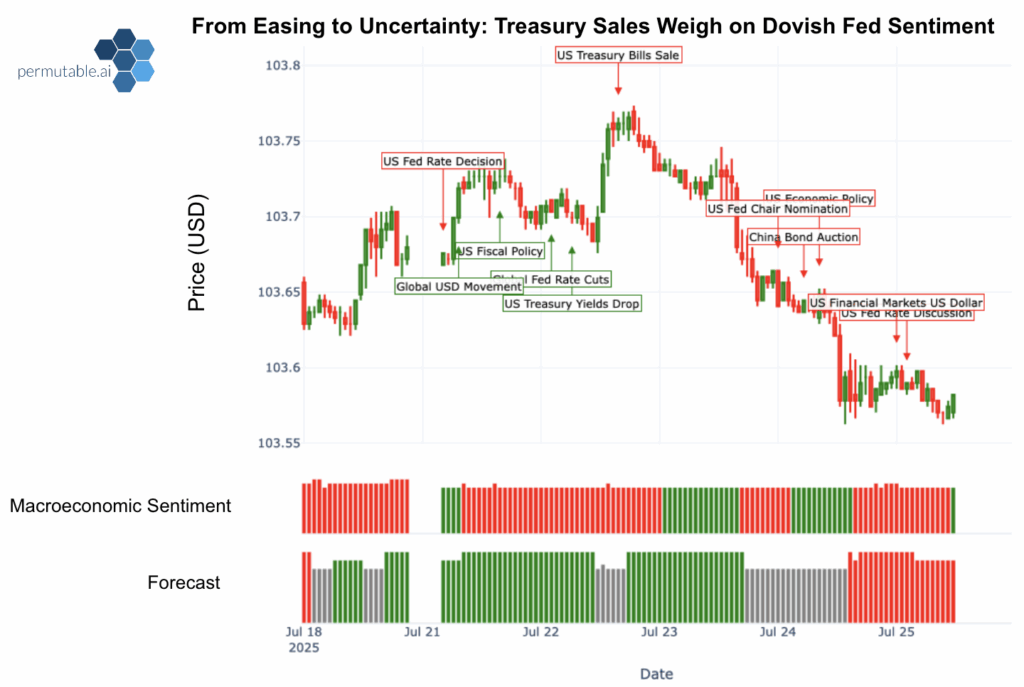
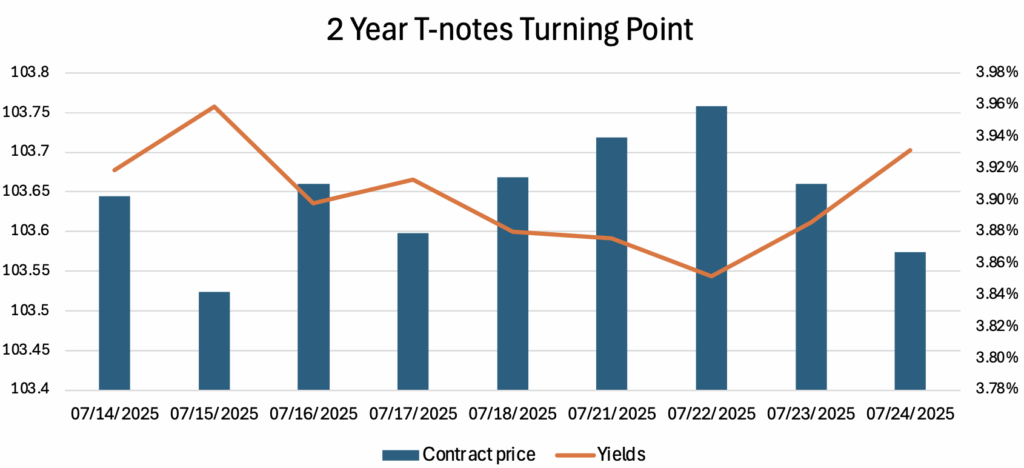
Between 18 and 23 July, our Trading Co-Pilot flagged a steady build-up in bullish sentiment surrounding the 2-year T-note as yields declined to around 3.85%, while the contract price rose from $103.60 to $103.75. This signal was driven by a combination of:
The signal came early, giving investors time to rotate before the broader market responded.

The recently signed US-Japan trade agreement, valued at over $550 bn, acted as a macro catalyst. Key provisions included Japanese investment in critical US sectors such as semiconductors and pharmaceuticals, alongside a reduction in US tariffs on Japanese cars from 27.5% to 15%.
The easing of trade tension sparked a rally in Japanese equities and led to a weaker greenback against the yen, improving the relative value of US Treasuries to foreign buyers. Our Trading Co-Pilot picked up on this rotation early, flagging sentiment gains tied to trade and FX dynamics.
The US Congress’s approval of a $9bn spending cut, targeted at foreign aid and public broadcasting, added another layer of support. Though modest in scale, it signalled a willingness to rein in public spending buoying investor confidence in fiscal restraint. The US Treasury’s preference for longer-dated issuance further supported demand at the short end.
Additional support came from Fed Governor Christopher Waller, whose dovish tone reinforced expectations for rate cuts to come. Although June CPI rose slightly to 2.7% from May’s print, inflation remained within the Fed’s acceptable range despite the trickle of tariff based inflation pressure creeping in. Our Trading Co-Pilot integrated these developments into a rising sentiment score well ahead of the rally in 2-year T-note prices.
However, from 24 July our Trading Co-Pilot detected a turn in sentiment as yields creeped back up and contract prices fell. This preceded the broader pause in Treasury gains and was driven by a convergence of factors:
Stronger labour market figures published on Thursday shifted the narrative of a slowing US growth. While markets still expect rate cuts in 2025, they have pulled back from pricing in two full cuts this year. A hold in July remains fully priced in, though expectations for a September move have weakened modestly.
Our Trading Co-Pilot incorporated these dynamics in real time. The forecast sentiment turned bearish on 24 July as yields rose and contract prices fell, reflecting an erosion in conviction around monetary easing. This foresight offered a vital edge as institutional positions recalibrated.

The 2-year T-note remains the most direct expression of market rate expectations. With its low duration and deep liquidity, it responds swiftly to shifts in policy tone and macro narrative. The combined effects of policy recalibration, geopolitical strain, trade stabilisation, and fiscal prudence have created a mixed environment for the 2-year T-note. Our Trading Co-Pilot translates these developments into forward-looking sentiment scores, ahead of both price action and consensus forecasts.
Even as gold retreated amid easing trade tensions, demand for 2-year T-notes still holds firm over concerns of increased market volatility. Our Trading Co-Pilot identified this divergence in real time, flagging a rotation towards yield-linked defensives as investors sought both safety and return.
Meanwhile, ongoing geo-political uncertainty in Japan, regional instability in the Middle East, and the prolonged war in Ukraine continued to support short-duration US Treasuries. Our Trading Co-Pilot tracked this constructive sentiment across geopolitical developments.
In a week marked by rapid shifts, our Trading Co-Pilot demonstrated its value as a real-time lens on the T-notes market. It identified the early bullish pivot, tracked the influence of trade diplomacy and macro policy, and detected the reversal.
In a market shaped by policy transition, trade realignment, and ongoing geopolitical risk, the 2-year T-note anchors institutional positioning.
Our Trading Co-Pilot intelligence suite delivers early, forward-looking insight across these moving parts, helping investors anticipate change and act before it becomes consensus.
For enquiries or trial access to our API or dashboard, contact us at: enquiries@permutable.ai
In this article, we explore Japan’s growing macro fragility as political uncertainty, surging bond yields, and a structurally weaker yen reshape investor sentiment. With JGB yields at multi-decade highs and the yen hitting record lows against major currencies, markets are undergoing a decisive re-pricing of risk. Amid this volatility, our Trading Co-Pilot has been able cut through the noise, identify turning points, and stay ahead of shifting macro trends.
In recent weeks, Japan’s economy and financial markets have entered a volatile phase, marked by a broad re-pricing of sovereign risk, mounting political uncertainty, and currency realignments across the board. Japanese Government bonds (JGBs) from 2-year to 30-year, have seen yields soar to levels not seen since the late 1990s, while the yen has collapsed to multi-decade lows against the euro, dollar, and Swiss franc. Against this backdrop, our Trading Co-Pilot has remained an essential lens through which investors can detect signals from noise, capturing inflection points, anticipating macro shifts, and providing confidence amid complexity.
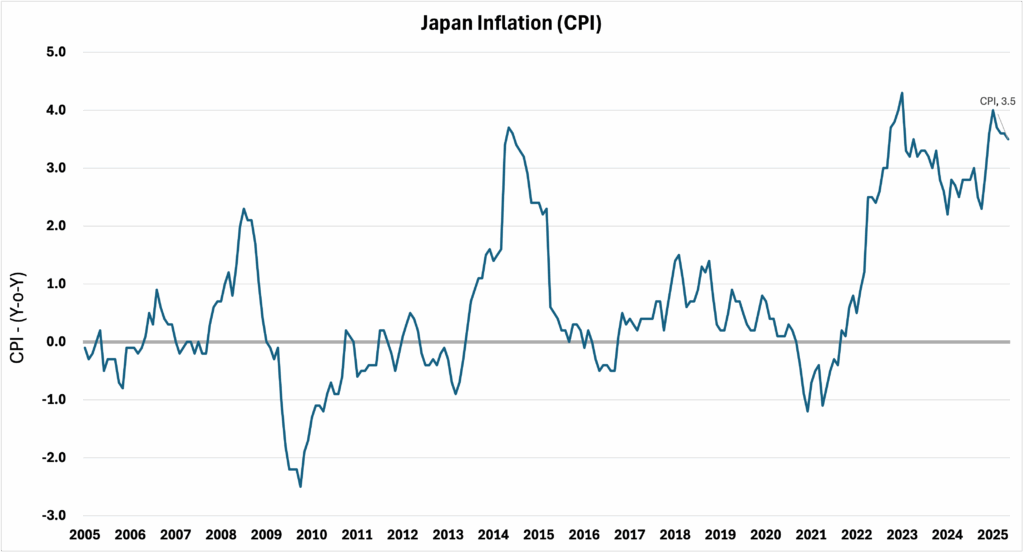
Japan’s inflation picture is diverging from historic norms. Headline inflation softened to 3.5% in May, its lowest reading since November, driven by slower price increases in healthcare, clothing, and household goods. However, the Bank of Japan’s (BoJ) preferred core inflation metric accelerated to 3.7%, its highest in over two years, reflecting structural price stickiness. Adding to the inflation woes is the doubling of rice prices, which has demonstrated the limitations of state subsidies in shielding households from food-driven price shocks.
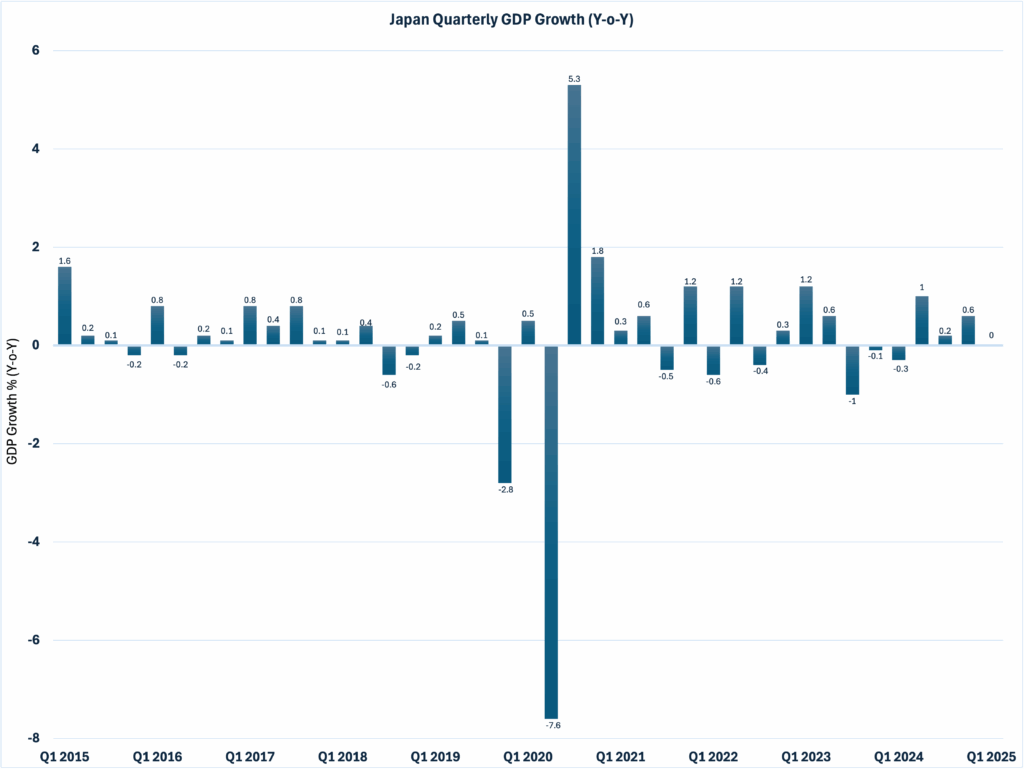
This presents a fundamental puzzle for the BoJ and reflects the broader uncertainty hanging over Japan’s economy. Having delivered its first interest rate hike in 17 years earlier in 2025, the BoJ opted to pause in June and to taper its bond issuance programme. Despite a string of weak GDP prints and flagging real wages, inflationary dynamics rooted in cost-push pressures, tariff-induced distortions, and wage trends suggest an undertone of fragility and persistent underlying price pressure. Growth remains subdued across Japan’s economy, with Q1 GDP flat and exporters challenged by a weakening yen and intensifying trade headwinds as Trump set a 25% tariff on Japanese imports. The political imperative, specifically looking ahead to the 20th July Upper House election, only raises the stakes.
In the absence of any new inflationary surprise, further monetary tightening is likely to be delayed until Q4 at the earliest. What we’re witnessing for policy in both a fiscal and monetary sense, is a balancing act whereby institutions are navigating a tightrope of inflation becoming too entrenched to dismiss, coupled with a subdued growth outlook too precarious to risk throwing off balance.
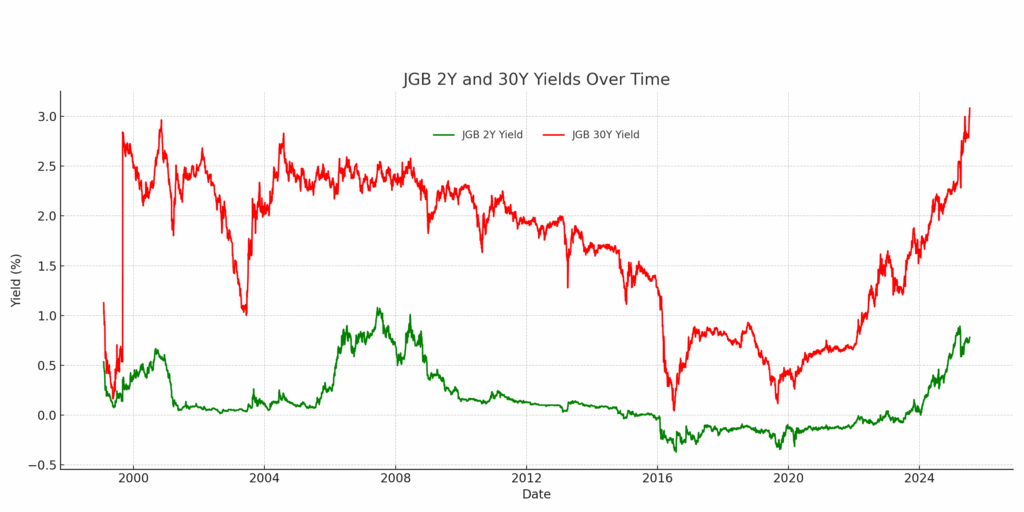
Japanese Government Bond yields have surged recently, signalling both structural unease and tactical repricing owing to mounting risk premiums. The 10-year yield has breached 1.55%, its highest level since March, and now teeters on the edge of a breaking higher above 1.6%, a level not seen since 2007. Meanwhile, the longer term bonds, notably the 30-year yield, have climbed past 3.2%, while the 20-year touched highs not seen since 1999.
This vertical repricing reveals a market bracing for fiscal slippage across Japan’s economy. With opposition parties campaigning on large-scale stimulus and potential tax cuts, the market fears a breakdown of fiscal discipline. Indeed, the Ministry of Finance’s earlier attempt to cap yields through bond issuance cuts proved short-lived and offered sparse relief. The chart reflects how JGB yields (both 2Y and 30Y) are now diverging from traditional norms, even as the yen weakens. This unusual dynamic underscores the risk premium now being priced into Japanese assets.
Our Trading Co-Pilot’s currency and political sentiment components have been leading indicators of this dislocation, signalling stress as early as June. The spread between the 2-year and 30-year JGB yields has widened dramatically, hinting investor discomfort.
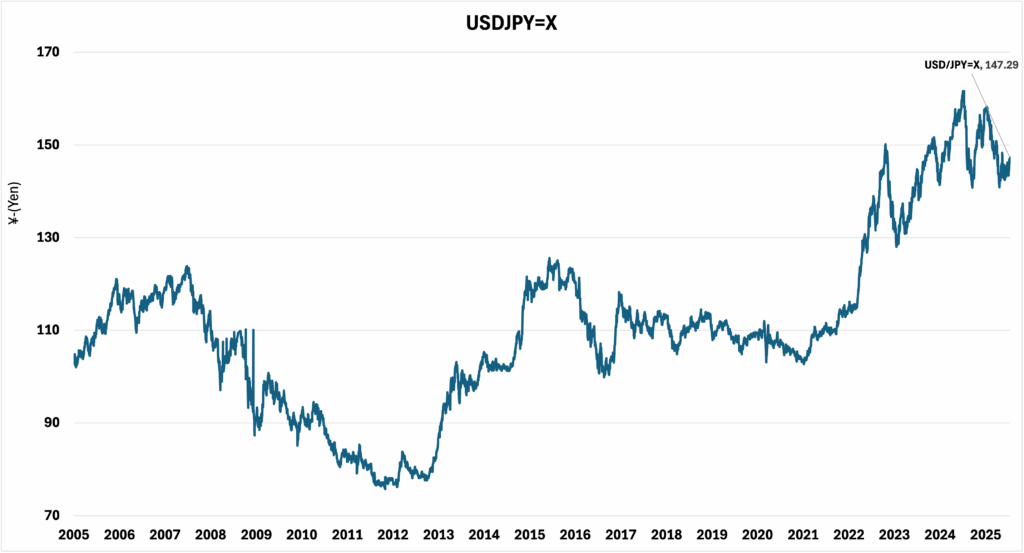
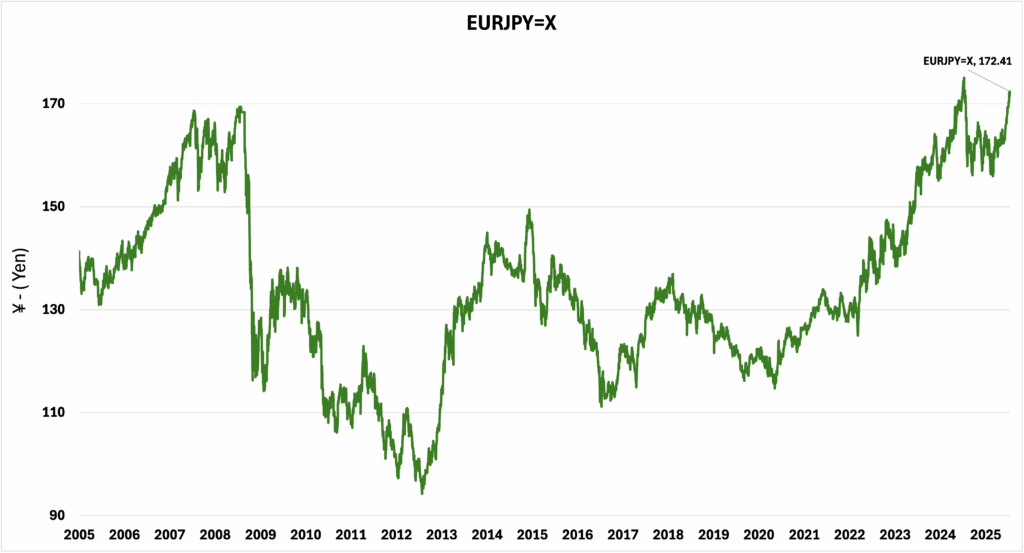
Despite the surge in JGB yields, the yen has continued to slide. USD/JPY has pushed above ¥147.00, closing in on cycle highs. Even more striking is the EUR/JPY cross, which hit a one-year high of ¥172.63, driven by euro strength and Japanese political risk. The yen’s underperformance reflects not just interest rate differentials, but also doubts over Japan’s fiscal trajectory, weak domestic demand, and the BoJ’s caution to commit to a sustained hiking cycle.
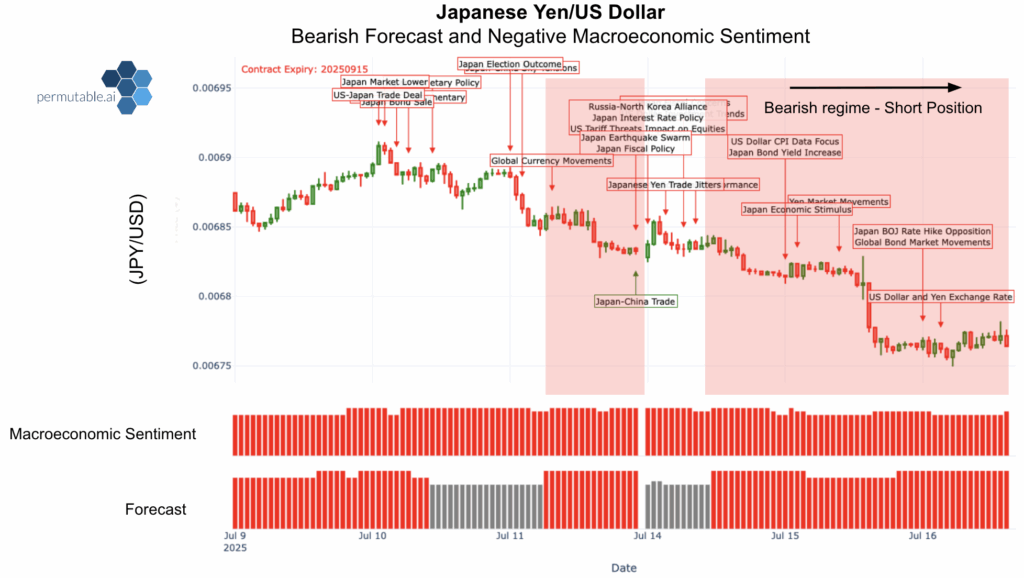
CHF/JPY offers another lens into safe haven divergence. Despite global risk-off sentiment, the Yen is no longer acting as a defensive asset. CHF/JPY recently surged to ¥185.30, in line with our Trading Co-Pilot headlines showing positive momentum in the Swiss economy, while Japan’s economy registered negative scores across nearly all categories, fiscal, political, and economic. The chart below shows the bearish outlook for the Yen, with macroeconomic and forecast sentiment turning pessimistic over the last week. Therefore, for investors to gain more confidence and the Yen to retain its defensive stature, the BoJ must look to signal a more hawkish stance or policymakers must allude to greater fiscal credibility which is difficult during election periods as parties look to appeal to voters.
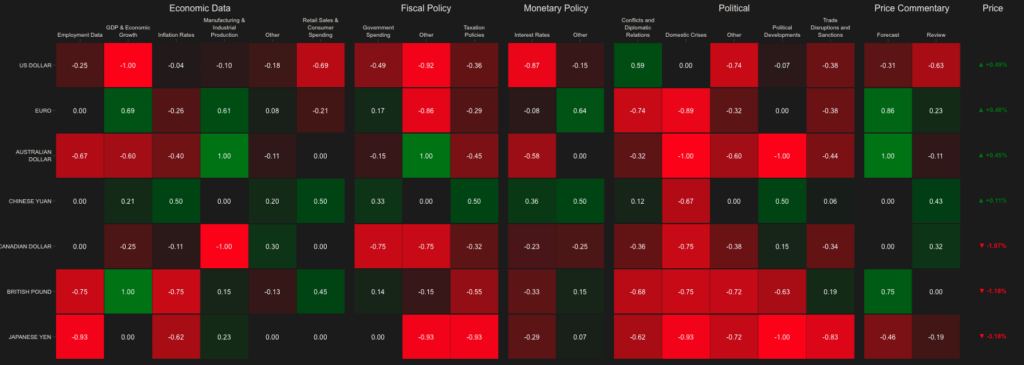
As highlighted in our FX sectoral heat-map, the Yen ranks as the weakest among major currencies. Negative sentiment spans across political developments (-1.00), employment data, fiscal policy, taxation, domestic crisis, at (-0.93), trade disruptions and sanctions (-0.83), inflation (-0.62), and interest rates (-0.29). This rare pattern of cross sector weakness explains the currency’s inability to benefit from yield rises or global volatility, conditions that historically supported the Yen.
The pair has surged to multi-week high of ¥147.00, as U.S. yields rose and Japanese yields repriced risk. Co-Pilot’s forecasts turned bullish on USD/JPY as early as July 9, correctly identifying the widening yield differentials and safe-haven premium for the dollar amid global tariff threats. The pair similarly reflects investor pessimism in the Japanese economy, showing strong negative sentiment with GDP growth (-0.80), interest rates (-0.77), and QE measures (-1.00), suggesting the market views Japanese tightening as tentative and insufficient given the fragility of Japan’s economy. In contrast, the dollar retains its policy momentum despite its own domestic challenges.
Recently soaring to a one-year high of ¥172.63, driven not just by Japanese weakness but eurozone resilience. Our Trading Co-Pilot’s EUR sentiment index pointed to continued investor rotation into euro assets due to comparative political stability and a hawkish-leaning ECB. EUR/JPY, is benefitting from a favourable eurozone backdrop. Modest economic resilience, improving inflation data, and political cohesion has benefitted rotation into the single currency. Even with EUR-based political frictions, the relative perception of stability keeps the Euro bid in JPY crosses.
The safe haven status of Swiss Franc has emerged as one of the most notable FX pivots. The pair has extended its longstanding uptrend, hitting highs near ¥185.30, supported by the Swiss franc’s classic safe-haven bid and deep investor scepticism toward Japan’s economy and its ability to contain fiscal slippage and recent geo-political shocks. The Franc is still regarded as the highest-quality safe haven across dimensions, with the yen losing its historical defensive status. The FX performance shows this clearly that CHF/JPY is now testing all-time highs even as JGBs rally, implying that market confidence in Japan’s policy coordination is fraying.
Looking ahead, Japan’s fiscal outlook and the Upper House election result will be pivotal. If the ruling coalition loses its majority, markets may brace for aggressive stimulus proposals, raising the spectre of debt monetisation. However, a divided opposition and legislative hurdles make immediate fiscal expansion less likely. It remains to be seen whether the current political noise will sustain uncertainty in bond markets, capping the Yen on the upside.
For investors, Japan’s economy is no longer the low-risk, low-return anchor that it once was. Yields are rising, but not for the right reasons. Currency weakness appears structurally inherent and not a tactical play. The bigger picture at hand sees the BoJ being boxed in by confluence of above target inflation and lacklustre growth. This is coupled by the emergence of political risk returning to Tokyo complicating matters of fiscal orthodoxy and raising the guard of bond vigilantes.
In this environment, our Trading Co-Pilot remains a vital tool for institutional decision-making. By aggregating sentiment across sectors and policy domains, being able to track structural divergences in real time enables faster rebalancing across FX strategies. As Japan’s economy edges towards its policy reckoning, we’ll be watching the headlines, and signalling ahead of the turn.
Stay ahead of structural dislocations and policy uncertainty with our real-time macro intelligence. Our plug and play Trading Co-Pilot intelligence suite empowers clients to anticipate turning points across FX and fixed income, before the market prices them in.
To access our full dashboards, strategy tools, or schedule a demo, simply email: enquiries@permutable.ai
A: It measures real-time sentiment across political, fiscal, monetary, and trade domains, highlighting how shifts in narrative and investor confidence shape Japan’s bond and currency markets.
A: This unusual divergence reflects structural concerns about Japan’s fiscal trajectory and doubts over the Bank of Japan’s commitment to sustained tightening. Rising yields are driven by risk premiums, not stronger fundamentals, while the yen’s safe-haven appeal has eroded.
A: Leadership uncertainty, election-driven fiscal promises, and tensions with trading partners amplify volatility. These political risks reduce confidence in fiscal discipline, contributing to both rising yields and yen weakness.
A: The yen has lost ground as a traditional defensive currency. Crosses such as CHF/JPY show investors increasingly prefer the Swiss franc, reflecting waning trust in Japan’s policy coordination during periods of global stress.
A: Institutional clients can integrate the sentiment data into FX and fixed-income strategies to anticipate turning points. It helps flag credibility risks, track divergence between yields and currencies, and identify structural dislocations before they manifest in price action.
At Permutable, we’re redefining how investors navigate market volatility. As shocks from global tariffs and geopolitical headlines increasingly drive near-instant market reactions, traditional economic indicators arrive too late to inform timely decisions. Built for this new era, Permutable’s Trade Sentiment Index (TSI) quantifies the tone, direction, and momentum of trade-related news in real time, across thousands of global sources.
Rather than reacting to backward-looking data, the TSI empowers investors to anticipate cross-asset moves in equities, commodities, FX, and rates, capturing shifts in market sentiment as they happen. In this study, we examine how the TSI provides a forward-looking lens on trade-driven volatility, enabling faster, more informed decisions in today’s headline-sensitive markets.
Trade sentiment has clearly emerged as the dominant force in market pricing, often displacing traditional economic data as the key input into asset valuation. All eyes are currently fixed on 1 August, the date on which Trump’s temporary tariff reprieve expires, potentially leaving over 100 countries facing the prospect of fresh levies.
This marks a fundamental transition in how markets interpret macroeconomic risk, driven less by data prints and more by evolving geopolitical narratives. Each new tariff threat, or, conversely, a pronouncement from the BRICS bloc, such as their recent statement of “grave concern” over unilateral trade measures, alongside renewed calls for de-dollarisation, sends a jolt through currencies, bonds and commodities. Only last week, an initial 10% tariff warning aimed at BRICS nations, specifically those deemed to instigate “anti-American policies”, propelled the dollar above 97.00. Meanwhile, gold, typically a refuge in times of volatility, retraced from $3,339 to $3,311 on mere murmurs of trade progress, demonstrating the market’s heightened sensitivity to geopolitical developments.
Copper, too, has become a geopolitical barometer. The July announcement of a 50% tariff on copper imports led to an unprecedented 17% surge in COMEX copper futures, the largest single-day move on record. While some of this spike reflects front-running behaviour ahead of the tariff’s implementation, it also signalled the market’s repricing of supply chain disruption and longer-term demand risk.
Simultaneously, the US administration’s expansion of its tariff campaign, with new 25 – 40% levies targeting Malaysia, Kazakhstan, South Africa, Laos, Myanmar, and trans-shipped goods via Vietnam. Vietnam brokered a more favourable two-part deal, a 20% tariff on domestically produced goods and 40% on trans-shipped imports, aimed at curbing indirect Chinese flows. These measures followed closely on the heels of a 25% tariff on imports from Japan and South Korea, two of America’s largest trading partners. Trump warned of additional 25% tariffs on any retaliatory measures. Japan’s Finance Minister labelled the move regrettable, while Prime Minister Ishiba firmly rejected the notion of capitulation.
Then, the European Union and Mexico were next to come in the firing line. With both recently receiving letters from the US confirming a blanket 30% tariff, a stark reversal after speculation just a day earlier of an imminent US-EU trade agreement. Trump’s long-standing hard-line rhetoric on the EU set the stage, and the letters make clear that August 1 is now the inflection point. The EU has delayed its retaliation until that date, opting to retain leverage while recalibrating strategy.
In this context, traditional safe havens have grown fragmented. The dollar continues to rally on negative sentiment shocks but quickly reverses on hints of dovish Fed policy pivot. While gold has maintained some safe-haven characteristics, it often retreats on signs of trade progress. Treasuries, meanwhile, have exhibited violent swings, reacting as much to fiscal risks as to pure sentiment.
This reveals that trade and tariff risk is not just a geopolitical flashpoint, but a fundamental shift in how markets price risk and manage strategies.
Permutable’s TSI is designed to quantify these narrative shifts in real time. Using natural language processing, the index ingests trade-related headlines from global sources, scoring them on tone, polarity, volume, and topic intensity. The result is a real-time signal that offers:
Clients can access the TSI via API, using it to monitor regime shifts, manage risk, and spot trading opportunities in volatile macro conditions.
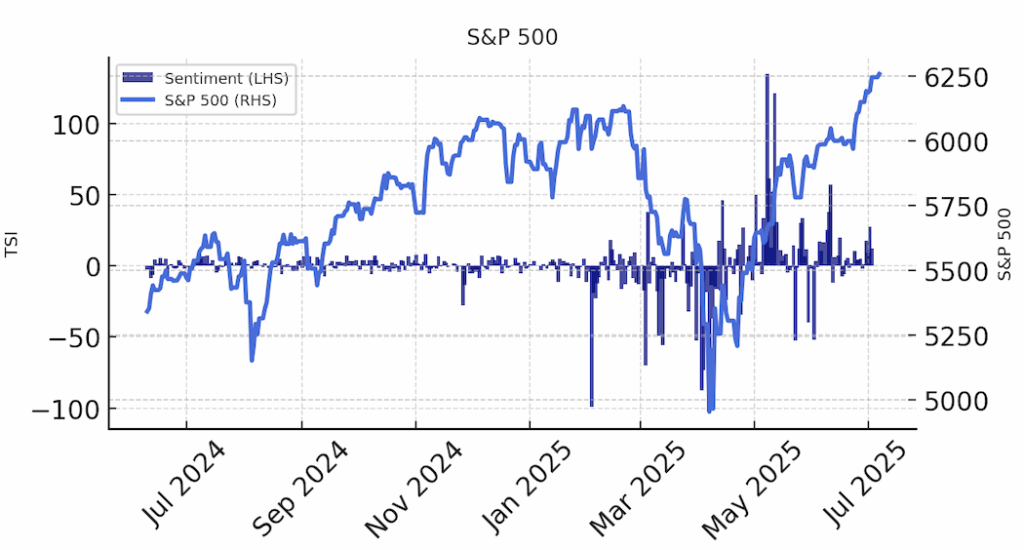
Among all asset classes, the S&P 500 demonstrates the strongest correlation with the TSI. March – April 2025 saw pronounced drops in TSI coincide with a steep decline in the index, followed by recovery in Q2 as sentiment improved.
Implication: TSI provides early/on the day signals of equity rotation and drawdown risk
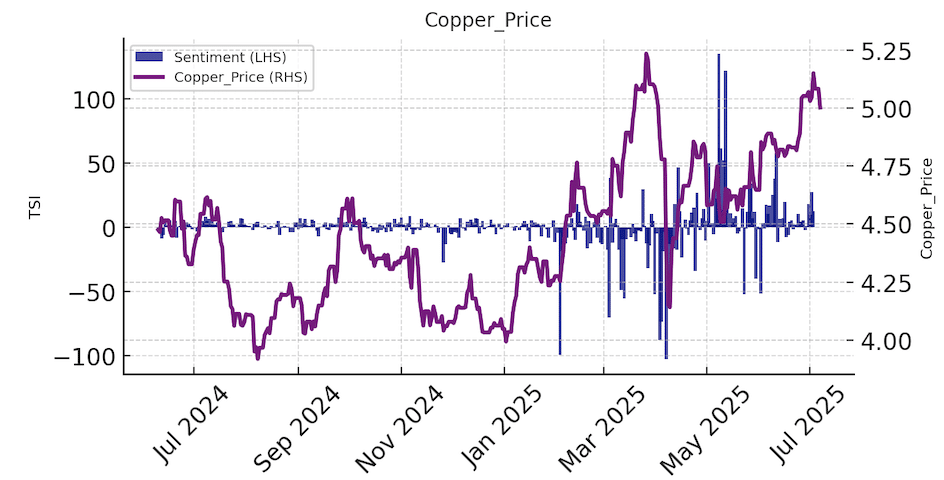
Copper, traditionally a proxy for industrial demand, has shown increasing sensitivity to trade sentiment. The recent tariff on copper imports announced in July 2025 triggered a record one-day price surge, highlighting copper’s role as a geopolitical barometer.
Correlation coefficient: +0.10
Implication: The TSI helps identify front-running behaviour ahead of supply chain disruption or demand rebounds
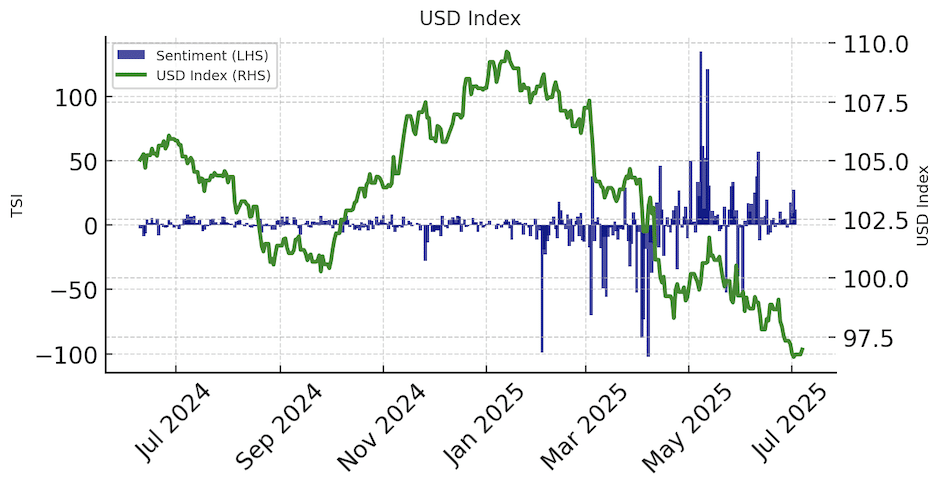
US Dollar dropped sharply on negative sentiment (e.g., during Feb, Apr, July tariff rounds). Domestic trade policy weakened USD appeal spurring capital flight. Investors are increasingly viewing US-linked tariffs, fiscal risks, and lower yield support as dollar-negative. Even modest recoveries in sentiment failed to revive the greenback. The Trade Sentiment Index is best used here to detect macro shifts in how the dollar is perceived.
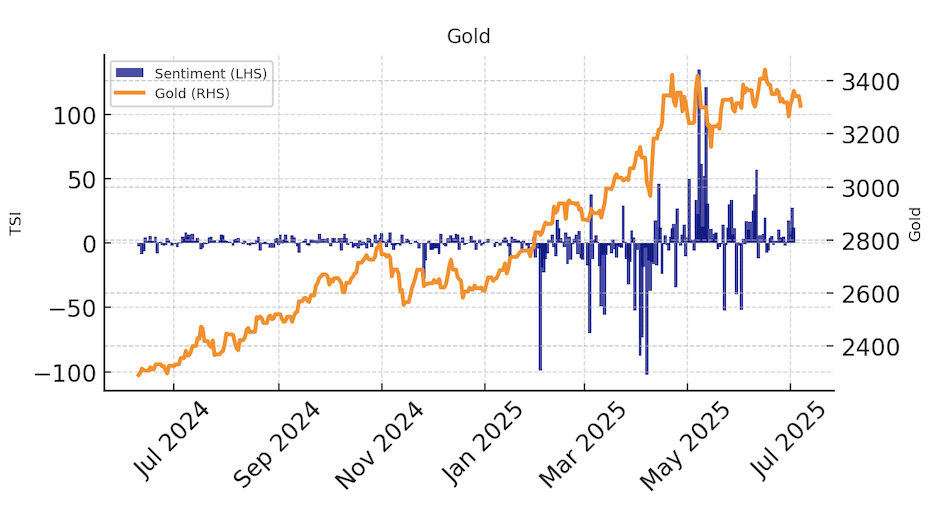
Gold surged to nearly $3,500/oz during mounting tariff escalation, reaffirming its role as a crisis hedge. It then plateaued, held back by rising real yields and brief dollar resilience. By late June, gold rebounded as sentiment worsened and the dollar declined. This shows gold remains effective as a hedge when falling sentiment aligns with loose liquidity. The Trade Sentiment Index is especially valuable for gold during acute stress events.
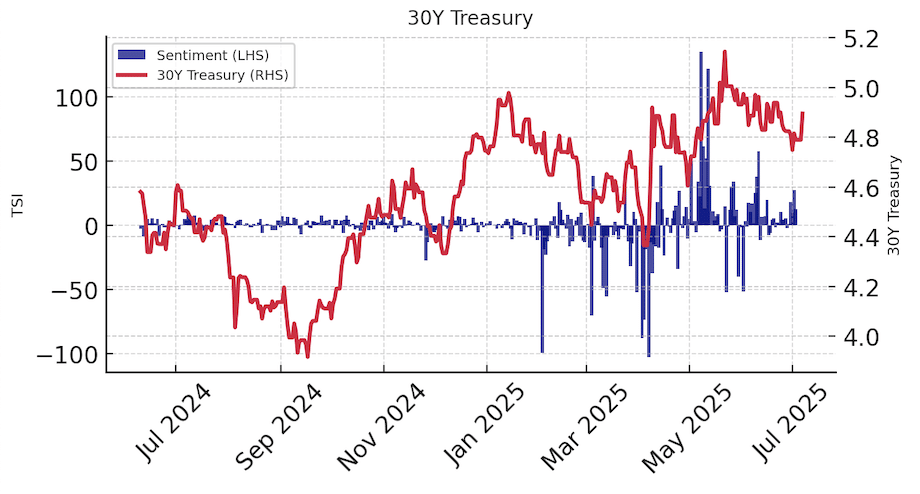
30-year treasury yields rose over ahead of April’s shock in trade sentiment, being reactive to protectionist shocks and US domestic strength. Yields have moved closely with sentiment momentum, as markets price in the inflationary and fiscal risks from escalating tariffs. Treasuries now reflect not just fear, but market judgement on policy credibility.
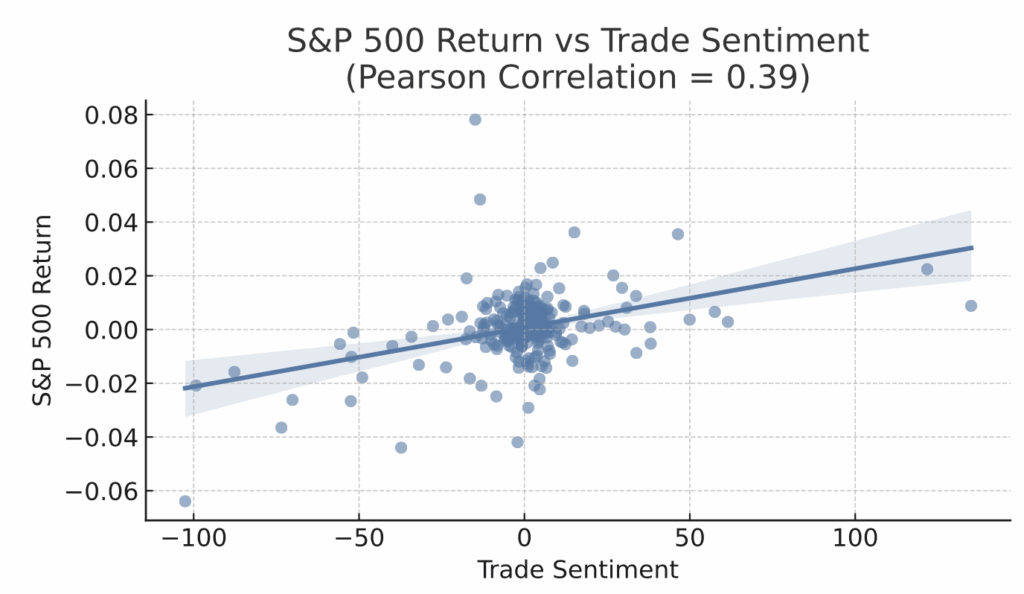
Recent regression analysis of our Trade Sentiment Index scores versus daily asset returns highlights a clear divergence in sensitivity across asset classes:
S&P 500 exhibits a moderate positive correlation (r = +0.39) with trade sentiment. As TSI scores rise, signalling an improving trade narrative – the index tends to rally, particularly in sectors with significant international exposure. This reinforces TSI’s value as a forward indicator for equity risk-on phases and investor confidence in global earnings stability.
Gold, by contrast, shows no meaningful correlation (r = 0.00) to TSI. While often considered a geopolitical hedge, gold’s price behaviour in 2025 has become increasingly selective, responding less to general trade noise and more to systemic stress signals such as instability, inflation or central bank actions. This suggests gold is a consistent hedge for geopolitical risk and ought to be pivoted into more tactically in diversified portfolios.
Copper and 30Y Treasuries exhibit low but positive correlations, respectively, indicating lagged or secondary reactions to sentiment shifts, consistent with copper’s role in industrial cyclicality and Treasuries’ sensitivity to broader risk conditions.
USD Index also shows a modest positive correlation, reinforcing the idea that the dollar strengthens modestly during sentiment recoveries but more sharply on crisis headlines.
The strength of the S&P 500’s alignment with our TSI suggests that trade sentiment has evolved into a reliable leading signal for equity allocation, while gold’s decoupling cautions against assuming traditional safe havens will always respond to geopolitical stress.
The timeline outlines the pivotal moments in 2024–25 when trade disruption reshaped market sentiment, drove asset repricing, and triggered regional volatility across equities, FX, metals, and bonds.
|
Date |
Event/Trigger |
Regions |
Market Reaction Snapshot |
|
2024-09-13 |
US hikes China tariffs |
US, China |
USD up, China stocks down, metals rally |
|
2025-01-20 |
Trump inauguration, tariff rhetoric |
US |
Mild USD uptick, cautious equities |
|
2025-02-04 |
US 10% tariff on China |
US, China |
Dollar up, gold soft, S&P drops |
|
2025-03-04 |
US +10% tariff; China retaliates |
US, China |
Gold/treasuries up, equities fall |
|
2025-03-12 |
US steel/aluminum tariffs |
US, BRIC, EU |
Metals spike, global stocks dip |
|
2025-04-02 |
US 34% China tariff + 10% global baseline |
US, China, EU |
Risk-off: USD/gold up, S&P/EM FX down |
|
2025-04-04 |
China 34% retaliation, WTO complaint |
US, China |
Gold up, US exporters hit |
|
2025-04-07 |
US 50% tariff on China |
US, China |
Treasuries up, equities drop |
|
2025-04-09 |
US 125% China tariff, delays for others |
US, China, EU |
Equities rebound, gold/bonds retrace |
|
2025-04-10 |
US/China escalate to 145%/125% tariffs |
US, China |
Global stocks down, gold/treasuries up |
|
2025-04-21 |
US retailers warn on tariff price hikes |
US, China, EU |
Retail/consumer stocks lag |
|
2025-04-24 |
Trump hints at tariff reductions |
US, China, EU |
Equities stabilise, risk appetite returns |
|
2025-05-03 |
US auto part tariffs |
US, BRIC, EU |
Autos down, USD steady |
|
2025-05-12 |
US-China 10% tariff truce (90 days) |
US, China |
Relief rally: S&P, EM FX up, gold down |
|
2025-06-09 |
US-China trade talks in London |
US, China |
Markets optimistic, S&P/EM FX climb |
|
2025-06-16 |
US 50% steel-appliance tariff |
Global |
Metals/equities volatile |
|
2025-06-25 |
EU announces new trade strategy & CBAM |
EU |
EUR weak, EU stocks mixed |
|
2025-06-27 |
US-China trade truce framework |
US, China |
Commodities stabilize, equities firm |
|
2025-07-07 |
US delays reciprocal tariffs |
US, BRIC, EU |
Temporary relief, risk assets bounce |
|
2025-07-08 |
US plans 49% tariffs for non-deal countries |
US, BRIC, EU |
USD up, metals rally |
|
2025-07-09 |
US 50% copper tariff |
US, Brazil, RU |
Copper up, EM FX pressured |
|
2025-07-10 |
US 50% tariff on Brazil |
US, Brazil |
BRL weak, Brazil stocks down |
|
2025-07-11 |
US 35% tariff on Canada |
US, Canada |
CAD down, Canadian stocks fall |
|
2025-07-12 |
US 30% tariffs on EU & Mexico |
US, EU, Mex |
EUR/MXN weak, EU/Mex stocks down |
|
2025-07-13 |
EU delays response to US tariffs |
EU |
EU markets cautious |
The Trade Sentiment Index transforms real-time narrative signals into strategic intelligence. Whether managing downside risk, capturing tactical opportunities, or enhancing existing models, the TSI provides a robust framework for navigating sentiment-driven markets.
In a sentiment-driven regime, long-term asset allocation strategies must account for both narrative volatility and its cascading impact across asset classes. Our TSI offers a powerful overlay for:
Our TSI adds a forward-looking, data-driven lens to macro allocation, helping investors avoid the lag embedded in traditional economic forecasting models.
In a market environment defined by speed and noise, clarity and timing have become competitive advantages. As geopolitical risks and trade policy shifts increasingly drive asset prices, investors need tools that cut through the narrative and deliver insight before traditional data reacts. The value is immediate, earlier positioning, clearer strategy, and better-informed risk decisions across portfolios.
The TSI detects real-time breakdowns in trade sentiment that often precede macro dislocations. For example, in early July 2025, sentiment around U.S.–BRICS trade deteriorated sharply ahead of new tariff measures. Renewed uncertainty around metals and EM currencies reacted sharply in the days following, but the TSI flagged this escalation beforehand. For macro funds managing cross-asset exposure, this lead time enables early risk reallocation and alpha generation around policy-driven volatility.
The TSI helps identify when risk appetite pivots, before it becomes consensus. In late April 2025, sentiment began to recover following weeks of protectionist escalation. The S&P 500 rebounded shortly after, as risk assets priced in easing trade tensions. TSI’s inflection provided a forward-looking signal for timely re-entering equities or increasing cyclical tilts, allowing allocators to act ahead of broader market positioning.
Sustained fall in TSI, such as those observed through March and early April 2025, can act as early warnings of structural macro stress. During this period, equity markets declined and uncertainty around global supply chains intensified. Strategists monitoring sentiment would have had the insight to shift exposures towards defensive assets sooner, reducing risk-weighted allocations, before fundamentals deteriorated. TSI supports a more adaptive, geopolitically aware allocation strategy.
Market behaviour is increasingly shaped by the tone of trade policy, not just its implementation. The Trade Sentiment Index offers a structured, real-time view of global trade narratives, allowing clients to respond with greater speed, precision, and alignment to the evolving macro regime.
The message is clear: trade sentiment is no longer a peripheral consideration – it has become a central force driving cross-asset price action. Against the backdrop of fragmented trade alliances, perpetual tariff threats, and politicised supply chains, traditional macroeconomic indicators alone no longer provide a complete picture. Investors must now account for the mood of the market, the tone of geopolitical dialogue, and the shifting narratives that shape risk and opportunity.
This marks a fundamental regime shift. Trade alliances are increasingly transient, tariff threats are ever-present, and global economic stability is deeply entangled with political perception. Market movements are no longer driven solely by data or policy; they are increasingly shaped in real time by sentiment, information flow, and geopolitical narrative shifts.
Permutable’s Trade Sentiment Index is designed specifically for this new reality. Unlike traditional tools that lag behind events, our TSI captures and quantifies emerging narratives as they unfold. It allows investors, asset managers, and strategists to track sentiment divergences between trading partners, detect geopolitical tone shifts, and anticipate volatility before it is reflected in prices. By bringing structure and intelligence to the noise, our TSI offers a unique advantage in understanding and navigating geopolitically driven markets.
In an era where perception moves faster than policy, sentiment is no longer noise – it’s signal. It is, in every sense, the new macro.
Anticipate market-moving events with real-time sentiment intelligence. Seamlessly integrate the Trade Sentiment Index via API and set tailored alerts by asset, region, or topic to stay ahead of the next volatility shock.
To schedule a demo or request access simply email enquiries@permutable.ai

This article explores how sophisticated geopolitical news and analysis capabilities enable institutional investors to convert political uncertainty into strategic advantage through AI-powered intelligence platforms. It is aimed at institutional investors, risk managers, portfolio strategists, and financial professionals seeking to enhance their geopolitical risk assessment and investment decision-making capabilities.
The landscape of institutional investing has fundamentally shifted, with geopolitical events now serving as primary drivers of market volatility across asset classes. Traditional approaches to political risk assessment – characterised by reactive analysis and limited data sources – are proving inadequate for navigating today’s interconnected global markets. The emergence of sophisticated geopolitical news and analysis of the kind that we offer through our own geopolitical data feeds enables investors to transform political uncertainty from a source of risk into a strategic opportunity through advanced intelligence capabilities.
Modern financial markets are demonstrating unprecedented sensitivity to political developments, with events ranging from election outcomes to international trade disputes capable of triggering significant asset price movements within minutes. This heightened sensitivity demands a fundamental shift in how institutional investors approach geopolitical risk management. Rather than relying on traditional news sources and retrospective analysis, leading institutions are increasingly turning to AI-powered platforms that provide real-time geopolitical news and analysis, enabling proactive positioning ahead of market-moving events.
The sophistication of contemporary geopolitical intelligence extends far beyond simple news aggregation. Our systems employ advanced natural language processing and machine learning algorithms to decode sentiment signals embedded within vast volumes of political discourse, policy documents, and international communications. By analysing these complex data streams, we provide institutions with predictive insights that traditional geopolitical news and analysis methods simply cannot provide. This capability proves particularly valuable when monitoring developments in key geopolitical hotspots, where early warning signals can provide significant competitive advantages.
Above: Crude oil multi-factor analysis dashboard from our Trading Co-Pilot intelligence suite showing the ranking of fundamental and geopolitical factors during the Iran crisis week. The heatmap visualisation reveals how geopolitical tensions (shown in red) dominated other market drivers like supply disruptions and demand patterns, with our sentiment algorithms providing clear early warning signals.
Our experience working with institutional clients across global markets has made it clear that traditional sources of alpha are eroding more rapidly in an environment defined by real-time information flow and geopolitical complexity. As political developments increasingly drive short-term market dislocations, the ability to respond with speed and precision has become essential to preserving performance margins.
Sophisticated geopolitical intelligence insights, such as those we provide, offer a timely antidote to alpha decay. By detecting early signals of, for example, political instability – often before they are reflected in mainstream media or market pricing – our systems enable investors and portfolio managers to act pre-emptively, not reactively. This reduces exposure to adverse price moves and strengthens the potential to generate relative outperformance over time.
And so, rather than relying on lagging indicators or retrospective analysis, those institutions equipped with real-time, AI-driven geopolitical insight are better positioned to maintain alpha in fast-moving conditions. In this context, real-time news intelligence is not simply a source of outperformance – it is a mechanism for preserving competitive edge in an increasingly crowded and volatile market landscape.
Above: The chart demonstrates our Trading Co-Pilot successfully identifying a strategic LNG entry point at €36.16/MWh on June 12th, preceding a sustained rally to €42/MWh driven by geopolitical tensions and bullish fundamentals. The system’s multi-layered sentiment analysis – spanning fundamental, macroeconomic, and geopolitical factors (shown in the bottom indicators) – provided early warning signals of market momentum shifts. Notable geopolitical catalysts included Iran tensions, LNG infrastructure developments, and supply chain disruptions, while the recent ceasefire agreement triggered the technical pullback. This exemplifies how sophisticated geopolitical intelligence transforms political uncertainty into actionable trading opportunities, with our Co-Pilot’s robust sentiment indicators enabling precise entry and exit timing ahead of market consensus.
The practical applications of sophisticated geopolitical intelligence extend across multiple investment strategies and risk management frameworks. For example, portfolio managers can harness our real-time political sentiment analysis to adjust sector allocations ahead of policy announcements, whilst risk teams can employ our geopolitical tension indices to calibrate exposure limits during periods of heightened international instability. The benefits also extend to currency traders leveraging diplomatic relationship monitoring to anticipate central bank interventions, and energy investors track geopolitical developments in key producing regions to forecast supply disruptions and price volatility.
Historical analysis reveals consistent patterns in how geopolitical events impact specific asset classes and market segments. Of course it goes without saying that energy markets demonstrate particular sensitivity to Middle Eastern political developments, whilst emerging market currencies respond predictably to shifts in US-China relations. Technology sectors show vulnerability to international trade policy changes, and defence contractors benefit from escalating international tensions. Understanding these historical relationships through comprehensive geopolitical news and analysis enables more sophisticated forecasting and strategic positioning, which is what our 10 year historical data facilitates.
Seamless integration with institutional investment systems
At Permutable, we’ve built our geopolitical intelligence to integrate effortlessly with institutional infrastructure. Through robust API connectivity, our real-time sentiment signals and geopolitical insights can be embedded directly into existing trading systems, portfolio construction tools, and risk management frameworks. This ensures that political developments are translated into actionable insights instantly – reducing the latency between event emergence and strategic decision-making, while preserving analytical rigour and auditability.
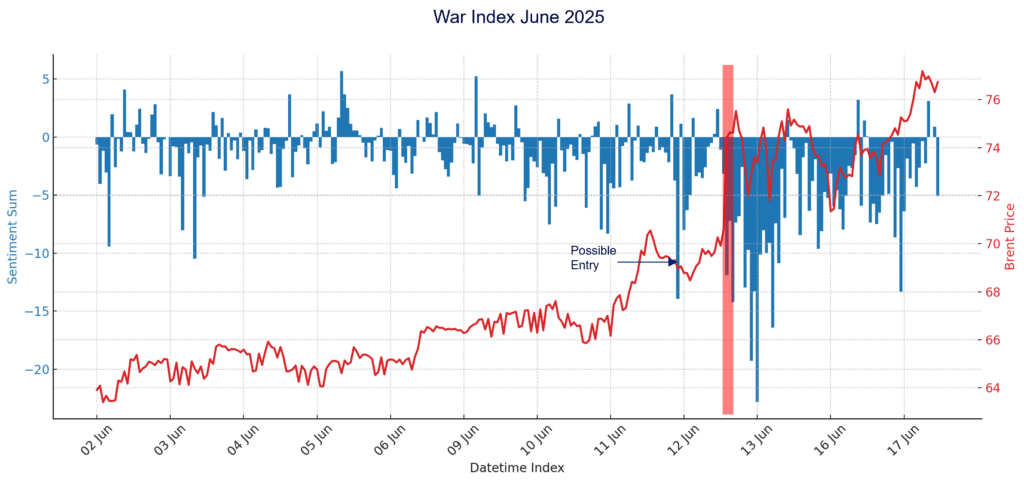
Above: Our War Index tracks real-time geopolitical tension levels through advanced sentiment analysis of global political discourse. The chart reveals a dramatic escalation in conflict risk during mid-June 2025, with sentiment indicators (blue bars) showing intense negative spikes coinciding with rising Brent crude prices (red line). The “Possible Entry” annotation highlights how our system identified optimal positioning opportunities as geopolitical tensions began building around June 11th, preceding the sharp price rally from $68 to over $76 per barrel. The sustained period of elevated tension (indicated by the red shaded area) demonstrates how our War Index provides early warning signals of geopolitical risk premiums entering energy markets, enabling institutional investors to anticipate and capitalise on volatility before it becomes widely recognised by market participants.
At Permutable, we equip our clients with the tools and data to move from reactive to proactive geopolitical risk management. By surfacing early sentiment shifts and identifying geopolitical fault lines in real time, we empower portfolio managers and risk teams to anticipate and respond to volatility before it’s widely recognised by the market. Institutions relying on legacy methods face mounting disadvantages — from increased transaction costs to eroded alpha — while those using Permutable’s platform gain a structural edge in positioning and timing.
Speak to our team to explore how Permutable’s geopolitical intelligence can help you stay ahead of market consensus and protect alpha. Discover how real-time signals can be seamlessly integrated into your investment strategy. Email our team at enquiries@permutable.ai to request a demo.
We have released our comprehensive 12-month analysis from the Political Tension Sentiment Index, revealing that global political sentiment has remained overwhelmingly negative throughout the period – driven by sustained trade conflicts, high-profile leadership events, and frequent diplomatic flashpoints.
Our Index, which leverages advanced machine learning to track sentiment across thousands of headlines in near real time, reveals a pattern of persistent volatility with minimal recovery periods. This signals heightened risk conditions for markets, institutions and policymakers alike.
Our data shows that political risk is no longer episodic – it has become systemic. The Index highlights continuous swings in political sentiment, reflecting embedded instability that extends well beyond one-off crises. Investors are now operating in a sentiment-driven environment where trade policy and public figures can have immediate and far-reaching impacts on market confidence.
Political risk manifests differently in global markets than it has historically. Rather than experiencing isolated periods of tension followed by stability, we are witnessing a sustained state of political volatility that has become the baseline condition for international relations. Understanding and managing political risk has therefore become crucial for modern investment strategies.
Our analysis identifies trade policy as the most significant driver of political sentiment volatility. The Index recorded substantial sentiment plunges during the US–Canada tariff dispute in February 2025 and again following Trump’s tariff policy announcements in April 2025. These events demonstrate how protectionist economic measures continue to drive global unease and create ripple effects across international markets.
The persistence of trade-related sentiment volatility suggests that global economic integration remains fragile, with markets highly sensitive to any signals of protectionist policy shifts. This finding has critical implications for commodity pricing, supply chain management, and international investment strategies. Political risk assessment must now account for the heightened sensitivity of global markets to trade policy announcements.
Whilst our data shows temporary sentiment rebounds linked to positive developments such as the US-UK trade deal and global tariff talks in May 2025, these improvements were quickly reversed. This pattern highlights the fragile nature of the current geopolitical outlook and suggests that markets remain sceptical about the sustainability of diplomatic progress.
The brief nature of these positive sentiment spikes indicates that investors and stakeholders are adopting a more cautious approach to geopolitical developments, requiring sustained evidence of stability before adjusting their risk assessments.
Our Index demonstrates how individual personalities are increasingly influencing global political sentiment. We recorded a sharp spike after Trump’s inauguration in January 2025 and a steep decline following the Trump-Musk fallout in June 2025. These events reveal the outsized influence that public figures and leadership dynamics have on market confidence.
Political risk becomes increasingly complex for risk managers and investors when individual personalities drive market sentiment, as traditional geopolitical analysis must now account for individual relationships and public controversies that can rapidly alter market sentiment. Modern political risk management requires sophisticated tools to track these personality-driven volatility patterns.
Our data shows that political risk is no longer episodic – it’s become systemic,” commented Wilson Chan, our Chief Executive Officer. “Investors are operating in a sentiment-driven environment where trade policy and public figures can have immediate and far-reaching impacts on market confidence. Our Political Tension Index provides an essential early indicator to help hedge funds, risk managers and policy strategists stay ahead of these shifts.”
Our market analyst Jack Watson anticipates that political volatility will remain elevated through the second half of 2025. “With upcoming elections, unresolved trade tensions, and continued scrutiny of political leaders, the environment remains highly reactive,” Watson explained. “Markets are likely to stay sensitive to sentiment-driven headlines, which could directly affect commodity pricing, equity markets, and broader global risk appetite into 2026.”
Our Political Tension Sentiment Index uses advanced natural language processing to extract sentiment signals from thousands of global media headlines. It tracks public mood related to governance, diplomacy, trade disputes, controversies and leadership perception, offering investors a clear lens on global political instability.
Political risk monitoring through our Index serves as a real-time warning signal and a leading indicator of rising tensions, helping investors and risk professionals make timely adjustments to their exposure. It also provides quantitative insight into political sentiment, making it a valuable alternative data source for macro modelling, geopolitical forecasting and stress testing. Effective political risk monitoring requires continuous data feeds and sophisticated analytical capabilities.
With daily updates and global scope, the Index reflects sentiment across international headlines, giving users a cross-border view of evolving political pressure points.
Political risk management strategies require fundamental reassessment given the systemic nature of current political volatility. Traditional approaches that treat political risk as episodic may be insufficient in the current environment. Our data suggests that continuous monitoring and rapid response capabilities are now essential for effective risk management. Political risk has evolved from a peripheral concern to a central factor in investment decision-making.
At Permutable, we provide real-time global market data intelligence to institutional investors and risk professionals through our AI-powered tools that extract and interpret insights from news media, macroeconomic indicators and geopolitical signals – enabling faster and more informed strategic decisions through our specialist plug and play intelligence solutions.
Contact our team today to discover how our Political Tension Index can enhance your risk management strategy. Get in touch by emailing enquiries@permutable.ai to schedule a demonstration and see how our real-time sentiment intelligence can protect your portfolio from unexpected political volatility.
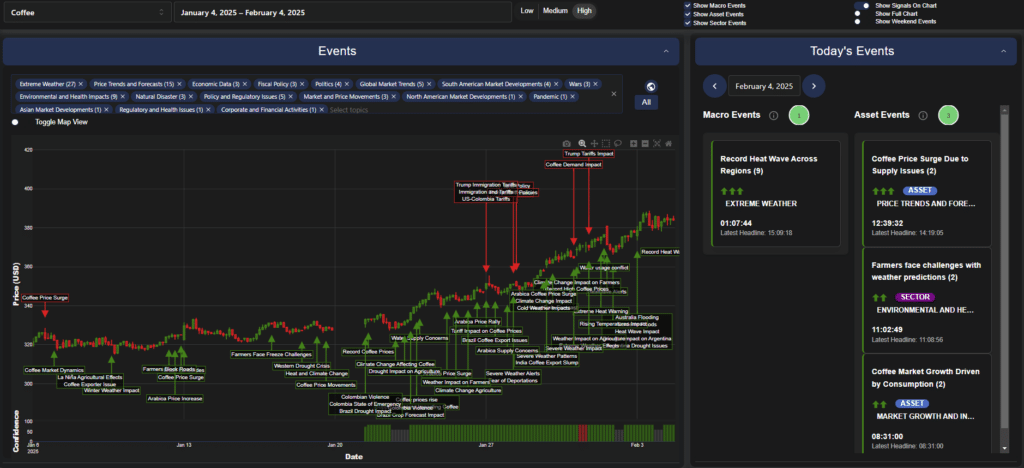
Understanding the factors affecting coffee prices has never been more key, especially as we look at the recent coffee market rally when coffee prices began their ascent towards 400 USD. According to our Trading Co-Pilot’s analysis, multiple interconnected factors drove this surge, creating a complex web of market influences that continues to shape the coffee trading landscape. Understanding these dynamics offers valuable insights for commodity traders, producers, and industry stakeholders alike. In this article we’ll take a closer look at the events that led to this historic milestone.
This year has brought unprecedented weather challenges to major coffee-producing regions. The trail of blood between severe weather events and price volatility has never been more apparent. A record heat wave across key growing areas marked a turning point in market sentiment, pushing prices above key resistance levels, whilst drought conditions in Brazil, the world’s largest producer, exacerbated supply concerns. Traders monitoring these weather patterns will have found significant predictive value in tracking regional climate anomalies.
For the initiated, these weather patterns represent more than temporary disruptions amongst the factors affecting coffee prices. Whether it is these factors or longer-term climate change impacts, the coffee market faces structural challenges that could reshape pricing dynamics for years to come. Around the same time, flooding in parts of South America further complicated the supply picture, creating opportunities for traders who could accurately forecast weather impacts on production.
The rivalry between major coffee-producing nations has intensified amid supply constraints, emerging as another crucial factor affecting coffee prices. In contrast to previous years, trade policies have taken centre stage. This is not a new revelation, but the impact of Trump-era tariffs and immigration policies looming over the market has added new complexities to coffee trading, requiring stakeholders to develop more sophisticated risk management strategies.
For some, this represents a fundamental shift in how coffee supply chains operate. The narrative picked up momentum when labour shortages began affecting harvesting operations. And there it sat, creating a bottleneck in the supply chain that rippled through to prices, offering opportunities for traders who could anticipate these disruptions.
Despite the challenges on the supply side, demand has played an equally key role among factors affecting coffee prices. Sometimes the problem lies in the changing consumption patterns across different markets. There is debate about whether these shifts represent temporary or structural changes in coffee consumption habits, with important implications for long-term price trends.
It is viewed as a potential game-changer that developing markets are showing increased appetite for premium coffee varieties. Will this last? Sentiment around coffee consumption remains strong, particularly in emerging markets where coffee culture continues to evolve, creating new opportunities for market participants.
Then there is what some would regard as the core issue: agricultural productivity as a factor affecting coffee prices. It is an experience that included both technological advances and setbacks. In the past few years, we have had a real-life experiment in how climate change affects coffee farming practices. And this is the other thing about modern coffee production: sustainability has become inseparable from pricing discussions, influencing investment decisions and risk assessments.
There may be something in that old saying about commodity prices and dollar strength. As we write, currency fluctuations continue to influence coffee trading patterns. There is the good, the bad, and the ugly about how exchange rates affect producer revenues and market pricing, making currency risk management an essential skill for market participants.
Both are on the radar screens of traders: inflation concerns and monetary policy shifts. It used to be the case that coffee prices moved primarily on supply-demand fundamentals. Anyway, despite all this, macroeconomic factors now play an increasingly important role, requiring a more sophisticated approach to market analysis.
These factors affecting coffee prices provide several key insights for market participants. To recap:
Analysing the factors affecting coffee prices requires a holistic understanding of multiple variables. From weather events to geopolitical tensions, from supply chain disruptions to changing consumption patterns, the coffee market continues to evolve in response to both traditional and emerging influences. Understanding and monitoring these dynamics whilst developing appropriate risk management strategies is crucial for success in today’s coffee trading environment.
Discover how our Trading Co-Pilot can improve your commodity trading operations by incorporating sophisticated coffee market insights into your portfolio. Our advanced platform seamlessly integrates real-time analysis of weather events, supply chain disruptions, and market sentiment, providing you with the competitive edge needed in today’s complex trading environment. By combining our coffee asset insights with your existing commodity strategies, you’ll unlock powerful cross-market correlation opportunities and gain access to early warning signals that can enhance your decision-making process.
We invite you to experience these capabilities firsthand through a personalised demo tailored to your institution’s specific trading requirements where we’ll show you how our AI-driven market intelligence can complement your existing operations and strengthen your risk management framework. For qualified institutional traders, we’re currently offering a 14-day trial to demonstrate the full potential of our platform in your trading environment.
Take the first step towards maximising your trading potential by contacting our enterprise team at enquiries@permutable.ai or fill in the form below to schedule your demo and join the leading trading houses already leveraging our next-generation market intelligence to stay ahead in the evolving commodity trading landscape.
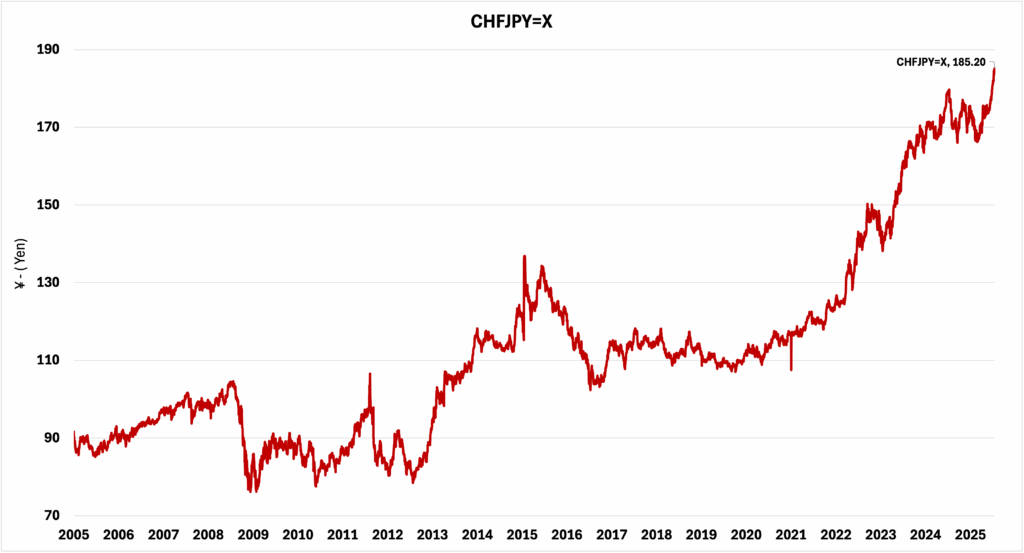
Trump’s first week in office has made for choppy times across commodity markets, with executive orders and announcements coming fix and fast out of the Trump administration effecting energy, precious metals, and agricultural commodities alike. In these early days as the market adjusts to these new policy announcements, perhaps the hardest part is quantifying the immediate impact against the backdrop of existing market dynamics. In this article, we’ll take a whistlestop tour around the latest developments to have unfolded in the last week.
First, the obvious, let’s focus on energy markets, where orders from Trump’s first week in office targeted LNG export restrictions. The revival of LNG gas exports has sent ripples through global energy markets and traders are already positioning themselves for increased US LNG exports. Then there is the challenge of U.S. sanctions which has led to a significant reduction in Russian oil offers, directly impacting supply dynamics in the market and causing a scramble for oil supply leading to concerns about the end of cheap oil and rising prices.
Adding to market volatility, Trump’s direct call on OPEC to lower oil prices has already impacted market sentiment, triggering a notable drop in WTI prices. This intervention, characteristic of Trump’s hands-on approach to oil markets, has created additional uncertainty around crude oil price trajectories and OPEC’s potential response.
With European energy markets facing particular exposure, as well as these recent developments from Trump’s first week in office, Europe also continues to grapple with seasonal demand fluctuations and the ongoing need to rebuild storage levels. All eyes will be particularly focused on how this slew of policy changes and pressures might affect the already delicate balance between Russian pipeline gas, Europe’s storage woes, U.S. LNG imports, and Europe’s ambitious renewable energy targets.
Gold has been clearly responsive to Trump’s first week in office, increasing significantly this week amid policy uncertainty. Needless to say, this reflects the traditional safe-haven status of precious metals during periods of geopolitical turbulence. The present outlook for gold remains bullish as markets digest the implications of Trump’s trade stance.
But the game changer will be the impact on industrial metals. The Nifty Metal index’s 2% decline following Trump’s tariff threats on Chinese imports demonstrates immediate market sensitivity across silver. The truth is more complicated when examining copper prices, as Trump’s executive order on mining activities in the Boundary Waters region suggests potential supply increases.
For the avoidance of any doubt, agricultural commodities haven’t escaped the policy whirlwind. The question here is how Trump’s immigration policies will affect farm labour availability. As a result, we can be reasonably confident that wheat markets will face increased volatility as farmers grapple with potential workforce challenges going forward.
Meanwhile, soybean prices showed sensitivity following Trump’s reiteration of tariff threats against China, impacting market sentiment. To add to this, the appointment of a USDA secretary who opposes ethanol and farm subsidies raised concerns about potential reductions in demand for soybeans, particularly as soybeans are a key ingredient in biofuel production.
If experience tells us anything, we can be reasonably confident that these market movements in response to Trump’s first week in office are not purely speculative. In fact, everywhere you look across the commodity markets, there’s evidence of fundamental shifts in supply and demand expectations. To reclaim stability, markets will need time to adjust to the new policy landscape, assessing the lay of the land once the dust settles.
With several areas of policy uncertainty clouding market outlooks, what is needed is clarity on long-term trade policy directions. And then, there’s the interplay between different commodity sectors deserves attention, as policy changes in one area often create ripple effects across others. We’ll all be looking out to see how the potential impact on global trade flows if Trump’s first month maintains this pace of policy shifts. If narratives shape politics, then commodity markets are already pricing in expectations of significant change. It’s no new news that we live in an age of highly volatile geopolitics, and Trump’s first week in office has amplified this reality across commodity markets.
As for the longer-term implications, commodity traders will be closely monitoring how these initial policy moves might evolve into broader structural changes in global commodity trades. This is not to say that all impacts will be negative – some sectors may benefit from reduced regulation and new trade arrangements. But there is no doubting there will be a significant adjustment period ahead for global commodity markets.
The commodity markets are evolving rapidly in response to Trump’s first week back in office, creating both risks and opportunities for traders. Our Trading Co-Pilot and API give you the edge needed to navigate these volatile markets with confidence. Access real-time policy impact analysis, and comprehensive market data integration through a single, powerful platform.
We’ve designed our solution to help you capitalise on emerging opportunities while managing risk in an increasingly complex trading environment. From LNG export policy shifts to sanctions-driven oil market dynamics, our platform keeps you ahead of market-moving developments. Experience the difference of trading with Al-driven insights yourself with a 30-day free enterprise trial of our premium features. Contact enquiries@permutable.ai to learn more about our enterprise solutions and start transforming your trading strategy today, or simply fill in the form below to get in touch.