This article explains how commodity shocks transmit across markets and how Permutable’s real-time sentiment signals reveal these shifts before they appear in price. It is aimed at institutional investors, hedge funds and trading desks seeking to identify early drivers of commodity and macro movements, improve signal detection and integrate narrative-based intelligence into discretionary and systematic workflows.
In commodity markets, the initial shock is rarely the full story. What matters is how that shock moves through the system. Oil prices above $110, disruption in key shipping routes and fractures within OPEC are the visible triggers. But for institutional investors, the real signal lies in how these events transmit into metals, agriculture and broader cost structures.
This process is not uniform. It is layered, nonlinear and often misread when relying solely on price or traditional data.
At Permutable AI, our real-time sentiment intelligence is designed to track this transmission as it unfolds, capturing how narratives evolve across supply, demand, macro conditions and logistics before those changes are fully reflected in markets.
Commodity shock transmission refers to the way a primary market disruption, such as an energy price spike, propagates through interconnected markets via input costs, production dynamics and supply chains.
An oil shock does not remain confined to oil.
It feeds into:
As these pressures move through the system, different markets respond in different ways. Some absorb the shock through demand adjustments. Others through supply constraints or margin compression. Understanding this distinction is key. It determines not only where risk is building, but how and when it is likely to appear in price.
Traditional data sources tend to lag these shifts. By the time changes are visible in price, inventory or macro releases, a significant portion of the move may already be priced in. This is where sentiment becomes valuable.
At Permutable, our models analyse over 250,000 global sources and millions of narratives to detect how market perception is evolving in real time. Rather than focusing on keywords alone, the system captures how themes such as supply disruption, demand resilience or logistics stress are gaining or losing traction across markets.
This provides an early-read layer that sits between raw information and price action. In practice, it allows institutional teams to identify which drivers are becoming dominant before those dynamics are fully expressed in markets.
To make this process actionable, we break commodity shock transmission into three core channels:
This occurs when rising costs begin to influence end-user behaviour. Copper is a clear example. The long-term structural drivers, including electrification and grid expansion, remain intact. However, higher energy prices increase the cost of using copper, not just producing it.
Freight, power and financing costs rise simultaneously. Industrial buyers become more selective. The question becomes whether demand can absorb these pressures without weakening.
In other markets, the constraint appears on the production side. For example, aluminium is currently exhibiting this dynamic. Power, alumina and logistics costs are tightening together, shifting the market from price discovery to physical availability.
Disruption in scrap flows and rising input costs are already forcing some producers to reduce output. In this regime, the key variable is not demand, but whether supply can be maintained under tighter operating conditions.
Agricultural markets often sit in a third category, where the primary impact is on margins. Input costs such as fertiliser, fuel and transportation rise, while crop prices adjust more slowly. This creates a structural imbalance for producers.
Over time, this imbalance feeds back into supply decisions, but the initial signal appears as pressure on profitability rather than immediate changes in output.
Permutable’s recent sentiment data highlights a clear concentration of supply-side risk across agricultural markets. Signals are clustering around production constraints, logistics pressure and energy-linked inputs. The move is not broad based. It is directional and increasingly coherent. The underlying issue is margin compression.
Input costs remain elevated and priced for disruption, while crop returns have not adjusted sufficiently to offset those pressures. This creates a “scissor” effect, where producer economics deteriorate despite stable or rising prices.
From a market perspective, this is significant because it often precedes more visible supply adjustments. Here, Permutable’s sentiment intelligence allows this process to be tracked in real time, identifying where stress is building before it is fully reflected in price.
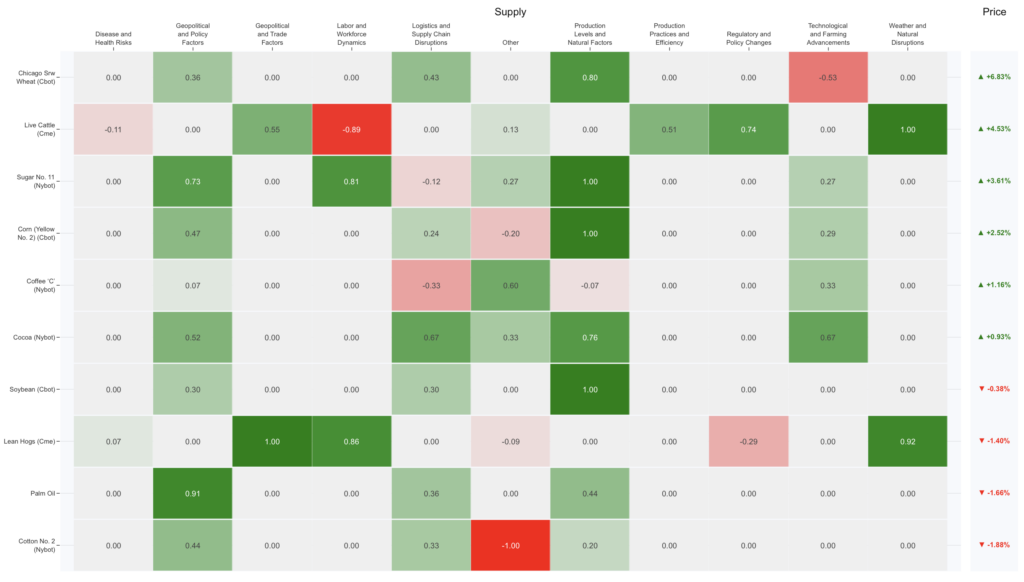
Above: Permutable AI’s Agriculture sentiment heat map showing supply-side drivers across key commodities, with bullish signals clustering around production risk, logistics disruption and energy-linked inputs. The concentration of green across production and supply chain factors highlights a developing margin squeeze, where input costs remain elevated while crop returns lag, signalling early-stage supply stress before full price adjustment.
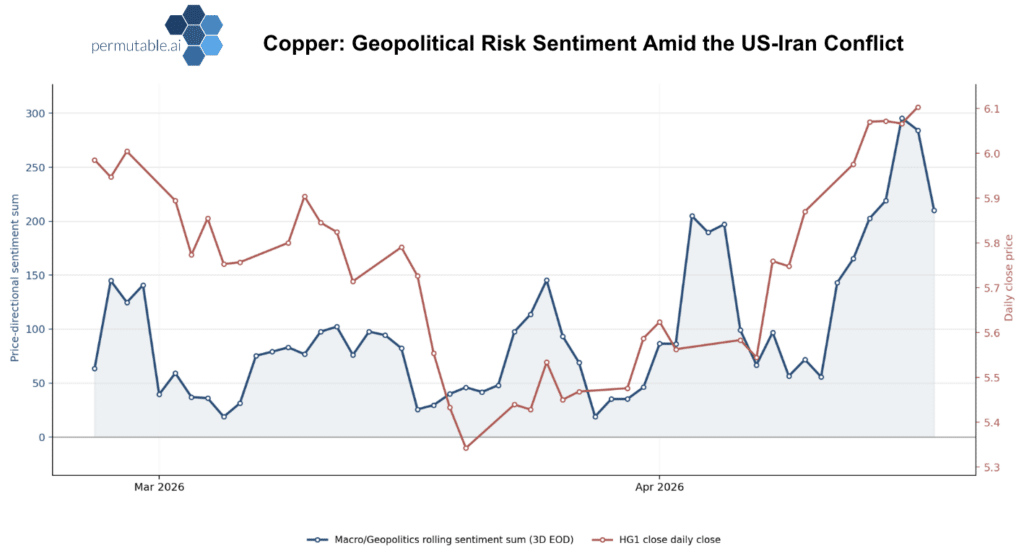
Above: Permutable AI’s copper geopolitical and macro sentiment versus price, illustrating how sentiment has strengthened ahead of the recent price move. The divergence reflects a market increasingly driven by demand resilience and geopolitical risk premium, with sentiment capturing the shift in narrative before it becomes fully embedded in price action.
Aluminium, by contrast, is increasingly defined by supply constraints. Rising power and input costs are tightening production capacity, shifting the focus toward availability rather than pricing.
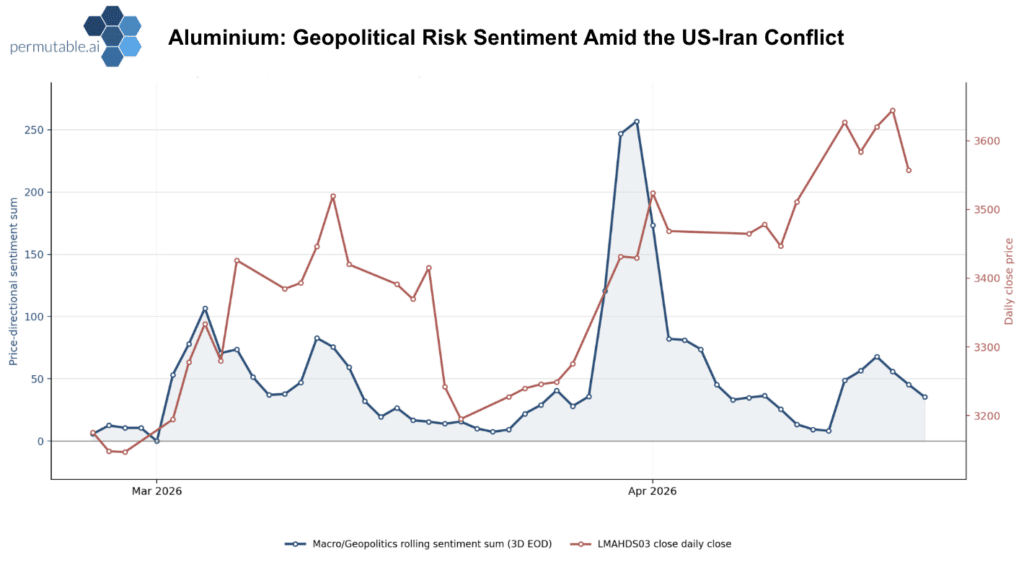
Above: Permutable AI’s aluminium geopolitical and macro sentiment versus price, highlighting a sharp spike in sentiment aligned with tightening production conditions. Unlike copper, the signal reflects supply-side constraint, where rising energy, input and logistics pressures are shifting the market from price discovery to availability, with sentiment identifying the tightening regime ahead of sustained price impact.
This distinction is important. Markets rarely move in a uniform way. Identifying whether a commodity is trading demand, supply or cost dynamics is essential to understanding where the next move is likely to emerge.
In modern commodity markets, the gap between narrative and price has become a key source of alpha. Markets do not wait for confirmation. They move as expectations shift.
Sentiment captures that shift at the point where narratives begin to consolidate. This provides a forward-looking signal that complements traditional data rather than replacing it.
For discretionary teams, this improves clarity around what is actually driving the market. For systematic strategies, it introduces a new layer of structured inputs that can enhance regime detection, timing and risk calibration. The objective here is not to react faster. It is to see earlier.
Permutable’s commodity signal layer translates real-time narrative flow into structured indicators that can be integrated into both discretionary and systematic workflows.
These signals can be used to:
Because the data is structured and consistent, it can be incorporated directly into research, backtesting and live trading environments.
Commodity markets are no longer trading isolated events. They are trading how those events move through the system. Consequently, the initial shock sets the direction, but the transmission determines the outcome.
For institutional investors, the edge lies in identifying that process early, when narratives are forming and before price fully adjusts. This is where Permutable’s real-time sentiment signals provide a meaningful advantage.
Explore Permutable’s real-time commodity and industrial metals sentiment intelligence, designed for institutional workflows. Request access: enquiries@permutable.ai
Commodity shock transmission describes how a primary market disruption, such as an energy price spike, spreads across related markets including metals and agriculture through supply chains, input costs and logistics.
Real-time sentiment signals capture how market narratives are evolving across supply, demand and macro conditions before those changes are fully reflected in price. This allows institutional investors to identify emerging trends earlier than traditional data sources.
Oil influences commodities through input costs such as energy, fertiliser and transport. As these costs rise, they affect production decisions, supply availability and demand behaviour across metals and agricultural markets.
Demand transmission occurs when rising costs affect consumption behaviour, supply transmission when production becomes constrained, and cost transmission when input pressures impact margins before output adjusts.
Permutable AI analyses over 250,000 global sources and millions of narratives to detect shifts in sentiment across macro and fundamental drivers, transforming unstructured data into structured, model-ready signals
Yes. Sentiment signals can be integrated into systematic strategies as regime indicators, feature inputs or cross-asset signals, helping improve timing, risk calibration and model performance.
Permutable tracks sentiment across 25+ economic indicators for over 50 countries, including inflation, interest rates, employment and geopolitical risk, using local and international sources in multiple languages
Markets react to expectations before confirmed data. Sentiment captures these expectations as they form, allowing investors to identify shifts in market direction before they are fully reflected in price action.
This article shows how our real-time AI turns global news flow into tradable insight across energy, metals, and agricultural markets – designed for institutional desks looking to enhance decision-making and timing.
In today’s volatile commodity markets, speed, context and foresight define success. Traditional data models and delayed indicators struggle when Brent reprices on sanctions within hours, grain markets swing on trade détente, or Henry Hub reacts to a single storage print. At Permutable AI, we’ve built an AI data analytics platform for commodity trading that connects global narrative data to real trading decisions – the same intelligence behind our work on Brent, grains, gas, precious and industrial metals.
Here are seven ways that intelligence shows up in practice, using recent market regimes as concrete examples.
Every day, billions of data points emerge across news wires, policy documents, local-language media and specialist sources. Our platform ingests this unstructured flow and converts it into structured, time-stamped, asset-aware intelligence.
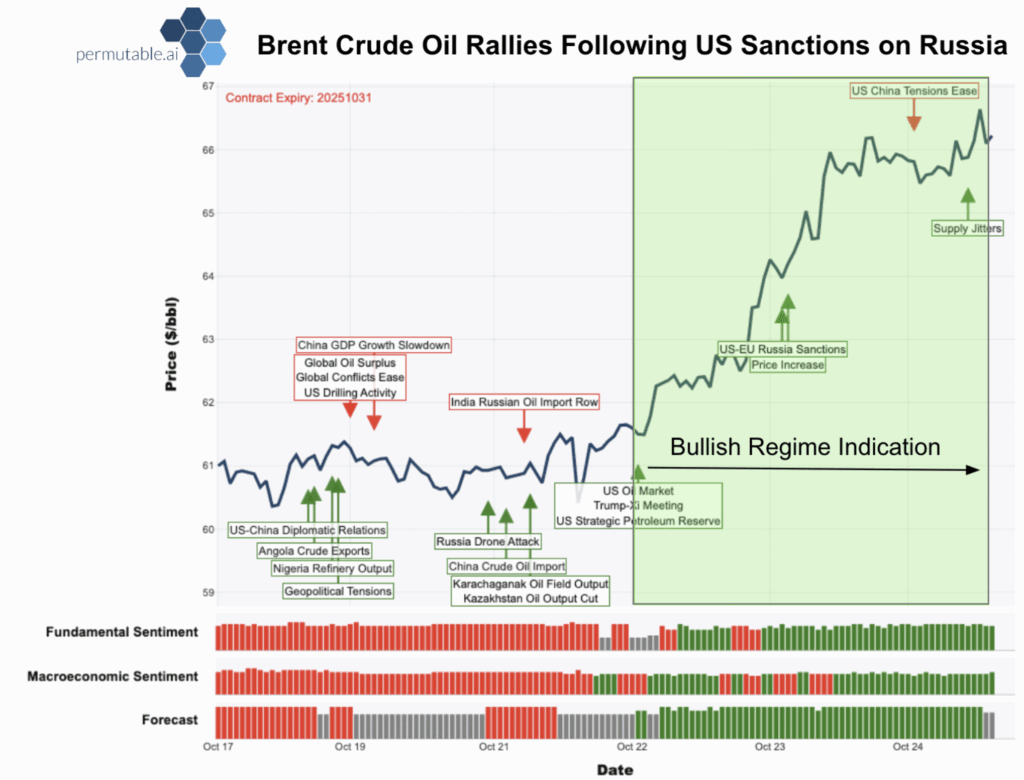
In Brent crude, the system picked up the tightening effect of new sanctions on Russian majors, shipping and insurance constraints, and longer trade routes well before those concerns were fully reflected in consensus balances. That is why our Trading Co-Pilot flagged a bullish turn as sanctions pushed immediacy premia higher, even while aggregate supply still looked comfortable on paper.
In agricultural markets, the same framework tracked the October soybean and wheat rally. It detected early relief in Washington-Beijing trade rhetoric, renewed Chinese liftings and improving tender activity, allowing the platform to recognise a genuine demand and policy shift before the price move was fully visible on the screen.
By transforming narrative “noise” into structured commodity intelligence, traders gain a clearer real-time view of what is actually driving each market.
Commodities move on context, not just headlines. Our multi-entity sentiment engine measures who is speaking, what they are speaking about and which asset is affected.
During the grain rally, the models distinguished between improving sentiment around US-China trade policy, more cautious sentiment on global demand, and still-benign supply conditions. That allowed the system to categorise the move as a demand and policy-led repricing rather than a classic supply shock.
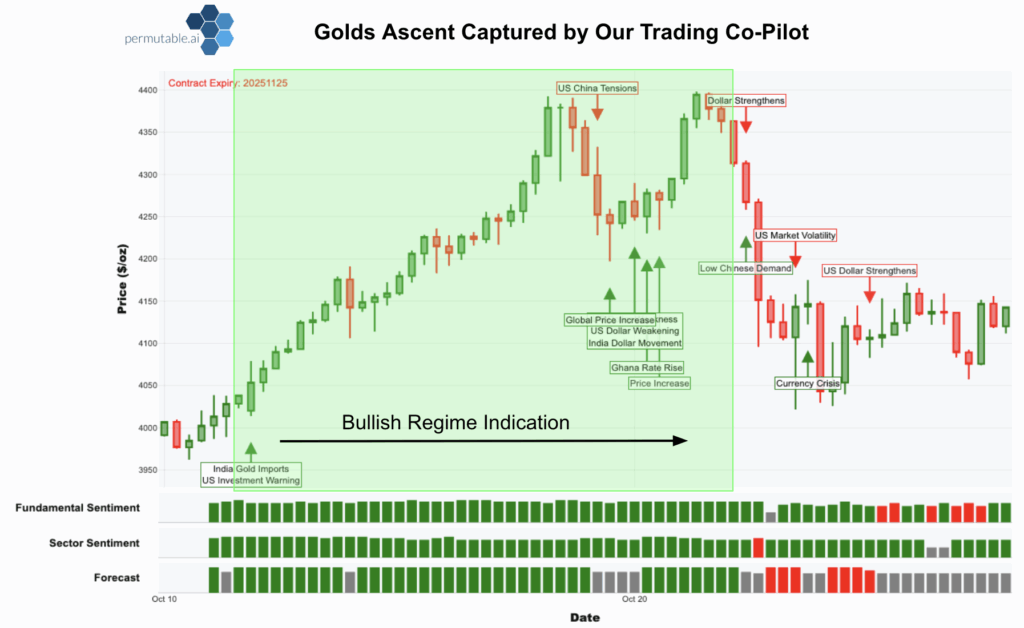
In precious metals, our analytics separated safe-haven narratives – US fiscal risk, geopolitics, central-bank buying – from risk-on narratives tied to an improving macro tone and tentative US–China thaw. That split is why the system could interpret October’s pullback in gold and silver as cooling risk appetite and profit-taking at elevated levels, rather than a collapse in the longer-term thesis.
This level of entity and topic awareness is central to AI for commodity trading: traders see which narrative is moving and how it relates to specific assets, not just a single aggregated score.
Timing is critical. Our event-detection engine looks for narrative patterns that historically precede price moves, rather than reacting to isolated headlines.
In Brent, the platform detected the accumulation of sanctions announcements, insurer comments, tanker route changes and shadow-fleet scrutiny that together signalled a logistics-driven tightening at the front of the curve. As these references built up, our Trading Co-Pilot turned bullish before the rally accelerated and time spreads fully reflected the shift in risk premia.
In gas and LNG, the system tracked stronger US export loadings, smaller-than-expected storage builds and colder early-season forecasts that supported Henry Hub, while at the same time it observed comfortable European inventories, reliable Norwegian pipeline flows and strong wind generation weighing on TTF. That combination led to a bullish bias in Henry Hub and a cautious, well-supplied tone in TTF, with storms and political headlines treated as short-lived noise rather than a structural change.
In the aluminium market, the event layer picked up signals around power constraints, policy caps on Chinese capacity, cancelled LME warrants and rising scrap tightness. Together, these pointed to a quiet but genuine physical squeeze which later expressed itself in firmer prices and stickier premia.
These are examples of how AI-driven event detection can surface regime change early across sectors and geographies.
We see AI as an augmentation layer for human decision-making, not a substitute for it. Our platform is designed to slot directly into the workflows institutional teams already use – whether that’s a trader watching intraday conditions in the UI, an analyst receiving narrative-shift alerts in real time, or a quant pulling structured sentiment data through the API into models and dashboards.
The goal is not to automate judgment, but to strengthen it: giving users earlier context, clearer explanations and cleaner signals so they can validate house views, challenge assumptions, and act with greater confidence. By integrating seamlessly across research, execution, and risk processes, our intelligence becomes part of the workflow rather than an external tool to consult – enhancing conviction without ever dictating decisions.
Explainability is essential, especially where model risk and governance matter. Every sentiment reading and forecast in our system can be traced back to topics, sources and time windows.
For Brent, clients could see a clear chain: sanctions headlines, shipping and insurance stress, a shift in topic-level sentiment, alignment across Fundamental and Macro layers, and finally the Forecast turning bullish. The narrative made sense: prompt tightness driven by logistics and compliance rather than an unexpected collapse in global supply.
In precious metals, the system showed Fundamental, Macro and Sector sentiment remaining broadly constructive, reflecting policy and structural demand, while the Forecast layer flipped bearish as risk appetite improved and the dollar firmed. This helped clients distinguish a tactical correction from a break in the long-term regime.
For aluminium, the explainable layers showed why prices were firming even as headline inventories rose: cancelled warrants, resilient regional premia, power-policy enforcement and stressed scrap markets provided a more accurate picture of physical tightness than the surface-level stock data.
Ultimately it is this level of explainable AI for commodity trading that builds the trust desks need to use these tools in real size and across governance-sensitive processes.
Commodity desks rarely operate in silos. Our AI engine links narratives and sentiment across oil, gas, metals and agriculture, mapping how shocks propagate and where they might surface next.
When sanctions tightened Russian crude flows, the system highlighted knock-on effects into freight and VLCC rates, refined products such as gasoil and gasoline, and broader inflation and policy narratives that later supported gold. As Washington-Beijing trade risks eased, it picked up improving sentiment in soybeans and wheat, a moderation of safe-haven demand in precious metals, and shifting macro narratives around tariffs and growth.
In gas and LNG, the balance between strong US exports and comfortable European storage informed our broader view on energy-linked inflation and industrial power costs – a critical backdrop for power-intensive metals such as aluminium. The same intelligence that tracked the Henry Hub versus TTF divergence also helped frame the Q4 aluminium squeeze and the evolving cost floor for smelting.
By running a unified AI data analytics platform for commodity trading, we help clients connect these cross-market signals in a systematic way, instead of relying solely on fragmented anecdotal insights.
We deploy our own models in live markets. Our AI data analytics platform underpins a systematic commodities strategy that has completed its first full year of trading, returning 20.6% with 7.3% volatility, a 4.4% max drawdown and a Sharpe ratio of 2.85, with low correlation to the S&P 500. The goal is not to make performance the story, but to demonstrate that these signals stand up when exposed to real risk, not just backtests.
The same building blocks that powered our calls on the sanctions-driven Brent rally, the October grain move linked to trade détente, the Henry Hub versus TTF split, the precious-metals correction at elevated levels and the aluminium Q4 squeeze are the inputs behind that strategy. Live trading creates a continuous feedback loop, allowing us to refine where reality diverges from backtest and to strengthen the robustness of our AI for commodity trading over time.
We do not just ship models; we curate data, stress-test signals and work with practitioners across oil, gas, metals and ags to ensure the output is genuinely usable. Our datasets are version-controlled and auditable, our signals are explainable, and our use cases are grounded in real markets – from Brent and grains to gas, precious metals and aluminium.
Commodity markets move quickly, but with the right intelligence, traders can move faster and with more conviction. At Permutable AI, we are redefining what is possible in AI for commodities by turning real-time narrative flow into decision-ready insight. Whether you are managing risk, seeking opportunity or refining systematic workflows, our platform is built to give you a clearer view of the regimes you are trading.
To see how our AI data analytics platform for commodity trading can support your strategies, you can request a short demo or contact the team at enquiries@permutable.ai.
In this article we analyse the rally in wheat and soybeans over October. We start with our Trading Co-Pilot flagging the Ags rally early, then reveal how the data and thawing trade tension confirmed the turn. The model shifted bullish as policy risk eased, buyers re-engaged, and short-term momentum followed through. As these signals aligned, the grain price outlook firmed.
The chart links the price move to a chain of sentiment drivers that followed through to the Forecast layer. Price broke higher from the 23-27 Oct, as sentiment shifted from neutral to bullish, led first by policy and geopolitical signals, then by demand cues tied to trade and export dynamics.
From late October the demand trends become increasingly upbeat and fundamentals turn persistently positive. The forecast layer continues to stay bullish as price level climbs. Sector sentiment stays mixed, reflecting stronger competition and upbeat harvest news, but the improvement in fundamentals and demand tone dominates.
By 29-30 Oct momentum cools. Headline flow fades, the sentiment stack softens, alongside the forecast layer slipping back to neutral. Price consolidates off the highs, consistent with a market that has absorbed the easing of tensions, tenders and data.
The read-through is clear, the rally came from a clean alignment of trade policy relief and the market expectations of future demand, the consolidation followed as those inputs lost their bite and traction subsides. This is clearly revealed in the soybean and wheat charts below.

The turn began with Washington–Beijing. Easing tariff risk and a renewed agricultural focus prompted China to resume US soybean purchases, including three cargoes scheduled for December-January via the Pacific Northwest route. Earlier in the week, soybeans touched a 15-month high and settled at $11.03/bu on 28 Oct. For wheat, the driver was not a sudden supply squeeze but clearer rules and a higher probability that forward buying would stick as trade tensions eased during Trumps Asia tour. When trade risk fades, procurement teams rebuild programmes, book capacity, and reopen lines. Confidence improves, capital follows, and Chicago wheat gravitates toward $5.30/bu.
The trade relief matters because China has spent the past decade diversifying toward Brazil and Argentina, eroding US export share. Renewed liftings signal lower near-term policy risk and a reopening of forward programmes. As of this morning, both soybean and wheat prices have softened modestly, reflecting cautious digestion of the de-escalation headlines and mixed market reactions, with futures dipping modestly as traders assess how durable the détente and associated agreements will prove. Together these dynamics shift the soybean and grain price outlook.
What changed on the ground was a willingness to pay up. North African tenders cleared for December delivery, signalling real buying rather than screen activity. European prices steadied, with firmer interest in Chicago and Black Sea grain. One 120,000-tonne tender passed without purchase, and EU common-wheat exports are roughly 21 percent lower year on year. US export inspections, a proxy for volumes, slumped: wheat to 259,000 tonnes (−46% w/w), the weakest since June, and soybeans (−27.9% w/w) to 1.06 million tonnes. Demand is present, but not yet strong.
The balance of evidence points to comfortable supply. Russia’s grain harvest is tracking around 135 million tonnes, including roughly 88 million tonnes of wheat, and a trimmed export tax is keeping Black Sea offers keenly priced even though early-October shipments ran about -16% below last year. Elsewhere, Argentina and Western Australia have raised wheat output estimates on better yields, adding incremental exportable tonnage.
Looking more closely soybeans, Brazil maintains momentum, shipping about 7.3 million tonnes in October, while in the United States more than four-fifths of the crop is reportedly harvested, easing near-term availability. Taken together, the outlook for both wheat and soybeans remains well supplied, which means sustained price gains will need confirmation from tenders, yields, and output, the soybean and grain price outlook is unlikely to extend decisively.
Trade progress sparked the initial move, with soybeans climbing on renewed China demand and improved visibility for liftings. Wheat followed as confidence in forward purchasing rose across the complex. From here, sustained gains require information which has proved sparse given the US shutdown. The supply side remains competitive, as South American and Black Sea offers are likely to set the competitive price, while the improved regional yields and harvest timing adds near term availability plus exportable Ags. Freight rates and FX will shape competitiveness and tenders.
A softer greenback, rouble or real, coupled with easing voyage rates, would amplify exports. In this setting, the soybean and grain price outlook should meet resistance unless demand accelerates and tightens spreads. The onus leans more heavily on buyers to keep rallies active and support the soy and grain price outlook, it is unsure if this is enough to offset an ample supply backdrop.
Our Trading Co-Pilot fuses policy tone, export flow and macro context into clear, sentiment-driven signals. It is built to spot regime transitions ahead of the lagging indicators that most desks rely on.
See our commodities intelligence suite in action, request a personalised demo at enquiries@permutable.ai to see how our real-time sentiment, API, and sector intelligence to help sharpen procurement and risk strategies.
This feature explores the key macro and sector-specific forces shaping the current price of commodities in Q4 2025 – from energy and agriculture to metals – for investors, analysts, and trading professionals seeking data-driven insight.
As 2025 draws to a close, global markets are confronting an unusual mix of slowing growth, shifting trade alliances, and rising geopolitical risk. The current price of commodities reflects this complexity: resilient in some areas, fragile in others. At Permutable, our real-time AI-driven Trading Co-Pilot intelligence suite monitors these – combining macro data, asset-level sentiment analysis, and supply-demand monitoring to interpret the market forces behind both current commodity prices and commodity future prices.
In energy markets, the current price of commodities such as Brent crude and natural gas remains caught between robust supply and simmering geopolitical tension. Brent is holding steady as OPEC+ continues to balance production cuts against weakening demand, while U.S. exports of crude and LNG are redrawing trade routes.
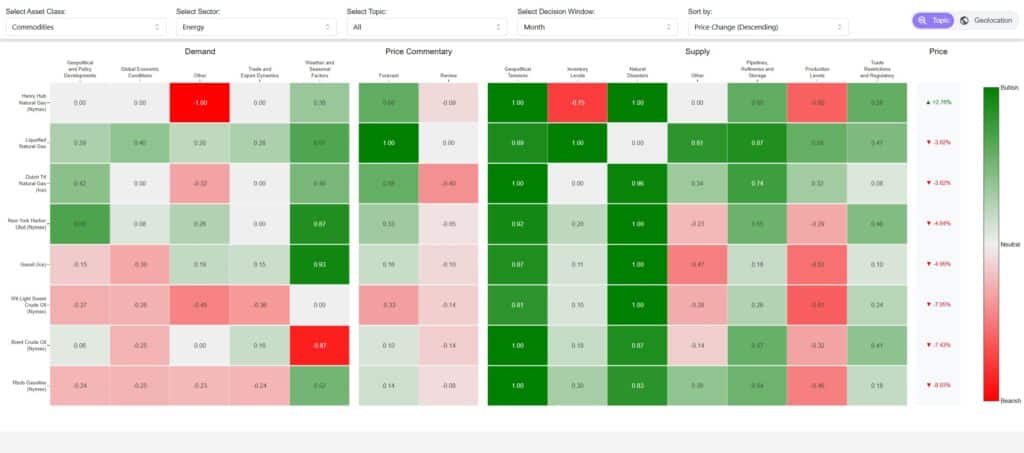
Our Trading Co-Pilot’s Sector Trends module shows that across the energy complex, geopolitical tension and weather-related demand are the most active drivers of sentiment. LNG, natural gas, and refined products such as diesel exhibit elevated sensitivity to inventory levels and natural-disaster disruptions, reinforcing the narrative of localised tightness rather than global shortage.
Above: Energy market sentiment across natural gas, LNG, and refined products remains heavily influenced by geopolitical tensions, weather-related demand, and supply disruptions. Our Trading Co-Pilot sector analysis shows that regional volatility, rather than broad oversupply, continues to define market direction heading in Q4 2025.
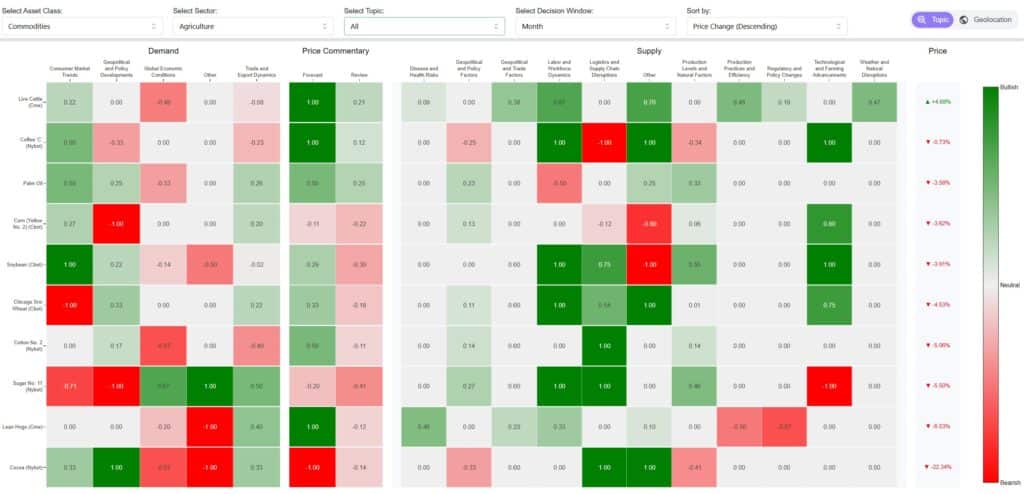
Across agriculture, the current price of commodities continues to be shaped by climate anomalies, export restrictions, and supply-chain fragmentation. Droughts in key producing regions have reduced crop yields, while trade barriers from Russia and Argentina have tightened supply for grains and sugar.
Here, our Trading Co-Pilot highlights divergent regional pressures:
Weather disruptions remain the strongest determinant of sentiment in grains and softs.
Labour and logistics constraints continue to amplify volatility in coffee, cocoa, and palm oil.
Policy and regulatory commentary is increasingly influencing future-price sentiment, particularly for biofuel-linked crops like soybeans.
While spot prices have softened slightly month-on-month, our models detect pockets of resilience in soybeans and palm oil, suggesting that demand from energy-linked sectors could act as a stabilising force into early 2026.
Above: Agriculture sentiment from our Trading Co-Pilot highlights a fragmented outlook, with weather disruptions, labour shortages, and logistics bottlenecks weighing on key crops. While grains and softs show bearish sentiment linked to export and policy risks, soybeans and palm oil continue to benefit from biofuel and energy-linked demand resilience.
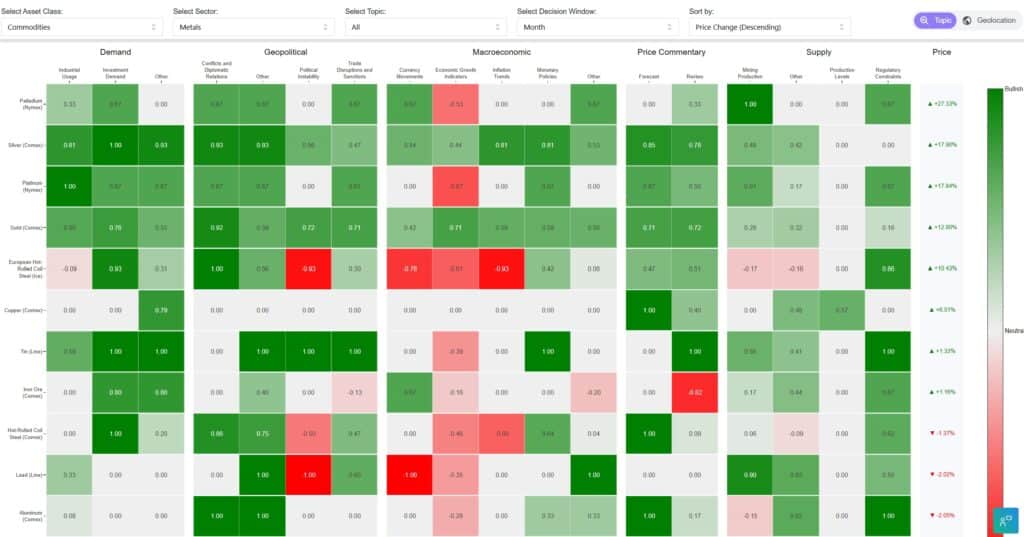
For industrial metals, the current price of commodities underscores a market defined by tight supply, fragmented trade routes, and structural demand from electrification. Our Trading Co-Pilot’s industrial metals intelligence identifies growing positive sentiment across aluminium, zinc, and copper, linked to the clean energy transition and infrastructure investment.
By contrast, iron ore and steel sentiment remains constrained by Chinese policy limits, softer construction output, and energy intensity concerns.
The data also shows that regulatory constraints and macroeconomic volatility continue to influence metals more than inventory data, as power availability and production curbs increasingly determine output. Overall, the industrial metals landscape is broadly bullish but uneven, with AI-tracked commentary revealing strong investor focus on energy costs, policy thresholds, and mine disruptions rather than simple supply-demand metrics.
Gold and silver remain the standout performers in Q4. Central-bank accumulation, a weaker dollar, and expectations of lower real interest rates have bolstered safe-haven demand. Our Trading Co-Pilot data captured a notable surge in silver-related sentiment, reflecting its dual role as both a monetary and industrial metal.
References to solar, clean technology, and electrification themes are at their highest levels this quarter, signalling that silver’s industrial relevance is reinforcing its safe-haven appeal. Platinum and palladium, meanwhile, remain steady, with demand underpinned by catalytic and green hydrogen applications. Should inflation expectations tick higher in 2026, both current commodity prices and future prices across precious metals could see renewed upside momentum.
Above: Our Trading Co-Pilot metals dashboard shows strengthening sentiment across aluminium, copper, and zinc amid persistent supply constraints and energy-driven production limits. Policy enforcement and regulatory factors remain dominant influences, reflecting the industrial metal sector’s sensitivity to power availability and trade realignments.
Across sectors, one theme dominates: interconnection. Energy costs influence fertiliser and freight prices in agriculture; power availability shapes metals output; and global liquidity trends ripple through every commodity index. At Permutable, our AI-powered Trading Co-Pilot continuously maps these sector trends and relationships.
By analysing millions of global data points – including macro commentary, policy shifts, and supply disruptions – the system identifies when changes in commodity sentiment are signalling broader market regime shifts. Ultimately, understanding today’s commodity markets is less about static price charts and more about interpreting how narratives, risks, and data interact in real time.
Heading into 2026, the current price of commodities will depend on whether global growth stabilises or contracts. A soft landing could support energy and metals; a deeper slowdown might lift defensive assets like gold and agricultural staples.
Whatever the scenario, data-driven insight will remain the key differentiator. Through our Trading Co-Pilot intelligence suit, we delivers real-time, explainable intelligence that helps institutional traders anticipate shifts in both current commodity prices and commodity future prices before they appear in traditional datasets.
In a world where every supply disruption, policy change, or climate event reverberates across markets, understanding the current price of commodities has never been more complex – or more essential. Through the fusion of AI and contextual analytics, we’re equipping investors and trading desks with the clarity to navigate volatility and uncover opportunity in an era of constant change..
Learn more by requesting a demo of our Trading Co-Pilot intelligence suite and understanding how our intelligence can be integrated into your workflow.
At Permutable, we are setting the standard for institutional market intelligence for systematic strategies. Our large language models transform global macro, geopolitical and financial noise into sentiment signals that lead the data. Built for hedge funds, asset managers, and investment banks, our technology delivers foresight where reaction times matter and clarity where traditional analysis falls short. In this FAQ, we’ll take a look at how our institutional grade solutions help address today’s market challenges.
Our leading LLMs and reasoning agents eliminate market noise and convert millions of narratives into structured, quant-ready intelligence. This enables our clients to act with foresight, integrating sentiment into both our systematic strategies and discretionary approaches.
We track thousands of individual sentiment drivers in real time across energy markets and regional macro indices spanning the G7, BRICS, and global economies. This delivers a continuous read on the factors driving growth, inflation, and asset prices in real time, which can be directly fed into systematic strategies.
By ingesting asset-level sentiment signals into our systematic strategies workflows, we isolate the causation behind market performance rather than surface correlations. This provides transparency into how narratives drive shifts in positioning, factor exposures, and risk premia, giving our clients a forward-looking framework for attribution and alpha capture to feed into their systematic investment strategies.
Our Trading Co-Pilot cuts analysis time by up to 90%, converting complex, multi-lingual sources and unstructured flows into actionable insights. This accelerates decision-making and frees teams to focus on execution and portfolio construction within their systematic strategies.
Through explainable AI models delivered via API or through our fully operational Trading Co-Pilot user interface. This ensures seamless integration across both our systematic strategies and discretionary workflows.
We work with leading global institutions and banks across commodities and macro. Our systematic strategies are validated through live trading that has delivered 17% annualised returns with a Sharpe ratio of 2.9. Complete vintage history is accessible via API, enabling full backtesting and independent validation.
How can hedge funds and asset managers use our systematic strategies?
Hedge funds can integrate our sentiment indicators into their systematic strategies to enhance Sharpe ratios whilst reducing drawdowns. Our AI processes thousands of news articles daily, converting market noise into structured alpha signals that could feed directly into quantitative models.
Asset managers can use our systematic strategies to dynamically adjust factor exposures based on real-time sentiment shifts. When geopolitical tensions spike, our models can automatically identify which commodities and currencies might benefit, enabling proactive positioning rather than reactive rebalancing.
Trading desks can leverage our systematic strategies to identify sentiment-driven volatility before it impacts traditional risk metrics. Our models analyse cross-asset correlations through narrative flows, potentially providing early warning signals for portfolio stress testing.
Energy traders can integrate our energy indices to anticipate supply disruptions through geopolitical sentiment analysis, potentially capturing alpha from physical-financial arbitrage opportunities.
Our real-time tracking of thousands of energy sentiment drivers could inform systematic strategies around inflation expectations, central bank policy shifts, and currency movements that impact commodity valuations.
The systematic advantage awaits
Whether you’re running a $100M hedge fund or a multi-billion asset management firm, our AI-driven intelligence will change how you think about systematic alpha generation.
Ready to see what systematic strategies look like when they’re powered by the future?
Schedule a demo by contacting our team at enquiries@permutable.ai
This article is aimed at systematic traders, energy and commodity traders, investment banks and asset managers seeking to understand how Permutable AI’s sentiment analysis API can be applied to trading strategies, research, and risk management.
In today’s markets, the ability to move faster than competitors rests not only on data access but on knowing which signals matter most. While traditional datasets such as prices, volumes and economic releases remain essential, they are fundamentally backward-looking. They tell you what has already happened. At Permutable, we have seen time and again that market inflection points are driven not just by fundamentals, but by narratives – the stories circulating across news, reports, and policy debates. Capturing and quantifying those narratives in real time is where our sentiment analysis API provides a genuine edge.
Having worked alongside trading teams, banks and asset managers, we understand the challenge: markets move on expectations, not history. Our sentiment analysis API translates global news and discourse into measurable, explainable indicators that can be integrated directly into workflows, strategies, and models.
Markets are forward-looking machines. A weak US jobs print does not simply show labour market deterioration; it raises questions about Federal Reserve policy, interest rates, and global flows into or out of risk assets. Similarly, a drone strike on an export hub is not just an isolated event; it ripples through oil futures, freight costs, insurance pricing, and cross-commodity hedges.
The challenge is separating noise from signal. This is precisely what our sentiment analysis API is designed to achieve. It processes vast volumes of global news and classifies sentiment around macroeconomic, political and market topics, creating indices that update in near real time.
For systematic and quantitative traders, sentiment data is often viewed as unstructured and hard to model. Our experience shows otherwise. By providing sentiment indices in a structured, backtestable format, our API enables quants to:
Incorporate sentiment as an alpha factor within existing strategies.
Detect regime shifts in real time, such as a change in the market’s response to central bank language.
Apply sentiment as a volatility filter, adjusting leverage or position sizing when signals point to heightened uncertainty.
Backtest against historical data, demonstrating how narrative intensity has impacted past market movements.
In practice, our sentiment analysis API can be used to anticipate moves around central bank meetings, sanctions announcements, and major data releases – events where sentiment, not just numbers, dictates positioning.
Commodity and energy markets are uniquely sensitive to geopolitical and environmental narratives. Our sentiment analysis API has proved valuable to commodity desks by flagging:
Geopolitical shocks, such as sanctions or supply chain disruptions, often before they are fully priced.
Weather narratives, including La Niña and hurricane season, where early warnings influence natural gas and LNG positioning.
Supply-demand talk, as coverage of inventories, refinery outages or OPEC+ policy drives rapid swings in futures curves.
Cross-commodity spillovers, where sentiment in one market (e.g. oil) cascades into others (e.g. shipping or refined products).
For energy clients, this means positioning ahead of sharp moves when, for instance, narrative intensity spikes around Russian supply disruptions or when weather-driven demand risk rises suddenly.
Banks must provide differentiated research and advisory to their clients. Here, our sentiment analysis API supports this in several ways:
Macro research: overlay sentiment indices on GDP, inflation or policy themes to provide a forward-looking perspective.
Event detection: pick up signals around elections, sanctions debates or geopolitical disputes ahead of official releases.
Client briefings: enrich morning notes and strategy reports with explainable sentiment indicators.
Transaction support: integrate sentiment into financing, hedging or deal analysis where policy or geopolitical risk is relevant.
In practice, research teams can use our API to strengthen house views by demonstrating how narrative sentiment is diverging from data, providing clients with actionable perspective on risks and opportunities.
For asset managers, portfolio resilience depends on identifying divergences before they become costly. Our sentiment analysis API supports:
Risk monitoring, spotting when rallies are fuelled by sentiment rather than fundamentals – a hallmark of bubble risk.
Portfolio overlays, adding sentiment as a non-price factor to diversify exposures.
Hedging strategies, where sentiment alerts around policy or geopolitical risk guide protective positioning.
Global macro allocation, quantifying narrative momentum across currencies, commodities, and equities.
In our experience, this will be particularly valuable when providing the ability to detect when optimism is fading before prices turn, enabling them to rebalance portfolios with greater precision.
The strength of our sentiment analysis API lies in three things:
Explainability – each signal is traceable to underlying narrative clusters, ensuring clarity for compliance and risk oversight.
Speed – updates occur in near real time, enabling faster decision-making.
Integration – our sentiment API is designed for enterprise-grade workflows, making it easy to plug into trading systems, analytics platforms, or research dashboards.
This combination of transparency, timeliness and usability makes our API more than just a data feed – it is a strategic tool.
| Audience | Use Case | Value Delivered |
|---|---|---|
| Systematic Traders | Signal generation (sentiment as alpha factor) | Unlock new tradeable signals beyond price & volume data |
| Regime detection | Identify when market responses to events (e.g. Fed policy) shift behaviour | |
| Risk filters | Adjust leverage/position sizing during sentiment-driven volatility spikes | |
| Backtesting with historical sentiment | Validate strategies with explainable, narrative-driven datasets | |
| Energy & Commodity Traders | Geopolitical shock detection | Anticipate sanctions, supply disruptions & OPEC+ headlines before pricing shifts |
| Weather/climate sentiment | Flag early La Niña/El Niño or hurricane risks driving gas & LNG | |
| Supply-demand narrative monitoring | Spot changes in inventory, refinery, or output narratives ahead of official data | |
| Cross-commodity sentiment | Track spillovers (e.g. oil sentiment impacting refined products or shipping) | |
| Investment Banks | Macro research enrichment | Strengthen research with forward-looking sentiment overlays on GDP, inflation & policy |
| Event detection | Detect elections, sanctions & geopolitical shifts in near real time | |
| Client advisory | Enhance strategy notes with explainable, sentiment-driven insights | |
| Deal & financing support | Use sentiment as a layer in M&A, commodity financing & treasury risk assessments | |
| Asset Managers | Risk monitoring | Flag divergences between sentiment-driven rallies & weak fundamentals |
| Portfolio construction | Add sentiment as a non-price factor for diversification & alpha | |
| Hedging strategies | Position defensively around political or macro shocks flagged by sentiment | |
| Global macro allocation | Track narrative-driven momentum across currencies, equities, and commodities |
Ultimately, the reason our clients integrate our sentiment analysis API is simple: markets move on expectations, not history. By quantifying narratives and sentiment, institutions can:
Position ahead of market-moving events.
Anticipate volatility before it shows up in the data.
Capture opportunities when sentiment alignment drives momentum.
In a world where information overload is the norm, being able to distinguish true signal from noise is what separates reactive trading from proactive strategy. At Permutable, we are proud to provide the tools that allow systematic traders, commodity desks, investment banks and asset managers to navigate complexity with precision and confidence.
To explore our how sentiment analysis API can support your strategy contact us at enquiries@permutabe.ai.
The Sentiment Analysis API is a real-time intelligence tool that quantifies global news and narratives across macroeconomics, geopolitics, energy, commodities and markets. It provides structured, explainable sentiment indices that can be integrated into trading systems, research workflows and risk models.
It processes vast volumes of global news and discourse using AI-driven natural language processing. The output is a set of topic-specific sentiment indices (e.g. inflation, energy supply, sanctions, policy rates) that update in near real time, giving users forward-looking insights.
It is built for institutional clients – including systematic traders, commodity and energy traders, investment banks, and asset managers – who need to anticipate market shifts rather than react to lagging data.
Unlike generic sentiment feeds, our API is explainable (traceable back to source narratives), fast (near real-time updates), and enterprise-ready (API-first integration for research, trading, and risk systems).
Yes. Historical datasets are available for strategy validation, performance testing, and research, allowing traders and analysts to understand how narratives shaped past market moves.
The API covers global macroeconomics, commodities, energy, geopolitics, monetary policy, and financial markets — providing indices tailored to the needs of traders, banks, and asset managers.
By capturing market narratives ahead of price and volume data, sentiment analysis highlights when shifts in expectations are likely to drive momentum, enabling traders to position earlier and manage risk more effectively.
The Sentiment Analysis API is available via enterprise-grade integration. To request a demo or access documentation, contact: enquiries@permutable.ai.
A sentiment analysis API in trading transforms unstructured market news and narratives into structured signals, helping traders anticipate price moves by measuring shifts in sentiment.
Systematic traders can integrate sentiment indices into models as alpha factors, volatility filters, or regime-detection tools, improving strategy precision and risk control.
Energy and commodity prices are highly sensitive to narratives around supply, demand, geopolitics and weather. Sentiment analysis detects these narratives in real time, giving traders an early signal before fundamentals shift.
Yes. Sentiment analysis strengthens macro research, supports client advisory, and provides early-warning signals around elections, sanctions, or policy changes that influence markets.
Asset managers can use sentiment data for portfolio construction, risk monitoring, and hedging strategies, particularly to identify divergences between narrative-driven rallies and weakening fundamentals.
Absolutely. Historical sentiment datasets allow backtesting, validation, and research — showing how past narratives shaped price action and improving confidence in new models.
This comprehensive analysis examines the current landscape of financial market sentiment indicators, evaluating innovative AI-driven platforms such as Permutable AI against leading providers and established giants like Bloomberg. The review is specifically tailored for institutional investors, hedge funds, and systematic macro traders who are assessing sentiment intelligence tools to enhance their portfolio strategies and gain a competitive edge in an increasingly narrative-driven marketplace.
In today’s rapidly evolving financial landscape, where market-moving narratives can shift sentiment faster than traditional fundamentals, institutional investors need sophisticated tools to decode the noise and identify actionable signals. As artificial intelligence transforms how we interpret vast streams of news, social media, and market data, the choice of sentiment analysis provider has become a critical strategic decision for portfolio managers and systematic traders alike.
When it comes to current financial market sentiment indicators, at Permutable, we are a leader by offering real-time, cross-asset coverage designed for institutional investors. Unlike traditional approaches that rely heavily on surveys or market-derived metrics, we combines natural language processing with anomaly detection to quantify global market sentiment and narratives in real time.
The strength of our system lies in its multi-entity sentiment analysis. Rather than treating the market as a single bloc, it breaks down sentiment at the level of central banks, commodities, sovereign debt, corporates, and policy institutions. For example, investors can track divergence between sentiment towards the Federal Reserve and the European Central Bank, or monitor narrative momentum in oil, LNG, and precious metals.
Transparency is another differentiator. Every sentiment signal of ours is traceable back to its underlying source, ensuring explainability and confidence in decision-making. Delivery is flexible: machine-readable API feeds integrate seamlessly into systematic models, while our Trading Co-Pilot dashboard provides intuitive visualisation for discretionary portfolio managers. With years of backtestable history, our market sentiment indicators allow investors not only to act in the present but to validate their strategies against past cycles.
Verdict: Best for institutional investors, hedge funds, and systematic macro traders who need real-time, cross-asset sentiment intelligence with transparent, source-traceable insights for both systematic models and discretionary decision-making.
Bloomberg’s Market Sentiment Index (MSI) is derived from Bloomberg Terminal data, tracking sentiment shifts based on user behaviour, news consumption, and market flows. For investors already embedded in the Bloomberg ecosystem, the MSI integrates conveniently with existing research tools. It is a valuable consensus measure that reflects prevailing investor activity, though it is more correlation-based than predictive in nature.
Best for investors who want sentiment seamlessly layered into the Bloomberg environment, particularly those using it as a complement to market flow data and consensus-driven research. However, for those needing predictive, anomaly-driven insights across asset classes, Permutable AI provides a more forward-looking alternative.
Sentieo positions itself as a research platform that integrates sentiment analysis within its broader analytics suite. By aggregating news, broker research, and financial documents, it allows users to track evolving sentiment connected to specific equities or themes. Its strength is versatility in research workflows, making it particularly useful for equity analysts and fundamental investors, though it is somewhat narrower in scope for those focused on macro, cross-asset signals.
Best for equity analysts or research teams who want sentiment woven into broader document search, modelling, and thematic research capabilities. Yet for cross-asset macro desks, Permutable AI offers deeper real-time intelligence that extends beyond equities and research documents.
Yewno|Edge applies AI to analyse earnings reports, news articles, and social signals, surfacing thematic sentiment trends. This makes it particularly attractive for equity researchers and thematic traders. While its focus is on company-level analysis rather than global macro sentiment, it provides valuable insights into micro-level market narratives.
Best for traders and analysts looking to capture company-level or sector-specific sentiment shifts, particularly around earnings season or event-driven strategies. For those managing portfolios with energy and commodities, sovereign debt, or FX exposure, Permutable AI provides broader macro coverage and anomaly detection.
Quandl, part of Nasdaq Data Link, offers a wide range of alternative datasets, including some sentiment feeds. Its strength lies in ease of access via APIs, making it a convenient data source for quant teams. However, its sentiment data is part of a broader menu rather than a dedicated, narrative-driven solution.
Best for quant developers and data scientists seeking modular feeds that can be plugged into models quickly, especially when combining sentiment with other alternative datasets. Where Quandl delivers breadth, Permutable AI delivers depth – with explainable, narrative-driven sentiment designed for institutional use.
StockGeist delivers real-time sentiment indicators for more than 2,200 traded names, especially across the S&P 500 and Nasdaq 100. Its visually intuitive platform makes it particularly useful for equity traders tracking live market chatter, though its coverage is primarily equity-focused.
Best for active equity traders looking to monitor intraday news and social media sentiment on individual stocks in a highly visual, interactive format. For multi-asset investors, Permutable AI offers wider coverage across commodities, sovereigns, and currencies in addition to equities.
FXSSI specialises in Forex sentiment analysis, offering tools that integrate with trading platforms such as MT4 and MT5. These indicators focus on client positioning, order books, and crowd sentiment in currency markets.
Best for FX traders wanting to visualise positioning data directly in their trading platforms, with an emphasis on crowd psychology and short-term market dynamics. For institutions managing broader macro strategies, Permutable AI provides more predictive and cross-market sentiment insights.
CMC Markets provides a client sentiment indicator that shows net long or short positioning across assets such as currencies, indices, and commodities. For retail and professional CFD traders, this provides useful transparency on crowd positioning.
Best for CFD traders seeking a quick snapshot of client sentiment across popular instruments, useful as a contrarian or confirmation tool in retail-heavy markets. Institutional desks, however, may find Permutable AI’s narrative-driven and globally sourced sentiment intelligence more actionable at scale.
A quick scan for institutional teams comparing coverage, use-cases, and where Permutable AI may add more value.
| Provider | Best for | Why Permutable AI might be better |
|---|---|---|
| Permutable AI Institutional-grade | Institutional investors, hedge funds, and systematic macro traders who need real-time, cross-asset sentiment with transparent, source-traceable insights for both systematic models and discretionary decision-making. | Goes beyond single-asset or consensus signals with anomaly detection and entity-level sentiment (central banks, sovereigns, commodities), plus explainability and backtestable history. |
| Bloomberg Market Sentiment Index (MSI) | Investors who want sentiment seamlessly layered into the Bloomberg environment as a complement to market flow data and consensus research. | For predictive, anomaly-driven insights across asset classes and narrative detection beyond activity correlations, Permutable AI offers a more forward-looking alternative. |
| Sentieo | Equity analysts or research teams who want sentiment woven into document search, modelling, and thematic research workflows. | Permutable AI extends beyond equity documents to real-time, cross-asset macro intelligence, supporting systematic strategies and discretionary macro views. |
| Yewno|Edge | Traders capturing company-level or sector-specific sentiment shifts, especially around earnings or event-driven strategies. | Permutable AI covers commodities, sovereign debt, FX and policy institutions with anomaly detection—useful for macro portfolios with multi-asset exposure. |
| Nasdaq Data Link (Quandl) | Quant developers and data scientists seeking modular API feeds to combine with other alternative datasets. | Where Data Link delivers breadth of datasets, Permutable AI provides depth and context: narrative-driven, explainable sentiment tailored for institutional decisioning. |
| StockGeist.ai | Active equity traders monitoring intraday news and social sentiment on individual stocks in an interactive, visual interface. | For multi-asset investors, Permutable AI brings wider coverage (commodities, sovereigns, currencies) and explainable signals beyond equity chatter. |
| FXSSI (Forex Sentiment Tools) | FX traders visualising positioning, order books, and crowd sentiment directly within MT4/MT5. | Institutions running broader macro strategies can use Permutable AI’s predictive, cross-market signals and narrative tracking beyond retail positioning. |
| CMC Markets Client Sentiment | CFD traders wanting quick snapshots of client long/short positioning across major instruments for contrarian or confirmation cues. | Permutable AI aggregates global narratives and sources, offering institution-scale explainability and cross-asset coverage beyond single-platform flows. |