Understanding Henry Hub Natural Gas price drivers: Essential analysis of market volatility November 2024

In these uncertain times, Henry Hub natural gas prices have demonstrated remarkable volatility throughout November 2024. This particular situation feeds on geopolitical instability and shifting fundamental factors that continue to reshape the market landscape. In this article, we’ll take a closer look at the seven key factors that have been impacting Henry Hub Natural Gas prices over the last month.

7 factors impacting Henry Hub Natural Gas price – a look at key price drivers of U.S. Natural Gas

1. Weather: The perpetual market mover

Indeed, there are of course parallels with previous seasonal patterns, as weather remains a dominant force in U.S. Natural Gas prices. Which is why the market responded so obviously to early winter weather warnings and subsequent temperature forecasts. The snag is that weather impacts have become increasingly unpredictable, with both warm and cold weather events triggering significant price movements.

2. Supply dynamics and production challenges

If you believe the old adage that supply drives the market, recent events certainly support this view. Ahead of the winter season, we’ve observed several critical supply-side developments. Gulf production offline events and Venezuela fuel supply concerns have created upward pressure on Henry Hub Natural Gas prices.

3. Infrastructure and technical factors

It is the pinning of all its hopes on new infrastructure developments that characterises the market’s longer-term outlook. Rather than merely reacting to short-term supply disruptions, traders will be closely monitoring developments across the sector. 

The expansion of LNG export facilities has emerged as a crucial factor, while Natural Gas leak incidents have introduced unexpected volatility. Meanwhile, oil and gas development boosts have provided some stability, while the impact of new facilities like the Louisiana Meta data centre gas plant applications has also been one to watch. 

4. Geopolitical influences

Given that it is still working its way through various international tensions, the U.S. Natural Gas market remains highly sensitive to global events. At which point when sanctions and supply stability concerns enter the equation, we typically see increased volatility in U.S. Natural Gas prices. 

The recent news events surrounding Russian supply stability and European energy security have created ripple effects across global gas markets, with Henry Hub prices increasingly responding to international supply disruptions. Insiders say this interconnectivity is only set to deepen as LNG export capacity expands and cross-continental gas flows become more fluid.

5. Demand patterns and market evolution

For the avoidance of any doubt, we’re witnessing a significant shift in consumption patterns. Thereby, new demand growth phases and LNG export demand increases have become crucial price drivers.

Meanwhile, the emergence of new data centres and their substantial energy requirements has added another layer of complexity to demand forecasting while the transition of power generation from coal to Natural Gas continues to reshape baseline demand expectations, creating a more nuanced and sophisticated market environment.

div]:bg-bg-300 [&_.ignore-pre-bg>div]:bg-transparent [&_pre]:-mr-4 md:[&_pre]:-mr-9″ style=”box-sizing: border-box; border-image: initial; –tw-border-spacing-x: 0; –tw-border-spacing-y: 0; –tw-translate-x: 0; –tw-translate-y: 0; –tw-rotate: 0; –tw-skew-x: 0; –tw-skew-y: 0; –tw-scale-x: 1; –tw-scale-y: 1; –tw-scroll-snap-strictness: proximity; –tw-ring-offset-width: 0px; –tw-ring-offset-color: #fff; –tw-ring-color: hsl(var(–accent-secondary-100)/1); –tw-ring-offset-shadow: 0 0 #0000; –tw-ring-shadow: 0 0 #0000; –tw-shadow: 0 0 #0000; –tw-shadow-colored: 0 0 #0000; outline-color: hsl(var(–accent-main-100)); position: relative; padding-right: 2.25rem; line-height: 1.65rem; font-family: var(–font-claude-message); border: 0px solid hsl(var(–border-100));”>

_*]:min-w-0″ style=”box-sizing: border-box; border-image: initial; –tw-border-spacing-x: 0; –tw-border-spacing-y: 0; –tw-translate-x: 0; –tw-translate-y: 0; –tw-rotate: 0; –tw-skew-x: 0; –tw-skew-y: 0; –tw-scale-x: 1; –tw-scale-y: 1; –tw-scroll-snap-strictness: proximity; –tw-ring-offset-width: 0px; –tw-ring-offset-color: #fff; –tw-ring-color: hsl(var(–accent-secondary-100)/1); –tw-ring-offset-shadow: 0 0 #0000; –tw-ring-shadow: 0 0 #0000; –tw-shadow: 0 0 #0000; –tw-shadow-colored: 0 0 #0000; outline-color: hsl(var(–accent-main-100)); display: grid; grid-template-columns: repeat(1, minmax(0px, 1fr)); gap: 0.625rem; border: 0px solid hsl(var(–border-100));”>

6. Environmental and regulatory impact

Insiders say that environmental regulations continue to shape market dynamics. But we need to understand that initiatives like the Clean Air Rule impact and methane fee implementation are likely to have longer-term implications for Henry Hub Natural Gas prices. 

The push towards stricter emissions standards is accelerating infrastructure upgrades across the industry, adding new cost considerations to production economics. Additionally, the growing emphasis on certified low-emission gas could create a two-tier market, potentially affecting price discovery mechanisms and trading patterns.

7. Forward-looking market indicators

So let us finish this analysis with two thoughts about the market’s direction. First, the combination of weather sensitivity and supply constraints suggests continued volatility in U.S. Natural Gas prices ahead. Second, the growing influence of global factors on Henry Hub natural gas prices indicates an increasingly interconnected market. The development of new pricing mechanisms and risk management tools will become increasingly crucial as market participants adapt to this evolving landscape. Furthermore, the integration of real-time data analytics and artificial intelligence in trading decisions is likely to transform how market participants interpret and react to price signals.

In short, while individual factors can drive short-term price movements, it’s important to remember that it is the interaction between these various elements that shapes the broader market trajectory. As we progress through the winter season, monitoring these key drivers will be crucial for understanding price dynamics in the natural gas market.#

Stay ahead of Henry Hub Price Movements

In today’s volatile Natural Gas markets, capturing real-time intelligence is nothing short of essential. Our Trading Co-Pilot and GenAI Commodities API are transforming how traders navigate Henry Hub price movements, processing thousands of market events instantly to deliver actionable insights and directional signals.

We’re currently offering select traders and institutions early access to our platform and GenAI Commodities API, which is already being used by leading early-adopter energy trading houses to detect price-moving events the moment they happen. Beyond merely aggregating news, our AI-powered system generates instant buy/sell signals by analysing complex market events and their potential impact on Natural Gas prices.

Whether you’re looking to enhance your existing trading infrastructure or seeking a comprehensive market intelligence solution, we’d be delighted to show you how our platform can integrate seamlessly into your workflow. Request a personalised demo to see firsthand how we track real-time events affecting Henry Hub, or start with a free trial of our Trading Co-Pilot to experience the competitive edge of AI-powered market intelligence. 

Why not get in touch with our team today – we’d love to hear from you and show you our tech’s capabilities. Simply drop us a line to enquiries@permutable.ai or fill in the form below to get in touch. Early access spots are limited – ensure you’re equipped with the next generation of trading intelligence.

Enquire now


Introducing our groundbreaking global macro and fundamental sentiment API for commodities

We’re excited to announce a major milestone in our mission to transform commodities trading. Today, we’re launching the world’s first Generative AI-powered API  for commodities trading desks.

Our API for commodities: A new era in trading intelligence

After years of dedicated research and development in applying GenAI and Large Language Models to commodities trading, we’ve created something truly unique. Our API is more than just a news aggregator – it’s a sophisticated system that processes thousands of articles in real-time, delivering deep market insights and trading signals that were previously impossible to obtain.

What sets our solution apart is its laser focus on the commodities sector. While other technology companies are only beginning to explore vertical-specific applications, we’ve already developed and deployed sophisticated GenAI technology tailored specifically for commodities trading. This specialised focus allows us to deliver insights with unprecedented precision and relevance.

Transformative features of our API for commodities trading

We believe our API for commodities represents a fundamental shift in how traders can interact with market data. Our system processes and analyses vast amounts of information instantaneously, offering a suite of powerful features:

Real-time market intelligence

Deep market understanding

  • Thematic insights on geopolitical and economic data
  • Cross-asset correlation analysis
  • Pattern recognition across multiple data sources
  • Historical trend analysis with predictive capabilities

Enterprise-grade infrastructure

  • Robust security with two-factor authentication
  • Scalable architecture supporting high-frequency requests
  • Reliable uptime with redundant systems
  • Comprehensive API support

Comprehensive market coverage

Our solution delivers detailed insights across major commodity sectors across:

Energy markets

Metals and mining

Agricultural markets

  • Crop yield predictions
  • Weather impact analysis
  • Global supply dynamics
  • Policy and trade impacts

A look at early adoption success of our API for commodities

The response from early adopters of our API for commodities trading has been extremely strong. Several of the world’s largest energy trading houses are already integrating our API into their trading infrastructure, validating our approach of building specifically for commodities trading rather than offering a general-purpose solution.

As our CEO Wilson Chan explains: “What we’re offering goes far beyond basic news aggregation – we’re providing wisdom and insight at a scale that’s never been possible before in commodities trading. The positive feedback from early adopters confirms that we’re addressing a crucial need in the market.”

Looking ahead

This launch represents just the beginning of our journey to transform commodities trading. We’re already working on additional features and capabilities that will further enhance our offering, including enhanced predictive analytics, additional asset class coverage, advanced customisation option and expanded historical data analysis among other developments.

Join the future of commodities trading

We’re now opening access to select qualified institutional clients, including commodity trading houses, energy trading firms, hedge funds and commodity trading advisors. Early access users will receive priority onboarding support, direct access to our development team, input into feature development and preferential pricing terms.

Get started

If you’re interested in being among the first to integrate our groundbreaking API for commodities into your trading infrastructure, we’d love to hear from you. Contact our team at enquiries@permutable.ai to schedule a demonstration and discuss how we can support your trading operations. The future of commodities trading is here, and we’re excited to be the ones bringing it to you. Visit our Trading Co-Pilot page to learn more or fill in the form below to request a Commodities API spec sheet.

Request Commodities API spec sheet


The story behind our Trading Co-Pilot and the AI tool for trading that’s reshaping market analysis

Perhaps it seems like a tall tale to some, but our vision is that artificial intelligence can transform the way we approach trading and market analysis. It started with our mission to build an AI/ML autonomous trading system, which evolved into the development of our Trading Co-Pilot – the AI tool for trading which we believe will reshaping the landscape of financial markets.

Of course, over the past few years, we’ve witnessed a huge surge in the application of AI in financial markets yet many solutions fall short of truly enhancing human capabilities. Our motto is simple: let’s radically improve decision time and quality, leading to increased P&L for trading desks.

The birth of our AI tool for trading: Our Trading Co-Pilot

Internally, we had been toying with the idea of an AI-powered trading assistant for some time. Against the odds, our team of experts with backgrounds in financial services and AI/ML set out to create something truly transformative and it was a long time in the making. Initial attempts provided a boost to our confidence as we knew we were onto something exciting, but we knew we needed to go further to have something that was ready to go-to-market with.

And so, as our startup painstakingly developed an AI tool for trading that uses all global news sources to understand the world’s sentiment about an asset. This little (or not so little) guy can swim through oceans of data, extracting valuable real-time insights that enhance the capabilities of human analysts and traders. Our philosophy here is this: there is an edge in the world’s perception of an asset versus its current price. In many ways, this premise has guided our entire approach to developing our AI tool for trading – and if you are a corporate trader, now it can be in your hands also.

From dashboard to Trading Co-Pilot

The first step in our journey was creating a dashboard to explain how our machine was making its decisions. Which makes this transparency crucial – we believe that for an AI tool for trading to be truly effective, it must work in harmony with human traders, not replace them. As debates rage over the role of AI in finance, we’ve taken a clear stance. Our AI tool for trading, evolved into a Trading Co-Pilot, enabling human traders to make better decisions by providing them with unparalleled market intelligence updated every 30 seconds, right round the clock.

The power of global sentiment analysis

Endless hours of development have gone into ensuring our AI tool for trading can accurately capture and analyse global sentiment. The lessons learnt along the way include the importance of diverse yet high-quality data sources, addressing bias and the need for continuous fine-tuning of our algorithms.

Fundamentally, markets are inherently complex and dynamic. Political and economic crises come and go, but our AI tool for trading is designed to adapt and provide valuable insights regardless of market conditions. We believe that less frenzy and more simplicity is needed in the world of trading, and that’s exactly what we’re striving for with our Trading Co-Pilot.

Enhancing human decision-making

One element is clear: our AI tool for trading is not about replacing human traders but empowering them. By providing comprehensive market analysis and sentiment insights through our Trading Co-Pilot, we’re enabling traders to make more informed decisions faster than ever before.

Some of the present chatter in the industry focuses on fully autonomous trading systems. While we’ve developed capabilities in this area, we believe the real power lies in the synergy between human intuition and machine intelligence. Our AI tool for trading processes vast amounts of global news and market data, providing traders with a clear picture of market sentiment. This capability is particularly crucial in today’s fast-paced markets, where information flows at an unprecedented rate.

Looking to the future

As we continue to refine our AI tool for trading, we’re constantly exploring new ways to enhance our offering, always with the goal of providing more value to our users and this is made possible by our early-stage users who are providing us with a continuous feedback loop. Ultimately, the future of trading is undoubtedly intertwined with AI, and we’re proud to be at the forefront of this transformation. We firmly believe that our team’s expertise in both finance and AI positions us uniquely to develop tools that truly understand and address the needs of traders.

Final thoughts: Empowering traders with AI

In a world where market dynamics can shift in the blink of an eye and trading losses can be eye-watering, tools like our AI-powered Trading Co-Pilot are becoming increasingly crucial. By leveraging the power of global sentiment analysis, our AI tool for trading enables traders to stay ahead of market movements and make more informed decisions.

Experience the power of our AI tool for trading for yourself. Whether you’re trading commodities, equities, or cryptocurrencies, our Trading Co-Pilot can provide you with unparalleled insights and a competitive edge. To learn more about how our AI tool for trading and our newly launched API for commodities can enhance your trading strategies, contact us at enquiries@permutable.ai or fill in the form below.

Get in touch


Global natural gas price forecast: What to expect in the next decade

The natural gas market has a big impact on the global energy scene, powering homes, industries, and transportation. However, the natural gas price forecast can change a lot, due to things like world events and environmental rules. As the world moves towards greener energy options, it’s more important than ever for businesses, investors, and policymakers to understand where natural gas prices are headed.

In this article, we’ll look at what’s driving natural gas prices and share our thoughts on what’s coming in the next ten years for this commodity. We’ll check out supply and demand patterns political tensions around the world, and how green energy is shaking things up. This will help us paint a full picture of natural gas price forecast for the future.

Global natural gas price forecast: Supply and demand patterns

At its core as a commodity, the natural gas price forecast follows the basic rules of supply and demand. In the past few years, people worldwide have used more natural gas. This increase comes from both developing and developed countries. Experts think this trend will keep going in Asia. Countries like China and India are building up their energy systems to meet their growing needs.

On the supply side, the market has seen big changes. In the U.S., the shale gas boom has caused a jump in natural gas production. This has turned the U.S. into a key seller of liquefied natural gas (LNG). This extra supply has kept prices down in North America.

But in other parts of the world, like Europe, the natural gas supply hasn’t been as reliable. This is because these areas depend on imports from Russia and the Middle East. This means that natural gas price predictions in these regions are more likely to change based on political conflicts and problems with supply routes.

Global natural gas price forecast: Important things to keep an eye on

  • Rising demand in Asia: As China and India keep growing their industries and cities, people will need more natural gas. This will push prices up.
  • Shale gas production in the U.S.: How much shale gas the U.S. makes will keep shaping global natural gas prices. This is particularly true as the country builds out more ways to ship out liquefied natural gas.
  • European dependence on imports: Europe remains heavily dependent on natural gas imports leaving if vulnerable to geopolitical risks and price fluctuations.  

How geopolitics influences the global natural gas price forecast

Geopolitical tensions have a huge impact on the natural gas price forecast making it hard to predict. Natural gas often sparks international tension as such a valuable commodity, and when supply chains are disrupted, this inevitably leads to price hikes.  

Look at the ongoing tensions between Russia and the West which is a price example of this. Russia, which pumps out tons of natural gas to export a large portion of this to Europe through big pipelines like Nord Stream. Now, political fights, sanctions, and concerns about having enough energy have pushed European countries to look for natural gas sources elsewhere. As a result, we’re buying more liquefied natural gas from the U.S., Qatar, as well as looking closer to home in Norway.

Likewise, the Middle East, with its vast natural gas reserves, remains an area of political unrest. Any unrest or interruption in this region can have an impact on the natural gas price forecast in Europe and Asia, which is highly dependent on these imports.

Geopolitical events to watch

  • Russia-Europe tensions: Any more strain in relations might cause supply problems pushing prices up in across European gas markets.
  • Middle East instability: Continuing conflicts and possible supply issues in the Middle East could affect global gas prices, particularly in Asia.
  • Global trade disputes: As natural gas grows more global through the LNG market, trade rules and taxes between big producers and users will shape price trends.

How renewable energy impacts the global natural gas price forecast

The worldwide move to clean energy has an impact on the long-term natural gas price forecast. With countries aiming to cut down their carbon output, many of them see natural gas as a likely “stepping stone” – it’s cleaner than coal and oil, but of course still creates some emissions. This shift is likely to slow down the rise in natural gas demand over time pushing prices. However, at the same time, it opens up new opportunities for gas to serve as a back up to green energy systems like wind and solar, which means it will still have an important role to play in the foreseeable. ch wind or sun. 

Climate-related trends to keep an eye on

  • Carbon taxes and emissions trading schemes: As more countries put these into action the cost of natural gas may increase, which could affect its price and demand.
  • The ups and downs of renewables: Natural gas will keep playing a big part in balancing energy systems that depend on renewable energy for some time yet, meaning its price will change based on how much renewable energy is made.
  • Energy storage technology: That said, better energy storage, like batteries, could cut down the need for natural gas as a backup for renewable energy, which might lower demand in the long run.

The role of new tech in the global natural gas price forecast

The ability to unlock the potential of new tech has had a big influence on the natural gas price forecast. In the past few years innovations like fracking and sideways drilling, have led to a production boom in the U.S.. Much of these new methods have kept prices around the world pretty low by making more gas available. However, it’s also important to note that advances in technology also pose risks to the natural gas market. For instance better renewable energy tech, like more productive solar panels or wind turbines, could lessen the need for natural gas having an impact on long-term price predictions.

Global natural gas price forecast: A complex and uncertain future for natural gas prices

One thing that is abundantly clear is that there are a myriad of  factors shaping the natural gas price forecast for the next ten years, from supply and demand patterns to global tensions and the shift in energy sources. Increasingly, geopolitical risks will keep driving price swings in areas that rely on imports. At the same time new tech in natural gas extraction and green energy will keep shaping supply and demand patterns.

At Permutable AI, our cutting-edge data give up-to-the-minute insights into these complex factors helping companies, investors and traders handle the unpredictable natural gas market. By keeping a close eye on world news and events, climate and tech trends, we are able offer a full picture of the forces that shape the natural gas price forecast.

Trading Co-Pilot exclusive access 

Are you ready to be part of the future of trading? We’ve developing an exciting Trading Co-Pilot that leverages real-time event-driven news and price insights across global natural gas and other commodities using the latest cutting-edge AI technology. Currently, this is available to corporate trading partners but we are currently gauging interest for a broader roll out so please do fill in the form below to let us know if you’d like to find out more.
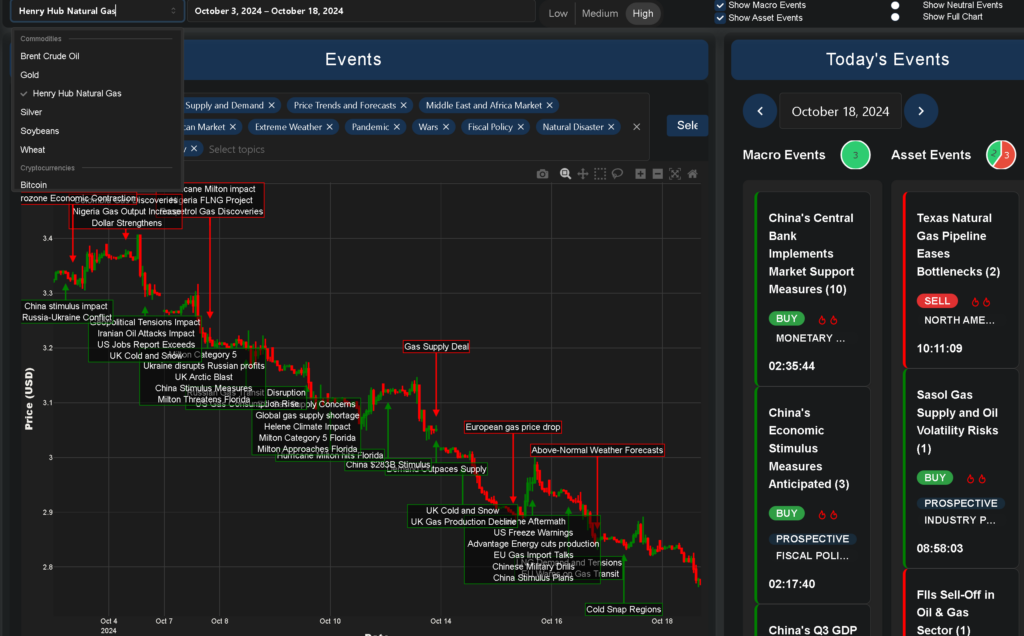
events affecting natural gas prices

Register your interest below


Brent crude oil prices historical: A deep dive into market patterns and major events

Brent crude oil prices serve as a crucial indicator of the global energy market. Their ups and downs affect economies, industries, and everyday people. Looking at the Brent crude oil prices historical path gives us key insights into how world events, from politics to economic changes, have shaped one of the planet’s most important resources.

As we look into the past trends of Brent crude oil prices, we uncover big moments that have shaped the oil market, offering a clear view of what history can teach us about future energy challenges.

Brent crude oil prices historical: Price volatility in the 1980s and 1990s

The 1980s kicked off a time of big swings in Brent crude oil prices historical data due to wars and less control over markets. The Iran-Iraq War, which ran from 1980 to 1988, caused major problems for oil production in the Persian Gulf, a key area for supply. This fight, along with the worldwide slump of the early 1980s, had an impact on Brent crude oil prices. They shot up to new highs at times then crashed back down.

By the late 1980s, the market changed as futures trading began. People traded Brent crude more on futures exchanges, which let market players protect against risks and guess future price changes. This change had an impact on Brent crude oil prices making them respond more to global economic signs, while also exposing them more to market guesses.

In the 1990s, oil prices stayed relatively steady, though the Soviet Union’s fall and the new way former Soviet states sold oil brought new factors to the world market. During this time, Brent crude oil prices showed how well global supply matched demand, while still reflecting the shaky politics in key oil-making areas.

Brent crude oil prices historical: The early 21st century

As we stepped into the 21st century, Brent crude oil prices historical trends took a new turn, with emerging economic powerhouses like China and India pushing global demand to new heights. The beginning of the 2000s witnessed a steady increase in oil prices driven by quick industrialisation, city growth, and a spike in worldwide trade. Brent crude oil prices soared to record levels in 2008 peaking at almost $150 per barrel just before the global financial crisis hit.

This era also saw financial markets having a greater influence on oil prices. As oil futures trading grew more intricate and advanced, Brent crude oil prices felt the impact of not just physical supply and demand but also financial speculation and market sentiment. This caused major price swings, with quick changes based on economic reports, stock market patterns, and even shifts in currency values.

The 2008 financial crisis though, brought a sharp turnaround. As economies shrank and energy demand fell, Brent crude oil prices took a nosedive dropping to about $40 per barrel by year’s end. This served as a clear reminder of how oil prices link to wider economic cycles.

Brent crude oil prices historical: Geopolitical shocks and the energy transition

In recent years, looking at Brent crude oil prices historical data shows how new geopolitical shocks and the current global energy shift have an impact on prices. The Arab Spring protests in 2011 in Libya, cut oil supply from key producing areas pushing Brent crude oil prices up again. In the same way, connflicts between Iran and the United States, plus trouble in Venezuela, added to market volatility. 

Meanwhile, the worldwide shift toward green energy and cutting carbon has shaken up the oil market. As nations promise to shrink their carbon footprints and switch to cleaner power sources, oil demand is likely to drop in the long run. This has caused doubt about what’s next for Brent crude oil prices, as big oil producers change their plans to deal with these changes.

At Permutable AI, our macro data intelligence keeps tabs on these changes showing how more complex factors have an impact on oil prices. Our platform analyses geopolitical risks, market sentiment, and other core data factors real-time to give businesses and investors the insights they need to tackle these issues. By using AI, we offer a full picture of how Brent crude oil prices historical patterns can help predict future market behaviour.

How climate change affects Brent crude oil prices

A key factor that will shape Brent crude oil prices in the future is the growing effect of climate change. Extreme weather events new regulations, and changes in energy use are all creating new risks for the oil market.

Our analysis reveals that climate risks play a bigger role in oil price swings. Take hurricanes in the Gulf of Mexico as an example. They often stop oil production and refining, which causes quick jumps in prices. Also when governments try to cut down on fossil fuel use through things like carbon taxes or limits on oil exploration, it could make Brent crude oil prices go down over time.

Ultimately, looking at how Brent crude oil prices historical patterns have changed because of environmental factors, we can better predict how these forces will shape the oil market in the future.

What we’ve learned and what’s ahead

This Brent crude oil prices historical story shows how global markets are all connected, and closely intwined with economic growth, political unrest, and environmental issues – all affecting price changes. From when North Sea production first started to today’s complex, AI-driven analysis of market trends, Brent crude continues to be a key benchmark for global energy markets.

Looking ahead, insights taken from past shifts in Brent crude oil prices can guide businesses, investors, and policymakers to handle the uncertainties in the global economy better. Our macro data intelligence offers real-time information allowing companies and investors to stay one step ahead and make informed choices in a fast-changing world.

In today’s world where markets are unpredictable and climate risks loom large knowing the Brent crude oil prices historical background is key for anyone involved in global energy markets. 

Trading Co-Pilot exclusive access 

Are you ready to be part of the future of trading? At Permutable AI, we’re extending an exclusive opportunity to a select group of corporate partners to gain early access to our advanced trading co-pilot, powered by cutting-edge machine learning for contextual understanding.

This is a rare chance to stay ahead of the competition by leveraging AI that not only processes data but also grasps the global context—analysing real-time sentiment and market-shaping events to deliver more precise and risk-aware trading strategies.

If your firm is ready to lead the way in AI-driven trading innovation, get in touch today to explore this limited opportunity and discover how our trading co-pilot can transform your approach to the market by contacting us at enquiries@permutable.ai or fill in the form below.

Get in touch


Commodities trading: Navigating the commodity market in 2024 – trends & insights

Navigating the intricate landscape of predicting the commodities trading for 2024 and beyond involves a delicate dance amidst a complex interplay of economic, geopolitical, and environmental factors. The commodities market, known for its volatility and sensitivity to global dynamics, requires a nuanced understanding of current trends and expert insights to gain a glimpse into the potential outlook for various commodity categories.

In this unpredictable terrain, uncertainties cast shadows over the future, demanding a comprehensive analysis that considers not only traditional economic indicators but also the ripple effects of geopolitical events and the ever-evolving environmental landscape. The ability to foresee trends and anticipate shifts in commodity prices has never been more crucial, especially in an era where markets are increasingly interconnected, and the impact of one event can reverberate across the globe.

As we delve into the forecasting of commodities trading for 2024, it becomes evident that traditional approaches must be augmented by insights drawn from diverse sources. The intricate dance of supply and demand, influenced by factors ranging from political decisions and climate change policies to technological advancements, paints a canvas where predicting market trajectories requires a blend of analytical precision and a keen eye for emerging trends.

This exploration will not only unravel the potential trends in traditional commodities trading but will also shed light on how emerging factors, such as advancements in technology, changes in consumer behaviour, and global efforts towards renewable energy, might reshape the landscape. The integration of these elements into the fabric of commodities trading underscores the need for a comprehensive and forward-looking approach to predicting market dynamics in 2024.

Base metals: A mix of challenges and opportunities

Overall perspective: The base metals market presents a mixed bag of challenges and opportunities in 2024. Notably, nickel faces a bearish outlook, primarily due to increased Indonesian production. On the flip side, copper and other industrial metals may experience positive momentum, driven by potential infrastructure spending initiatives.

Key influencing factors: Several key factors will shape the base metals market. Global economic growth, particularly in major industrial nations, will be a significant determinant. The level of construction activity in China, a major consumer of base metals, and the ongoing transition to clean energy will also play crucial roles in shaping the outlook.

Precious metals: Bullish momentum amid economic dynamics

Market outlook: Precious metals, including gold and silver, are poised for a bullish trend in 2024. This optimistic outlook is rooted in expectations of subdued inflation and central banks adopting more accommodative monetary policies. Consequently, gold and silver prices may surge, potentially reaching new highs.

Key drivers: The trajectory of interest rates, investor sentiment towards safe-haven assets, and geopolitical tensions will serve as pivotal factors influencing precious metal markets. As global economic dynamics evolve, these metals are likely to maintain their allure as safe-haven investments.

Energy: Navigating volatility and geopolitical factors

Oil market dynamics: The oil market is expected to face continued volatility in 2024. The potential for both upside and downside movements will be influenced by factors such as economic recovery, recessionary fears, decisions by the OPEC+ alliance on production levels, and ongoing geopolitical concerns.

Natural gas outlook: Natural gas prices are anticipated to remain volatile and elevated, primarily due to supply constraints and the persistent conflict in Ukraine. The war has disrupted energy supplies, contributing to sustained pressures on natural gas prices.

Agriculture: Bullish trends fueled by disruptions and weather

Overall agricultural outlook: The agriculture sector is anticipated to witness bullish trends, particularly in the early months of 2024. Factors such as supply chain disruptions and weather-related concerns are expected to drive price increases in commodities like sugar and grains.

Key agricultural factors: Weather patterns, crop yields, and the dynamics of global trade will be pivotal in determining specific trends within the agriculture sector. As climate conditions evolve, strategic decisions in response to changing agricultural landscapes will be crucial.

Additional considerations: Trends beyond traditional factors

The green transition: Investments in commodities linked to clean energy technologies, such as lithium and cobalt, are projected to experience steady growth. Government policies supporting green initiatives and the increasing demand for electric vehicles contribute to the optimism surrounding these commodities.

Technological advancements: The incorporation of artificial intelligence  and big data in commodities trading and analysis is a noteworthy trend. This integration enhances efficiency and opens new avenues for investment opportunities, reflecting the broader influence of technology on traditional markets.

A cautionary approach: Diversification and research

In navigating the commodities trading landscape of 2024, a cautious approach with a focus on diversification is recommended. Thorough research, an understanding of specific market dynamics, and seeking professional guidance are crucial steps before making any investment decisions. While informed predictions offer valuable insights, unforeseen events can disrupt even the most well-founded expectations. Staying informed and adapting strategies as market conditions evolve will be imperative for investors.

How Permutable AI can empower commodities trading  

In the volatile landscape of 2024, investors are seeking innovative tools to gain a competitive edge. This is where Permutable AI steps in, offering technology-driven solutions that harness the power of artificial intelligence to navigate the erratic nature of the commodities market.

AI unleashing hidden patterns: Commodities trading requires a keen understanding of various variables, and AI algorithms excel in processing vast amounts of data to unveil hidden patterns and correlations. Permutable AI’s technology dives deep into historical market trends, global economic indicators, geopolitical events, and environmental factors, extracting valuable insights that might elude traditional analysis. By deciphering complex data sets, the AI can provide a nuanced understanding of commodity movements, enabling investors to make informed decisions.

Real-time analysis for dynamic markets: Commodities trading and the market is known for its rapid changes, influenced by global events and economic shifts. Permutable AI’s real-time analysis capabilities ensure that investors receive up-to-the-minute insights into market fluctuations. This empowers them to make agile decisions, responding promptly to changing conditions and seizing opportunities that may arise amidst the dynamic nature of commodity prices.

Tailored recommendations for diversification: No two commodities are alike, and the factors influencing their prices can vary significantly. Permutable AI employs sophisticated models to personalise recommendations based on an investor’s risk tolerance, financial goals, and unique investment constraints. By tailoring suggestions to individual preferences, the AI ensures that portfolios are diversified strategically, mitigating risks associated with the volatile commodities market.

Proactive risk management: The commodities market is inherently risky, and effective risk management is crucial for investors. Permutable AI’s technology goes beyond providing insights; it actively contributes to risk management strategies. By identifying potential risks and offering proactive solutions, the AI helps investors navigate the market with greater confidence and resilience.

Adaptability in unpredictable environments: One of the standout features of our AI trading provision is its adaptability in unpredictable environments. The commodities market is susceptible to sudden shifts influenced by unforeseen events. Permutable AI’s technology is designed to adapt swiftly, ensuring that investors remain agile and responsive to emerging trends or unexpected developments, thereby minimising the impact of market surprises.

Ethical and transparent AI use: In the responsible deployment of AI, Permutable AI prioritises ethical considerations and transparency. Our technology is designed to provide clear insights into its decision-making processes, fostering trust among investors. This explainability and commitment to ethical AI ensures that investors can confidently leverage technology as a valuable tool in their decision-making processes.

As we navigate the complexities of the commodities trading in 2024, at Permutable AI, we’re here as a strategic partner for investors seeking a data-driven and technology-enabled approach. From unveiling hidden patterns to real-time analysis, tailored recommendations, proactive risk management, and adaptability in unpredictable environments, Permutable AI empowers investors to navigate the volatile commodities market with confidence and foresight. To find out more, why not get in touch with us by filling in the contact form below – we’d love to hear from you. Until then, be sure to keep up to date with our latest summary of commodity trading trends for 2025.

Get in touch