Current forex market sentiment weekly overview: Are currency markets trending or trapped between competing narratives?

This weekly FX sentiment overview, based on Permutable AI data, analyses how macro, policy and geopolitical narratives are shaping currency markets in real time. It is designed for institutional investors, macro desks and FX traders seeking to identify shifts in sentiment across major currencies and pairs before they are fully reflected in price. All observations reflect conditions at the time of writing.

Welcome to Our Weekly Forex Market Sentiment Roundup

Overview

This report provides a structured view of global FX sentiment using real-time data from Permutable AI. The dataset aggregates tens of thousands of headlines across hundreds of sources, transforming narrative flow into directional indicators across major currencies and FX pairs.

All sentiment indicators reflect market conditions at the time of writing. In current FX markets, narrative shifts can occur rapidly, particularly when driven by policy signals or intervention, and positioning may adjust quickly.

The defining feature of the current regime is not directional clarity, but balance. Across most major currencies and pairs, sentiment is neutral, with conviction levels clustering around 65 to 75 percent. This reflects a market where macro, geopolitical and policy drivers are offsetting one another rather than reinforcing a single trend.


Executive view

Currently, FX markets are characterised by equilibrium rather than trend persistence.

  • The US dollar lacks sustained safe-haven momentum despite geopolitical risk
  • Commodity-linked currencies are supported but face intermittent volatility
  • Policy signals across central banks are no longer aligned, creating fragmentation
  • Intervention dynamics, particularly in Japan, are introducing episodic dislocation

The result is a regime defined by consolidation, where price action is reactive rather than directional.


Major currencies

US dollar – Neutral 

The US dollar is currently defined by competing forces. Geopolitical risk continues to provide some safe-haven support, but this has been offset by mixed domestic data, weaker growth signals and fluctuating Treasury yields. Recent sessions have also seen profit-taking, while intervention-driven yen strength has reduced the dollar’s momentum across key crosses.

Permutable AI’s data suggests the dollar is no longer acting as the central driver of FX direction. Instead, it is reacting to external developments and shifting risk appetite. Presently, this supports a neutral stance, though conditions may change quickly.


Euro – Neutral 

The euro remains range-bound, with supportive and negative forces broadly offsetting one another. Rising yields and inflation expectations have provided intermittent support, while weak growth data, energy pressures and geopolitical uncertainty continue to limit upside. Recent price action shows that euro rallies are struggling to build sustained momentum, particularly when the dollar benefits from safe-haven demand or stronger US data.

Permutable AI’s data indicates a market still searching for direction rather than confirming a durable trend. As of now, the euro sits in a neutral regime, with volatility likely if policy or energy narratives shift.


British pound – Neutral 

Sterling is trading in a mixed sentiment regime. Bank of England policy stability and occasional positive domestic data have supported the pound, but growth concerns, trade risks and geopolitical uncertainty continue to cap conviction. Recent rallies appear more corrective than structural, with gains repeatedly challenged by broader dollar dynamics and domestic fragility.

Permutable AI’s data suggests the pound is neither breaking down nor establishing clear leadership among major currencies. At the time of reporting, sentiment remains neutral, with positioning likely to remain sensitive to UK growth data, inflation expectations and global risk appetite.


Japanese yen – Neutral 

The yen remains one of the most volatile currencies in the current FX landscape. Recent intervention by Japanese authorities triggered a sharp appreciation, reinforced by safe-haven flows, higher Japanese government bond yields and firmer Bank of Japan signalling. However, part of that strength has since been offset by profit-taking and mixed domestic data, including concerns around below-target inflation.

Permutable AI’s data indicates that while yen downside has been challenged, the case for sustained appreciation is not yet conclusive. In the current context, the yen remains neutral, with intervention risk keeping volatility elevated.


Canadian dollar – Bullish 

The Canadian dollar stands out as one of the stronger major currencies at the time of writing. Permutable AI data shows that CAD sentiment is being supported by elevated oil prices, positive energy-sector developments and expectations of potential Bank of Canada tightening. Canada’s role as a major energy exporter means rising crude prices continue to reinforce currency demand. Although soft domestic data and a firmer US dollar present counterweights, these have not yet displaced the dominant commodity narrative. The current bullish stance reflects strong energy-linked support, but remains sensitive to any reversal in oil prices.


Australian dollar – Neutral 

The Australian dollar is supported by commodity exposure and rising expectations of a Reserve Bank of Australia rate increase, but the broader sentiment picture remains mixed. Permutable AI data shows that AUD has recovered from risk-off weakness, helped by materials and mining strength. However, stronger US dollar episodes, softer domestic confidence and a slight decline in Australia’s commodity price index have limited conviction. This creates cautious optimism rather than a clear bullish regime at the currency level.

In the current context Permutable AI’s sentiment indicators are showing that AUD remains neutral, though AUD/USD still shows stronger relative upside versus the dollar.


Chinese yuan – Neutral 

The Chinese yuan remains in a managed and balanced sentiment regime. Permutable AI’s data shows support from firmer domestic policy signals, trade incentives and previous appreciation linked to stronger local data. However, these positives are being offset by external pressures, including US export controls, geopolitical tension and uncertainty around trade flows. Recent price action indicates consolidation rather than sustained appreciation. The yuan remains policy-supported but not independently directional.

Currently, Permutable’s sentiment indicators are neutral, with potential for volatility if policy stance, trade conditions or dollar dynamics shift materially.


High conviction pairs and key crosses

AUD/USD – Bullish 

AUD/USD remains one of the clearest directional expressions in the current FX landscape. Permutable AI’s data shows that Australian dollar strength is being supported by elevated commodity prices, improving risk sentiment and expectations of a Reserve Bank of Australia rate move. At the same time, the US dollar lacks sustained momentum following the Federal Reserve’s recent pause. The pair experienced volatility earlier in the week during a risk-off episode, but subsequent price action indicates recovery and stabilisation.

At this stage, the balance of narratives continues to favour AUD, although the outlook remains sensitive to global risk sentiment shifts.


USD/CAD – Bearish 

USD/CAD reflects strong Canadian dollar outperformance driven primarily by energy markets. Permutable AI’s data indicates that rising oil prices, supported by geopolitical tensions and supply concerns, are reinforcing CAD strength. As a major oil exporter, Canada benefits directly from this environment, which has outweighed intermittent support for the US dollar. Recent price action shows consistent downside pressure on the pair, with limited ability for USD to regain momentum.

As of now, Permutable’s indicators are showing a bearish stance reflecting sustained commodity-driven support for CAD, although the trajectory remains highly sensitive to any reversal in oil prices.


GBP/JPY – Bearish 

GBP/JPY has shifted decisively lower, driven primarily by yen strength following intervention by Japanese authorities. Permutable AI’s data highlights that the yen’s sharp appreciation was supported by rising Japanese government bond yields and a more hawkish Bank of Japan stance. At the same time, the British pound has faced pressure from weaker domestic data and limited policy support. This divergence has created strong downward momentum in the pair.

At this point, the bearish outlook reflects yen-driven repricing rather than sterling collapse, although further direction remains dependent on additional intervention signals and global risk dynamics.


EUR/USD – Neutral 

EUR/USD is currently characterised by balance rather than direction. Permutable AI’s data shows that euro support from rising yields and inflation expectations has been offset by US resilience and safe-haven flows. Geopolitical developments and energy price volatility have introduced further uncertainty, resulting in range-bound trading conditions. While the euro has demonstrated periods of strength, these have not translated into sustained upward momentum.

Presently, neither currency exhibits clear dominance, supporting a neutral stance. Future direction is likely to depend on policy divergence and shifts in macroeconomic expectations across both regions.


GBP/USD – Neutral 

GBP/USD reflects a market defined by competing narratives. Sterling has shown resilience, supported by Bank of England policy stability and occasional positive data, but these gains have been capped by broader US dollar dynamics and geopolitical risk. The pair has exhibited repeated rallies followed by retracements, indicating a lack of sustained conviction. Permutable AI’s data suggests that both currencies are reacting to external drivers rather than establishing independent trends.

As things stand, the pair remains range-bound, with direction likely to depend on shifts in global risk sentiment and relative macro data surprises.


USD/JPY – Neutral 

USD/JPY is currently driven by intervention dynamics rather than conventional macro factors. The pair initially moved higher on US yield support and geopolitical risk, but this was sharply reversed following direct intervention by Japanese authorities. Permutable AI’s data shows that this has introduced significant volatility and capped upside potential for the dollar. At the same time, underlying yen fundamentals remain mixed, limiting sustained appreciation.

At the time of writing, the pair is trading in equilibrium, with traders cautious and highly sensitive to further policy action from the Bank of Japan and evolving global risk conditions.


EUR/GBP – Neutral 

EUR/GBP remains firmly range-bound, reflecting a balance of weaknesses rather than strengths. Permutable AI’s data indicates that both the euro and sterling are influenced by domestic economic challenges and external pressures, including energy costs and geopolitical developments. While the euro has benefited from yield support, UK asset demand has provided relative stability for sterling. Neither currency has established a decisive advantage.

Currently, the cross reflects equilibrium conditions, with limited directional conviction. Future movement is likely to be driven by relative growth data and shifts in central bank expectations.


Conclusion

FX markets are currently defined by competing narratives rather than a single directional force. Permutable AI’s data indicates that while selected pairs show conviction, the broader market remains balanced. Most currencies are trading within neutral regimes at the time of writing, with volatility driven by shifts in policy, commodities and geopolitics. The advantage lies in tracking sentiment as it evolves, rather than reacting after price adjusts.

Access real-time FX sentiment intelligence

Institutional FX teams require more than delayed macro data or reactive price signals. At Permutable, our real-time sentiment intelligence layer continuously monitors global news flow, policy developments and macro narratives, transforming them into structured, model-ready indicators across currencies and FX pairs.

This enables earlier identification of regime shifts, clearer attribution of market drivers and more precise timing of positioning decisions.

To access Permutable’s full real-time FX sentiment indicators, cross-asset narrative analytics and institutional data feeds, request a demo or speak directly with our team at: enquiries@permutable.ai
USD sentiment analysis – what headline data reveals about US Dollar drivers

This article analyses USD sentiment using Permutable AI’s quantitative research, revealing how monetary policy, macro narratives, and market dynamics drive the US dollar across different regimes. It is aimed at institutional investors, macro traders, and analysts seeking data-driven insights to enhance FX strategies using alternative data and systematic sentiment signals.

For institutional investors and FX strategists, identifying what truly drives the US dollar is less about access to data and more about the ability to systematically measure how evolving macro narratives are reflected in price. But while conventional analysis tends to focus on interest rates, central bank policy, and economic releases, the challenge has always been measuring how these narratives translate into market behaviour in real time.

That is where large-scale sentiment analysis becomes valuable.

At Permutable, our latest quantitative research into USD sentiment shows that headline data can provide statistically robust insight into the forces shaping the dollar across different market environments. Based on systematic testing across thousands of signals, the findings point to a clear conclusion – the US dollar is highly responsive to news flow, but interpreting that response requires much more than a simple bullish or bearish read.

This research is based on headline sentiment signals covering the period from 2018 to 2026, using 2,355 trading days of price data and 12,096 signal tests. Of these, 3,080 were statistically significant, with 55.1 percent persisting out-of-sample. The strongest out-of-sample correlation reached 0.70, and the US dollar ranked number one out of eight assets in cross-asset persistence.

That matters because it suggests USD sentiment is not just noisy macro commentary. It contains repeatable structure. In other words, the dollar appears especially well suited to signal extraction through news analytics.

Monetary policy is the dominant USD sentiment driver

The strongest message from the research is that monetary policy dominates USD sentiment.

Permutable AI’s analysis identifies monetary policy as the top scoring group overall, with the highest group score and the strongest persistent out-of-sample signal quality. Within that group, the most important themes include:

  • FX intervention and stability
  • policy stance and guidance
  • interest rate decisions

This aligns closely with how professional FX markets actually trade. The dollar is not only a reflection of US economic conditions. It is also a pricing mechanism for global liquidity, rate differentials, and policy credibility. Headlines about intervention, forward guidance, and rate decisions shape expectations quickly and often before those expectations are fully reflected in price.

One of the strongest persistent out-of-sample drivers in the study was FX intervention and stability, with an out-of-sample correlation of -0.6811 and sign consistency of 73 percent. Policy stance and guidance also showed robust persistence, while interest rate decisions remained significant across 7-day, 1-month, and 3-month horizons.

For anyone using USD sentiment in a market context, this is the clearest practical insight – central bank communication and intervention narratives are not peripheral. They are core dollar drivers.

Macro headlines still matter – but not always where you expect

Beyond monetary policy, macroeconomic news also plays an important role in USD sentiment. The macro group showed robust out-of-sample performance, with a best out-of-sample correlation of 0.66 and persistence of 54 percent. Among the standout themes were macro-other, labour market and employment, and consumption and retail.

Perhaps the most striking result is that Macro-Other was actually the single strongest persistent out-of-sample driver in our analysis, with an out-of-sample correlation of 0.7009.

That suggests something important. Markets do not respond only to scheduled economic releases. They also respond to the broader macro narrative – the less tidy but often highly informative cluster of headlines that shape expectations around growth, resilience, and economic direction.

This is one of the advantages of sentiment analysis over traditional event-based models. Rather than focusing only on known releases, it captures the wider information field surrounding the dollar.

Market dynamics amplify the signal

The research also highlights the importance of market dynamics in shaping USD sentiment.

The market dynamics group delivered a best out-of-sample correlation of 0.62, with headline count identified as the best-performing metric at group level. Price action and volatility stood out as one of the strongest persistent drivers overall, again significant across all major horizons.

This matters because the dollar is not moved by fundamentals alone. It is also shaped by positioning, momentum, and volatility transmission across global markets. In periods of uncertainty, the dollar often becomes both a macro asset and a risk barometer. Sentiment tied to price action can therefore reflect changing market structure as much as changing economic conviction.

Direction is unstable – regime conditioning is essential

One of the most important findings in our analysis is also one of the most actionable.

While USD sentiment signals show persistent magnitude, they do not always preserve directional consistency. Sign consistency across the full set of out-of-sample signals is just 47.1 percent, meaning correlations frequently reverse between up and down markets.

This is not a weakness of the research. It is a realistic reflection of how markets work.

For example, price action and volatility show a sign flip between market regimes. By contrast, policy stance and guidance and interest rate decisions appear more stable. FX intervention and stability remains strong in both regimes, but is stronger in up markets. The “other” driver is stronger in down markets.

The implication is straightforward – USD sentiment is highly informative, but it must be interpreted through a regime-aware framework.

For directional strategies, that means incorporating trend state, volatility regime, or market context alongside the raw signal. For risk and monitoring applications, however, the persistence of magnitude alone may already be highly valuable.

Time horizon matters for USD sentiment

Our analysis also shows that all top 10 drivers are significant across 7-day, 1-month, and 3-month return horizons. But the dominant metric varies slightly by horizon.

This is useful for strategy design. It suggests that USD sentiment is not just a short-lived reaction signal. It can also help track the development of medium and longer-term narrative trends.

USD stands out among FX peers

Finally, the cross-asset comparison is notable. The US dollar recorded 55 percent out-of-sample persistence, ahead of CNY, JPY, CAD, EUR, CHF, GBP, and AUD.

That makes the dollar the strongest performer among the FX peers tested in this framework. For systematic investors, it reinforces the case for treating the dollar as one of the most responsive currencies for sentiment-led analysis.

Final take

Our research suggests that USD sentiment can be measured in a way that is both statistically rigorous and practically useful.

The headline conclusions are clear:

  • monetary policy is the dominant dollar driver
  • macro narrative matters more than narrow release-based analysis suggests
  • market dynamics strengthen and shape the signal
  • regime conditioning is essential for directional use
  • the US dollar is one of the strongest assets for out-of-sample sentiment persistence

For analysts, traders, and institutions, the bigger point is this – understanding the dollar now requires more than watching the next Fed meeting or payroll print. It requires tracking how the global information environment is evolving around policy, macro conditions, and market structure. That is exactly where systematic sentiment analysis can add real edge.

Access full USD sentiment insights 

Get in touch to request the full fact sheet displaying the complete results of our USD sentiment analysis by emailing enquiries@permutable.ai.

USD/JPY outlook: Regime shifts, rate cycles and macro sentiment (2016-2026)

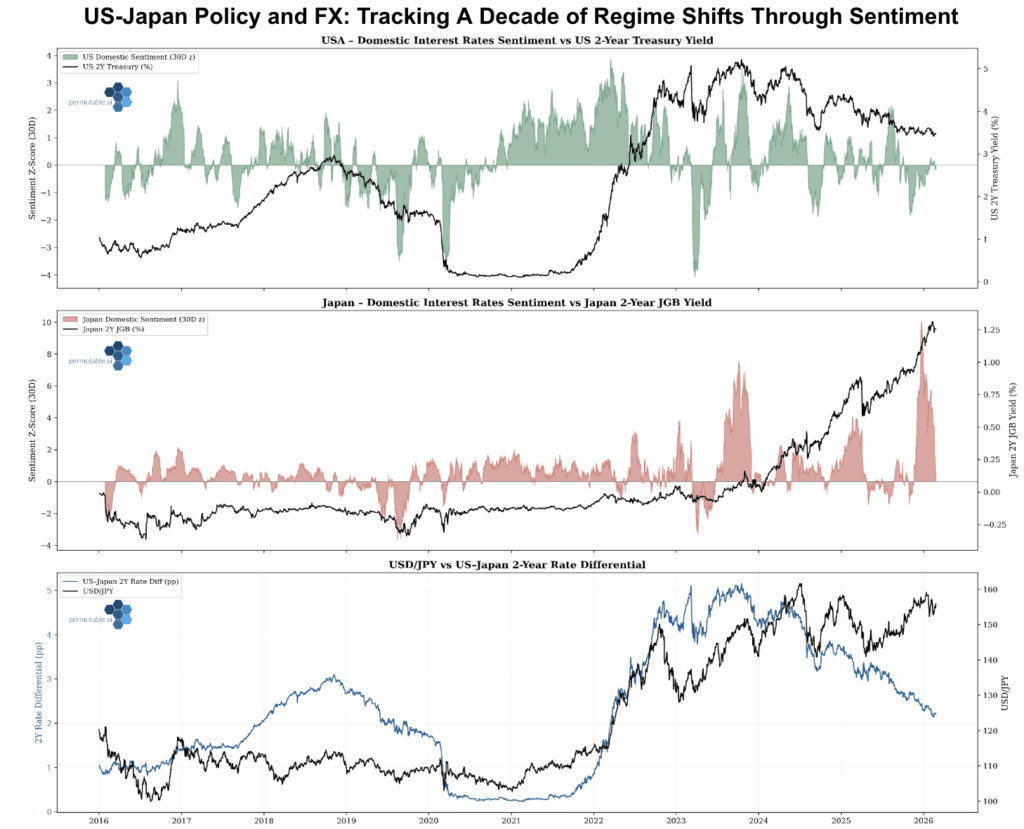
In this article, we analyse USD/JPY through the lens of domestic US and Japan rates sentiment, testing whether FX has kept pace with the compression in the 2-year spread. For discretionary macro and systematic desks, we combine bond market pricing with cross-sectional policy analysis to assess whether the next regime shift is already underway, or still playing catch up.

The Old Regime Ends a New One Begins

For a decade, USD/JPY was the clearest expression of monetary divergence and the carry trade. Japan in monetary anaesthesia. The US in perpetual motion. The carry machine hummed away, the yen absorbed the adjustment, and the spread did the explaining.

That regime has faded into a distant memory. The rate differential has compressed, yet FX has only partly followed. The question now is whether USD/JPY will finally move with the new spread reality, or continue to chart its own course.

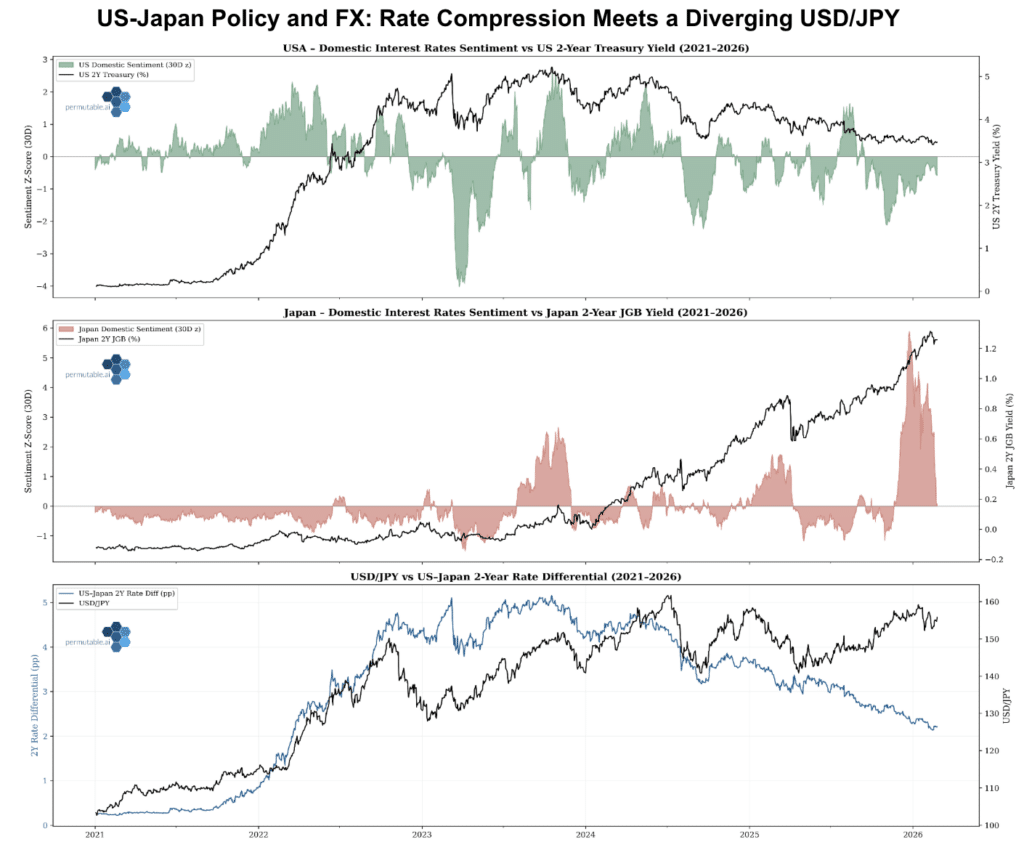
The 2-year US-Japan rate differential has compressed by nearly 300 basis points from its 2023 peak. Japanese domestic rate sentiment has reached levels unseen in the prior decade, a structural shift, not noise. Yet USD/JPY remains in the mid-150s, pricing a divergence regime the bond market has already left behind.

The framework here is cross-asset and cross-sectional. We focus on the 2-year point of the curve, where policy is transmitted most directly, and draw on domestic interest rate sentiment from Regional Macro Indices spanning more than a decade and 50+ countries. Hard data confirm what has already occurred. Sentiment identifies what is building.

From financial repression, through the divergence peak, to today’s early convergence, USD/JPY has moved through three clear regimes. What stands out now is the gap between what the front end is pricing and where FX is trading. It is not just a narrative mismatch, but a meaningful skew for the path ahead.

USD/JPY Outlook
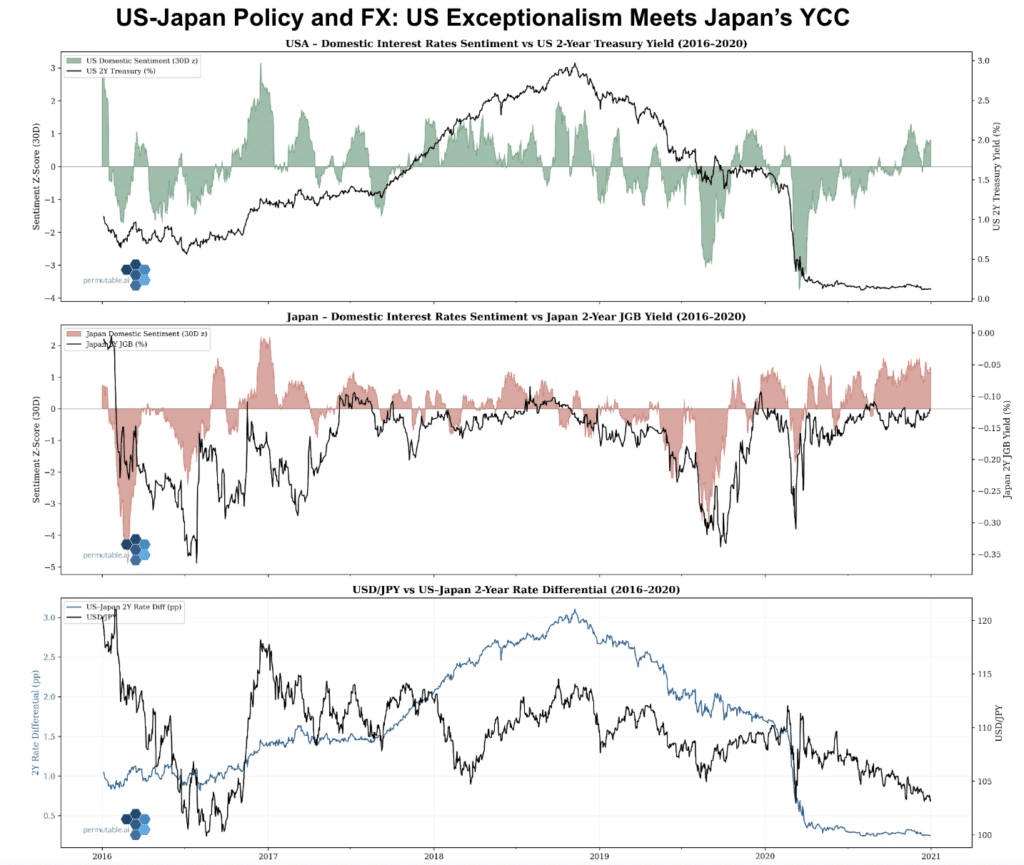
Chart 1 – Full Cycle View (2016-2026). US and Japan domestic rate sentiment (30D z-score), 2Y yields (%), USD/JPY spot, US-Japan 2Y rate differential

The Divergence Regime: 2016 – 2020

Between 2016 and 2020, asymmetry defined global macro. The Federal Reserve operated within a conventional tightening and easing cycle. The Bank of Japan remained committed to Yield Curve Control and negative rates. Japan functioned as the world’s monetary ballast, stable, suppressed, and predictable.

The 2-year JGB traded as though policy had been fixed in place. Yields hovered near or below zero. The 10-year was actively managed. Domestic rate sentiment in Japan was not merely subdued, it was dormant. For most of the period, readings clustered near zero with little sustained deviation. The market had stopped pricing the possibility of change.

The Fed, by contrast, tightened into 2018, pivoted in 2019, and maintained a structural yield premium over Japan even during easing phases. USD/JPY tracked the 2-year differential closely. The transmission was straightforward: wider spread, stronger dollar. Japan was the funding currency. The carry trade dominated positioning logic.

US rate narratives oscillated with growth and inflation cycles. Japanese narratives barely moved. That asymmetry underpinned a profitable yen-funded carry environment, and the sentiment data from this period show just how absolute Japan’s rate inertia was. The z-score of Japanese domestic rate sentiment barely surfaced above zero for the entire 2016-2020 window.

USD/JPY 2016-2020

The Shock and Repricing: 2020 – 2023

The pandemic disrupted the regime. US yields collapsed in 2020, with the 2-year Treasury falling below 0.2%. Japan barely moved, policy was already fully compressed. There was nowhere lower to go.

The inflation shock of 2021-2022 reversed the dynamic with violent speed. US domestic rate sentiment did not just turn positive, it ignited. The hiking cycle arrived not as a gentle recalibration but as a four-alarm fire. The 2-year Treasury repriced by more than 400 basis points in under eighteen months. USD/JPY followed the spread like a compass finding north. The carry machine was running at full throttle with the handbrake off.

Japan kept the lights off. Yield Curve Control held. The yen became the world’s preferred funding currency, borrowed cheaply, sold freely, and recycled into everything with a yield attached. USD/JPY moved above 150 and approached 160. Divergence reached its most extreme expression.

Yet even at the divergence peak, the tone was beginning to shift. Japanese domestic rate sentiment started to rise in 2023 as inflation proved more persistent and policy debate intensified. The carry remained intact, but momentum was no longer one-directional. Sentiment registered the turn before spreads fully adjusted.

USD/JPY 2021-2026
Chart 3 — The Repricing and Convergence (2021-2026). Japan rate sentiment z-score breaks above +5 in late 2025, a level with no precedent in the prior decade, as the US-Japan 2Y differential compresses from 5pp to just above 2pp.

Exit from YCC and Compression of the Spread: 2023 – 2026

Yield Curve Control was first adjusted, then dismantled. The 2-year JGB, anchored below zero for years, moved above 1.2% by early 2026. In absolute terms that level remains modest. Relative to the prior decade, it represents a structural shift.

Japanese domestic rate sentiment reinforces this notion. By late 2025, the 30-day z-score exceeded +5, a reading without precedent in the prior cycle. This was not incremental adjustment. It marked the end of the ultra-loose policy era.

In the US, the hiking cycle ended and expectations shifted toward gradual easing. The 2-year Treasury rolled from its 2023 peak toward the mid-3% range. Rate sentiment cooled steadily from its extreme positive readings toward neutral.

The US-Japan 2-year differential compressed from nearly 5pp to just above 2pp. The macro anchor rotated from divergence to convergence.

After retreating from near 160 during the January 2026 intervention episode, USD/JPY stabilised in the mid-150s. FX remained elevated relative to the new spread regime. The adjustment process is incomplete.

February 2026: Policy Signalling vs Pricing

By late February 2026, the US-Japan complex reflects various overlapping dynamics. Their interaction defines the near-term range and the medium-term direction. What appears noisy at the surface is, underneath, a story of gradual convergence constrained by politics and policy tripwires.

1. The US Curve: Moderation Without Capitulation

The 2-year Treasury sits near 3.45%, consistent with modest easing expectations. The 10-year trades around 4.05%, the 30-year near 4.7%. The curve has steepened as the fiscal materialises. Cuts are being priced in, but not as aggressively as thought with the incoming appointment of Warsh being the next Fed chair .

US domestic rate sentiment reflects that shift. The tone of 2022-2023 has faded toward neutral. The US is no longer widening the differential. It is contributing to compression of the rate differential.

2. Japan: Normalisation with Political Spillover

The yen has softened on reports that Prime Minister Takaichi is uncomfortable with further rate rises, and on the nomination of incoming BoJ board members leaning more towards a dovish stance. Yet in reality the centre of gravity towards normalisation may not shift as far as the headlines imply.

Additionally, against Japan’s new fiscal backdrop, this adds a further dimension debate. The LDP’s commanding lower-house majority following the February 2026 snap election gives the government capacity to push fiscal support, household tax relief and defence spending. With public debt still swelling above 200% of GDP and debt-servicing costs rising as yields lift from their decade-long floor, markets are assessing whether fiscal activism and monetary normalisation can coexist in the same breathe. They potentially can, but not without periodic friction.

The base case in the market still points to a June hike taking the policy rate to 1.0%. The structural trajectory has not shifted on the policy side. Inflation remains elevated beyond historic norms. Wage growth is accelerating. The debate now sits around the pace pace, not reversal.

3. FX Intervention ?

USD/JPY has consolidated since January’s rate-check episode. The 157 high from early February is within reach again. A clean break higher returns intervention risk to the foreground. The 155-160 range now functions as a political hurdle.

The asymmetry is structural: upside faces a political ceiling from the optics of currency weakness and rising import costs. 

Three forces lead to the FX misalignment. The US is cooling. Japan is normalising. The question is not whether convergence continues, it is how much longer FX diverge from the the front end. 

What the Sentiment Data Reveals

Traditional macro data confirm developments with delay. CPI validates disinflation after it occurs. GDP confirms output trends a quarter late. Sentiment captured in real time across 50+ economies reflects the early change in tide, the signal that the market is forming before it appears in price.

Three points stand out from the Regional Macro Indices for the current setup. First, US domestic rate narratives have cooled steadily since mid-2025, a directional fade from extreme positivity, not a collapse. Second, Japanese rate narratives have strengthened materially since 2023, reaching z-scores with no precedent in the prior decade. Third, and most important: the sentiment gap has moved in Japan’s favour even as USD/JPY remains near 155. Narrative momentum is fading in the US and building in Japan.

Cross-sectionally, Japan’s shift stands out across G10. While the Fed debates cuts and the ECB edges toward neutral, Japan alone is transitioning from ultra loose to policy normalisation. That cross-sectional divergence in sentiment strengthens the convergence thesis in rates. Rates, historically, pull FX. Yet the FX has broken away.

Discretionary and Systematic Use Cases

For macro desks, domestic rate sentiment provides a live read on policy direction before it is fully embedded in front-end pricing. It clarifies whether moves reflect cyclical noise or structural transition, between heat without light and a genuine directional shift.

In the current environment: if US tone continues to soften while Japan’s remains elevated, further compression is the base case. A re-acceleration in US inflation could temporarily re-widen the spread, a reflex rally in rate expectations, not a structural reversal. The carry machine does not announce when it is losing torque. Sentiment does.

For systematic investors, sentiment functions as a regime filter alongside yield differentials and volatility, identifying when the spread-FX relationship is stable versus when it is fraying under structural rotation. As a cross-sectional factor, it locates where policy narratives are turning first and fastest, before the price signal is clean.

The current read: Japan’s normalisation narrative is cross-sectionally dominant across G10. US sentiment has faded to near-neutral. The spread-FX gap is wide. The inflection is audible. Pricing is behind the story.

The Old Anchor Has Lifted

From financial repression to divergence peak to convergence phase, the US-Japan complex has transitioned across three distinct regimes. Bond markets moved first. Policy language confirmed the shift. FX is recalibrating from a position of meaningful overvaluation relative to the spread that has historically explained it.

The convergence story is asymmetric. Political sensitivity constrains upside in USD/JPY. Downside, if spread compression continues, faces fewer structural limits. The next phase is defined by conditional convergence, not sustained divergence. Hard data will confirm it later. Sentiment is already pricing it now.

The JGB has surfaced from a decade below zero. US rate narratives are cooling. The 2-year spread has compressed by nearly 300 basis points. The rubber band has been stretching for eighteen months. The carry machine is running on borrowed time.

USD/JPY is the last instrument in the complex to not have got the memo. And when it does, the move will not feel gradual to those who waited for the data to confirm it.

Monitor the Regime in Real Time

The Regional Macro Indices track domestic policy narratives across more than 50 economies, capturing shifts in rate expectations before they are fully reflected in front-end pricing. For further information on integrating the indices into discretionary frameworks or systematic models, get in touch at enquires@permutable.ai

Yen outlook: How dual headwinds and rising China tensions are shaping JPY market sentiment

In this article we take a closer look at the recent volatility in the yen outlook as Japan grapples with a Q3 growth setback, weakening domestic demand and a hardening China risk premium. We examine how setbacks to tourism and tech shocks, rising long-end JGB yields, deteriorating cross-asset sentiment and a cautious BoJ are shaping the currency’s trajectory, and what this means for USD/JPY and GBP/JPY. We also assess the shifting hierarchy of safe-haven currencies, with institutional sentiment favouring the Swiss franc over the yen in FX strategies.

Japan is currently facing a volatile blend of cyclical softness and geopolitical strain, a mix visible both in price action and in our AI-driven market sentiment signals. Our Trading Co-Pilot’s thematic heatmap shows broad deterioration across political, macroeconomic and monetary-policy themes through mid-November. 

Political and geopolitical topics have remained firmly bearish, while growth and interest-rate themes have deteriorated further. Occasional pockets of improvement in economic-data have been too feeble to offset the prevailing wave of negative news sentiment.

Yen Outlook Thematic heat map
This chart shows the Japanese yen alongside our thematic market sentiment heatmap. Since mid-November, signals across macroeconomic, political and monetary-policy categories have shifted increasingly red, indicating a persistent build-up in bearish JPY sentiment even as price action drifts lower.

This bearish backdrop or market sentiment mirrors the current macro landscape. Q3 GDP contracted -1.8% annualised, the first decline in six quarters, pressured by weaker exports, subdued consumption and a sharp housing correction. At the same time, sentiment tied to China relations, travel flows and trade disruptions turned sharply negative after Beijing’s travel advisory and the sell-off in tourism-linked equities. Together, the data and news sentiment profile show a yen under pressure from both domestic fragility and external risk premia, with investors adopting a distinctly defensive stance.

GDP Breakdown: Temporary Weakness Meets Structural Friction

The Q3 figures confirm the loss of momentum across key components. External demand pulled -0.2% from GDP as exports fell -1.2% q-o-q, reversing the tariff-distorted frontloading in auto shipments. Domestic demand provided only modest support. Consumption remains constrained by a persistent cost-of-living squeeze and sticky food inflation, while residential investment dropped -32.5% annualised, the sharpest drag on the quarter.

Business investment rose 1% q-o-q, offering the only sign of resilience. Yet indicators around capex and hiring have cooled, pointing to increasing caution in Q4 and heading into 2026. Overall, the domestic base is flagging at a moment when Japan is increasingly exposed to external headwinds, a combination that leaves the yen sensitive to swings in global risk appetite.

Tourism and Tech Shock: The External Hit 

The more acute pressure originates abroad. China’s travel advisory and the deterioration of relations have hit tourism, retail and other consumer-facing sectors hard. Close to 80% of Chinese bookings to Japan have been cancelled, and major Chinese airlines have moved to refund tickets in response to the escalation. The result has been a broad sell-off in Japanese tourism and retail names, with market unease clearly on display as firms such as Shiseido and Isetan slid -10% to -12%. At the same time, the sentiment surrounding political and trade-related themes turned decisively bearish, reinforcing the impression that investors see this as a lasting drag rather than a passing diplomatic flare-up.

Chinese visitors to Japan account for about a quarter of inbound arrivals and close to ¥600bn in quarterly spending. If flows remain depressed, the economic hit could equate to 0.3% to 0.4% of annual GDP. Japan’s semiconductor and tech supply chains also sit near the fault lines of the broader US-China strategic environment, amplifying the external risk. This deterioration across China-linked sectors has become a central driver of the yen outlook.

The Policy Backdrop: Domestic Fragility and External Risk Premiums

The yen remains constrained by the overlap of weak domestic demand, external shocks and rising fiscal concerns. The GDP setback reinforces expectations that the BoJ will normalise policy slowly. Tourism weakness and softer equity sentiment weigh on Japan’s external balance, while long-end JGB yields are rising for supply-driven reasons rather than stronger growth. Japan’s Finance Minister Satsuki Katayama has been clear that growth comes first and that the forthcoming stimulus will do the lifting, but offered no hint on its size, a line the bond market reads as more supply with few constraints and a heavier overhang at the long end.

With public debt above 200% of GDP and a ¥17tn-plus stimulus plan under discussion, concerns around fiscal sustainability have resurfaced. Uncertainty around fiscal stability, China exposure and policy clarity has softened in parallel. In turn, the yen continues to trade more on risk premia than on classical rate differentials.

Going forward policy communication now sits at the heart of the currency’s trajectory. Soft Q3 data and worsening inflation outlook strengthen the case for additional fiscal measures, but markets remain cautious about the heavier issuance profile that follows. Governor Ueda has stressed vigilance over FX and policy moves, yet the BoJ’s comment of a measured, data-dependent approach limits immediate influence over currency stabilisation.

A firmer alignment between fiscal and monetary policy or a more supportive external environment would help improve the yen outlook. Until then, rallies are likely to fade and sentiment will continue to guide short-term moves.

Japan’s growth setback may prove partly temporary, but the added pressure from China leaves the yen exposed in the near term. A Q4 rebound is possible if travel flows stabilise and exports gain traction, but USD/JPY and GBP/JPY remain upward-biased for now.

USD/JPY

yen usd sentiment
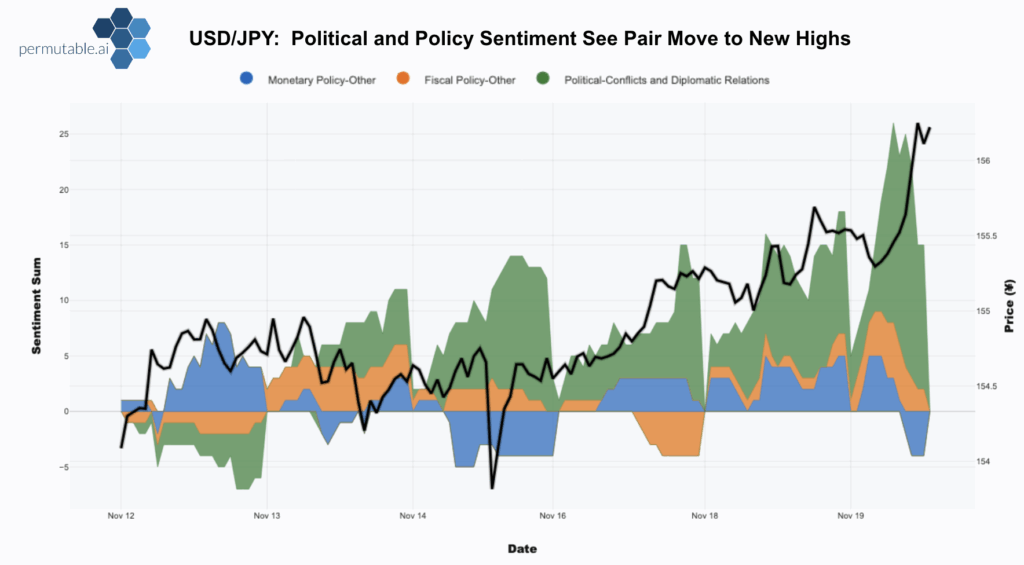
This chart tracks USD/JPY against our stacked thematic market sentiment index. Political and policy-related headlines, particularly around conflicts, fiscal expansion and BoJ stance, have stirred a build up of sentiment through mid-November, helping to support the latest climb up in USD/JPY despite mixed US data backdrop.

USD/JPY trades near recent highs, even as the dollar narrative becomes more mixed. The US government shutdown and delayed data have clouded the short-term macro signal. Softer labour indicators support earlier rate cuts, while the Fed remains cautious, producing a firm floor under the dollar rather than outright strength.

Here, Japan-specific drivers remain central. Fiscal expansion, supply-driven JGB steepening and a gradual BoJ stance ensure USD/JPY remains supported. Market sentiment toward Japan’s policy mix has weakened, meaning even softer US data no longer translates into the same degree of yen strength seen in previous cycles. A durable reversal would require a meaningful softening in US activity or clearer FX guidance from Tokyo.

GBP/JPY

yen gbp sentiment
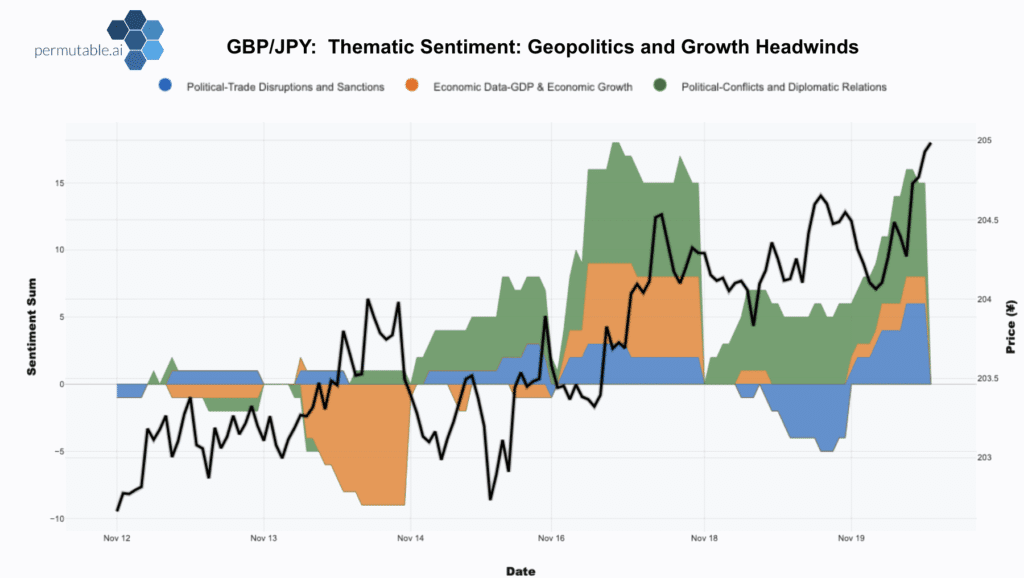
This chart plots GBP/JPY against our stacked thematic sentiment index. Political and trade-related headlines, together with weaker growth signals, dominate the sentiment mix.

GBP/JPY has drifted higher following softer UK inflation, with headline CPI at 3.6% y/y and core at 3.4%, reinforcing expectations for BoE easing in 2025. However, the cross remains dominated by yen factors. Japanese macro softness, fiscal uncertainty and China-linked risks keep GBP/JPY upward-biased, with support near 204 acting as a key level.

CHF vs JPY: A Safe Haven Pivot Shift

CHF JGB
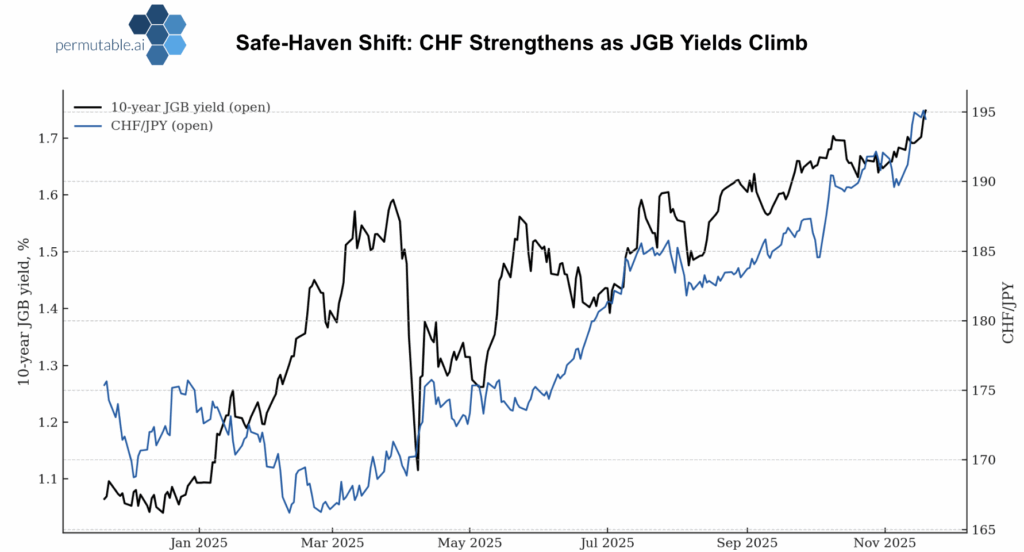
Yen keeps sliding against the Swiss franc even as 10-year JGB yields climb, underscoring stimulus hopes and the currency’s fading safe-haven status.

The yen is also losing its footing in the safe-haven hierarchy. Political uncertainty following Ishiba’s resignation, a tilt toward looser fiscal settings and a reserved BoJ have eroded confidence in Japan’s policy path. With public debt above 200% of GDP, Japan’s balance sheet faces renewed scrutiny.

Switzerland provides a contrasting set of fundamentals. Public debt is below 40% of GDP, the trade surplus is stable, and institutional frameworks remain robust. Sentiment reflects this shift. CHF is increasingly treated as the cleaner hedge during risk aversion, compared to the yen. 

This structural divergence has led financial institutions and traders to prefer long CHF over JPY in risk-off phases, underlining how the yen outlook is now judged against stronger alternatives. 

See the power of our FX sentiment data

Our Trading Co-Pilot intelligence layer continues to monitor every macro headline, political shift and policy signal, giving FX teams the earliest possible insight into sentiment regimes across global currency markets in real-time.

Institutional teams can access our full multi-asset forex sentiment indicators, real-time narrative heatmaps and intraday FX risk signals by requesting a demo or reaching out to us at enquiries@permutable.ai.  

Market sentiment indicators September 2025: Regional fractures and commodity rallies define the month

This analysis examines key market sentiment indicators September 2025, focusing on regional market divergences, commodity rallies, and central bank policy shifts. Aimed at hedge funds, institutional investors, and financial professionals seeking advanced market intelligence and sentiment-driven insights for strategic positioning across global markets.

September 2025 delivered a masterclass in how market sentiment indicators can expose the underlying dynamics driving global markets long before traditional macroeconomic data confirms the shifts. Our comprehensive analysis of key market sentiment data this month reveals a landscape defined by regional divergences, commodity strength, and the persistent fragility beneath headline stability.

Market sentiment indicators September 2025: Key stories in charts

Fed Pivot Sparks US Dollar Weakness

The Federal Reserve’s first rate cut since December 2024 reshaped market dynamics with surgical precision. Our US Monetary Policy Sentiment Index captured the dovish build-up weeks before the 25 basis point cut to 4.00-4.25%, providing hedge funds and institutional clients with early positioning signals that proved decisive.

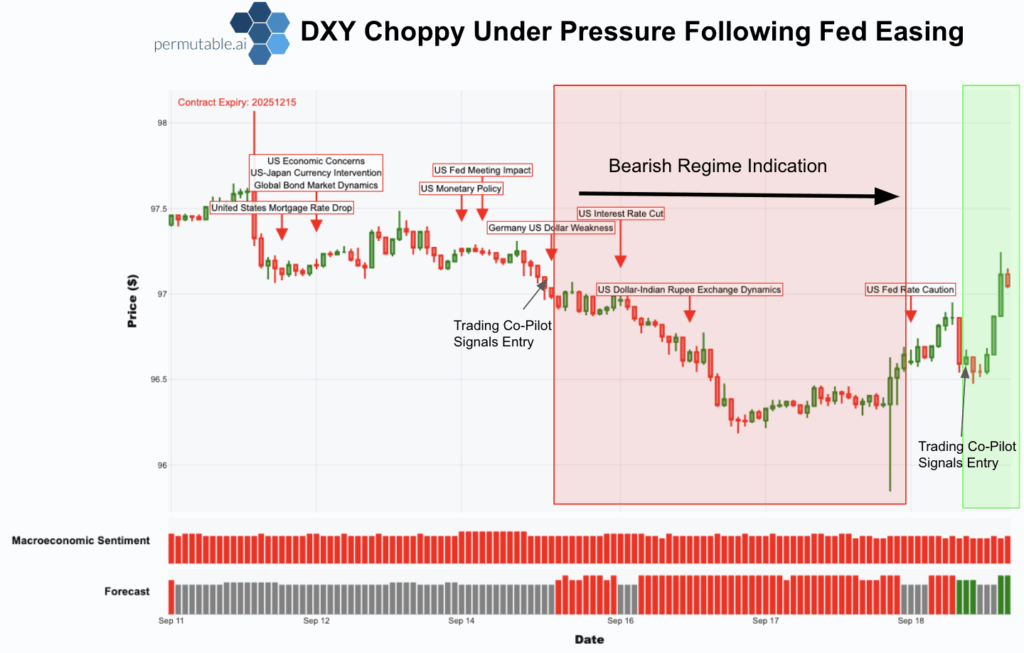
The dollar’s reaction was swift and telling. The US Dollar Index plunged to 96.25, a three-year low, as our Trading Co-Pilot flagged the structural bearish skew that had been building throughout September. This wasn’t merely a policy response but a fundamental shift in market sentiment around dollar strength, with our commodities intelligence platform identifying the knock-on effects across energy and precious metals markets.

Our market sentiment indicators clearly showed that Powell’s measured tone and firmer inflation projections provided only temporary relief. By Thursday, the greenback had staged a modest recovery to 97.00, but our sentiment analysis revealed this as tactical rather than structural, with the broader trajectory tilted decisively lower.

US Dollar Index

Europe’s Political Drag Weighs on Regional Sentiment

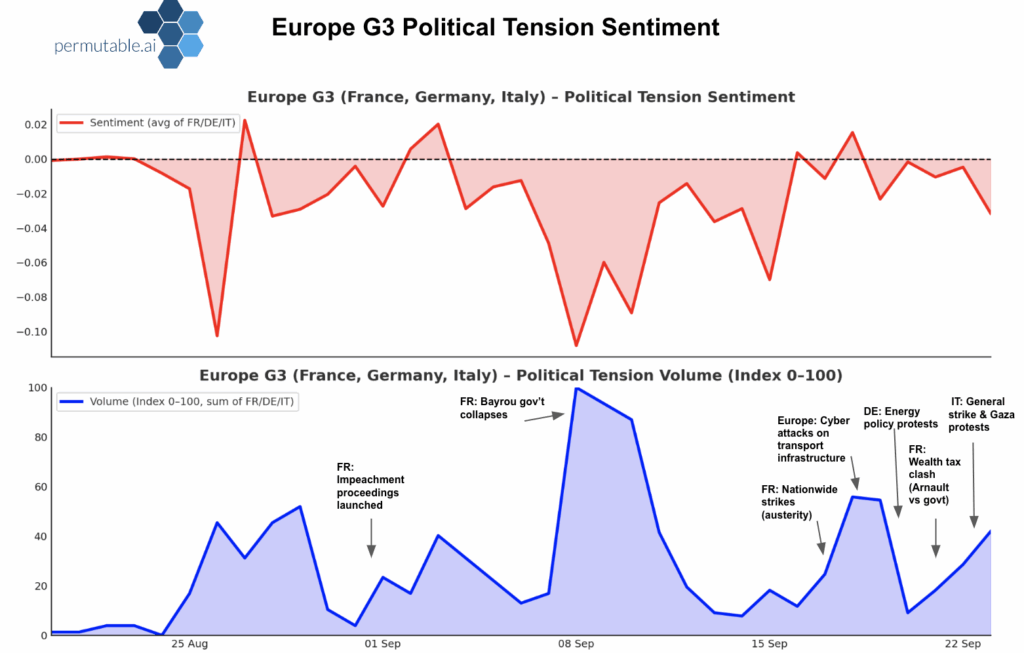
Whilst the US pivoted towards risk appetite, Europe remained mired in political uncertainty that our regional macro indices quantified with stark clarity. France’s wealth tax proposals unsettled luxury equities, whilst political turmoil across Germany and Italy created a persistent drag on market confidence.

Our Political Tension Indices for France, Germany, and Italy remained firmly negative throughout September, with France serving as the epicentre of volatility. The coordinated cyberattack disrupting airline systems across London, Berlin, and Brussels highlighted how infrastructure risks translate directly into market sentiment data, creating opportunities for sophisticated investors to position ahead of the crowd.

This regional divergence created clear relative value opportunities. Our macroeconomic data analysis showed European exporters and cyclicals under pressure, whilst resource-linked names benefited from safe-haven flows that our sentiment models captured in real-time.

Europe Political Tension

Gold’s Record Rally: Universal Hedge in Fractured Markets

September’s standout performer was gold, climbing to record highs of $3,780 per ounce, up 12% for the month. Our Trading Co-Pilot identified gold sentiment as uniquely positioned to absorb capital flows when regional market sentiment indicators diverge.

The precious metal’s rally reflected more than monetary policy expectations. Our commodities intelligence revealed gold functioning as the bridge between US dollar weakness and European political instability. Central bank accumulation continued, with emerging market reserves diversifying away from dollar dominance in a trend our macroeconomic data flagged months ahead of official statistics.

Silver’s accompanying surge past $41.50 reinforced the broader theme. Our analysis identified distinct drivers beyond gold’s coattails, including industrial scarcity and strategic reserve recognition that our commodity sentiment models weighted appropriately.

Gold Rally on Market Sentiment

China’s Growth Paradox: Headlines vs Reality

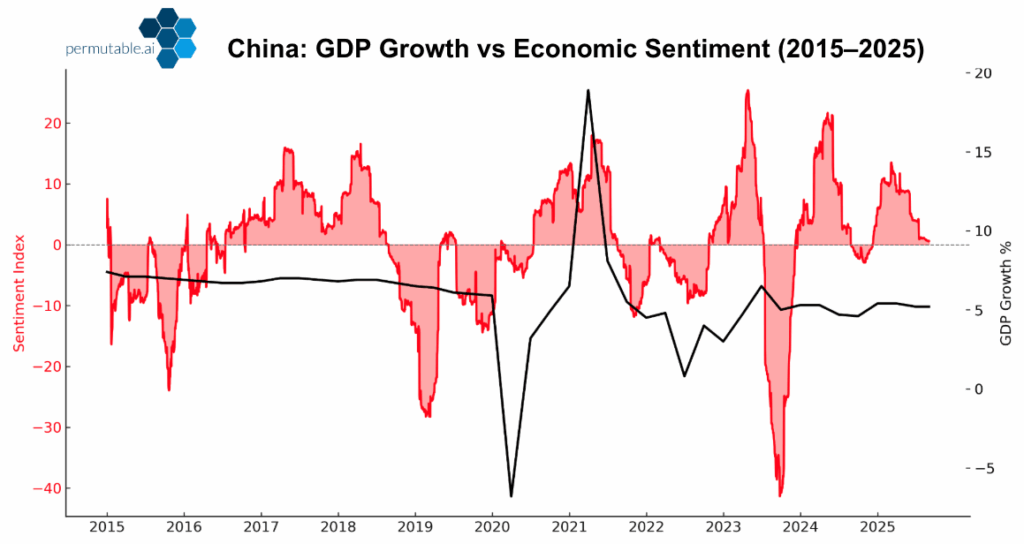
China’s economic narrative epitomised September’s theme of surface stability masking deeper strains. GDP growth held near 5%, yet our China macro sentiment indices revealed households, firms, and investors far more cautious than headline figures suggested.

The property market remained the central drag, with our China Housing Sentiment Index firmly negative since early 2024. Real estate investment fell 11% year-on-year, worse than 2024’s contraction, whilst residential prices continued sliding at -7% annually. Our sentiment analysis captured this persistent weakness with conviction, adding crucial context to official numbers.

Manufacturing presented a more complex picture. Output expanded 5.7% year-on-year, supported by strategic industries, yet our China Manufacturing Sentiment Index peaked in early 2024 and declined through 2025. This divergence between solid output growth and weakening sentiment highlighted markets’ view of current strength as brittle, reliant on subsidies rather than sustainable demand.

China GDP data

Energy Markets: Balanced on a Knife’s Edge

Energy markets approached Q4 in what our commodities intelligence described as fragile equilibrium. Supply abundance weighed on prices, with OPEC+ adding 137,000 barrels per day in October and US output hitting record levels at 13.4 million barrels daily.

Our energy market sentiment indicators captured the persistent geopolitical risk premium that provided support despite oversupply. Drone strikes on Russian infrastructure and Houthi Red Sea activity sparked price spikes, yet most rallies proved fleeting against structural supply weight.

Weather risk remained the wildcard, with La Niña probabilities at 55-71% for Q4. Our Trading Co-Pilot scenario analysis across 1-day to 6-month horizons provided weighted probabilistic outcomes, enabling institutional clients to position for convergence of multiple drivers.

Brent Crude

Equity Markets: The S&P 500 Paradox

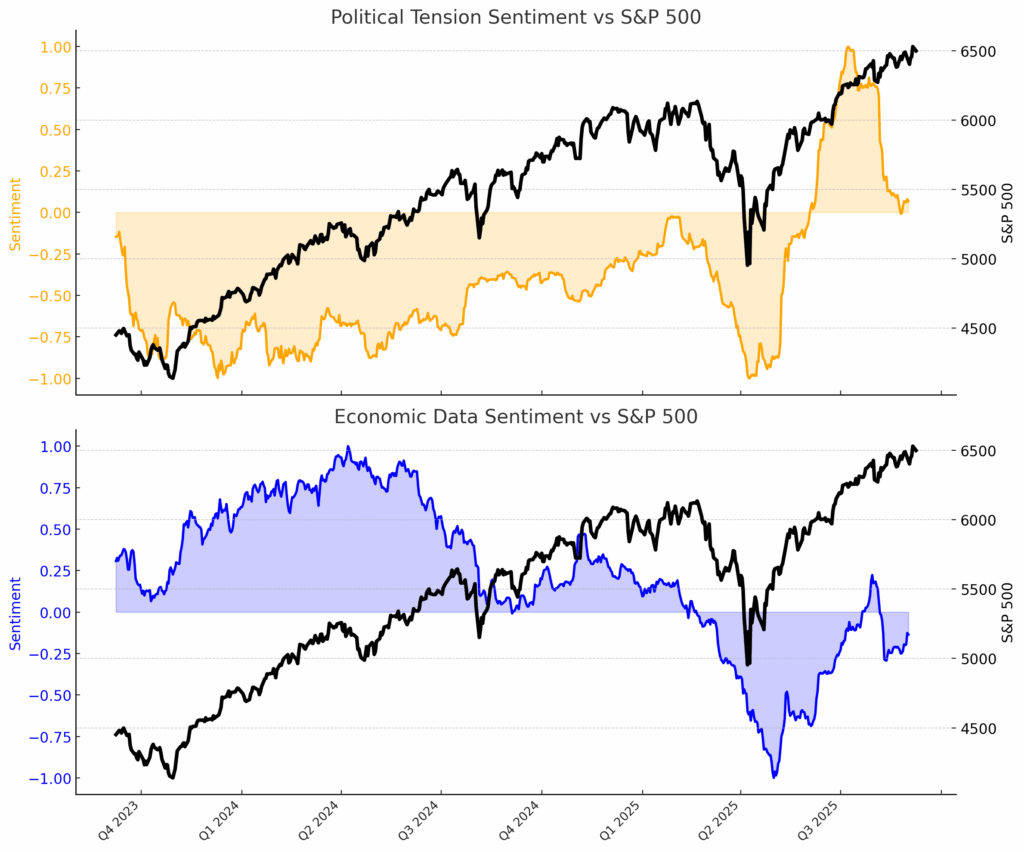
September’s equity performance presented a compelling case study in sentiment-driven markets. The S&P 500 rally persisted despite weakening economic fundamentals, with the Bureau of Labor Statistics’ historic downward revision halving job growth estimates yet equity markets powering to fresh record highs. Our Political Tension Index revealed the underlying dynamics driving this apparent disconnect, capturing how initial corporate anxiety around Trump’s tariff measures gave way to adaptation strategies as firms renegotiated supply chains and passed costs to consumers.

The key insight from our sentiment analysis lies in understanding that markets price expectations, not historical data. When job growth weakens, traders interpret potential Fed responses—looser policy, cheaper credit, and risk asset support – which our GDP Narrative Index and Policy Rate Index captured in real-time. This dynamic reinforces why market sentiment indicators serve as leading rather than lagging measures, with narratives about monetary policy, AI productivity gains, and dollar weakness driving positioning long before hard data could confirm directional changes.

S&P 500 Rally: US Macro Sentiment vs S&P 500

Germany’s Manufacturing: Stabilisation Signal

German manufacturing offered September’s most nuanced sentiment story. After 25 months of contraction, our German Manufacturing Sentiment Index began stabilising, with volatility easing and expectations no longer set on relentless decline.

This matters because market sentiment indicators often turn before hard data. Whilst output remained fragile, sentiment’s levelling suggested the contraction phase was ending. Our macroeconomic data analysis identified this as a potential turning point for eurozone recovery, given Germany’s role as the industrial hub.

Germany's Manufacturing sentiment

Market Sentiment Indicators 2025 and Beyond: Gaining Strategic Advantage

September 2025 demonstrated why sophisticated investors rely on market sentiment indicators rather than lagging economic data. Our Trading Co-Pilot and regional macro indices provided early signals across multiple asset classes, from the Fed’s dovish pivot to gold’s safe-haven rally to China’s underlying fragility.

The month’s key lesson centres on divergence. When traditional correlations break down and regional sentiment fractures, opportunities emerge for those equipped with real-time sentiment analysis. Our commodities intelligence and macroeconomic data platforms transformed fragmented market developments into coherent signals for enhancing cross-asset strategies.

For hedge funds and institutional investors, September reinforced that market sentiment data functions as the economy’s heartbeat, capturing shifts in confidence that official statistics smooth away. In an environment where macro shocks move markets instantly, sentiment-driven intelligence delivers both risk resilience and early advantage in spotting opportunities before they become consensus trades.

Explore Our Advanced Market Intelligence Further

September’s market dynamics demonstrate why leading institutional investors increasingly rely on sentiment-driven intelligence to navigate complex global markets. Our comprehensive suite of market sentiment indicators, commodities intelligence platforms, and macroeconomic data analysis transforms fragmented market narratives into actionable signals for hedge funds and sophisticated investment strategies.

Looking to access real-time sentiment analysis that captures market-moving dynamics before they appear in traditional data? 

Contact our team at enquiries@permutable.ai to request a demonstration of our Trading Co-Pilot, regional macro indices, and commodities intelligence and discover how sentiment-led market intelligence can enhance your investment edge and risk management capabilities across global markets.
Key use cases of our forex sentiment for institutional traders

This article is aimed at institutional forex traders, systematic desks, and macro strategists who want to understand how forex sentiment indices, daily sentiment analysis, and FX market signals can enhance trading strategies and risk management.

In the institutional trading world, speed and foresight determine success. The foreign exchange market, with its trillions in daily volume, reflects not just economic fundamentals but also the shifting narratives and expectations of investors worldwide.

At Permutable, we have seen first-hand how forex sentiment often moves ahead of traditional data. Central bank language, geopolitical tensions, or sudden policy shifts can reframe market direction long before hard numbers confirm the change. That is why our sentiment analysis API includes both single currency indices and currency pair indices designed specifically to measure forex market sentiment in real time.

By translating news flow and macro narratives into structured, explainable indices, we give institutional traders a forward-looking perspective on FX sentiment that enhances both strategy and risk management.


Why forex sentiment matters

Currencies are macro assets by nature. Their value reflects growth, inflation, monetary policy, and political risk. Yet what drives positioning is rarely the data alone. It is how the market interprets that data.

For instance, when US inflation comes in soft, traders don’t just see weaker prices; they anticipate how the Federal Reserve may adjust policy. A single headline about trade tensions can spark safe-haven flows into the yen or Swiss franc before fundamentals shift.

This is why forex sentiment is so powerful. Unlike backward-looking statistics, it captures live changes in how currencies are being discussed. Our daily sentiment index updates in near real time, showing how narratives around each currency are evolving. For institutional traders, this provides clarity at the very moments when uncertainty is highest.

Single currency indices: a measure of confidence

Our single currency indices quantify how the pound, dollar, euro, sterling, yen and other G7 majors are perceived across global news and commentary.

Use cases include:

  • Tracking safe-haven demand, such as yen sentiment during geopolitical flare-ups.

  • Monitoring policy expectations, for example shifts in dollar sentiment ahead of FOMC meetings.

  • Detecting political risk, such as changes in sterling sentiment during elections.

For FX desks, these indices act as a daily sentiment tool, helping to flag when markets are about to price in volatility before it appears in spot or futures prices.

Fed cut

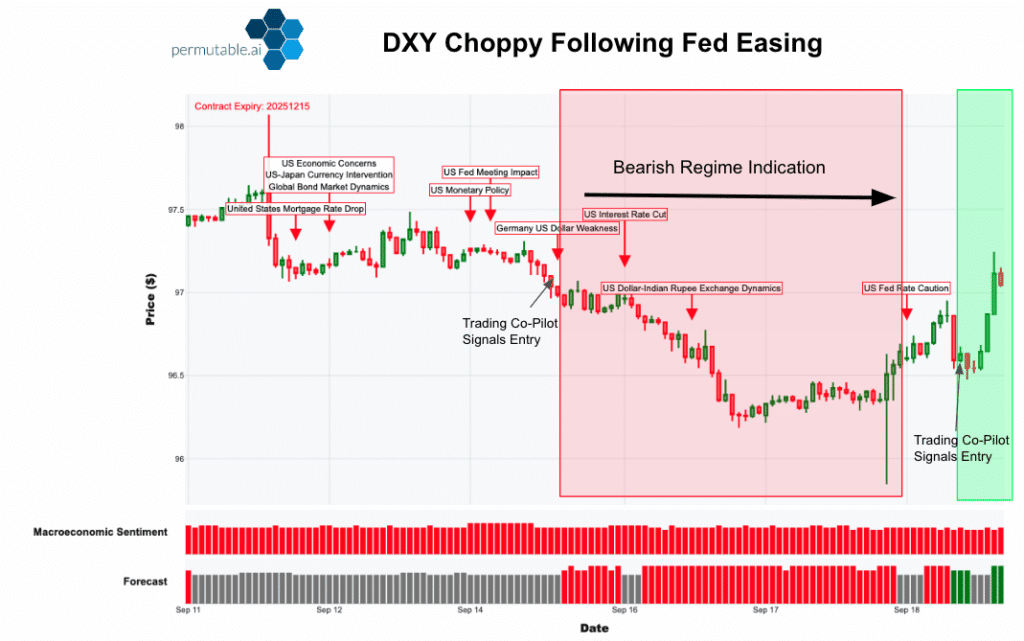
Above: DXY sentiment analysis reveals choppy dollar performance following Fed policy easing signals. Permutable’s Trading Co-Pilot identified key bearish regime indicators through macroeconomic sentiment tracking, with red sentiment bars highlighting negative dollar narratives during the bearish phase (highlighted in pink), followed by green bullish signals as Fed rate caution emerged. The integration of real-time sentiment data with price action demonstrates how narrative shifts precede traditional technical breakouts

Currency pair indices: mapping divergences

While single currencies matter, forex is ultimately traded in pairs. Our pair indices track relative sentiment between currencies, making it possible to spot when one side of the trade is strengthening against the other.

Institutional applications include:

  • Identifying when forex market sentiment supports a breakout in EUR/USD or GBP/USD.

  • Filtering out short-lived spikes to focus only on durable shifts in FX sentiment.

  • Providing systematic traders with backtestable inputs for quantitative models.

For example, if euro sentiment strengthens while dollar sentiment weakens, our daily sentiment index for EUR/USD highlights this divergence before price action confirms the move.

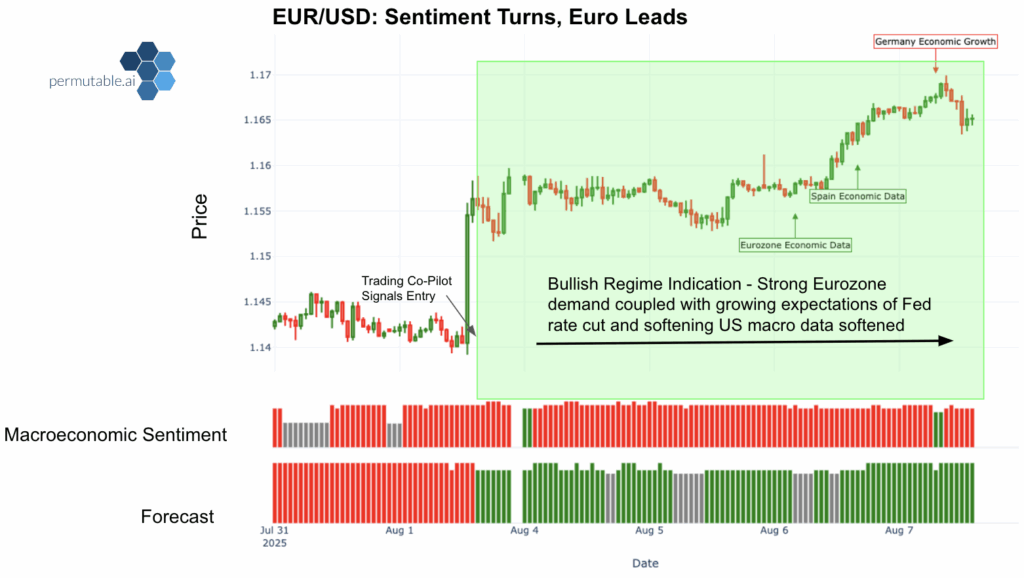
EUR/USD

Above: EUR/USD sentiment divergence captures euro strength as narratives shift in favour of eurozone fundamentals. The Trading Co-Pilot’s sentiment analysis (shown in bottom panels) transitioned from bearish red to sustained bullish green signals, anticipating the EUR/USD rally highlighted in the green zone. Key fundamental drivers including Spain and Eurozone economic data, coupled with Germany economic growth expectations, supported the bullish regime indication as Fed rate cut expectations and softening US macro data strengthened the euro’s relative positioning.

Institutional use cases across FX desks

From our work with clients, several clear applications for forex sentiment are to be highlighted here:

1. Macro event anticipation

Our FX sentiment tools enable desks to track narrative build-up in real time ahead of key macro events such as central bank meetings, elections, or trade disputes. Instead of relying solely on consensus forecasts or lagging analyst commentary, traders can observe how market mood is shifting in the days and hours before announcements. This allows for proactive positioning around volatility catalysts and greater confidence in managing exposure during periods of heightened uncertainty.

2. Short-term trading filters

Intraday and short-term traders are often challenged by distinguishing between random noise and genuine trend formation. By applying daily forex sentiment signals, our intelligence provides a filter that helps separate fleeting spikes driven by headlines or rumours from sustained momentum backed by broader narrative shifts. This clarity allows traders to avoid false signals and time entries with greater precision.

3. Risk monitoring

Institutional desks can integrate Permutable’s forex sentiment indices directly into their risk dashboards to monitor vulnerabilities in their portfolios. By flagging sudden increases in negative sentiment towards specific currencies, the system offers an early warning of potential stress points. This gives risk managers a forward-looking lens to complement traditional VaR models and volatility measures, improving resilience during turbulent market phases.

4. Cross-asset strategy alignment

Currency flows rarely move in isolation. Our sentiment indices allow FX desks to compare market mood across asset classes – from commodities to equities – and identify where correlations may strengthen or break down. For example, a bullish skew in oil-linked currencies can be cross-checked against real-time commodity sentiment to validate trades or adjust exposures, ensuring strategies are aligned with broader market narratives.

5. Systematic strategy enrichment

For quants and systematic desks, Permutable’s forex sentiment offers a robust, quantifiable alpha factor that can be incorporated into existing models. Unlike traditional price or volume-based inputs, sentiment captures the qualitative narrative embedded in global media and policy discussions. When embedded into algorithmic frameworks, it enriches predictive power, reduces model blind spots, and provides an additional dimension of diversification within trading signals.


Why our forex sentiment analysis API stands out

Of course, there are many forex sentiment tools on the market, so why should institutional clients choose our forex market sentiment solutions?

  • Explainability: Each sentiment index is tied to identifiable narrative clusters, ensuring compliance and research teams understand the source.

  • Speed: Our daily sentiment index updates in near real time, allowing traders to react quickly to breaking stories.

  • Integration: Delivered via API, the data slots seamlessly into existing trading platforms, quant dashboards, or risk systems.

This combination of transparency, timeliness and usability makes our forex sentiment solution far more than a simple data feed.


Case example: Policy divergence

When the ECB turned dovish while the Fed remained cautious, eurozone fundamentals pointed one way but forex market sentiment revealed another. Our indices showed euro sentiment rising as narratives around fiscal stability outweighed inflation concerns. Traders monitoring this signal were able to anticipate EUR/USD resilience before it became visible in price action.

This illustrates the value of measuring FX sentiment at the narrative level rather than relying solely on lagging economic prints.

monetary Policy DOVISH vs HAWKISH

Above: Fed policy sentiment analysis demonstrates how dovish and hawkish narrative volumes anticipate Federal Reserve rate decisions across multiple cycles. Permutable’s sentiment tracking shows hawkish commentary (red bars) dominated during the 2018-2019 tightening cycle and again through 2022-2023 as inflation concerns peaked, while dovish sentiment (blue bars) surged during the 2019-2020 easing period and has recently intensified in 2024-2025 as rate cut expectations build. The sentiment volume shifts consistently precede actual Fed funds rate changes (black line), highlighting how institutional traders can leverage narrative analysis to position ahead of monetary policy pivots rather than react to them.

From signal to strategy

For institutional forex traders, the challenge is not information scarcity but information overload. News, data and commentary flood in constantly. What matters is distinguishing true market-moving signals from noise.

By offering structured indices for both single currencies and currency pairs, our forex sentiment analysis API gives traders that capability. The daily sentiment index shows when narratives are gaining momentum. Meanwhile, our single currency indices reveal how each currency is perceived globally. Pair indices map divergences that can spark the next move.

Together, these tools give FX desks the foresight needed to:

At Permutable, our mission is to transform complex market narratives into actionable insight. For institutional forex traders, this means turning forex sentiment into a measurable, tradeable advantage.

To explore how our platform can support your strategy, contact us at enquiries@permutable.ai


Fed cuts, dollar talks: The FX sentiment signal we captured in our Trading Co-Pilot

In this article, we unpack how the September Fed cut reshaped market dynamics, why sentiment around the US dollar swung so sharply, and how our Trading Co-Pilot captured the bearish build-up, the post-Fed plunge, and the recovery that followed.

The Federal Reserve’s long-awaited cut has landed with a softer thud than markets had braced for. The FOMC lowered the funds rate by 25 bps to 4.00-4.25%, the first easing since December 2024. The Fed’s updated economic projections, the SEP, pointed to two further cuts before year-end, marginally more dovish than June’s outlook, but shy of the aggressive easing cycle investors had begun to sketch in.

The dollar’s reaction was swift and telling. The US Dollar Index (DXY) plunged to 96.25, a three year low, as traders treated the dot plot as confirmation that the gates to the easing cycle had opened. Yet by Thursday morning the greenback had managed to reclaim some ground, trading back near 97.00. This rebound owed much to Powell’s measured tone and firmer inflation projections, which together dampened expectations of a rapid cutting cycle.

Powell’s Balancing Act

Powell framed the policy stance as risk mitigation in the face of weakening labour data, while stressing there was no urgency to accelerate easing. The press conference emphasised the Fed’s positioning to retain optionality, even as employment risks mount.

The vote itself echoed that balance. Stephen Miran, newly sworn in governor, favoured a deeper 50 bps fed cut, but the lone outlier was overwhelmed by an 11-1 majority. Against the backdrop of political pressure over Fed independence, the solidarity was evident, a board closing ranks, perhaps to buy some breathing space in the face of political pressure.

Still, the shift in stance is clear-cut. Job creation has reined in notably, unemployment has climbed to 4.3%, and benchmark revisions erased nearly a million jobs, cancelling out a large chunk of earlier gains and amplifying fears of a faltering labour market. Inflation lingers at 2.9%, but stabilising the labour market has once again become the priority.

Trading Co-Pilot: Bearish Build-Up, Fragile Rebound

Fed cut

Our Trading Co-Pilot mapped the dollar’s September path with precision. What began as a gradual erosion of confidence early in the month hardened into a structural shift in positioning. Rising jobless claims and anaemic payroll growth fed directly into our macroeconomic layers, revealing a market increasingly unwilling to treat the greenback as a safe harbour.

By mid-September, the divergence was clear. Equities climbed on liquidity hopes while the dollar wilted. Our Trading Co-Pilot’s heatmaps showed sentiment locking into a decisive downside skew, bearishness was no longer episodic but entrenched.

On the morning of the Fed’s decision, the dollar staged a tentative rally. Yet the move stalled, a sign in our signals of limited resilience. The post-Fed collapse through to 96.30 verified the bearish stance. At the same time, our Trading Co-Pilot flagged a tactical rebound, as Treasury yields firmed in response to Powell’s careful rhetoric. Structurally, the dollar remains under pressure, rebounds may occur but lack the force to alter the structural trend.

Gauging Market Sentiment

Market sentiment is caught between relief and frustration. Relief that the Fed cut has finally come, frustration that Powell has not endorsed the sweeping easing cycle markets had hoped for. The message was one of caution and optionality, neither fully dovish nor convincingly defensive, leaving investors with little to cling on to regarding the policy path.

That ambivalence showed in positioning. Equities spiked before surrendering gains. Gold held near record highs, its demand fuelled by doubts over Fed credibility. Treasuries saw real yields creep higher, a move that underpinned the dollar’s modest rebound. Futures markets now assign a much higher chance of another 25 bp cut in October, than pre-meeting, but conviction moving forward wears thin.

Fresh data on the 18th added another twist. With jobless claims dropping to 231,000 and continuing claims easing to 1.92 million, the labour market ushers signs of fortitude. That resilience spurred a modest lift in the dollar further, with the DXY mounting a comeback back to 97.5. This is not a reversal of the broader bearish trend, but a tactical rebound driven by labour market strength, firmer yields, and technical support. Structurally, the forward-looking easing cycle still weighs heavily on the dollar, but near-term data prints will determine whether rebounds persist or dissipate.

The weight of momentum continues to press against the dollar. The Fed cut has reduced the dollar’s yield advantage, making rebounds look like short-lived bounces rather than sustainable recoveries. For the moment, the DXY is confined to a narrow 97.00-97.50 band, with upticks best read as corrections rather than the beginnings of a comeback in the making. Without a decisive turn in US data or a renewed flare in inflation, the broader trajectory still tilts lower.

FX Sentiment Signals and Policy Transmission in Action

The Fed has eased, and the dollar is transmitting that shift across global markets. The DXY has become the gauge through which a softer labour market, realigning yield spreads, and doubts over policy credibility are being priced.

Our Trading Co-Pilot caught the bearish build-up ahead of the Fed, the collapse through 96.25, and the tentative rebound that followed. At present, the greenback’s pivot rests on a sustained break. In this cycle, the dollar is not simply reflecting Fed policy,  it is the mechanism through which that policy is being absorbed by the markets.

Strategic Takeaway

Our Trading Co-Pilot captured  the US Dollar move with clarity. Its layered sentiment intelligence provided an early, clean, and risk-aware bearish call. This enabled clients to position with confidence and respond strategically in a dynamic FX environment.

Unlock the Edge

Contact enquiries@permutable.ai to access our real-time, sentiment-led FX intelligence and strengthen your trading strategy.

Systematic strategies and our AI-driven market intelligence: Your questions answered

At Permutable, we are setting the standard for institutional market intelligence for systematic strategies. Our large language models transform global macro, geopolitical and financial noise into sentiment signals that lead the data. Built for hedge funds, asset managers, and investment banks, our technology delivers foresight where reaction times matter and clarity where traditional analysis falls short. In this FAQ, we’ll take a look at how our institutional grade solutions help address today’s market challenges.

How do we generate alpha from vast amounts of unstructured data?

Our leading LLMs and reasoning agents eliminate market noise and convert millions of narratives into structured, quant-ready intelligence. This enables our clients to act with foresight, integrating sentiment into both our systematic strategies and discretionary approaches.

How do we stay ahead in a rapidly shifting economic and geopolitical environment?

We track thousands of individual sentiment drivers in real time across energy markets and regional macro indices spanning the G7, BRICS, and global economies. This delivers a continuous read on the factors driving growth, inflation, and asset prices in real time, which can be directly fed into systematic strategies.

How do we anticipate market moves and identify underlying drivers?

By ingesting asset-level sentiment signals into our systematic strategies workflows, we isolate the causation behind market performance rather than surface correlations. This provides transparency into how narratives drive shifts in positioning, factor exposures, and risk premia, giving our clients a forward-looking framework for attribution and alpha capture to feed into their systematic investment strategies.

How do we reduce the time spent on signal extraction and insight analysis?

Our Trading Co-Pilot cuts analysis time by up to 90%, converting complex, multi-lingual sources and unstructured flows into actionable insights. This accelerates decision-making and frees teams to focus on execution and portfolio construction within their systematic strategies.

How are our insights deployed into quantitative investment strategies?

Through explainable AI models delivered via API or through our fully operational Trading Co-Pilot user interface. This ensures seamless integration across both our systematic strategies and discretionary workflows.

What validates our approach?

We work with leading global institutions and banks across commodities and macro. Our systematic strategies are validated through live trading that has delivered 17% annualised returns with a Sharpe ratio of 2.9. Complete vintage history is accessible via API, enabling full backtesting and independent validation.

Use cases

How can hedge funds and asset managers use our systematic strategies?

Hedge funds can integrate our sentiment indicators into their systematic strategies to enhance Sharpe ratios whilst reducing drawdowns. Our AI processes thousands of news articles daily, converting market noise into structured alpha signals that could feed directly into quantitative models.

Asset managers can use our systematic strategies to dynamically adjust factor exposures based on real-time sentiment shifts. When geopolitical tensions spike, our models can automatically identify which commodities and currencies might benefit, enabling proactive positioning rather than reactive rebalancing.

What applications exist for investment banks and prop trading desks?

Trading desks can leverage our systematic strategies to identify sentiment-driven volatility before it impacts traditional risk metrics. Our models analyse cross-asset correlations through narrative flows, potentially providing early warning signals for portfolio stress testing.

What opportunities exist for commodity trading houses?

Energy traders can integrate our energy indices to anticipate supply disruptions through geopolitical sentiment analysis, potentially capturing alpha from physical-financial arbitrage opportunities.

Our real-time tracking of thousands of energy sentiment drivers could inform systematic strategies around inflation expectations, central bank policy shifts, and currency movements that impact commodity valuations.

The systematic advantage awaits

Whether you’re running a $100M hedge fund or a multi-billion asset management firm, our AI-driven intelligence will change how you think about systematic alpha generation.

  • Proven performance: Live systematic strategies delivering 17% annualised returns
  • 90% time reduction: From analysis paralysis to actionable insights in minutes
  • Real-time intelligence: Track thousands of sentiment drivers across global markets
  • Seamless integration: API-ready solutions that plug directly into your existing workflows
  • Full transparency: Complete vintage history available for independent validation

Ready to see what systematic strategies look like when they’re powered by the future?

Schedule a demo by contacting our team at enquiries@permutable.ai

Unlocking market insight: Key use cases of our sentiment analysis API

This article is aimed at systematic traders, energy and commodity traders, investment banks and asset managers seeking to understand how Permutable AI’s sentiment analysis API can be applied to trading strategies, research, and risk management.

In today’s markets, the ability to move faster than competitors rests not only on data access but on knowing which signals matter most. While traditional datasets such as prices, volumes and economic releases remain essential, they are fundamentally backward-looking. They tell you what has already happened. At Permutable, we have seen time and again that market inflection points are driven not just by fundamentals, but by narratives – the stories circulating across news, reports, and policy debates. Capturing and quantifying those narratives in real time is where our sentiment analysis API provides a genuine edge.

Having worked alongside trading teams, banks and asset managers, we understand the challenge: markets move on expectations, not history. Our sentiment analysis API translates global news and discourse into measurable, explainable indicators that can be integrated directly into workflows, strategies, and models.


Why sentiment matters

Markets are forward-looking machines. A weak US jobs print does not simply show labour market deterioration; it raises questions about Federal Reserve policy, interest rates, and global flows into or out of risk assets. Similarly, a drone strike on an export hub is not just an isolated event; it ripples through oil futures, freight costs, insurance pricing, and cross-commodity hedges.

The challenge is separating noise from signal. This is precisely what our sentiment analysis API is designed to achieve. It processes vast volumes of global news and classifies sentiment around macroeconomic, political and market topics, creating indices that update in near real time.


Systematic traders: Sentiment as a tradeable signal

For systematic and quantitative traders, sentiment data is often viewed as unstructured and hard to model. Our experience shows otherwise. By providing sentiment indices in a structured, backtestable format, our API enables quants to:

  • Incorporate sentiment as an alpha factor within existing strategies.

  • Detect regime shifts in real time, such as a change in the market’s response to central bank language.

  • Apply sentiment as a volatility filter, adjusting leverage or position sizing when signals point to heightened uncertainty.

  • Backtest against historical data, demonstrating how narrative intensity has impacted past market movements.

In practice, our sentiment analysis API can be used to anticipate moves around central bank meetings, sanctions announcements, and major data releases – events where sentiment, not just numbers, dictates positioning.

Monetary policy sentiment index

Energy and commodity traders: Capturing the unseen drivers

Commodity and energy markets are uniquely sensitive to geopolitical and environmental narratives. Our sentiment analysis API has proved valuable to commodity desks by flagging:

  • Geopolitical shocks, such as sanctions or supply chain disruptions, often before they are fully priced.

  • Weather narratives, including La Niña and hurricane season, where early warnings influence natural gas and LNG positioning.

  • Supply-demand talk, as coverage of inventories, refinery outages or OPEC+ policy drives rapid swings in futures curves.

  • Cross-commodity spillovers, where sentiment in one market (e.g. oil) cascades into others (e.g. shipping or refined products).

For energy clients, this means positioning ahead of sharp moves when, for instance, narrative intensity spikes around Russian supply disruptions or when weather-driven demand risk rises suddenly.

Brent Crude Oil market sentiment indices

Investment banks: Enriched research and client advisory

Banks must provide differentiated research and advisory to their clients. Here, our sentiment analysis API supports this in several ways:

  • Macro research: overlay sentiment indices on GDP, inflation or policy themes to provide a forward-looking perspective.

  • Event detection: pick up signals around elections, sanctions debates or geopolitical disputes ahead of official releases.

  • Client briefings: enrich morning notes and strategy reports with explainable sentiment indicators.

  • Transaction support: integrate sentiment into financing, hedging or deal analysis where policy or geopolitical risk is relevant.

In practice,  research teams can use our API to strengthen house views by demonstrating how narrative sentiment is diverging from data, providing clients with actionable perspective on risks and opportunities.

UK Inflation sentiment

Asset managers: risk management and portfolio construction

For asset managers, portfolio resilience depends on identifying divergences before they become costly. Our sentiment analysis API supports:

  • Risk monitoring, spotting when rallies are fuelled by sentiment rather than fundamentals – a hallmark of bubble risk.

  • Portfolio overlays, adding sentiment as a non-price factor to diversify exposures.

  • Hedging strategies, where sentiment alerts around policy or geopolitical risk guide protective positioning.

  • Global macro allocation, quantifying narrative momentum across currencies, commodities, and equities.

In our experience, this will be particularly valuable when providing the ability to detect when optimism is fading before prices turn, enabling them to rebalance portfolios with greater precision.

S&P 500 Rally: US Macro Sentiment vs S&P 500

What makes our approach different

The strength of our sentiment analysis API lies in three things:

  1. Explainability – each signal is traceable to underlying narrative clusters, ensuring clarity for compliance and risk oversight.

  2. Speed – updates occur in near real time, enabling faster decision-making.

  3. Integration – our sentiment API is designed for enterprise-grade workflows, making it easy to plug into trading systems, analytics platforms, or research dashboards.

This combination of transparency, timeliness and usability makes our API more than just a data feed – it is a strategic tool.

Audience Use Case Value Delivered
Systematic Traders Signal generation (sentiment as alpha factor) Unlock new tradeable signals beyond price & volume data
  Regime detection Identify when market responses to events (e.g. Fed policy) shift behaviour
  Risk filters Adjust leverage/position sizing during sentiment-driven volatility spikes
  Backtesting with historical sentiment Validate strategies with explainable, narrative-driven datasets
Energy & Commodity Traders Geopolitical shock detection Anticipate sanctions, supply disruptions & OPEC+ headlines before pricing shifts
  Weather/climate sentiment Flag early La Niña/El Niño or hurricane risks driving gas & LNG
  Supply-demand narrative monitoring Spot changes in inventory, refinery, or output narratives ahead of official data
  Cross-commodity sentiment Track spillovers (e.g. oil sentiment impacting refined products or shipping)
Investment Banks Macro research enrichment Strengthen research with forward-looking sentiment overlays on GDP, inflation & policy
  Event detection Detect elections, sanctions & geopolitical shifts in near real time
  Client advisory Enhance strategy notes with explainable, sentiment-driven insights
  Deal & financing support Use sentiment as a layer in M&A, commodity financing & treasury risk assessments
Asset Managers Risk monitoring Flag divergences between sentiment-driven rallies & weak fundamentals
  Portfolio construction Add sentiment as a non-price factor for diversification & alpha
  Hedging strategies Position defensively around political or macro shocks flagged by sentiment
  Global macro allocation Track narrative-driven momentum across currencies, equities, and commodities

Turning narratives into strategy

Ultimately, the reason our clients integrate our sentiment analysis API is simple: markets move on expectations, not history. By quantifying narratives and sentiment, institutions can:

  • Position ahead of market-moving events.

  • Anticipate volatility before it shows up in the data.

  • Capture opportunities when sentiment alignment drives momentum.

In a world where information overload is the norm, being able to distinguish true signal from noise is what separates reactive trading from proactive strategy. At Permutable, we are proud to provide the tools that allow systematic traders, commodity desks, investment banks and asset managers to navigate complexity with precision and confidence.

To explore our how sentiment analysis API can support your strategy contact us at enquiries@permutabe.ai.

FAQ: Permutable Sentiment Analysis API

Q1. What is Permutable AI’s Sentiment Analysis API?

The Sentiment Analysis API is a real-time intelligence tool that quantifies global news and narratives across macroeconomics, geopolitics, energy, commodities and markets. It provides structured, explainable sentiment indices that can be integrated into trading systems, research workflows and risk models.

Q2. How does the API work?

It processes vast volumes of global news and discourse using AI-driven natural language processing. The output is a set of topic-specific sentiment indices (e.g. inflation, energy supply, sanctions, policy rates) that update in near real time, giving users forward-looking insights.

Q3. Who is the Sentiment Analysis API designed for?

It is built for institutional clients – including systematic traders, commodity and energy traders, investment banks, and asset managers – who need to anticipate market shifts rather than react to lagging data.

Q4. What makes Permutable’s approach different?

Unlike generic sentiment feeds, our API is explainable (traceable back to source narratives), fast (near real-time updates), and enterprise-ready (API-first integration for research, trading, and risk systems).

Q5. Can I backtest with historical sentiment data?

Yes. Historical datasets are available for strategy validation, performance testing, and research, allowing traders and analysts to understand how narratives shaped past market moves.

Q6. What markets and sectors does it cover?

The API covers global macroeconomics, commodities, energy, geopolitics, monetary policy, and financial markets — providing indices tailored to the needs of traders, banks, and asset managers.

Q7. How does sentiment analysis improve trading?

By capturing market narratives ahead of price and volume data, sentiment analysis highlights when shifts in expectations are likely to drive momentum, enabling traders to position earlier and manage risk more effectively.

Q8. How can we access the API?

The Sentiment Analysis API is available via enterprise-grade integration. To request a demo or access documentation, contact: enquiries@permutable.ai.


People Also Ask 

What is a sentiment analysis API in trading?

A sentiment analysis API in trading transforms unstructured market news and narratives into structured signals, helping traders anticipate price moves by measuring shifts in sentiment.

How can systematic traders use sentiment analysis?

Systematic traders can integrate sentiment indices into models as alpha factors, volatility filters, or regime-detection tools, improving strategy precision and risk control.

Why is sentiment analysis important in energy and commodity markets?

Energy and commodity prices are highly sensitive to narratives around supply, demand, geopolitics and weather. Sentiment analysis detects these narratives in real time, giving traders an early signal before fundamentals shift.

Can sentiment analysis help investment banks?

Yes. Sentiment analysis strengthens macro research, supports client advisory, and provides early-warning signals around elections, sanctions, or policy changes that influence markets.

How can asset managers use sentiment data?

Asset managers can use sentiment data for portfolio construction, risk monitoring, and hedging strategies, particularly to identify divergences between narrative-driven rallies and weakening fundamentals.

Is historical sentiment data useful?

Absolutely. Historical sentiment datasets allow backtesting, validation, and research — showing how past narratives shaped price action and improving confidence in new models.

Top providers of current financial market sentiment indicators in 2025

This comprehensive analysis examines the current landscape of financial market sentiment indicators, evaluating innovative AI-driven platforms such as Permutable AI against leading providers and established giants like Bloomberg. The review is specifically tailored for institutional investors, hedge funds, and systematic macro traders who are assessing sentiment intelligence tools to enhance their portfolio strategies and gain a competitive edge in an increasingly narrative-driven marketplace.

In today’s rapidly evolving financial landscape, where market-moving narratives can shift sentiment faster than traditional fundamentals, institutional investors need sophisticated tools to decode the noise and identify actionable signals. As artificial intelligence transforms how we interpret vast streams of news, social media, and market data, the choice of sentiment analysis provider has become a critical strategic decision for portfolio managers and systematic traders alike.

Permutable AI

When it comes to current financial market sentiment indicators, at Permutable, we are a leader by offering real-time, cross-asset coverage designed for institutional investors. Unlike traditional approaches that rely heavily on surveys or market-derived metrics, we combines natural language processing with anomaly detection to quantify global market sentiment and narratives in real time.

The strength of our system lies in its multi-entity sentiment analysis. Rather than treating the market as a single bloc, it breaks down sentiment at the level of central banks, commodities, sovereign debt, corporates, and policy institutions. For example, investors can track divergence between sentiment towards the Federal Reserve and the European Central Bank, or monitor narrative momentum in oil, LNG, and precious metals.

Transparency is another differentiator. Every sentiment signal of ours is traceable back to its underlying source, ensuring explainability and confidence in decision-making. Delivery is flexible: machine-readable API feeds integrate seamlessly into systematic models, while our Trading Co-Pilot dashboard provides intuitive visualisation for discretionary portfolio managers. With years of backtestable history, our market sentiment indicators allow investors not only to act in the present but to validate their strategies against past cycles.

Verdict: Best for institutional investors, hedge funds, and systematic macro traders who need real-time, cross-asset sentiment intelligence with transparent, source-traceable insights for both systematic models and discretionary decision-making.


Bloomberg Market Sentiment Index

Bloomberg’s Market Sentiment Index (MSI) is derived from Bloomberg Terminal data, tracking sentiment shifts based on user behaviour, news consumption, and market flows. For investors already embedded in the Bloomberg ecosystem, the MSI integrates conveniently with existing research tools. It is a valuable consensus measure that reflects prevailing investor activity, though it is more correlation-based than predictive in nature.

Best for investors who want sentiment seamlessly layered into the Bloomberg environment, particularly those using it as a complement to market flow data and consensus-driven research. However, for those needing predictive, anomaly-driven insights across asset classes, Permutable AI provides a more forward-looking alternative.


Sentieo

Sentieo positions itself as a research platform that integrates sentiment analysis within its broader analytics suite. By aggregating news, broker research, and financial documents, it allows users to track evolving sentiment connected to specific equities or themes. Its strength is versatility in research workflows, making it particularly useful for equity analysts and fundamental investors, though it is somewhat narrower in scope for those focused on macro, cross-asset signals.

Best for equity analysts or research teams who want sentiment woven into broader document search, modelling, and thematic research capabilities. Yet for cross-asset macro desks, Permutable AI offers deeper real-time intelligence that extends beyond equities and research documents.

Yewno|Edge

Yewno|Edge applies AI to analyse earnings reports, news articles, and social signals, surfacing thematic sentiment trends. This makes it particularly attractive for equity researchers and thematic traders. While its focus is on company-level analysis rather than global macro sentiment, it provides valuable insights into micro-level market narratives.

Best for traders and analysts looking to capture company-level or sector-specific sentiment shifts, particularly around earnings season or event-driven strategies. For those managing portfolios with energy and commodities, sovereign debt, or FX exposure, Permutable AI provides broader macro coverage and anomaly detection.


Quandl (Nasdaq Data Link)

Quandl, part of Nasdaq Data Link, offers a wide range of alternative datasets, including some sentiment feeds. Its strength lies in ease of access via APIs, making it a convenient data source for quant teams. However, its sentiment data is part of a broader menu rather than a dedicated, narrative-driven solution.

Best for quant developers and data scientists seeking modular feeds that can be plugged into models quickly, especially when combining sentiment with other alternative datasets. Where Quandl delivers breadth, Permutable AI delivers depth – with explainable, narrative-driven sentiment designed for institutional use.


StockGeist.ai

StockGeist delivers real-time sentiment indicators for more than 2,200 traded names, especially across the S&P 500 and Nasdaq 100. Its visually intuitive platform makes it particularly useful for equity traders tracking live market chatter, though its coverage is primarily equity-focused.

Best for active equity traders looking to monitor intraday news and social media sentiment on individual stocks in a highly visual, interactive format. For multi-asset investors, Permutable AI offers wider coverage across commodities, sovereigns, and currencies in addition to equities.


FXSSI (Forex Sentiment Tools)

FXSSI specialises in Forex sentiment analysis, offering tools that integrate with trading platforms such as MT4 and MT5. These indicators focus on client positioning, order books, and crowd sentiment in currency markets.

Best for FX traders wanting to visualise positioning data directly in their trading platforms, with an emphasis on crowd psychology and short-term market dynamics. For institutions managing broader macro strategies, Permutable AI provides more predictive and cross-market sentiment insights.


CMC Markets Client Sentiment Indicator

CMC Markets provides a client sentiment indicator that shows net long or short positioning across assets such as currencies, indices, and commodities. For retail and professional CFD traders, this provides useful transparency on crowd positioning.

Best for CFD traders seeking a quick snapshot of client sentiment across popular instruments, useful as a contrarian or confirmation tool in retail-heavy markets. Institutional desks, however, may find Permutable AI’s narrative-driven and globally sourced sentiment intelligence more actionable at scale.

Comparative Chart: Financial Market Sentiment Providers

A quick scan for institutional teams comparing coverage, use-cases, and where Permutable AI may add more value.

Provider Best for Why Permutable AI might be better
Permutable AI Institutional-grade Institutional investors, hedge funds, and systematic macro traders who need real-time, cross-asset sentiment with transparent, source-traceable insights for both systematic models and discretionary decision-making. Goes beyond single-asset or consensus signals with anomaly detection and entity-level sentiment (central banks, sovereigns, commodities), plus explainability and backtestable history.
Bloomberg Market Sentiment Index (MSI) Investors who want sentiment seamlessly layered into the Bloomberg environment as a complement to market flow data and consensus research. For predictive, anomaly-driven insights across asset classes and narrative detection beyond activity correlations, Permutable AI offers a more forward-looking alternative.
Sentieo Equity analysts or research teams who want sentiment woven into document search, modelling, and thematic research workflows. Permutable AI extends beyond equity documents to real-time, cross-asset macro intelligence, supporting systematic strategies and discretionary macro views.
Yewno|Edge Traders capturing company-level or sector-specific sentiment shifts, especially around earnings or event-driven strategies. Permutable AI covers commodities, sovereign debt, FX and policy institutions with anomaly detection—useful for macro portfolios with multi-asset exposure.
Nasdaq Data Link (Quandl) Quant developers and data scientists seeking modular API feeds to combine with other alternative datasets. Where Data Link delivers breadth of datasets, Permutable AI provides depth and context: narrative-driven, explainable sentiment tailored for institutional decisioning.
StockGeist.ai Active equity traders monitoring intraday news and social sentiment on individual stocks in an interactive, visual interface. For multi-asset investors, Permutable AI brings wider coverage (commodities, sovereigns, currencies) and explainable signals beyond equity chatter.
FXSSI (Forex Sentiment Tools) FX traders visualising positioning, order books, and crowd sentiment directly within MT4/MT5. Institutions running broader macro strategies can use Permutable AI’s predictive, cross-market signals and narrative tracking beyond retail positioning.
CMC Markets Client Sentiment CFD traders wanting quick snapshots of client long/short positioning across major instruments for contrarian or confirmation cues. Permutable AI aggregates global narratives and sources, offering institution-scale explainability and cross-asset coverage beyond single-platform flows.

This chart highlights where each provider excels, and how Permutable AI extends capabilities for institutional-grade, cross-asset sentiment intelligence.


Top providers of current financial market sentiment: Final thoughts

The market for current financial market sentiment indicators is diverse, ranging from survey-based consensus measures to sophisticated AI-driven platforms. While each provider has strengths, we believe that at Permutable AI, we stand out by by delivering institutional-grade sentiment intelligence that is real-time, transparent, and cross-asset. For hedge funds, systematic macro traders, and asset managers, this combination provides both defensive protection against blind spots and the opportunity to seize market shifts ahead of consensus.

Ready to cut through the noise?

In markets where narratives can change direction overnight, relying on consensus sentiment isn’t enough. At Permutable, we equip institutional investors with real-time, cross-asset intelligence that goes deeper – from central banks to commodities, currencies to corporates. Transparent, explainable, and built for systematic as well as discretionary strategies, our platform helps you see the shifts before they hit the headlines.

Book a demo today at enquiries@permutable.ai and discover how our market intelligence can give your team the edge in an increasingly narrative-driven marketplace.