Key factors influencing major currency pairs: Trading Co-Pilot analysis Feb 2025
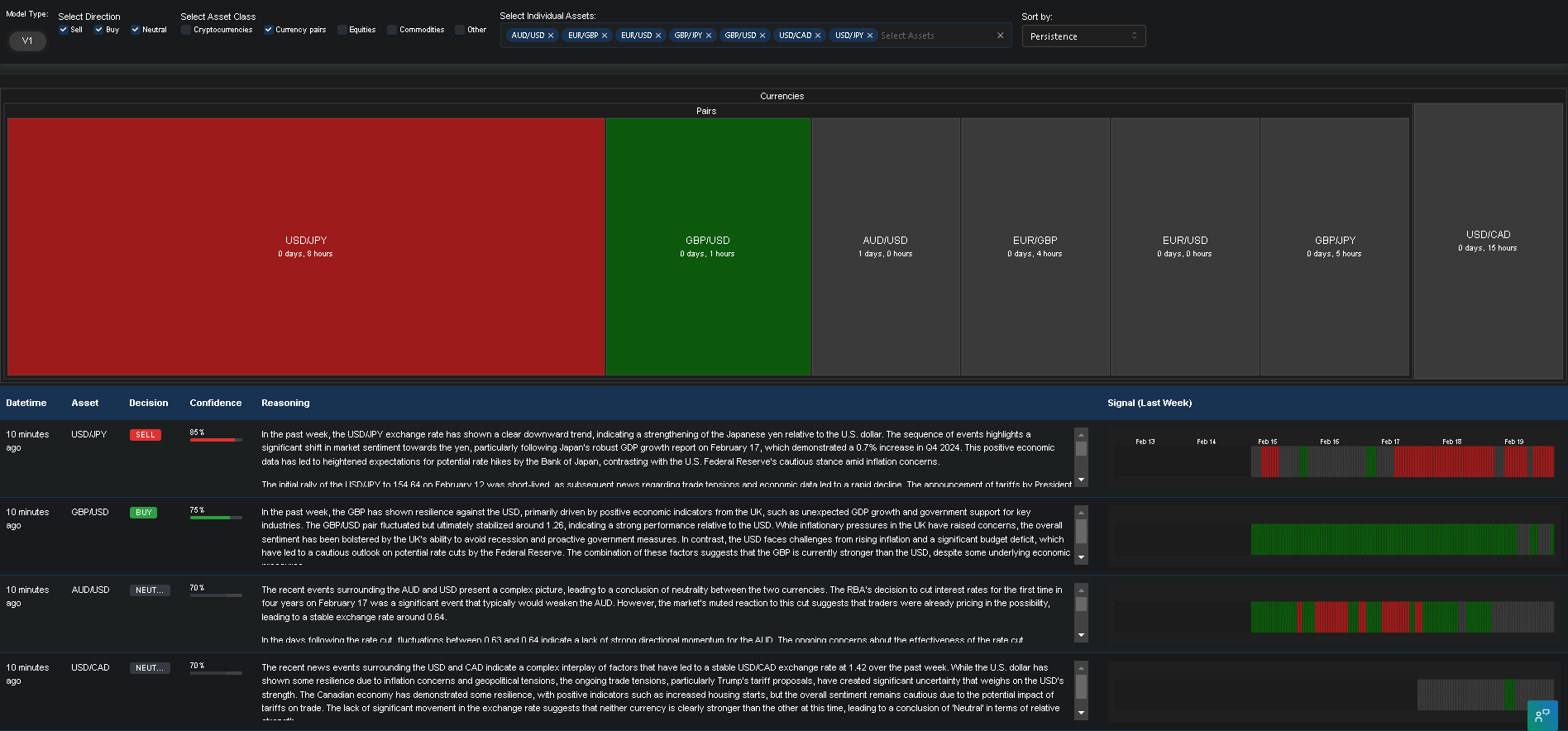
Our Trading Co-Pilot has identified significant movements across major currency pairs over the past week, with geopolitical tensions emerging as the dominant market narrative. Our engine’s analysis reveals that Trump’s proposed tariff plan has created notable pressure on the US Dollar, particularly against the Japanese Yen and Euro. As a matter of fact, our sentiment analysis detected heightened market concerns immediately following the February 11 announcement, with ripple effects continuing throughout the trading week.

The dollar weakness observed across major currency pairs coincided precisely with escalating rhetoric around potential retaliatory measures from affected trading partners. Our signal heatmap indicated particular vulnerability in USD/JPY and EUR/USD pairs, with correlation patterns suggesting traders are actively positioning for sustained trade tensions.

Inflation concerns reshaping major currency pair dynamics

Overall, our Trading Co-Pilot identified inflation as a key factor influencing major currency pairs during the analysis period. Consumer price data released on February 12 triggered unexpected volatility, with our AI agents detecting significant repositioning across GBP/USD and USD/CAD pairs. The market reaction suggests traders are increasingly concerned about how tariff-induced inflation might impact central bank policy divergence.

Our proprietary LLM-driven market sentiment analysis revealed particularly strong correlations between inflation narratives and major currency pair movements on February 13, when trade tensions and inflation data created a complex market environment. Given the Federal Reserve’s current policy stance, these inflation concerns appear to be creating asymmetric effects across different major currency pairs, with commodity-linked currencies showing distinct reaction patterns.

Central bank policy divergence: Reshaping major currency pair trajectories

Our Trading Co-Pilot’s analysis of central bank policy implications is especially valuable for understanding major currency pair movements throughout the week. Our models identified notable shifts in interest rate expectations following the inflation data, with particular impact on EUR/USD and GBP/USD pairs. Speaking more broadly, the potential for divergent monetary policy paths appears to be creating new correlation patterns across major currency pairs.

Historical confidence metrics from our Trading Co-Pilot suggest the current market environment resembles previous periods of policy uncertainty, though with important distinctions in how major currency pairs are responding to mixed economic signals. To add to this, interest rate sensitive pairs showed particular volatility during the February 14-15 trading sessions, as market participants attempted to reconcile inflation concerns with growth implications.

Trade policy uncertainty: New risk premium across major currency pairs

In essence, our Trading Co-Pilot has identified a growing risk premium across major currency pairs directly attributable to trade policy uncertainty. The proposed tariff package appears to be creating significant hedging activity, with institutional positioning shifts detected across USD/JPY, EUR/USD and USD/CHF pairs. Our confidence metrics indicate high certainty regarding the correlation between tariff discussions and subsequent major currency pair movements.

To put it differently, major currency pairs are now pricing in potential supply chain disruptions and their implications for global trade flows. Our Trading Co-Pilot’s cross-asset correlation analysis reveals particularly strong linkages between industrial metal prices and certain major currency pairs, suggesting traders are anticipating sector-specific impacts from the proposed tariffs.

Regional economic resilience: Differential impact on major currency pairs

The final dimension of our Trading Co-Pilot analysis focused on how regional economic resilience is influencing major currency pair performance. Asian currencies demonstrated notable strength against the dollar following the February 17 trading session, with our sentiment indicators suggesting market participants are assessing varying degrees of exposure to potential trade disruptions across different economies.

Consumer spending resilience emerged as a particularly important factor for major currency pairs linked to consumption-driven economies, with stronger-than-expected retail activity providing support for certain currencies despite broader trade concerns, creating nuanced trading opportunities across major currency pairs.

Navigating major currency pair volatility: Strategic implications

For institutional traders monitoring major currency pairs, these findings highlight the importance of integrating geopolitical analysis with traditional economic indicators. The Trading Co-Pilot’s ability to quantify sentiment shifts and detect correlation patterns has proven particularly valuable during this period of heightened uncertainty for major currency pairs.

This analysis suggests continued volatility across major currency pairs in the near term, with particular sensitivity to trade policy developments and inflation data. It’s important to remember that historical precedent indicates similar periods of policy uncertainty which have typically led to extended realignment phases for major currency pairs as markets establish new equilibrium levels.

Experience our Trading Co-Pilot’s advanced FX analysis 

Discover how our next generation Trading Co-Pilot can help your team navigate major currency pair volatility with confidence. Our Trading Co-Pilot provides real-time analysis of geopolitical factors, inflation impacts, and trade policy implications affecting FX markets. Qualified institutional users and FX providers can arrange a personalised demonstration of our platform, featuring our proprietary LLM-driven sentiment analysis specifically calibrated for major currency pairs. Select trading desks may also qualify for a limited 30-day trial to experience our analytical capabilities firsthand with your own trading data. Contact our team at  enquiries@permutable.ai or fill in the form below.

Priority access available for institutional FX desks, macro hedge funds, and B2B2C currency trading platforms.

Request your personalised demo/free trial


GBPJPY analysis: A tale of two economies at critical turning points

The first principle of understanding GBPJPY movements lies in recognising the complex interplay between two major economies at crucial policy junctures. For several years, both nations have followed divergent monetary paths, but recent developments suggest a potential convergence that’s dramatically impacting the currency pair. In this article we’ll look at developments across one of the most volatile currency pairs, taken from our Trading Co-Pilot, where we are gearing up to a roll out of FX on our market intelligence platform. 

GBPJPY news analysis

Policy evolution 

Let’s start with the fact that the Bank of Japan’s monetary policy is undergoing its most significant transformation in decades. There is evidence of fundamental change as the BOJ raised rates to 0.5%, making it one of the most substantial policy shifts since 2008. This is obviously a pivotal moment for FX traders, with more than just rate differentials at stake. The BOJ’s planned balance sheet reduction of nearly $500 billion through quantitative tightening measures signals a fundamental shift in Japanese monetary policy that could support long-term yen strength, suggesting this may be just the beginning of a longer-term policy normalisation cycle.

Economic contrasts

It is the story of contrasting economic narratives. While Japan emerges out of the doldrums of deflation, the UK faces mounting challenges. Only after this week’s data releases did the full picture emerge, showing UK consumer confidence hitting its lowest level in over a year. This contrasts with Japan’s gradual but steady economic recovery. The compound effects are particularly visible in employment markets, where UK firms report the largest decline in output and profit since the pandemic.

Market sentiment and dynamics

Market sentiment towards GBPJPY reflects these divergent economic trajectories, whilst technical aspects show no signs of abating volatility. The consequences of these movements are far-reaching, particularly given the pair’s sensitivity to risk sentiment. Trading volumes suggest institutional investors are actively repositioning their portfolios in response to these shifts. Meanwhile, our event analysis has identified a notable increase in correlation between GBPJPY movements and global risk sentiment indicators, suggesting the pair could become increasingly sensitive to broader market dynamics beyond purely bilateral economic factors

Structural changes 

What many observers have found surprising is the pace of the BOJ’s policy evolution, especially considering Japan’s corporate service inflation reaching 2.9%. Part of this attitude has developed from years of ultra-loose monetary policy. Beyond the immediate rate decision, the UK’s projected population growth of five million by 2032 due to migration presents a complex economic variable that could influence long-term GBPJPY trends. Though the current situation has unique characteristics given the global monetary policy environment, previously similar policy transitions have typically led to sustained currency trends.

Trading considerations 

However, we are not out of the woods yet with GBPJPY volatility. The acceleration of Japan’s policy normalisation, combined with UK economic uncertainty, creates an important reminder that currency markets can shift rapidly. A range of factors, from interest rate differentials to economic growth trajectories, continues to influence the pair’s direction, and particular attention should be paid to signs of BOJ policy normalisation acceleration and UK employment figures.

Market navigation

The compound effects of the above factors require a sophisticated approach to risk management, and so far, analysts reckon that the pair’s direction will heavily depend on both central banks’ next moves and economic performance indicators. This is magnified by the current global economic environment and shifting monetary policy landscapes. Ultimately, the answer will fall to several key factors in the coming weeks, but traders who maintain disciplined risk management and stay informed of both economies’ developments will be best positioned to navigate these challenging markets – and for that, there is the FX roll out on our Trading Co-Pilot

Get early access to FX on our Trading Co-Pilot

As we prepare for the FX roll-out on our Trading Co-Pilot platform, our mission is to bring the same level of comprehensive market intelligence we’ve delivered in commodities markets to currency trading. Our platform processes over 10,000 articles daily, providing real-time event detection and analysis that helps traders stay ahead of market-moving developments.

Want to be among the first to experience our FX capabilities? We’re currently accepting registrations from enterprise clients for early access to our beta testing programme. Our platform offers real-time currency market event detection, advanced geolocation filtering, cross-asset correlation analysis, customisable event alerts, and comprehensive macro monitoring.

Contact us at enquiries@permutable.ai to learn more about how we can help you navigate FX market complexity together or fill in the form below to register interest.

Register interest for FX roll out on our Trading Co-Pilot


Read other articles in this series

GBP/USD FX rate: A deep dive into Sterling’s market reality using our Trading Co-Pilot January 2025

FX It is perhaps fair to say that the start of 2025 has brought an unprecedented confluence of factors moving the GBP/USD FX rate. Looking back, the acceleration of UK wage growth to 5.5% has set the stage for what many hope will be the comeback year for British economic policy, and if that’s the case, there will of course be direct implications for the GBP/USD FX rate. In fact, this burgeoning trend will have left many watching anxiously for signs of how the Bank of England might respond to these inflationary pressures.

The policy puzzle

If we had to summarise the current view, pragmatism is needed more than ever. The GBP/USD FX rate’s sensitivity to central bank announcements has created some interesting trading dynamics to say the least. It remains to be seen what the Bank of England’s approach will be at their next base rate review in February and if this will achieve the desired stability in sterling markets that is so desperately needed (we say this wholeheartedly writing from our UK office). Well, like everything in FX markets, we’ll have to see how these potential outcomes play out. 

Political influence and market reality

There’s no doubt that political developments, particularly from across the Atlantic which we’ve all been playing out with Trump officially in office this week and, have become increasingly influential in driving the GBP/USD FX rate. Indeed so, the impact of the slew of Trump-related news has created distinct volatility windows in sterling trading. Whether this narrative holds through the year will be an interesting one to watch. 

And let’s just say it’s pretty remarkable how these political events have synchronised with economic data releases to create some interesting market movements. In truth, this goes beyond simple cause and effect – it’s a reflection of the complex interplay between global political dynamics and currency valuations that we’re currently seeing play out. 

Trading implications and opportunities

All of this means that the current market environment and sentiment demands a sophisticated approach to risk management when it comes to FX trading. What our Trading Co-Pilot’s analysis shows is that there’s a clear clustering of high-impact events, and that it’s tools like this that equip traders with the market insights they need to anticipate and navigate these volatile periods which come with an overwhelming amount of market-moving event data.

As we head further on into 2025, we can expect more turbulence, particularly around key economic data releases and central bank communications. Then there is the noise from political quarters, where one could make the argument that traditional currency correlations might not hold as firmly as they once did.

Looking forward

Ultimately, the success of FX trading in this environment will depend largely on maintaining a balanced perspective while staying alert to rapid changes in market conditions. For traders equipped with the right tools and insights – cue our Trading Co-Pilot, these challenging conditions might actually present more opportunities than risks.

The key is understanding that volatility isn’t just noise – it’s information. And in this respect, our Trading Co-Pilot’s ability to map and analyse these complex interactions provides valuable context for making more informed trading decisions. As we progress through 2025, it will be this kind of systematic analysis that will become increasingly valuable for successful market navigation.

The future of FX trading intelligence is here

We’re excited to announce the launch of FX on our Trading Co-Pilot platform, and we’re looking for select enterprise users to help shape its evolution. Our Trading Co-Pilot has already proven its worth in energy and commodities, and now we’re bringing that same powerful analysis to FX markets. The platform’s unique ability to map complex market interactions and provide clear, actionable insights has already transformed how our users navigate market volatility.

We’re offering early adopters a unique opportunity to shape the future of FX market intelligence. As part of our select group of enterprise users, you’ll receive early access to our advanced FX market intelligence platform, direct influence on feature development, premium support with dedicated onboarding, and preferential early-adopter pricing. You’ll have a direct line to our development team and exclusive early access to future releases.

The launch of our FX capabilities comes at a key time. As we’ve seen in recent market movements, the interplay between political events, economic data, and central bank decisions has created unprecedented complexity in event-driven trading. Our platform uniquely maps these interactions, providing the clarity needed to make informed trading decisions in volatile markets.

To ensure we can provide the highest level of support and incorporate meaningful feedback, we’re selecting a small group of enterprise users to join this early access programme with only five spots available. This exclusive opportunity allows you to be at the forefront of FX market intelligence technology while helping shape its evolution.

Simply contact our team at enquiries@permutable.ai to find out more about our early access FX programme, or schedule a demo by filling in the form below. 

Get in touch