How to turn news sentiment into strategy: A guide for institutional investors

This is a comprehensive guide for institutional investors, quants, and macro strategists on applying news sentiment to trading, risk management, and regime detection, with examples taken from Permutable AI’s market sentiment data. 

We’re often asked how to apply our market sentiment insights in practice, how to turn the behavioural layer of markets into measurable, actionable intelligence. This guide brings together our best practices, use cases, and live results to show how news sentiment in trading can be harnessed across asset classes.

Real-time insight into the forces driving risk and return

Markets move on perception before they move on data. Whether it is fear, optimism, or conviction, each leaves a measurable trace. The challenge has been turning those traces into something institutions can trust and use. That is where market sentiment adds edge: it quantifies the market narrative and converts it into a tradable, target-aware signal that leads the data and sharpens price discovery.

Our market sentiment intelligence does precisely that. We capture global financial, geopolitical, and policy news in real time, measure tone across millions of headlines, and translate the flow into structured, time-stamped data. The outcome is a continuous read of market perception, supported by more than ten years of history, providing a behavioural pulse that complements fundamentals and price action. Every observation is version controlled, time stamped, and traceable to source for full transparency and auditability.

Delivered via our Trading Co-Pilot and alert system, or directly through an API, our signals give economists, portfolio managers, and quants a faster view of shifting narratives and a practical way to turn that insight into strategy. In a world where policy rhetoric, supply shocks, and geopolitical risk shape expectations ahead of official releases, market sentiment supplies the missing layer of context. It shows not only what has happened, but what the market believes is happening, and belief often moves first.

The two charts below illustrate how this works in practice across both an asset and macro level. At the asset level, gold’s monetary-policy sentiment series captures how shifts in central-bank communication, liquidity expectations and policy risk premia accumulate into market positioning long before those dynamics are visible in price alone. At the macro level, Japan’s inflation sentiment provides a high-frequency reading of narrative pressure around prices and wages, often anticipating inflection points in core CPI. 

Taken together, they show how sentiment functions as a real-time gauge of market interpretation,  revealing investors are processing news flow, giving clients an earlier and more nuanced read on evolving regimes.

Gold monetary policy sentiment
Left: Gold monetary-policy sentiment, capturing shifts in central-bank narrative and liquidity expectations ahead of price.
Japan inflation sentiment
Right: Japan inflation sentiment, showing how policy and news flow accumulate across the wider economy and provide an alternative lens on inflation.

Proving the concept: Sentiment proven alpha in our trading strategy

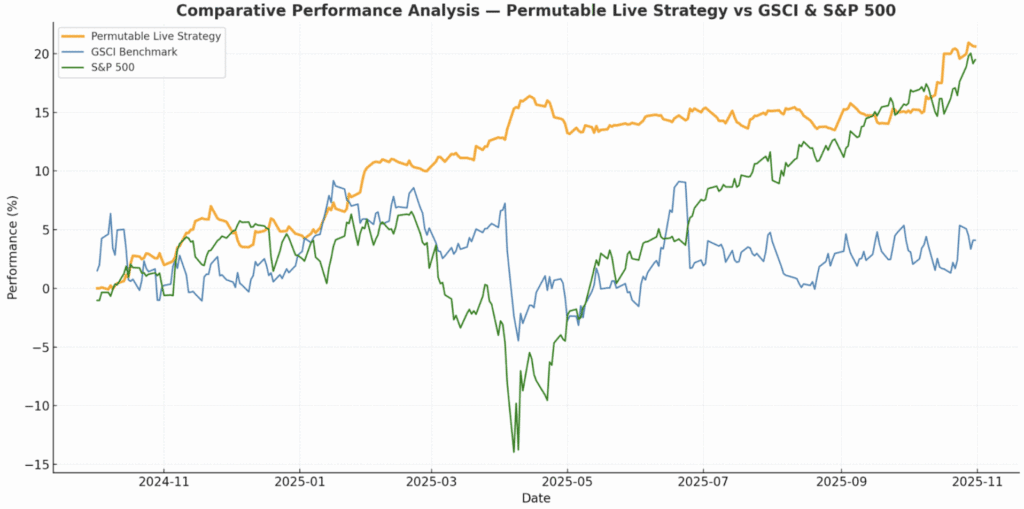
At Permutable, we don’t just provide market sentiment intelligence, we trade on it ourselves. For the past twelve months, we’ve run a fully audited systematic commodity strategy driven entirely by our sentiment signals. This wasn’t a backtest or simulation. It was real capital, real markets, and real risk.
AI for commodity trading 2

From October 2024 to November 2025, our strategy delivered:

  • 20.6% return with 7.3% volatility.
  • Sharpe ratio of 2.85, demonstrating consistent risk-adjusted performance.
  • Maximum drawdown of just 4.4%, showing disciplined risk control.
  • 0.12 correlation to the S&P 500, providing genuine diversification

Our systematic strategy runs a balanced long-short structure across six liquid front-month contracts in energy, agriculture, and precious metals, distributing risk evenly across sectors. Every position is driven by sentiment signals. 

Why does this matter? 

Because it proves sentiment-driven trading isn’t theoretical. When market narratives shift, whether due to sanctions, weather, or policy changes, our signals capture those shifts early and translate them into disciplined, profitable positions. The track record validates what we offer: intelligence that consistently outperforms the market.

Brent systematic trading
Brent’s bid in October – (left) Sentiment flagged the bullish turn early as trade tensions, sanctions and supply signals aligned into a clear regime shift. (right) Our strategy captured the move well ahead of price.

In October 2024, our strategy generated a 13.6% return on Brent and 21.8% on natural gas by capturing narrative shifts before they appeared in pricing. When fresh sanctions on Russian producers shifted the risk position from production to logistics, longer routes, compliance costs, vessel uncertainty, our sentiment layers detected trade tensions and shipping disruption in the news flow early, initiating long exposure ahead of the rebound while earlier shorts cushioned drawdowns. 

Similarly, when winter demand risk, record US exports, and volatile weather converged to flip natural gas sentiment sharply bullish, the model closed shorts ahead of the rally, held through the surge, then trimmed as momentum faded, preserving profits through disciplined regime adaptation. This is market sentiment in action, identifying not just what is moving, but why, and positioning accordingly before the rest of the market has a chance to catch up.

The economist’s lens: Turning perception into structure

Traditional economics measures outcomes. Market sentiment measures perception. Each headline carries a measurable tone, expressed as a score between +1 and -1. We apply news sentiment analysis across more than 50 traded assets spanning energy, metals, agriculture, FX, crypto and equities. Each headline is scored and fed into 2,580 asset-level indices, refreshed with upwards of 500,000 new stories each day. 

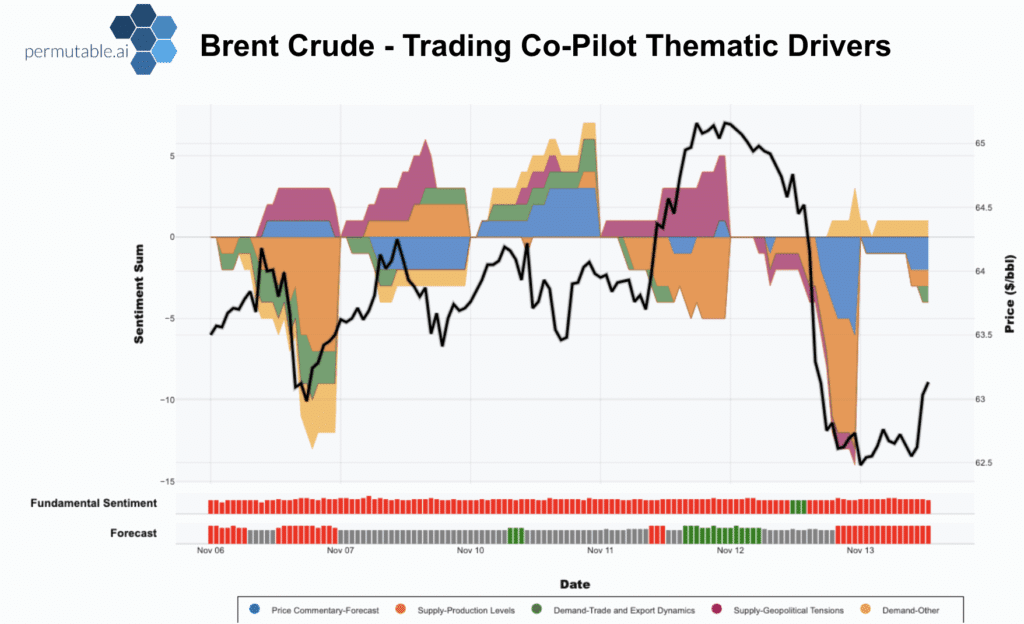
This turns the market narrative into structured, high-frequency signals that behave like traditional market indicators yet respond immediately to changes in news flow. In the Brent chart below, those same signals are decomposed into supply, demand, trade and geopolitical themes to show which narratives are driving prices.
Brent thematic sentiment
Our Trading Co-Pilot shows the breakdown of topic-layer sentiment revealing which narratives are driving the market, supply stress, trade risk and demand signals shifting ahead of the price break.

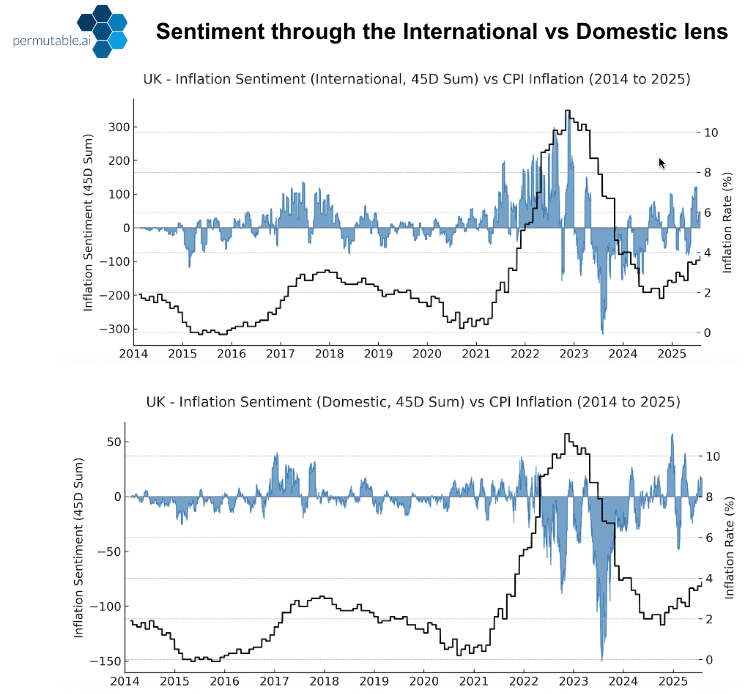
At the macro level we take the same approach, aggregating local-language news from global sources into 2,640 regional macro indices with more than a decade of history across over 30 regions. For each topic we split news sentiment into international and domestic lenses, separating how the story is told on the ground from how it is framed globally. 

The chart below compares UK inflation sentiment from these two angles, international headlines and domestic news, against CPI, showing how global and local narratives can diverge or move together before the official data. Applied at scale, these indices behave like familiar economic time series but move at the speed of real-time news, flagging shifts in growth, inflation, labour markets, policy and political risk ahead of releases.
UK inflation sentiment domestic vs international
Charts above give two lens views on sentiment from a domestic and international perspective: Domestic headlines track the lived pressure of inflation. While international headlines focus on data, policy and wider macro implications. Together they provide a fuller read on UK inflation sentiment.

Unlike surveys, which are periodic, lagging and prone to response bias, market sentiment indices update continuously with the flow of information, providing an immediate map of collective perception. Structured into indices, these readings become early indicators of how economies and assets are evolving, and where pressure is building or fading.

The raw signal captures tone, rolling averages smooth short-term noise, z-scores can help place narratives today in historical context, and topic-level breakdowns show where attention is clustering, whether around inflation, labour markets, political tension, energy supply or policy risk, across both assets and macro.

Opening new analytical ground:

  • Macro-leading inputs: Enrich nowcasts, dynamic factor models, and regime detectors, identifying turning points ahead of official prints.
  • Policy signalling: Track hawkish or dovish drift and liquidity shifts, anticipating changes in term premia, credit spreads, and volatility.
  • Growth and inflation read: Distinguish demand and supply shocks, aligning with output, prices, labour, and trade in real time.
  • Transmission mapping: Trace policy and geopolitical shocks through FX, rates, commodities, and equities for stress and scenario analysis.
  • Narrative calibration: Provide a live read on how policy, supply chains, and fiscal shifts are interpreted domestically and internationally.
  • Attribution with context: Explain moves by topic, source, and region to identify true drivers and behavioural bias.
  • Research-ready series: Clean, version-controlled, and backtestable, ready for factor blends, forecast combinations, and portfolio models.

Market sentiment does not replace traditional data, it refines it. It turns narrative into measurable evidence and connects perception with reality.

The systematic lens: Turning market sentiment into alpha

For systematic investors and quantitative teams, market sentiment is a live signal rather than a concept. Each score is a numerical input, time-stamped, replicable, and ready for testing, converting unstructured information into tradable behavioural factors.

Tuned market sentiment windows identify when optimism or pressure is building and how persistent that move is. Within systematic strategies, market sentiment plays three clear roles:

Systematic sentiment
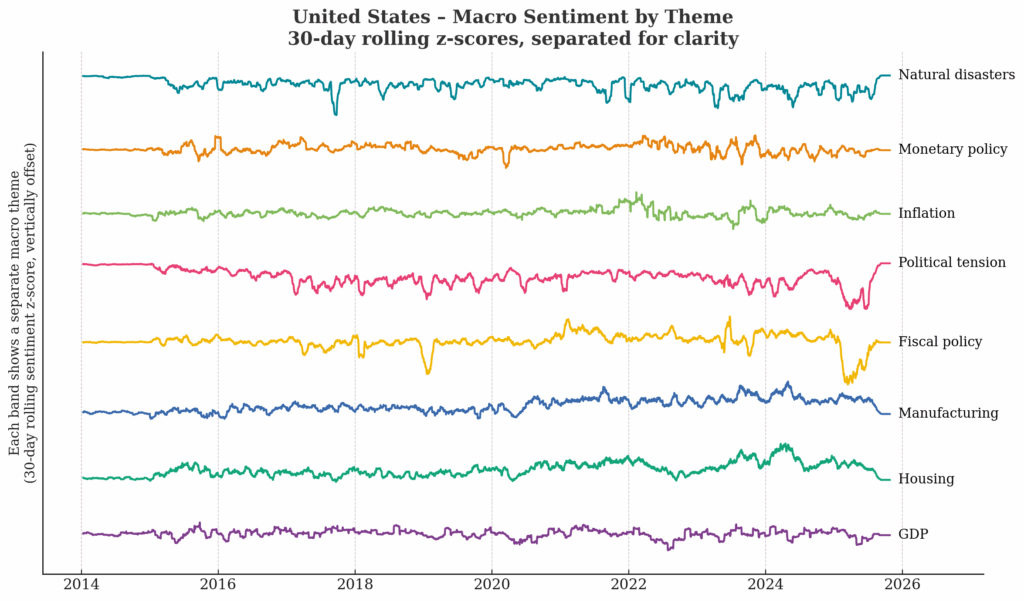
Normalised regional macro-sentiment data sets give quants a clean read on regime shifts, separating themes, controlling for volume, and revealing pattern changes that feed directly into systematic models.

This chart tracks Permutable’s US macro sentiment indices, normalised and smoothed over 30 days so you can see the underlying regimes across growth, housing, manufacturing, policy and politics without getting lost in day-to-day noise. 

Looking at the themes side by side lets a systematic user spot persistent patterns and turning points, then test them properly: which narratives tend to move first, which ones line up with future returns, spreads or macro surprises, and which are mostly noise. From there you can group themes into cleaner factors, build “policy pressure” or “growth risk” baskets, and drop weaker signals, giving you a more stable feature set and a better chance of keeping performance out of sample.

This framework extends naturally across energy, metals, and agriculture. By embedding market sentiment feeds into systematic workflows, traders capture not only what has moved but why, improving conviction, responsiveness, and drawdown control.

Our own trading strategy demonstrates this in practice: a 2.85 Sharpe ratio over twelve months shows what’s possible when sentiment signals are integrated systematically.

Market sentiment in practice: Quantifying markets

Markets are narratives in motion. Quantifying them requires objectivity, scale, and continuous monitoring.

Our framework translates headlines and policy commentary into structured evidence of how investors interpret change. When positive or negative market sentiment dominates coverage, liquidity adjusts and risk premia shifts. As news sentiment builds in one direction, positioning often changes before fundamentals do. These behavioural transitions, visible in tone, emphasis, and persistence, underpin market sentiment’s reflexive power.

Tracking how narratives cluster and evolve allows our indices to surface early signals of where attention, confidence, and stress are shifting, the same forces that drive asset repricing.

Institutional workflows and applications

Commodity and energy desks

Track evolving narratives around supply, demand, regulation, and weather. Shifts in policy or disruption tone appear first in market sentiment data, often preceding volatility or curve steepening across oil, gas, metals, and agriculture. Our October Brent performance, capturing the sanctions-to-logistics narrative shift, illustrates this edge in practice.

Multi-asset strategy teams

Use market sentiment as a high-frequency complement to conventional indicators. Changes in tone around growth, inflation, and policy frequently precede data releases or surveys, sharpening scenario analysis and turning-point detection.

Systematic and quant investors

Treat market sentiment as a behavioural factor that can be tested directly within trend, carry, or volatility models, enriching alpha generation and regime classification. Our live 2.85 Sharpe demonstrates this isn’t theory, it’s repeatable performance.

FX and macro strategists

Monitor divergences in growth, policy and news sentiment between economies. When tone splits meaningfully across regions, it can highlight curve misalignments or FX asymmetries before markets adjust.

Risk and portfolio oversight

Identify where stress is building and where complacency persists. Real-time news sentiment provides early signals of overheating or uncertainty, adding a behavioural lens to leverage, liquidity, and hedge calibration.

Sharper market insights, powered by our Trading Co-Pilot intelligence suite
Brent crude sentiment regime
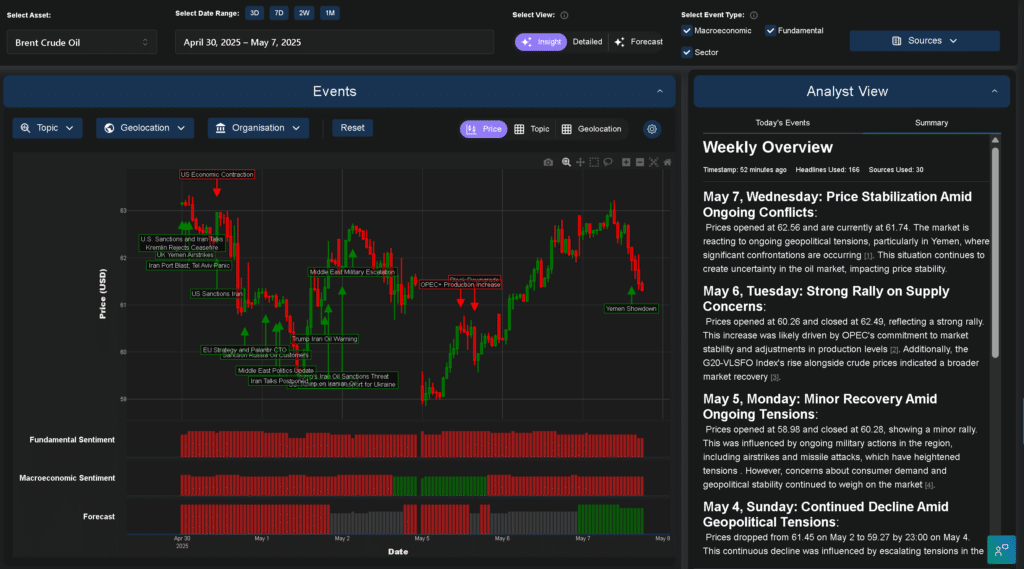
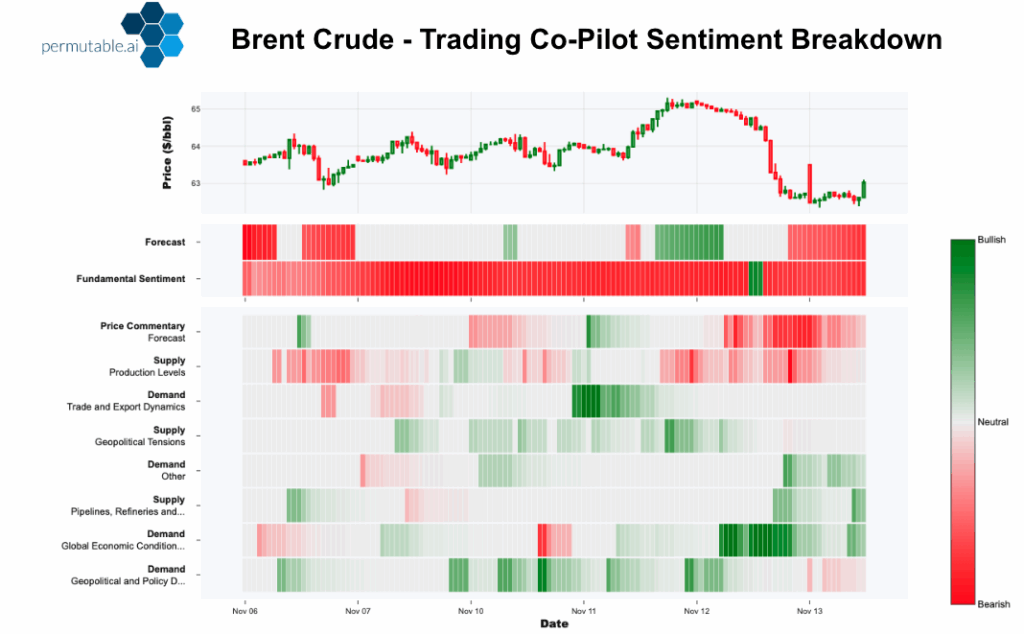
Brent crude’s intraday price action alongside our Trading Co-Pilot sentiment layers. Fundamental sentiment and short-term forecast signals sit directly beneath price, highlighting shifts in tone and direction. Green shades indicate rising bullish tone, red shades indicate bearish pressure, and neutral areas reflect balanced or low-intensity flow. Together, these layers provide a real-time map of the narratives influencing key thematic drivers and directional bias.

Our Trading Co-Pilot turns sentiment data into clear visual intelligence on market conditions. It highlights the headlines shaping each sentiment regime, maps bullish or bearish shifts across categories like supply, demand, and policy, and aligns these directly with asset-price behaviour.

From the bullish rotation in Brent to volatility spikes in metals or FX turbulence ahead of policy meetings, each chart combines sentiment and price action to provide an immediate, explainable view of the forces driving regime change.

For quant, systematic, and data-sourcing teams, the API delivers the same intelligence at scale: structured, transparent, and ready to integrate into dashboards, quantitative models, or automated trading systems.

Where market sentiment becomes edge

The edge now lies not in spotting the fundamentals first, but in understanding how the market already feels about them, and news sentiment makes that visible.

At Permutable AI, we convert global news and policy narratives into real-time, explainable signals that strengthen timing, conviction, and risk control across asset classes. For economists, portfolio managers, and quants, our Trading Co-Pilot and API provide a structured bridge between perception and performance. Market sentiment becomes a live input to strategy, continuously testing house views against the information set and signalling where narratives are shifting before prices move.

Here, it is important to note that news sentiment does not replace expertise, it amplifies it. It gives investment teams a systematic read on market psychology, transforming perception into foresight and narrative into alpha.

We don’t just sell these signals. We trade them ourselves. And over the past twelve months, we’ve demonstrated they work: 20.6% returns, 2.85 Sharpe, and 4.4% maximum drawdown in live markets.

Next steps: Explore how our solutions can fit into your workflow:

  • Request a live demo of our Trading Co-Pilot intelligence suite.
  • Access our market sentiment indices through our API to test within your own models (covering 50+ assets across energy, metals, agriculture, FX, and equities).
  • Discuss integration or strategic partnership options tailored to your macro, quantitative, or commodity focus.

Reach out to our team at enquiries@permutable.ai to see how our real-time news sentiment intelligence can enhance your decision-making across markets, assets and strategies.
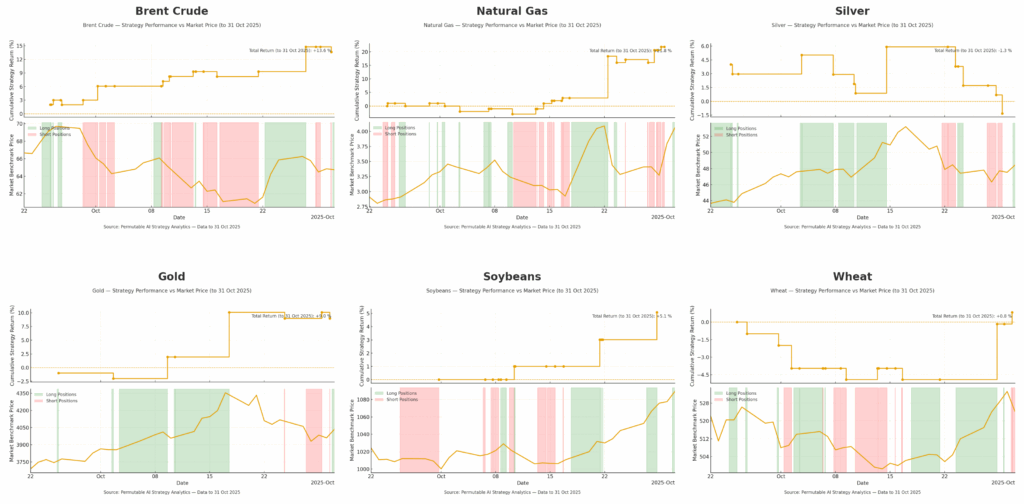
AI for commodity trading: Permutable AI’s one-year results review

Although at Permutable, our core offering is market intelligence, one of our key differentiators is that we run a live systematic commodity trading strategy built on those insights which has delivered clear, repeatable results over the past year. 

Clients asked whether our sentiment signals only back-test well. We took this one step further – using our AI for commodity trading, leveraging our AI-driven signals  in real time. The result is a disciplined commodity trading strategy that has not only navigated tariff headlines and geopolitics with conviction, but taken the right side of regime shifts, and delivered consistent risk-adjusted returns. Against other benchmarks we have outperformed 90%+ of CTAs, proving that sentiment is not only actionable but has clear alpha. 

From 1 Oct 2024 to 1 Nov 2025 our live book outperformed major benchmarks with low equity beta and tight drawdown control. The track record stands at 20.6% with 7.3% volatility, a 4.4% maximum drawdown and a Sharpe of 2.85. Over the same period the S&P 500 returned 18.1% with 18.2% volatility, while the GSCI delivered 4.1% with 17.2% volatility. We run a balanced long and short structure, trade highly liquid front-month futures, and spread risk evenly across energy, agriculture and metals. 

AI for commodity trading 2
Strategy: A simple balance mixed 50/50 long-short commodity book of six highly liquid contracts across energy, agriculture and precious metals. These results highlight the effectiveness of using AI for commodity trading in delivering steady, risk-adjusted performance even amid volatile global markets.

Performance Snapshot (live, 1 Oct 2024 to 1 Nov 2025)

  • Return: 20.6%
  • Volatility: 7.3%
  • Max drawdown: 4.4%
  • Sharpe ratio: 2.85
  • Correlation to S&P 500: ~12.2%
  • Risk Allocation: Evenly distributed VaR across global energy, agriculture, and metals markets.

October strategy review

October Review

Brent Crude (+13.6%)
Brent delivered a firm 13.6% return over October, with our strategy capturing both the early-month softness and the subsequent recovery. A series of well-timed long entries into the late-month rebound drove gains, while short exposure earlier in the period cushioned the drawdown. The performance reflects a measured approach to positioning in a market that remained volatile but directional.

Our AI-driven signals turned higher as sanctions tightened and shipping/insurance frictions pushed a premium into prompt barrels. With logistics risk lifting the front of the curve, conviction rose and we seized longs while keeping discipline as spreads cooled. This is reflected in the graph below, where our system detected the convergence of bullish factors for Brent crude oil in late October and made a timely long call that captured the upside.  

Brent rally

Natural Gas (+21.8%)
Natural gas was the standout performer, returning 21.8% across a turbulent month. The model navigated sharp reversals effectively, closing shorts before the mid-October rally and maintaining disciplined long exposure as prices surged. This result underlines the strategy’s capacity to handle high volatility and extract value from rapid shifts in market sentiment.

The signal pivot came as weather risk and record US export prints outweighed supply additions. Alerts around project restarts and cargo cancellations kept risk light into early November, preserving gains as momentum faded.

Silver (-1.3%)
Silver finished marginally lower, hindered by premature long entries ahead of a short-lived correction. Losses were contained, however, with risk controls limiting downside. The strategy adapted well in the first half of the month, realigning with renewed downside pressure. Overall, performance was steady given the reversal of conditions in precious metals.

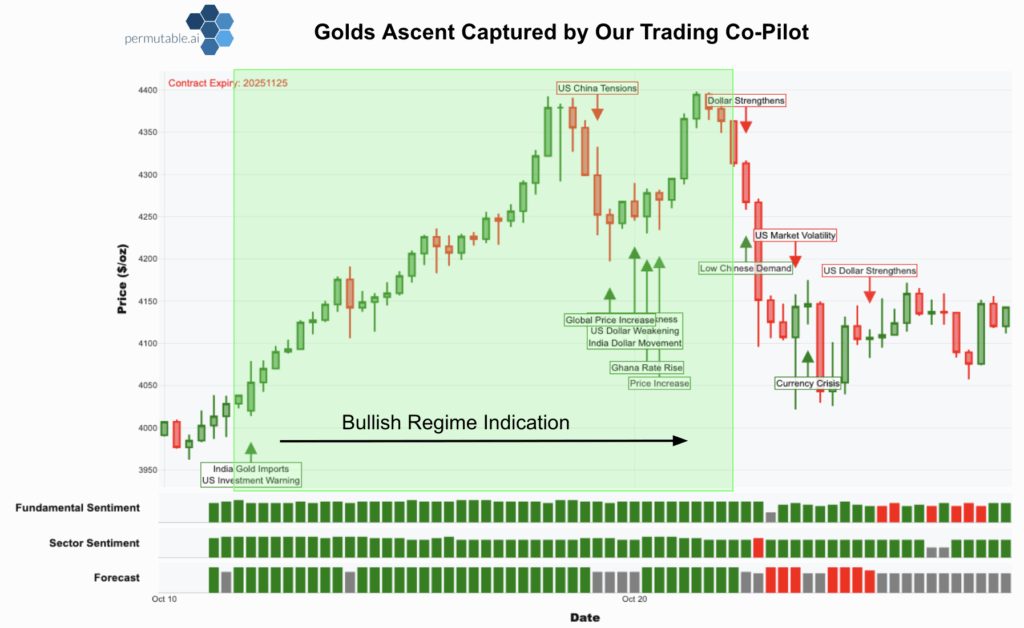
Gold (+9.0%)
Gold posted a formidable 9% gain, benefitting from well-placed long exposure during the mid-month rally. The strategy avoided early noise and tracked the broader risk-off theme that spurred precious metals. Its patience in holding positions through the mid-October climb captured the bulk of the upward move, reinforcing gold’s value as a defensive trade.

Conviction eased later in the month as the cooling of tension and risk appetite re-emerged, cooling the heat out of the yellow metals run. We followed the signal back to neutral stance and banked the long position, treating following movements as profit-taking within a still supportive structural backdrop of central-bank and Asian demand.

Golds ascent

Soybeans (+5.1%)
Soybeans advanced 5.1% as the model successfully rotated from short to long in the second half of the month. The strategy captured the late-October recovery in agricultural prices, with improved timing following a choppy start. The gain reflects stronger trend recognition and tighter discipline in execution.

Policy tone improved with Washington–Beijing détente and re-emergence of Chinese booking late October, we rotated long and trimmed as headlines faded and momentum cooled into month-end.

Wheat (+0.8%)
Wheat recovered from early losses to close modestly higher at 0.8%. Initial exposure proved to miss the mark, but later long entries boded well in the late-month rebound. The system’s adjustments helped preserve capital through volatility, as momentum pivoted.

In late October the easing trade tensions lifted confidence in forward purchasing, yet a comfortable supply backdrop (Russia, Argentina, Western Australia) capped bullish enthusiasm. Signals supported a tactical long bias late in the month, with risk kept modest given soft US inspections and slower EU exports.

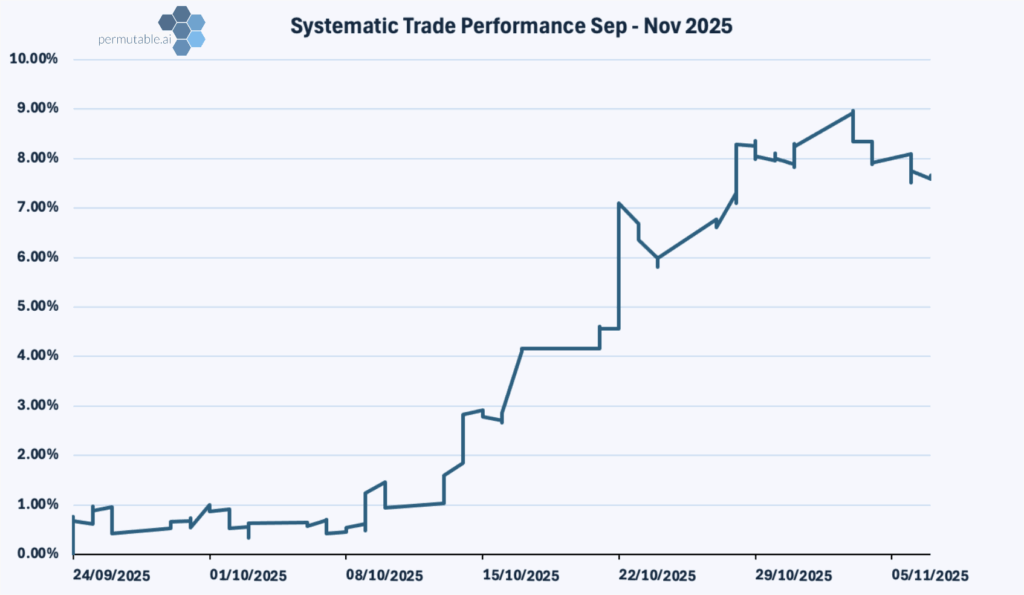
Each commodity’s performance further validates our thesis: that AI for commodity trading can recognise shifting market narratives earlier than price and guide positioning with measurable confidence. Our systematic trade performance from late September to early November reflects the effectiveness of signals and strategy.   

systematic trade

How this fits into client strategy and workflow: The case for AI for commodity trading

Our approach offers institutional desks a practical way to integrate AI for commodity trading directly into macro, CTA, and multi-asset strategies – providing low-correlation returns and explainable signals.

Where it fits
  • Diversifier with low equity beta: Adds a differentiated return stream through commodities market due to the current stock rally, correlation ~0.12 to the S&P 500.
  • Macro overlay: Signals highlight regime shifts around tariffs, supply dislocations and geopolitics, supporting tilt decisions in broader macro books.
  • CTA complement: Cleaner risk profile and shorter reaction time versus broad commodity indices.
Transparency
  • Explainable signals: Each change is accompanied by a short note on drivers, including from geo-political, supply, demand, broken down further through region, to which narratives are dominant.
  • Audit trail: Version controlled signal history, orders and fills, with a daily, weekly and monthly review.
Benefits to the desks and PMs
  • Earlier conviction: Signals often turn ahead of price, helping analysts and PMs to lean into market moves rather than chase them.
  • Clean event narratives: Clear asset agnostic event allocation capturing the drivers as they unfold in real-time, allowing them to keep on top of regimes and infection points.
  • Operational ease: Delivered as an API plus an intuitive UI dashboard, ready for modelling, market catch ups for morning meetings and intelligent insights briefing notes.

Why Permutable is the leader in AI for commodity trading

Running the strategy live demonstrates what matters for investors: sentiment is actionable. The same domestic and international lenses that power our research inform entries, exits and risk allocation, helping us spot regime shifts early, lean into market narratives that matter, capturing the alpha. Our systematic performance record makes the case clear, sentiment matters more than ever whilst AI for commodity trading can operationalise that insight at scale.

How clients work with us

We have often been asked why we haven’t launched a fund to showcase our systematic strategy. The answer is simple – our goal isn’t to compete with clients or run capital, but to provide technology, data, signals and workflow infrastructure directly to institutional partners in a variety of ways.

Through our API Licence, partners can access our asset- and macro-level APIs, embedding real-time signals and alerts into existing OMS and trading systems without the friction of new infrastructure. For those seeking a more visual experience, our Trading Co-Pilot dashboard offers secure access to live signals and alerts, market intelligence, and event-driven reporting – ready to plug into existing workflows.

We recognise that adopting new AI systems can come with integration and governance challenges, so our model is designed for transparency, explainability, and control – helping partners deploy adaptive AI with minimal disruption.

Explore our systematic trading solutions or read our case study to see how institutions are using our approach in practice. To stay up to date, sign up for our newsletter or contact us at enquiries@permutable.ai to find out more.

The geopolitical risk premium takes centre stage as energy markets rally

In this article, we examine how a wave of geopolitical developments has reshaped the landscape across global energy markets. From renewed pressure on Russian energy to the unveiling of a US-EU energy pact, the past week has marked a decisive shift in the drivers of oil and gas prices.

Against this backdrop, our Trading Co-Pilot identified a build-up of bullish momentum signals across Brent, WTI, and TTF. These signals emerged alongside regime shifts, where accelerating sentiment and converging macro risks pushed markets into a new phase of price action. What we see is a market increasingly driven by political risk, regulation, and diplomatic shifts, rather than by supply-demand fundamentals alone.

Our Trading Co-Pilot surfaces a series of high-conviction entry points, each aligned with shifts in sentiment and structural market changes. These signals anticipated sharp rallies across all three benchmarks, revealing how pricing dynamics have evolved in response to rising policy pressure. We break down the political, structural, and market forces behind the moves and assess the themes likely to define the path forward for energy markets.

Brent Crude: Geopolitical Risk Offsets Increased Supply

Brent futures rose to $72.70, touching a five-week high, as sanctions risk eclipsed optimism around OPEC+ output increases. While the markets showed signs of stabilisation, the growing uncertainty around Russian-linked barrels spurred the swift price ascent.

Sanctions Over Supply: A New Risk Premium Forms

Recent policy rhetoric revived the possibility of further sanctions targeting those involved in the transport and financing of Russian energy. Even in the absence of formal enforcement, the stern message alone introduced a reputational risk premium, increasing legal and financial exposure across energy markets.

Geopolitical Drivers: A Sharp Escalation in Policy Risk

In just a few days, the U.S. administration issued a series of high-impact policy threats:

  • A 10-day ultimatum for Russia to come up with a ceasefire plan to end its invasion of Ukraine, paired with a warning of 100% secondary tariffs on Russian oil.

  • New export tariffs aimed at India and China, increasing pressure on their Russian energy imports.

  • Broader signals of enforcement against Iranian-linked crude shipments.

This sudden squeeze on trade through renewed sanction pressure, has introduced significant uncertainty across Asian energy trade routes. The market quickly repriced geopolitical risk in energy markets, as the shift from rhetoric to enforcement came into the spotlight.

Strategic Realignment: Transatlantic Energy Policy Takes Centre Stage

The US–EU energy pact formalised a structural shift away from Russian energy. While the strategic direction is now set, the timeline for execution remains constrained by infrastructure gaps, regulatory friction, and limited market coordination. Full implementation is expected by 2027, though delays remain likely.

Market views remain split. Some expect geopolitical tailwinds to keep prices elevated, driven by sustained policy risk. Others anticipate a correction as OPEC+ supply ramps up and macroeconomic pressures ease.

Our Trading Co-Pilot Tracks the Breakout

Our Trading Co-Pilot flagged the bullish momentum shift just as Brent cleared $71. The signal aligned with sanctions-driven sentiment, EU policy realignment, and OPEC+ output. Prices moved swiftly toward the $72–$73 range.

Brent Crude
Our Trading Co-Pilot captured the early inflection, as legal and political risk returned to dominate Brent price formation.

WTI Crude: Tariffs, Sanctions and Supply Signals Push Prices into Bullish Territory

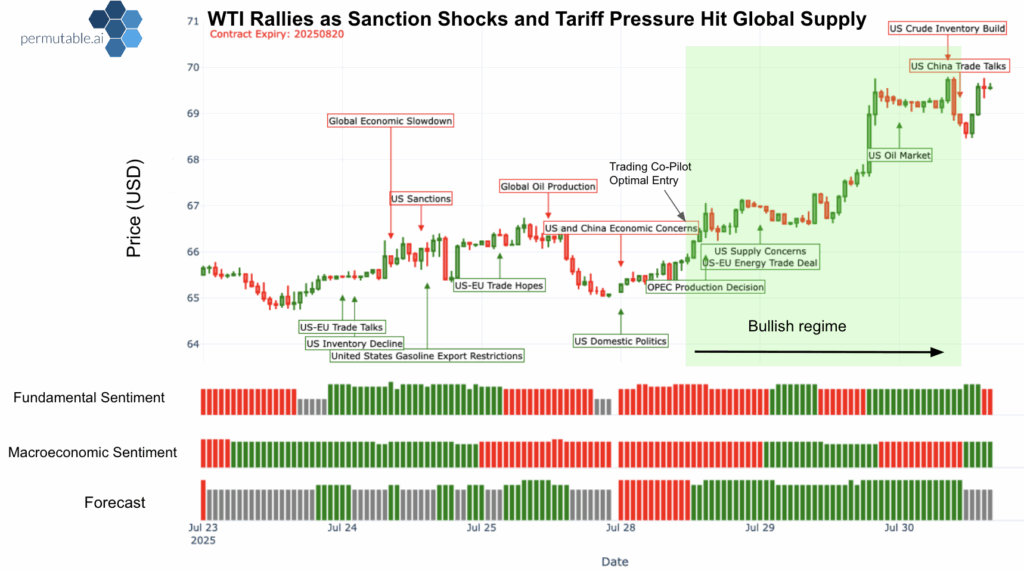
WTI crude held firm near $69 per barrel this week, as geopolitical risk in energy markets overshadowed a contradictory U.S. inventory picture. The rally was not driven solely by supply dynamics, but by a surge in regulatory pressure, including threats of secondary sanctions, renewed tariff pressure, and shifting trade alignments.

WTI oil
Our Trading Co-Pilot identified the optimal entry ahead of the breakout, driven by macro and sentiment alignment.

Our Trading Co-Pilot Captures the Regime Shift

Our Trading Co-Pilot identified a bullish regime shift in WTI, marking the point where escalating policy risk and rising sentiment momentum converged. The signal preceded a sharp upward move, offering clients a well-timed entry as the market transitioned into a sustained rally.

Key Movements

  • 28–29 July: WTI rallied from $66 to $69 after U.S. inventory draws and the transatlantic energy pact announcement.
  • 30–31 July: Prices dipped briefly on upside inventory surprises from EIA and API data.

While our Trading Co-Pilot’s bullish forecast reflects strong directional conviction, risks remain. Inventory build-ups and surging output confirmed by the EIA and API continue to place downward pressure on sentiment, and a proposed reintroduction of Venezuelan exports under Chevron waivers may temper further upside. Still, trade policy remains the dominant driver in the near term.

TTF Natural Gas:  Heatwaves and Supply Friction Lift Prices Despite Structural Softness

Dutch TTF gas prices rose from €32.10 to €34.90, driven by a combination of heatwave-related demand, short-term supply constraints, and speculative positioning. However, the rally appears increasingly detached from underlying fundamentals, with structural weakness continuing to weigh on the broader European gas market.

Heatwave Impact: Cooling Demand Drives Short-Term Surge

Extreme heat across Europe boosted short-term gas consumption and triggered speculative activity in power markets. Prices opened at €34.72 on 30 July, buoyed by headlines highlighting U.S.–EU LNG cooperation. Still, recent EIA data showed a drop in Dutch spot prices earlier in the month, reinforcing the view that the rally is regionally concentrated and sentiment-driven.

Supply Strains

  • Norwegian gas output declined for a fourth consecutive month.
  • UK storage builds slowed, tightening near-term balances.
  • Qatar signalled potential LNG disruptions due to maintenance risks.
  • China increased Russian pipeline uptake

While these constraints triggered upward price pressure, they are cyclical rather than structural long-term supply weakness.

Demand Headwinds: Structural Softness Still Dominates

  • Dutch gas-fired generation fell to multi-year lows.
  • EU industrial demand remains weak.
  • LNG import expansion is constrained by regulatory and infrastructure delays.
TTF gas
Our Trading Co-Pilot anticipated the sentiment-driven move, distinguishing short-term volatility from longer-term demand weakness.

Our Trading Co-Pilot Captures the Rebound

Our Trading Co-Pilot issued a timely entry just under €32.5 mark, detecting upbeat sentiment around weather risks, LNG bottlenecks, and regional supply pressures. The decisive signal positioned clients well ahead of TTF’s rebound towards €35.

Global Energy Markets: The Road Ahead

Recent price action across Brent, WTI, and TTF reflects a market increasingly shaped by political risk, regulatory intervention, and shifting global alignments. As energy markets move further away from traditional fundamentals, traders must adapt to a more volatile, policy-sensitive environment.

Bullish Catalysts

  • Enforcement of secondary sanctions on Russian or Iranian oil
  • LNG disruptions from Qatar, Hormuz, and U.S. terminals.
  • Continued weather driven demand surges in Europe or Asia.

Bearish Headwinds

  • U.S. crude builds and refinery throughput spikes.
  • Venezuelan supply returns and ramping up of OPEC+ deliveries.
  • Further demand weakness from China and a slowdown in Eurozone industrial output.

Where Signal Meets Strategy

This week’s rally across Brent, WTI, and TTF reflects a market increasingly driven by geopolitical risk in energy markets. Traders are no longer reacting solely to supply and demand data, but to policy shifts, enforcement threats, and macroeconomic volatility.

Our Trading Co-Pilot identified these inflection points in real time, blending sentiment analytics, macroeconomic filters, and policy signals into clear, actionable trade calls. Rather than relying on hindsight, our Trading Co-Pilot tracks evolving conditions as they unfold, enabling well-timed entries and exits with conviction. The result is enhanced clarity and precision in trade execution, cutting through market noise and volatility across global energy markets.

To request a demo or speak to one of our team, simply email enquiries@permutable.ai 

Inside our newly redesigned macro newsletter – and why every institutional investor needs it

In a world where market-moving information travels at the speed of light, the difference between profit and loss often comes down to having the right intelligence at precisely the right moment. That’s where our Permutable Insights Weekly macro newsletter comes in – a weekly briefing of our real-time intelligence for institutional investors who refuse to let alpha decay cost them profitable opportunities.

Beyond traditional market commentary

Traditional macro newsletters follow a predictable pattern: they analyse what happened last week, offer commentary on established trends, and provide educated guesses about what might come next. But in today’s hyperconnected markets, by the time conventional analysis reaches your inbox, the primary positioning opportunities have often passed. Our redesigned macro newsletter operates on an entirely different paradigm – we reveal how our market intelligence surfaced the signals before they became consensus.

Over the past year, our 3000+ and growing subscriber base has had a ringside seat, being walked through how our live market intelligence called Bitcoin’s surge to record heights at $123,000 to the Iran-Israel conflict that drove Brent crude from $69 to $74 ahead of time. This has all been through our macro newsletter which has provided a lens into how our market sentiment intelligence has consistently identified inflection points hours – sometimes days – before traditional indicators caught up.

Bitcoin bullish regime

Sanctions, tariffs and geopolitical risk

This was a key theme we explored in our recent newsletter editions, examining how oil and gas markets have begun moving not on inventory or consumption data, but on diplomatic signals, sanctions rhetoric, and regulatory alignment. As we highlighted to our subscribers, this represents a new regime shift where political risk now trumps traditional supply-demand narratives.

In our recent coverage, we walked subscribers through how our Trading Co-Pilot identified bullish momentum signals across WTI, Brent, and TTF, aligned with sudden changes in sentiment around sanctions, tariffs, and cross-border energy flows.

Brent Crude

Previewing our Political Tension Index

As we detailed in our recent newsletter analysis, geopolitical instability isn’t cyclical anymore – it’s systemic. Our 12-month Political Tension Index, which was featured in Trader’s Magazine, reveals deepening negative sentiment across global leadership narratives, trade policies, and regional unrest. Through our newsletter, we’ve shown subscribers how our real-time AI signals help front-run political shocks before they price in.

Our newsletter featured analysis of our Political Tension Index over the past 12 months, highlighting key global political flashpoints including US shutdown risks, tariff disputes, and high-profile leadership conflicts. As we explained to subscribers, this type of structured intelligence enables institutional investors to quantify political risk in real time and adapt strategies proactively.

Real-time intelligence that predicts market moves 

The engine behind our macro newsletter is our proprietary AI-driven intelligence platform, powered by 22 distinct macro indices including our War Sentiment Index, Trade Sentiment Index, and Political Tension Index. These aren’t simple keyword-matching tools – they represent sophisticated LLM-driven systems that process thousands of articles daily, understanding context, evaluating source credibility, and weighing geopolitical significance with analyst-grade precision.

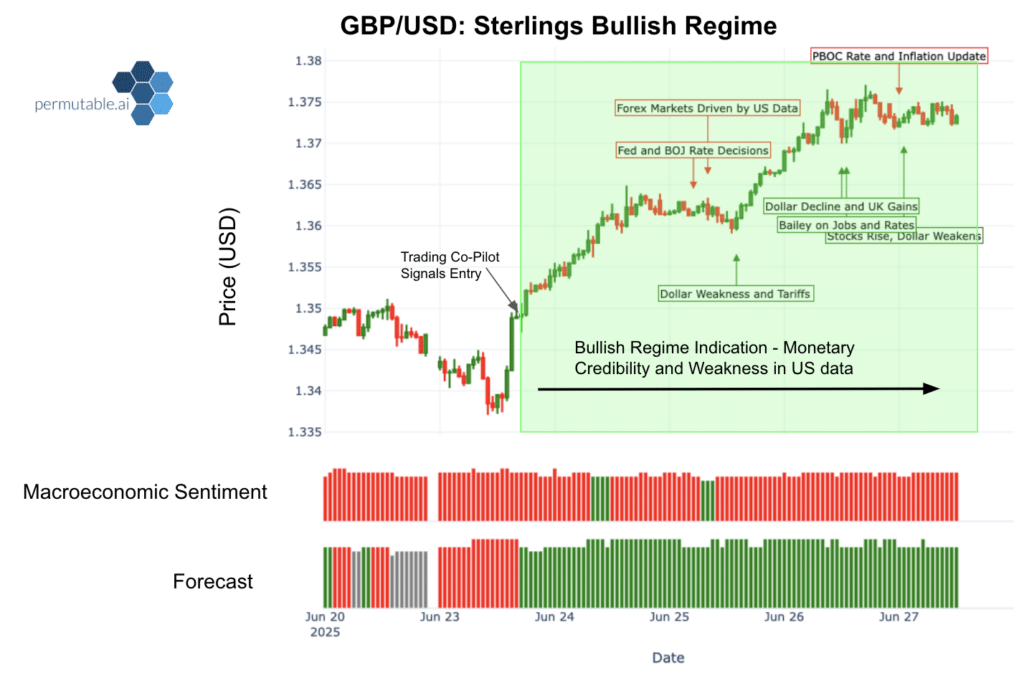
Consider our recent coverage of Sterling’s rally to 1.3740 against the dollar. While traditional FX analysis focused on interest rate differentials and economic data, our macro newsletter identified the narrative shift weeks earlier – processing divergent central bank communications and cross-referencing macro sentiment patterns that conventional analysis completely missed. 

GBP USD forecast
subscribe to our macro newsletter

What sets our macro newsletter apart

Our Insights Weekly operates on three core principles that distinguish it from every other macro newsletter in the institutional investment space:

Through The Lens of Our Intelligence: In every issue, we walk our readers through exactly how our Trading Co-Pilot saw what was happening in real-time, and more importantly, what was coming next – a perfect example here looking at the correlation between Fed rate cuts and Market Sentiment Volume which will be going out in next week’s newsletter. 

Cross-Asset Signal Correlation: Modern markets don’t respect traditional sector boundaries. A supply chain disruption in Southeast Asia impacts European automotive stocks, copper futures, emerging market currencies, and high-yield credit spreads simultaneously. In our macro newsletter, we make light of these  these interconnected signals, ensuring subscribers receive comprehensive intelligence rather than fragmented sector-specific alerts.

Actionable Implementation Guidance: In our macro newsletter, we also explore implementation pathways. Whether you’re managing systematic strategies, discretionary portfolios, or risk management frameworks, we provide the specific intelligence you need to translate signals into profitable positioning.

Institutional-grade analysis for serious investors

Our macro newsletter is fast becoming essential reading for portfolio managers at multi-billion dollar systematic funds, commodities traders at Tier 1 investment banks, and CIOs managing multi-strategy operations.  Every edition of delivers comprehensive coverage across the themes that matter most to institutional investors. Recent issues have explored Bitcoin’s transformation from speculative asset to institutional treasury holding, Japan’s economic crossroads as political instability challenges its safe-haven status, and the systematic impact of trade sentiment on multi-asset portfolio performance.

But beyond individual market calls, our macro newsletter provides strategic intelligence on the evolving landscape of institutional investment management itself. From avoiding multi-asset alpha decay through real-time intelligence integration to understanding how AI-driven sentiment analysis is becoming standard practice for professional trading operations.

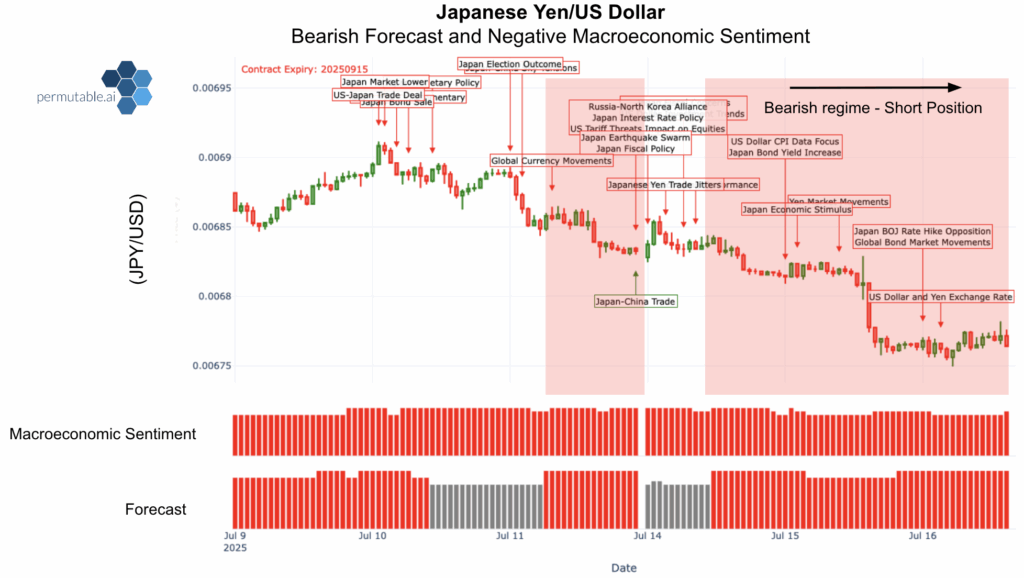
Japan's economy

Your edge in an increasingly complex world

The financial markets of 2025 demand far more than traditional analysis can provide. Geopolitical tensions drive commodity volatility, central bank communications move currencies before policy changes, and narrative shifts determine asset allocation flows across global portfolios. Our macro newsletter provides the real-time intelligence infrastructure necessary to navigate this complexity successfully.

With 3000+ followers already relying on our market intelligence across LinkedIn, and institutional clients showing consistently growing appetite for our market events intelligence, our Insights Weekly is establishing itself as the essential macro newsletter for serious institutional investors.

Now the question isn’t whether AI-driven market intelligence will become standard practice – it’s how quickly you’ll integrate these capabilities into your investment process before your competitors do. Subscribe to Permutable Insights Weekly and discover how to transform uncertainty into actionable opportunity.

subscribe to our macro newsletter

US Treasuries Pivot: Tracking policy repricing in real time

This article explores how the 2-year T-note became the focal point of a short-duration rally and subsequent reversal, and how our Trading Co-Pilot tracked both in real time. From detecting the initial bullish pivot in mid-July to flagging the slowdown as macro headwinds emerged, our Trading Co-Pilot continues to provide institutional investors with a distinct tactical edge.

In today’s volatile fixed income landscape, turning points in US Treasuries are increasingly driven by subtle shifts in sentiment rather than traditional data releases alone. This is where our Trading Co-Pilot proves invaluable, capturing the earliest signals across monetary policy, trade flows, and geopolitical risk.

Real-Time Detection: The Early Bullish Signal

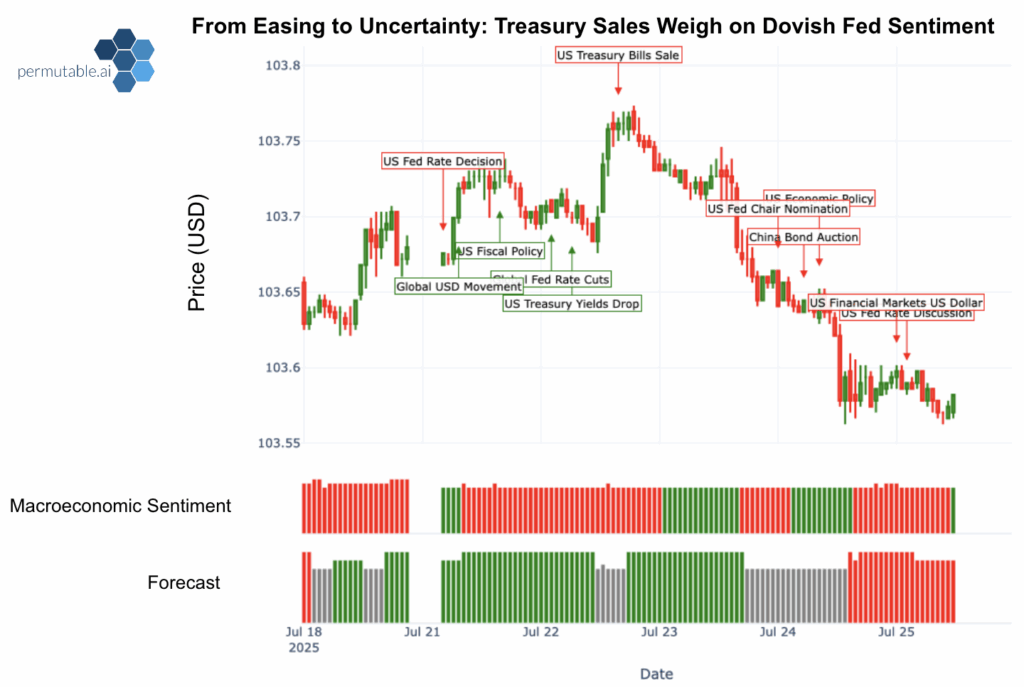
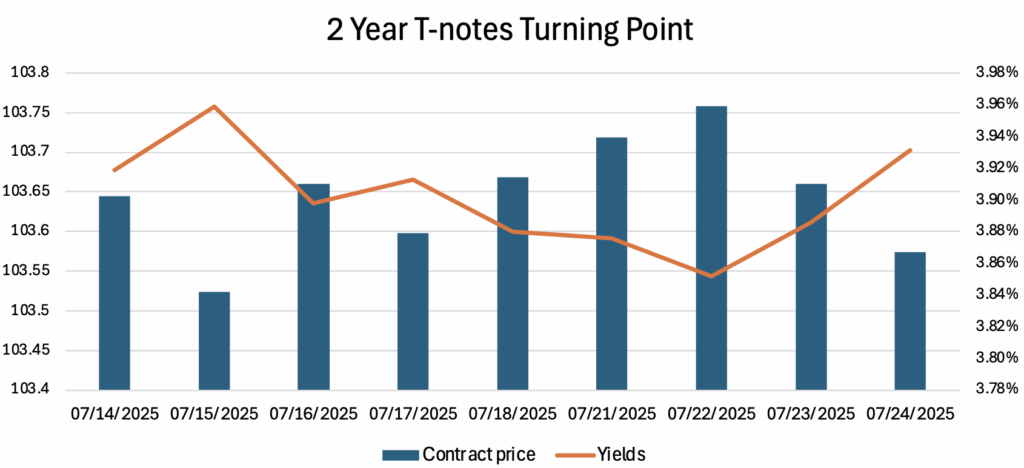
Between 18 and 23 July, our Trading Co-Pilot flagged a steady build-up in bullish sentiment surrounding the 2-year T-note as yields declined to around 3.85%, while the contract price rose from $103.60 to $103.75. This signal was driven by a combination of:

  • Dovish messaging from Federal Reserve officials.
  • Strengthening US-Japan trade ties.
  • Heightened geopolitical tensions supporting safe-haven flows.
  • A more disciplined fiscal tone from US policymakers.

The signal came early, giving investors time to rotate before the broader market responded.

US Treasuries Co-Pilot
Our Trading Co-Pilot flagged rising sentiment as 2-year yields fell spurring contract prices to climb, driven by dovish Fed tone, US-Japan trade optimism, and safe-haven demand.

What Moved the Needle

Renewed Trade Optimism

The recently signed US-Japan trade agreement, valued at over $550 bn, acted as a macro catalyst. Key provisions included Japanese investment in critical US sectors such as semiconductors and pharmaceuticals, alongside a reduction in US tariffs on Japanese cars from 27.5% to 15%.

The easing of trade tension sparked a rally in Japanese equities and led to a weaker greenback against the yen, improving the relative value of US Treasuries to foreign buyers. Our Trading Co-Pilot picked up on this rotation early, flagging sentiment gains tied to trade and FX dynamics.

Fiscal Restraint and the Supply Picture

The US Congress’s approval of a $9bn spending cut, targeted at foreign aid and public broadcasting, added another layer of support. Though modest in scale, it signalled a willingness to rein in public spending buoying investor confidence in fiscal restraint. The US Treasury’s preference for longer-dated issuance further supported demand at the short end.

Dovish Signals

Additional support came from Fed Governor Christopher Waller, whose dovish tone reinforced expectations for rate cuts to come. Although June CPI rose slightly to 2.7% from May’s print, inflation remained within the Fed’s acceptable range despite the trickle of tariff based inflation pressure creeping in. Our Trading Co-Pilot integrated these developments into a rising sentiment score well ahead of the rally in 2-year T-note prices.

Inflection Detected: From Momentum to Market Caution

However, from 24 July our Trading Co-Pilot detected a turn in sentiment as yields creeped back up and contract prices fell. This preceded the broader pause in Treasury gains and was driven by a convergence of factors:

  • A significant upcoming $70 bn 5-year treasuries auction raised concerns over short-end supply.


  • Renewed political tensions, as President Trump clashed publicly with Fed Chair Powell over fiscal priorities, with the chair signalling no intention to resign.


  • A strengthening US dollar reduced the appeal of Treasuries for foreign investors.


  • Economic data surprised markets, particularly a drop in initial jobless claims and robust consumer sentiment.

Stronger labour market figures published on Thursday shifted the narrative of a slowing US growth. While markets still expect rate cuts in 2025, they have pulled back from pricing in two full cuts this year. A hold in July remains fully priced in, though expectations for a September move have weakened modestly.

Our Trading Co-Pilot incorporated these dynamics in real time. The forecast sentiment turned bearish on 24 July as yields rose and contract prices fell, reflecting an erosion in conviction around monetary easing. This foresight offered a vital edge as institutional positions recalibrated.

2 Year T-notes
Markets trimmed rate cut bets as hawkish Fed rhetoric and strong macro data pushed yields higher and contract prices lower, reflecting weakening conviction around near-term easing.

The Bigger Picture

The 2-year T-note remains the most direct expression of market rate expectations. With its low duration and deep liquidity, it responds swiftly to shifts in policy tone and macro narrative. The combined effects of policy recalibration, geopolitical strain, trade stabilisation, and fiscal prudence have created a mixed environment for the 2-year T-note. Our Trading Co-Pilot translates these developments into forward-looking sentiment scores, ahead of both price action and consensus forecasts.

Safe Haven Rotation: Flight to Yield Amid Volatility

Even as gold retreated amid easing trade tensions, demand for 2-year T-notes still holds firm over concerns of increased market volatility. Our Trading Co-Pilot identified this divergence in real time, flagging a rotation towards yield-linked defensives as investors sought both safety and return.

Meanwhile, ongoing geo-political uncertainty in Japan, regional instability in the Middle East, and the prolonged war in Ukraine continued to support short-duration US Treasuries. Our Trading Co-Pilot tracked this constructive sentiment across geopolitical developments.

Turn Market Complexity into Trading Edge 

In a week marked by rapid shifts, our Trading Co-Pilot demonstrated its value as a real-time lens on the T-notes market. It identified the early bullish pivot, tracked the influence of trade diplomacy and macro policy, and detected the reversal. 

In a market shaped by policy transition, trade realignment, and ongoing geopolitical risk, the 2-year T-note anchors institutional positioning.

Our Trading Co-Pilot intelligence suite delivers early, forward-looking insight across these moving parts, helping investors anticipate change and act before it becomes consensus.

For enquiries or trial access to our API or dashboard, contact us at: enquiries@permutable.ai


FAQ on our Auto Analyst and Market Forecast Agents

This FAQ is designed for institutional investors, analysts, and strategic teams looking to understand how Permutable AI’s Auto Analyst and Forecast Agents provide real-time market forecast capabilities and explainable insights across asset classes.

At Permutable, we help institutional decision-makers go beyond delayed data and headline-chasing. Our Auto Analyst and Forecast Agents tools provide actionable, explainable intelligence that helps you make faster, smarter decisions across markets. In this FAQ, we’ll answer the key questions we hear from traders, asset managers, investment banks, and corporate strategy teams looking to integrate real-time macro and sentiment data into their workflows.


What’s the difference between Auto Analyst and Market Forecast Agents?

Auto Analyst gives you clear, analyst-style summaries of recent market movements. It identifies the key drivers behind price action using a blend of sentiment analysis, macro data, and fundamental news. Think of it as your go-to for understanding what happened and why — in minutes, not hours.

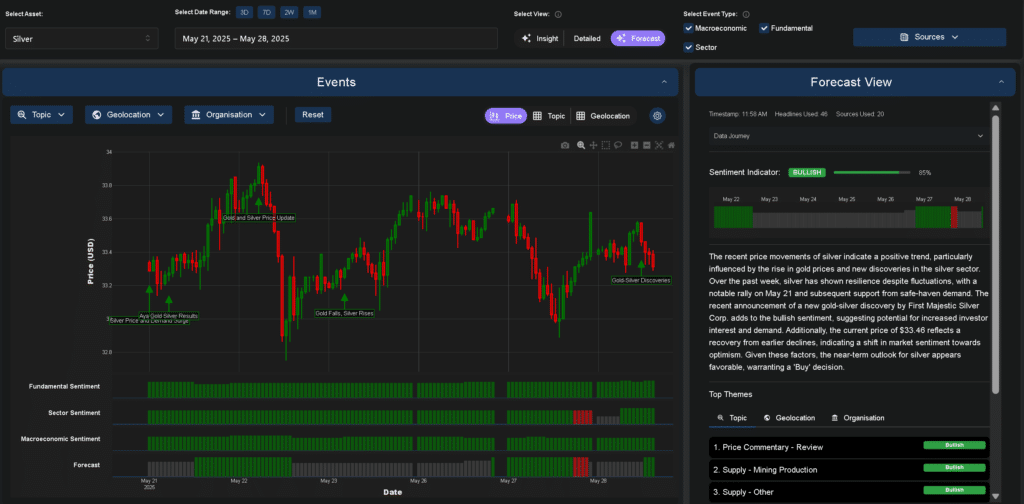
Forecast Agents, on the other hand, provide forward-looking predictions on market direction – refreshed hourly. Each forecast includes a directional call (e.g. BUY/SELL), the supporting rationale, and topic-level sentiment scores.

Use both tools together to gain a complete picture of past, present, and future market dynamics.

Gold vs oil correlation brent crude oil
silver price forecast 28 May 2025

How accurate are these insights and predictions?

We combine large language models, market signals, and validated global sources to deliver insights that are explainable, relevant, and timely. Forecasts are continuously tested against historical price action, and updated every hour to reflect the latest information flow. This means you’re acting on quantified insight, not outdated consensus.


What markets do you cover?

Our tools cover a wide range of asset classes:

  • Energy: Crude oil, natural gas, renewables

  • Metals: Gold, silver, copper, platinum, palladium 

  • Agriculture: Grains, softs, livestock

  • Currencies: Major FX pairs and indices

  • Fixed Income & Equities: Coming soon

Use cases include:

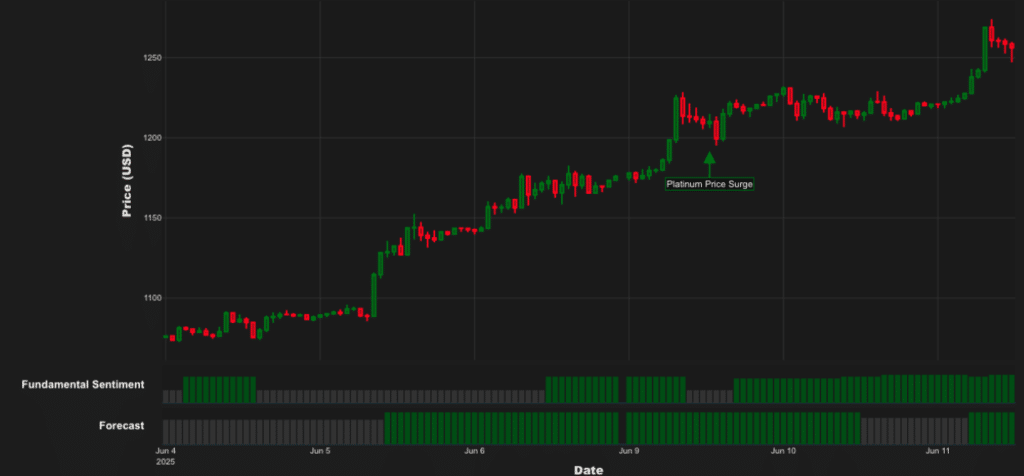
platinum price surge
Wheat Rallies

How is this different from a typical research platform?

Most research platforms tell you what’s already happened — often without context. Our tools tell you why something happened and what might happen next. Auto Analyst condenses thousands of headlines, economic signals, and sentiment shifts into a concise, readable summary. Forecast Agents take it further by offering live directional calls with transparent logic. No black boxes. Just insight you can trust.


Can this be integrated with our internal systems?

Yes. Both Auto Analyst and Forecast Agents are available via secure, enterprise-grade API. That means you can plug them directly into dashboards, trading models, or strategy tools – no new platform required. Some clients also surface the data within investment committee presentations, client reports, or deal evaluation workflows.


How often are insights updated?

This makes both tools well-suited for live desk use, as well as daily and weekly macro strategy workflows.


Are these just for traders?

Not at all. Here is a list of use cases from our clients:

If you’re tracking markets to inform decisions – our Plug and Play intelligence tools are for you.


What if I want transparency behind the output?

Transparency is built in. Each Auto Analyst report includes plain-English reasoning behind market shifts. Forecast Agents provide supporting arguments for every directional call, drawn from our global signal layer. We highlight top themes (e.g. monetary policy, economic data, trade risks) and the specific news items influencing the model – so you always understand the “why” behind the forecast.


Can we try it before committing?

Absolutely. We offer:

  • Live, tailored demos based on your asset focus

  • Access to sample API outputs for both Analyst and Forecast endpoints

  • A walkthrough of how our tools fit into your workflows, systems, and reporting

Just email us at enquiries@permutable.ai to get started.


How do I know if this fits my workflow?

Our tools are built to support both front-office and strategic roles. Whether you’re monitoring price drivers in real time, enhancing internal models with macro reasoning, writing weekly strategy briefs for CIOs and clients, or building a more data-driven corporate intelligence function, Auto Analyst and Forecast Agents are designed for speed, scale, and clarity.

Clients often tell us it’s like having an army of analysts on call – without the delay. Whether you’re reviewing the past week or anticipating tomorrow’s move, our solutions help you cut through the noise and focus on what truly matters.

Ready to stop reacting and start anticipating?

See how our Auto Analyst and Forecast Agents can supercharge your decision-making, eliminate research lag, and give your team an edge—before the market moves. Request your demo now at enquiries@permutable.ai

Is the VIX Volatility Index broken? Why real-time sentiment is the new signal for market risk

This article examines the limitations of the VIX volatility index in modern markets and demonstrates how real-time sentiment analysis provides superior risk signals for institutional investors.  It is written for institutional investors, systematic traders, risk managers, and portfolio managers seeking advanced market intelligence and risk assessment tools.

For decades, institutional investors have turned to the VIX as their primary barometer of market fear. This volatility index, derived from S&P 500 options pricing, has served as the go-to metric for gauging investor anxiety and positioning for market turbulence. Yet as we navigate increasingly complex global markets in 2025, a fundamental question emerges: what is the VIX Volatility Index actually telling us about modern risk?

The traditional VIX framework, whilst historically reliable, is showing its age. Today’s markets are driven by geopolitical tensions, cross-asset contagion, and sentiment-driven regime changes that occur at lightning speed across multiple asset classes. The VIX, anchored to equity options pricing, simply cannot capture this multifaceted risk landscape. Forward-thinking institutions are recognising that real-time sentiment analysis offers a more dynamic, granular view of market psychology – one that anticipates volatility rather than merely reflecting it.

The limitations of the VIX Volatility in 2025

Understanding what is the VIX volatility index reveals its fundamental constraints. The VIX Volatility Index measures implied volatility in S&P 500 options, providing a backward-looking snapshot of equity market expectations. However, this narrow focus creates significant blind spots when assessing broader market risk.

The index’s lagging nature becomes particularly problematic during sudden regime changes. Whilst the VIX reacts to options pricing adjustments, it often fails to signal impending volatility spikes, especially those originating from geopolitical events or cross-asset market dynamics. This limitation has become increasingly apparent as markets have grown more interconnected and sentiment-driven.

VIX Volatility Index

The chart above illustrates this divergence perfectly. In April 2025, as Brent crude (blue line) traded around $74 per barrel, the VIX (red line) remained relatively contained near 25, suggesting benign market conditions. However, the dramatic crude oil collapse that followed – dropping from $74 to below $62 within days – caught VIX-dependent strategies completely off-guard. 

Meanwhile, in the chart below the one-year correlation between Brent crude prices (black line) and our War Sentiment Index (red bars). The chart demonstrates consistent predictive patterns where major sentiment spikes preceded significant oil price movements, including the recent Iran-related surge, validating our AI-driven approach to geopolitical market intelligence.

Geopolitical risk analytics: Permutable's War Index v Crude Oil (Last 12 Months)

Why sentiment outperforms in modern market regimes

The structural advantages of sentiment analysis become evident when compared to traditional volatility measures. Unlike the VIX, which captures only equity options activity, sentiment analysis processes unstructured event flow in real time across all asset classes. This comprehensive approach tracks market mood and reaction patterns, not merely pricing adjustments after the fact.

Sentiment analysis works seamlessly across foreign exchange, rates, and commodities markets – providing a unified risk framework that traditional volatility indices cannot match. Our backtested validation demonstrates consistent outperformance when sentiment signals are layered with systematic strategies, offering institutional investors a genuine informational edge.

The methodology captures subtle shifts in market psychology that often precede major price movements. By analysing real-time news flow, policy statements, and market commentary, sentiment analysis identifies brewing tensions before they manifest in options pricing or traditional volatility measures.

Application: Integrating our sentiment into trading frameworks

The sophisticated institutions we work with are already incorporating our sentiment signals into their systematic trading frameworks. These applications span macro strategy overlays, commodity trend-following signals, risk regime switching indicators, and volatility triggers for systematic hedging programmes.

Our clients access this intelligence through low-latency APIs, backtest-ready data formats, and comprehensive tagging taxonomies that integrate seamlessly with existing trading systems. The integration process allows for sophisticated risk management overlays that complement traditional volatility-based approaches. Ultimately, the value lies when our structured sentiment analysis feeds are used to provide an additional layer of intelligence that enhances decision-making across multiple time horizons and asset classes.

Final thoughts: The VIX Volatility Index isn’t useless – but it’s incomplete

The VIX Volatility Index retains value as one lens through which to view market risk, but it represents an increasingly incomplete picture of modern market dynamics. As financial markets continue evolving, the informational advantage of traditional volatility metrics continues to decay. Real-time sentiment analysis offers the next generation of edge for institutional investors seeking to stay ahead of market psychology.

The shift from implied volatility to real-time investor psychology has already begun among forward-thinking institutions. Those who adapt their risk frameworks to incorporate sentiment analysis will find themselves better positioned to navigate the complex, interconnected markets of 2025 and beyond. The question isn’t whether sentiment will replace traditional volatility measures – it’s whether your institution will embrace this evolution before your competitors do.

Contact our institutional team at enquiries@permutable.ai to explore how our sentiment analysis can enhance your trading strategies and provide the edge traditional volatility measures can’t deliver.

Geopolitical news and analysis: Leveraging political intelligence for strategic investment advantage

This article explores how sophisticated geopolitical news and analysis capabilities enable institutional investors to convert political uncertainty into strategic advantage through AI-powered intelligence platforms. It is aimed at institutional investors, risk managers, portfolio strategists, and financial professionals seeking to enhance their geopolitical risk assessment and investment decision-making capabilities.

The landscape of institutional investing has fundamentally shifted, with geopolitical events now serving as primary drivers of market volatility across asset classes. Traditional approaches to political risk assessment – characterised by reactive analysis and limited data sources – are proving inadequate for navigating today’s interconnected global markets. The emergence of sophisticated geopolitical news and analysis of the kind that we offer through our own geopolitical data feeds enables investors to transform political uncertainty from a source of risk into a strategic opportunity through advanced intelligence capabilities.

Market sensitivity demands real-time intelligence

Modern financial markets are demonstrating unprecedented sensitivity to political developments, with events ranging from election outcomes to international trade disputes capable of triggering significant asset price movements within minutes. This heightened sensitivity demands a fundamental shift in how institutional investors approach geopolitical risk management. Rather than relying on traditional news sources and retrospective analysis, leading institutions are increasingly turning to AI-powered platforms that provide real-time geopolitical news and analysis, enabling proactive positioning ahead of market-moving events.

The power of predictive political signal decoding

The sophistication of contemporary geopolitical intelligence extends far beyond simple news aggregation. Our systems employ advanced natural language processing and machine learning algorithms to decode sentiment signals embedded within vast volumes of political discourse, policy documents, and international communications. By analysing these complex data streams, we provide institutions with predictive insights that traditional geopolitical news and analysis methods simply cannot provide. This capability proves particularly valuable when monitoring developments in key geopolitical hotspots, where early warning signals can provide significant competitive advantages.

Multi-factor analysis dashboard showing the ranking of fundamental and geopolitical factors

Above: Crude oil multi-factor analysis dashboard from our Trading Co-Pilot intelligence suite showing the ranking of fundamental and geopolitical factors during the Iran crisis week. The heatmap visualisation reveals how geopolitical tensions (shown in red) dominated other market drivers like supply disruptions and demand patterns, with our sentiment algorithms providing clear early warning signals.

Protecting alpha in an age of information saturation

Our experience working with institutional clients across global markets has made it clear that traditional sources of alpha are eroding more rapidly in an environment defined by real-time information flow and geopolitical complexity. As political developments increasingly drive short-term market dislocations, the ability to respond with speed and precision has become essential to preserving performance margins.

Sophisticated geopolitical intelligence insights, such as those we provide, offer a timely antidote to alpha decay. By detecting early signals of, for example, political instability – often before they are reflected in mainstream media or market pricing – our systems enable investors and portfolio managers to act pre-emptively, not reactively. This reduces exposure to adverse price moves and strengthens the potential to generate relative outperformance over time.

And so, rather than relying on lagging indicators or retrospective analysis, those institutions equipped with real-time, AI-driven geopolitical insight are better positioned to maintain alpha in fast-moving conditions. In this context, real-time news intelligence is not simply a source of outperformance – it is a mechanism for preserving competitive edge in an increasingly crowded and volatile market landscape.

LNG trade Chart

Above: The chart demonstrates our Trading Co-Pilot successfully identifying a strategic LNG entry point at €36.16/MWh on June 12th, preceding a sustained rally to €42/MWh driven by geopolitical tensions and bullish fundamentals. The system’s multi-layered sentiment analysis – spanning fundamental, macroeconomic, and geopolitical factors (shown in the bottom indicators) – provided early warning signals of market momentum shifts. Notable geopolitical catalysts included Iran tensions, LNG infrastructure developments, and supply chain disruptions, while the recent ceasefire agreement triggered the technical pullback. This exemplifies how sophisticated geopolitical intelligence transforms political uncertainty into actionable trading opportunities, with our Co-Pilot’s robust sentiment indicators enabling precise entry and exit timing ahead of market consensus. 

From portfolio management to trading strategy

The practical applications of sophisticated geopolitical intelligence extend across multiple investment strategies and risk management frameworks. For example, portfolio managers can harness our real-time political sentiment analysis to adjust sector allocations ahead of policy announcements, whilst risk teams can employ our geopolitical tension indices to calibrate exposure limits during periods of heightened international instability. The benefits also extend to currency traders leveraging diplomatic relationship monitoring to anticipate central bank interventions, and energy investors track geopolitical developments in key producing regions to forecast supply disruptions and price volatility.

Historical patterns as predictive tools

Historical analysis reveals consistent patterns in how geopolitical events impact specific asset classes and market segments. Of course it goes without saying that energy markets demonstrate particular sensitivity to Middle Eastern political developments, whilst emerging market currencies respond predictably to shifts in US-China relations. Technology sectors show vulnerability to international trade policy changes, and defence contractors benefit from escalating international tensions. Understanding these historical relationships through comprehensive geopolitical news and analysis enables more sophisticated forecasting and strategic positioning, which is what our 10 year historical data facilitates. 

Seamless integration with institutional investment systems

At Permutable, we’ve built our geopolitical intelligence to integrate effortlessly with institutional infrastructure. Through robust API connectivity, our real-time sentiment signals and geopolitical insights can be embedded directly into existing trading systems, portfolio construction tools, and risk management frameworks. This ensures that political developments are translated into actionable insights instantly – reducing the latency between event emergence and strategic decision-making, while preserving analytical rigour and auditability.

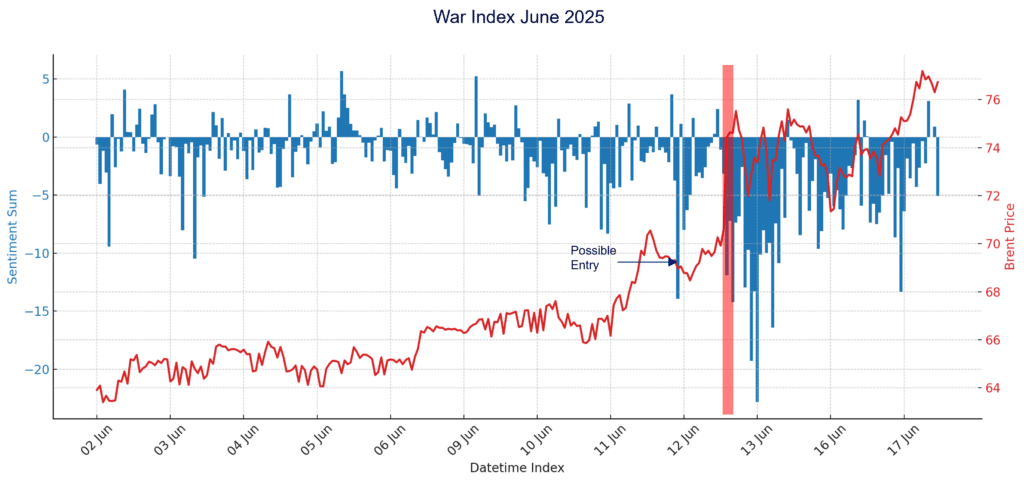
Above: Our War Index tracks real-time geopolitical tension levels through advanced sentiment analysis of global political discourse. The chart reveals a dramatic escalation in conflict risk during mid-June 2025, with sentiment indicators (blue bars) showing intense negative spikes coinciding with rising Brent crude prices (red line). The “Possible Entry” annotation highlights how our system identified optimal positioning opportunities as geopolitical tensions began building around June 11th, preceding the sharp price rally from $68 to over $76 per barrel. The sustained period of elevated tension (indicated by the red shaded area) demonstrates how our War Index provides early warning signals of geopolitical risk premiums entering energy markets, enabling institutional investors to anticipate and capitalise on volatility before it becomes widely recognised by market participants.

Turning political risk into strategic advantage

At Permutable, we equip our clients with the tools and data to move from reactive to proactive geopolitical risk management. By surfacing early sentiment shifts and identifying geopolitical fault lines in real time, we empower portfolio managers and risk teams to anticipate and respond to volatility before it’s widely recognised by the market. Institutions relying on legacy methods face mounting disadvantages — from increased transaction costs to eroded alpha — while those using Permutable’s platform gain a structural edge in positioning and timing.

Speak to our team to explore how Permutable’s geopolitical intelligence can help you stay ahead of market consensus and protect alpha. Discover how real-time signals can be seamlessly integrated into your investment strategy. Email our team at enquiries@permutable.ai to request a demo.

Founder insight: Event trading in an age of uncertainty and the strategic value of real-time intelligence

The current market climate is increasingly being shaped by event trading and in this high-stakes environment where volatility is driven by rapidly evolving geopolitical and macroeconomic events, traders and portfolio managers face mounting pressure to act fast and act smart.

Over the past six months, we’ve seen a surge in geopolitical tensions, international policy shifts, and economic uncertainty. These events don’t unfold gradually- they explode into the market, often overnight. For traders, reacting to such moves has become less about prediction and more about precision. That’s where event trading is gaining renewed importance.

Navigating a multi-layered market environment

The forces shaping the market today are highly complex and interconnected. In recent months, shifting diplomatic alliances, global supply chain disruptions, and election-related uncertainty have all played significant roles in influencing asset prices. This evolving landscape makes it increasingly difficult to determine where the market is heading next.

For many portfolio managers, it’s no longer enough to rely on standard economic indicators. The real edge now lies in understanding how event trading can be supported by fast, intelligent systems capable of recognising signals as they emerge and acting accordingly.

Why traditional methods are falling short

Many institutions still rely on slow-moving analytical frameworks and manual research processes. But as the pace of change accelerates, these methods leave managers vulnerable to being caught off guard by sudden announcements or unexpected reversals.

We’ve seen this play out time and again: a central bank makes an unscheduled policy statement; a new conflict emerges overnight; or an election result shakes currency markets. In all these scenarios, event trading strategies are only effective if they’re powered by real-time intelligence.

At Permutable, our platform is designed to help traders respond in the moment. We use advanced natural language processing and machine learning to detect thematic shifts across global media and official communications — and to deliver actionable insights that align with event-driven market moves.

The value of real-time, machine-led decision support

One of the key challenges in event trading is separating signal from noise. Markets are constantly bombarded with information, but not all of it has real impact. That’s where our machine-led systems provide tremendous value — by contextualising developments in newsflow and quantifying their likely market implications.

Rather than trying to forecast long-term outcomes, our technology is built to respond to broad shift changes in real time. Whether it’s a policy pivot, geopolitical escalation, or new economic data point, our AI-driven models help traders understand what’s happening now — and what it might mean for their portfolios.

Adapting to constantly shifting market themes

What’s driving the market today may not be what drives it tomorrow. Over the past six months, the dominant theme has been international conflict. In another six months, it might be renewed fears of a global recession, regulatory tightening, or environmental policy shocks.

For event trading to remain effective, it must adapt to these thematic shifts. Our systems are designed to evolve alongside the market, continuously scanning and interpreting a wide range of signals across news headlines, official data and diplomatic communications. This agility is crucial for traders looking to capitalise on market-moving events, not after they happen, but as they unfold.

Building resilience through intelligent systems

For institutions, the shift toward event trading strategies signals a broader evolution in how portfolios are managed. It’s not about replacing human decision-making, but about enhancing it with systems that can monitor, analyse, and alert at machine speed.

With the right infrastructure, traders can move from reactive to proactive – positioning well ahead of key developments as sentiment indicators start changing and well before the market reacts. That’s a fundamental advantage in today’s volatile landscape.

Event trading in commodities and macro use cases

Event trading strategies take on heightened relevance in commodities and macro markets, where real-time shifts in supply, policy, and sentiment can rapidly reshape the trading landscape. These markets offer some of the most compelling opportunities for real-time intelligence to generate meaningful advantage.

In commodities, market moves often stem from tangible disruptions – weather events, port strikes, or geopolitical flashpoints. Our platform has been especially effective at detecting early signals across global supply chains, identifying developments such as pipeline delays or agricultural disruptions before they fully register in pricing. By parsing real-time data across news headlines, we help traders anticipate volatility in crude oil, natural gas, and agricultural futures with greater precision.

Macro traders face a different challenge: navigating a fluid policy environment marked by shifting central bank guidance, election cycles, and economic sentiment. Here, our system excels at contextualising announcements – distinguishing between a passing remark and a signal of genuine policy change. Whether it’s central bank commentary, polling data, or a surprise fiscal measure, we provide timely, contextual insight across currencies, bonds, and soon too equities.

The most successful event-driven strategies blend macro and commodities intelligence, recognising that today’s geopolitical developments often straddle asset classes. Our integrated approach supports traders in spotting cross-asset correlations, identifying regime shifts, and reacting to market stress in real time. Ultimately, it’s this ability to synthesise diverse data streams that allows the institutions we work with to build more resilient, responsive trading strategies.


Final thoughts

In a world where news breaks in minutes and markets react just as fast, event trading is no longer a niche tactic — it’s a necessity. But to truly succeed, traders need intelligent systems that offer clarity, speed, and actionable insights when it matters most. At Permutable, we’re proud to support some of the world’ best energy trading desks with the real-time intelligence they need to navigate complex, high-stakes environments. Ultimately, in markets like these, staying ahead isn’t just about what you know — it’s about how far ahead you know it.

Coffee futures: Market oversupply fuels strategic bearish opportunity

In this article, we explore the structural oversupply reshaping global coffee markets, the resulting downward pressure on coffee futures, and how AI-driven tools like our Trading Co-Pilot identified a high-conviction short opportunity ahead of the market.

Global coffee markets are entering a structural oversupply phase as production ramps up in Brazil and Vietnam, driving sustained downward price pressure on coffee futures. Our Trading Co-Pilot identified this fundamental shift early, flagging a high-conviction short position that yielded a 16.12% return as prices declined from $342.65 on 16 June to $287.40 on 2 July. 

The rapid repricing reflects fading risk premiums. In June, early gains in coffee futures were driven by appreciation of the Brazilian real and heightened weather concerns. These headwinds quickly reversed as Brazil’s frost dissipated and rainfall improved harvest expectations, reducing uncertainty and eroding risk premiums that had provided technical support. 

Recent data underpins this bearish outlook, forecasting record global coffee production of 178.68mn bags, up 2.5% (y-o-y), with ending stocks rising 4.9% to 22.8mn bags, reaffirming a mounting supply glut. This reshaping of market dynamics has challenged price support mechanisms, confirming a clear case of coffee oversupply.

Coffee futures short
Our Trading Co-Pilot identified a fundamental shift in coffee futures, flagging a high-conviction short as prices dropped from $342.65 on 16 June to $287.40 by 2 July.

Fundamental oversupply driving price recalibration

June’s price correction signals a transition from weather-driven volatility to a market dominated by abundant supply. Arabica and Robusta coffee futures have dropped to multi-month lows, with Arabica September contracts at over six-month troughs and Robusta hitting a 13-month low. These lower contract prices reflect a widening coffee oversupply. 

Brazil’s production shift and substitution effect

Brazilian coffee production is forecast to rise slightly to 65mn bags in 2025/26, with a notable shift towards Robusta coffee, expected to surge 15% (y-o-y) to 24.1mn bags. Farmers have pivoted towards the more durable Robusta variety, signalling strategic adaptation to climatic headwinds and shifting market demand. 

Meanwhile, Arabica coffee production is forecast to decline by 6.4% to 40.9mn bags, affected by recent heavy rainfall weighing on harvest and crop yields. However, improved irrigation and modern agricultural practices have mitigated weather risks, reduced risk premiums, and smoothed out seasonal volatility in coffee farming. Brazil’s harvest now appears to be progressing steadily, running modestly below last year’s pace but aligned with five-year averages, despite ongoing climatic exposure.

Southeast Asia export growth accelerates supply pressure

Vietnam, the world’s largest Robusta coffee exporter, reached its full-year 2025 export target of $5.5bn by June, despite falling global prices. Vietnamese coffee output is forecast to climb 6.9% this year, marking a four-year high of 31mn bags. This strong performance offsets last year’s meagre crop yield, which was due to prolonged drought. Meanwhile, Indonesia’s coffee exports surged 9.7%, further intensifying the global coffee oversupply.

Inventory pile up confirms supply glut

ICE Arabica inventories have climbed to near a five-month high, while Robusta inventories remain pressured, reflecting a complex and evolving supply-demand balance. USDA projections indicate global coffee ending stocks in 2025 to rise by 4.9%, reinforcing the market narrative of coffee oversupply.

Our Trading Co-Pilot’s captures short position 

Our Trading Co-Pilot captured this market shift in real-time, with sentiment turning decisively  bearish forming a high-probability opportunity for shorting coffee futures. This opportunity was driven not by fleeting weather factors but by a deepening structural oversupply. Our Trading Co-Pilot’s precise “sell” signal on 16 June at $342.65 marked a decisive turning point. The subsequent price descent to $287.40 by 2 July validated the short strategy, delivering a 16.12% return.

June’s sustained price decline was fundamentally anchored, with converging bearish signals such as surging Brazilian Robusta output (forecast +15%), accelerated exports from Vietnam and Indonesia, and climbing global inventories (Arabica at five-month highs and USDA projections of elevated ending stocks). As the mounting factors of oversupply pile up, our Trading Co-Pilot detected limited upside risk and a high probability of continued downside pressure offering support to the bearish call.

Crucially, dissipating frost-risk premiums in Brazil’s key growing areas removed a significant tail-risk. With no new demand catalysts, momentum had turned. Our Trading Co-Pilot recognised this inflection point as a regime shift, detecting a market pivot from weather-related volatility to a supply-glut. Identifying and acting on these sentiment transitions proved the decisive edge.

Broader market implications and structural evolution

The coffee market is clearly changing in fundamental ways. Production is becoming more flexible, thanks to new technologies, climate adaptation strategies, and better logistics. This is helping to absorb price swings and reduce the build-up of risk premiums. Brazil’s move towards cultivating more Robusta coffee is a smart response to changes in both the environment and market demand. Likewise, Vietnam’s steady export figures show just how well oiled their supply chains have become.

Even though coffee markets expect to see slightly less Arabica coffee this year, the significant growth in Robusta production and high global stockpiles continue to push coffee futures prices down. This illustrates the complexity of the coffee market, where an abundance of one coffee type can offset less of another.  Looking ahead these are key market considerations for coffee futures prices:

  • Technological advances continue to ease traditional supply constraints.
  • Climate adaptation strategies enhance production resilience.
  • Improved export infrastructure accelerates supply responsiveness.
  • Demand growth in the premium coffee market.

Unlock competitive edge with our AI-driven agricultural market insights

The June market correction demonstrates our Trading Co-Pilot’s timely, actionable insight perfectly. The precise sell signal identified structural oversupply early, spotting and acting on subtle shifts in market mood, stock levels, and wider trade movements. 

This highlights the utility value of our AI-powered analysis of agricultural commodity markets. As the market moves away from short bursts of volatility towards underlying trends, being able to identify early shifts in sentiment and regimes gives our clients the edge. By combining real-time data, predictive modelling, and sector intelligence, our Trading Co-Pilot empowers our clients to stay ahead of volatility, identify high-conviction opportunities, and respond to evolving market conditions with precision.

Not using our commodity sentiment intelligence yet? Request a personalised demo by contacting us at enquiries@permutable.ai to discover how our Trading Co-Pilot intelligence suite can enhance your institutional trading strategy.

Jack Watson is Permutable AI’s in-house analyst, leveraging our AI-driven insights to decode market trends, uncover global data signals, and explore how intelligent analytics are reshaping trading and investment strategies.