This is a comprehensive guide for institutional investors, quants, and macro strategists on applying news sentiment to trading, risk management, and regime detection, with examples taken from Permutable AI’s market sentiment data.
We’re often asked how to apply our market sentiment insights in practice, how to turn the behavioural layer of markets into measurable, actionable intelligence. This guide brings together our best practices, use cases, and live results to show how news sentiment in trading can be harnessed across asset classes.
Markets move on perception before they move on data. Whether it is fear, optimism, or conviction, each leaves a measurable trace. The challenge has been turning those traces into something institutions can trust and use. That is where market sentiment adds edge: it quantifies the market narrative and converts it into a tradable, target-aware signal that leads the data and sharpens price discovery.
Our market sentiment intelligence does precisely that. We capture global financial, geopolitical, and policy news in real time, measure tone across millions of headlines, and translate the flow into structured, time-stamped data. The outcome is a continuous read of market perception, supported by more than ten years of history, providing a behavioural pulse that complements fundamentals and price action. Every observation is version controlled, time stamped, and traceable to source for full transparency and auditability.
Delivered via our Trading Co-Pilot and alert system, or directly through an API, our signals give economists, portfolio managers, and quants a faster view of shifting narratives and a practical way to turn that insight into strategy. In a world where policy rhetoric, supply shocks, and geopolitical risk shape expectations ahead of official releases, market sentiment supplies the missing layer of context. It shows not only what has happened, but what the market believes is happening, and belief often moves first.
The two charts below illustrate how this works in practice across both an asset and macro level. At the asset level, gold’s monetary-policy sentiment series captures how shifts in central-bank communication, liquidity expectations and policy risk premia accumulate into market positioning long before those dynamics are visible in price alone. At the macro level, Japan’s inflation sentiment provides a high-frequency reading of narrative pressure around prices and wages, often anticipating inflection points in core CPI.
Taken together, they show how sentiment functions as a real-time gauge of market interpretation, revealing investors are processing news flow, giving clients an earlier and more nuanced read on evolving regimes.


At Permutable, we don’t just provide market sentiment intelligence, we trade on it ourselves. For the past twelve months, we’ve run a fully audited systematic commodity strategy driven entirely by our sentiment signals. This wasn’t a backtest or simulation. It was real capital, real markets, and real risk.
Our systematic strategy runs a balanced long-short structure across six liquid front-month contracts in energy, agriculture, and precious metals, distributing risk evenly across sectors. Every position is driven by sentiment signals.
Because it proves sentiment-driven trading isn’t theoretical. When market narratives shift, whether due to sanctions, weather, or policy changes, our signals capture those shifts early and translate them into disciplined, profitable positions. The track record validates what we offer: intelligence that consistently outperforms the market.

In October 2024, our strategy generated a 13.6% return on Brent and 21.8% on natural gas by capturing narrative shifts before they appeared in pricing. When fresh sanctions on Russian producers shifted the risk position from production to logistics, longer routes, compliance costs, vessel uncertainty, our sentiment layers detected trade tensions and shipping disruption in the news flow early, initiating long exposure ahead of the rebound while earlier shorts cushioned drawdowns.
Similarly, when winter demand risk, record US exports, and volatile weather converged to flip natural gas sentiment sharply bullish, the model closed shorts ahead of the rally, held through the surge, then trimmed as momentum faded, preserving profits through disciplined regime adaptation. This is market sentiment in action, identifying not just what is moving, but why, and positioning accordingly before the rest of the market has a chance to catch up.
Traditional economics measures outcomes. Market sentiment measures perception. Each headline carries a measurable tone, expressed as a score between +1 and -1. We apply news sentiment analysis across more than 50 traded assets spanning energy, metals, agriculture, FX, crypto and equities. Each headline is scored and fed into 2,580 asset-level indices, refreshed with upwards of 500,000 new stories each day.
This turns the market narrative into structured, high-frequency signals that behave like traditional market indicators yet respond immediately to changes in news flow. In the Brent chart below, those same signals are decomposed into supply, demand, trade and geopolitical themes to show which narratives are driving prices.

At the macro level we take the same approach, aggregating local-language news from global sources into 2,640 regional macro indices with more than a decade of history across over 30 regions. For each topic we split news sentiment into international and domestic lenses, separating how the story is told on the ground from how it is framed globally.
The chart below compares UK inflation sentiment from these two angles, international headlines and domestic news, against CPI, showing how global and local narratives can diverge or move together before the official data. Applied at scale, these indices behave like familiar economic time series but move at the speed of real-time news, flagging shifts in growth, inflation, labour markets, policy and political risk ahead of releases.

Unlike surveys, which are periodic, lagging and prone to response bias, market sentiment indices update continuously with the flow of information, providing an immediate map of collective perception. Structured into indices, these readings become early indicators of how economies and assets are evolving, and where pressure is building or fading.
The raw signal captures tone, rolling averages smooth short-term noise, z-scores can help place narratives today in historical context, and topic-level breakdowns show where attention is clustering, whether around inflation, labour markets, political tension, energy supply or policy risk, across both assets and macro.
Market sentiment does not replace traditional data, it refines it. It turns narrative into measurable evidence and connects perception with reality.
For systematic investors and quantitative teams, market sentiment is a live signal rather than a concept. Each score is a numerical input, time-stamped, replicable, and ready for testing, converting unstructured information into tradable behavioural factors.
Tuned market sentiment windows identify when optimism or pressure is building and how persistent that move is. Within systematic strategies, market sentiment plays three clear roles:

This chart tracks Permutable’s US macro sentiment indices, normalised and smoothed over 30 days so you can see the underlying regimes across growth, housing, manufacturing, policy and politics without getting lost in day-to-day noise.
Looking at the themes side by side lets a systematic user spot persistent patterns and turning points, then test them properly: which narratives tend to move first, which ones line up with future returns, spreads or macro surprises, and which are mostly noise. From there you can group themes into cleaner factors, build “policy pressure” or “growth risk” baskets, and drop weaker signals, giving you a more stable feature set and a better chance of keeping performance out of sample.
This framework extends naturally across energy, metals, and agriculture. By embedding market sentiment feeds into systematic workflows, traders capture not only what has moved but why, improving conviction, responsiveness, and drawdown control.
Our own trading strategy demonstrates this in practice: a 2.85 Sharpe ratio over twelve months shows what’s possible when sentiment signals are integrated systematically.
Markets are narratives in motion. Quantifying them requires objectivity, scale, and continuous monitoring.
Our framework translates headlines and policy commentary into structured evidence of how investors interpret change. When positive or negative market sentiment dominates coverage, liquidity adjusts and risk premia shifts. As news sentiment builds in one direction, positioning often changes before fundamentals do. These behavioural transitions, visible in tone, emphasis, and persistence, underpin market sentiment’s reflexive power.
Tracking how narratives cluster and evolve allows our indices to surface early signals of where attention, confidence, and stress are shifting, the same forces that drive asset repricing.
Track evolving narratives around supply, demand, regulation, and weather. Shifts in policy or disruption tone appear first in market sentiment data, often preceding volatility or curve steepening across oil, gas, metals, and agriculture. Our October Brent performance, capturing the sanctions-to-logistics narrative shift, illustrates this edge in practice.
Use market sentiment as a high-frequency complement to conventional indicators. Changes in tone around growth, inflation, and policy frequently precede data releases or surveys, sharpening scenario analysis and turning-point detection.
Treat market sentiment as a behavioural factor that can be tested directly within trend, carry, or volatility models, enriching alpha generation and regime classification. Our live 2.85 Sharpe demonstrates this isn’t theory, it’s repeatable performance.
Monitor divergences in growth, policy and news sentiment between economies. When tone splits meaningfully across regions, it can highlight curve misalignments or FX asymmetries before markets adjust.
Identify where stress is building and where complacency persists. Real-time news sentiment provides early signals of overheating or uncertainty, adding a behavioural lens to leverage, liquidity, and hedge calibration.

Our Trading Co-Pilot turns sentiment data into clear visual intelligence on market conditions. It highlights the headlines shaping each sentiment regime, maps bullish or bearish shifts across categories like supply, demand, and policy, and aligns these directly with asset-price behaviour.
From the bullish rotation in Brent to volatility spikes in metals or FX turbulence ahead of policy meetings, each chart combines sentiment and price action to provide an immediate, explainable view of the forces driving regime change.
For quant, systematic, and data-sourcing teams, the API delivers the same intelligence at scale: structured, transparent, and ready to integrate into dashboards, quantitative models, or automated trading systems.
The edge now lies not in spotting the fundamentals first, but in understanding how the market already feels about them, and news sentiment makes that visible.
At Permutable AI, we convert global news and policy narratives into real-time, explainable signals that strengthen timing, conviction, and risk control across asset classes. For economists, portfolio managers, and quants, our Trading Co-Pilot and API provide a structured bridge between perception and performance. Market sentiment becomes a live input to strategy, continuously testing house views against the information set and signalling where narratives are shifting before prices move.
Here, it is important to note that news sentiment does not replace expertise, it amplifies it. It gives investment teams a systematic read on market psychology, transforming perception into foresight and narrative into alpha.
We don’t just sell these signals. We trade them ourselves. And over the past twelve months, we’ve demonstrated they work: 20.6% returns, 2.85 Sharpe, and 4.4% maximum drawdown in live markets.
Reach out to our team at enquiries@permutable.ai to see how our real-time news sentiment intelligence can enhance your decision-making across markets, assets and strategies.
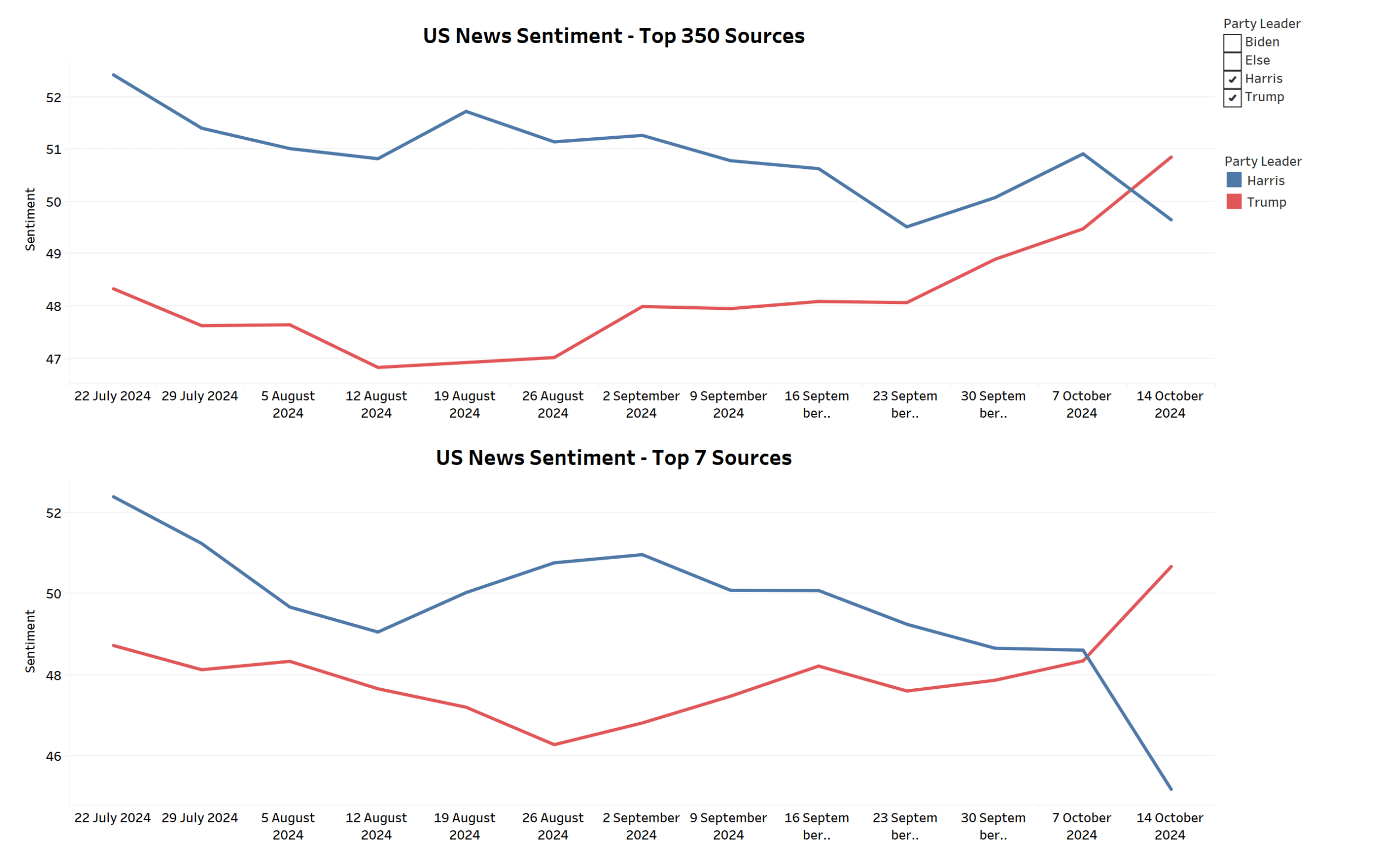
With only just over two weeks left to the U.S. election, in this follow up analysis to our previous Trump vs Harris news sentiment analysis, we look at how news sentiment seems to be shifting between the two candidates. These findings may – or perhaps may not – come as a surprise to many political pundits and election watchers, with Kamala Harris seeming to maintain a consistent lead over Donald Trump in terms of positive sentiment across major news sources.
On the week of October 7th, something changed. Our AI-driven sentiment analysis detected a notable shift that could potentially alter the course of the election. It is perhaps due to a combination of factors, but the data is clear: Trump’s sentiment surpassed Harris’s for the first time since the impact of the assassination attempt and within the analysed period.
Some may voice concerns that AI-driven analysis might be biased or unreliable in political forecasting. So how do we address this? Fundamentally, our technology doesn’t just count positive or negative words. Instead, it understands context, nuance, and the complex interplay of factors that influence perception.
Sketching out the details, here’s what our analysis revealed:
The idea of this analysis is to provide unbiased, data-driven insights that can help understand the shifting political landscape. Today, it seems that landscape is more volatile than many expected. In recent weeks, we’ve all seen a flurry of activity from both campaigns. Supporters of Harris might argue that this is just a temporary blip, a reaction to recent events that will soon correct itself. And, optimists believe that the Harris campaign has time to regain lost ground. We will have to wait and see if this argument holds water or as others have put forward, whether the Harris campaign has reached its ceiling.
But, now to mention the obvious. This shift in sentiment doesn’t necessarily translate directly to votes. That’s because, without actual ballot results, we’re still in the realm of prediction and analysis. Of course, there will always be exceptions to the rule, and political campaigns are notoriously unpredictable. As so often is the case, they cannot have their cake and eat it too – just like election polls can get it wrong, positive news sentiment doesn’t guarantee electoral victory, but it may be an indicator of things to come.
Now on the subject of momentum, it seems that Trump’s campaign has found its stride at a crucial moment having – some would say – earlier lost steam post assassination attempt. Never one to mince his words, Trump has been capitalising on this shift in public perception. Cynicism is based on the idea that this is just another example of Trump’s ability to dominate news cycles. After a golden period for Harris, the tables appear to have turned.
Another interesting finding from our analysis is that the volume of election coverage reached its lowest point during this period of significant sentiment change. This time, they are making every headline count. Some say that this is a deliberate strategy to focus media attention when it matters most as some say U.S. election fatigue has well and truly set in.
In all of this, it would seem, that the Harris campaign faces an uphill battle in the final weeks before the election. But how much should we read into this? Well, only time – and votes – will tell. Meanwhile, according to the latest data, early voting has already begun in many states, potentially amplifying the impact of this sentiment shift.
As ever, whilst our AI-analysis is perhaps a peek into the mood around the U.S. election sentiment, we must be cautious about drawing too firm conclusions. Whilst our analysis provides a unique window into the evolving narrative of this election, an obvious point to make is that perhaps this shouldn’t be attributed to any single event or statement, but rather a culmination of factors that our AI is uniquely positioned to detect.
Another point to note is that it is not just the overall sentiment that’s changing, but the nuances of how each candidate is perceived on key issues. We all know that Trump is known for his ability to rally his base and dominate media narratives. And the last thing the Harris campaign needs it a last-minute surge to overshadow the real issues at stake in this election – although the possibility is a very real one.
Our news sentiment analysis shows that the issues driving this sentiment shift are complex and multifaceted. But, many expect that the final weeks of the campaign will see even more dramatic swings in public opinion. Building news sentiment for the Harris ticket will take more than just a few good news cycles for the Harris campaign. However, that does not mean the election is decided – far from it. With two weeks to go in the final sprint, there’s still room for manoeuvre.
At Permutable AI, we’re committed to providing unbiased, data-driven insights. Our approach combines cutting-edge AI technology with a deep understanding of both financial markets and political landscapes. By applying the same rigorous methodologies we use in financial analysis to political sentiment, we offer a unique perspective on how public opinion evolves.
Our approach combines cutting-edge AI technology with deep understanding of both financial markets and political landscapes. We’re excited to announce that our geopolitical data insights like those featured above are being integrated into our powerful Trading Co-Pilot. Register your interest now by emailing enquiries@permutable.ai or fill in the form below.
The question – how is the US economy viewed? – is a particularly interesting one in present times. Global news reports about the U.S. economy and its expected trajectory have been somewhat conflicting of late. On one hand, analysts have been mulling over the possibility that the U.S. economy may be heading for a recession. But then those speculations are also sitting cheek-by-jowl next to the U.S. economy heading for healthy growth, albeit with some challenges to navigate along the way.
But what does the world really think? We used our AI-driven news sentiment analysis to provide a fascinating overview of sentiment in relation to US economic indicators, and it puts forward a rather interesting answer to the question “How is the US economy viewed”, especially in the run up to the upcoming U.S. election.
When you take a step back, our data shows a complex and often polarised view of how the US economy is doing according to perceptions from around the world. From regions like Oceania and the Middle East to Europe and Asia, there are varying degrees of sentiment, and each tells its own story. The context for this is shaped by geopolitics, trade relations, foreign policy, and, of course, economic outlooks. But there’s a broader point of view here—this isn’t just about economics, but rather how nations position themselves in relation to the world’s leading economy.
Let’s start with the good news. Thankfully for the US, in Oceania, the sentiment towards their economy is generally positive. Australia (+43%) and New Zealand (+47%) show a level of confidence in how the US economy is doing. The answer seems obvious – these nations maintain strong trade and defence ties with the US, which naturally bolsters their economic optimism. But there’s a broader point of view here: Oceania countries often see the US as a key ally, not only in terms of trade but also security.
Now for the bad news. Here, the Middle East tells a deeply different story. Our data shows lukewarm sentiment from UAE at only +1%, then starkly negative sentiment from Israel (-92%) and Qatar (-84%) highlighting how regional geopolitics can turn perception on its head. And this, we fear, is a reflection of recent US foreign policy decisions that have left a bruising sentiment in certain Middle Eastern countries.
To be clear, Asia is not homogenous in its view of how the US economy is doing. Much is left to be desired in terms of sentiment from India (-2%), Indonesia (0%), and Vietnam (+3%) meanwhile Thailand (+11%), Singapore (+16%) Pakistan (+19%), Malaysia (+24%) are somewhat more positive. All these countries have complex relationships with the US, balancing between cooperation and competition with China. But what about the Philippines? Here, we see a notably high positive sentiment (+68%) which in all likelihood reflects the strength of ongoing US-Philippines economic and military cooperation, with the US viewed as a reliable partner.
Amid the furor surrounding US relations with other parts of the world, Africa has an overall positive view of the US economy. Nigeria (+63%) and Zimbabwe (+65%) display significant confidence in how the US economy is doing according to our data. Fact check: Africa’s growing trade with the US and the potential for investment and aid play a key role here. But you can glimpse another factor—many African nations view the US as a key player in global development, which adds a layer of goodwill to the economic perception.
And then we have Europe, where the sentiment towards how the US economy is rather tepid. Germany (+30%) exhibits perhaps the strongest confidence in the US economy according to our data, while the UK (+7%) is still positive yet cautious likely influenced by Brexit’s ongoing economic uncertainties and trade negotiations with the US. Meanwhile countries like Spain and Portugal (both at 0%), and Italy (just slightly up at 1%) only just keep within the neutral range. We should perhaps say that Europe’s diverse sentiment towards the US is as much about politics as it is about economics. In retrospect, Europe’s rather half-hearted sentiment may signal a reluctance to fully commit to the US economically until global economic conditions stabilise.
So, why does this matter? When you examine how the US economy is doing based on economic indicators, you uncover deep layers of geopolitical and economic dynamics. There have been, broadly, three things influencing global sentiment towards the US. First, trade relations – countries with strong trade ties to the US tend to have more positive perceptions. Second, geopolitical alliances – nations aligned with US foreign policy tend to show greater economic optimism. And third, regional economic stability – countries with less reliance on the US or a strong regional bloc, like the EU, may lean towards neutrality or even indifference.
But there is a key message here, and its that signs that all is not perfect in the US economy – such as inflation or foreign policy missteps—can cast long shadows on global perception. And it is, we think, this last point that is most significant. Global perception of the US economy, driven by a combination of hope and caution, will shape future economic ties and cooperation.
The result of our analysis is something of a disparity between countries that see the US as a continued economic leader and those that are taking a wait-and-see approach. And that is why understanding how the US economy is doing matters more than ever. Thankfully, AI-driven news sentiment analysis like this, allows us to monitor and measure these perceptions in real time. This bruising sentiment in some regions is balanced by optimism in others, and it is this interplay that will determine the future of US global economic leadership.
The sentiment analysis was conducted using Permutable’s AI-driven intelligence, which is the product of the analysis of millions of news articles, and other publicly available text-based sources from around the world. The system employs advanced natural language processing and machine learning algorithms to assess the tone, context, and frequency of mentions related to the US economy.
Omissions: Our news sentiment analysis does not include how China and Russia perceives the United States economically due to limited access to unbiased, reliable data sources within China that meet our standards for comprehensive and accurate insights. We also do not currently offer news sentiment analysis on how Latin America perceives the United States, and some Middle Eastern and African countries, due to gaps in comprehensive media coverage, limiting the availability of consistent and reliable data sources from the region.
Want real-time insights into how US economic indicators are impacting financial markets? Our Trading Co-Pilot, now in BETA, offers AI-powered analysis to keep you ahead of market shifts. If you’re a corporate trader looking to trial this cutting-edge tool, get in touch with us today and be one of the first to experience the future of trading with precision and confidence.
Schedule a free enterprise demo to see how our Trading Co-Pilot can help you make smarter trading decisions, faster.
Gold and silver have long been regarded as valuable commodities. Investors, traders, and governments closely monitor their prices. The gold and silver spot prices reflect the current market value of these precious metals, quoted for immediate delivery. A multitude of factors can influence these prices, ranging from macroeconomic indicators to geopolitical events. Understanding these factors is essential for anyone involved in the precious metals market, whether for investment, hedging, or trading. This article explores the key elements that impact gold and silver spot prices.
The principle of supply and demand significantly impacts gold and silver spot prices. When demand for gold and silver rises—perhaps due to increased industrial use or heightened investor interest—prices tend to climb. Conversely, an oversupply can lead to price drops. For instance, the amount of gold and silver mined can fluctuate based on geological discoveries or new regulations, directly affecting the available supply. Additionally, large central banks hold substantial reserves of gold, and their buying or selling activities can cause significant market fluctuations.
The state of the global economy plays a crucial role in determining gold and silver spot prices. During times of economic uncertainty or recession, investors often turn to safe-haven assets like gold and silver, driving their prices higher. This occurs because precious metals are perceived to retain value better than other assets during economic instability. On the other hand, during periods of economic growth, with rising stock markets and strong currencies, the demand for gold and silver may decrease, leading to lower spot prices.
Inflation has a direct influence on gold and silver spot prices. As inflation rises, the purchasing power of money declines, prompting investors to seek assets that preserve their value over time. Gold and silver are traditionally viewed as hedges against inflation, so their prices tend to increase with inflation rates. Similarly, fluctuations in currency values, especially the US dollar, affect spot prices. Since gold and silver are typically priced in dollars, a weaker dollar makes these metals cheaper for investors holding other currencies, boosting demand and pushing up prices.
Interest rates play a pivotal role in shaping gold and silver spot prices. When interest rates are low, the opportunity cost of holding non-yielding assets like gold and silver decreases, making them more attractive to investors. Low interest rates generally lead to higher spot prices for these metals. Conversely, rising interest rates can prompt investors to shift their capital into interest-bearing assets such as bonds, reducing demand for precious metals and causing their prices to fall.
Geopolitical events, such as conflicts, political instability, or trade disputes, often lead to increased demand for safe-haven assets like gold and silver. During such times, gold and silver spot prices tend to rise as investors seek protection from potential losses in other markets. For example, tensions in the Middle East or trade negotiations between major economies can create uncertainty, leading to higher demand for precious metals. This flight to safety reflects a desire to preserve wealth amidst global instability.
Investor and speculator actions significantly influence gold and silver spot prices. Speculative trading, often driven by market sentiment and technical analysis, can lead to short-term price fluctuations. For instance, if traders anticipate a rise in gold prices due to forthcoming economic data, they may purchase gold futures or physical gold, driving up the spot price. Similarly, large sell-offs can occur when investors expect prices to decline, leading to a decrease in spot prices. The behaviour of exchange-traded funds (ETFs) that hold large quantities of gold and silver also impacts the market. When ETFs engage in significant buying or selling, they can cause sharp movements in spot prices.
While gold is primarily used for investment and jewellery, silver has substantial industrial demand, particularly in electronics, solar panels, and medical devices. Changes in industrial demand for silver can, therefore, have a notable impact on gold and silver spot prices. For instance, advancements in green technologies, such as solar energy, have increased demand for silver, supporting higher spot prices. Conversely, a slowdown in industrial production can reduce demand for silver, exerting downward pressure on its price.
Central banks play a crucial role in shaping gold and silver spot prices. Their policies on gold reserves, including buying or selling large quantities of gold, can influence market prices. Additionally, central banks’ monetary policies, such as quantitative easing or tightening, affect the broader economic environment, which in turn influences demand for gold and silver. For example, expansive monetary policies that increase money supply can lead to higher inflation expectations, boosting demand for precious metals as a hedge.
Technological advancements, particularly in mining and refining processes, can affect the supply side of the market, thereby influencing gold and silver spot prices. Improvements in mining technology can increase the efficiency of extraction, potentially increasing the supply of these metals and lowering prices. Conversely, any technological disruptions that hinder production can reduce supply, leading to higher spot prices.
Government actions, such as taxation on mining operations, import/export tariffs, and environmental regulations, can impact the supply and cost of gold and silver. For example, stricter environmental regulations might reduce mining activity, limiting supply and driving up gold and silver spot prices. Similarly, government policies that affect the broader economic environment, such as fiscal stimulus or austerity measures, can also influence demand for these metals.
Gold and silver spot prices are influenced by a complex interplay of factors, including supply and demand dynamics, global economic conditions, inflation, interest rates, geopolitical tensions, and investor behaviour. To navigate the precious metals market effectively, it is essential to understand these factors. Gold and silver serve various purposes, from hedging against inflation to acting as safe-haven investments during uncertain times. These metals will continue to play a vital role in global financial markets, making it crucial to monitor the elements that affect their spot prices in order to succeed in this dynamic market.
In the dynamic world of precious metals, where gold and silver spot prices can shift rapidly in response to global events, economic indicators, and market sentiment, having the right information at the right time is crucial. The value of gold and silver is influenced by a myriad of factors, from geopolitical tensions to changes in inflation rates, and staying ahead of these fluctuations can make a significant difference to your investment outcomes.
At Permutable, we offer a state-of-the-art solution designed to keep you informed and ahead of the curve. Our advanced real-time data intelligence leverages artificial intelligence and natural language processing to provide real-time insights into gold and silver spot prices, driven by comprehensive news sentiment analysis. By continuously monitoring and analysing news as it breaks, we’re able to deliver immediate, actionable intelligence that allows you to navigate the precious metals market with confidence.
By using our market intelligence you can gain a competitive advantage in several ways:
React quickly to market movements: Our real-time sentiment analysis ensures you understand the underlying market sentiment as it develops, enabling you to make informed decisions before the broader market reacts. Whether it’s a sudden geopolitical event or an economic report affecting precious metal prices, Permutable AI keeps you ahead of the game.
Mitigate risk and enhance precision: Investing in gold and silver carries its own set of risks, but with our real-time insights, you can reduce uncertainty. By accurately gauging market sentiment and understanding the factors driving price movements, you can make more precise investment decisions. This strategic approach helps you mitigate risks associated with price volatility and maximise your returns in the precious metals market.
Identify emerging trends: Beyond real-time analysis, our predictive insights that help you anticipate future trends in gold and silver spot prices. By analysing historical data and current news sentiment, we can forecast potential market movements, giving you the foresight to plan and position your investments for long-term success in the precious metals market.
To truly stay ahead in the volatile world of gold and silver trading, you need more than just raw data—you need intelligent insights that provide clarity and direction. Our market intelligence offers exactly that, empowering you to make informed decisions, secure your investments, and capitalise on opportunities with confidence.
Are you ready to be part of the future of trading? At Permutable AI, we’re extending an exclusive opportunity to a select group of corporate partners to gain early access to our advanced Trading Co-Pilot, powered by cutting-edge machine learning for contextual understanding.
This is a rare chance to stay ahead of the competition by leveraging AI that not only processes data but also grasps the global context—analysing real-time sentiment and market-shaping events to deliver more precise and risk-aware trading strategies.
If your firm is ready to lead the way in AI-driven trading innovation, get in touch today to explore this limited opportunity and discover how our Trading Co-Pilot can transform your approach to the market by contacting us at enquiries@permutable.ai or fill in the form below.
Today’s fast financial markets need more than standard analysis to stay competitive. AI in financial services is causing a revolution in how investors, analysts, and companies interpret market shifts. Sentiment analysis stands out as one of the most effective tools in this new age—an AI-driven method to analyze text data from different sources to measure public opinion and forecast market trends. This article looks at how sentiment analysis is changing daily market predictions giving investors a big advantage as they navigate the complex world of global finance.
Sentiment analysis also known as opinion mining, uses natural language processing (NLP), text analysis, and computational linguistics to find and extract subjective information from text. In financial markets, sentiment analysis looks at news articles social media posts, analyst reports, and other relevant texts to figure out the sentiment or emotional tone—positive, negative, or neutral—toward a specific stock, sector, or market.
This tech lets investors tap into the market’s overall mood giving them a deeper understanding of how different factors might shape market behaviour. By examining huge amounts of unstructured data in real-time, sentiment analysis can provide insights that traditional financial models often miss.
Daily market movements have many influences such as economic data, corporate earnings, geopolitical events, and investor sentiment. In the past, investors used fundamental and technical analysis to predict these movements. Now, sentiment analysis brings a new angle by capturing the market’s mood, which can signal where the market might go.
Take this example: sentiment analysis spots a jump in negative feelings about a company because of bad news. This could predict a fall in the company’s stock price even before the whole market reacts. On the flip side positive sentiment detected in news stories might point to a possible rise in a stock or sector.
A major benefit of sentiment analysis is its speed in processing data outpacing human capabilities. Markets shift in response to news, and the ability to grasp the mood behind this information can give investors a crucial edge. This matters a lot in today’s market environment where there’s a ton of information and often little time to act on it.
A few noteworthy examples show how sentiment analysis helps predict markets daily:
Traditional risk and trading systems were built for a world where prices reflected information gradually. That world no longer exists. Today, markets react to headlines, policy shifts and geopolitical developments within minutes, often before analysts or risk models have time to respond. By the time volatility rises or correlations break down, the opportunity to act early has already passed.
For market risk teams, this creates a persistent blind spot. VaR, stress testing and scenario models are inherently backward-looking, built on historical relationships that assume the future will resemble the past. But the most material risks facing portfolios today – energy supply shocks, elections, central bank rhetoric, sanctions, regulatory action and corporate events – originate outside the market itself. They start as information, narratives and signals in the real world before they ever show up in prices.
This is why forward-looking intelligence has become essential. Institutions increasingly require a continuous view of what is forming globally, not just what has already happened. External intelligence bridges that gap, transforming the world’s information flow into early warnings that risk and trading teams can act on with confidence.


Many sentiment providers stop at visual dashboards or generic scores. While useful for exploration, these tools rarely fit naturally into institutional workflows. Risk and trading teams do not need another screen to monitor; they need signals that integrate directly into the systems they already use.
At Permutable AI our sentiment intelligence is designed as infrastructure rather than software. Our intelligence is delivered as structured, machine-readable data that can feed directly into risk engines, internal models and trading systems. Instead of manually interpreting headlines, teams receive quantifiable indicators that can be incorporated into VaR overlays, stress scenarios, exposure monitoring and systematic strategies.
This shift from qualitative insight to model-ready data is critical. It means intelligence becomes operational, not observational. Signals are no longer something you look at – they are something your systems can act on automatically or flag in real time. For institutions operating at scale, this difference determines whether information is interesting or truly actionable.
At Permutable, we’re a leading provider bringing sentiment analysis to daily market forecasts. Our platform uses cutting-edge AI and machine learning systems to examine huge amounts of text data as it comes in giving investors and companies useful insights they can act on. As intelligence can be tailored to your needs letting you zero in on specific sectors, companies, or regions. This personalized approach makes sure the insights you get are spot-on for what you’re after boosting the power of your investment game plan.
On top of real-time sentiment tracking, we provide a look at how sentiment has changed over time. This helps you spot patterns and see how sentiment and market shifts line up. This big-picture view makes our data intelligence a must-have to keep you one step ahead in the always-changing world of finance.
As AI tech keeps getting better, sentiment analysis will play a bigger part in daily markets. With more data popping up every day, the need to and accurately make sense of this info will become even more crucial.
Looking ahead, we can expect sentiment analysis tools to get smarter grasping more complex language and context. This will lead to even more accurate predictions narrowing the gap between what people feel about the market and how it moves.
Also, as sentiment analysis becomes a bigger part of trading algorithms and financial models, it might have a larger impact on automated trading strategies. These changes could make markets more efficient, as predictions based on sentiment help smooth out some of the irrational behaviour that can happen when investors react to news.
Sentiment analysis is causing a revolution in how investors approach the daily market and related predictions. This AI-driven technology gives real-time insights into market sentiment offering a powerful tool to navigate the complexities of global finance. As the daily market becomes more data-driven, those who use sentiment analysis will be better prepared to anticipate and respond to market movements.
At Permutable AI, we want to help our clients get ahead. Our cutting-edge sentiment analysis gives you the insights you need to make smart choices in today’s fast-moving daily market. If you’re an institutional investor, a financial analyst, or a business leader, we can help you use AI to boost your investment strategies.
In today’s turbulent global economy, the labour market is more dynamic and complex than ever before. With economic conditions, technological advancements, and political climates constantly shifting, understanding labour market trends is crucial for businesses, policymakers, and investors.
Our AI-driven news sentiment analysis offers unique insights into labour market intelligence, capturing how the labour market in one country is perceived across borders. By analysing vast amounts of global news data, our technology provides a comprehensive view of labour market sentiment, helping stakeholders navigate the challenges and opportunities in different regions.
Labour market sentiment refers to the general outlook or attitude of businesses, workers, and policymakers towards the current and future state of employment, wages, and working conditions. Traditional methods of gauging this sentiment have relied on surveys, economic indicators, and expert analysis. However, these methods often struggle to keep pace with the rapid changes in today’s labour market.
At Permutable, we’re addressing this gap by using advanced natural language processing (NLP) and machine learning algorithms to analyse global news sources in real-time. By scanning thousands of articles, reports, and other publicly available information, we can identify and quantify sentiment related to labour markets in different countries. This approach allows for a more immediate and nuanced understanding of how labour markets are evolving and how they are perceived globally.
One of the unique strengths of our data intelligence is its ability to capture how labour market conditions in one country are perceived by stakeholders in other countries. This cross-border sentiment analysis is crucial in a globalised economy, where labour markets are increasingly interconnected. For example, changes in labour laws or employment rates in one country can have significant implications for international trade, investment, and migration patterns.
Our analysis can reveal how news about labour market developments in one country is reported and interpreted in another. For instance, if there are reports of rising unemployment in a major economy like the United States, we can track how this news influences sentiment in other countries, such as whether it leads to concerns about reduced demand for exports or increased competition for jobs among immigrants.
This capability is particularly valuable for multinational companies and investors who need to understand not only the labour market conditions in the countries where they operate but also how those conditions are perceived in other key markets. By providing insights into cross-border sentiment, Permutable AI helps these stakeholders make more informed decisions about where to allocate resources, how to manage risks, and how to capitalise on emerging opportunities.
Our news sentiment analysis also highlights regional differences in labour market sentiment. For example, labour market sentiment in Europe may be shaped by factors such as the European Union’s labour regulations, demographic trends, and economic conditions in member states. In contrast, labour market sentiment in Asia might be influenced by rapid industrialisation, shifts in manufacturing hubs, and government policies aimed at boosting employment.
By analysing news from different regions, we can identify these regional nuances and provide a more granular view of labour market conditions. This information is invaluable for businesses that operate in multiple regions and need to tailor their strategies to local labour market dynamics. For example, a company looking to expand its operations in Asia might use our insights to identify countries with a favourable labour market sentiment, such as those with low unemployment rates and strong economic growth.
In addition to capturing current sentiment, our technology can also be used to predict future labour market trends. By analysing patterns in news sentiment over time, we can identify early warning signs of potential shifts in the labour market. For example, if news sentiment around labour strikes or wage demands is increasing, it may indicate growing labour unrest that could lead to disruptions in the near future.
Similarly, a sustained increase in positive sentiment around job creation or economic growth could signal a strengthening labour market, which might attract more investment and lead to higher wages. By providing these predictive insights, we can enable businesses and policymakers to anticipate changes in the labour market and adjust their strategies accordingly.
Labour market policies are often shaped by a combination of economic data and public sentiment. By providing real-time insights into how labour market conditions are perceived both domestically and internationally, our insights can help policymakers craft more informed and effective policies.
For instance, if there is widespread negative sentiment about labour market conditions in a particular sector, policymakers might prioritise interventions in that area, such as offering retraining programmes or providing incentives for businesses to create jobs. Conversely, positive sentiment around a booming industry could lead to policies that support further growth, such as tax breaks or infrastructure investments.
Similarly, our insights can also help policymakers understand how their labour market policies are being received in other countries. This is particularly important in the context of international trade negotiations or when attracting foreign investment, as positive sentiment about a country’s labour market can enhance its appeal as a business destination.
Our news sentiment analysis shows how the US is viewed on employment opportunities by audiences in Asia and the Middle East. Using our country bias matrix as part of our geopolitical intelligence we can share the following insights:
The sentiment varies across different regions in Asia and Middle East. These are influenced by economic ties, political relationships and recent global events.
Positive in Asia: Generally Asian countries have a more positive view of US employment opportunities. This is due to strong economic ties with countries like India, Japan and South Korea where US companies have a big presence. The tech sector plays a big role in shaping the positive image with many Asian professionals looking to work in Silicon Valley and other major US tech hubs.
Mixed in the Middle East: The Middle East has a mixed sentiment reflecting the complex geopolitics in the region. Countries with stronger economic and military ties with the US like Saudi and UAE have a more positive view of US employment opportunities. Countries with strained relations or economic challenges have a more skeptical or negative view.
Economic ties: Countries with strong trade ties with the US tend to have a more positive view of US employment. For example, Southeast Asian countries that rely heavily on trade with the US will view US employment positively as a path to economic growth and professional development.
Political alliances and conflicts: Political relationships also play a big role. In regions where the US has been involved in diplomatic conflicts or where US foreign policy is perceived negatively the sentiment towards US employment is less positive. This is evident in parts of the Middle East where US involvement in regional conflicts has created lasting resentment.
Cultural affinity: In Asia there is a cultural aspiration to work in the US especially in countries that value education and career advancement. This cultural perception drives the positive sentiment as working in the US is seen as a prestigious opportunity that can lead to better socioeconomic status.
Mobility and visa policies: The US visa policies and immigration laws also play a big role in shaping the sentiment. Restrictive policies can dampen the positive view especially in regions where there is high demand for skilled labour migration to the US. Conversely policies that make it easier to get into US employment can boost the positive view.
In an increasingly complex global economy, understanding labour market sentiment is more important than ever. Permutable AI’s advanced news sentiment analysis provides a powerful tool for capturing and interpreting these sentiments across borders. By offering real-time insights into how labour markets are perceived in different countries and regions, we’re helping businesses, investors, and policymakers make more informed decisions, anticipate changes, and navigate the challenges and opportunities of the global labour market.
As AI technology continues to evolve, the ability to analyse and understand labour market sentiment will become an even more critical component of labour market intelligence, driving more effective strategies and policies in a rapidly changing world.
Whether you are a business leader, investor, or policymaker, our insights can help you make more informed decisions, anticipate market shifts, and strategically navigate the complex dynamics of the global labour market. Contact us now to request a sample of our data and discover how our geopolitical intelligence can provide you with the competitive edge you need in this turbulent economic environment. Simply send an email to enquiries@permutable.ai or fill in the form below.
US Federal Reserve Chairman Jerome Powell’s announcement about upcoming interest rate cuts signals a key shift in the world’s economic scene. The Fed now aims to boost economic growth by lowering borrowing costs, after years of sharp rate increases to control inflation. This change comes as inflation in the United States seems to be moving towards the central bank’s 2% goal. Yet, this choice affects more than just the US. Countries worldwide are keeping a close eye on these changes and the United States inflation rate.
Jerome Powell’s speech at the Jackson Hole meeting points to a big shift in US monetary policy. The Fed, which had been hiking interest rates fast to fight the worst inflation in years now plans to cut these rates. US inflation hit 9.1% in June 2022 but fell to 2.9% in July 2024, so the central bank thinks it has a handle on price growth and can start to loosen its money stance. Powell also noted “downside risks” to jobs, with unemployment up a bit. This shows the Fed worries about the economy slowing down if tight money rules stay too long.
People expect the Fed to cut rates to keep the US economy from falling into a recession. When the Fed lowers interest rates, it tries to make borrowing cheaper for companies and consumers, which should boost economic activity. This is part of a bigger plan to achieve a “soft landing,” where inflation returns to normal without causing a major economic slump. But when and how fast these cuts happen will be key and will depend on ongoing economic numbers and risks.
The US, as the world’s biggest economy, has a big influence on global financial markets. When it changes its monetary policy, like adjusting interest rates, this has widespread effects. The way different parts of the world see the United States inflation rate, based on our news sentiment analysis data taken from our Country Bias Matrix, part of our Geopolitical Dataset, gives us a good feel of how various regions view the situation.
In Europe, perceptions of US inflation vary significantly. Big economies like Germany and Spain mostly view the United States inflation rate negatively . They worry about how US economic policies might affect their own economies. Take Germany, for example. It relies heavily on international trade. It might be afraid that US inflation and high interest rates could make fewer people buy its goods. Spain has a similarly negative perception, suggesting it’s concerned about keeping its economy stable and how US inflation might impact the Eurozone.
Still, nations like Ireland stand out with a positive outlook maybe showing a more upbeat view of economic bounce-back and gains from trade across the Atlantic. This split in views within Europe highlights the ins and outs of the region’s economic scene where different countries feel the effects of US money policies in different ways and to different degrees.
Asian countries have different views on United States inflation rate. India and Thailand have a negative outlook because they worry about how the United States inflation rate and interest rates might affect money flows and exchange rates in their economies. A stronger US dollar backed by high interest rates, can cause money to leave emerging markets. This makes their currencies weaker and increases the cost of imports key products like oil.
Vietnam however, sees US inflation in a positive light. This suggests they feel good about their economic ties with the US and might see chances for trade and investment. These different views across Asia show how various economies think about and get ready for the effects of US policies. Their unique economic links and dependencies shape these outlooks.
In Africa, people see US inflation as bad news in countries like Nigeria and Zimbabwe. These countries already face significant money problems. They think the US inflation and the interest rates that come with it make their economic troubles worse, making it harder for them to handle debt and get new investments.
Oceania, including Australia and New Zealand also has a negative view. These countries depend a lot on global trade. They worry that US economic choices will affect global demand and the prices of raw materials. This matters a lot to their economies, which rely on selling goods to other countries.
North America shows a split in views. The US has a mixed outlook, with both good and bad sentiment about inflation. This divide shows the wider argument in the US about how inflation and Fed policies affect different parts of the economy.
Canada also has a mix of bad and good views. This is likely because it’s so tied to the US economy. Changes in US inflation and interest rates shape Canadian economic factors, from trade balance to how strong the currency is.
The US Federal Reserve’s choice to reduce interest rates is set to have a big impact on world money markets. Countries that don’t see US inflation in a good light, like those in Africa and some parts of Europe and Asia, might worry about ups and downs in money flows, currency rates, and economic steadiness. These countries may need to take steps to protect their economies from possible shocks.
On the flip side, countries with a brighter view such as Ireland and Vietnam, might see the Fed’s moves as a chance to build stronger economic bonds with the US. They could take advantage of cheaper loans and the better economic outlook in the world’s biggest economy.
As the US Federal Reserve prepares to lower interest rates, the world economy keeps a close eye feeling both excited and worried. The different views shown by our Country Bias Matrix show how complex and linked today’s global economy is. For leaders and companies around the world, it’s key to understand these views to handle the ups and downs that will come as the Fed starts this new phase in how it manages money. Ultimately, the US’s chance to pull off a “soft landing” will not test its own economy but also signal how stable the world economy might be in the coming years.
If you’re interested in understanding more about how global perceptions of inflation or other market factors can influence geopolitical dynamics, or if you want to explore our comprehensive geopolitical intelligence offerings, reach out to us. To discover how our cutting-edge data insights can help your business stay ahead of global trends and make informed decisions in an ever-changing economic landscape simply email us at enquiries@permutable.ai or fill out the form below.
Have you been wondering recently how the UK is perceived in Europe? As the long shadow of Brexit continues to linger on, years on how do our European neighbours perceive the UK’s economy? The results may just surprise you, according to our AI-driven news sentiment analysis.
In this article, we’ll delve into the views of our continental cousins about the financial health of Britain as we take a closer look at how the UK is perceived in Europe, specifically through the lens of economic data.
First let us all breathe a huge sigh of relief. Regardless of what happened with Brexit, perhaps remarkably, most of Europe still considers Great Britain to be an economically stable country. Like being voted “Most Likely to Succeed” in Europe’s economic world yearbook – it’s flattering if a bit perplexing given our recent performance and erratic behaviour over the years.
Interestingly, Bulgaria in particular seems to be head over heels for us with an astonishing 91% positive rating. And then there is Hungary and Finland not very far behind in terms of how they view the UK and it’s economic prowess.
While this is certainly positive news with regards to how the UK is perceived in Europe, it’s not completely smooth sailing – unsurprisingly. The negative end of the spectrum finds Ukraine not singing our praises at all with -20% bias. Perhaps a little harsh?
When you look closer home, Ireland and Portugal portray a certain frostiness level, which is best characterized as a lukewarm handshake– not an outright rejection but perhaps there’s space for improving attitudes towards us here.
Ah, France. Our dear neighbours across the channel view us with a modest 10% positive bias. It is an economic shrug, a Gallic shrug – not bad, yet no popping of champagne corks either. Meanwhile, Germany is right in the middle, without being biased. It is their way of saying “We are watching you, UK but we’ll keep our opinions to ourselves at the moment”. Very diplomatic indeed!
Here’s where it gets interesting in terms of the UK is perceived in Europe. Surprisingly enough, Russia seems to think that our economy isn’t too shabby after all, boasting of a 33% positive bias. It’s like unexpected praise from your colleague you constantly disagree with smiling back at you – sweetly puzzling as hell.
So in terms of how the UK is perceived in Europe with regards to its economic standing, what do all these varied opinions mean? It is clear that Britain’s economy has a reputation as diverse as the weather in England – mostly sunny but with some showers. For policy makers and business leaders, these perceptions according to our LLM-driven news sentiment analysis are more than just trivia. They can affect everything from trade deals to investment decisions mentioned above.
When exploring how the UK is perceived in Europe through the lens of economic performance, understanding these attitudes may be crucial for navigating the stormy waters of global economics as we embark on our new post-EU reset. Sadly, we have a knack for souring relationships with our immediate neighbours; and things may even get more interesting yet. At present, we should strive to keep the ship afloat; maybe win over those who remain unconvinced while cherishing those in which we are already doing well. It is like throwing a dinner party where some of your guests are known to you since childhood, others are new acquaintances while the remaining are weighing up whether they really like what you cooked or not.
From all indications, the UK remains one of the most significant players in the EU economic space, a notion which is bolstered by the IMF’s recent prediction that the Britain is to be Europe’s fastest major growing economy. Everyone has an opinion on Britain’s economy – and those opinions of course tend to vary as our news sentiment analysis demonstrates. It’s complicated; just as international economics has always been. It would be prudent for us to keep an eye on these perceptions as we march ahead under a new government. In view of this, the United Kingdom still plays a leading role in Europe’s economic drama, attracting much attention towards itself.
Want to gain a deeper understanding of how countries perceive each other? Try our Geopolitical Risk Intelligence Dashboard and explore our interactive Country Bias Matrix. Uncover hidden trends and insights that can inform your strategic decisions by contacting us.
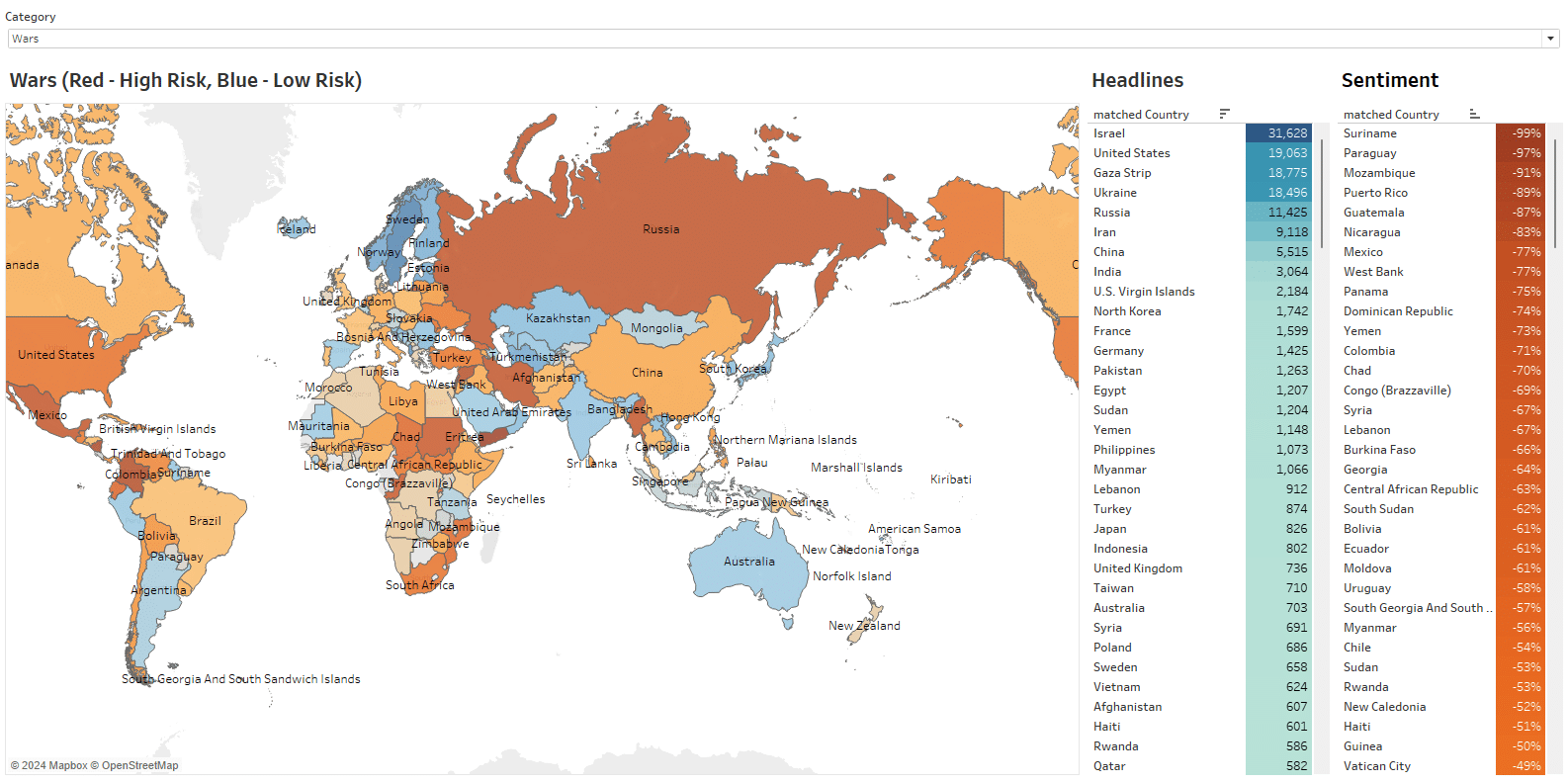
Looking for more insights? Why not explore our analysis on US regional concerns or explore what wars are happening now.
Looking for more global insights? Why not read our articles on:
How countries of Europe view each other’s economy according to GDP
How the UK’s economy is perceived in Europe
How France’s political situation is viewed
An analysis of sentiment around the UK property market recovery
How the world views Russia in terms of wars, politics and the economy
An analysis of global perceptions towards the Germany economy
To say the world has become an increasingly volatile place to do business is no exaggeration. With that being the case, it’s absolutely no wonder that geopolitical risk data has become the unsung hero of many of today’s critical decisions. From assessing the stability of a country to predicting the impact of social unrest, geopolitical risk data provides a treasure trove of insights for businesses, investors, and policymakers. The fact is that thanks to the advancements in technology such a LLM transformers – which is the foundation of what we use at Permutable AI – this data revolution means that the provision of real-time in-depth geopolitical risk sentiment analysis can make or break strategic decisions.
One thing above all is certain. understanding geopolitical risks isn’t just an option in the current business climate; it’s a necessity. Imagine you’re a business executive eyeing an expansion into a new market. Geopolitical risk data can shed light on the political, economic, and social dynamics at play, helping you make informed decisions. It’s like having a crystal ball that highlights potential pitfalls and opportunities.
Take, for example, Permutable AI’s geopolitical risk sentiment analysis. By tapping analysing vast amount of news data related to geopolitical risk in real-time data, we’re able to provide businesses with actionable insights that can guide everything from market entry strategies to supply chain adjustments. The point is, this isn’t just about avoiding risks; it’s about seizing opportunities that others might miss.
Business is harder than ever and competition is fierce. But geopolitical risk data can give decision-makers competitive edge in several ways. For instance, our geopolitical analysis digs into the political and economic factors that could impact operations, giving businesses a clearer picture of the landscape.
Needless to say, identifying potential risks is half the battle. Armed with this knowledge, companies can develop strategies to manage and mitigate these risks. Whether it’s diversifying supply chains or adjusting market entry plans, geopolitical risk data is invaluable. Additionally, in the fast-paced business world, staying ahead of the curve is crucial. Companies that effectively leverage geopolitical risk data can anticipate market changes and identify new opportunities before their competitors.
When it comes to businesses operating internationally, geopolitical risk data is a game-changer. It can help to identify potential risks and develop strategies to manage them. For instance, our data and analysis can highlight political instability or economic downturns in specific regions, allowing companies to adjust their strategies accordingly. The key here is a proactive approach, which not only ensures business continuity but also protects investments and assets.
We know from our clients that investors rely heavily on geopolitical risk data to make informed decisions. By evaluating the stability and growth potential of different markets, they can allocate their capital more wisely. Our sentiment analysis helps investors makes strides when assessing the risks and rewards associated with various opportunities, leading to higher risk-adjusted returns. Not only that, it also enables companies to stay ahead of regulatory changes and adapt to evolving geopolitical landscapes.
There’s no question that in today’s global supply chain network, understanding geopolitical risks is crucial. First and foremost, geopolitical risk data can map and assess risks associated with supply chains, such as trade disputes or natural disasters. Ultimately, geopolitical risk insights provide organizations with valuable information to help diversify and optimize supply chains, ensuring resilience and continuity. Additionally, this data helps companies identify potential bottlenecks and develop contingency plans to mitigate disruptions effectively.
For insurers, accurately pricing risks is vital. So where does geopolitical risk data come into play? This type of data allows them to understand the risks associated with different regions and industries. In this case, geopolitical risk data helps insurers develop tailored products and enhance their overall risk management strategies, ensuring they are well-prepared for any eventuality. It also enables insurers to improve their portfolio diversification and make more informed decisions about reinsurance arrangements.
Increasingly, governments and policymakers are also benefitting from geopolitical risk data, aiding in national security assessments, economic policy formulation, and disaster preparedness. That means governments can develop more effective policies and allocate resources more efficiently. It also supports international cooperation and diplomacy efforts by providing a clearer understanding of global dynamics and potential threats.
There’s no question that geopolitical risk data can significantly impact how companies design and implement their CSR initiatives. First and foremost, understanding the social and political dynamics of a region allows companies to tailor their CSR efforts to address local needs more effectively. For example, our data can highlight areas where environmental or social issues are particularly pressing, enabling businesses to focus their resources where they can make the most significant impact. This not only benefits the community but also enhances the company’s reputation and stakeholder relations.
In an era where crises can bubble up unexpectedly – from political upheavals to natural disasters – having robust emergency response plans is essential. Geopolitical risk data provides critical insights into potential crisis hotspots and helps organizations prepare for various scenarios. As a result, companies using this data can develop comprehensive crisis management strategies, ensuring they are ready to respond swiftly and effectively when a crisis occurs. Case in point – our real-time geopolitical data and analysis can be particularly valuable in monitoring developing situations and providing up-to-date information to guide response efforts.
While the benefits of geopolitical risk data are clear, it’s crucial to use this data judiciously. First and foremost, ensure the data is sourced from reputable and credible providers like Permutable AI, known for their accurate and insightful analysis. It’s also vital that the data is regularly updated to reflect the latest developments and changes in the global landscape.
Interpreting geopolitical risk data within the broader context of the relevant region, industry, or organization is essential. This means considering historical trends, cultural nuances, and socio-political factors that might influence the data. A holistic approach to interpretation leads to more accurate assessments and strategic decisions. Combining quantitative data, such as economic indicators and political stability indexes, with qualitative insights like expert analysis and on-the-ground intelligence provides a more comprehensive understanding of geopolitical risks. This mixed-methods approach can uncover deeper insights and nuances that numbers alone might miss.
Transparency and objectivity in the data are also crucial. Look for providers that offer clear and unbiased assessments, as data influenced by biases or political agendas can skew analysis. An objective provider ensures that the data is presented without undue bias, offering a clear and accurate picture of the risks. Additionally, regular monitoring and updating of geopolitical risk assessments are vital because geopolitical landscapes can change rapidly. This ensures that decisions and strategies remain relevant and effective, allowing for adaptation to new information and trends, which is key to maintaining a proactive stance in risk management.
Finally, integrating geopolitical risk data into broader strategic planning processes ensures that it informs all aspects of decision-making. This integration helps align risk management strategies with overall business or policy objectives, maximizing the value of the data and making it a powerful tool for navigating the complexities of the global landscape.
In today’s complex world, effectively managing geopolitical risks is crucial. The bottom line is this: by leveraging geopolitical risk data, organizations, investors, and policymakers can make strategic decisions that mitigate threats and capitalize on opportunities. Companies like Permutable AI are leading the way, developing the tools needed to surface geopolitical insights in real-time in the ever-changing global landscape.
Ready to see how AI-driven geopolitical risk intelligence can transform your decision-making? Contact us for a demo of our AI-driven news sentiment analysis which is available through our Trading Co-Pilot subscription, or to request a free trial. You can also access top-line geopolitical insights through our Real-Time Geopolitical Insights & AI Market Sentiment Analysis Dashboard which is publicly available to view.
Biden may vow to fight on and beat Trump after the recent embarrassment of the Biden vs Trump debate, but is the rest of the world convinced?
As Biden works to try and convince campaign donors that he can still win the election, our recent AI-driven analysis of sentiment around Joe Biden following the U.S. presidential debate suggests that his attempts may be futile.
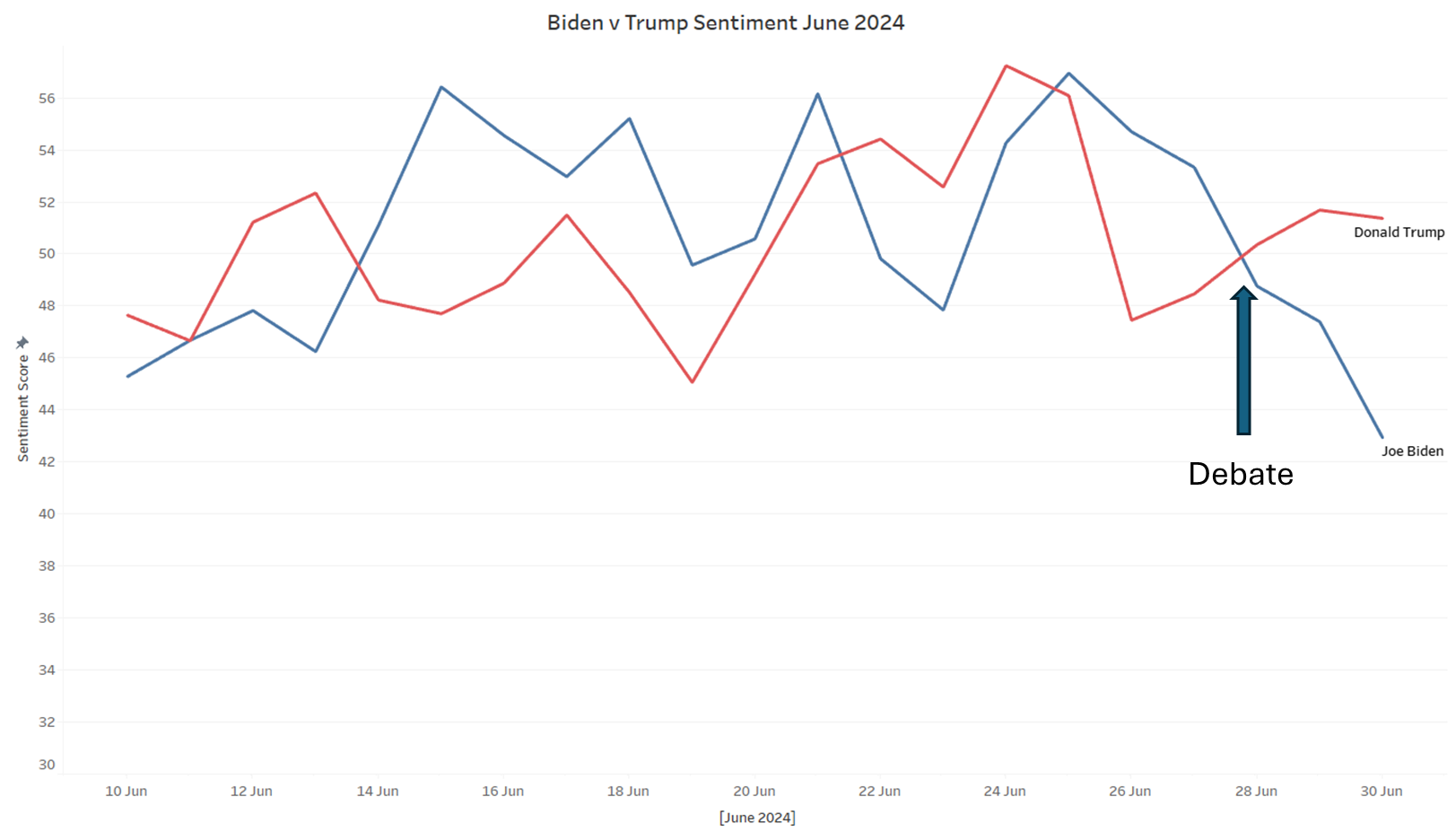
Our analysis reveals a startling and significant drop. Just take a look at the image above which shows that Biden’s sentiment scores have plunged to below 40%, which is largely due to critical media coverage and public reactions to his performance during the Biden vs. Trump debate.
To add insult to injury, this freefall of sentiment has been made all the more worse by the recent suggestion from the New York Times that Biden should step down from the presidential race to serve his country. Ouch.
Ever since this hit the world, it’s without question that this has heavily influenced public opinion further against Biden, and further contributed to the demise of Biden’s sentiment. It is absolutely irrefutable that the Biden vs Trump debate dynamics have been heavily influenced by these media narratives. Now the question on everyone’s lips is this: Could this be make or break for Biden?
This sentiment analysis conducted by our team using our proprietary algorithms was undertaken by analysing public news data over the period March to July 2024. Our machine learning model sifted through over 1 million articles across more than 3,700 sources to gauge the overall sentiment and identify shifts in public opinion. Here’s what we found….
We thought it would be interesting to look at how sentiment towards the two candidates was shaping up on a state-by-state basis. Let’s take a look at how things are looking through this lens:
So what is actually going on here? There’s no doubt that the fateful political debate of June 28 had a intense knock-on effect on both candidates’ sentiment scores. What this shows us is that Biden has been kicked while down, signified by the sharp decline in sentiment post-debate. But while the misery piles on Biden, Trump is understandably enjoying the gains with a peak in sentiment here.
Additionally, it is absolutely irrefutable that the New York Times’ recent statement suggesting that Biden should leave the presidential race to serve his country further compounded the negative sentiment around Biden. Look at how powerful media commentary is in shaping public perception here.
Our sentiment analysis highlights the ultra sensitive nature of public opinion, especially around pivotal events like political debates such as these. Prior to the debate, Biden’s sentiment scores were generally higher than Trump’s in several key states, indicating stronger public support in those regions. However, that all changed after the debate and subsequent media coverage rubbed salt into the wound and significantly impacted Biden’s public perception, leading to a glaringly obvious drop in sentiment. As with most things in politics, perception is everything in the Biden vs Trump debate.
So what about Trump? His sentiment showed resilience and peaked post-debate, reflecting a relatively positive reception from the public during this critical period (no wonder, it wasn’t hard for him to look good in front of a faltering Biden!). Suffice to say, these findings show just how important the media’s influence can be in the rapidly changing world of political sentiment. The world will be watching and waiting to see what’s next.
Wilson Chan, CEO of Permutable AI, commented on our findings: “It is evident from our data set, how such pivotal moments as this debate and related press releases can shift public sentiment by a huge margin Such a negative sentiment shift post the debate again pointed towards the role of media and public opinion in fanning the flames.
In the intense political environment exploring technologies such as our AI-based real-time sentiment analysis tools serve as a a convenient short-cut to the constantly shifting course of the political rollercoaster. To get more details about this, stay tuned for more insights or request a free trial through enquiries@permutable.ai.