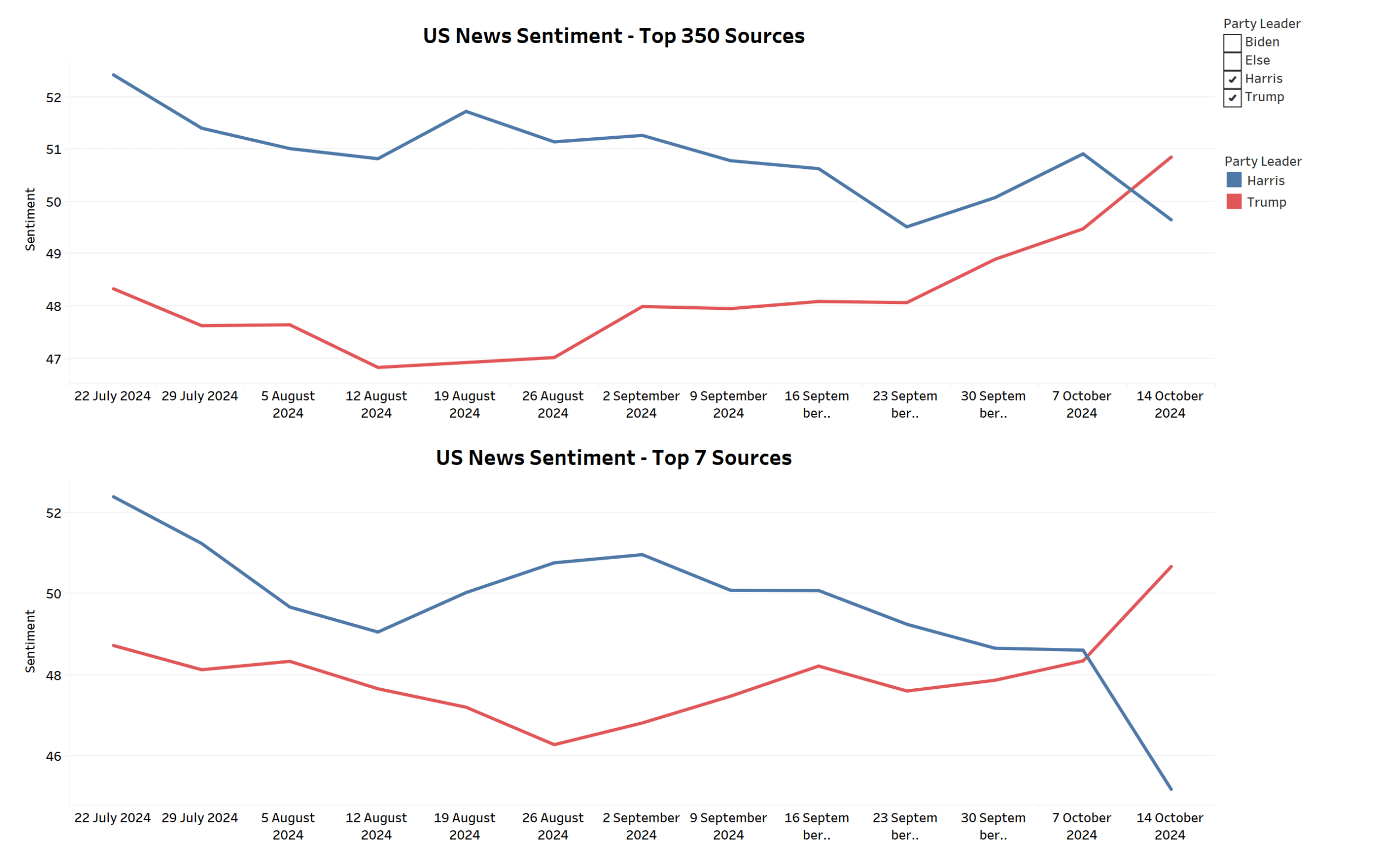
With only just over two weeks left to the U.S. election, in this follow up analysis to our previous Trump vs Harris news sentiment analysis, we look at how news sentiment seems to be shifting between the two candidates. These findings may – or perhaps may not – come as a surprise to many political pundits and election watchers, with Kamala Harris seeming to maintain a consistent lead over Donald Trump in terms of positive sentiment across major news sources.
On the week of October 7th, something changed. Our AI-driven sentiment analysis detected a notable shift that could potentially alter the course of the election. It is perhaps due to a combination of factors, but the data is clear: Trump’s sentiment surpassed Harris’s for the first time since the impact of the assassination attempt and within the analysed period.
Some may voice concerns that AI-driven analysis might be biased or unreliable in political forecasting. So how do we address this? Fundamentally, our technology doesn’t just count positive or negative words. Instead, it understands context, nuance, and the complex interplay of factors that influence perception.
Sketching out the details, here’s what our analysis revealed:
The idea of this analysis is to provide unbiased, data-driven insights that can help understand the shifting political landscape. Today, it seems that landscape is more volatile than many expected. In recent weeks, we’ve all seen a flurry of activity from both campaigns. Supporters of Harris might argue that this is just a temporary blip, a reaction to recent events that will soon correct itself. And, optimists believe that the Harris campaign has time to regain lost ground. We will have to wait and see if this argument holds water or as others have put forward, whether the Harris campaign has reached its ceiling.
But, now to mention the obvious. This shift in sentiment doesn’t necessarily translate directly to votes. That’s because, without actual ballot results, we’re still in the realm of prediction and analysis. Of course, there will always be exceptions to the rule, and political campaigns are notoriously unpredictable. As so often is the case, they cannot have their cake and eat it too – just like election polls can get it wrong, positive news sentiment doesn’t guarantee electoral victory, but it may be an indicator of things to come.
Now on the subject of momentum, it seems that Trump’s campaign has found its stride at a crucial moment having – some would say – earlier lost steam post assassination attempt. Never one to mince his words, Trump has been capitalising on this shift in public perception. Cynicism is based on the idea that this is just another example of Trump’s ability to dominate news cycles. After a golden period for Harris, the tables appear to have turned.
Another interesting finding from our analysis is that the volume of election coverage reached its lowest point during this period of significant sentiment change. This time, they are making every headline count. Some say that this is a deliberate strategy to focus media attention when it matters most as some say U.S. election fatigue has well and truly set in.
In all of this, it would seem, that the Harris campaign faces an uphill battle in the final weeks before the election. But how much should we read into this? Well, only time – and votes – will tell. Meanwhile, according to the latest data, early voting has already begun in many states, potentially amplifying the impact of this sentiment shift.
As ever, whilst our AI-analysis is perhaps a peek into the mood around the U.S. election sentiment, we must be cautious about drawing too firm conclusions. Whilst our analysis provides a unique window into the evolving narrative of this election, an obvious point to make is that perhaps this shouldn’t be attributed to any single event or statement, but rather a culmination of factors that our AI is uniquely positioned to detect.
Another point to note is that it is not just the overall sentiment that’s changing, but the nuances of how each candidate is perceived on key issues. We all know that Trump is known for his ability to rally his base and dominate media narratives. And the last thing the Harris campaign needs it a last-minute surge to overshadow the real issues at stake in this election – although the possibility is a very real one.
Our news sentiment analysis shows that the issues driving this sentiment shift are complex and multifaceted. But, many expect that the final weeks of the campaign will see even more dramatic swings in public opinion. Building news sentiment for the Harris ticket will take more than just a few good news cycles for the Harris campaign. However, that does not mean the election is decided – far from it. With two weeks to go in the final sprint, there’s still room for manoeuvre.
At Permutable AI, we’re committed to providing unbiased, data-driven insights. Our approach combines cutting-edge AI technology with a deep understanding of both financial markets and political landscapes. By applying the same rigorous methodologies we use in financial analysis to political sentiment, we offer a unique perspective on how public opinion evolves.
Our approach combines cutting-edge AI technology with deep understanding of both financial markets and political landscapes. We’re excited to announce that our geopolitical data insights like those featured above are being integrated into our powerful Trading Co-Pilot. Register your interest now by emailing enquiries@permutable.ai or fill in the form below.
Biden may vow to fight on and beat Trump after the recent embarrassment of the Biden vs Trump debate, but is the rest of the world convinced?
As Biden works to try and convince campaign donors that he can still win the election, our recent AI-driven analysis of sentiment around Joe Biden following the U.S. presidential debate suggests that his attempts may be futile.
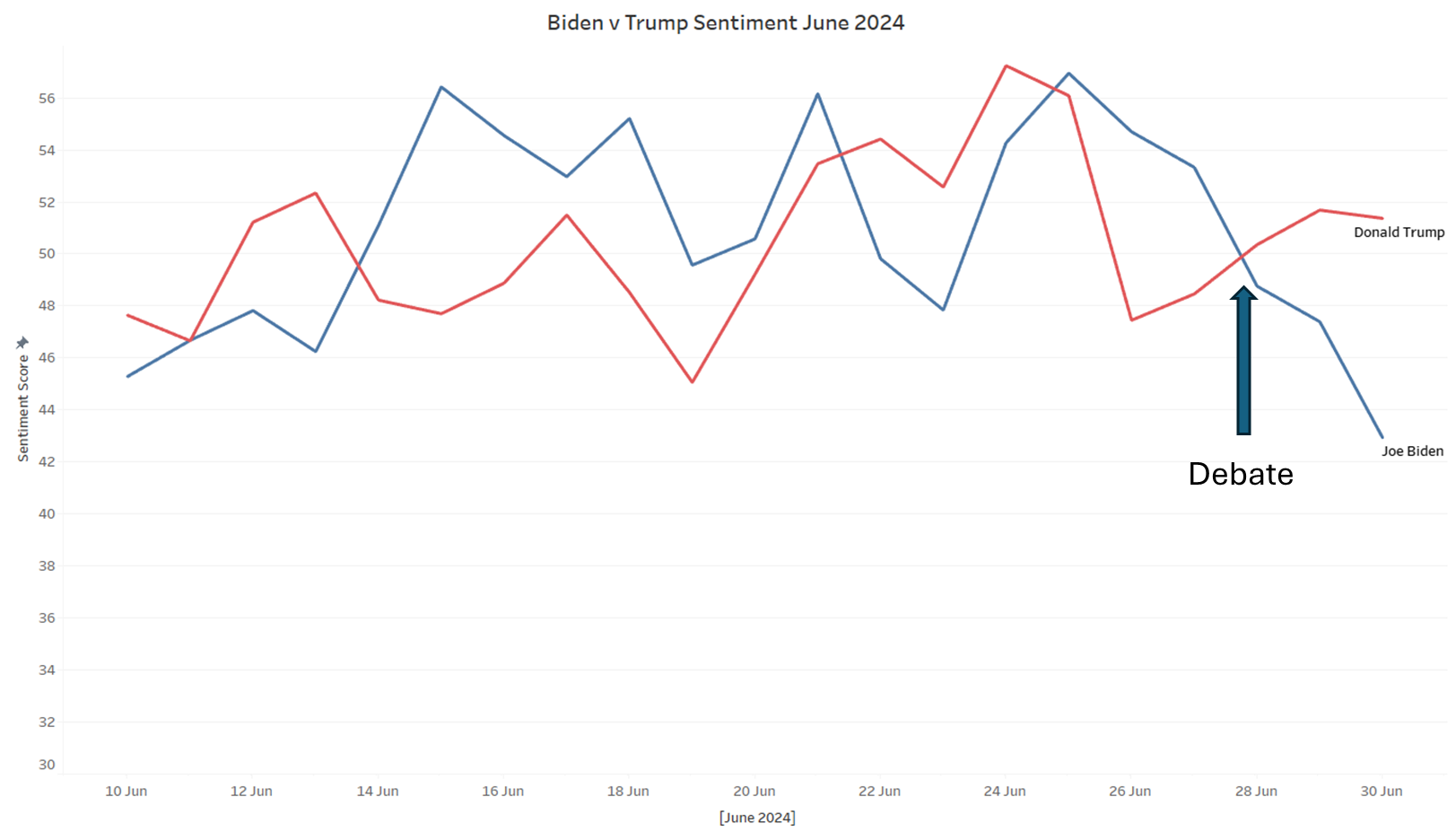
Our analysis reveals a startling and significant drop. Just take a look at the image above which shows that Biden’s sentiment scores have plunged to below 40%, which is largely due to critical media coverage and public reactions to his performance during the Biden vs. Trump debate.
To add insult to injury, this freefall of sentiment has been made all the more worse by the recent suggestion from the New York Times that Biden should step down from the presidential race to serve his country. Ouch.
Ever since this hit the world, it’s without question that this has heavily influenced public opinion further against Biden, and further contributed to the demise of Biden’s sentiment. It is absolutely irrefutable that the Biden vs Trump debate dynamics have been heavily influenced by these media narratives. Now the question on everyone’s lips is this: Could this be make or break for Biden?
This sentiment analysis conducted by our team using our proprietary algorithms was undertaken by analysing public news data over the period March to July 2024. Our machine learning model sifted through over 1 million articles across more than 3,700 sources to gauge the overall sentiment and identify shifts in public opinion. Here’s what we found….
We thought it would be interesting to look at how sentiment towards the two candidates was shaping up on a state-by-state basis. Let’s take a look at how things are looking through this lens:
So what is actually going on here? There’s no doubt that the fateful political debate of June 28 had a intense knock-on effect on both candidates’ sentiment scores. What this shows us is that Biden has been kicked while down, signified by the sharp decline in sentiment post-debate. But while the misery piles on Biden, Trump is understandably enjoying the gains with a peak in sentiment here.
Additionally, it is absolutely irrefutable that the New York Times’ recent statement suggesting that Biden should leave the presidential race to serve his country further compounded the negative sentiment around Biden. Look at how powerful media commentary is in shaping public perception here.
Our sentiment analysis highlights the ultra sensitive nature of public opinion, especially around pivotal events like political debates such as these. Prior to the debate, Biden’s sentiment scores were generally higher than Trump’s in several key states, indicating stronger public support in those regions. However, that all changed after the debate and subsequent media coverage rubbed salt into the wound and significantly impacted Biden’s public perception, leading to a glaringly obvious drop in sentiment. As with most things in politics, perception is everything in the Biden vs Trump debate.
So what about Trump? His sentiment showed resilience and peaked post-debate, reflecting a relatively positive reception from the public during this critical period (no wonder, it wasn’t hard for him to look good in front of a faltering Biden!). Suffice to say, these findings show just how important the media’s influence can be in the rapidly changing world of political sentiment. The world will be watching and waiting to see what’s next.
Wilson Chan, CEO of Permutable AI, commented on our findings: “It is evident from our data set, how such pivotal moments as this debate and related press releases can shift public sentiment by a huge margin Such a negative sentiment shift post the debate again pointed towards the role of media and public opinion in fanning the flames.
In the intense political environment exploring technologies such as our AI-based real-time sentiment analysis tools serve as a a convenient short-cut to the constantly shifting course of the political rollercoaster. To get more details about this, stay tuned for more insights or request a free trial through enquiries@permutable.ai.
Data has never been more crucial for understanding public sentiment across regions, and vital for shaping effective political and communication strategies. This is particularly true when we look at U.S. election state sentiments. Recently, at Permutable AI, we have unveiled our sentiment analysis derived from news headlines across the United States, focusing specifically on the topic of elections. This analysis of U.S. election state sentiments not only highlights the varied emotions and opinions held by the populace but also showcases our advanced capabilities in parsing large-scale data.
Our world events sentiment analysis offers a granular look at how different states perceive their electoral processes. By analyzing thousands of news headlines and categorizing them into U.S. election state sentiments, we are able to paint a vivid picture of the national mood surrounding elections. This analysis is particularly relevant today, as the political climate in the United States remains highly polarized.
Our analysis reveals intriguing patterns. States such as Pennsylvania, North Carolina, and Missouri exhibit positive sentiments towards the U.S. election, with scores of 25%, 7%, and an impressive 68% respectively. These positive scores suggest a general approval of the electoral proceedings and could indicate satisfaction with local governance or candidate selections.
Conversely, states like Nevada, Connecticut, and Arizona showed neutral to negative U.S. election state sentiments, with Nevada at -17%, Connecticut at -3%, and Arizona at a flat 0%. These figures imply varying degrees of dissatisfaction or controversy surrounding the elections within these states, potentially pointing to contentious local issues and/or divisive political environments. Of course, this is no surprise considering that Nevada and Arizona both swing states.
The volume of election-related headlines also provide insights into public engagement and media focus. California and Florida dominate in terms of headline counts, with 1,501 and 469 headlines respectively, highlighting intense public and media interest in U.S. election state sentiments. This high level of engagement suggests that elections in these states are unsurprisingly highly newsworthy and of significant public concern. This is undoubtedly due to their political weight and impact on national politics.
In contrast, and perhaps surprisingly, smaller or less populated states such as Montana, despite having fewer headlines (53), still showed significant public interest relative to their size. This indicates that local elections are closely followed and are of great importance to the residents across the country, regardless of the national spotlight.
The Northeast and Midwest regions of the United States display a mixture of U.S. election state sentiments, reflecting the diverse political climates across these areas. For example, Michigan showed a significantly positive sentiment at 41%, suggesting a favourable reception to electoral outcomes and processes. However, neighbouring states like Ohio and Indiana display much more reserved or even negative sentiments, once again signalling political discontent and/ or divisive issues at play.
A key aspect of this analysis is the role of media in shaping U.S. election state sentiments. In states with extensive media coverage but neutral or negative sentiments, such as Florida, it is possible that the coverage may have focused on contentious or controversial aspects of the elections, thereby influencing public perception negatively. Consequently, this highlights the power of media narratives in shaping political opinions and underscores the need for a nuanced understanding of how news coverage correlates with public sentiment.
Our AI-driven sentiment analysis presents a clear cut way of understanding the complex landscape of U.S. election state sentiments across the United States. By providing a detailed, data-driven snapshot of regional sentiments, it not only highlights the diversity of political opinions across the country but also showcases the critical role of advanced analytics in cutting through information overload and deciphering the public discourse surrounding key democratic processes. Suffice to say, this analysis is a testament to the power of our data analysis in crafting a more informed and responsive political dialogue.
Want to know how U.S. election sentiment is changing in the final sprint? Get our latest findings in our newly released Trump or Harris news sentiment analysis.
The year 2024 is set to be a pivotal moment in global politics, as a significant number of countries and regions around the world prepare to hold their national elections. These elections will not only determine the leadership and direction of individual nations but will also have far-reaching implications for the geopolitical landscape. From the United States to India, Brazil to Nigeria, the outcomes of these elections will shape the course of international relations, economic policies, and social agendas for years to come.
As the world grapples with a range of pressing issues, such as economic uncertainty, climate change, and rising authoritarianism, the 2024 elections will serve as a crucial test for the strength of democratic institutions and the will of the people. This article will delve into the key countries and regions holding elections in 2024, the political landscape leading up to these events, the major candidates and parties in the spotlight, and the potential global implications of the outcomes.
The 2024 election supercycle will see a diverse array of countries and regions holding national elections, each with its unique political, economic, and social dynamics. Some of the most significant elections to watch include:
These are just a few of the many countries and regions that will be holding elections in 2024, each with its unique set of political dynamics and global significance.
As the world prepares for the 2024 election supercycle, the political landscape in many countries is marked by a range of factors that will shape the campaigns and outcomes. These include:
These and other factors will create a complex and dynamic political landscape leading up to the 2024 elections, with each country and region facing its unique set of challenges and opportunities.
As the 2024 election supercycle approaches, a range of political parties and individual candidates will emerge as key players on the global stage. Some of the notable figures and political movements to watch include:
These are just a few examples of the key players and political dynamics that will shape the 2024 election cycle around the world. As the campaigns unfold, new candidates and parties may emerge, and the political landscape could shift in unexpected ways.
The 2024 election campaigns around the world will be shaped by a range of pressing issues and hot-button topics, which will vary from country to country. Some of the common themes that are likely to feature prominently include:
The specific mix of issues and hot topics will vary across different countries and regions, but they will all play a crucial role in shaping the narratives and strategies of the 2024 election campaigns.
The results of the world elections 2024 will have far-reaching implications for the global community, as they will shape the policies and priorities of national governments and their interactions on the international stage. Some of the key areas that may be impacted include:
As the world watches the unfolding of the 2024 elections, it will be essential to analyze the potential global implications of the outcomes and how they may shape the future of international relations, economic cooperation, and the overall global order.
Given the complexity and unpredictability of the global political landscape, making accurate predictions about the outcomes of the 2024 elections is a challenging task. However, based on current trends, political analysts and experts have begun to offer their forecasts and projections for some of the key elections:
These are just a few examples of the predictions and forecasts that are emerging for the 2024 elections around the world. As the campaigns progress and new developments unfold, these projections will likely be refined and updated, providing valuable insights into the potential outcomes and their global implications.
The 2024 elections around the world will undoubtedly have a significant impact on the global stage, shaping the course of international relations, economic policies, and social agendas for years to come. As voters in countries and regions across the globe head to the polls, they will be making decisions that will reverberate far beyond their national borders.
The outcomes of these elections will not only determine the leadership and direction of individual nations but will also influence the balance of power, the willingness of countries to cooperate on global challenges, and the overall trajectory of the international community. Whether it is the United States, India, Brazil, the European Union, or Nigeria, the 2024 election cycle will be a pivotal moment in the history of global politics.
As the world watches these elections unfold, it will be crucial for citizens, policymakers, and the global community to engage in informed and constructive dialogue, to uphold democratic values, and to work towards a more just, sustainable, and prosperous future for all.
In the ever-evolving landscape of global politics, real-time insights are invaluable for understanding the dynamics driving election outcomes. At Permutable AI, we offer cutting-edge political intelligence data and sentiment analysis, providing unparalleled insights into elections and political tensions worldwide. Our advanced algorithms analyze news sentiment on elections, political dynamics, and tensions, offering a powerful barometer for understanding the complex interplay between public sentiment and electoral outcomes. By harnessing the power of AI technology, our platform empowers stakeholders to make informed decisions and navigate the intricate world of global politics with confidence.
Unlock the potential of real-time political intelligence data. Sign up now for a free 2-week trial of our political intelligence data and analysis and gain a competitive edge in understanding the political landscape of 2024.