Russia stands as one of the most powerful countries in the world, and its choices have a big impact on global politics, money matters, and conflicts. But how does the world see Russia? To answer this question, we analysed global news sources to discover the prevailing news sentiment around the country, looking at data from June to August 2024 in three key areas: war, politics, and the economy.
Using advanced AI, our analysis breaks down the amount and tone of media stories about Russia. This gives us a fact-based grasp of how people see the country in various fields. This article digs into these results and gives a full picture, giving us an answer to the question – how does the world see Russia.
Let’s start with the issue of Russia’s role in war and armed conflict, one of the most divisive topics in today’s global politics. Since it took over Crimea in 2014 and the ongoing strife with Ukraine and Western nations that followed, Russia’s military moves keep casting a dark cloud over how the world sees it.
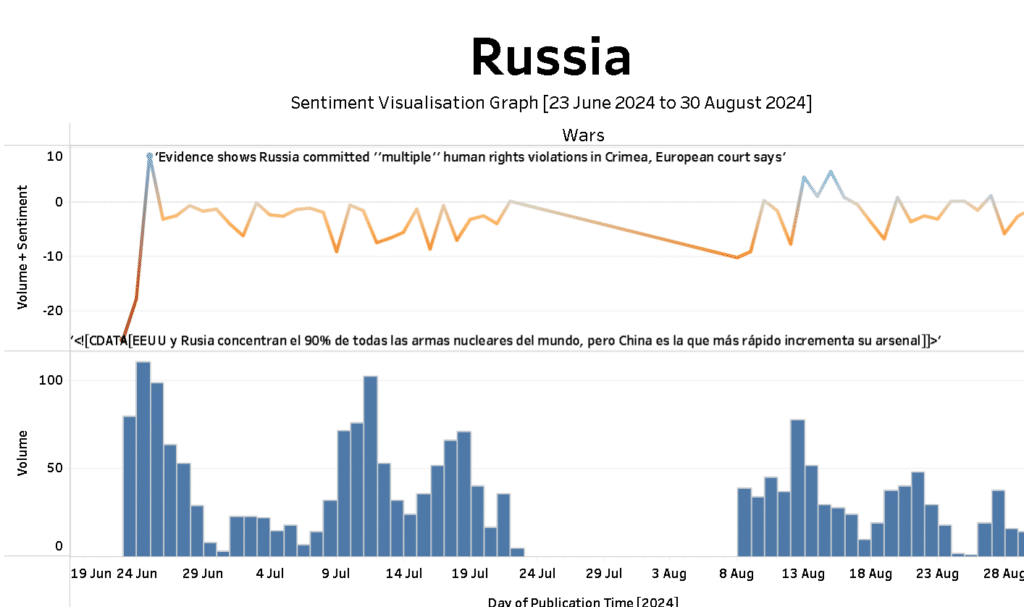
From June to August 2024, our sentiment analysis unsurprisingly revealed a negative view of Russia in news related to the war. This period was marked by big swings in sentiment due to major events related to military operations and human rights abuses.
Sentiment was markedly negative around Russia after a European court made a decision in late June. The court said Russia had broken a string of human rights laws in Crimea. This news further damaged Russia’s image in Europe and North America, where human rights violations is regarded as an extreme violation of justice.
Another major source of negative sentiment bubbled up in July, this time regarding discussions around Russia’s nuclear posture which caused global concern. Russia’s part in this story increased fears in Western countries that its military goals could upset global peace.
Our analysis reveals that military actions unsurprisingly shape Russia’s image worldwide as depicted in international media. News about Russia’s ongoing war with the Ukraine and claims of war crimes keep worldwide sentiment toward Russia’s involvement in conflict negative. This shows deep distrust and worry in Western free countries.
But remember, news about Russia always spikes when big military events happen and Russia’s moves will never fail to grab world news attention. This constant news focus keeps Russia in people’s minds globally, albeit for the wrong reasons.
Russia’s standing on the world stage is tricky to say the least. It has rocky relationships with Western nations but has far more positive relations with non-Western countries like India and China. Our news sentiment analysis reveals the mood regarding Russia in relation to political news from June to August 2024.
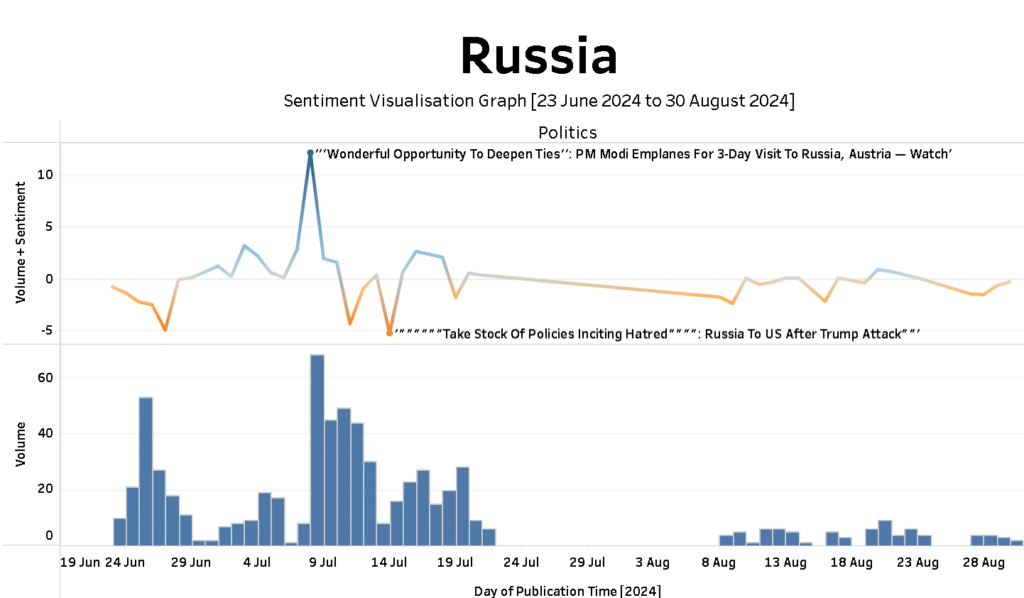
At the start of July, sentiment reached its peak due to Indian Prime Minister Modi’s state visit to Russia and Austria. People saw this event as a “wonderful opportunity to deepen ties,” which highlighted how much Russia values its relationships with non-Western powers. India has kept a practical relationship with Russia, striking a balance between working together and considering wider geopolitical interests. The upbeat sentiment shows hope for diplomatic talks between Russia and countries outside the West.
In contrast to this diplomatic goodwill, the mood soured after Russia criticized U.S. policies. When Donald Trump attacked Russian policy, the Russian government fired back with harsh words. This caused a negative shift in public opinion. This incident shows how the ongoing political friction between Russia and the U.S. still shapes much of the global story, and ultimately, casts a dark cloud over Russia’s political image in Western media.
Russia’s political reputation divides opinion worldwide. Western countries view Russia negatively due to political clashes and sanctions that have damaged relationships. Yet, Russia has built good ties with non-Western powers like India and China, proving that not everyone sees the country in a bad light. These friendships give Russia other ways to boost its political power, even though its rocky relations with the U.S. and Europe often sway overall world opinion.
The world has long kept a close eye on Russia’s economy given international sanctions, changing energy prices, and its huge natural resource deposits. Even with these hurdles, Russia still plays a big role in global energy markets, and news about its economy often catches worldwide attention.
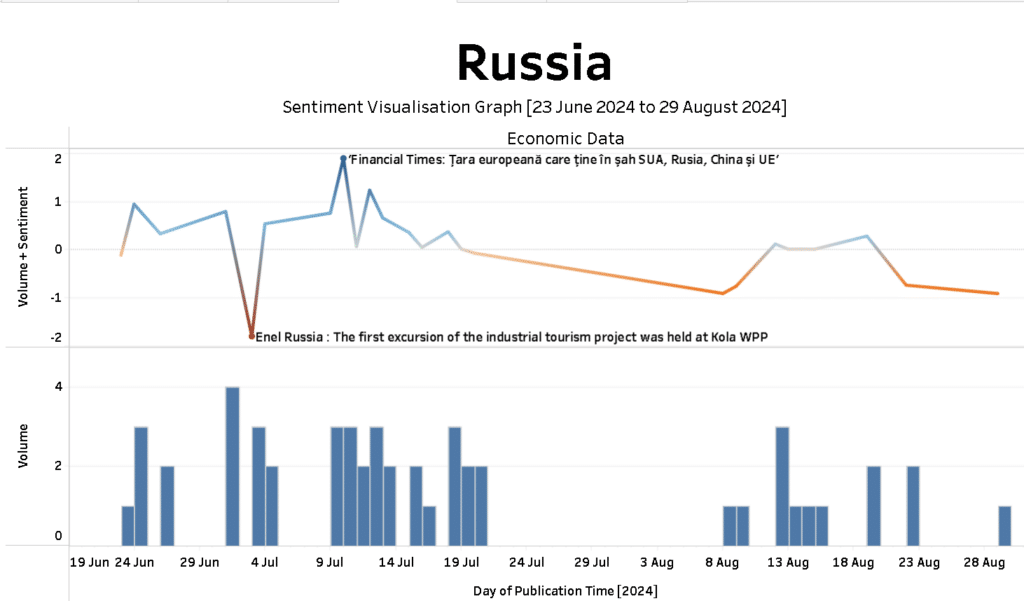
Our news sentiment analysis showed that global media views were steadier compared to war and political areas, with sentiment rising and falling in relation to specific events, but staying more balanced overall.
At the start of July, people positive was more sentiment after the Financial Times published an article about Serbia’s strategic role in international relations, influencing the United States, Russia, China, and the European Union. It examines how this country navigates geopolitical tensions, impacting the balance of power among these global players.
On the flip side, sentiment took a hit in late June after news broke about Russia’s Kola WPP (Wind Power Plant) industrial tourism project. The project might have sparked some interest, but the bigger picture includes worries about environmental and energy-related issues in Russia. These concerns echo the ongoing global discussion about Russia’s energy policies and how they affect sustainability and climate change.
The world’s view of Russia’s economy stays steady, with ups and downs tied to news stories. Even though its political and military moves often lead to bad press and negative sentiment, Russia’s key role in energy markets ensures it’s still a crucial player in world economics, despite being embroiled in political tensions and conflict.
Our news sentiment analysis shows a complex view of Russia worldwide. Russia’s military moves and political strains often lead to negative sentiment in Western news, but its economic power and friendly ties with non-Western countries paint a more detailed and surprisingly positive picture.
Of course, when it comes to war and military action, Russia is seen in a bad light, with news around the world pointing out human rights violations and concerns about nuclear weapons. In politics, Russia’s image goes fluctuates, gaining some diplomatic wins but also harsh criticism. In regards to economic matters, Russia keeps a steadier global image, thanks to its key role in energy, though it faces hurdles related to long-term growth and trade limits.
As with many complex geopolitical situations, the world’s view of Russia depends on the context — whether people see it through the lens of war, talks between countries, or economic matters. Each of these areas helps shape a bigger, ever-changing story about where Russia stands in the world right now.
Surely, then, it’s important to consider all these factors when analysing Russia’s global standing. The obvious point here is that Russia’s image is multifaceted and often contradictory. But also, we must remember that perceptions can shift rapidly in response to world events.
Separately, it’s inevitable that Russia’s actions on the world stage will continue to be scrutinised closely. In essence, the country’s global image is a reflection of its complex role in international affairs. Most importantly, understanding these perceptions is crucial for anyone engaged in global politics or business.
There are two questions that arise from this analysis: How can Russia improve its global image, particularly in the West? And how can other nations engage with Russia constructively while addressing concerns about its actions?
Take your strategic decision-making to the next level with our advanced economic and geopolitical datasets. Our in-depth, real-time analytics give you unmatched insights into worldwide market trends, political shifts, and news patterns. Our datasets use state-of-the-art AI tech to analyse sentiment in real-time, predicting economic factors, and assessing geopolitical risks in detail. Be at the forefront of data-driven strategy and get ahead in today’s fast-changing global scene. To see how our capabilities can help stay ahead, simply email us at enquiries@permutable.ai to set up a demo of our services tailored to your needs, or fill in the form below.
Looking for more global insights? Why not read our articles on:
How countries of Europe view each other’s economy according to GDP
How the UK’s economy is perceived in Europe
How France’s political situation is viewed
An analysis of sentiment around the UK property market recovery
An analysis of global perceptions towards the Germany economy
As China grows its global reach, its ties with Africa have caught the eye of political experts and economists. China-Africa teamwork has hit new highs so grasping how people across Africa view this bond matters a lot for policy shapers and business heads. Our recent sentiment analysis on how China is perceived by Africa give us key insights into African views on China in politics and business. This article digs into the main points from our data analysis, taking a close look at the feelings that shape China-Africa links and what they mean on a bigger scale, just in time for the China-Africa co-operation summit.
China’s ties with Africa have deep roots in diplomatic and economic history. In the last 20 years, these connections have grown stronger, and China now stands as Africa’s biggest trading partner. This relationship involves big infrastructure projects wide-ranging trade deals, and more political teamwork. Events like the Forum on China-Africa Cooperation taking place this week showcase this partnership, which aims to benefit both sides. China offers money and know-how, while gaining access to Africa’s rich natural resources and growing markets.
Yet, like any global partnership, views and feelings can swing based on many things such as world events, money matters, and what’s going on in each country. Our sentiment analysis, which looked at news stories and what people were saying from June 23, 2024, to August 30, 2024, gives us a peek into these views. It shows both hope and worry in African communities about their ties with China.
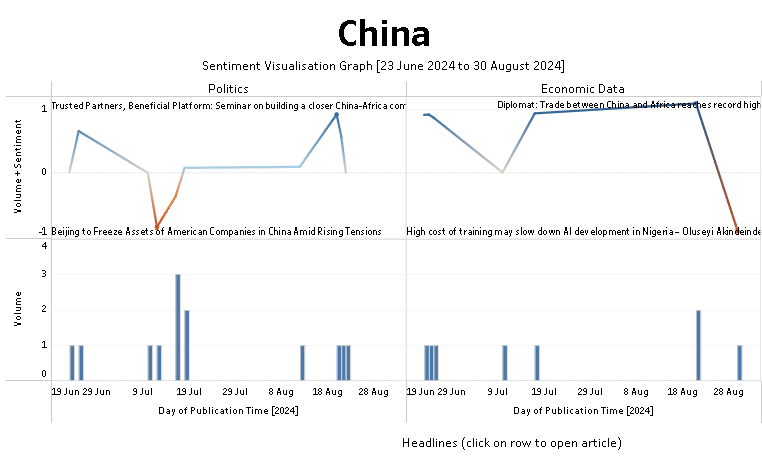
In terms of how China is perceived by Africa, as shown by our sentiment analysis (chart below), there seems to be a mix of trust, teamwork, and careful thinking. Our insights point to a good view of China’s political work in Africa when it comes to plans to build stronger ties between the two. News titles like “Trusted Partners, Beneficial Platform: Seminar on building a closer China-Africa connection” show that Africa sees China as a reliable and helpful friend. This view highlights how much Africa values China’s part in helping to build infrastructure giving money aid, and backing African countries in world political meetings.
China’s way of dealing with Africa gets described as teaming up rather than acting like a parent. This idea sits well with many African countries that have gone through tough times with old colonial rulers in the past. The good feelings shown in the study hint that African nations see China’s political moves as real tries to build a relationship where everyone wins, not as a new kind of colonialism.
But the analysis also reveals underlying worries linked to wider geopolitical shifts. A clear drop in mood connects to the headline “Beijing to Freeze Assets of American Companies in China Amid Rising Tensions.” While this news relates to U.S.-China ties, it echoes in Africa. Many African nations, with close bonds to both China and the United States fear getting caught between superpowers’ disputes. The negative feeling here hints at fears of possible unrest and the effect that growing global conflicts could have on African economies, which are more and more linked with China.
When it comes to the economy, the sentiment analysis shows that people see China’s part in Africa’s economic growth in a good light. The news “Diplomat: Trade between China and Africa reaches record highs” matches up with a high point in positive feelings showing the economic gains that many African countries have gotten from their ties with China. Trade between China and Africa has gone up a lot in recent years. Africa sends raw materials to China, while Chinese made goods, tech, and money flow into African markets. This business partnership has boosted GDPs across the continent. It has also helped create jobs and build infrastructure, which are key to African economic growth.
Our news sentiment data shows that there is an appreciation of the economic chances China offers in trade and investment. China’s readiness to invest in big infrastructure projects—from roads and railways to ports and power plants—has made a huge difference for many African countries. These projects have often filled important gaps left by Western investors, who might have been more careful or less keen to fund such plans. The good feeling tied to record-high trade levels suggests that at least in money matters, people see China as a key partner to help Africa grow.
The report also points out some worrying issues about whether these economic gains will last and benefit everyone. For example, sentiment takes a nosedive around the headline, “High cost of training may slow down AI development in Nigeria.” This shows wider fears about the hurdles African countries face to use the tech and money opportunities China offers. The big price tag for training and building skills in cutting-edge fields like AI, shows Africa might fall behind in the global tech race even with China’s help.
Surely then, these worries suggest the China-Africa economic ties could very well be out of balance. China builds infrastructure and brings in technology, but in some areas, locals are likely to struggle to make the most of these assets. If this doesn’t change, it could mean China’s investments don’t pay off as much as they should in cutting-edge fields that matter for staying competitive in the future.
Our sentiment analysis gives us a glimpse of how Africa sees China – it’s not simple, and it’s changing. Overall, there is positive sentiment around the relationship. This shows that working with China has helped Africa’s economy and politics and the overall impact is net positive. But there are some question marks in there too, which point to weak spots in how China is perceived by Africa.
The obvious point here is that it will be crucial for African leaders and policymakers to handle the China-Africa relationship. Ultimately, they need to fully understand its potential benefits and drawbacks to ensure long-term and inclusive impacts. This might mean working out better deals in trade agreements, building up local skills to make the most of Chinese tech, and keeping a balanced approach to foreign policy. This way, they can avoid getting caught up in tricky global politics.
How China is perceived by Africa seems to be in the most part at least. But there’s still room to address its African partners’ concerns. China could improve its involvement by concentrating on initiatives to build capacity, empowering African countries to manage and maintain the infrastructure and technology it provides on their own. Also, keeping things open and avoiding the look of too much sway in African political matters will be key to keeping the good image it has now.
Get a deeper look into what’s happening around the world with our geopolitical data. Our real-time news sentiment analysis can help you stay ahead of shifting global dynamics, helping you understand how these changes may affect your business. Don’t pass up the chance to make smart strategic choices based on AI-driven data intelligence. Start using our service for free today and see how our full set of geopolitical data can help inform your strategic decisions. Simply email us at enquiries@permutable.ai or fill in the form below to get in touch.
Looking for more global insights? Why not read our articles on:
How countries of Europe view each other’s economy according to GDP
How the UK’s economy is perceived in Europe
How France’s political situation is viewed
An analysis of sentiment around the UK property market recovery
How the world views Russia in terms of wars, politics and the economy
An analysis of global perceptions towards the Germany economy
Have you been wondering recently how the UK is perceived in Europe? As the long shadow of Brexit continues to linger on, years on how do our European neighbours perceive the UK’s economy? The results may just surprise you, according to our AI-driven news sentiment analysis.
In this article, we’ll delve into the views of our continental cousins about the financial health of Britain as we take a closer look at how the UK is perceived in Europe, specifically through the lens of economic data.
First let us all breathe a huge sigh of relief. Regardless of what happened with Brexit, perhaps remarkably, most of Europe still considers Great Britain to be an economically stable country. Like being voted “Most Likely to Succeed” in Europe’s economic world yearbook – it’s flattering if a bit perplexing given our recent performance and erratic behaviour over the years.
Interestingly, Bulgaria in particular seems to be head over heels for us with an astonishing 91% positive rating. And then there is Hungary and Finland not very far behind in terms of how they view the UK and it’s economic prowess.
While this is certainly positive news with regards to how the UK is perceived in Europe, it’s not completely smooth sailing – unsurprisingly. The negative end of the spectrum finds Ukraine not singing our praises at all with -20% bias. Perhaps a little harsh?
When you look closer home, Ireland and Portugal portray a certain frostiness level, which is best characterized as a lukewarm handshake– not an outright rejection but perhaps there’s space for improving attitudes towards us here.
Ah, France. Our dear neighbours across the channel view us with a modest 10% positive bias. It is an economic shrug, a Gallic shrug – not bad, yet no popping of champagne corks either. Meanwhile, Germany is right in the middle, without being biased. It is their way of saying “We are watching you, UK but we’ll keep our opinions to ourselves at the moment”. Very diplomatic indeed!
Here’s where it gets interesting in terms of the UK is perceived in Europe. Surprisingly enough, Russia seems to think that our economy isn’t too shabby after all, boasting of a 33% positive bias. It’s like unexpected praise from your colleague you constantly disagree with smiling back at you – sweetly puzzling as hell.
So in terms of how the UK is perceived in Europe with regards to its economic standing, what do all these varied opinions mean? It is clear that Britain’s economy has a reputation as diverse as the weather in England – mostly sunny but with some showers. For policy makers and business leaders, these perceptions according to our LLM-driven news sentiment analysis are more than just trivia. They can affect everything from trade deals to investment decisions mentioned above.
When exploring how the UK is perceived in Europe through the lens of economic performance, understanding these attitudes may be crucial for navigating the stormy waters of global economics as we embark on our new post-EU reset. Sadly, we have a knack for souring relationships with our immediate neighbours; and things may even get more interesting yet. At present, we should strive to keep the ship afloat; maybe win over those who remain unconvinced while cherishing those in which we are already doing well. It is like throwing a dinner party where some of your guests are known to you since childhood, others are new acquaintances while the remaining are weighing up whether they really like what you cooked or not.
From all indications, the UK remains one of the most significant players in the EU economic space, a notion which is bolstered by the IMF’s recent prediction that the Britain is to be Europe’s fastest major growing economy. Everyone has an opinion on Britain’s economy – and those opinions of course tend to vary as our news sentiment analysis demonstrates. It’s complicated; just as international economics has always been. It would be prudent for us to keep an eye on these perceptions as we march ahead under a new government. In view of this, the United Kingdom still plays a leading role in Europe’s economic drama, attracting much attention towards itself.
Want to gain a deeper understanding of how countries perceive each other? Try our Geopolitical Risk Intelligence Dashboard and explore our interactive Country Bias Matrix. Uncover hidden trends and insights that can inform your strategic decisions by contacting us.
Looking for more insights? Why not explore our analysis on US regional concerns or explore what wars are happening now.
Looking for more global insights? Why not read our articles on:
How countries of Europe view each other’s economy according to GDP
How the UK’s economy is perceived in Europe
How France’s political situation is viewed
An analysis of sentiment around the UK property market recovery
How the world views Russia in terms of wars, politics and the economy
An analysis of global perceptions towards the Germany economy
Geopolitics has never been more deeply intertwined with global markets. Wars and conflicts are not only humanitarian crises but also key forces shaping commodity prices, energy markets, supply chains, and investor sentiment. In 2025, understanding what wars are happening now is no longer the remit of policymakers alone – it has become a strategic imperative for traders, investors, and business leaders.
At Permutable, our geopolitical feeds and Trading Co-Pilot are designed to decode these dynamics in real time. By combining sentiment analysis across global news flows with our proprietary War Index, we provide clarity on where risks are rising, how markets are likely to react, and where opportunities may lie amid volatility.
Our methodology remains rooted in large-scale data analysis. We track millions of news articles and reports daily to detect sentiment shifts and geopolitical signals. The outputs are visualised in our Trading Co-Pilot and indexed in our geopolitical risk feeds – turning a vast stream of unstructured data into clear, actionable intelligence.
For traders, this means our geopolitical data doesn’t just show where conflict is happening but also how markets are responding. When tensions escalate in the Middle East or Ukraine, for instance, our Trading Co-Pilot correlates this news sentiment with commodities such as crude oil, natural gas, wheat, and metals – highlighting potential breaks from current ranges before the wider market prices them in.
Above: Our Trading Co-Pilot detected how bullish LNG sentiment, fuelled by geopolitical tensions and policy shifts, translated into sustained price momentum – – signalling a regime change well before the market caught up.
Our latest geopolitical feed highlights several persistent flashpoints:
Middle East:
Israel-Palestine: The Gaza conflict continues to drive instability across the region, with knock-on effects for energy markets and shipping lanes.
Yemen: Ongoing conflict involving regional powers continues to threaten Red Sea trade routes.
Eastern Europe:
Ukraine: Now into its second decade, the war remains a major driver of global grain and energy market volatility, amplified by sanctions and NATO policy.
Africa:
Sudan: The fragile political transition remains overshadowed by active conflict in multiple regions.
Ethiopia: While the Tigray war has eased, unrest continues to threaten stability across the Horn of Africa.
Libya: Rival factions maintain a precarious stalemate, with oil output vulnerable to disruption.
Our War Index and Political Tension Index has shown particular value in recent months. For example:
In energy markets, our index captured spikes in sentiment following drone attacks on Russian export hubs and Houthi activity in the Red Sea. Our Trading Co-Pilot flagged these signals as short-term bullish for crude oil and LNG, even as structural oversupply capped medium-term rallies.
In agriculture, heightened tensions in Ukraine drove sentiment around “export bans” and “grain corridor risks.” Our geopolitical feeds linked these directly to wheat futures volatility, helping desks adjust positioning.
In FX markets, rising conflict sentiment around tariffs and sanctions shifted flows into the US dollar and Japanese yen. Our clients used these insights to refine forex sentiment models and hedge exposure.
This integration of geopolitical intelligence into market analysis is where we provide our clients with real value. We don’t just report on what wars are happening now – we map how sentiment from these conflicts flows into asset classes in real time. Here, our Trading Co-Pilot translates geopolitical signals into trading scenarios.
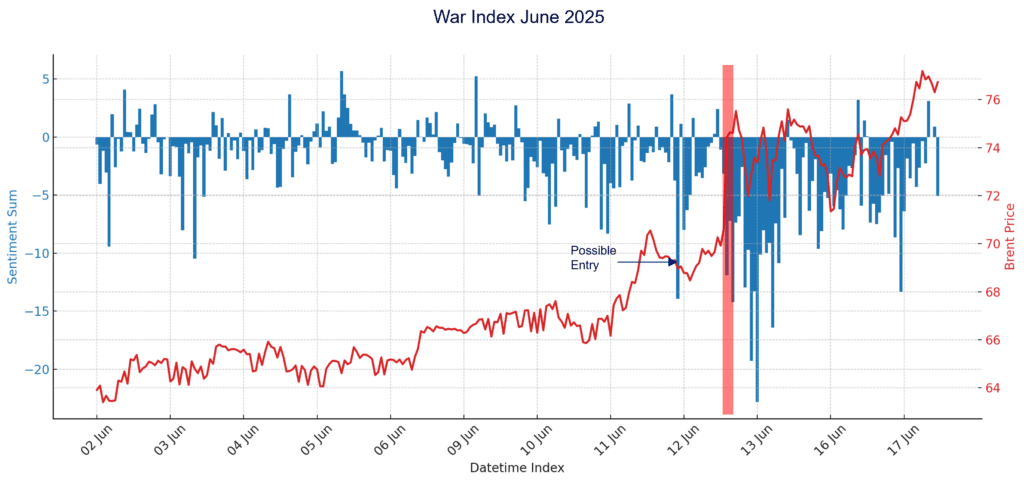
Above: Our War Index revealed how geopolitical tensions in June 2025 drove Brent crude higher, pinpointing possible entry opportunities as conflict-related sentiment translated directly into market volatility.
Looking forward, we are expanding our world events datasets and continually refining our macro models to act as early warning systems. By training on historical patterns of sentiment escalation and policy responses, we are building predictive capabilities that help clients prepare for volatility before it hits the headlines. In 2025, and on into 2026. conflicts will remain central to global market dynamics. Understanding what wars are happening now is only the first step. The real advantage lies in anticipating how these conflicts shape commodities, currencies, equities, and investor sentiment.
At Permutable, our geopolitical feeds and Trading Co-Pilot give institutional traders, asset managers, and corporates the clarity they need to navigate volatility with confidence.
Contact us at enquiries@permutable.ai to see how our intelligence platform can support your strategy.
A: Wars and conflicts disrupt supply chains, drive energy and commodity price volatility, and shift investor sentiment. In 2025, conflicts in regions such as the Middle East, Eastern Europe, and Africa remain central to market risk, influencing energy markets, agricultural and metal commodities.
A: We use large-scale AI-driven sentiment analysis to process millions of global news articles daily. The data is distilled into our War Index and Political Tension Index, which track sentiment intensity and link geopolitical risks directly to asset classes.
A: The Trading Co-Pilot is our real-time intelligence platform that translates geopolitical sentiment into trading scenarios. It provides base, bullish, and bearish cases across multiple time horizons, helping traders anticipate volatility before it impacts markets.
A: While no model can forecast conflicts with certainty, our AI identifies early signals of sentiment escalation and policy shifts. By learning from historical patterns, our models act as an early warning system for institutional traders and risk managers.
A: Institutional quantitative and systematic traders, asset managers, investment banks, and corporates use our geopolitical feeds to understand how wars and political tensions affect commodities, currencies, equities, and investor sentiment.
Wars create supply disruptions, increase risk premiums, and drive volatility in commodities such as crude oil, natural gas, wheat, and metals. For example, drone strikes or shipping blockages can trigger sharp moves in oil and LNG, even when underlying supply remains strong.
A geopolitical risk index measures sentiment and risk signals from news and data relating to wars, sanctions, and political instability. Permutable AI’s War Index and Political Tension Index capture these signals in real time, linking them directly to market outcomes.
Geopolitical sentiment analysis allows traders to anticipate how conflicts will influence asset classes. By mapping war-related sentiment into trading signals, Permutable AI’s Trading Co-Pilot helps identify bullish or bearish scenarios for commodities, FX, and equities before markets fully price them in.
In a world of increasing global interconnectedness, it has become increasingly critical for businesses to navigate the complex and ever-evolving landscape of geopolitical risk. Geopolitical risk refers to the potential for political, economic, and social instability in different regions of the world to impact the operations, investments, and overall well-being of organisations and individuals. As the global landscape undergoes significant shifts, the ability to anticipate and respond to these risks has become a critical skill for success in the modern business environment.
This article aims to provide a comprehensive guide to navigating geopolitical risk 2024, equipping readers with the knowledge and tools necessary to anticipate and mitigate the potential impacts of global trends on their operations and investments.
In an increasingly volatile and unpredictable world, the ability to anticipate global trends has become essential for businesses and individuals seeking to maintain a competitive edge and ensure long-term resilience. By staying ahead of the curve and proactively addressing potential geopolitical risks, organisations can better position themselves to capitalise on emerging opportunities, minimise disruptions, and safeguard their operations and investments.
Anticipating global trends also allows for more informed decision-making, enabling businesses to develop contingency plans, diversify their portfolios, and adapt their strategies to changing market conditions. This proactive approach can help organisations stay agile and responsive, ultimately enhancing their chances of success in an uncertain global landscape..
As the world continues to navigate the complexities of the post-pandemic era, several key geopolitical tensions are expected to shape the global landscape in 2024. These include:
The ongoing rivalry between the United States and China, characterized by trade disputes, technological competition, and potential flashpoints over issues like Taiwan, remains a central driver in global affairs. This competition has far-reaching implications for economic relations, technological innovation, and geopolitical stability worldwide.
Continued tensions and instability in regions such as the Persian Gulf, the Levant, and North Africa, driven by factors like sectarian divisions, proxy wars, and the influence of regional powers, pose significant risks to global energy markets and security. Managing these conflicts requires careful diplomacy and strategic engagement to prevent further escalation and mitigate humanitarian crises.
The fallout from the Russia-Ukraine conflict, internal tensions within the European Union, and the ongoing implications of Brexit continue to shape the geopolitical landscape in Europe. These challenges highlight the importance of cooperation among European nations and their allies to address common security threats and promote stability in the region.
Developing economies, particularly in regions like Latin America, Africa, and parts of Asia, face increased political and economic volatility due to factors such as social unrest, resource scarcity, and the impact of global economic trends. Managing risks in these markets requires robust governance frameworks, proactive risk management strategies, and investments in sustainable development to foster resilience and stability.
The growing importance of cybersecurity, the race for technological dominance, and the potential for digital conflicts to escalate into physical confrontations are significant concerns in the geopolitical landscape. As nations and non-state actors increasingly leverage technology for strategic purposes, addressing cyber threats and promoting responsible use of emerging technologies are critical for safeguarding global security and stability.
By closely monitoring these and other emerging geopolitical tensions, businesses and individuals can better anticipate and mitigate the potential impacts on their operations, investments, and overall well-being.
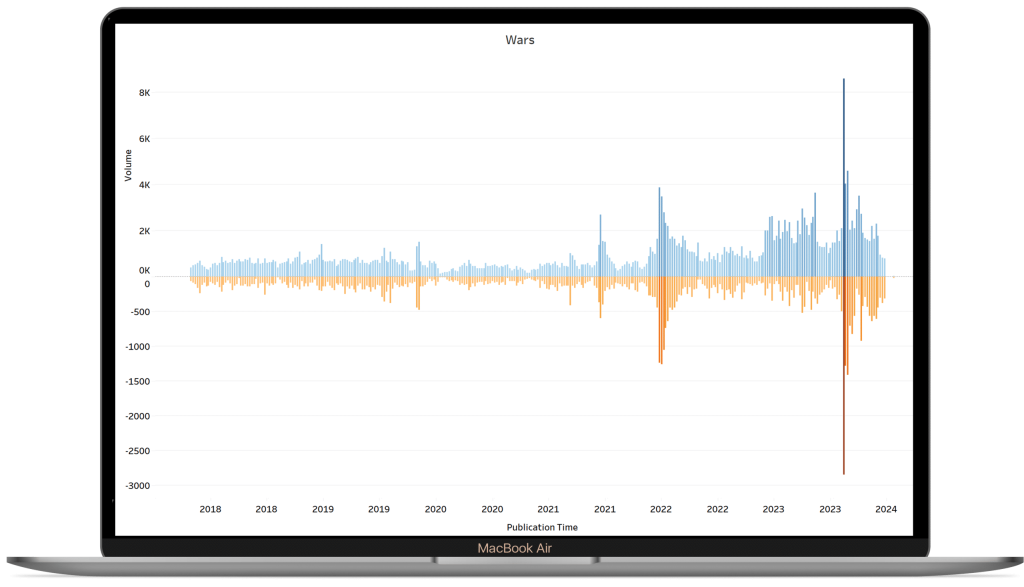
Above: Permutable AI’s global conflict sentiment tracker
Geopolitical risks can have far-reaching consequences for businesses, impacting a wide range of areas, including:
Geopolitical risks, including political instability, trade disputes, and logistical challenges, can disrupt the smooth flow of goods, materials, and services along supply chains. These disruptions may result in delays in production, increased costs associated with alternative sourcing or transportation, and challenges in meeting customer demands. Businesses reliant on global supply chains are particularly vulnerable to such disruptions, which can ultimately impact their overall efficiency and competitiveness in the market. Implementing strategies such as diversifying suppliers, establishing contingency plans, and investing in supply chain visibility technologies can help mitigate these risks and enhance supply chain resilience.
Changing political dynamics, economic sanctions, and regulatory shifts can pose significant challenges for businesses seeking to access new markets or expand their operations internationally. Such restrictions may limit the ability of businesses to establish presence in lucrative markets, make strategic investments, or engage in cross-border trade. Navigating these complexities requires businesses to stay abreast of evolving geopolitical developments, engage in proactive risk assessments, and diversify their market portfolios to reduce dependency on high-risk regions. Additionally, forging partnerships with local entities, leveraging diplomatic channels, and advocating for favorable trade policies can help mitigate the impact of market access restrictions and foster sustainable growth opportunities.
Geopolitical tensions often contribute to financial market volatility, including fluctuations in currency exchange rates, stock prices, and commodity markets. These fluctuations can have significant implications for businesses, affecting revenue streams, profit margins, and investment decisions. Businesses with exposure to international markets must carefully monitor geopolitical developments and their potential impact on financial markets. Implementing robust risk management strategies, such as hedging against currency risks, diversifying investment portfolios, and maintaining adequate liquidity, can help mitigate the adverse effects of financial volatility and safeguard financial stability.
Geopolitical risks, such as civil unrest, terrorist attacks, extreme weather events and natural disasters, can pose threats to a business’s physical assets, personnel, and overall operational continuity. Ensuring business continuity in the face of such threats requires the implementation of comprehensive risk management plans and contingency measures. This may include establishing emergency response protocols, enhancing physical security measures, and diversifying operational facilities to minimize single-point-of-failure risks. Additionally, investing in technologies such as remote monitoring systems, cloud-based infrastructure, and disaster recovery solutions can help businesses maintain operational resilience and minimize disruptions during times of crisis.
Businesses operating in geopolitically sensitive regions or engaging in controversial activities may face reputational risks stemming from associations with political controversies, human rights violations, or unethical practices. Protecting brand reputation and maintaining stakeholder trust is essential for long-term success and sustainability. Businesses must prioritize corporate social responsibility initiatives, uphold ethical business practices, and demonstrate transparency and accountability in their operations. Proactively engaging with stakeholders, including customers, investors, and regulatory authorities, and addressing concerns through open dialogue and timely actions can help mitigate reputational risks and preserve brand integrity in the face of geopolitical challenges.
By comprehensively understanding the potential impact of geopolitical risks on their operations, businesses can proactively identify vulnerabilities, develop contingency plans, and implement risk mitigation strategies. Building resilience in the face of geopolitical uncertainties enables businesses to navigate turbulent environments more effectively and sustain long-term growth and success.
By understanding the potential impact of geopolitical risks on their operations, businesses can develop more effective strategies for mitigating these challenges and building resilience in an uncertain global landscape.
As businesses and individuals navigate the complexities of geopolitical risk 2024, several key strategies can be employed to enhance their resilience and adaptability:
Spreading operations, investments, and supply chains across multiple regions and markets can help mitigate the impact of localized geopolitical disruptions. By diversifying geographic presence, businesses reduce their exposure to risks in any single location. This strategy provides resilience against sudden changes in political, economic, or social conditions in specific regions, allowing businesses to maintain continuity and stability in their operations.
Developing and regularly updating contingency plans for a range of potential geopolitical scenarios can enable more agile and responsive decision-making. Scenario planning involves identifying and analyzing various geopolitical risks, such as political instability, trade conflicts, or natural disasters, and developing strategies to mitigate their impact. By simulating different scenarios and their potential consequences, businesses can anticipate challenges, adapt their strategies, and implement proactive measures to safeguard their interests.
Maintaining open communication and collaboration with key stakeholders, including government agencies, industry partners, and local communities, can help organizations better anticipate and respond to geopolitical risks. Engaging with stakeholders allows businesses to gather valuable insights, exchange information, and build mutually beneficial relationships. By understanding the perspectives and interests of different stakeholders, organizations can identify potential risks early, address concerns effectively, and leverage collective expertise to navigate complex geopolitical environments.
Leveraging emerging technologies, such as data analytics, artificial intelligence, and blockchain, can enhance an organization’s ability to monitor, analyze, and respond to geopolitical developments in real-time. Advanced analytics tools can process vast amounts of data from diverse sources, allowing businesses to identify patterns, trends, and potential risks more effectively. Artificial intelligence algorithms can automate risk assessments, predict future scenarios, and provide actionable insights to support decision-making. Additionally, blockchain technology offers secure and transparent data sharing capabilities, enabling better coordination and collaboration among stakeholders in complex geopolitical environments.
By adopting a multifaceted approach to geopolitical risk management, businesses and individuals can increase their chances of weathering the challenges and capitalising on the opportunities presented by the evolving global landscape.
To illustrate the practical application of geopolitical risk management strategies, let’s examine a few case studies of companies that have navigated complex geopolitical environments effectively:
Unilever, the multinational consumer goods company, recognized the growth potential of emerging markets such as Africa, Asia, and Latin America. To mitigate the impact of localized political and economic instability in these regions, Unilever strategically diversified its operations and supply chains. By establishing production facilities, distribution networks, and local partnerships in multiple countries, Unilever spread its risk across different geographic regions, reducing its dependence on any single market. This diversification strategy not only helped the company navigate geopolitical challenges but also allowed it to capitalize on the opportunities presented by rapidly evolving consumer demographics and preferences in emerging markets.
Faced with the uncertainties of the US-China trade dispute and other geopolitical tensions, Volkswagen, the leading automotive manufacturer, implemented a robust scenario planning process to anticipate and respond to potential geopolitical developments. By evaluating multiple scenarios, including trade restrictions, tariffs, and regulatory changes, Volkswagen gained insights into the potential impacts on its production, supply chain, and market demand in China. Armed with this foresight, the company was able to adjust its strategies accordingly, such as optimizing production schedules, diversifying its supplier base, and exploring alternative market opportunities. This proactive approach enabled Volkswagen to maintain its competitiveness and profitability in the Chinese market despite geopolitical uncertainties.
Coca-Cola, the global beverage giant, has adeptly managed geopolitical challenges, particularly in regions like the Middle East, where political instability poses significant risks. Adopting a multifaceted approach, the company decentralizes its supply chain by establishing manufacturing plants and distribution centers across various countries in the region. This strategy not only enhances supply chain resilience but also fosters stronger relationships with local communities and governments. Additionally, Coca-Cola has invested in stakeholder engagement and corporate diplomacy, collaborating with local authorities and NGOs to address socio-political challenges and build trust. Leveraging advanced data analytics, Coca-Cola proactively monitors geopolitical developments to anticipate and mitigate risks, enabling the company to adapt its strategies and operations swiftly.
These case studies demonstrate the value of adopting a proactive and multifaceted approach to geopolitical risk management, leveraging strategies such as diversification, scenario planning, and risk transfer mechanisms to navigate complex global environments.
Geopolitical risk analysis plays a crucial role in informing the decision-making processes of businesses, governments, and individuals. By providing a comprehensive understanding of the global landscape and the potential impacts of geopolitical events, geopolitical risk analysis can help guide a wide range of strategic decisions, including:
Geopolitical risk analysis provides essential data and insights for evaluating potential investment opportunities. By assessing the political, economic, and social stability of different regions or markets, organizations can identify and mitigate risks associated with specific investments. This analysis informs decisions regarding asset allocation, portfolio diversification, and risk management strategies, ensuring prudent investment decisions that align with long-term objectives.
Insights from geopolitical risk analysis inform organizations’ decisions about entering new markets or expanding their operations. By understanding the geopolitical dynamics of target markets, including regulatory environments, geopolitical tensions, and cultural factors, businesses can develop informed market entry and expansion strategies. This analysis guides decisions regarding market selection, entry timing, localization strategies, and partnerships, minimizing risks and maximizing opportunities for success.
Geopolitical risk analysis supports the development of resilient and adaptable supply chain and logistics strategies. By assessing geopolitical risks such as political instability, trade disputes, and natural disasters, organizations can identify vulnerabilities in their supply chains and proactively implement risk mitigation measures. This analysis informs decisions regarding supplier selection, distribution network design, inventory management, and contingency planning, ensuring continuity of operations and minimizing disruptions.
Anticipating potential geopolitical crises is essential for organizations to develop robust crisis management and contingency plans. Geopolitical risk analysis enables organizations to identify potential triggers for crises, assess their potential impact, and develop response strategies to mitigate risks and minimize disruptions. This analysis informs decisions regarding crisis communication, resource allocation, stakeholder engagement, and business continuity planning, ensuring effective response and resilience in the face of geopolitical challenges.
Geopolitical risk analysis helps organizations navigate complex regulatory environments and ensure compliance with evolving policies and sanctions. By monitoring geopolitical developments, organizations can anticipate changes in regulations, sanctions regimes, and political dynamics that may impact their operations. This analysis informs decisions regarding risk assessment, regulatory compliance strategies, legal due diligence, and reputational risk management, safeguarding organizations from legal and reputational consequences.
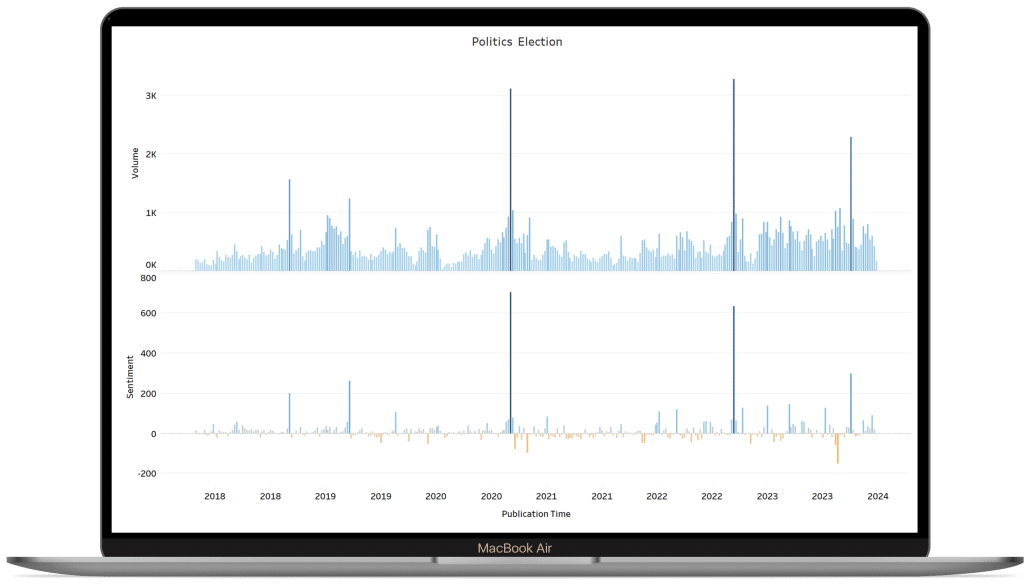
Above: Permutable AI’s global elections sentiment tracker
At Permutable AI, our Political Data Intelligence leverages advanced algorithms and machine learning techniques to provide real-time analysis of geopolitical risks, empowering businesses, governments, and individuals to make informed decisions in an ever-changing global landscape.
Permutable AI continuously monitors a vast array of data sources, including news articles, social media feeds, government reports, and expert analyses, to track geopolitical developments as they unfold. By aggregating and analyzing this real-time data, Permutable AI identifies emerging trends, geopolitical hotspots, and potential risk factors, enabling users to stay ahead of the curve and react swiftly to changing circumstances.
At Permutable AI, we employ sentiment analysis techniques to assess the tone and context of geopolitical events and discussions. By analyzing public sentiment expressed in public sources, our algorithms can gauge the level of optimism, concern, or unrest surrounding specific geopolitical issues. This sentiment analysis provides valuable insights into the potential impact of geopolitical events on public opinion, market sentiment, and stakeholder perceptions.
Our technology is able to analyze various factors, including political stability, economic indicators, social unrest, and regulatory developments in order to generate risk scores and heatmaps that highlight areas of heightened geopolitical risk, allowing users to prioritize attention and resources where they are most needed. Additionally, our technology is able to identify potential cascading effects and interconnected risks, enabling users to anticipate and mitigate the broader implications of geopolitical events.
Leveraging predictive analytics capabilities, we are currently developing the capability to forecast upcoming geopolitical trends and scenarios based on historical data, trend analysis, and scenario modeling. By identifying patterns and correlations in past events, our algorithms can predict potential outcomes and trajectories for geopolitical developments, helping users anticipate risks and opportunities well in advance. This predictive intelligence enables proactive decision-making and strategic planning, enabling users to adapt their strategies and allocate resources effectively in anticipation of future geopolitical challenges.
As the world continues to grapple with the challenges and uncertainties of the post-pandemic era, the ability to anticipate and navigate geopolitical risk has become increasingly vital for businesses, governments, and individuals alike. By leveraging a comprehensive understanding of global trends, data-driven risk analysis, and proactive mitigation strategies, organisations can build resilience and adaptability in the face of an ever-evolving geopolitical landscape.
Ready to see how AI-driven geopolitical risk intelligence can transform your decision-making? Contact us for a demo of our AI-driven news sentiment analysis which is available through our Trading Co-Pilot subscription, or to request a free trial. You can also access top-line geopolitical insights through our Real-Time Geopolitical Insights & AI Market Sentiment Analysis Dashboard which is publicly available to view.
The year 2024 is set to be a pivotal moment in global politics, as a significant number of countries and regions around the world prepare to hold their national elections. These elections will not only determine the leadership and direction of individual nations but will also have far-reaching implications for the geopolitical landscape. From the United States to India, Brazil to Nigeria, the outcomes of these elections will shape the course of international relations, economic policies, and social agendas for years to come.
As the world grapples with a range of pressing issues, such as economic uncertainty, climate change, and rising authoritarianism, the 2024 elections will serve as a crucial test for the strength of democratic institutions and the will of the people. This article will delve into the key countries and regions holding elections in 2024, the political landscape leading up to these events, the major candidates and parties in the spotlight, and the potential global implications of the outcomes.
The 2024 election supercycle will see a diverse array of countries and regions holding national elections, each with its unique political, economic, and social dynamics. Some of the most significant elections to watch include:
These are just a few of the many countries and regions that will be holding elections in 2024, each with its unique set of political dynamics and global significance.
As the world prepares for the 2024 election supercycle, the political landscape in many countries is marked by a range of factors that will shape the campaigns and outcomes. These include:
These and other factors will create a complex and dynamic political landscape leading up to the 2024 elections, with each country and region facing its unique set of challenges and opportunities.
As the 2024 election supercycle approaches, a range of political parties and individual candidates will emerge as key players on the global stage. Some of the notable figures and political movements to watch include:
These are just a few examples of the key players and political dynamics that will shape the 2024 election cycle around the world. As the campaigns unfold, new candidates and parties may emerge, and the political landscape could shift in unexpected ways.
The 2024 election campaigns around the world will be shaped by a range of pressing issues and hot-button topics, which will vary from country to country. Some of the common themes that are likely to feature prominently include:
The specific mix of issues and hot topics will vary across different countries and regions, but they will all play a crucial role in shaping the narratives and strategies of the 2024 election campaigns.
The results of the world elections 2024 will have far-reaching implications for the global community, as they will shape the policies and priorities of national governments and their interactions on the international stage. Some of the key areas that may be impacted include:
As the world watches the unfolding of the 2024 elections, it will be essential to analyze the potential global implications of the outcomes and how they may shape the future of international relations, economic cooperation, and the overall global order.
Given the complexity and unpredictability of the global political landscape, making accurate predictions about the outcomes of the 2024 elections is a challenging task. However, based on current trends, political analysts and experts have begun to offer their forecasts and projections for some of the key elections:
These are just a few examples of the predictions and forecasts that are emerging for the 2024 elections around the world. As the campaigns progress and new developments unfold, these projections will likely be refined and updated, providing valuable insights into the potential outcomes and their global implications.
The 2024 elections around the world will undoubtedly have a significant impact on the global stage, shaping the course of international relations, economic policies, and social agendas for years to come. As voters in countries and regions across the globe head to the polls, they will be making decisions that will reverberate far beyond their national borders.
The outcomes of these elections will not only determine the leadership and direction of individual nations but will also influence the balance of power, the willingness of countries to cooperate on global challenges, and the overall trajectory of the international community. Whether it is the United States, India, Brazil, the European Union, or Nigeria, the 2024 election cycle will be a pivotal moment in the history of global politics.
As the world watches these elections unfold, it will be crucial for citizens, policymakers, and the global community to engage in informed and constructive dialogue, to uphold democratic values, and to work towards a more just, sustainable, and prosperous future for all.
In the ever-evolving landscape of global politics, real-time insights are invaluable for understanding the dynamics driving election outcomes. At Permutable AI, we offer cutting-edge political intelligence data and sentiment analysis, providing unparalleled insights into elections and political tensions worldwide. Our advanced algorithms analyze news sentiment on elections, political dynamics, and tensions, offering a powerful barometer for understanding the complex interplay between public sentiment and electoral outcomes. By harnessing the power of AI technology, our platform empowers stakeholders to make informed decisions and navigate the intricate world of global politics with confidence.
Unlock the potential of real-time political intelligence data. Sign up now for a free 2-week trial of our political intelligence data and analysis and gain a competitive edge in understanding the political landscape of 2024.