*This article analyses how trade tensions are affecting different economies, highlighting UK’s resilience, Asia-Pacific’s retail growth, and Western nations’ employment challenges. It’s aimed at institutional investors and financial professionals seeking data-driven insights on currency markets and macroeconomic trends to inform their investment strategies in an increasingly complex global trade environment.
In the constantly evolving theatre of global finance, understanding the increasingly intricate relationships between trade policies, domestic economic indicators, and currency movements has never been more fundamentally important that during the times we are living through. Despite what Trump purports, we – like many others – maintain there is nothing “beautiful” about tariffs. In this article, we’ll look at the latest global trade tariff impact through our Trading Co-Pilot’s newly launched Sector Analysis feature, which reveal a fascinating divergence in how major economies are responding to mounting global trade tariff pressures.
When looking at our LLM-driven market sentiment data across G10 currencies using our new Sector Analysis feature, a clear pattern emerges: nearly all major economies are displaying signals of domestic crisis against the backdrop of escalating global trade tariff conflicts. This week’s imposition of tariffs by the Trump administration has only exacerbated these tensions. Perhaps one of the most interesting stories here – particularly for those of us based out of the UK is that the United Kingdom stands as a notable exception to this trend.
Our Sector Analysis sentiment matrix provides a detailed breakdown of how these tensions are manifesting across different economic dimensions. The data suggests that the ripple effects of trade barriers are now extending beyond immediate trade balances and beginning to influence core domestic indicators.
As we can observe from our sentiment heatmap, the negative values clustering around employment data and inflation rates for most currencies tell a worrying story about market concerns. What we are clearly seeing is that in terms of market sentiment, the global trade tariff impact is no longer contained to international commerce metrics but has created vulnerabilities throughout domestic economic structures. The imposition of these taxes will, presumably, only deepen these vulnerabilities.
On the bright side, a more positive insight from our analysis is the resilience currently being displayed in retail and consumer sectors across several Asia-Pacific economies. The Australian Dollar, Japanese Yen, and Chinese Yuan are all showing strong positive sentiment values in retail sales and consumer spending categories.
In particular, the Australian Dollar exhibits a robust +0.80 sentiment score particularly in connection with manufacturing and industrial production, complemented by an impressive +1.00 in GDP growth indicators. Similarly, the Japanese Yen demonstrates robust strength in consumer spending with a +1.00 sentiment reading, suggesting that domestic consumption remains buoyant despite external pressures.
What makes this particularly noteworthy is that this retail strength persists despite the global trade tariff impact threatening supply chains and potentially increasing consumer prices. Our Trading Co-Pilot’s cross-dimensional analysis indicates that these economies have successfully insulated their consumer sectors through a combination of monetary policy adjustments and fiscal support measures.
Moving on, in stark contrast to the Asia-Pacific region’s consumer resilience, Western economies are displaying troubling signals in employment data and persistent inflation concerns. The sentiment readings for the Canadian Dollar, US Dollar, and British Pound reveal a consistent pattern of weakness in labour market indicators.
The Canadian Dollar’s -0.30 sentiment in inflation rates, coupled with the US Dollar‘s -0.33 reading in employment data, points to a challenging economic environment where central banks face the difficult balancing act of addressing inflation without triggering further employment deterioration. What makes this all the more worrying is the rhetoric surrounding these policy decisions, with bizarre arguments such as tariffs being “job creators” flying in the face of the data our Trading Co-Pilot is surfacing.
Most telling is the cluster of negative sentiment values in the Western currencies‘ GDP growth prospects. These values suggest that the global trade tariff impact is creating more profound structural challenges for these economies than for their Asia-Pacific counterparts.
Our analysis also reveals that markets anticipate these employment and growth challenges to persist, with forecasting models indicating continued pressure. This is particularly evident in the deeply negative readings in the trade disruptions category, where Western currencies universally display sentiment scores below -0.8.
Now here’s an interesting story – while the UK shares some of the employment and GDP concerns of its Western counterparts, our Sector Analysis breakdown reveals a more nuanced picture. Here, we can see the British Pound showing stronger resilience in market sentiment in certain categories, particularly in monetary policy sentiment, where it outperforms both the US and Canadian dollars.
This relative strength may explain why the UK appears to be weathering the global trade tariff impact more effectively than other major economies (for now, at least). The data suggests that market sentiment perceives UK monetary policy as more appropriately calibrated to current economic conditions, despite the challenges in growth and employment.
Furthermore, the UK’s +0.50 reading in the forecast category stands in contrast to the negative readings for both the US and Canadian dollars, indicating greater market confidence in the UK’s medium-term economic trajectory.
As the above trends continue to evolve, our LLM-driven Sector Analysis feature is a powerful way of monitoring shifts in sentiment across all categories in real-time. The retrograde step in global trade policy will continue to require careful analysis as its effects ripple through economies worldwide. Ultimately, the persistence of these patterns, particularly the strength in Asia-Pacific retail sectors and the weakness in Western employment data will be key indicators of how the global trade tariff impact will continue to reshape the economic landscape.
The current global economic environment presents a complex picture of vulnerabilities and resilience. While the global trade tariff impact continues to create headwinds for most major economies, the divergent responses across different regions offer valuable insights for investors and policymakers alike.
By leveraging our Trading Co-Pilot’s comprehensive sentiment analysis, market participants can gain a deeper understanding of how these cross-currents are likely to influence currency movements and economic outcomes in the months ahead. As always, we remain committed to providing timely, data-driven insights that cut through market noise and highlight the trends that truly matter.
Ready to move beyond surface-level market analysis? Our Trading Co-Pilot delivers comprehensive macroeconomic sentiment data you need to navigate today’s complex investment environment with confidence. Our proprietary LLM-driven analytics tool provide institutional investors with unparalleled insights into global economic trends, helping you identify emerging opportunities and avoid hidden risks before they impact your portfolio. To request a personalised demo of our Trading Co-Pilot dashboard and to learn how you can leverage our analytics for your investment and trading decisions, simply contact our team at enquiries@permutable.ai or fill in the form below to request a complimentary trial.
According to that latest in Europe economy news as outlined in a recent article posted by LinkedIn editors, British firms recently reported their strongest growth in four months, with the PMI rising to 53.4 in August. This outpaced expectations and suggests a healthy economic expansion without fuelling inflation. Meanwhile, European PMI data revealed a mixed landscape. France surged to a 27-month high of 55.0, buoyed by the Olympic Games. However, Germany’s business activity contracted for the second month running. The Eurozone composite PMI bounced to 51.2, showing surprising strength. Markets are now focused on the US Fed’s Jackson Hole conference, with Chair Jerome Powell’s speech on Friday eagerly anticipated for hints on future rate decisions.
In connection with this Europe economy news, our latest analysis examines the perceptions held by the major economies of Europe—Germany, the United Kingdom, France, Italy, and Spain—regarding each other’s economic strength, particularly their Gross Domestic Product (GDP). Using our state-of-the-art sentiment analysis, we’ve uncovered some insights into the biases and sentiments that shape economic relations within Europe.
Germany, Europe’s largest economy, plays a pivotal role in the continent’s financial landscape. Yet, our analysis reveals a spectrum of perceptions. While Germany is confident in its economic might, with a 100% neutral to positive self-view, it faces significant scepticism from the UK, which views Germany’s GDP with a distinct -49% bias, according to our data. This negative perception is particularly relevant in light of Germany’s recent financial challenges, as indicated by its weak PMI data, showing a contraction in business activity for two consecutive months. Despite its industrial strength and global influence, other European nations now view Germany’s economic future with caution.
The United Kingdom remains one of Europe’s leading economies, and our data shows that its European neighbours hold it in high regard. Germany views the UK’s GDP 80% positively, while France has a 74% favourable perception, reflecting a strong recognition of the UK’s economic power. This positive sentiment aligns with recent Europe economy news developments in the UK, where British firms have reported their strongest growth in four months, with the PMI rising to 53.4 in August. This growth bodes well for the Bank of England and the new UK government, suggesting that the UK can navigate post-Brexit challenges without exacerbating inflationary pressures.
France stands out in our analysis, with other European nations viewing it favourably. Italy, for instance, sees France’s GDP with a 47% positive bias, highlighting the robust business ties between these two countries. This perception is further bolstered by France’s recent economic performance, where the PMI soared to a 27-month high of 55.0, driven by the Olympic Games. France’s ability to maintain and even enhance its economic standing in a mixed European landscape underscores its role as a stable and growing economy within the Eurozone, as reflected in the latest Europe economy news.
Italy is another key European economy that receives favourable perceptions from its neighbours. Both the UK and France exhibit a 47% positive bias towards Italy’s GDP, recognising the country’s strengths in sectors such as fashion, automotive, and tourism. Despite broader economic challenges in Europe, Italy maintains a positive and stable image, indicating that it is seen as a resilient economy which has weathered the recent crisis well, contributing significantly to the European market. This positive perception is crucial for Italy as it continues to play a vital role in the region’s economic dynamics, as observed in recent Europe economy news.
Spain’s economy is perceived as stable, with the UK and France each showing a 33% positive outlook. While Spain may not command the same attention as Germany or France, its steady economic performance and diverse industries provide a solid foundation in Europe’s mixed economic landscape. Spain’s neutral image may reflect its consistent, if less dynamic, economic results. As the country continues to develop its cultural and industrial sectors, maintaining this stability will be crucial for its long-term economic influence in Europe. This is an important aspect of the ongoing Europe economy news.
Our data analysis paints a rich and diverse picture of economic perceptions within Europe. While countries like Germany and the UK face mixed or challenging views, France and Italy enjoy more favourable opinions from their European counterparts. These perceptions are not abstract sentiments—they reflect real economic outcomes and influence how countries interact on the global stage. Staying informed about these perspectives is essential for understanding the broader context of Europe economy news.
At Permutable AI, as a Data as a Service provider, we believe that understanding these biases is essential for anyone looking to conduct business in Europe or shape economic policy. Our cutting-edge sentiment analysis tools provide the insights needed to navigate these complex environments, helping our clients stay ahead in an ever-changing economic landscape.
As markets turn their attention to major global events such as the US future interest rate decisions, gaining an accurate understanding of economic perceptions in Europe becomes increasingly critical. At Permutable, we are committed to providing the core data and insights that will help our clients make informed decisions in this dynamic landscape, as covered in the latest Europe economy news.
To gain deeper insights and discover how our advanced data intelligence solutions can benefit your organisation, explore our comprehensive country bias matrix and geopolitical data analysis. Simply email us at enquiries@permutable.ai to find out more or fill in the form below.
Have you been wondering recently how the UK is perceived in Europe? As the long shadow of Brexit continues to linger on, years on how do our European neighbours perceive the UK’s economy? The results may just surprise you, according to our AI-driven news sentiment analysis.
In this article, we’ll delve into the views of our continental cousins about the financial health of Britain as we take a closer look at how the UK is perceived in Europe, specifically through the lens of economic data.
First let us all breathe a huge sigh of relief. Regardless of what happened with Brexit, perhaps remarkably, most of Europe still considers Great Britain to be an economically stable country. Like being voted “Most Likely to Succeed” in Europe’s economic world yearbook – it’s flattering if a bit perplexing given our recent performance and erratic behaviour over the years.
Interestingly, Bulgaria in particular seems to be head over heels for us with an astonishing 91% positive rating. And then there is Hungary and Finland not very far behind in terms of how they view the UK and it’s economic prowess.
While this is certainly positive news with regards to how the UK is perceived in Europe, it’s not completely smooth sailing – unsurprisingly. The negative end of the spectrum finds Ukraine not singing our praises at all with -20% bias. Perhaps a little harsh?
When you look closer home, Ireland and Portugal portray a certain frostiness level, which is best characterized as a lukewarm handshake– not an outright rejection but perhaps there’s space for improving attitudes towards us here.
Ah, France. Our dear neighbours across the channel view us with a modest 10% positive bias. It is an economic shrug, a Gallic shrug – not bad, yet no popping of champagne corks either. Meanwhile, Germany is right in the middle, without being biased. It is their way of saying “We are watching you, UK but we’ll keep our opinions to ourselves at the moment”. Very diplomatic indeed!
Here’s where it gets interesting in terms of the UK is perceived in Europe. Surprisingly enough, Russia seems to think that our economy isn’t too shabby after all, boasting of a 33% positive bias. It’s like unexpected praise from your colleague you constantly disagree with smiling back at you – sweetly puzzling as hell.
So in terms of how the UK is perceived in Europe with regards to its economic standing, what do all these varied opinions mean? It is clear that Britain’s economy has a reputation as diverse as the weather in England – mostly sunny but with some showers. For policy makers and business leaders, these perceptions according to our LLM-driven news sentiment analysis are more than just trivia. They can affect everything from trade deals to investment decisions mentioned above.
When exploring how the UK is perceived in Europe through the lens of economic performance, understanding these attitudes may be crucial for navigating the stormy waters of global economics as we embark on our new post-EU reset. Sadly, we have a knack for souring relationships with our immediate neighbours; and things may even get more interesting yet. At present, we should strive to keep the ship afloat; maybe win over those who remain unconvinced while cherishing those in which we are already doing well. It is like throwing a dinner party where some of your guests are known to you since childhood, others are new acquaintances while the remaining are weighing up whether they really like what you cooked or not.
From all indications, the UK remains one of the most significant players in the EU economic space, a notion which is bolstered by the IMF’s recent prediction that the Britain is to be Europe’s fastest major growing economy. Everyone has an opinion on Britain’s economy – and those opinions of course tend to vary as our news sentiment analysis demonstrates. It’s complicated; just as international economics has always been. It would be prudent for us to keep an eye on these perceptions as we march ahead under a new government. In view of this, the United Kingdom still plays a leading role in Europe’s economic drama, attracting much attention towards itself.
Want to gain a deeper understanding of how countries perceive each other? Try our Geopolitical Risk Intelligence Dashboard and explore our interactive Country Bias Matrix. Uncover hidden trends and insights that can inform your strategic decisions by contacting us.
Looking for more insights? Why not explore our analysis on US regional concerns or explore what wars are happening now.
Looking for more global insights? Why not read our articles on:
How countries of Europe view each other’s economy according to GDP
How the UK’s economy is perceived in Europe
How France’s political situation is viewed
An analysis of sentiment around the UK property market recovery
How the world views Russia in terms of wars, politics and the economy
An analysis of global perceptions towards the Germany economy
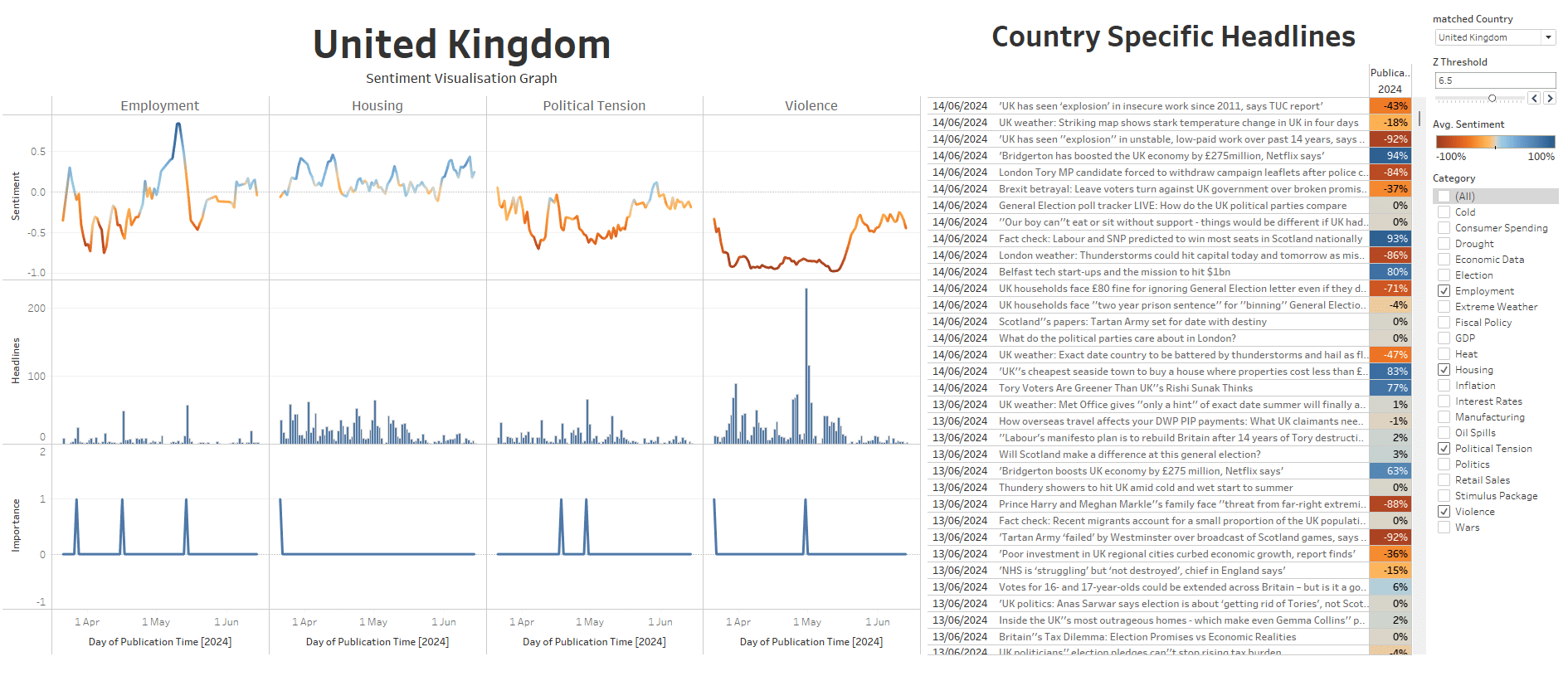
The pulse of news sentiment can shift rapidly, understanding these changes is crucial for policymakers, business leaders, and community advocates. Our recent comprehensive analysis of our UK data sets sheds light on the intricacies of public mood across various sectors in the United Kingdom, revealing how employment, housing, political tension, and concerns over violence influence collective sentiment. Let’s take a closer look at what we have uncovered.
Let’s start by looking at employment sentiment. The employment landscape in the UK during the selected period of late March to June 2024 has been marked by significant volatility, as indicated by our UK data sets. Over the past few months, news sentiment has experienced sharp peaks and deep troughs, reflecting the complex realities of the job market. Take late April – for example – where there was a notable spike in positive sentiment, suggesting a temporary boost in public confidence. This is likely to be due to the announcement of new legislation expanding rights for employees around flexible working, paid and unpaid leave, and protection from redundancy during parental leave around that time. Sad to say that this resulting optimism was sadly short-lived as sentiment quickly plummeted thereafter. But look how the fluctuating sentiment can be linked to a series of impactful headlines.
In contrast to the employment sector, the housing market sentiment has been relatively stable in recent months, albeit with its own set of challenges which we are all well versed on. Here, the overall trend is that of a slight positive sentiment, which suggests that despite periodic setbacks, the public maintains a generally optimistic view of the housing sector. This stability is occasionally disrupted by minor peaks and valleys, often triggered by specific news events. For example, a headline like “UK’s cheapest seaside town to buy a house where properties cost less than £83,000” in early June unsurprisingly brought a wave of positive sentiment. This would have provided a glimmer of hope for potential homeowners, reflecting affordability and accessibility in certain areas while so many continue to struggle to get a foot on the ladder. However, the housing market remains susceptible to broader economic trends and policy changes, so continuous monitoring and adaptive strategies are the order of the day, as reflected in the UK data sets.
Next, let’s look at political sentiment. Political sentiment in the UK remains predominantly negative, reflecting widespread public dissatisfaction with the current political landscape. Our UK data sets reveal significant dips in sentiment, particularly in late March and mid-April. These periods of heightened tension are often driven by contentious political developments and policy decisions, and in this case most likely linked to when speculation around a general election date began to mount. As so often happens, headlines like “Brexit betrayal: Leave voters turn against UK government over broken promises” capture the essence of public discontent. The ongoing Brexit saga, coupled with perceived governmental failures, continues to erode public trust. This sustained negativity calls for a more transparent and accountable political process to rebuild confidence and address the root causes of dissatisfaction, as suggested by the trends in the UK data sets.
Now let’s talk violence. News sentiment regarding violence has remained consistently low, highlighting a deep-seated concern among the populace. Although there are brief periods of stabilisation, the overall mood is marked by apprehension and unease. The persistent negative sentiment around violence highlights a need for comprehensive strategies to address underlying causes and improve public safety to mitigate these concerns. The reality is that this low sentiment is reflective of widespread fear and anxiety about crime and violence, which can have far-reaching impacts on community well-being and cohesion that must be addressed by policymakers and community leaders alike.
So what does this all mean? All of these points taken from our UK data sets highlight the varying sentiments across different sectors, illustrating the complexities of news sentiment. For policymakers, this data provides critical insights into areas requiring immediate attention, such as employment stability and political transparency. For businesses, understanding these trends is vital for tailoring strategies that resonate with consumer sentiment and address their concerns effectively. Ultimately, the data highlights the importance of staying connected to news sentiment. By keeping a finger on the pulse of public opinion through our UK data sets, decision makers can better navigate the challenges and opportunities that lie ahead. For community leaders and advocates, this means leveraging these insights to drive positive change and foster resilience within communities.
Now let’s get to the part where we explain how we do this. We use advanced machine learning algorithms to analyse extensive news data from various reputable sources. This comprehensive process begins with data collection, where news articles, reports, and headlines related to key sectors such as employment, housing, political tension, and violence are aggregated. Next, sentiment analysis is conducted using natural language processing (NLP) techniques to evaluate the tone of each news piece, categorising it as positive, negative, or neutral and assigning a sentiment score to quantify its intensity.
But that’s not all. The analysis also includes trend identification, tracking sentiment trends over time to detect significant fluctuations and patterns, thereby understanding how specific events and headlines influence public sentiment daily. Finally, significant sentiment changes are correlated with impactful headlines and news events, providing context and insight into the underlying factors driving public mood.
Our data-driven analysis of news sentiment in the United Kingdom, based on our UK data sets, offers a nuanced understanding of the current mood across various sectors. The fluctuating sentiments around employment, the relative stability in housing, the persistent negativity in political tensions, and the consistent concerns over violence all paint a complex picture of public opinion.
There are so many use cases for our UK data sets. If you’d like to experience firsthand how our comprehensive news sentiment analysis can inform your decisions and strategies, get in touch to request a free by emailing enquiries@permutable.ai or fill in the form below.