Navigating the Great Power Competition: Geopolitical risk and corporate strategy
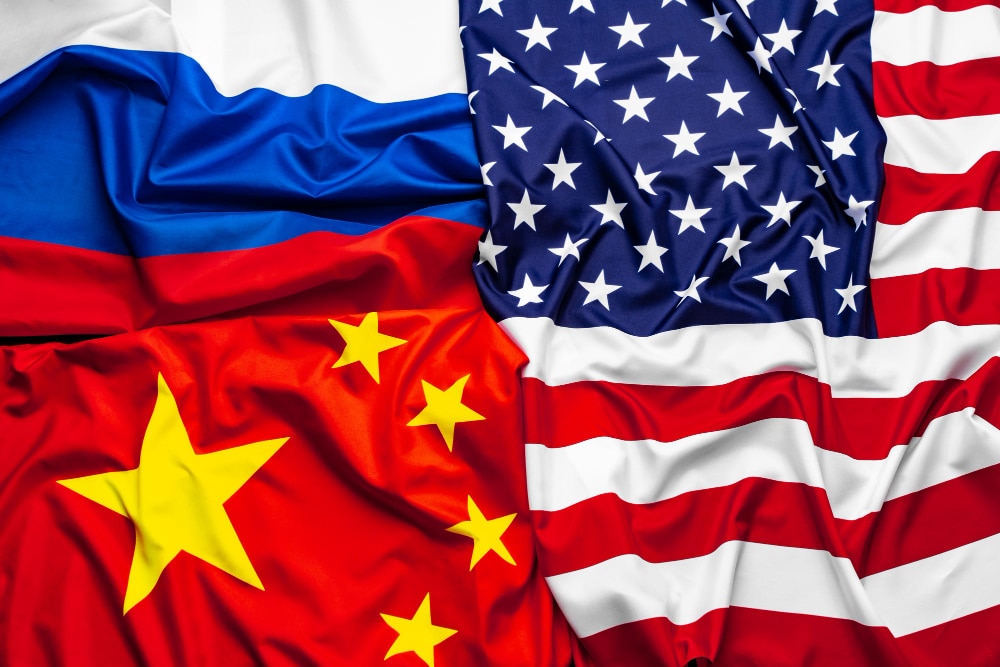
You can also access top-line geopolitical insights through our Real-Time Geopolitical Insights & AI Market Sentiment Analysis Dashboard which is publicly available to view. One of the biggest developments in today’s global economy is the challenges companies face from geopolitical shifts and growing rivalry among major world powers like the US, China, and Russia. The Great Power Competition goes beyond military strength and affects key areas such as trade, tech, and investment. As these countries compete for strategic control, businesses must create strong risk management plans to handle this tricky situation. This article looks at how great power competition affects corporate strategy and how advanced analytics like our geopolitical data can help companies stay on top of these global changes.

How the Great Power Competition affects business strategy

It’s inevitable that the Great Power Competition has become a key feature of the 21st-century geopolitical scene. As countries like the US, China, and Russia fight for global influence, their actions shake up the global economy. Trade wars, tariffs, sanctions, and rule changes are just some of the ways these powers try to assert control often causing big problems in international trade and investment.

The problem is, for big companies working in many countries, these dynamics create big risks. Let’s start with the issue of tariffs between the US and China, which have raised costs for businesses that rely on cross-border supply chains. Then there is are the sanctions against Russia which have made Western companies working there rethink their plans often leading them to sell off assets or change how they operate.

In this environment, the obvious point here is that companies can’t just sit back. They need to manage the risks that come with geopolitical instability. With that in mind, they need to understand the immediate effects of policy changes and also predict future developments. As a result, a well-planned risk management strategy will help businesses reduce potential losses and, in some cases even use geopolitical shifts to gain an edge over competitors.

Navigating the Great Power Competition: Key risk management strategies

At Permutable, we are lucky to work with a collection of seasoned geopolitical analysts. Their advice on how to navigate the risks presented by the Great Power Competition is summarised below.

Spreading out supply chains

One of the best ways to handle geopolitical risk is to spread out supply chains. Companies that depend on making or buying from one country in unstable regions, face big risks. By getting supplies from different places around the world, businesses can reduce their risk of problems caused by tariffs, trade limits, or political instability.

Planning for different scenarios

Planning for different scenarios is a crucial tool in managing geopolitical risk. It involves coming up with several possible ways geopolitical events might unfold and figuring out how they could affect business operations. By getting ready for a range of outcomes, companies can better position themselves to respond and to unexpected events.

Insurance against political risk

For companies working in high-risk areas, insurance against political risk can provide protection against losses caused by political instability such as property seizure, currency problems, or violent conflict. While this insurance can be expensive, it’s often worth it for businesses facing big geopolitical risks.

Getting involved in public policy

Companies can reduce geopolitical risks by taking part in public policy discussions and pushing for rules that support stable and predictable business environments. This involvement can include lobbying, joining industry groups, or teaming up with other businesses to influence policy decisions that affect the global market.

Being able to adapt and change

A fast-changing geopolitical scene calls for quick changes. Companies must stay nimble ready to shift their plans as new events unfold. This might mean moving investments breaking into new markets, or even changing how they do business to fit the new geopolitical reality.

The Great Power Competition and how our geopolitical data can help you manage political risks 

In today’s digital age, companies can access seemingly infinite amounts of data to shape their risk plans. But the sheer amount of info can be too much, and finding useful insights is tough. This is where our AI-driven geopolitical data solutions step in. We use top-notch artificial intelligence to analyse geopolitical events and trends in real-time. By crunching vast amounts of data from news, social media, and government sources, we’re able to spots patterns and predicts risks with high accuracy.

Here’s how our geopolitical data is a game-changer in boosting a company’s risk management:

Real-time monitoring

In a world where geopolitical changes happen fast and without warning, staying informed is key. Permutable AI keeps a constant eye on geopolitical events letting companies know right away about changes that could affect their work. Whether it’s new tariffs, a sudden flare-up in a regional conflict, or a major policy change, businesses get instant alerts and can act .

Future forecasting

Beyond just reporting current events, our algorithms can predict future geopolitical trends. By looking at past data and current signs, the AI can forecast potential risks and chances giving businesses a leg up. For example, if the AI thinks trade tensions between two countries might get worse, companies can change their supply chains or protect themselves against possible money losses.

Risk checking and planning

Our tools can also fit into a company’s planning process. By giving detailed risk checks based on many factors, from economic signs to political feelings, the AI can help businesses create more accurate and complete plans. This leads to better-informed choices and stronger strategies.

Custom insights

Every business has its own risk factors based on its industry where it operates, and how it works. We offers insights tailored to each company’s specific needs. This ensures the info provided is useful and actionable letting businesses focus on the risks that matter most to them.

Better decision-making

By giving a clear, data-driven view of the geopolitical scene, we are able to support our clients to make smart decisions. This is valuable in high-stakes situations where delays or wrong calls can lead to big losses.

In a time of big power rivalries, businesses need strong risk management plans to navigate the complex and ever-changing geopolitical scene. The stakes are high, and the risks are real, but with the right tools and strategies, companies can not protect themselves from possible losses but also grab chances that come from geopolitical shifts.  Our geopolitical data solutions mark a big step forward in risk management. By providing real-time monitoring, future forecasting, and custom insights, this technology gives businesses the edge they need to navigate the complexities of the Great Power Competition. 

Secure your business future with Permutable AI’s data intelligence

Don’t let geopolitical risks catch your business off guard. Equip your team with the tools and insights needed to navigate the complexities of the Great Power Competition. Discover how Permutable AI’s cutting-edge geopolitical data solutions can help you stay ahead of global shifts and turn risks into opportunities. Take the first step towards stronger risk management today. Simply send an email to enquiries@permutable.ai to learn more, or fill in the form below. You can also access top-line geopolitical insights through our Real-Time Geopolitical Insights & AI Market Sentiment Analysis Dashboard which is publicly available to view. 

Get in touch


Europe economy news: Insights from Permutable AI’s latest GDP sentiment analysis

According to that latest in Europe economy news as outlined in a recent article posted by LinkedIn editors, British firms recently reported their strongest growth in four months, with the PMI rising to 53.4 in August. This outpaced expectations and suggests a healthy economic expansion without fuelling inflation. Meanwhile, European PMI data revealed a mixed landscape. France surged to a 27-month high of 55.0, buoyed by the Olympic Games. However, Germany’s business activity contracted for the second month running. The Eurozone composite PMI bounced to 51.2, showing surprising strength. Markets are now focused on the US Fed’s Jackson Hole conference, with Chair Jerome Powell’s speech on Friday eagerly anticipated for hints on future rate decisions.

In connection with this Europe economy news, our latest analysis examines the perceptions held by the major economies of Europe—Germany, the United Kingdom, France, Italy, and Spain—regarding each other’s economic strength, particularly their Gross Domestic Product (GDP). Using our state-of-the-art sentiment analysis, we’ve uncovered some insights into the biases and sentiments that shape economic relations within Europe.

Europe economy news: How the major economies of Europe are perceived in terms of GDP

Europe economy news: Country matrix GDP

Europe economy news: How Germany is perceived

Germany, Europe’s largest economy, plays a pivotal role in the continent’s financial landscape. Yet, our analysis reveals a spectrum of perceptions. While Germany is confident in its economic might, with a 100% neutral to positive self-view, it faces significant scepticism from the UK, which views Germany’s GDP with a distinct -49% bias, according to our data. This negative perception is particularly relevant in light of Germany’s recent financial challenges, as indicated by its weak PMI data, showing a contraction in business activity for two consecutive months. Despite its industrial strength and global influence, other European nations now view Germany’s economic future with caution.

How the United Kingdom is viewed

The United Kingdom remains one of Europe’s leading economies, and our data shows that its European neighbours hold it in high regard. Germany views the UK’s GDP 80% positively, while France has a 74% favourable perception, reflecting a strong recognition of the UK’s economic power. This positive sentiment aligns with recent Europe economy news developments in the UK, where British firms have reported their strongest growth in four months, with the PMI rising to 53.4 in August. This growth bodes well for the Bank of England and the new UK government, suggesting that the UK can navigate post-Brexit challenges without exacerbating inflationary pressures.

How France is looked upon

France stands out in our analysis, with other European nations viewing it favourably. Italy, for instance, sees France’s GDP with a 47% positive bias, highlighting the robust business ties between these two countries. This perception is further bolstered by France’s recent economic performance, where the PMI soared to a 27-month high of 55.0, driven by the Olympic Games. France’s ability to maintain and even enhance its economic standing in a mixed European landscape underscores its role as a stable and growing economy within the Eurozone, as reflected in the latest Europe economy news.

How Italy is perceived

Italy is another key European economy that receives favourable perceptions from its neighbours. Both the UK and France exhibit a 47% positive bias towards Italy’s GDP, recognising the country’s strengths in sectors such as fashion, automotive, and tourism. Despite broader economic challenges in Europe, Italy maintains a positive and stable image, indicating that it is seen as a resilient economy which has weathered the recent crisis well, contributing significantly to the European market. This positive perception is crucial for Italy as it continues to play a vital role in the region’s economic dynamics, as observed in recent Europe economy news.

How Spain is viewed 

Spain’s economy is perceived as stable, with the UK and France each showing a 33% positive outlook. While Spain may not command the same attention as Germany or France, its steady economic performance and diverse industries provide a solid foundation in Europe’s mixed economic landscape. Spain’s neutral image may reflect its consistent, if less dynamic, economic results. As the country continues to develop its cultural and industrial sectors, maintaining this stability will be crucial for its long-term economic influence in Europe. This is an important aspect of the ongoing Europe economy news.

Europe economy news: Interpreting Europe’s economic perceptions

Our data analysis paints a rich and diverse picture of economic perceptions within Europe. While countries like Germany and the UK face mixed or challenging views, France and Italy enjoy more favourable opinions from their European counterparts. These perceptions are not abstract sentiments—they reflect real economic outcomes and influence how countries interact on the global stage. Staying informed about these perspectives is essential for understanding the broader context of Europe economy news.

At Permutable AI, as a Data as a Service provider, we believe that understanding these biases is essential for anyone looking to conduct business in Europe or shape economic policy. Our cutting-edge sentiment analysis tools provide the insights needed to navigate these complex environments, helping our clients stay ahead in an ever-changing economic landscape.

As markets turn their attention to major global events such as the US future interest rate decisions, gaining an accurate understanding of economic perceptions in Europe becomes increasingly critical. At Permutable, we are committed to providing the core data and insights that will help our clients make informed decisions in this dynamic landscape, as covered in the latest Europe economy news.

Europe economy news: Find out more

To gain deeper insights and discover how our advanced data intelligence solutions can benefit your organisation, explore our comprehensive country bias matrix and geopolitical data analysis. Simply email us at enquiries@permutable.ai to find out more or fill in the form below. 

Get in touch