Key geo political issues 2025: 8 global flashpoints investors can’t ignore

This article provides a comprehensive analysis of the most critical breaking geo political issues 2025 at time of writing and their profound impact on global markets, providing institutional investors with strategic insights for navigating unprecedented political risk. It is aimed at institutional investors, portfolio and macro strategists, risk managers, commodities and energy traders, and global research teams seeking to anticipate and capitalise on geopolitical developments before they reach market consensus.

The landscape of global geopolitical risk has fundamentally shifted in 2025, presenting institutional investors with a complex web of interconnected tensions that demand sophisticated analytical capabilities and real-time intelligence. The rising wave of geo political issues are not merely isolated incidents but part of a broader realignment of global power structures that will continue to shape market dynamics for years to come. The traditional approach of reactive positioning – waiting for geopolitical events to unfold before adjusting portfolios – has proven increasingly inadequate in an environment where milliseconds can determine the difference between capturing alpha and experiencing significant losses.

For institutional investors, the challenge extends beyond simply identifying potential flashpoints to understanding their interconnected nature and cascading effects across multiple asset classes, regions, and time horizons. The sophisticated investor recognises that effective macro research in today’s environment requires not just awareness of these tensions but the ability to process vast streams of real-time intelligence, identify subtle shifts in sentiment and positioning, and translate these insights into actionable investment strategies before market consensus emerges.

Key geo political issues 2025

1. US-China trade relations and alliance dynamics

The evolving trade relationship between the United States and China continues to represent one of the most significant geo political issues in 2025, with implications extending far beyond bilateral trade flows. The complexity of this relationship has deepened as both nations navigate technological competition, supply chain reorganisation, and strategic alliance building. For institutional investors, understanding these dynamics requires monitoring not only official government communications but also corporate earnings calls, supply chain disruptions, and shifting patterns in global manufacturing and technology investment.

The alliance dimension adds another layer of complexity, as US partnerships with Japan, South Korea, Australia, and European nations create ripple effects that impact everything from semiconductor markets to rare earth metal pricing. Importantly, sophisticated macro research capabilities enables investors to track sentiment shifts across multiple jurisdictions simultaneously, providing early warning signals for policy changes that may not be immediately apparent through traditional diplomatic channels. The ability to process and analyse these diverse information streams in real-time through technologies such as our provides powerful advantages for positioning in technology sector equities, emerging market currencies, and commodity futures.

2. Iran-Israel regional conflict and energy security implications

The ongoing tensions between Iran and Israel have evolved into a broader regional confrontation with profound implications for global energy markets and Middle Eastern stability. The Strait of Hormuz, through which approximately 20% of global oil passes, remains a critical chokepoint that demands constant monitoring by energy traders and macro strategists. The sophistication required to analyse this situation extends beyond simple conflict monitoring to encompass complex supply chain analysis, regional alliance dynamics, and the potential for proxy conflicts across multiple theatres.

For institutional investors, the challenge lies in understanding how these regional tensions translate into global market impacts. Oil price volatility, safe-haven flows into precious metals and government bonds, and currency fluctuations in energy-dependent economies all require sophisticated analytical capabilities that can process information from diverse sources whilst identifying patterns and connections that may not be immediately apparent. It is here that real-time sentiment analysis of government communications, military positioning, and diplomatic initiatives provides distinct competitive advantage, providing crucial early warning signals for potential escalation or de-escalation scenarios.

3. India-Pakistan border dynamics and South Asian stability

The persistent tensions along the India-Pakistan border represent a significant source of regional instability with global implications for technology outsourcing, manufacturing supply chains, and emerging market investment flows. The nuclear dimension of this relationship adds layers of complexity that require sophisticated risk assessment capabilities beyond traditional geopolitical analysis. For institutional investors with exposure to South Asian markets, understanding these dynamics requires monitoring not only official government communications but also military movements, diplomatic initiatives, and public sentiment across both nations.

The economic implications extend far beyond the immediate region, with potential disruptions to global technology supply chains, pharmaceutical manufacturing, and textile production. Macro research capabilities that can track sentiment shifts in this context provide essential insights for investors seeking to position themselves appropriately in emerging market equities, currency markets, and sector-specific exposures that may be affected by escalating tensions.

4. Turkey-Israel confrontation and Syrian complexity

The evolving relationship between Turkey and Israel, particularly in the context of Syrian developments, represents a complex geopolitical dynamic with implications for NATO cohesion, regional stability, and energy transit routes. The multifaceted nature of this situation requires advanced analytical capabilities that can process information from diverse sources whilst understanding the historical context and strategic implications of various policy positions.

For institutional investors, the challenge lies in understanding how these regional dynamics translate into broader market impacts. Currency volatility in the Turkish lira, implications for European energy security, and potential disruptions to trade routes all require sophisticated analytical frameworks that can identify subtle connections between seemingly unrelated developments. The ability to track sentiment across multiple stakeholders and jurisdictions provides obvious advantages for positioning in emerging market currencies, energy sector equities, and regional bond markets.

5. China-Russia-Iran-North Korea strategic coordination

The emerging strategic coordination between China, Russia, Iran, and North Korea – otherwise known as “The Axis of Upheaval” – represents a concerning fundamental shift in global power dynamics with far-reaching implications for international trade, financial markets, and security architecture. Understanding this complex relationship requires analytical capabilities that can process information from diverse sources whilst identifying patterns and connections that may not be immediately apparent through traditional diplomatic channels.

For institutional investors, the implications extend across multiple asset classes and regions. Sanctions regimes, trade route disruptions, technology transfer restrictions, and commodity price volatility all require sophisticated risk assessment capabilities that can anticipate policy changes and market reactions before they are reflected in asset prices. Here, the ability to track sentiment and positioning across multiple jurisdictions provides essential early warning signals for potential market disruptions or investment opportunities.

6. Chinese naval activity in the Tasman Sea

The expansion of Chinese naval presence in the Tasman Sea represents a significant development with implications for regional security architecture, trade routes, and alliance dynamics between Australia, New Zealand, and their Pacific partners. Understanding the strategic implications of this development requires analytical capabilities that can process information from diverse sources whilst assessing the potential for escalation or accommodation.

For institutional investors, the implications extend beyond immediate regional concerns to encompass broader questions about global trade routes, commodity exports, and currency stability in the Pacific region. The ability to track sentiment and positioning across multiple stakeholders provides crucial insights for positioning in commodity markets, regional currencies, and sector-specific exposures that may be affected by evolving strategic dynamics.

7. The War in Ukraine and proxy risk scenarios

The ongoing conflict in Ukraine continues to represent one of the most significant sources of geopolitical risk in 2025, with implications extending far beyond the immediate theatre of operations. The potential for proxy conflicts, alliance testing, and economic disruption requires sophisticated analytical capabilities that can process vast amounts of information whilst identifying patterns and connections across multiple dimensions of international relations.

For institutional investors, the challenge lies in understanding how this conflict continues to shape global markets through energy price volatility, supply chain disruptions, defence sector investment, and safe-haven flows. The ability to track sentiment and positioning across multiple stakeholders provides essential insights for positioning in energy markets, defence sector equities, and European regional investments alike that may be affected by evolving conflict dynamics.

The market impact of key geo political issues in 2025

The cumulative effect of these geo political issues in 2025 has created an environment of heightened market volatility that demands sophisticated risk management capabilities and strategic positioning. Traditional approaches to portfolio construction and risk assessment have proven inadequate in an environment where geopolitical developments can trigger rapid shifts in asset prices, currency values, and commodity markets within hours or even minutes of initial reports.

The interconnected nature of modern financial markets means that geopolitical developments in one region can quickly propagate across multiple asset classes and geographic regions. Central bank policy responses, safe-haven flows, and inflation expectations all become interconnected variables that require comprehensive analytical frameworks capable of processing vast amounts of information whilst identifying subtle patterns and relationships that may not be immediately apparent.

For institutional investors, the challenge extends beyond simply identifying potential risks to understanding their potential market impacts and developing appropriate hedging strategies. The ability to integrate real-time geopolitical intelligence into existing risk management frameworks provides crucial advantages for maintaining portfolio stability whilst identifying opportunities for alpha generation during periods of heightened volatility.

How our geopolitical intelligence enables strategic advantage in geopolitical analysis

Our advanced geopolitical sentiment provides institutional investors with the sophisticated analytical capabilities required to navigate these complex dynamics effectively.

LNG trade Chart

Above: Our real-time geopolitical and macro sentiment intelligence identified a bullish LNG regime before price momentum took off. From early entry post-project disruption to accurately tracking the market’s response to EU sanctions, pipeline expansions, and force majeure developments, Our system flagged the bullish shift in fundamentals and macro tone — well ahead of the crowd. 

Our real-time sentiment analysis enables investors to track developments, providing early warning signals for potential escalation or de-escalation scenarios before they are reflected in market prices. Importantly, the integration of historical data spanning multiple years enables sophisticated backtesting and scenario analysis that can help investors understand how their strategies might perform under various geopolitical conditions.

war index

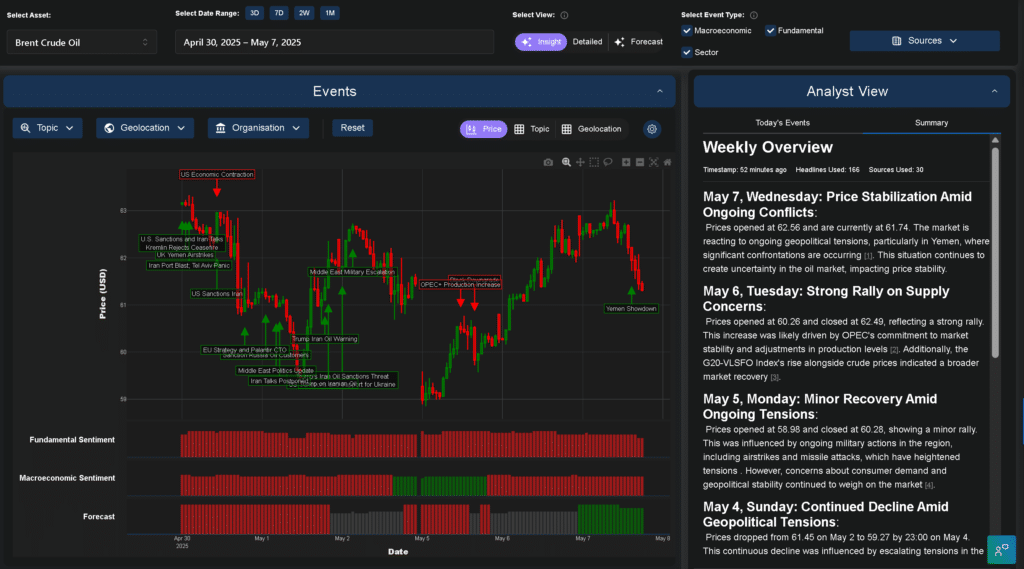
Above: This chart reveals how our geopolitical sentiment data tracked a deepening negative tone surrounding Iran–Israel tensions before Brent crude broke out. With a clear sentiment trough marking the possible entry, investors using our signal analytics gained valuable early warning before the oil rally began to price in risk premium.

In terms of macro research, the ability to feed real-time sentiment data directly into trading algorithms and risk management systems represents a fundamental shift in how institutional investors can respond to evolving geopolitical conditions using our data. This integration enables dynamic adjustment of portfolio exposures based on real-time developments rather than static risk parameters or delayed market reactions.

Above: Our Political Tension Index captures 12 months of shifting geopolitical risk, from the US shutdown threat and Canada tariff war to the Trump-Musk fallout. The green zone highlights a brief diplomatic reprieve – rapidly followed by re-escalation. For institutional clients, this index offers a quantifiable edge in forecasting how political narratives translate into market volatility across FX, commodities, and safe-haven assets.

The bottom line here is that the top geo political issues 2025 weave a complex and delicate landscape of risk requiring sophisticated analytical capabilities that can process vast amounts of information whilst identifying actionable insights for institutional investors. Ultimately, the institutions that successfully leverage these advanced capabilities will find themselves with substantial competitive advantages in an increasingly complex global environment. Why? Simply because the future of geopolitical risk management lies not in replacing human expertise but in augmenting it with powerful analytical tools that can process information at scales and speeds that would be impossible through traditional methods.

As global tensions continue to evolve and intensify, the ability to anticipate and respond to geo political issues before they reach market consensus will become increasingly valuable for institutional investors seeking to maintain competitive advantages whilst managing portfolio risks effectively. The question for institutional investors is not whether to adopt these advanced capabilities but how quickly they can be integrated into existing investment processes to capture the substantial opportunities they represent.

Transform geopolitical chaos into alpha generation – discover how our real-time geopolitical intelligence turns breaking tensions into strategic advantage before they hit market consensus. Contact our enterprise team at enquiries@permutable.ai to see how institutional leaders are using our advanced analytics to navigate 2025’s most volatile geopolitical landscape.
FAQ on our Auto Analyst and Market Forecast Agents

This FAQ is designed for institutional investors, analysts, and strategic teams looking to understand how Permutable AI’s Auto Analyst and Forecast Agents provide real-time market forecast capabilities and explainable insights across asset classes.

At Permutable, we help institutional decision-makers go beyond delayed data and headline-chasing. Our Auto Analyst and Forecast Agents tools provide actionable, explainable intelligence that helps you make faster, smarter decisions across markets. In this FAQ, we’ll answer the key questions we hear from traders, asset managers, investment banks, and corporate strategy teams looking to integrate real-time macro and sentiment data into their workflows.


What’s the difference between Auto Analyst and Market Forecast Agents?

Auto Analyst gives you clear, analyst-style summaries of recent market movements. It identifies the key drivers behind price action using a blend of sentiment analysis, macro data, and fundamental news. Think of it as your go-to for understanding what happened and why — in minutes, not hours.

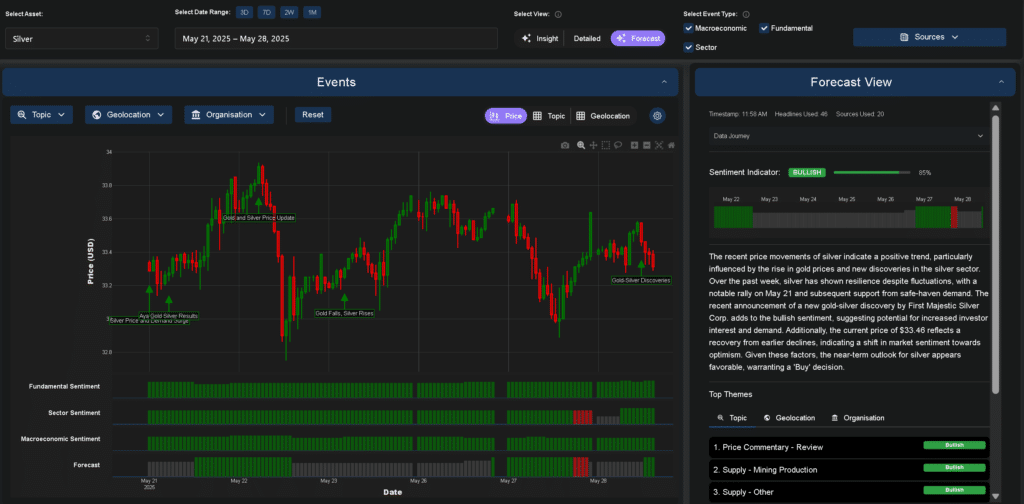
Forecast Agents, on the other hand, provide forward-looking predictions on market direction – refreshed hourly. Each forecast includes a directional call (e.g. BUY/SELL), the supporting rationale, and topic-level sentiment scores.

Use both tools together to gain a complete picture of past, present, and future market dynamics.

Gold vs oil correlation brent crude oil
silver price forecast 28 May 2025

How accurate are these insights and predictions?

We combine large language models, market signals, and validated global sources to deliver insights that are explainable, relevant, and timely. Forecasts are continuously tested against historical price action, and updated every hour to reflect the latest information flow. This means you’re acting on quantified insight, not outdated consensus.


What markets do you cover?

Our tools cover a wide range of asset classes:

  • Energy: Crude oil, natural gas, renewables

  • Metals: Gold, silver, copper, platinum, palladium 

  • Agriculture: Grains, softs, livestock

  • Currencies: Major FX pairs and indices

  • Fixed Income & Equities: Coming soon

Use cases include:

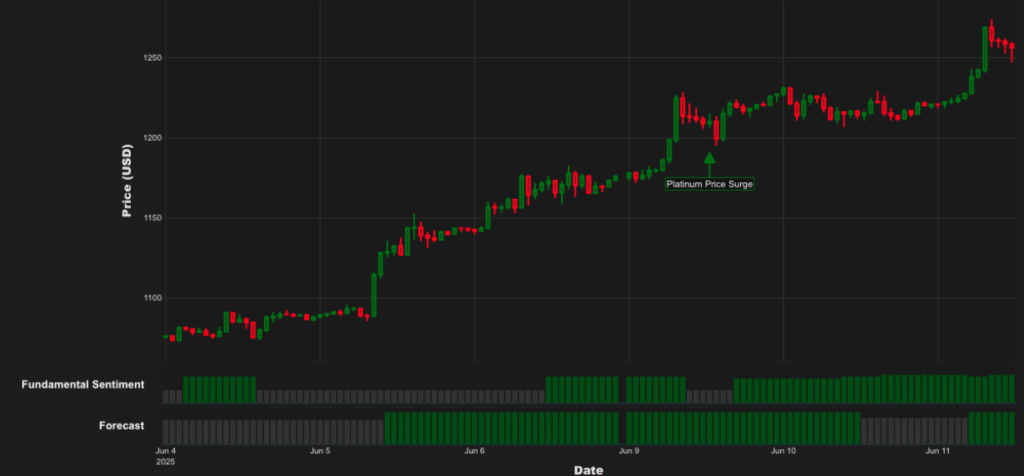
platinum price surge
Wheat Rallies

How is this different from a typical research platform?

Most research platforms tell you what’s already happened — often without context. Our tools tell you why something happened and what might happen next. Auto Analyst condenses thousands of headlines, economic signals, and sentiment shifts into a concise, readable summary. Forecast Agents take it further by offering live directional calls with transparent logic. No black boxes. Just insight you can trust.


Can this be integrated with our internal systems?

Yes. Both Auto Analyst and Forecast Agents are available via secure, enterprise-grade API. That means you can plug them directly into dashboards, trading models, or strategy tools – no new platform required. Some clients also surface the data within investment committee presentations, client reports, or deal evaluation workflows.


How often are insights updated?

This makes both tools well-suited for live desk use, as well as daily and weekly macro strategy workflows.


Are these just for traders?

Not at all. Here is a list of use cases from our clients:

If you’re tracking markets to inform decisions – our Plug and Play intelligence tools are for you.


What if I want transparency behind the output?

Transparency is built in. Each Auto Analyst report includes plain-English reasoning behind market shifts. Forecast Agents provide supporting arguments for every directional call, drawn from our global signal layer. We highlight top themes (e.g. monetary policy, economic data, trade risks) and the specific news items influencing the model – so you always understand the “why” behind the forecast.


Can we try it before committing?

Absolutely. We offer:

  • Live, tailored demos based on your asset focus

  • Access to sample API outputs for both Analyst and Forecast endpoints

  • A walkthrough of how our tools fit into your workflows, systems, and reporting

Just email us at enquiries@permutable.ai to get started.


How do I know if this fits my workflow?

Our tools are built to support both front-office and strategic roles. Whether you’re monitoring price drivers in real time, enhancing internal models with macro reasoning, writing weekly strategy briefs for CIOs and clients, or building a more data-driven corporate intelligence function, Auto Analyst and Forecast Agents are designed for speed, scale, and clarity.

Clients often tell us it’s like having an army of analysts on call – without the delay. Whether you’re reviewing the past week or anticipating tomorrow’s move, our solutions help you cut through the noise and focus on what truly matters.

Ready to stop reacting and start anticipating?

See how our Auto Analyst and Forecast Agents can supercharge your decision-making, eliminate research lag, and give your team an edge—before the market moves. Request your demo now at enquiries@permutable.ai

Top market sentiment companies of 2025: A strategic comparison

This article is a comprehensive comparison guide of leading sentiment analytics companies in the financial markets, aimed at institutional investors, traders, asset managers, and fintech professionals who are evaluating different sentiment analysis platforms to enhance their trading strategies and investment decision-making processes.

As markets become increasingly data-driven, sentiment companies are playing a central role in helping institutional investors, traders, and analysts extract timely insight from unstructured information. Whether it’s gauging reactions to central bank announcements or spotting early shifts in commodity prices, the best sentiment companies offer more than just a trend – they provide a critical edge.

But with a variety of platforms claiming to offer “AI-powered sentiment,” how do you know which solution is right for you?

At Permutable, we’re often compared to other leading sentiment companies. So we’ve compiled this guide to show how we — and they — stack up, using clear, honest comparisons to help you choose the best fit for your needs.


Top market sentiment companies: What to look for 

When evaluating sentiment companies for institutional use, several key factors separate the leaders from the pretenders. Here’s what serious buyers should prioritise:

Data quality and coverage

Real-time, high-quality data feeds are non-negotiable for institutional traders and asset managers. Look for providers that offer comprehensive coverage across multiple asset classes, geographic regions, and data sources. The best sentiment analytics platforms process thousands of news sources, social media feeds, regulatory filings, and alternative data streams simultaneously, ensuring you never miss market-moving information.

Methodology and transparency

Transparency in scoring methodology builds trust and enables proper risk management. Serious institutional buyers need to understand exactly how sentiment scores are calculated, what data sources contribute to each signal, and how the models handle edge cases or conflicting information. Avoid “black box” solutions that can’t explain their reasoning – regulatory requirements and internal risk frameworks demand explainable AI.

Asset class specialisation

Different asset classes require specialised multi-entity sentiment approaches. Equity sentiment differs significantly from commodity sentiment, which in turn varies from FX or fixed income analysis. Leading sentiment companies develop distinct models for each asset class, accounting for unique market dynamics, participant behaviour, and information flows specific to that market.

Integration and workflow compatibility

Modern institutional workflows require seamless integration capabilities. Look for sentiment providers offering robust sentiment APIs, flexible data formats, and compatibility with existing trading systems, portfolio management platforms, and research tools. The best solutions integrate directly into your existing workflow rather than requiring analysts to switch between multiple platforms.

Speed and latency

In today’s markets, milliseconds matter. Top-tier sentiment analytics platforms identify and score market-moving events within minutes – or even seconds – of occurrence. This speed advantage is crucial for systematic trading strategies, risk management, and capitalising on short-term market inefficiencies before they’re arbitraged away.

Customisation and scalability

Institutional requirements vary significantly across firms, strategies, and use cases. The most valuable sentiment providers offer customisable models, adjustable sensitivity parameters, and the ability to create bespoke sentiment indices for specific investment mandates or trading strategies.


Sentiment companies at a glance

Here’s a breakdown of the sentiment companies that often come up in conversations with clients and prospects, including our own.


1. Permutable

Best for: Institutional teams who need real-time, multi-entity sentiment tracking from news, macro events, and global data sources.

Why it works: At Permutable, we offer real-time data intelligence across thousands of entities – from commodities to equities and currencies – layered with contextual sentiment powered by proprietary LLM models. We don’t just say a news story is “positive” or “negative.” We identify the exact economic, geopolitical or environmental event, track its trajectory, and show you what’s shifting – and why.

Built for: Traders, asset managers, macroeconomic analysts, and fintech platforms who need speed, accuracy, and explainability.

Why people switch to us: Faster reaction time, richer context, and fully transparent scoring – all in a customisable, analyst-ready format.


2. Alexandria

Best for: Asset managers and financial services firms looking for thematic sentiment summaries.

Why it works: Alexandria uses natural language processing (NLP) to surface thematic trends across economic and financial narratives. They’re known for strong design and dashboard-based insights, with some ESG and macro overlays.

What’s the difference? Unlike Permutable, Alexandria tends to update sentiment in batches and has less focus on multi-entity correlation (e.g., how trade tensions in China affect copper, FX, and oil simultaneously).

Why companies switch to us: More detailed granularity, real-time responsiveness, multi-entity sentiment insights, and a broader range of event tagging.


3. Accern

Best for: Finserv teams who want NLP insights from financial news and social media.

Strengths: Good for surface-level signals and keyword trend detection, especially when integrated with traditional finance workflows.

Limitations: Typically lacks advanced contextualisation (multi-entity, macro linking), and leans more toward alerting than decision-making.

Why people consider Permutable instead: We offer more explainability, signal strength scoring, and use-case-ready insights for commodities, equities, FX, and global risk.

4. SESAMm

Best for: ESG and reputational sentiment analytics at the enterprise level.

Strengths: Strong reputation analysis across media sources, including litigation and controversy tracking.

Limitations: Less emphasis on real-time financial market movement, and limited in terms of intraday use by traders or quants.

Why Permutable appeals to traders: We focus directly on market-shifting data for commodities, equities, FX, macro indicators, and economic regimes — with explainable LLM-driven scoring.


5. Amenity Analytics (Now part of Symphony)

Best for: Event extraction from earnings calls and corporate filings.

Strengths: Earnings-specific sentiment, risk flags, and KPI tracking from structured corporate data.

Limitations: Primarily focused on equities and structured disclosures, not broader market news or geopolitical developments.

Why Permutable is different: We cover macro shifts, economic sentiment, global crises, and their direct impact across sectors — not just earnings.


6. RavenPack

Best for: Quant desks and hedge funds integrating news sentiment into models.

Strengths: Long-standing credibility in quant finance, structured feeds for systematic strategy development.

Limitations: Less transparency around scoring, slower updates in volatile news scenarios, and less flexibility around customisation.

Why people are choosing Permutable instead: Our explainability, next generation technology stack, cross-entity analysis, and real-time signal sensitivity deliver a clearer, more accessible and less crowded edge.

Company Best For Why It Works Limitations Why Companies Switch to Permutable AI
Permutable AI Institutional teams needing real-time, multi-asset sentiment across equities, macro, commodities, and FX Contextual, explainable sentiment across thousands of entities, powered by proprietary LLMs. Real-time updates, analyst-ready scoring, and cross-asset relationships — including equities, commodities, currencies, and global macro themes. Not designed for traditional earnings call parsing; instead, focused on broader market dynamics and real-time multi-entity sentiment. Clients switch for faster signal speeds, transparent scoring, and real-time event-based insights that integrate directly into macro, trading, and investment workflows.
Alexandria Asset managers and financial services looking for thematic dashboards Thematic sentiment analysis with ESG overlays and well-designed UI Sentiment updates in batches, less correlation tracking across entities and slower responsiveness Permutable offers more granular, real-time, and multi-asset sentiment with broader event tagging and macro mapping.
Accern Financial services teams wanting basic NLP alerts from financial news and social media Good for surface-level alerts and keyword trends across traditional finance content Limited contextualisation, weak macro integration, and not ideal for actionable signals Permutable provides deeper signal explainability, real-time sentiment strength, and use-case-ready insights across markets.
SESAMm Large enterprises monitoring ESG, litigation, and reputational sentiment Reputation analytics across media sources; strong in controversy tracking Not tailored for traders or real-time market monitoring Permutable appeals to financial teams seeking real-time sentiment that moves markets — not just reputational signals.
Amenity Analytics Equity analysts extracting KPIs from earnings calls and filings Corporate disclosure parsing with a focus on equity and KPI risk flagging Limited macro, geopolitical, or cross-sector event tracking Permutable enables broader economic sentiment mapping and market signal correlation across sectors — including equity news and market-moving themes.
RavenPack Quant desks and hedge funds using structured feeds for model building Structured news sentiment data for quant integration with long-standing industry presence Lower transparency in scoring, slower to adapt to volatile events, limited flexibility Clients choose Permutable for its modern architecture, transparent logic, and real-time multi-entity signal mapping across equities, commodities, currencies, and macro.

What’s the difference?

Any sentiment company can put a “positive” or “negative” label on a headline. The real question is — does the signal come in time, and does it help you act? At Permutable, we have built and our continuously refining our technology with institutional decision-making in mind. Our LLMs decode relationships in real time between events, entities, and asset classes. Whether it’s interest rate divergence in Asia, LNG supply shocks in Europe, or droughts impacting commodity prices in Argentina, our models deliver insight that’s immediate, specific, and actionable.


Who is our market sentiment for?

We’re not a one-size-fits-all vendor. We’re a market sentiment partner – designed for teams who want to move faster, with confidence.

Real-world use cases 

Explore some real-world applications of our market sentiment intelligence below:

Energy market foresight

Our narrative-driven energy indices have been used by commodity desks to detect sentiment-led shifts in oil and gas markets. For example, changes in OPEC-related narratives and geopolitical tensions in our indices aligned with subsequent crude oil price moves, providing traders with early warning signals to test alongside their existing models

Brent Crude Oil market sentiment indices

Macro policy monitoring

Our Monetary Policy Sentiment Index has highlighted how dovish and hawkish narratives often precede Federal Reserve rate decisions. Institutional clients use this to anticipate potential pivots before they are priced into yields, improving their positioning around FOMC announcements.

monetary Policy DOVISH vs HAWKISH

Political risk tracking

Our Political Tension Index has shown that political volatility is no longer episodic but systemic, with trade disputes, elections, and leadership events triggering market stress. Hedge funds and risk managers use the index as an early-warning system to adjust exposure ahead of headline-driven shocks.

Commodities strategy insights

Our agriculture sentiment has been be applied to wheat and soybean markets, where drought and trade policy headlines shifted sentiment before supply-demand data caught up. For commodity traders, this has provided a forward-looking lens into pricing pressure.

coffee

FX and fixed income signals

Through our Trading Co-Pilot’s cross-asset sentiment, clients track how currency weakness (like the yen) or yield curve stress (like UK gilts) links directly to political or macro sentiment shifts. This offers quant researchers and risk managers structural context beyond price action alone.

UK 30yr gilt

Why hedge funds and institutional trading desks are switching to Permutable

Our clients have been switching to  us because we offer what many sentiment companies can’t: real-time, explainable market intelligence tailored for today’s fast-moving, cross-asset trading environment and  ultimately proven alpha. Unlike tools built for batch updates, equities earnings, or basic media alerts, at Permutable we deliver high-frequency, multi-entity sentiment insights mapped directly to macroeconomic trends, commodities and currencies, equities and geopolitical events. Our transparent scoring and domain-specific LLMs ensure that the institutional teams we work with – from macro strategists to commodities traders – get not only speed and scale, but also clarity and confidence in their decision-making. Simply put, we help you act faster and smarter, when it matters most.

Don’t just monitor sentiment – understand it

Choosing the right sentiment company is about clarity, not features. It’s about who helps you see the signal, not the noise. At Permutable, we’re leading the next generation of sentiment companies by offering true data intelligence  – and this is what alpha looks like. 

Thinking of trying a new sentiment provider? Contact our team at enquiries@permutable.ai to discuss a demo or trial and experience first-hand how our sentiment data compares and discover why more trading desks are choosing data intelligence they can trust. 

Frequently Asked Questions

Q: How do I evaluate the accuracy of different sentiment analytics providers?

A: The best approach is to request historical backtesting data and pilot programmes that allow you to test sentiment signals against your specific use cases and trading strategies.

Q: What’s the typical implementation timeline for enterprise sentiment analytics?

A: Implementation timelines vary significantly based on your technical requirements and integration complexity. At Permutable, basic API integrations can be operational within a matter of days. The most successful implementations involve close collaboration between your quantitative team and our technical specialists to ensure optimal configuration for your specific use cases.

Q: How do I ensure sentiment data quality and avoid false signals?

A: Quality assurance should include multiple validation layers: source credibility weighting, cross-verification with market data, sentiment confidence scoring, and historical accuracy tracking. The best sentiment providers offer transparency into their data sources, allow you to adjust sensitivity parameters, and provide detailed attribution for each sentiment signal so you can understand exactly what’s driving the score.


People Also Ask

How reliable is sentiment analysis for commodities trading? 

Sentiment analysis can be particularly effective for commodities due to the significant impact of geopolitical events, weather patterns, and supply disruption news on commodity prices. The key is using providers with specialised commodity expertise who understand the unique drivers affecting different commodity markets.

How do sentiment analytics handle multiple languages and global markets?

The best providers use native language models rather than translation-based approaches, ensuring cultural nuances and market-specific terminology are properly captured. Look for providers with proven expertise in your target markets and languages, particularly for emerging market analysis.

What’s the future of AI in sentiment analysis for trading?

The industry is moving toward more sophisticated contextual analysis, multi-modal data fusion and real-time explanation capabilities. Generative AI and large language models are enabling more nuanced understanding of complex financial narratives and cross-asset correlations.

How do I measure ROI from sentiment analytics investments? 

Track metrics including alpha generation, risk-adjusted returns improvement, early warning system effectiveness, and operational efficiency gains. Many successful implementations show measurable improvements in Sharpe ratios, reduced drawdowns during volatile periods, and faster reaction times to market-moving events.


Avoiding multi asset alpha decay: How sentiment signals help you stay ahead of market consensus

This article explores how alpha decay erodes multi asset investment returns and demonstrates how real-time macroeconomic and geopolitical sentiment intelligence helps institutional investors maintain their competitive edge. It is written for portfolio managers, institutional traders, risk managers, and investment professionals seeking to preserve alpha in increasingly efficient markets.

The pursuit of sustainable alpha has become increasingly challenging in today’s hyper-efficient, data-saturated markets. Traditional investment approaches that once delivered consistent outperformance are facing diminishing returns as information asymmetries compress and market participants gain access to similar datasets. This erosion is particularly acute in geopolitical risk assessment, where conventional analysis methods lag behind real-time developments by critical hours or days unlike our geopolitical sentiment data.

The fundamental challenge lies in timing. To preserve alpha, institutional investors must anticipate market-moving events before consensus pricing reflects them. This requires moving beyond reactive positioning towards predictive intelligence that identifies sentiment shifts across asset classes, macroeconomic themes, and geopolitical developments as they emerge. The institutions that succeed in this environment will be those who recognise that alpha decay is not inevitable—it’s a consequence of relying on outdated intelligence frameworks that fail to capture the full spectrum of market-moving sentiment.

Alpha decay: Why it’s accelerating

Alpha decay represents the gradual erosion of excess returns as markets become more efficient and information spreads rapidly across participants. In modern markets, this phenomenon has accelerated dramatically due to reactive positioning, delayed signals, and herd behaviour that characterises institutional decision-making.

The mechanics of alpha decay are straightforward: when investment opportunities rely on publicly available information or widely-used datasets, competitive advantages compress rapidly. This creates a cycle where traditional analysis methods deliver diminishing returns, forcing institutions to chase increasingly marginal opportunities or accept market-level performance.

Sentiment signals as early indicators of market shifts

At Permutable, our sentiment analysis technology addresses this challenge by decoding market-relevant signals from global media, government sources, and official communications in real-time. Our artificial intelligence systems process vast quantities of unstructured data to identify sentiment divergences that precede price movements, providing institutional clients with crucial timing advantages.

The methodology goes beyond simple news aggregation. Our systems analyse policy statements, diplomatic communications, and regulatory filings to detect subtle shifts in sentiment that traditional analysis overlooks. This comprehensive approach captures emerging themes before they reach mainstream financial media, creating opportunities for forward-positioned investors.

Getting ahead of the curve: Timing advantage through intelligence

The importance of signal latency cannot be overstated in modern markets. Decision speed measured in minutes determines whether opportunities generate alpha or merely follow consensus. Early sentiment shifts reveal turning points before they’re priced in, providing the timing advantage that separates outperforming strategies from market followers.

The intelligence advantage extends beyond individual trades to broader portfolio construction. For example. by identifying sentiment inflection points in geopolitical tension, investment teams can adjust sector weightings, currency exposures, and risk budgets before consensus catches up. This systematic approach to sentiment-driven positioning creates sustainable alpha streams that compound over time.

Avoiding herd mentality and consensus traps

Ultimately, real-time sentiment signals help distinguish genuine market-moving developments from noise, breaking away from consensus-based strategies that trap investors in crowd-driven reversals. Traditional approaches often react to developments that are already priced in, creating the illusion of sophistication whilst delivering market-level returns.

The challenge lies in information interpretation. Markets are flooded with data, but most participants lack the analytical framework to separate signal from noise. Permutable’s sentiment analysis provides this differentiation by focusing on policy-relevant developments that drive asset prices rather than general market commentary.

Integrating sentiment signals into multi asset alpha preservation strategies 

The practical applications for portfolio managers, traders, and risk teams are extensive. Sentiment signals enhance sector rotation strategies by identifying policy themes before they manifest in earnings or economic data. Macro positioning benefits from early warning of regulatory changes or geopolitical developments that affect currency and commodity markets. Multi asset allocation strategies gain timing precision by anticipating sentiment-driven regime changes.

Our API integration allows systematic incorporation into existing investment processes without disrupting established workflows. The technology layers seamlessly with quantitative strategies, providing fundamental context for systematic trading decisions. This integration approach ensures that sentiment intelligence enhances rather than replaces existing analytical frameworks.

The applications extend to risk management, where sentiment signals provide early warning of developing stress conditions. Rather than reacting to volatility after it emerges, risk teams can adjust exposures based on sentiment deterioration, protecting portfolio performance whilst maintaining upside participation.

Intelligence as alpha infrastructure

The forward-looking institutions we work with know that using AI-driven sentiment analytics is to reap the benefits of layering an intelligence edge that preserves alpha in increasingly efficient markets. This technological advantage becomes particularly valuable during periods of heightened geopolitical uncertainty when traditional analysis methods prove inadequate yet when our sentiment indicators demonstrate outperformance. 

Short-term trading strategies benefit from tactical positioning opportunities, whilst longer-term investment approaches gain strategic insight into policy directions and regulatory changes. This comprehensive coverage ensures that our sentiment intelligence adds value regardless of investment style or asset class.

Outperforming by staying ahead of consensus

The bottom line is that sentiment signals significantly delay alpha decay by providing the timing advantage necessary to outperform increasingly efficient markets. As traditional analytical methods lose their edge, institutions that adopt AI-powered sentiment intelligence position themselves for sustainable outperformance.

The transformation has already begun among the forward-thinking institutions we work with, with those who embrace sentiment-driven intelligence frameworks already capturing alpha opportunities that remain invisible the majority. The question is not whether artificial intelligence will reshape investment analysis – it’s whether your institution will lead this evolution, follow, or perhaps lag behind it.

In essence, alpha preservation requires more than sophisticated models and extensive datasets. It demands intelligence infrastructure that anticipates market developments rather than reacts to them. In an environment where information advantages compress rapidly, the institutions that invest in predictive intelligence will be those that maintain their competitive edge in the years ahead.

Protect your alpha with Permutable’s advanced sentiment intelligence. Contact our institutional team at enquiries@permutable.ai to discover how geopolitical sentiment signals can enhance your investment strategies and keep you ahead of market consensus.


Enhancing inflation nowcast accuracy with machine learning-driven sentiment analysis

This article provides an overview of the five key methods by which Permutable’s advanced sentiment data feeds and machine learning capabilities can enable inflation nowcast professionals to enhance their forecasting models through real-time processing of global media, commodity signals, and market sentiment, offering institutional investors, central banks, and financial analysts unprecedented data inputs for their inflation prediction frameworks. It is written for chief economists, portfolio managers, central bank officials, financial analysts, and institutional investors seeking to enhance their inflation nowcast capabilities and risk management strategies through cutting-edge sentiment intelligence.

In the rapidly evolving landscape of economic forecasting, the ability to predict inflation movements has become increasingly key for institutional investors, central banks, and financial analysts. Traditional inflation metrics, whilst comprehensive, suffer from significant temporal delays that can leave market participants vulnerable to sudden price pressures. 

This is where Permutable’s macroeconomic sentiment intelligence can add instant value, providing economic forecasters with the real-time inputs needed to build more sophisticated inflation nowcast models that fundamentally change how professionals approach economic prediction and risk management.

In this article, we’ll explore give ways economic forecasters can use our real-time sentiment analysis API and platform to move beyond retrospective analysis to predictive intelligence. 

1. Real-time media and sentiment analysis for enhanced inflation nowcast models

Economic forecasters seeking to improve their inflation nowcast accuracy can leverage our sophisticated natural language processing capabilities, which continuously monitor over 100,000 global media sources, financial reports, and economic commentary feeds. 

Through advanced sentiment analysis algorithms developed specifically for financial markets, our platform quantifies the urgency and frequency with which inflationary pressures are being discussed across international markets. When news sources begin reporting on “rising food prices,” “labour shortages,” or “energy cost spikes” with increasing intensity, forecasting professionals can integrate these sentiment signals into their inflation nowcast models within minutes of publication.

More importantly., the sophistication of our sentiment data extends far beyond simple keyword detection. Our sentiment engine’s proprietary machine learning models analyse context, tone, and source credibility to provide nuanced sentiment assessments that forecasting professionals can use as leading indicators of inflation expectations. 

Drawing from our extensive experience in financial data processing, these sentiment metrics have been calibrated against years of market data, enabling forecasters to recognise subtle patterns that precede inflationary movements. This capability proves particularly valuable when traditional economic indicators may not yet reflect emerging price pressures, giving forecasting professionals crucial temporal advantages in their predictive models.

2. Commodity price sentiment tracking for supply-side inflation predictions

Harnessing machine learning to produce a weekly inflation nowcast can significantly enhance commodity price forecasting through the integration of our comprehensive sentiment feeds from energy markets, agricultural sectors, and raw materials industries. 

By continuously analysing commodity sentiment flows from specialised trade publications, regional news sources, and industry reports, our platform provides forecasters with early warning signals of potential price shocks before they manifest in official statistics. Our system’s ability to process sentiment from diverse sources provides unparalleled coverage of commodity market psychology and expectations.

For instance, our proprietary sentiment feeds include real-time monitoring of market reactions to drought conditions affecting agricultural commodities, oil production announcements impacting energy markets, and transport disruptions affecting supply chains. 

This sentiment intelligence enables forecasting professionals to build more sophisticated cost-push inflation models that incorporate market psychology alongside traditional economic indicators. For institutional investors managing inflation-sensitive portfolios, incorporating our commodity sentiment data can provide more accurate hedging recommendations and cross-asset allocation strategies.

Our platform’s supply chain disruption sentiment detection capabilities represent another significant advantage for forecasting professionals. By processing sentiment from logistics companies, port authorities, and shipping industry sources, our algorithms can provide forecasters with real-time indicators of supply chain stress that typically precede inflationary pressures. It is this granular sentiment intelligence allows forecasting professionals to anticipate regional price variations and sector-specific inflation risks with unprecedented accuracy.

3. Labour market sentiment analysis for demand-pull inflation forecasting

Economic forecasters can enhance their demand-pull inflation models by integrating Permutable’s extensive employment sentiment analysis capabilities. Drawing from employment-related data sources including job posting aggregators, union communications, and industry-specific publications, Permutable’s sentiment feeds provide forecasters with early indicators of wage pressure dynamics. By analysing sentiment flows related to wage negotiations, industrial strikes, job openings, and worker shortages across different geographies and industries, forecasting professionals can build more accurate models of labour market tensions that drive inflation.

The granular nature of Permutable’s employment sentiment allows forecasting professionals to develop sector-specific inflation models that traditional economic statistics often miss. For instance, forecasters utilising our intelligence might detect emerging wage pressure sentiment in the logistics sector through analysis of trade publications and company announcements before they appear in official labour market data. This sentiment intelligence, processed through our proprietary algorithms, enables forecasting professionals to provide more nuanced inflation predictions for businesses and investors operating in related industries.

4. Public sentiment on price expectations

Perhaps the most valuable application for inflation nowcast professionals lies in our analysis of public sentiment regarding price changes through comprehensive digital content monitoring capabilities. Here, our sentiment analysis engine provides forecasters with quantified measures of how consumers feel about price developments. This sentiment data serves as a crucial input for inflation expectations models, which central banks and institutional investors rely upon as key drivers of actual inflation outcomes.

This sophisticated sentiment analysis, built on Permutable’s extensive experience in financial sentiment analysis, enables forecasters to build more accurate inflation expectations models that incorporate public psychology alongside traditional economic indicators. By capturing shifts in consumer confidence sentiment, our platform helps identify emerging inflationary or deflationary sentiment well before it manifests in official data releases. This forward-looking signal empowers central banks, policymakers, and institutional investors to anticipate changes in inflation expectations with greater precision – enhancing both policy calibration and market positioning in volatile macro environments.

5. Integration with central bank communication analysis

The ability to detect emerging price pressures early through our comprehensive sentiment monitoring network allows forecasting professionals to provide more nuanced and timely policy recommendations. For instance, our engine can analyse sentiment surrounding central bank communications , providing forecasters with insights into how policy announcements are being received by markets.

This capability enables the development of more sophisticated policy transmission models that account for communication effectiveness and market psychology. For central banks seeking to understand the impact of their forward guidance, sentiment analysis provides crucial feedback on message clarity and credibility.

Ultimately, the integration of our sentiment intelligence with central bank communication analysis creates a feedback loop that enhances both policy effectiveness and inflation forecasting accuracy. Here, forecasting professionals can build models that incorporate not just what central banks say, but how those messages are received and interpreted by market participants, creating more realistic assessments of policy transmission mechanisms.

Integrating our sentiment intelligence into your inflation nowcast

In today’s volatile economic landscape, the difference between reacting to inflation and predicting it lies in the quality of your data sources, and whilst your competitors rely on delayed official statistics, forward-thinking institutions are already leveraging our sentiment intelligence to gain unprecedented visibility into emerging inflationary pressures. 

Every day without real-time sentiment data represents missed opportunities and unmitigated risks, leaving institutions vulnerable to sudden market shifts, portfolio losses, and suboptimal policy decisions – the question isn’t whether you can afford to integrate advanced sentiment intelligence, it’s whether you can afford not to. 

Get in touch to discuss how our sentiment intelligence can be integrated into your inflation nowcast capabilities and discover how our advanced sentiment data feeds can provide your forecasting team with the real-time inputs needed to build more accurate inflation nowcast models and secure your competitive edge. Email enquiries@permutable.ai to speak with our team. 

Q3 2025 cross-asset outlook: Decoding the macro shift ahead

In this article, we explore the cross-asset macro shifts shaping the outlook in Q3 2025 across US Treasuries, high-growth tech, and institutional crypto, uncovering how our Trading Co-Pilot offers unparalleled foresight, enabling institutional traders to navigate and capitalise on this new market cycle.

As Q3 2025 marches forward, global markets, recently challenged by market fragility and geopolitical volatility, now exhibit rare cross-asset synchronicity. US Treasuries, high-growth tech, and institutional crypto flows are moving in shared bullish harmony. While strategists debate the longevity of asset price ascent, citing ‘FOMO’ as a driving force, a new market cycle is clearly forging ahead, propelled by a re-evaluation of the monetary policy outlook, renewed risk appetite, and AI-powered market intelligence.

Our Trading Co-Pilot has proved instrumental in identifying these turning points. Through its sector-focused analysis and expert insights, it flagged the convergence across these diverse assets, clarifying shifting market trends with precision. 

Leveraging advanced machine learning and real-time sentiment data, it intelligently interprets vast volumes of unstructured global information, from policymaker rhetoric and geopolitical developments to proprietary datasets and capital market flows. 

In this analysis, we use insights from our Trading Co-Pilot to explain how sentiment is shifting, what critical themes are emerging, and where capital is moving, offering unparalleled foresight.

US Treasuries: Yields Recalibrate, Fed Easing Expected

After months of volatility, US Treasuries have staged a comeback, with yields moving lower as the market narrative decisively pivots towards Federal Reserve easing. The 10-year Treasury yield now sits at 4.19%, with the 30-year near 4.78%.

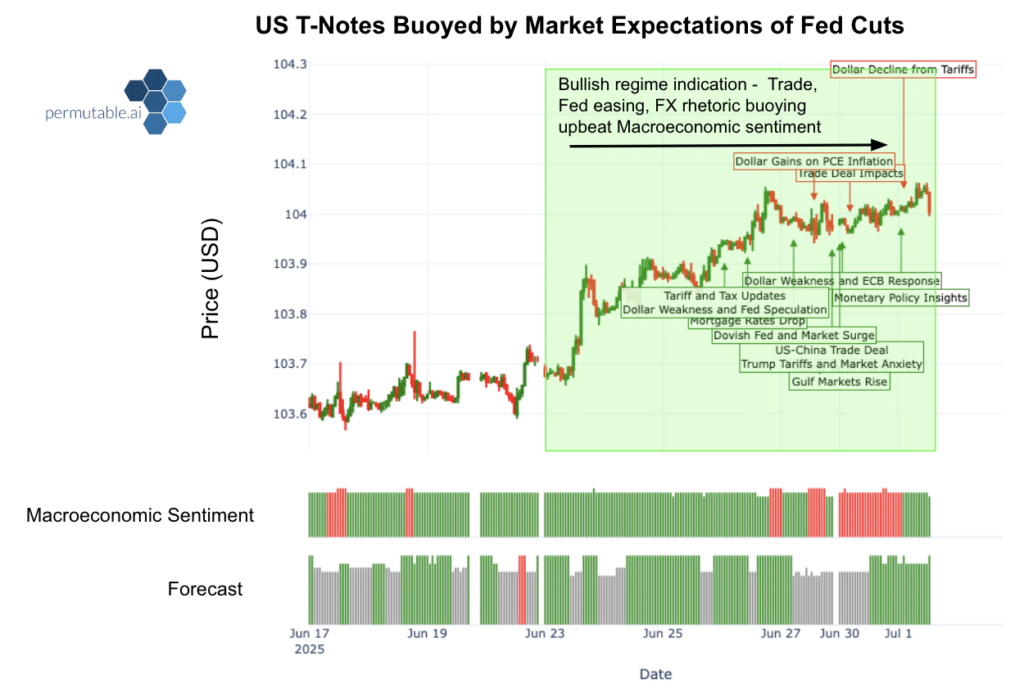
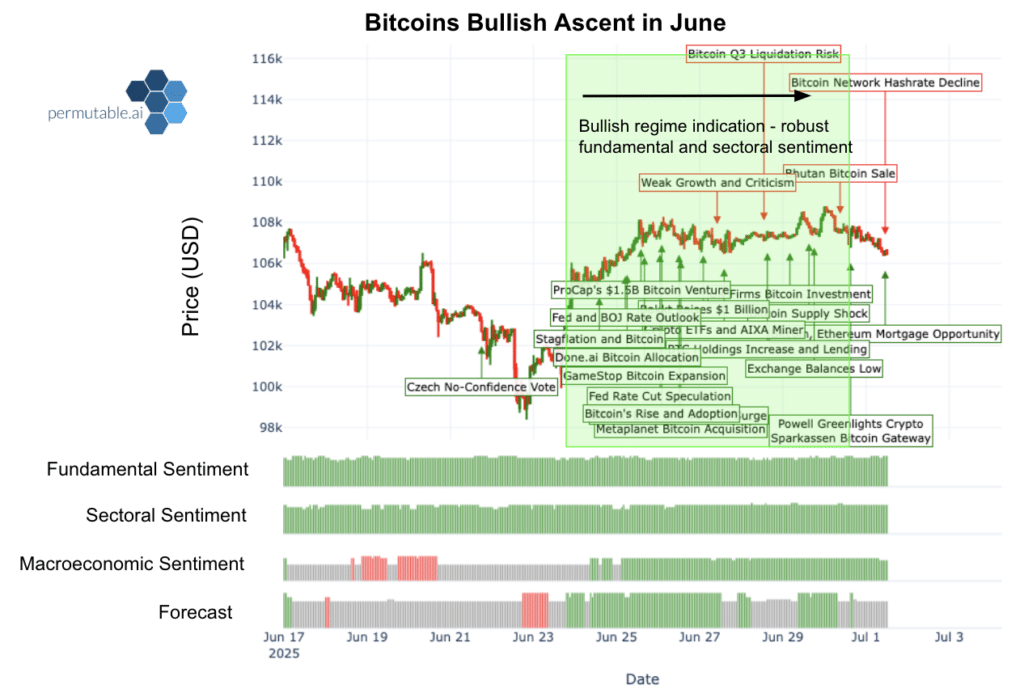
  • Sentiment shift: Our Trading Co-Pilot’s real-time sentiment analysis, meticulously tracking Fed rhetoric and macro data, pinpointed this decisive shift in market outlook. It detected early surges in institutional flows, driven by safe-haven demand and a weakening US dollar, signalling a pivot in risk appetite and a “Bullish” signal from 23rd June to 1st July. 
  • Macro catalysts: A downward Q1 2025 US GDP revision to -0.5% (the first negative print since 2021) and benign payroll and wage growth data reinforced the easing narrative. The US unemployment rate held steady at, with average hourly earnings growth moderating as well.
  • The markets dovish tilt: The June FOMC minutes revealed a greater focus among policymakers on emerging labor market softness and the potential impact of tariff effects. The market is now expecting a dovish tilt, pricing in cuts by September and more by year-end 2025.
  • Greenbacks demise: The US dollar’s retreat has buoyed foreign demand for Treasuries. This, coupled with gold’s rally past $3,340/oz (reaching new all-time highs), further validated the flight to quality fixed income assets and weakening macro trend identified early by our Trading Co-Pilot.
US treasury
Caption: Our Trading Co-Pilot detected upbeat macroeconomic sentiment around the 23rd June, sustaining a positive outlook for T-notes going into 1st July supported by market pricing in more Fed cuts by end-2025 and improving macroeconomic data.

Equities: Nvidia and BlackRock’s Enduring Strength

While broader equity indices drifted higher, market leaders have been  propelled by the uplift of structural tailwinds. Notably, Nvidia and BlackRock stand tall above the rest in terms of reshaping their sectors and having robust stock performance.

Nvidia: AI Market Dominance Unwavering 

Nvidia’s recent performance encapsulates the market’s conflicted yet ultimately bullish relationship with AI’s long term market prominence. After a consecutive five-day surge that briefly crowned it the world’s most valuable company in June, shares pulled back to $155.98, a modest dip from its recent high that proves little in shaking the tech firm off its upward trajectory this year.

  • Robust fundamentals: Strategic moves like securing Wistron’s AI server capacity through 2026 and an expanded HPE partnership signal management’s adept navigation of supply chain complexities and ensure continued enterprise momentum. Consumer products like the release of the GeForce RTX 5050 maintain a key retail pipeline.
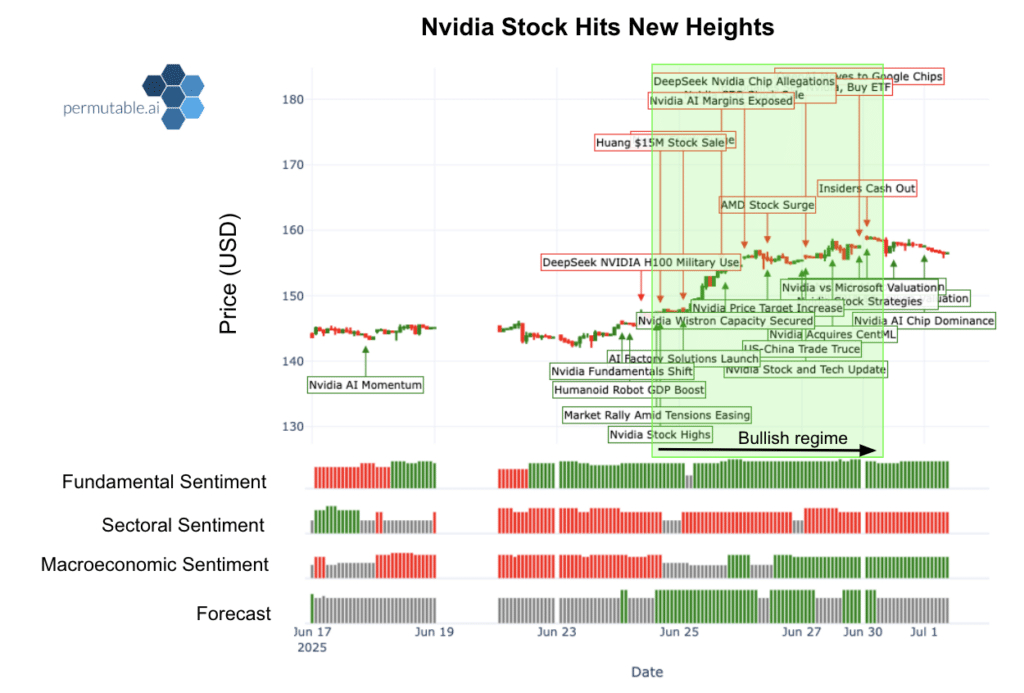
  • Our Trading Co-Pilot’s sentiment detection: Our system consistently detected persistent optimism, overriding headline noise. Its recent analysis of earnings reports, institutional investment, supplier contracts, and accelerated AI infrastructure expansion confirmed sustained momentum flagged a “Bullish” signal on 24th to 30th June. 
  • Financial trajectory: Revenue in 2025 has surged 114% to $130.5bn, as enduring Data centre demand dominates total revenue, underpinning expectations of continued double-digit growth and upside stock from analysts in 2025.
  • Potential headwinds: Insider selling has reached $1bn over the past year, with $557mn occurring in June alone. Competition in R&D from AMD intensifies adding some element of bearish sentiment.
Nvidia Outlook
Our Trading Co-Pilot detected upbeat macroeconomic, sectoral and fundamental sentiment around the 24th June, sustaining a positive outlook for Nvidia going into 30th June supported by renewed market optimism of long-term AI adoption and demand and robust revenue indicators from retail pipeline.

BlackRock: Reshaping Finance Through Digital Assets

BlackRock’s evolution into a digital asset powerhouse represents one of the year’s most significant strategic pivots. The firm’s IBIT ETF has impressively surpassed $70bn in assets under management, reversing a recent weeks-long volume decline that had concerned crypto traders.

  • Crypto backing: BlackRock’s aggressive Bitcoin accumulation, notably the purchase of $430mn in June, reinforces its leadership in the crypto ETF space, reflecting broader institutional acceptance of crypto as a legitimate asset class.
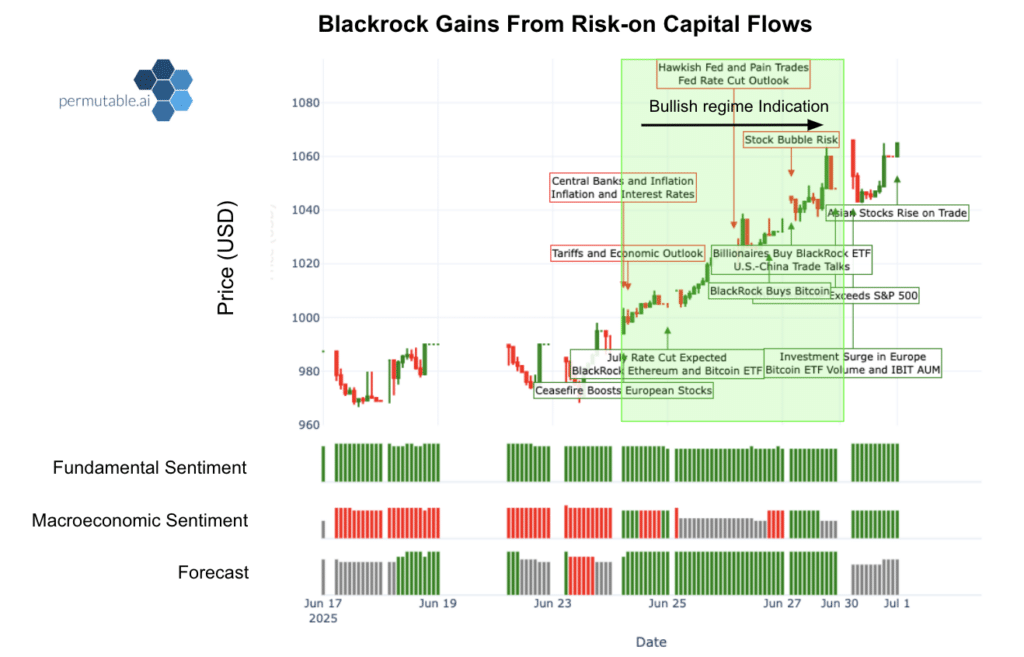
  • Our Trading Co-Pilot’s call: Our system provided early detection of this trend, signaling a “Bullish” call on 24th to 30th June, after having identified the persistent surge of institutional flows into BlackRock’s Ishares Bitcoin trust ETF and tracking rapid AUM growth. Our system has flagged this call having recognised the strong correlation between ETF growth and digital asset prominence, with BlackRock actively reshaping notions on mainstream institutional adoption.
Blackrock outlook
Our Trading Co-Pilot detected upbeat macroeconomic and fundamental sentiment around the 24th June, sustaining a positive outlook for Nvidia going into 30th June supported by Risk-on capital flows, relaxing of regulatory barriers and increased institutional adoption by the market.

Crypto Markets: Bitcoins Strategic Allocation in Diversifying Portfolio’s

Once characterised by volatility, crypto markets have entered a profound new phase of institutional acceptance. Bitcoin’s recent rally above the $107,000 mark speaks volumes to the market faith and confidence in its role as a strategic and diversified asset.

  • Our Trading Co-Pilot’s insights: Its sophisticated real-time engine registered sustained institutional confidence, particularly as the full impact of Hong Kong’s retail crypto ETF feeds through and dovish US regulatory tones take hold. Upbeat macroeconomic sentiment highlights the easing of global liquidity concerns caused our system to signal a “Bullish” signal on 24th June to 1st July, with cryptocurrencies set to benefit from risk-on rotation and its emerging role in institutional portfolio diversification.
  • Key drivers: Robust ETF demand, increasing regulatory clarity, and declining exchange-held balances drive this maturity. The regulatory landscape continues to improve, with policymakers advancing digital asset legislation and removing a significant amount of red tape.

Bitcoin outlook

Trading Co-Pilot: The Future of Market Intelligence

In a world demanding decisive action, institutional traders require clarity, context, and unwavering confidence. Our Trading Co-Pilot delivers our clients this cross-asset strategic edge.

Here’s how our Trading Co-Pilot can do the same for you:

Request a personalised demo or contact us at enquiries@permutable.ai  to discover how our Trading Co-Pilot can enhance your institutional trading strategy.

Jack Watson is Permutable AI’s in-house analyst, leveraging our AI-driven insights to decode market trends, uncover global data signals, and explore how intelligent analytics are reshaping trading and investment strategies.


GBP USD outlook: USD demise as GBP takes spotlight

This article examines the unique dynamics propelling GBP/USD to a three-and-a-half-year high. It explores the interplay of fundamental macroeconomic indicators and market perceptions of institutional credibility, unveiling systemic truths behind sterling’s 2025 rally and the unexpected deterioration of US economic exceptionalism.

Advanced AI market intelligence

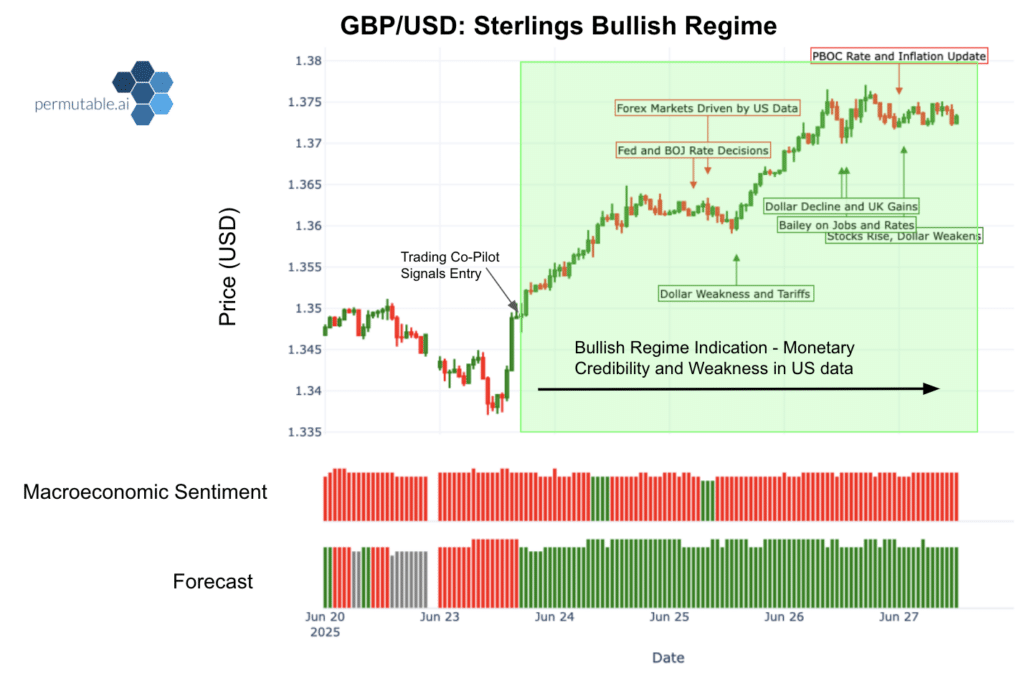
This week, our AI-driven Trading Co-Pilot detected early bullish signals in GBP/USD, picking up on subtle shifts in market sentiment, macroeconomic data flow, and central bank rhetoric well before the broader market reacted. Our Trading Co-Pilot issued a “Buy” signal on 23rd June, as its forecast quickly turned bullish in response to changing market dynamics, specifically the easing tensions in the Middle East and evolving US monetary policy rhetoric. The accompanying chart clearly shows a significant bullish regime for GBP/USD, highlighting its swift ascent. These machine learning-driven analytical insights are increasingly vital in fast-moving FX markets, where gaining an edge by positioning ahead of key inflection points directly informs successful strategies. 

The world of FX rarely encounters such reversals of fortune as seen in the GBP/USD over the course of the last 3 years. Yet sterling’s meteoric rise to 1.3740 against the greenback represents a narrative that goes beyond cyclical momentum, but one of fundamental pivot away from prior norms. As geopolitical tensions simmer down, the focus of FX markets has migrated away from safe haven flows and leans towards growth, political stability and monetary credibility.

GBP USD forecast
GBP USD enters a bullish regime as dollar weakness, as central bank signals, and robust UK data drive upward momentum. Permutable AI’s Trading Co-Pilot identified the entry point, with macro sentiment and forecasts aligning to support sterling strength.

The dollar’s demise: When political pressure meets monetary policy

Fed’s new reality

For decades, the Federal Reserve’s independence was the bedrock of global monetary policy. Currently, that foundation appears to be cracking under political pressure. Public criticism from Trump and his appointed governors targeting Chair Powell’s hawkish ‘wait and see’ stance has created broader market concern over political interference. This perceived erosion of the wall between politics and monetary policy is now being priced in by investors as an inherent risk premium.

Key indicators reflect this shift:

  • Markets are still pricing in 60-70 basis points cut from the Fed till 2025-end.
  • Treasury yields, with the 10-year yield falling to 4.27%, reflect fading institutional credibility.
  • The Dollar Index (DXY) hovers around 97.0-97.50, reaching multi-year lows despite recent safe-haven demand buoying the greenback.

This policy uncertainty and weakening of perceived Fed independence directly challenge the dollar’s dominance.

Economic fundamentals underpinned by political risk

The US economy’s Q1 contraction of -0.5% (y-o-y) points to deeper structural issues. While headline GDP weakness can be fleeting, the convergence of political and economic fractures casts a shadow over the dollar’s resilience. The greenback’s deterioration reflects a market revaluation of US institutional risk premium, beyond mere cyclical weakening.

Key pressure points include:

  • Private consumption growth significantly slowed, rising merely 0.5% (q-o-q) in Q1, marking its weakest post-pandemic reading amidst a cooling labour market.
  • Initial jobless claims show an upward trend, reflecting a softening labour market.
  • The recent widening of trade deficits is amplified by aggressive tariff policies and pre-tariff import surges.
  • The recent downgrade of US sovereign debt across the board, including Moody’s Ratings to Aa1 from Aaa on 16th May, starkly reflects mounting fiscal deterioration and ratings agencies’ lack of faith in policy makers ability to control ballooning debt.

Sterling’s rise 

Monetary integrity

As markets grapple with monetary interference elsewhere, the Bank of England (BoE) has emerged as a beacon of institutional stability. Governor Bailey’s unwavering integrity, combined with the BoE’s ability to manage tempering services inflation (5.4%) and broader growth concerns, exemplifies astute policy discipline. Such inherent credibility has fostered a yield advantage for investors in sterling, particularly as Fed policy uncertainty persists, proving supportive for the currency.

UK’s comparative outperformance

Britain’s Q1 2025 GDP expansion of 0.7% (q-o-q) indicates genuine economic momentum despite April’s lackluster m-o-m data. While Brexit fears and past economic policy challenges owing Truss’s mismanagement of economic guidance dominated headlines in prior years, the economy has slowly adapted and found new momentum. The current rally reflects the maturing of this prolonged adjustment period, backed by shifting underlying growth drivers.

Key growth drivers include:

  • Increased business investment as market confidence returns.
  • Resilient consumer demand despite global headwinds.
  • Industrial strategy investments in key sectors like AI, life sciences, and clean energy are beginning to yield dividends.

FX markets at work

The multiplier effect

GBP/USD’s breakthrough above the 1.37 resistance level has triggered strategic UK-bound flows. However, the pound’s selective strength, underperforming against the euro (EUR/GBP at 0.853) while gaining against the dollar. This highlights the rally’s true nature, sterling’s strength coming at a point of dollar demise. FX markets are now diversifying away from dollar-heavy portfolios, favouring alternatives with credible policy frameworks. Sterling benefits favourably from this pivot, owing to the UK’s liquid markets and robust fundamentals.

EUR GBP outlook
EUR/GBP trends upward as euro resilience outpaces sterling, supported by ECB updates, and UK macro data concerns. Market movements reflect cautious sentiment and rate cut expectations, our Our Trading Co-Pilots forecasts highlighting the euro’s relative strength.

European resilience

The Eurozone’s own revival, with 0.6% Q1 growth and continued ECB hawkishness, complicates sterling’s narrative. Germany’s planned fiscal stimulus and the Euro Area’s current account surplus provide structural support the UK lacks. While sterling benefits from dollar weakness, it must also justify its gains against a resurgent euro, backed by robust macro-fundamentals and robust external balances.

The current account conundrum

Britain’s deep-seated current account deficit remains its strategic vulnerability. While recent trade data has shown some volatility, this underlying structural imbalance has the potential to reverse sterling’s gains in risk-off environments. The currency’s strength thus depends heavily on continued global risk appetite and stable capital flows.

The bigger picture in FX: diversification of capital flows

The GBP/USD forecast outlook

For investors, this signifies accelerating diversification away from the dollar, favouring currencies like sterling as a hedge against US institutional uncertainty. FX Strategy increasingly hinges on governance quality, not only traditional macro metrics. If current trends persist, GBP/USD could approach 1.40, though prevailing risks and technical barriers linger, from the UK’s persistent current account deficit, enduring services inflation, and external shocks like a Fed policy reversal or stronger eurozone growth.

The appreciation of GBP/USD shows a broader pivot in FX markets. As the dollar’s perceived exceptionalism fades, currencies rooted in credible, independent central banks and measured policy frameworks are attracting capital flows. Institutional integrity is now as paramount as traditional economic might in currency valuations. Political interference in central banking is increasingly being priced in as a risk premium. For sterling, the challenge is proving this strength can endure beyond the current cycle of dollar depreciation.

The GBP/USD narrative highlights the advantage of AI-driven market insights

The GBP/USD narrative highlights the critical role of sophisticated, AI-driven market insights. Our Trading Co-Pilot’s ability to detect shifts in sentiment, macro divergences, and policy rhetoric early enables positioning ahead of broader market consensus. This provides instant analytical value in today’s fragmented and politically sensitive FX landscape.

As traditional correlations weaken and political risk premiums reshape FX valuations, the power of Large Language Model (LLM) derived sentiment pattern recognition becomes indispensable. Such systems are crucial for identifying key inflection points within currency pairs before they become apparent through conventional analysis. In today’s FX markets – where central bank credibility plays an outsized role in driving currency movements – gaining an informational edge is everything. Our Trading Co-Pilot delivers real-time institutional and policy-driven insight, making it an essential tool for traders looking to stay ahead in an increasingly fast-paced and macro-sensitive environment.

Discover how our integrated intelligence can transform your FX trading performance. Contact enquiries@permutable.ai to unlock these market-moving insights in real-time.

Jack Watson is Permutable AI’s in-house analyst, leveraging our AI-driven insights to decode market trends, uncover global data signals, and explore how intelligent analytics are reshaping trading and investment strategies.

How energy traders can develop a smarter lens on breaking geopolitical tensions 2025

This comprehensive analysis explores how energy traders are adapting to navigate breaking geopolitical tensions 2025 through advanced market intelligence and AI-powered insights. Written for commodity traders, energy analysts, portfolio managers, and institutional trading desks seeking sophisticated tools to decode complex market dynamics and geopolitical risks.

It’s fair to say that energy markets have entered an era of unprecedented complexity, where breaking geopolitical tensions 2025 continue to reshape global commodity flows and pricing dynamics in ways that traditional analysis simply cannot capture. For energy traders operating across Brent crude, LNG, TTF, and Henry Hub markets, the challenge extends far beyond fundamental supply and demand metrics. Today’s successful trading strategies require a sophisticated understanding of how geopolitical developments, sanctions regimes, pipeline disruptions, and OPEC statements cascade through interconnected global energy systems.

The reality facing energy traders today is that market-moving events often unfold with little warning, and their impacts ripple across multiple energy commodities simultaneously. Consider the significant movements witnessed in the LNG market over recent fortnights, driven by a volatile combination of geopolitical uncertainty and robust demand-side fundamentals. These market conditions exemplify why energy traders require more than traditional analysis – they need intelligent systems capable of processing vast amounts of real-time information and translating complex geopolitical signals into actionable trading insights.

LNG trade Chart

Above – LNG Momentum in the Era of Breaking Geopolitical Tensions 2025.  This chart illustrates how Permutable AI detected a bullish regime shift in LNG markets amid breaking geopolitical tensions 2025. Powered by robust macroeconomic and fundamental sentiment signals, the system enabled early positioning ahead of major price moves—driven by shifting policies, sanctions, and supply disruptions across the LNG landscape.

The limitations of traditional energy market analysis

Traditional energy market analysis has relied heavily on fundamental metrics such as inventory reports, production data, and seasonal demand patterns. However, these approaches fundamentally misunderstand how breaking geopolitical tensions actually influence energy pricing mechanisms. Modern energy markets are increasingly driven by sentiment, expectation, and risk perception rather than purely by physical supply and demand imbalances. When Iran-Israel tensions escalate or sanctions discussions emerge, the market impact often precedes any actual supply disruption by weeks or months.

This disconnect between traditional analysis and market reality has created significant opportunities for energy traders equipped with advanced intelligence capabilities. The most successful energy trading desks now recognise that geopolitical sentiment analysis, combined with sophisticated data processing, provides superior insights compared to conventional fundamental analysis alone. The challenge lies in accessing and interpreting the vast streams of global information that influence energy market sentiment on an hourly basis.

Advanced intelligence for complex energy markets

The transformation in energy trading intelligence represents a fundamental shift towards systems that can process and interpret thousands of global information sources simultaneously. Rather than relying on delayed reports or simplified sentiment indicators, elite energy trading desks can now leverage proprietary multi-agent frameworks that combine artificial intelligence with large language model sentiment analysis to provide real-time market intelligence.

As per feedback from our clients, this next gen capability has proven particularly valuable in recent market conditions. For instance, our comprehensive AI-driven analysis of the Iran-Israel conflict‘s impact on global financial markets has demonstrated how geopolitical tensions create distinct risk patterns and market opportunities that differ significantly from other geopolitical events such as the Russia-Ukraine situation. Institutional investors and trading professionals who understand these nuanced patterns can position themselves advantageously during periods of heightened uncertainty.

Multi-factor analysis dashboard showing the ranking of fundamental and geopolitical factors

Above – Decoding Market Risk Amid Breaking Geopolitical Tensions 2025: This multi-factor dashboard visualizes how real-time AI sentiment across geopolitical, macroeconomic, and fundamental drivers correlates with price movements in energy markets. As breaking geopolitical tensions 2025 continue to reshape global commodity flows, tools like this are essential for traders seeking clarity in an increasingly complex environment.

Real-time intelligence across energy commodities

The good news is that the sophistication of the kind of modern energy market intelligence we offer here at Permutable extends across all major energy commodities, from crude oil benchmarks to natural gas markets. Recent analysis of TTF price movements and underlying European gas sector dynamics illustrates how real-time intelligence systems can decode the drivers behind market resilience even during volatile periods. Energy commodity traders and portfolio managers now have access to comprehensive insights that reveal the subtle interplay between regional pricing mechanisms and global sentiment indicators.The practical value of advanced intelligence systems becomes evident through specific trading outcomes. Our recent case study demonstrated how AI-driven sentiment analysis can accurately predict Henry Hub natural gas price movements, leading to demonstrable gains such as the documented 5.5% return achieved through advanced market intelligence. These results showcase the tangible benefits available to energy traders and commodity fund managers who embrace cutting-edge analytical methods like our Trading Co-Pilot intelligence suite rather than relying on conventional market analysis.


Breaking geopolitical tensions 2025: Regional pricing dynamics and global sentiment integration

One of the most vital aspects of modern energy trading involves understanding how global news sentiment translates into regional pricing impacts. Energy markets are inherently global, yet pricing mechanisms remain distinctly regional. Brent crude pricing reflects different sentiment factors compared to WTI, while LNG pricing in Asia responds to different geopolitical signals than European TTF pricing. It is here that our advanced intelligence systems excel at mapping these complex relationships, providing traders with nuanced insights into how global events will impact specific regional markets.The integration of global macroeconomic data feeds with real-time sentiment analysis enables our clients to anticipate market movements rather than merely react to them. This capability proves particularly valuable during periods of breaking geopolitical tensions, when traditional correlations may break down and new market dynamics emerge rapidly. Traders equipped with sophisticated intelligence platforms can identify optimal positioning opportunities while others struggle to interpret conflicting signals from conventional data sources.

The competitive advantage of advanced market intelligence 

Energy trading success increasingly depends on access to superior information processing capabilities rather than simply having more information. The most successful trading operations now combine proprietary data feeds with advanced analytical frameworks that can synthesise complex global developments into actionable trading signals. This approach enables traders to maintain consistent performance even during volatile market conditions driven by breaking geopolitical tensions 2025 and beyond. The evidence supporting this evolution in energy trading intelligence continues to accumulate through documented trading outcomes and market analysis. 
 
From detecting volatile energy market landscapes in LNG to accurately forecasting natural gas price movements, advanced intelligence systems demonstrate consistent value creation for institutional energy trading operations. The key differentiator lies not in the raw data available to traders, but in the sophisticated analytical capabilities that transform complex information streams into precise trading insights.Energy markets will continue evolving in response to geopolitical developments, technological changes, and shifting global demand patterns. Traders who adapt their analytical capabilities to match this complexity will maintain competitive advantages, while those relying on traditional methods will find themselves increasingly disadvantaged in fast-moving markets influenced by breaking geopolitical tensions 2025.

Navigating breaking geopolitical tensions 2025 with superior LLM-driven energy trading intelligence

Discover how our energy market sentiment feeds can give you new edge in your your energy trading through advanced sentiment analysis, real-time geopolitical intelligence, and proven market insights across Brent, LNG, TTF, and Henry Hub markets. Don’t let traditional analysis limit your trading potential when sophisticated AI-driven intelligence is available.

Contact our team at enquiries@permutable.ai to schedule a personalised demonstration and see how our global macroeconomic data API can transform your energy trading strategy. Experience firsthand how cutting-edge market intelligence turns complex geopolitical signals into profitable trading opportunities.


Permutable launches War Sentiment Index: Real-time geopolitical risk analytics for institutional investment strategies

We are pleased to announce that we have officially launched our  War Sentiment Index, an advanced real-time geopolitical risk analytics feed that measures worldwide conflict sentiment, delivering institutional investors critical intelligence on geopolitical factors driving market instability.

As current Middle East tensions from the Iran-Israel situation, broader regional conflicts, and persistent Russia-Ukraine hostilities fuel substantial market turbulence – impacting commodity pricing, exchange rates, and sectoral shifts – our War Sentiment Index provides the essential geopolitical risk analytics that investors need to successfully navigate geopolitical uncertainty while maximizing sentiment-based trading opportunities.

Transforming complex geopolitics risk analytics into actionable investment intelligence

Our War Sentiment Index converts intricate international developments into practical investment guidance through sophisticated geopolitical risk analytics. Dating back to 2015, our advanced AI-powered platform has monitored all significant conflicts and geopolitical developments, equipping institutional partners with crucial data infrastructure for strategic decision-making during heightened market volatility periods.

“Our War Index represents the most straightforward global conflict tension indicator available, providing clear sentiment aggregation from worldwide news sources,” explained Wilson Chan, our Founder and Chief Executive. “The system accurately identified Israel’s initial strike timing and detected Iran’s nuclear response anxiety 24 hours in advance. This capability allows fund managers to strategically position portfolios during critical and unstable timeframes.”

Comprehensive macro intelligence ecosystem

Our War Sentiment Index operates within our extensive 22-feed macro intelligence ecosystem, offering institutional clients comprehensive oversight of all market-influencing worldwide developments:

  • Political Tension Feed – Monitoring diplomatic emergencies and governmental instability
  • Natural Disasters Feed – Measuring environmental and seismic event consequences
  • Election Feed – Observing democratic activities and leadership changes
  • 19 Supplementary Specialized Feeds – Encompassing complete macro event spectrum

Advanced technical capabilities

Core technical specifications:

  • 200+ Global Sources: Full-spectrum analysis from premier financial and news organizations
  • 60-Minute Refresh Cycles: Immediate sentiment monitoring for instant market intelligence
  • Advanced Analytical Engine: Individual articles systematically evaluated on -1 to +1 scale for accurate sentiment measurement
  • Decade-Plus Operational History: Uninterrupted service from 2015 with validated market relationships

Target markets and applications

Our War Sentiment Index targets hedge funds, investment managers, pension schemes, and institutional dealing rooms, seamlessly incorporating into current risk oversight and profit-generation frameworks.

Key applications include:

  • Automated Trading Integration: Delivers measured sentiment intelligence for systematic trading implementation
  • Risk Management: Functions as advance warning infrastructure for geopolitical exposure risks
  • Portfolio Optimization: Supports re-evaluation processes by identifying anxiety and unstable conditions in global conflicts
  • Strategic Positioning: Provides analytical intelligence for strategic allocation and sector repositioning
  • Market Timing: Tracks rapid sentiment declines for tactical opportunities and optimal protective positioning

As the premier supplier of live sentiment and event analytics for institutional markets, our proprietary AI technology converts international news streams into targeted, executable investment data, supporting hedge funds, investment houses, and institutional trading operations globally. Our analytical tools have established themselves as fundamental infrastructure for advanced investment methodologies in today’s increasingly volatile international landscape.

Interested in incorporating our War Sentiment Index into your trading operations? Contact our team at enquiries@permutable.ai to learn more and to discuss detailed specifications.

subscribe to our newsletter

Navigating geopolitical tension with our Trading Co-Pilot: A compass in turbulent times

This comprehensive analysis examines how the Iran-Israel conflict has impacted global financial markets, comparing its effects to the Russia-Ukraine war. Aimed at institutional investors, fund managers, and trading professionals, it offers critical insights for navigating geopolitical tension and understanding risk patterns and market opportunities during periods of heightened uncertainty.

As the storm brewed over global financial markets on 13th June with the Iran-Israel conflict, this unleashed a familiar risk-off posture amongst investors. Whilst the tremors might not match the seismic shock of the Russia-Ukraine war’s initial impact, the similarities in investor behaviour are unmistakable. As military strikes escalate, equities, after an initial shudder, have largely found their footing this week. It’s a precarious calm, as investors balance the perceived containment of the conflict with one eye on monetary policy and the other on potential global spillover should tensions fail to simmer.

The market’s pulse reflects this anxiety. The VIX, a barometer of volatility, surged above 20, mirroring heightened market uncertainty. Energy prices, predictably, have climbed. Initially, the stampede was towards traditional safe havens and the bedrock of defensive and energy sectors. Yet, beneath this broad movement, sectoral themes highlight persistent inflation risks and a hypersensitivity to every word from central banks.

Brent Crude Oil Price vs VOX Volatility Index

Above: This chart shows that persistent geopolitical tensions pushed the VIX above 20 and drove energy prices higher; sharp drops in Brent Crude in April followed Trump’s tariff plans, while June’s VIX spike reflects Middle East conflict, prompting investors to seek safety in energy commodities.

The main concern for policymakers is the potential for regional escalation and its inflationary spillover. Sustained high oil prices could reignite inflation, threatening to douse the nascent monetary policy easing cycles across major central banks. This mirrors the commodity shock that followed the Russia-Ukraine war, where soaring prices exacerbated the global inflation trajectory. 

This escalating conflict acts as a multiplier on an already fragile global economy, straining trade dynamics, slowing growth, fuelling inflation, and leaving central banks with less room to manoeuvre. Investors find themselves walking a tightrope, balancing geopolitical tremors against the subtle shifts in monetary policy. 

It’s a feedback loop: instability constrains policy, which then impacts growth and market sentiment. In this storm of uncertainty, the ability to discern sectoral fragilities through real-time sentiment and price signals becomes not just valuable, but vital. Our Trading Co-Pilot analysis detected that geopolitical tension scores were registering uniformly high across the board in the energy sector (between 0.9-1.0), reflecting pervasive market apprehension. While the manifestation of this tension varies by sector, the underlying sentiment is undeniably shaped by the ongoing conflict which has dominated news coverage this last week. This is evident in the daily sentiment sum chart, where war-related topics spiked sharply on 13 June, underscoring the conflict’s outsized influence on market perceptions. 

War topic: Daily sentiment sum (last 12 months)

Above: This chart demonstrates that war related news is a persistent and often negative driver of market sentiment, with sharp declines such as the one on June 13, underscoring the powerful influence that geopolitical conflict exerts on market perceptions and behaviour.

Sectoral analysis via our Trading Co-Pilot heatmap

This is where a tool like our Trading Co-Pilot helps navigate a path, transforming raw market noise into actionable intelligence, guiding investors to identify opportunities and effectively weather the storm. Our Trading Co-Pilot decodes sectoral shocks with real-time sentiment signals. In periods of high uncertainty, disciplined analysis and selective positioning are key to staying ahead of market shifts using leading indicators. Our Trading Co-Pilot’s insights provide an unparalleled sectoral analysis, real-time insights, and historical context transforming raw market data into actionable intelligence, empowering investors to make disciplined, strategic decisions, identify opportunities, and mitigate risks during periods of high uncertainty.

Energy sector sentiment heat map: Supply-side drivers

Above: The energy sector sentiment heat map shows five key supply-side factors including, geopolitical tensions, inventory levels, infrastructure, production, and trade regulations. The heat map shows the impacted major energy commodity prices during the week of June 10–16, highlighting which drivers influenced price movements across the sector.

Energy: A tale of two spikes

Both the tensions in the Russia-Ukraine war and the Iran-Israel conflict have shaped the story of energy prices in recent years, fuelled by fears of supply disruption.

Russia-Ukraine war (February 2022)

The invasion unleashed an immediate torrent. Brent crude leapt 15.7% (from $92/bbl to $106/bbl), WTI oil ascended 7.3% (from $92.10/bbl to $98.80/bbl), and European natural gas (TTF) experienced a monumental, sustained surge, fundamentally redrawing the global energy map by August 2022.

Iran-Israel (current tensions)

The recent Middle East escalation, whilst initially less explosive, is a simmering cauldron. Brent crude gained 9% (from $68/bbl to $75/bbl), WTI oil climbed 10% (from $67/bbl to $74/bbl), and LNG saw a modest but notable 5% bump (from $36/MMBtu to $38/MMBtu). As of 17th June 2025, Brent has eased to around $74/bbl, WTI to $72/bbl, whilst LNG continues its steady ascent to $39/MMBtu.

The lingering uncertainty surrounding the Strait of Hormuz, the narrow choke point through which a quarter of the world’s seaborne oil and LNG flows, casts a worrying shadow if tensions mount. Any closure here would unleash a price surge mirroring the Russia-Ukraine war’s extreme peaks of $115/bbl, with some analysts bracing for $100/bbl if regional tensions escalate. Whispers of targeting Iranian oil and gas infrastructure further amplify these supply fears.

Gold: The enduring anchor for investors

Across both geopolitical maelstroms, gold has unfailingly reaffirmed its status as the ultimate safe-haven asset.

Russia-Ukraine

Gold rallied significantly, climbing 3.8% from $1,907/ounce to nearly $1,980/ounce in early February 2022, an immediate and powerful embrace of its safe-haven status.

Iran-Israel

Gold again surged 1.8% (from $3,407/ounce to $3,467/ounce). However, recent profit-taking and the cautionary narrative of a bubble have led to a minor pullback. As of 17th June 2025, gold trades around $3,388/ounce, a -2% dip from its conflict high. Investor sentiment remains complex, weaving persistent anxiety with short-term market dynamics, all underpinned by the uncertain central bank narrative.

Comparative market reactions to geopolitical conflict outbreaks

Above: This chart compares the performance of key commodities – Brent Crude, WTI Crude, TTF Gas, and Gold – following the outbreak of the Russia-Ukraine war in 2022 and the Iran-Israel conflict in 2025. The Russia-Ukraine war triggered sharper moves in Brent, TTF Gas, and Gold, driven by fears over European energy security and a surge in safe-haven demand. By contrast, WTI Crude saw a stronger reaction during the Iran-Israel conflict, reflecting heightened concerns over supply risks.

Commodities: Beyond the oil and gas fields

The ripples of geopolitical tension extend beyond energy, touching other commodity markets with varying degrees of influence.

Russia-Ukraine

This conflict directly impacted agricultural commodities, leveraging the region’s crucial role as a global grain basket. Industrial metals like palladium also experienced sharp surges, reflecting both supply anxieties and the heightened demand of a wartime economy.

Iran-Israel

Whilst its impact is less direct on the ground, the ongoing Middle East tensions contribute to broader supply chain disruptions and increased energy costs. Given the indispensable nature of Gulf shipping routes for global trade, these factors could indirectly inflate the prices of industrial metals and agricultural goods by lengthening transit times and spiking freight rates, echoing the broader economic pressures felt in 2022.

Equities & crypto: Markets weathering geopolitical headwinds

The Russia-Ukraine war initiated a sharp global equity sell-off, particularly impacting European markets tied to Russian energy. Similarly, the Iran-Israel escalation caused an initial market flinch. However, the current Middle East tensions, after an initial jolt, show a different narrative. Major stocks like the FTSE 100 and S&P 500 are demonstrating remarkable resilience. This strength is largely fuelled by robust energy and defence sectors, where investors gravitate during geopolitical turmoil. Broader equity markets also benefited from positive signals, such as recent Chinese retail data providing an unexpected boost to Asian markets.

In the crypto space, Bitcoin has seen mixed signals. It experienced a price surge followed by a technical pullback, declining from $107K to around $105.5K. This was primarily driven by geopolitical tensions, significant liquidations, and ongoing market volatility concerns. Despite this, bullish catalysts like MicroStrategy’s substantial Bitcoin purchase and positive news regarding Vietnam’s crypto legalisation provided some tailwind. Market sentiment remains cautious, as institutional interest has yet to translate into sustained upward momentum due to these external pressures.

Sectoral divergences: Unpacking the split market performance

The geopolitical landscape has painted a clear picture of market winners and losers.

Beneficiaries

Much like the Russia-Ukraine conflict, defence contractors and cybersecurity firms have emerged as unequivocal beneficiaries, their stock prices soaring on the anticipation of increased defence spending. Energy giants have also reaped significant gains, mirroring the commodity cycle witnessed in early 2022. And, of course, gold producers have seen their prices rise, cementing the metal’s safe-haven allure.

Impacted sectors

Conversely, sectors exquisitely sensitive to discretionary spending and soaring operational costs, such as airlines and travel stocks, have registered significant declines. This reflects a twin blow of flagging travel sentiment and surging fuel prices.

The Strait of Hormuz: A bottleneck of global trade

The shockwaves from Middle East tensions ripple throughout global markets. Escalating aggression directly impacts specific economic sectors through intricate supply chains, commodity prices, and the fragile threads of investor confidence. The shipping sector is navigating a treacherous path. Recent reports convey profound caution, with ship owners actively charting courses to avoid the Persian Gulf and the Strait of Aden. Oil shipping rates for Middle Eastern routes have spiked as some tanker owners and managers pause, assessing escalating risks and fuelling deep concerns over critical flows from the region. 

Furthermore, electronic interference and GPS jamming in the Strait of Hormuz dangerously complicate navigation, prompting maritime authorities to urge caution and alternative communication. These disruptions inevitably lead to increased transit times, higher insurance premiums, and surging freight rates, further straining already fragile global supply chains.

Whilst the probability of significant supply disruptions might seem remote at this moment, the stability of shipping in and around the Middle East will be watched with caution. Iran’s ability to shut off the Strait of Hormuz is a stark reality. With the region responsible for about a third of the world’s oil production, major exporters like Saudi Arabia have limited scope to divert exports if needed. Whilst physical delivery of liquefied natural gas (LNG) doesn’t appear broadly affected yet, any interruption in these critical sea lanes would strain the market at a crucial juncture for Europe’s stockpiling season, stirring up reminders of the energy security woes that followed the Russia-Ukraine conflict.

Simultaneously, such disruptions weigh on operational output and outlays, leading to slower global growth and a higher inflationary burden as producers and consumers face elevated costs. This confluence of rising inflation and slowing growth is a key trait of emerging stagflationary pressures. It only complicates matters for central banks, as typical monetary policy tools, such as interest rate adjustments and quantitative easing, are less effective at addressing both growth and inflation simultaneously without exacerbating one over the other. Geopolitical risk, therefore, is a significant catalyst for this challenging and uncertain macroeconomic scenario, levying additional pressure on markets.

Trading Co-Pilot: A compass for uncertain times

The current geopolitical climate demands proactive, informed strategies to navigate the intricate interplay of global politics, economic fundamentals, and evolving market sentiment. In these periods of volatility, the ability to unpack sectoral themes using real-time sentiment and price signals becomes a competitive advantage that separates successful investors from those caught off-guard by rapid market shifts.

Our Trading Co-Pilot’s sentiment analysis offers a powerful lens, peering into financial news opinions and emotions surrounding market-moving events, topics, and companies and ultimately providing next gen intelligence for navigating future market activity and understanding how broader reactions in the news directly influence market performance. Through advanced techniques, including LLM models and AI machine learning, this analytical process seamlessly transforms vast amounts of unstructured data into actionable intelligence, helping you chart a clearer course.

Don’t let the next geopolitical shock catch you unprepared – unlock our Trading Co-Pilot’s real-time sentiment intelligence and turn market volatility into your competitive edge. Simply email enquiries@permtuable.ai to request a demo.