Coffee futures: Market oversupply fuels strategic bearish opportunity

In this article, we explore the structural oversupply reshaping global coffee markets, the resulting downward pressure on coffee futures, and how AI-driven tools like our Trading Co-Pilot identified a high-conviction short opportunity ahead of the market.

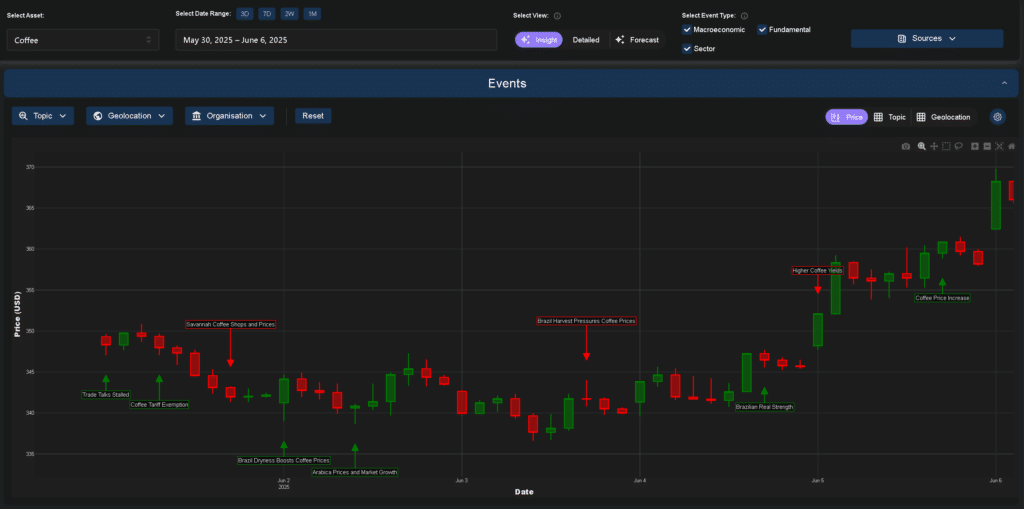
Global coffee markets are entering a structural oversupply phase as production ramps up in Brazil and Vietnam, driving sustained downward price pressure on coffee futures. Our Trading Co-Pilot identified this fundamental shift early, flagging a high-conviction short position that yielded a 16.12% return as prices declined from $342.65 on 16 June to $287.40 on 2 July. 

The rapid repricing reflects fading risk premiums. In June, early gains in coffee futures were driven by appreciation of the Brazilian real and heightened weather concerns. These headwinds quickly reversed as Brazil’s frost dissipated and rainfall improved harvest expectations, reducing uncertainty and eroding risk premiums that had provided technical support. 

Recent data underpins this bearish outlook, forecasting record global coffee production of 178.68mn bags, up 2.5% (y-o-y), with ending stocks rising 4.9% to 22.8mn bags, reaffirming a mounting supply glut. This reshaping of market dynamics has challenged price support mechanisms, confirming a clear case of coffee oversupply.

Coffee futures short
Our Trading Co-Pilot identified a fundamental shift in coffee futures, flagging a high-conviction short as prices dropped from $342.65 on 16 June to $287.40 by 2 July.

Fundamental oversupply driving price recalibration

June’s price correction signals a transition from weather-driven volatility to a market dominated by abundant supply. Arabica and Robusta coffee futures have dropped to multi-month lows, with Arabica September contracts at over six-month troughs and Robusta hitting a 13-month low. These lower contract prices reflect a widening coffee oversupply. 

Brazil’s production shift and substitution effect

Brazilian coffee production is forecast to rise slightly to 65mn bags in 2025/26, with a notable shift towards Robusta coffee, expected to surge 15% (y-o-y) to 24.1mn bags. Farmers have pivoted towards the more durable Robusta variety, signalling strategic adaptation to climatic headwinds and shifting market demand. 

Meanwhile, Arabica coffee production is forecast to decline by 6.4% to 40.9mn bags, affected by recent heavy rainfall weighing on harvest and crop yields. However, improved irrigation and modern agricultural practices have mitigated weather risks, reduced risk premiums, and smoothed out seasonal volatility in coffee farming. Brazil’s harvest now appears to be progressing steadily, running modestly below last year’s pace but aligned with five-year averages, despite ongoing climatic exposure.

Southeast Asia export growth accelerates supply pressure

Vietnam, the world’s largest Robusta coffee exporter, reached its full-year 2025 export target of $5.5bn by June, despite falling global prices. Vietnamese coffee output is forecast to climb 6.9% this year, marking a four-year high of 31mn bags. This strong performance offsets last year’s meagre crop yield, which was due to prolonged drought. Meanwhile, Indonesia’s coffee exports surged 9.7%, further intensifying the global coffee oversupply.

Inventory pile up confirms supply glut

ICE Arabica inventories have climbed to near a five-month high, while Robusta inventories remain pressured, reflecting a complex and evolving supply-demand balance. USDA projections indicate global coffee ending stocks in 2025 to rise by 4.9%, reinforcing the market narrative of coffee oversupply.

Our Trading Co-Pilot’s captures short position 

Our Trading Co-Pilot captured this market shift in real-time, with sentiment turning decisively  bearish forming a high-probability opportunity for shorting coffee futures. This opportunity was driven not by fleeting weather factors but by a deepening structural oversupply. Our Trading Co-Pilot’s precise “sell” signal on 16 June at $342.65 marked a decisive turning point. The subsequent price descent to $287.40 by 2 July validated the short strategy, delivering a 16.12% return.

June’s sustained price decline was fundamentally anchored, with converging bearish signals such as surging Brazilian Robusta output (forecast +15%), accelerated exports from Vietnam and Indonesia, and climbing global inventories (Arabica at five-month highs and USDA projections of elevated ending stocks). As the mounting factors of oversupply pile up, our Trading Co-Pilot detected limited upside risk and a high probability of continued downside pressure offering support to the bearish call.

Crucially, dissipating frost-risk premiums in Brazil’s key growing areas removed a significant tail-risk. With no new demand catalysts, momentum had turned. Our Trading Co-Pilot recognised this inflection point as a regime shift, detecting a market pivot from weather-related volatility to a supply-glut. Identifying and acting on these sentiment transitions proved the decisive edge.

Broader market implications and structural evolution

The coffee market is clearly changing in fundamental ways. Production is becoming more flexible, thanks to new technologies, climate adaptation strategies, and better logistics. This is helping to absorb price swings and reduce the build-up of risk premiums. Brazil’s move towards cultivating more Robusta coffee is a smart response to changes in both the environment and market demand. Likewise, Vietnam’s steady export figures show just how well oiled their supply chains have become.

Even though coffee markets expect to see slightly less Arabica coffee this year, the significant growth in Robusta production and high global stockpiles continue to push coffee futures prices down. This illustrates the complexity of the coffee market, where an abundance of one coffee type can offset less of another.  Looking ahead these are key market considerations for coffee futures prices:

  • Technological advances continue to ease traditional supply constraints.
  • Climate adaptation strategies enhance production resilience.
  • Improved export infrastructure accelerates supply responsiveness.
  • Demand growth in the premium coffee market.

Unlock competitive edge with our AI-driven agricultural market insights

The June market correction demonstrates our Trading Co-Pilot’s timely, actionable insight perfectly. The precise sell signal identified structural oversupply early, spotting and acting on subtle shifts in market mood, stock levels, and wider trade movements. 

This highlights the utility value of our AI-powered analysis of agricultural commodity markets. As the market moves away from short bursts of volatility towards underlying trends, being able to identify early shifts in sentiment and regimes gives our clients the edge. By combining real-time data, predictive modelling, and sector intelligence, our Trading Co-Pilot empowers our clients to stay ahead of volatility, identify high-conviction opportunities, and respond to evolving market conditions with precision.

Not using our commodity sentiment intelligence yet? Request a personalised demo by contacting us at enquiries@permutable.ai to discover how our Trading Co-Pilot intelligence suite can enhance your institutional trading strategy.

Jack Watson is Permutable AI’s in-house analyst, leveraging our AI-driven insights to decode market trends, uncover global data signals, and explore how intelligent analytics are reshaping trading and investment strategies.

7 high-impact AI use cases reshaping commodity pricing and energy trading

This article explores seven transformative AI applications in commodity pricing, aimed at energy traders, commodity analysts, and trading desk professionals and heads of trading innovation seeking competitive advantages through advanced market intelligence.

In today’s volatile global markets, commodity pricing has never been more unpredictable or challenging to navigate. The convergence of geopolitical tensions, supply chain disruptions, and accelerating energy transition policies demands sophisticated analytical tools that can process vast information streams and translate complex data patterns into actionable trading intelligence. Traditional approaches to commodity pricing analysis – whilst historically reliable – are proving increasingly insufficient against the velocity and complexity characterising modern energy markets.

For institutional traders operating across metals, energy, and agricultural commodities, the margin for error has narrowed considerably. Market movements that once developed over days now unfold within minutes, whilst interconnected global supply chains create cascading effects that traditional models struggle to anticipate. This environment necessitates artificial intelligence systems capable of detecting subtle patterns, processing geopolitical developments, and delivering real-time insights that enable proactive rather than reactive commodity pricing strategies.

In this article we’ll explore seven high-impact AI use cases reshaping commodity pricing and energy trading, with examples taken from our own technology and applications amongst our current clients. 

1. Real-time price signal detection: Capturing market momentum

The most critical advantage in commodity pricing lies in identifying market movements before they fully materialise. Recent market analysis demonstrates this principle effectively, with LNG markets experiencing dramatic shifts that rewarded early detection capabilities. Between June 10th and June 23rd, TTF benchmark prices surged from €34.85/MWh to exceed €42.02/MWh – a movement that AI-driven systems identified at optimal entry points around €36.16/MWh on June 12th.

This precision in commodity pricing signal detection stemmed from our advanced algorithms processing multiple data streams simultaneously, including government announcements supporting TotalEnergies’ LNG ambitions and Japanese backing for JERA’s strategic initiatives. Such developments conveyed lasting commitment from major consuming nations, providing the fundamental catalyst for sustained upward momentum in commodity pricing that traditional analysis might have missed until well after optimal positioning opportunities had passed.

LNG trade Chart

Above: Our commodity pricing intelligence in action. Our AI detected optimal LNG entry at €36.16/MWh on 12th June, capturing the surge to over €42/MWh by processing real-time geopolitical developments and sentiment shifts that traditional commodity pricing models missed entirely.

2. Geopolitical risk assessment: Beyond traditional headlines

Modern commodity pricing increasingly reflects geopolitical developments, with supply disruptions and regional conflicts creating immediate market impacts. The recent Iran-Israel tensions exemplify how AI systems like ours excel at processing political intelligence and diplomatic communications to assess potential commodity pricing implications before they manifest in market movements.

During the June escalation, energy sector sentiment scores registered between 0.9-1.0 across the board, reflecting pervasive market apprehension that translated into commodity pricing volatility. When ceasefire agreements emerged, LNG prices fell sharply – dropping over 10% to €36.14/MWh – demonstrating how geopolitical risk premiums directly influence commodity pricing mechanisms. Our AI systems processed diplomatic communications and conflict assessments enabling traders to position portfolios appropriately for both escalation and de-escalation scenarios.

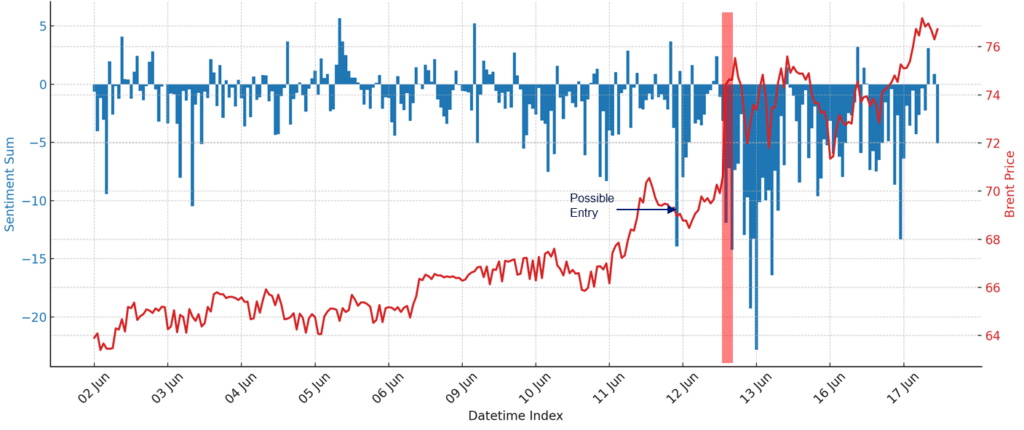
Iran oil price surge war sentiment

Above: Brent crude oil sentiment analysis reveals optimal trading opportunities during geopolitical volatility. The chart demonstrates how AI-driven sentiment detection (blue bars) identified a crucial “Possible Entry” point ahead of significant price movements, with Brent prices (red line) surging during the Iran-Israel conflict period highlighted in the red-shaded area. This exemplifies how real-time sentiment intelligence enables traders to position ahead of geopolitical commodity pricing shifts.

3. Cross-market correlation intelligence: Understanding interconnected dynamics

Sophisticated commodity pricing strategies require understanding dynamic correlations between different benchmarks that shift based on macroeconomic conditions and geopolitical developments. The relationship between Brent crude, WTI, TTF gas, and Henry Hub natural gas creates complex arbitrage opportunities that AI systems such as ours can identify more effectively than traditional statistical methods.

Our recent AI-driven analysis reveals how these correlations evolved during energy supply disruptions, with traditionally independent commodity pricing mechanisms becoming increasingly interdependent. The Strait of Hormuz tensions, for instance, affected not only oil markets but created ripple effects across LNG flows and freight rates, demonstrating the interconnected nature of modern commodity pricing that AI systems capture through continuous correlation monitoring.

4. Sentiment-driven market intelligence: Reading between the lines

Market sentiment increasingly precedes fundamental supply-demand shifts in commodity pricing, making sentiment analysis a key component of modern trading strategies. The wheat market’s recent performance illustrates this dynamic perfectly, with wheat prices surging from below $560/Bu to $590/Bu – a 9.16% gain driven primarily by short-covering rather than fundamental supply changes.

Our AI systems identified this opportunity by detecting extensive short positioning alongside improving sectoral sentiment, including favourable renewable fuel proposals and increased wheat utilisation by beverage brands. These subtle signals, processed through large language models and machine learning algorithms, provided early warning of the impending short squeeze that traditional commodity pricing analysis might have overlooked until after significant price movements had occurred.

Wheat Rallies

Above: Our advanced commodity pricing sentiment analytics in action. Our system identified the wheat short squeeze through sentiment analysis and positioning data, delivering 9.16% gains from $560/Bu to $590/Bu.

5. Agricultural volatility forecasting: Weather and beyond

Agricultural commodities present unique challenges for commodity pricing due to weather dependencies, seasonal patterns, and complex supply chain dynamics. Taking again the example of our recent wheat market analysis, this demonstrates how AI-driven volatility models incorporate diverse data sources – from weather patterns to speculative positioning – to generate predictive insights that inform commodity pricing strategies.

The convergence of supply constraints, weather-related concerns across key producing regions, and renewed export dynamics created the conditions for the wheat rally. Our AI systems processed these multiple variables simultaneously, identifying the bullish setup before traditional analysis might have recognised the developing squeeze in commodity pricing that ultimately drove substantial gains for positioned traders.

6. Metals market precision: Structural supply analysis

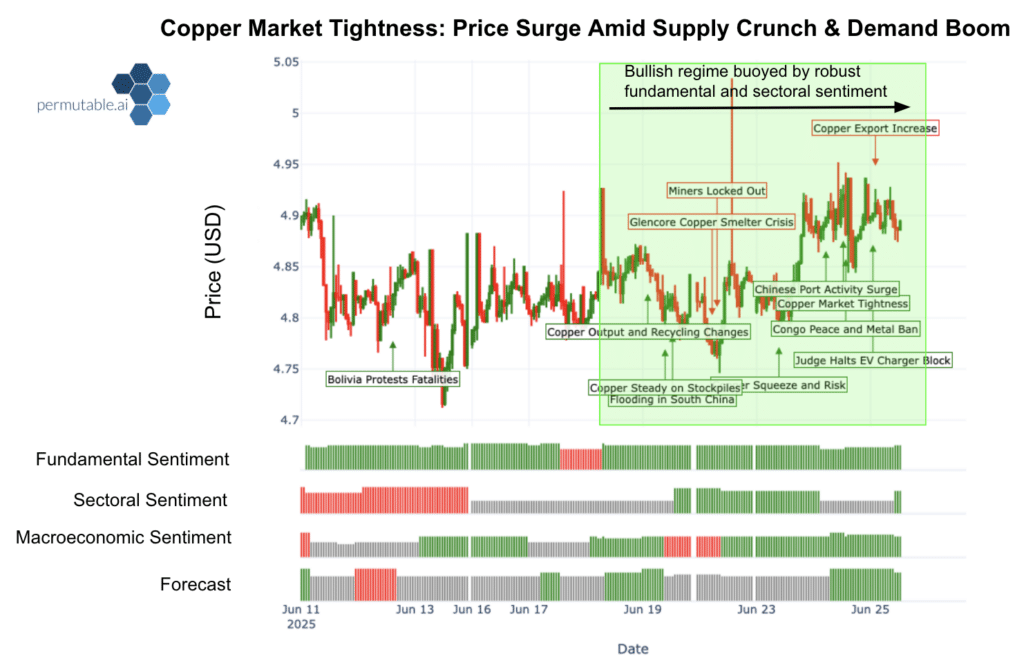
The copper market exemplifies how our AI systems excelled at identifying structural supply constraints that traditional commodity pricing models might underestimate. Our recent AI-driven analysis revealed the drivers behind copper prices climbing from $4.82 to $4.91, including acute supply shortages and plummeting warehouse inventories that fell 80% year-over-year.

Here, our AI-driven analysis captured this dynamic by processing multiple supply-side indicators simultaneously: LME inventory declines, smelting bottlenecks reflected in collapsing treatment charges, and geopolitical developments affecting key producing regions. This comprehensive approach to commodity pricing analysis identified the structural nature of supply constraints that position copper favourably amongst industrial commodities for sustained upward pressure.

copper market tightness

Above: Copper market tightness analysis showcasing our AI-powered commodity pricing intelligence in action. Our Trading Co-Pilot identified a sustained bullish regime supported by robust fundamental and sectoral sentiment indicators (green sentiment bars at bottom), with copper prices climbing from $4.82 to $4.91 amid supply crunch conditions. Key market events – from Bolivia protests to Chinese port activity surges – demonstrate how comprehensive sentiment analysis captures the complex drivers behind structural commodity pricing movements.

7. Seamless integration: From intelligence to action

Ultimately, the effectiveness of AI-driven commodity pricing intelligence depends on seamless integration with existing trading infrastructure. Our enterprise grade API connectivity enables direct integration with trading desks, risk management platforms, and portfolio monitoring systems without manual intervention or data transfer delays.

This integration ensures commodity pricing intelligence flows directly into decision-making processes within familiar working environments. When geopolitical tensions spike or supply constraints emerge, trading teams receive instant value with our real-time updates on price signals, risk assessments, and market correlations through their established workflows, maximising the practical utility of our AI-driven insights for immediate trading decisions.

Summing up: The strategic advantage of advanced analytics

The integration of artificial intelligence into commodity pricing represents more than technological enhancement – it signifies fundamental evolution in how energy and commodity markets operate. As demonstrated through recent market examples across LNG, copper, wheat, and broader energy complexes, our AI systems consistently identify opportunities and risks before they become apparent through traditional analysis methods.

Consequently, energy and commodity trading professionals leveraging these capabilities position themselves advantageously in an increasingly dynamic commodity pricing environment. The question has evolved beyond whether AI will transform commodity trading to how quickly organisations can adapt their operational frameworks to harness these analytical tools effectively. Our clients who are already embracing this technological evolution are already reaping the benefits of superior performance in capturing commodity pricing opportunities whilst managing associated risks.

The evidence across recent market movements – from LNG’s geopolitical sensitivity to copper’s structural supply constraints – validates the transformative potential of AI-driven commodity pricing analysis. As markets continue increasing in complexity and information volumes expand exponentially, these analytical capabilities will doubtlessly transition from competitive advantage to essential infrastructure for successful commodity trading operations.

The world’s best commodity and energy trading desks are already capturing tomorrow’s opportunities with our AI-powered commodity pricing intelligence. The systematic advantages outlined above are available only to traders equipped with our next-generation market intelligence. Contact our team at enquiries@permutable.ai to see our AI-driven energy and commodity intelligence in action.

Copper market outlook: AI signals point to sustained tightness amid supply crunch

The story behind the copper market outlook in recent weeks has transformed dramatically, driven by escalating supply shortages and persistent demand that show no signs of abating. This supply crunch has propelled prices higher and created a distinctly bullish environment that our Trading Co-Pilot’s AI-driven analysis has accurately captured in real-time.

Copper prices have surged throughout June, propelled by an acute supply shortage with no signs of abating. The red metal’s upward trajectory has been pronounced, climbing from $4.82 on June 23rd to $4.91 the following day, before settling at $4.89 on June 25th. This rally reflects deepening market tightness caused by dwindling inventories and persistent structural supply constraints. The supply-demand imbalance has intensified over the past week , with rising demand forecasts amplifying the squeeze on available copper stocks. Our Trading Co-Pilot’s analysis confirms strong bullish sentiment underpinning these price movements, with the sustained upward pressure validating expectations of continued market momentum. The convergence of supply shortfalls and robust demand signals suggests this bullish trend may persist as the copper market remains stretched.

copper market tightness
Copper prices have surged, reflecting tight supply conditions and robust demand, signalling sustained bullish pressure in the near-term market outlook. Trading Co-Pilot has flagged renewed bullish sentiment, underpinned by strong fundamental drivers and broad-based sectoral momentum.

Warehouse stocks plummet

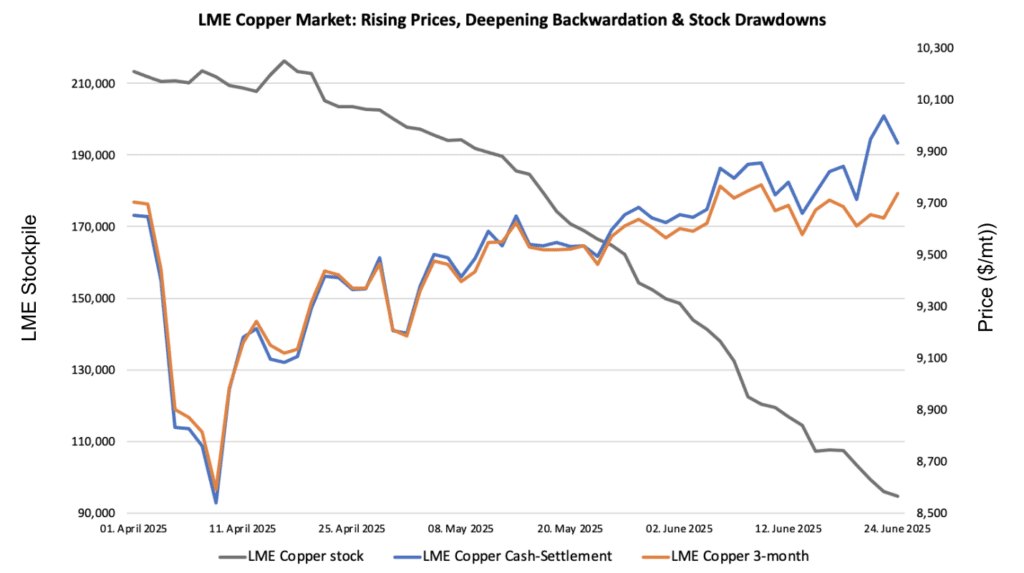
The most drastic evidence of copper’s supply crisis has emerged through collapsing warehouse inventories, creating scarcity that’s pushing the market into backwardation. This is by no means a temporary dip, but represents a fundamental shift toward critical shortage levels that are reshaping global copper market dynamics. The clearest sign of copper’s supply crisis emerged on June 23rd when London Metal Exchange (LME) inventories posted another sharp decline. Key indicators include:

  • Stock depletion: Accessible copper stocks have plummeted 80% this year, representing a severe depletion in global supply.
  • Price spike: LME spot copper prices surged above $10,000/mt, while the COMEX hovers around $4.90 mark.
  • Market backwardation: Steep premium for immediate delivery over future contracts.
  • Premiums soar: The backwardation has spurred the three-month contract premium to reach nearly $280 above the cash-settlement.
Copper Stockpile and Price
Copper prices rise sharply as backwardation emerges amid a steep decline in LME inventories, indicating a severe supply squeeze—evidenced by the spot price trading above the three-month futures contract.

Tariff-driven demand compounds shortage

The price spike reflects more than speculative trader interest and has had a compounding effect on an already tight supply situation:

  • The scramble in U.S. copper buying is driven by tariff threats on metal imports, with the redirection of global supply creating shortages and undersupply in markets elsewhere.

Smelting bottlenecks worsen supply constraints

Beyond the immediate inventory crisis, copper faces deeper structural fractures in its supply chain that threaten medium-term availability. The smelting sector, the crucial bridge between raw ore and refined metal, is experiencing unprecedented stress at treatment level as smelting fees collapse and capacity mismatches create systemic bottlenecks.

Structural supply chain disruptions

Beyond falling inventories, copper supply chain faces deeper structural headwinds:

  • Australian smelter closures: Announced due to raw material shortages and collapsing treatment charges.
  • Treatment charge collapse: Fees miners pay to process copper ore have collapsed, with some smelters now effectively paying miners to convert raw materials into refined metal. An unheard of occurrence.

Chinese capacity expansion vs. mining shortages

While Chinese smelters show some positive developments it has amplified the supply bottleneck as mining output shortages persist causing a mismatch between smelting capacity and raw material output.

  • Capacity expansion: Chinese smelters expanding and negotiating longer-term contracts with marginally positive fees.
  • Fundamental imbalance: Building smelting capacity takes far less time than developing new mines, with the shortage of raw material a prevailing headwind for smelters. 

Geopolitical complexity

Global political developments continue to influence supply chains and the copper price outlook:

  • DRC peace agreement: Initial hopes for supply stability stemming from the Democratic Republic of Congo’s peace deal, has subsequently fallen off as the Congolese government announced an extension on its ongoing metals export ban, reintroducing greater market uncertainty surrounding mining output.
  • Mixed signals: Positive developments like Teck Resources securing Kamloops mine extension and expansion permits are offset by development timelines being unable to meet the near-term supply deficit. 

Demand endures despite price gains

While supply constraints dominate headlines, copper demand continues to demonstrate remarkable resilience in the face of higher prices. This sustained appetite, particularly from key consuming nations, suggests the market’s tightness reflects genuine consumption strength to absorb the available metal at elevated price levels.

Chinese market dynamics

Copper demand has remained surprisingly resolute despite higher copper price outlook:

  • Port activity surge: Chinese port activity increased, signaling enduring appetite from the world’s largest copper consumer. While copper imports dipped slightly month-on-month in May, year-on-year figures show resilient momentum and growth. 
  • Strategic positioning: China continues to expand its smelting capacity while accumulating strategic stockpiles for industrial use. 

Copper market outlook via Trading Co-Pilot: Tightness to persist

The copper market faces a deepening supply crisis that underpins a compelling bullish outlook. Rapidly depleting LME stocks, persistent smelting bottlenecks, and mining constraints have created acute market tightness, while global demand, driven by electrification and renewable energy transitions, remains robust despite geopolitical headwinds. Our Trading Co-Pilot captured this dynamic with strong bullish forecast and a “Buy” signal issued on June 24th, accurately reflecting positive sentiment across fundamental and sectoral indicators. Recent smelter disruptions and continued inventory drawdowns reinforce the structural nature of current supply constraints. While new mining projects promise eventual relief, their impact remains years away, leaving the market vulnerable to sustained tightness. With copper’s critical role in the global energy transition and limited near-term supply solutions, the fundamentals rank among the strongest in industrial commodities. The whirlwind of structural supply deficits and resilient demand creates a foundation for continued upward price pressure, positioning copper favourably amongst commodity market traders.

To explore how real-time commodity market sentiment data can enhance your trading strategies and risk models, contact us at enquiries@permutable.ai to request a tailored demonstration.

Predicting market movements through advanced sentiment analysis

This article explores how advanced narrative intelligence and real-time AI-driven sentiment analysis are transforming the way professional traders and systematic investors approach predicting market movements.

When Brent crude spiked from $69 to $74 in June 2025, traditional analysts were still parsing Middle Eastern headlines whilst our War Sentiment Index had already flagged the narrative shift hours earlier. This isn’t an isolated incident – story signals have fundamentally changed the game, enabling systematic traders to position ahead of market consensus rather than react to price action that’s already occurred.

Understanding story signals

Story signals essentially capture the narrative momentum that drives market behaviour through our sophisticated proprietary algorithms that process vast amounts of unstructured data across thousands of media sources simultaneously. Unlike traditional analysis that relies on historical price data, our story signals identify the underlying narrative forces that eventually translate into trading decisions by market participants.

The power of our approach lies in capturing the informational edge that exists in the temporal gap between when news breaks and when markets fully digest its implications. Our systematic framework processes linguistic patterns, source credibility, and cross-reference validation at speeds impossible for human analysts, transforming market prediction from reactive analysis to proactive strategy implementation.

The four pillars of our story signal detection for predicting market movements

Effective market prediction through story signals relies on understanding four distinct signal categories that our algorithms continuously monitor across global media sources.

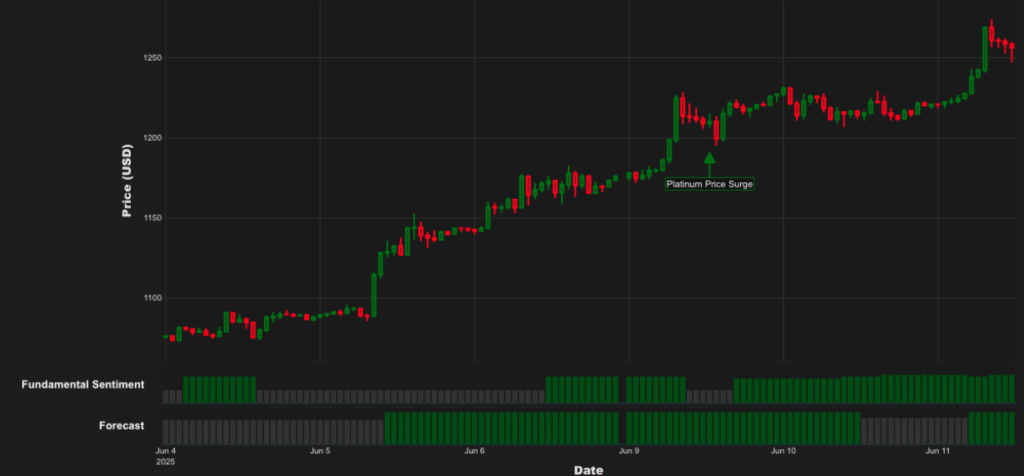
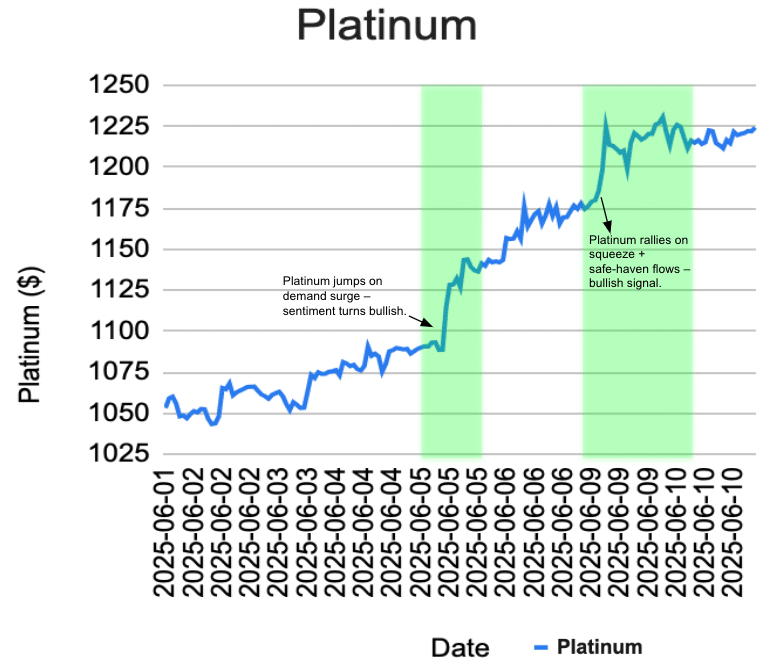
Breakout Signals occur when previously dormant stories suddenly capture widespread media attention, often indicating the beginning of significant price movements as market awareness shifts dramatically. The recent platinum surge above $1,268 in June 2025 exemplifies this pattern perfectly. Our Trading Co-Pilot detected unusual narrative momentum building around platinum supply constraints and geopolitical risks hours before the metal broke through resistance at $1,089.50. Our system issued a “strong bullish” sentiment alert during early Asian trading, providing our subscribers with critical positioning advantages before prices accelerated from $1,127.20 to $1,222.50.

Volume Build-up Signals represent the gradual accumulation of narrative momentum around particular themes or asset classes. Unlike sudden breakout spikes, volume build-up creates sustained pressure that enables long-term trend prediction. The euro’s strengthening trend demonstrated this signal type in action. As ECB officials maintained hawkish tones while the Federal Reserve showed dovish tendencies, our Trading Co-Pilot systems tracked the building narrative around monetary policy divergence. This volume build-up preceded EUR/USD’s surge above $1.1570 to levels not seen since late 2021, with the single currency benefiting from systematic capital flows as investors repositioned for central bank policy differences.

EUR/GBP Surge: Sterling Weakness Drives Euro to Multi-Month Highs

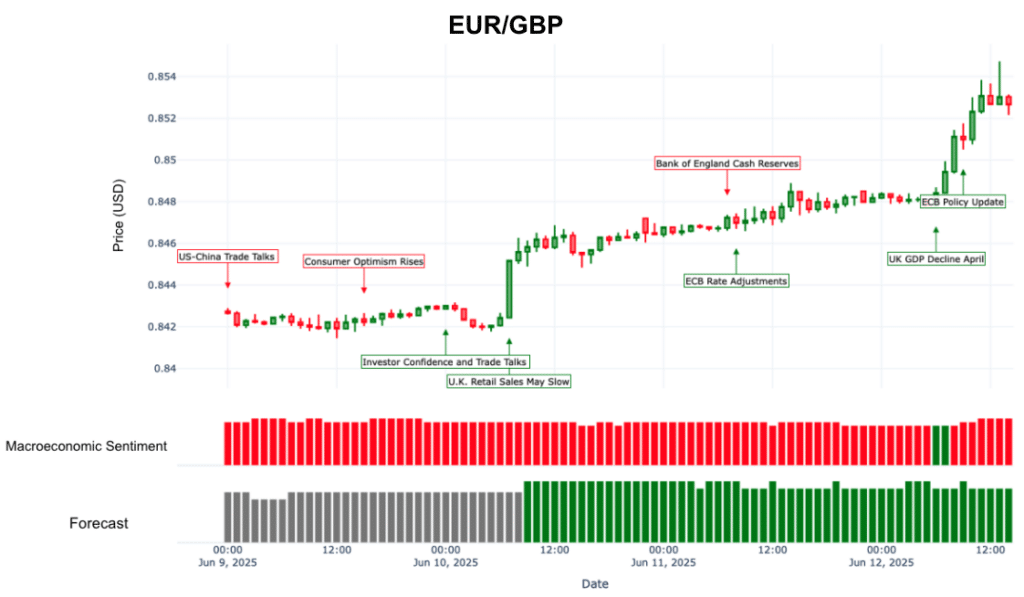
Above: Tracking macroeconomic sentiment: The EUR/GBP rally in June 2025 was preceded by sustained positive sentiment and narrative signals – enabling traders to anticipate the euro’s climb amid UK economic weakness and ECB policy updates.

Direction Shift Signals identify when established narratives begin changing course, providing critical intelligence for anticipating price reversals before technical indicators suggest trend changes. The recent shift in oil market sentiment surrounding Middle Eastern tensions illustrates this pattern. Initially, markets had become somewhat complacent about regional risks, but our War Sentiment Index detected early signals of changing narrative tone. On June 12th, our algorithms began detecting unusual patterns in media coverage of Iran-Israel tensions, with sentiment scores showing significant negative spikes hours before Brent crude moved from $69 to $74 following escalating strike warnings.

Persistence Signals measure the staying power of existing narratives, helping traders distinguish between temporary noise and stories with genuine long-term market impact. The sustained euro strength against sterling demonstrates our persistence signal effectiveness. EUR/GBP’s ascent to 0.85 was driven by persistent negative narratives around UK economic performance, with our Trading Co-Pilot tracking consistent bearish sentiment following Britain’s -0.3% GDP contraction in April 2025. The persistence of negative UK economic stories, combined with eurozone resilience narratives, created sustained pressure that traditional technical analysis struggled to quantify.

Real-world performance: Our systematic advantages in action

The effectiveness of our story signal technology extends across multiple asset classes and market conditions, with documented success providing systematic traders with measurable competitive advantages.

Precious Metals Intelligence: The platinum market surge in June 2025 showcases our story signals’ precision in commodity markets. Our Trading Co-Pilot identified the two-stage rally before price action confirmed the moves, capturing demand surge narratives in May and squeeze dynamics in June. When platinum opened sharply higher at $1,268.90 following intensified Russian drone attacks on Kyiv, our system had already signalled bullish sentiment shifts, enabling our subscribers to position ahead of safe-haven buying flows.

Currency Market Prediction: The euro’s remarkable strength against major currencies demonstrates our story signals’ effectiveness in foreign exchange markets. Our Trading Co-Pilot‘s sentiment analysis captured the shift from bearish to bullish conditions across EUR/USD and EUR/GBP, identifying macro data impacts and central bank rhetoric changes before markets moved. Our system correctly anticipated EUR/USD’s sustained upward trajectory past 1.16, whilst simultaneously tracking the narrative divergence that drove EUR/GBP higher as UK growth fears intensified.

Energy Market Intelligence: Oil markets provided perhaps the most dramatic demonstration of our story signals’ predictive power. Our War Sentiment Index, one of 22 proprietary macro indices we’ve developed, detected escalating Middle Eastern tensions hours before Brent crude spiked from $69 to $74. Our system processed thousands of articles in real-time, assigning sentiment scores and evaluating source credibility to create high-confidence signals that traditional geopolitical analysis could never match for speed and accuracy.

Iran oil price surge war sentiment

Above: Early warning in action: Our War Sentiment Index flagged negative sentiment spikes hours before Brent crude surged from $69 to over $74 on June 13, 2025 – providing a clear possible entry point well ahead of market consensus.

Integration with systematic trading strategies

The competitive advantage in modern systematic trading increasingly depends on information processing speed and accuracy, precisely where our story signals excel. Our algorithms can detect narrative shifts within minutes of emergence, providing systematic traders with significantly improved entry and exit timing capabilities.

The quantitative nature of our signals integrates seamlessly with existing algorithmic trading systems, providing an additional intelligence layer that enhances rather than replaces traditional technical and fundamental analysis approaches. This allows for positioning ahead of market consensus rather than following it, providing edge in trading operations

During volatile periods, such as the recent Iran-Israel escalation, our story signals provided our clients with actionable intelligence hours before markets fully priced in geopolitical risks. Traditional analysis would have required manual processing of news flows, expert interpretation, and risk assessment – processes that consume valuable time whilst opportunities disappear.

Macro strategy applications

Macro strategists face unique challenges in connecting global narratives with specific asset class implications across interconnected markets. Our story signals excel in this environment through multi-asset correlation analysis that helps strategists understand how geopolitical tensions, central bank communications, or economic policy shifts create ripple effects across different instruments and regions.

The recent convergence of multiple macro themes demonstrates this capability. European monetary policy divergence, Middle Eastern geopolitical tensions, and commodity supply constraints created complex cross-asset relationships that traditional analysis struggled to quantify systematically. Our story signals provide the framework for identifying which narratives deserved immediate attention versus those representing temporary noise, enabling more efficient allocation of analytical resources.

Meanwhile, the correlation between our War Sentiment Index and Brent crude over the past year reveals patterns impossible to detect through manual analysis, with major sentiment spikes consistently preceding significant oil price movements. 

The evolving competitive landscape

Financial markets have fundamentally changed, with information velocity and complexity reaching levels that traditional analysis cannot adequately address. Our story signals represent the natural evolution of market intelligence, combining artificial intelligence capabilities with deep understanding of market psychology and behaviour patterns.

What we are seeing is that this transformation is becoming indispensable to our clients as markets grow increasingly efficient and competitive, with early adopters of our story signal technology are already seeing significant advantages.

The question facing professional traders and institutions is not whether AI-driven sentiment analysis will become standard practice, but how quickly these capabilities can be integrated before competitors gain systematic advantages. Every day, commodity and currency markets experience inflection points that separate profitable positions from missed opportunities, and without real-time sentiment detection, significant alpha potential remains uncaptured.

Looking forward

As the sophistication of modern markets continues evolving, the demand for equally sophisticated analytical tools grows correspondingly. At Permutable, we’re building tools for today’s markets – are preparing traders for tomorrow’s complexity. We believe that the integration of real-time narrative intelligence with systematic trading strategies represents the next evolutionary step in professional market analysis.

Discover how our narrative intelligence and Sentiment Analysis API can enhance your ability to predict market movements and gain the competitive edge that separates successful systematic traders from the rest. Email us at enquiries@permutable.ai to request a demo.

LNG price ascent stirred by geopolitical volatility: Our Trading Co-Pilot’s guide through turbulent energy markets

This article looks at the significant movements in the Liquefied Natural Gas (LNG) market over the past fortnight, driven by a combination of geopolitical volatility and strong demand-side fundamentals. Our proprietary Trading Co-Pilot, leveraging advanced Artificial Intelligence and Large Language Model (LLM) sentiment analysis, precisely detected this volatile energy market landscape, identifying optimal positions and generating demonstrative gains amidst market uncertainty.

The Liquefied Natural Gas (LNG) market has recently witnessed a remarkable two-week LNG price surge in the TTF benchmark, climbing sharply from €34.85/MWh on June 10th to surpass €42.02/MWh by June 23rd. This robust bullish momentum, was capitalised upon by our Trading Co-Pilot, was fundamentally driven by a mixture of renewed global demand, strategic global infrastructure developments, and increasingly pronounced geopolitical risk premiums, all buoyed by highly favourable fundamental and macroeconomic sentiment dynamics. 

The LNG price ascent occurred against a backdrop of escalating tensions in the Middle East and ongoing concerns over global energy supply that continued to stir markets. However, in a significant recent development, prices across the energy market have seen a tumble following a ceasefire agreement. LNG price has fallen sharply this morning, dropping over 10% to €36.14/MWh on Tuesday, hitting its lowest level in more than a week, after Trump reached a ceasefire agreement between Iran and Israel. If this truce proves lasting, the tension will officially end after 24 hours, concluding 12 days of hostilities. Crucially, this truce has eased concerns of a broader regional spillover of the conflict that could disrupt energy flows through the Strait of Hormuz.

Our Trading Co-Pilot’s precision in navigating uncertainty

The analytical capabilities of our Trading Co-Pilot were paramount in navigating geopolitical volatility throughout this fortnight. Its ability to discern subtle shifts in market sentiment allowed for the identification of an optimal entry point around June 12th at €36.16/MWh, preceding the most substantial part of this sustained upward trajectory. The initial impetus for this high-conviction ‘buy’ call stemmed from a robust bullish outlook, significantly bolstered by key announcements. Our Trading Co-Pilots buy decision was detected by firm demand signals, with the French government’s endorsement of TotalEnergies’ LNG ambitions and, crucially, the Japanese government’s explicit backing for JERA’s future LNG strategy. These signals conveyed a lasting commitment from major consuming nations towards long-term energy utilisation, involving expanding LNG imports and ramping up receiving and regasification capacity. Such detection of sentiment from government backed support by the Trading Co-Pilot’s analysis, acted as a powerful positive catalyst, reinforcing underlying market fundamentals and validating the system’s early bullish signal. The accompanying chart accurately illustrates this decisive period of bullish regime momentum, showcasing the Trading Co-Pilot’s foresight.

LNG trade Chart
The Trading Co-Pilot identifies a bullish LNG price regime on 12th – 23rd June, supported by strong macroeconomic and fundamental sentiment, with key news events driving sustained upward momentum.

LNG price and market resilience

The market’s remarkable resilience during this fortnight further underpins the strength of the bullish sentiment, particularly in the wake of significant geopolitical shocks. Indeed, a brief pullback over the recent weekend was triggered by news of US airstrikes on Iranian nuclear facilities, stoking energy-linked geopolitical volatility and momentarily offering thermal coal an appealing competitive edge. US officials lauded the strikes as a victory. Despite this immediate uncertainty, the market’s recovery was swift and resolute. This rapid rebound was largely a reflection of escalating concerns surrounding the stability and capabilities of Qatar’s LNG exports and supply. This concern was amplified by the uncertainty surrounding Iran’s broader response having launched strikes on US bases in Qatar. 

Strait of Hormuz: The crucial chokepoint and its impact on LNG markets

The heating up of tension had significantly increased the likelihood of our scenario, whereby disruptions in shipping through the Strait of Hormuz would spillover into all of the energy markets. This is a crucial choke point for global oil and LNG flows, with a quarter of seaborne oil trade and roughly 20% of global LNG trade moving through its narrow sea lanes. Even with scope for some flow diversion, an effective blocking of Hormuz would have dramatically altered the outlook of LNG, pushing the market into a deep supply deficit. However the truce has eased market concerns of a broader war that could disrupt energy flows through the Strait of Hormuz. 

Strong fundamental sentiment and demand

Beyond the immediate geopolitical concerns, the bullish trajectory was firmly supported by compelling fundamental sentiment across key demand centres:

Diverse demand growth: While China’s LNG imports are notably set to slump for the first time in three years, a consequence of flagging industrial output and robust domestic gas pipeline supply. Such a regional softening has been limited by surging demand elsewhere as Europe and US are forecast to experience severe heatwaves, spurring cooling demand which is poised to significantly spike usage for air conditioning, directly increasing LNG consumption. Concurrently, Japan’s proactive long-term strategy for ensuring winter power needs is driving significant forward contracting and import demand.

Project advancements: The market is demonstrating a healthy absorption capacity for new supply. Significant milestones in new export facilities and liquefaction projects, particularly those emerging from North America (e.g., Canada), are being effectively integrated. This indicates that despite increasing supply, underlying demand remains prevalent, hinting towards strong future market absorption.

Strategic partnerships: The proliferation of long-term agreements between major industry players – such as Woodside, JERA, and Petronas – underpins a profound and sustained commitment to LNG as a crucial component of the global energy mix. These multi-year commitments provide a stable demand base that underpins investment and trading confidence.

Supportive macroeconomic sentiment: The broad economic implications

The macroeconomic backdrop further reinforces the bullish outlook, particularly concerning the escalating geopolitical risk premium and its broader economic implications:

Geopolitical risk premium: The instability in the Middle East, stirred concerns surrounding the Strait of Hormuz and Qatar’s export vulnerability. This injected a considerable and growing risk premium into LNG prices. This elevated risk was starkly reflected in TTF gas prices hitting a recent multi-month high, alongside surging freight rates for LNG carriers across key routes. Our Trading Co-Pilot’s continuous monitoring of these macro-level geopolitical tensions allows it to factor these crucial elements into its sentiment and forecast models, providing a comprehensive market view.

LNG outlook leveraging our Trading Co-Pilot

The overarching outlook had been profoundly bolstered by the compounding positive signals and prevailing market momentum. This robust assessment is rigorously validated by our fundamental and macroeconomic sentiment indicators, which have consistently provided strong support for a ‘Buy’ decision for LNG since June 12th. We held a high degree of confidence in this sustained bullish signal until June 23rd. Based on current dynamics and the comprehensive insights provided by our Trading Co-Pilot, the near-term outlook as of the 24th appears to see a pullback from the markets. The recent truce has indeed calmed market fears of supply-side bottlenecks, proving favourable for dependent European energy markets as the price within the LNG market reconsolidates, even as the global geopolitical climate simmers down, as the degree of uncertainty in markets abating.

Stay ahead of geopolitical volatility in energy markets with real-time sentiment intelligence from our Trading Co-Pilot. Transform uncertainty into opportunity with data-driven insights. Simply email enquiries@permtuable.ai to request a demo.

Wheat rally today: Short squeeze captured by our market sentiment intelligence

Wheat futures experienced a significant upswing, primarily propelled by a short-covering wheat rally amid evolving sectoral sentiment and supply-side constraints. Our Trading Co-Pilot identified these early bullish indicators and issued a timely ‘Buy’ recommendation. This precise, data-driven insight on the recent wheat rally provided a valuable strategic advantage in navigating the complexities of a dynamic commodity markets.

The recent wheat rally has been predominantly attributed to a robust short-covering rally, rather than fundamental shifts in market supply and demand. This dynamic propelled wheat to a notable recent high of $590/Bu, culminating in a significant 9.16% gain this week. The predominant catalyst was the  liquidation of extensive net short positions held by speculators. As prices initiated their ascent, these bearish positions rapidly unwound, injecting substantial upward momentum into the market. Notably, our Trading Co-Pilot accurately detected this market shift. Leveraging its advanced AI and Large Language Models (LLMs), it was able to identify bullish signals from improved sectoral sentiment and extensive short positions. This insight enabled the timely signalling and execution of a ‘Buy’ recommendation, providing clients with an early trading advantage.

Wheat rallies
The Co-Pilot accurately identified the impending wheat rally, driven by supply constraints and a short-covering squeeze. Its timely ‘Buy’ recommendation below $560/Bu on 17 June positioned clients to capitalise on the ensuing bullish regime, as prices advanced to $590/Bu, delivering substantial gains.

Wheat rally market catalysts

This short squeeze was further amplified by a convergence of supportive factors that collectively shifted sectoral sentiment. Contributing to this upward pressure were emerging demand signals, including a favourable renewable fuel proposal and increased wheat utilisation by drinks brands. These factors were compounded by weather-related supply concerns across key grain producing regions, ranging from wet conditions delaying the US winter wheat harvest to dryness in parts of Russia and the EU. Simultaneously, renewed global export dynamics, notably highlighted by Algeria’s substantial wheat procurement, underscored robust international demand, compelling further short liquidation. While optimistic crop assessments and an anticipated large Eastern European harvest might temper expectations for a prolonged surge, the dominant driver of this appreciation remained undeniably the unwinding of speculative short positions. This bullish sentiment for wheat then spread across other grain futures, fostering a broader positive sentiment throughout the agricultural commodity sector.

Co-Pilot’s precision in trade execution

Equipped with advanced forecast and sectoral sentiment capabilities, our Trading Co-Pilot precisely identified the impending bullish market shift, driven by supply constraints and a surge in short-covering demand. Critically, the system issued and executed a ‘Buy’ recommendation on 17th June at 19:00 BST, initiating the trade below the $560/Bu mark. This timely entry was strategically positioned ahead of any major price action, perfectly aligned with prevailing robust sectoral indicators. As the accompanying graph illustrates, prices subsequently surged past this initial trade entry point, climbing towards $590/Bu before a modest market pullback. This enabled clients to effectively capitalise on the wheat rally.

Our Trading Co-Pilot’s unique edge lies in its ability to discern subtle, yet pivotal, shifts in market and news sentiment through sophisticated LLM and AI analysis. By identifying these underlying bullish signals, particularly those stemming from extensive short positioning,  our clients were strategically positioned as the market pivoted from bearish to decisively bullish. While the sector remains upbeat owing to improved growing conditions, the Co-Pilot’s precise forecast signal consistently demonstrates how AI-powered sentiment analysis provides a distinct edge when navigating commodity markets.

Ensure you remain well prepared for unforeseen developments in the agricultural markets by leveraging the real-time sentiment intelligence of our Trading Co-Pilot. Convert market fluctuations into a strategic advantage. Simply email enquiries@permtuable.ai to request a demo.

Energy sector news: 7 key trends that shaped energy markets in June 2025

This article provides a comprehensive breakdown of the seven most significant energy market trends during May-June 2024, analysed through advanced intelligence from Permutable’s comprehensive news monitoring. It is written for energy traders, market analysts, portfolio managers, and industry professionals seeking actionable insights into recent energy market movements and emerging trends.

Energy markets have experienced extraordinary volatility over the past month, with supply risk premiums dominating trading across virtually every commodity. Through comprehensive analysis of energy sector news across 78,082 headlines from 270 authoritative sources between 11 May and 11 June via our Trading Co-Pilot technology, our sophisticated market intelligence reveals seven key trends that shaped energy sector news and drove significant price movements.

1. Geopolitical supply risk premium becomes market foundation

The most dominant trend throughout this period saw geopolitical tensions establishing a persistent risk premium across energy commodities. This fundamental shift in market psychology created the foundation for sustained price elevation, with traders increasingly factoring supply disruption scenarios into their positioning strategies.

Energy sector news coverage consistently emphasised how geopolitical flare-ups translated directly into commodity pricing mechanisms. Market participants recognised that traditional supply-demand fundamentals were becoming secondary to geopolitical risk assessment, creating a new paradigm where political stability carried unprecedented weight in price discovery processes.

This trend presented across different energy sectors – whether examining crude oil, natural gas, or refined products, the same geopolitical anxiety manifested in risk premium calculations. Consequently, energy markets began operating with elevated baseline pricing that reflected ongoing supply security concerns rather than immediate physical tightness.

2. Hurricane season warnings drive preemptive risk management

The National Oceanic and Atmospheric Administration’s forecast for an above-normal hurricane season created the second major trend, with market participants adopting increasingly defensive positioning strategies. This proactive risk management approach differed markedly from previous years, where markets typically responded to actual weather events rather than seasonal forecasts.

Our energy sector news analysis revealed how hurricane risk premium became embedded in pricing structures well before any actual storm activity materialised. with refinery complexes along the Gulf Coast representing critical vulnerabilities that could impact not only regional but global energy supply chains.

The anticipatory nature of this trend demonstrates market maturity, with participants preferring to pay for protection rather than risk exposure to potential supply disruptions. This shift towards preemptive risk management created sustained support for energy prices throughout the period, even absent immediate weather threats.

3. Pipeline and infrastructure vulnerabilities expose system fragility

Infrastructure outages emerged as the third critical trend, highlighting how modern energy systems remain vulnerable to operational disruptions despite technological advances. Pipeline issues and refinery downtime created tactical pressure points that amplified broader supply concerns, reinforcing the risk premium narrative dominating energy sector news.

These infrastructure challenges illustrated the interconnected nature of energy supply chains, where localised disruptions could generate widespread price impacts.   The cumulative impact of various infrastructure issues throughout the period demonstrated how operational risk could compound geopolitical concerns to create particularly volatile trading environments. This trend suggested that infrastructure resilience will become an increasingly important consideration in energy market analysis moving forward.

Energy sector news and trends June 2025

Above: Energy sector sentiment heatmap reveals divergent market forces driving commodity performance over the past month. Our Trading Co-Pilot intelligence shows LNG leading with strongest bullish sentiment across geopolitical tensions and supply factors (bright green), while Henry Hub natural gas displays bearish sentiment despite weather demand – highlighting how abundant US supply fundamentals override external pressures. The matrix demonstrates how our AI processes complex sentiment patterns across demand drivers, supply constraints, and price commentary to identify trading opportunities that traditional analysis might miss. This is precision market intelligence transforming energy sector news into actionable trading signals.

4. Asian and US heatwaves accelerate demand dynamics

Early summer heat waves across both Asia and the United States created the fourth significant trend, with exceptional temperatures driving demand surges that caught many market participants off-guard. These weather patterns provided immediate fundamental support for energy prices whilst reinforcing longer-term concerns about climate volatility impacts on energy systems.

The Asian heatwave particularly influenced LNG markets, with cooling demand creating substantial buying interest that translated into global price pressures with regional weather extremes generating worldwide commodity impacts through trading networks and supply chain interconnections.

Similarly, US temperature extremes supported both power generation demand and cooling requirements, creating broad-based energy consumption increases. This trend demonstrated how weather patterns are becoming increasingly important drivers of energy market dynamics, requiring more sophisticated forecasting and risk management approaches.

5. European gas markets reflect continental energy security concerns

European gas market dynamics represented the fifth crucial trend, with TTF contracts posting 11% gains amid concerns about Norwegian supply flows and broader continental energy security considerations. This performance reflected ongoing European vulnerabilities despite efforts to diversify energy sources following recent geopolitical developments.

The sensitivity of European gas markets to supply disruption narratives exceeded that of other global energy commodities, suggesting that risk premium mechanisms operated with heightened intensity across continental Europe. Energy sector news sentiment during this period consistently emphasised how even minor supply concerns could generate disproportionate price responses in these markets.

This trend highlighted the complex interplay between energy transition policies and immediate supply security requirements, with market participants navigating between long-term sustainability goals and short-term availability concerns. The European experience provided valuable insights into how energy security considerations could override traditional economic factors in pricing mechanisms.

6. LNG markets demonstrate global interconnectedness

The liquefied natural gas sector’s 11% rally constituted the sixth major trend, perfectly illustrating how regional demand pressures could create global commodity price impacts through sophisticated trading networks. Strong shipping utilisation rates combined with Asian buying interest to create particularly robust fundamentals in LNG markets.

This trend showcased the maturation of global LNG trading, with spot markets responding rapidly to supply-demand imbalances across different regions. Energy sector news analysis revealed how LNG markets had evolved into truly global commodities, where Asian heatwaves could influence European gas prices through complex arbitrage mechanisms.

The absence of significant headwinds in LNG markets during this period contrasted notably with other energy commodities, suggesting that supply-demand fundamentals in the LNG sector remained exceptionally strong throughout these weeks. This trend indicated that LNG markets might serve as leading indicators for broader energy market health.

7. US natural gas fundamentals override external pressures

The seventh and perhaps most instructive trend over the last month emerged from US natural gas markets, where Henry Hub contracts declined despite experiencing the same weather-related demand pressures that supported other energy commodities. This performance anomaly demonstrated how abundant supply could override significant external pressures.

Storage levels sitting 15% above five-year averages combined with record domestic production to create overwhelming supply fundamentals that absorbed both weather-related demand surges and hurricane risk premiums. Energy sector news increasingly focused on this disconnect, recognising exceptional supply strength in US natural gas markets.

This trend provided crucial insights into how different energy commodities respond variably to the same fundamental drivers. Whilst other sectors experienced risk premium elevation, natural gas markets demonstrated remarkable resilience that could neutralise multiple supportive factors through pure supply abundance.

Intelligence-driven market navigation

These seven trends collectively demonstrate how modern energy markets require sophisticated intelligence gathering and analysis to navigate successfully. Our analysis of 78,082 headlines across 270 sources reveals patterns that would take hours of manual analysis using traditional research methods alone.

As energy markets continue evolving amid geopolitical uncertainties, weather extremes, and infrastructure vulnerabilities, the ability to identify and understand these trends using our next gen technology and intelligence is becoming increasingly valuable for making informed trading decisions and managing risk exposures effectively across the energy sector news landscape.


Ready to harness of real-time AI-driven energy market intelligence?

Ready to harness real-time AI-driven energy market intelligence? Join the institutional traders already using our Co-Pilot’s News intelligence and Auto Analyst to identify breakout signals before they hit the market. Our advanced sector trend analysis processes thousands of sources daily, transforming market noise into actionable trading opportunities that deliver consistent alpha. Don’t trade on yesterday’s news when you can position ahead of tomorrow’s trends. Transform your energy trading approach with intelligence that thinks faster than the market moves – because in energy markets, timing isn’t everything, it’s the only thing.

Email our team at enquiries@permutable.ai to discover how AI-powered trend analysis can transform your trading approach and help you stay ahead of rapidly evolving energy market dynamics.

Unpacking June’s platinum price surge – how our Trading Co-Pilot delivers edge

This article provides an in-depth analysis of the recent platinum price surge above $1,268 demonstrating how our proprietary AI-powered Trading Co-Pilot system delivered critical early sentiment signals ahead of major price movements. The piece combines real-time trading intelligence with macro analysis from our in-house analyst, examining supply constraints, geopolitical risks, and fundamental drivers behind platinum’s sustained rally and is aimed at professional commodity traders, precious metals investors, systematic trading funds, and institutional clients seeking advanced trading intelligence and real-time sentiment analysis for precious metals markets. Particularly valuable for traders managing multi-asset portfolios who require early-warning systems for commodity market inflection points.

Platinum has taken the spotlight this month, roaring back into focus after breaking above $1,268.90, its highest level since May 2021. The fundamentals surrounding the metal point to a combination of a perfect storm of supply constraints, geopolitical risk, and investor positioning driving the sustained rally. The move began on 5 June, when platinum broke through resistance at $1,089.50. 

During early Asian trading, our Trading Co-Pilot system issued a “strong bullish” sentiment alert, hours before prices surged to $1,127.20, and then accelerated to $1,222.50. This early signal gave a critical edge ahead of a sharp breakout fuelled by renewed momentum and technical positioning. By 10 June, the market paused, taking a natural pullback. 

Our Co-Pilot concurrently flagged this indicating a shift to neutral sentiment, capturing the cooling tone as profit-taking and consolidation took place. However, on 11 June, the rally reignited. Platinum opened sharply higher at $1,268.90, propelled by renewed safe-haven buying after an intensified Russian drone offensive on Kyiv spurred geopolitical risk aversion during the Asian session. Our Trading Co-Pilot once again tracked the real-time shift, signalling a bullish turn in sentiment and helping traders stay ahead of the curve.

platinum price surge

Above: Our Trading Co-Pilot sentiment indicators caught the platinum rally early – while traditional analysts focused on supply fundamentals, our AI detected shifting institutional sentiment patterns across news sources before the breakout. The sentiment heat map showed bullish momentum building in precious metals discourse, with platinum-specific mentions spiking as traders rotated from gold. This is exactly how intelligent sentiment analysis transforms market timing.

The macro outlook: Why platinum has rallied

Several structural and macroeconomic drivers are underpinning platinum’s price strength:

Tight supply: Major producers in South Africa and Russia have curbed output amid a prolonged low price environment owing to covid and the rise of EV’s, worsening an already deepening deficit. The World Platinum Investment Council (WPIC), most recent report forecasts a 966,000oz shortfall for 2025, the third consecutive annual deficit.

Investor safe-haven flows: With elevated lease rates and geopolitical instability, platinum has regained traction as a store of value, attracting capital inflows on the margins.

China demand shift: In retail markets, platinum is gaining prominence in the Chinese jewellery market as a lower-cost alternative to gold, which has fueled additional demand.

Tariff hedging: Earlier in 2025, large volumes were diverted to the United States as investors braced for a potential return to Trump-era tariffs, signalling how political risk is being priced into physical flows.

Sentiment-Driven Platinum Trading Signals in Action

Above: Breakout signals – our intelligence-driven trading alerts identified platinum’s two-stage rally before price action confirmed the moves. Permutable AI sentiment indicators captured demand surge narratives in May and squeeze dynamics in June, delivering actionable positioning opportunities ahead of the 15% price appreciation.

Why it matters: Signals and substance

This rally exemplifies the importance of combining real-time sentiment systems like our Trading Co-Pilot with robust macro, sectoral, and fundamental analysis. In a volatile, undersupplied market like platinum, timing is everything. In this case, our Trading Co-Pilot not only captured the rally, it anticipated key inflection points in sentiment, giving users the ability to position ahead of price moves. With platinum markets now driven by both tight fundamentals and headline risk, tools that identify sentiment shifts early are critical in capturing the market early. Co-Pilot delivers that edge.

How many critical market moves are you missing without real-time sentiment intelligence?

Every day, commodity markets experience inflection points that separate profitable positions from missed opportunities. Without real-time sentiment detection, how much alpha is your trading operation leaving on the table? Traders relying on traditional technical analysis entered platinum positions hours after our Co-Pilot users had already capitalised on the initial momentum, and in volatile, headline-driven markets, this timing differential compounds across every major move. 

Your competitors are already gaining systematic advantages through our advanced sentiment intelligence, and as markets become increasingly driven by geopolitical headlines and macro sentiment shifts, the question isn’t whether you need real-time sentiment analysis – it’s whether you can afford to operate without it whilst your competition gains positioning advantages on every market inflection. 

Contact our trading intelligence team at enquiries@permutable.ai to discover how our Trading Co-Pilot intelligence suite and systematic data feeds deliver systematic positioning advantages for your commodity and precious metals strategies.

Silver rally today: Understanding current market momentum

This article provides an in-depth FAQ analysis of the silver rally today powered by Permutable AI’s Auto Analyst, examining the key drivers behind the precious metal’s breakthrough above $36.00/oz and what it means for investors. It is aimed at investment professionals, precious metals traders, portfolio managers, and sophisticated investors seeking expert analysis on current silver market dynamics.

In commodity market news this week, silver has captured significant attention, with prices decisively breaking through the psychologically important $36.00 per ounce barrier. This comprehensive FAQ addresses the most pressing questions surrounding the silver rally today, providing institutional-grade insights for discerning investors.

What’s driving the silver rally today?

The current silver rally represents a confluence of multiple bullish factors that have aligned to create exceptional momentum in the precious metals space. Most notably, the combination of safe-haven demand and US dollar weakness has created a powerful tailwind for silver prices. As geopolitical tensions continue to simmer across various global hotspots, investors are increasingly seeking refuge in tangible assets that have historically preserved wealth during periods of uncertainty.

Furthermore, the dollar’s recent softness has made dollar-denominated commodities more attractive to international buyers, whilst simultaneously reducing the opportunity cost of holding non-yielding precious metals. This dual impact has been particularly pronounced in the silver market, where industrial demand components add another layer of complexity to the investment thesis.

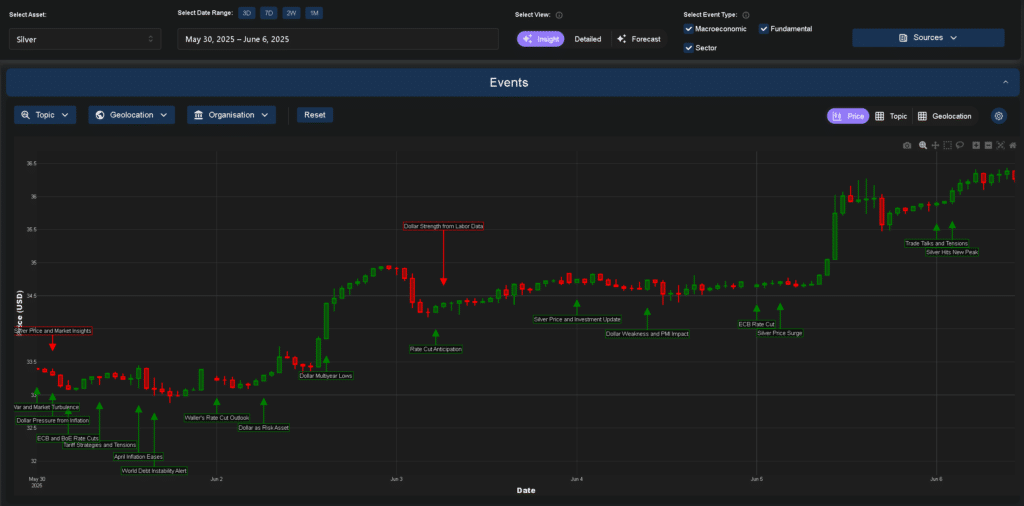
Silver rally today AI-Powered Insights Behind the Breakout

This chart from Permutable AI’s Trading Co-Pilot highlights the key macroeconomic, sector, and fundamental drivers behind silver’s rally past $36/oz. From early signals like rate cut expectations and inflation easing to momentum built by dollar weakness and institutional buying, our system connected the dots – well before the breakout.

How significant was the June 2nd rally in setting the current tone?

The June 2nd rally serves as a crucial technical and psychological milestone that cannot be understated in its importance to current market dynamics. That Monday’s sharp upward movement, which was primarily fueled by dollar weakness and renewed physical buying interest, established a foundation of momentum that has subsequently carried silver through multiple resistance levels.

More importantly, the volume characteristics and follow-through action witnessed after June 2nd suggest institutional participation rather than merely speculative froth. This distinction is critical, as institutional flows tend to provide more sustainable price support compared to retail-driven momentum surges.

What role is gold’s performance playing in silver’s current strength?

Gold’s march to record highs has created a fascinating dynamic within the precious metals complex that seasoned analysts have been watching closely. As gold becomes increasingly expensive for many investors, silver has emerged as an attractive alternative for those seeking precious metals exposure without the premium price tag associated with gold’s current levels.

This phenomenon, often referred to as the “poor man’s gold” trade, has historically occurred during extended precious metals bull markets. However, the current iteration appears more sophisticated, with institutional investors using silver as a portfolio diversification tool rather than simply a gold substitute. The gold-to-silver ratio dynamics suggest there’s still considerable room for silver to outperform on a relative basis.

How are supply constraints affecting the current rally?

Supply-side fundamentals have been quietly building bullish pressure in the silver market for several quarters, and these factors are now contributing meaningfully to the current rally. Global silver inventories have tightened considerably over the past year, with several major producing regions reporting lower-than-expected output due to various operational challenges.

Additionally, recent drilling results from key exploration projects have been promising, yet the timeline from discovery to production remains lengthy in the mining sector. This creates an interesting paradox where long-term supply prospects may be improving, but near-term availability constraints continue to support higher prices. The industrial demand component, particularly from solar panel manufacturing and electronics sectors, has maintained steady growth throughout this period.

What makes this rally different from previous silver surges?

The current silver rally exhibits several characteristics that distinguish it from previous speculative episodes in the precious metals markets. Firstly, the underlying fundamental backdrop appears more robust, with genuine safe-haven demand complementing industrial consumption rather than purely speculative positioning driving prices higher.

Secondly, the technical progression has been more methodical, with silver grinding higher through resistance levels rather than experiencing the parabolic moves that often characterise unsustainable rallies. This measured approach suggests a healthier foundation for sustained price appreciation.

Are there any bearish risks investors should consider?

Whilst the current outlook for silver remains decidedly positive, prudent risk management requires acknowledgement of potential headwinds. A significant strengthening of the US dollar could pressure silver prices, particularly if driven by unexpectedly hawkish Federal Reserve policy shifts.

However, based on current macroeconomic conditions and policy trajectories, such scenarios appear less probable in the near term. The absence of obvious bearish catalysts, combined with the supportive fundamental environment, reinforces the constructive outlook for silver prices.

What’s the outlook moving forward?

From both technical and fundamental perspectives, the silver market appears well-positioned for continued strength. The breakthrough above $36.00/oz represents more than just a psychological milestone – it suggests the market has sufficient conviction to push through significant resistance levels.

The convergence of safe-haven demand, dollar weakness, supply constraints, and spillover effects from gold’s strength creates a compelling investment narrative that should support higher silver prices in the coming months.

The silver rally today represents a sophisticated interplay of fundamental and technical factors that professional investors ignore at their own peril. With no obvious bearish catalysts on the horizon and multiple supportive elements remaining in place, the precious metals sector continues to offer compelling opportunities for those positioned appropriately.

Are you positioned to anticipate silver’s next move?

In a market shaped by macro uncertainty, supply pressure, and technical momentum, simply reacting is no longer enough. Discover how our institutional-grade insights can help you decode market shifts before they happen. 

Speak with our enterprise team to learn how our market intelligence can help you stay ahead of what’s next. Get in touch at enquiries@permutable.ai to find out more about our full suite of market intelligence solutions. 

Weekly commodities market news roundup 06.05.25

This  commodities market news roundup is aimed at institutional investors, commodity traders, and market analysts seeking to better understand the forces driving this week’s volatile commodity markets – from geopolitical tensions to weather disruptions – and how advanced AI tools like Permutable AI’s Trading Co-Pilot can provide a critical edge in navigating them.

This week’s commodities markets have presented a fascinating complex of conflicting forces, with geopolitical tensions, weather disruptions, and evolving supply dynamics creating significant price volatility across multiple asset classes. Drawing from our Trading Co-Pilot’s comprehensive analysis there have been several key themes that dominated market sentiment and price discovery mechanisms throughout the trading period.

The overarching narrative this week centered on the delicate balance between supply-side disruptions and demand-side uncertainties, with geopolitical risk premiums playing an increasingly prominent role in price formation. Notably, the interplay between U.S.-China trade dynamics, OPEC+ production decisions, and weather-related supply concerns created a complex web of interdependencies that our analytical models flagged as particularly significant for near-term price trajectories.

Commodities market news: Energy

The energy sector exhibited remarkable resilience this week, with crude oil markets demonstrating their characteristic sensitivity to both fundamental supply-demand metrics and geopolitical developments. OPEC+’s confirmed 411,000 barrel per day production increase for July served as a cornerstone event, providing markets with much-needed clarity regarding supply expectations. However, this bullish supply signal was consistently tempered by ongoing concerns about global demand trajectories, particularly following the OECD’s revised growth forecasts.

What proved particularly noteworthy was the market’s reaction to news this week of refinery disruptions, most prominently the outages at BP’s Rotterdam facility, which our algorithms identified as a critical supply-side catalyst driving intraday volatility. Concurrently, the Canadian wildfire situation, which knocked out approximately 350,000 barrels per day of production, highlighted the persistent vulnerability of North American supply chains to weather-related disruptions.

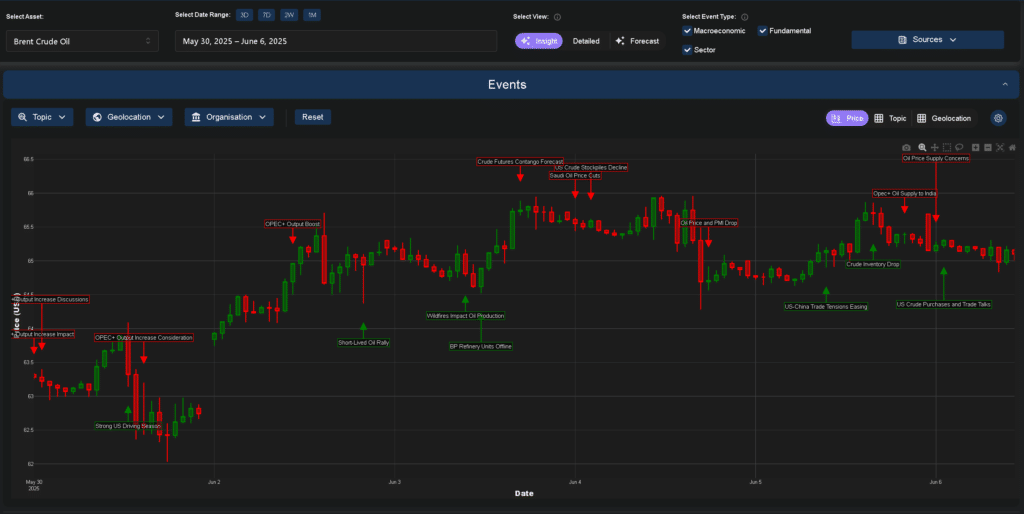
Brent Crude Oil Price Movements and Key Market Events: 30 May – 6 June 2025

Above: Our Trading Co-Pilot’s tracking of commodities market news for Brent Crude Oil sentiment (30 May – 6 June 2025), highlighting key geopolitical, macroeconomic, and fundamental events illustrating the significant impact of OPEC+ decisions, refinery outages, and US-China trade developments on intraday price volatility.

The heating oil market reflected similar dynamics, with geopolitical tensions maintaining elevated risk premiums throughout the week. The Ukrainian drone attacks on Russian airbases and ongoing conflict-related supply concerns provided consistent upward pressure, though this was partially offset by bearish supply signals and inventory builds that emerged mid-week.

Natural gas markets experienced particularly dynamic price action, driven primarily by weather forecasts and their implications for seasonal demand patterns. The emergence of above-normal summer temperature projections across key U.S. consumption regions created a bullish undercurrent that persisted despite larger-than-expected inventory builds, with the significance of the 19% rise in May’s gas price index as a key fundamental indicator supporting the bullish thesis.

Commodities market news: Agriculture

The agricultural complex presented an interesting narrative this week, with weather-related supply concerns intersecting with evolving trade relationships to create significant price volatility. Wheat markets, in particular, demonstrated exceptional sensitivity to geopolitical developments, with Russian strikes on Ukrainian ports providing consistent upward momentum that our analytical systems flagged as a sustained bullish catalyst.

The emergence of agroterrorism-related fungus concerns added an entirely new dimension to agricultural risk premiums, representing a novel supply-side threat that markets are still learning to price appropriately. This development, combined with drought conditions affecting Chinese wheat harvests, created a compelling bullish narrative that sustained price advances throughout the latter half of the week.

Corn markets exhibited their characteristic responsiveness to weather patterns, with Central Illinois rainfall providing relief to drought-stressed crops. However, this positive weather development was consistently balanced against ongoing trade uncertainties and the specter of tariff escalations that continued to weigh on export prospects.

Meanwhile, coffee markets demonstrated remarkable resilience, with Brazilian weather concerns and currency dynamics creating a potent combination of bullish factors. The strengthening of the Brazilian real provided crucial support for producer pricing power, while weather-related supply concerns in key growing regions maintained elevated risk premiums throughout the trading period.

Coffee Price Action and Market Drivers: 30 May – 6 June 2025

Above: Coffee price drivers over the week, with key macroeconomic and fundamental events tracked by our Trading Co-Pilot. This snapshot of commodities market news sentiment for coffee highlights notable drivers include Brazilian weather conditions, currency fluctuations, trade developments, and harvest yield updates – all contributing to intraday volatility and directional momentum.

Looking now to soybeans, which reflected the broader trade narrative, with U.S.-China relations serving as a primary driver of sentiment and price discovery. The announcement of a $2 billion U.S.-Vietnam agricultural agreement provided a counterbalance to ongoing trade tensions, highlighting the market’s increasing focus on supply chain diversification strategies.

Cotton markets demonstrated their sensitivity to both weather patterns and trade dynamics, with monsoon forecasts for key producing regions creating significant intraday volatility. The closure of the ‘de minimis’ trade loophole represented a structural shift that our analytical models identified as potentially significant for longer-term price trends.

Concurrently, sugar markets continued to grapple with the fundamental challenge of abundant global supplies, with production forecasts consistently pointing toward oversupply conditions that weighed on price discovery mechanisms throughout the week. However, weather-related supply concerns in key producing regions provided periodic relief rallies that demonstrated the market’s ongoing sensitivity to production disruptions.

Commodities market news: Metals 

The precious metals complex delivered some of the week’s most impressive performances, with gold reaching new highs above $3,400 per ounce as central bank dovishness and geopolitical uncertainties combined to create powerful bullish momentum. The European Central Bank’s 25 basis point rate cut served as a catalyst for renewed institutional interest, while the Federal Reserve’s increasingly dovish rhetoric provided sustained support for dollar-denominated safe-haven assets.

Silver’s breakout above $35 per ounce represented a particularly significant technical development, with our momentum algorithms identifying this move as potentially sustainable given the underlying fundamental drivers. The combination of tight physical inventories and renewed industrial demand created a compelling supply-demand imbalance that institutional flows have begun to exploit.

Silver Price Trends and Market Drivers: 30 May – 6 June 2025

Above: Silver price movements over the week, highlighting key macroeconomic and fundamental events uncovered by our Trading Co-Pilot. In this snapshot of commodities market news for silver, central bank rate cuts, labour data, dollar volatility, and trade developments all contributed to silver’s breakout to a new peak – demonstrating the value of real-time intelligence in volatile market conditions.

Platinum and palladium markets reflected the complex interplay between industrial demand patterns and safe-haven considerations, with both metals benefiting from the broader risk-off sentiment while maintaining their sensitivity to automotive sector developments. The emergence of supply disruption concerns, particularly related to geopolitical tensions affecting key producing regions, added an additional layer of complexity to price formation mechanisms.

Meanwhile, copper’s performance this week highlighted the metal’s unique position at the intersection of industrial demand expectations and monetary policy considerations. The combination of infrastructure spending optimism and central bank easing created a supportive backdrop, though concerns about Chinese demand growth continued to provide periodic headwinds.

Commodities market news outlook and implications

Looking ahead, commodities markets will continue to navigate the complex interplay between geopolitical developments, weather patterns, and evolving trade relationships. The persistence of central bank dovishness across major economies provides a supportive backdrop for commodity prices generally, while specific sectoral dynamics will likely continue to drive relative performance differentials.

Here, the integration of our real-time news intelligence feeds with advanced algorithmic analysis positions market participants to capitalise on emerging trends and navigate the increasingly complex landscape of global commodity markets. As we continue to monitor developments across all major asset classes using our state-of-the-art commodity market intelligence tools, the importance of this calibre of comprehensive data integration and sophisticated analytical capabilities becomes ever more apparent.

Turn market complexity into clarity with real-time AI-powered insights

In today’s volatile and data-saturated commodity markets, staying ahead of rapidly shifting dynamics is harder than ever. Many traders struggle to cut through the noise and identify actionable signals with enough speed and clarity to make confident decisions. That’s where Permutable AI’s Trading Co-Pilot comes in.

Our Auto Analyst and global macroeconomic data feeds are designed to solve this by turning complexity into clarity – delivering real-time insights you can trust. If you’re ready to move from reactive trading to strategic foresight, get in touch with our enterprise sales team to schedule a personalised demo and see how our platform can help you gain a decisive edge. Simply email enquiries@permutable.ai to speak to our team.