Why is Nvidia stock going down today? Analysis using Permutable AI’s Trading Co-Pilot

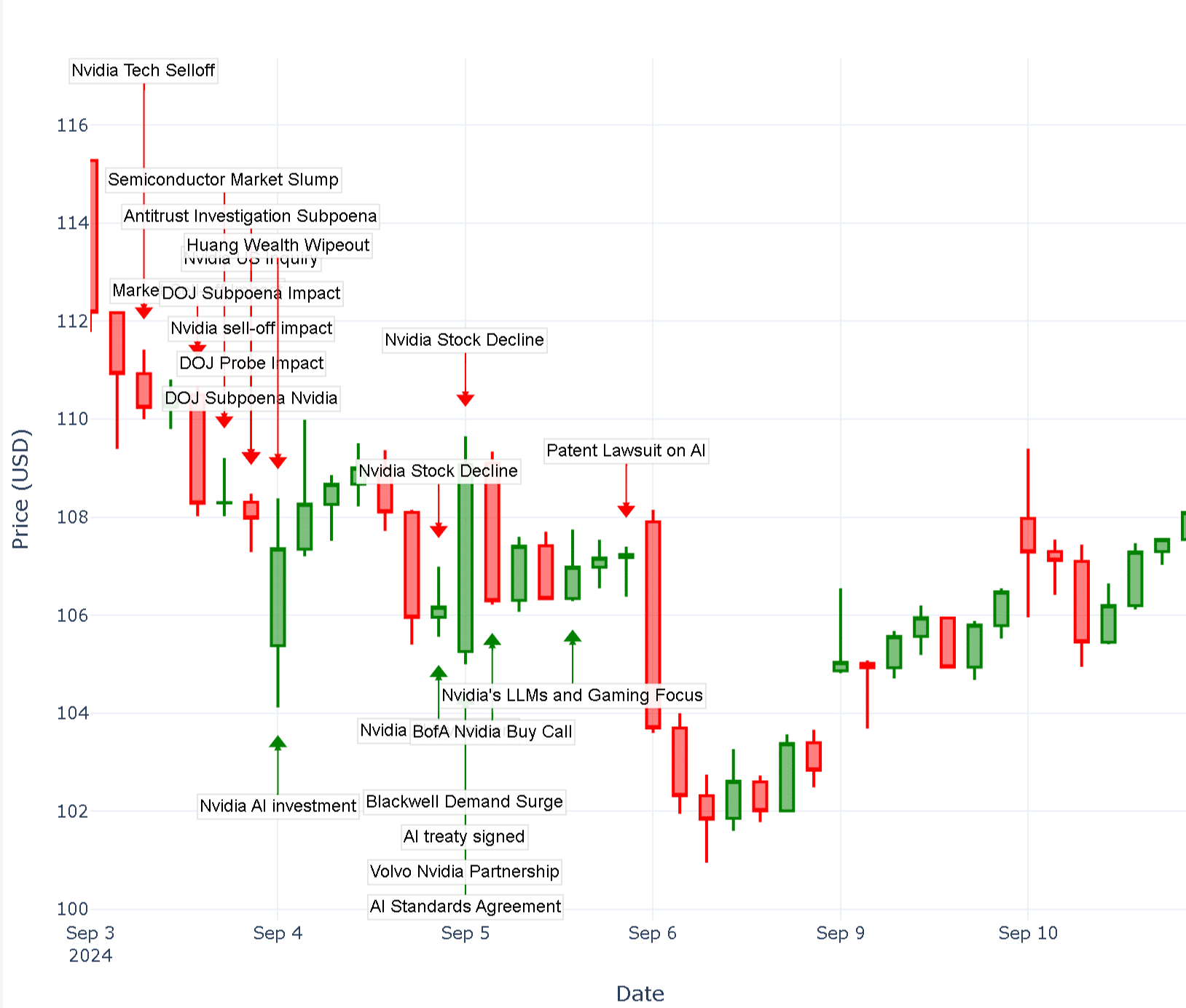
If you’ve been asking yourself, “Why is Nvidia stock going down today?”, you’re not alone. The recent volatility from September 3 to September 9, 2024, highlights significant market events and broader macroeconomic factors. These events, while expected, led to Nvidia’s stock price facing dramatic fluctuations. Now, nearly a week later, we analyse why Nvidia stock went down and explore its future outlook. We’ve put together this analysis of recent events using insights from our Trading Co-Pilot  which provided a confident, data-driven understanding of Nvidia’s movements in relation to world and macros events. 

Why is Nvidia stock going down today?

September 3: Market sell-off and semiconductor slump

It all started on September 3, when Nvidia stock witnessed a sharp decline. Why is Nvidia stock going down today? This isn’t just because of Nvidia’s internal affairs, but rather a market-wide sell-off, compounded by a semiconductor market slump. In stark contrast to Nvidia’s previous steady growth, the market faced global economic fears of a recession. This highlighted the tech sector’s sensitivity to macroeconomic factors, with Nvidia being particularly vulnerable.

But look how our Trading Co-Pilot immediately flagged the downturn, warning investors about the potential ripple effects of the broader market decline. The reality is that Nvidia’s stock reacted as part of a natural correction phase following months of bullish sentiment.

September 4 – 5: A brief recovery

Initially, September 4 brought a small rebound, with news of Nvidia’s  partnership expansion announcement with Volvo to boost AI and autonomous driving. September 5 saw news about Nvidia’s push further into LLMs and gaming. But while these announcements were positive, they weren’t enough to completely calm investor nerves. So, why is Nvidia stock going down today despite these efforts? The answer came from a Patent Lawsuit on AI, which introduced legal challenges for Nvidia’s cutting-edge technologies.

September 6: Nvidia stock tanks

By September 6, the concern for investors asking why is Nvidia stock going down today became even more apparent. Macroeconomic factors—particularly US job growth slowing and concerns around Fed rate cuts introduced further uncertainty. In this scenario, Nvidia, alongside other tech giants, became vulnerable to rate-related volatility. So despite broader market trends, macroeconomic concerns outweighed Nvidia’s positive fundamentals and ultimately, took their toll on the stock. 

September 9: Stabilisation beckons

By September 9, Nvidia’s stock began showing signs of stabilisation. After a week of volatility driven by broader market concerns and legal challenges, the stock found a temporary foothold. Our Trading Co-Pilot flagged this stabilisation, suggesting a pause in the downtrend. But as always, macroeconomic issues loom large, particularly with ongoing concerns about interest rates, inflation, and global growth slowing down. Despite Nvidia’s strong fundamentals and market leadership in AI, the stock remains sensitive to these larger economic forces.

The stabilisation seen on September 9 could mark the beginning of a more balanced trading period for Nvidia, but caution is warranted as macroeconomic uncertainties persist. Nonetheless, our Trading Co-Pilot continues to monitor these developments, providing real-time insights into how broader global factors may impact Nvidia’s stock price moving forward.

What’s next for NVIDIA stock?

Ultimately, the fluctuations seen over this period were driven by a combination of macroeconomic uncertainty, legal issues, and market speculation. Initially, a market sell-off and semiconductor slump led to the first significant decline, which was further exacerbated by legal challenges and macroeconomic concerns. It’s the same story on macroeconomic factors: uncertainty will likely persist in the short term, but Nvidia’s leadership in AI should provide stability over time.

These concerns also shape market sentiment, keeping the question of why is Nvidia stock going down today relevant, particularly for short-term traders. It’s important to remember that ever since Nvidia became an AI leader, it has faced challenges, however analysts believe Nvidia’s long-term growth potential remains solid, particularly in terms of its AI leadership, which continues to drive innovation across industries.  If you’re navigating this complex market landscape, Permutable AI’s Trading Co-Pilot offers real-time insights and predictive analytics to help you stay ahead.

Unlock AI-powered market insights with Permutable’s Trading Co-Pilot

At Permutable AI, we’re excited to announce that we are inviting select corporate partners for a free trial of our Trading Co-Pilot – the cutting-edge AI-powered tool that provided the insights you just read. Limited spaces are available, so if you’re ready to take your market analysis to the next level powered by our advanced AI technologies, we encourage you to get in touch. Don’t miss your chance to be among the first to leverage this transformative tool. Reach out now to us at enquiries@permutable.ai to request a spec and secure your spot or fill in the form below.


Disclaimer: The information provided by Permutable AI is for informational purposes only and does not constitute financial advice, investment advice, or a recommendation to buy, sell, or hold any securities. While we strive to provide accurate and up-to-date information, we do not guarantee the completeness, accuracy, or reliability of the data. All investments involve risks, including the loss of principal. Past performance is not indicative of future results. Users are advised to conduct their own independent research and consult with a licensed financial advisor before making any investment decisions. Permutable AI, its affiliates, or its employees shall not be held liable for any losses or damages resulting from reliance on the information provided.

Stock market insights: 7 key factors driving Advanced Micro Devices stock price performance

Advanced Micro Devices (AMD) is a leading global semiconductor company known for its innovative processors and graphics technologies. With a strong presence in the technology industry, AMD has gained significant attention from investors and analysts alike. This article will delve into the key factors that have been driving Advanced Micro Devices stock price performance. 

Is AMD a good stock to buy? AMD target price and investment outlook

AMD presents a compelling buying opportunity, with many analysts rating it as a stock to buy due to its strong financial performance, innovative product lineup, and market share gains. The company’s data center segment has shown significant growth, contributing to AMD’s ability to surpass Wall Street expectations in revenue and earnings per share. Analyst ratings have been largely positive, with firms like Morgan Stanley and Citi Research upgrading their AMD target price to $130 and $140 respectively. 

The company’s success in the competitive semiconductor industry, driven by products like the Ryzen 7000 Series, has led to impressive yearly growth, with client segment revenue alone growing by 42% year-over-year. While investors should consider risks such as macroeconomic factors and intense competition, AMD’s strong position in key markets and positive analyst sentiment suggest it could be a valuable addition to a diversified investment portfolio, with some analysts projecting potential yearly gains of up to 80%.

Factors influencing Advanced Micro Devices stock price performance

Financial performance and revenue growth of AMD

One of the primary factors that influences Advanced Micro Devices stock price is its financial performance. Investors closely monitor the company’s revenue growth, profitability, and overall financial health. In recent years, AMD has experienced remarkable growth, driven by its successful product launches and expanded customer base. The company’s revenue has consistently increased, reflecting its ability to capture market share in the highly competitive semiconductor industry. This impressive financial performance has undoubtedly contributed to the positive stock price performance of Advanced Micro Devices.

When AMD’s client segment revenue grew 42 percent year-over-year and 46 percent sequentially to $1.5 billion, mainly due to an increase in Ryzen 7000 CPU sales, this allowed the chip designer to beat Wall Street’s expectations on revenue by $110 million, and its earnings per share of 70 cents also exceeded analyst estimates, by 2 cents.

Product innovation and technological advancements

Another critical factor driving Advanced Micro Devices stock price is its commitment to product innovation and technological advancements. AMD has consistently pushed the boundaries of semiconductor technology, introducing cutting-edge processors and graphics solutions that have gained significant market traction. The company’s ability to develop products that meet the evolving demands of consumers and businesses has resulted in increased adoption and market share. Investors recognize the importance of product innovation in the technology industry and often reward companies like AMD with higher stock prices.

With the launch of the Ryzen 7000 Series Processors – the first desktop processors built on 5nm process technology, offering significant performance and efficiency gains over previous generations –  positive reviews for their performance and value, captured significant market share from competitor Intel. Strong demand led to supply shortages in the initial months, further showcasing industry enthusiasm. Meanwhile, adoption by major PC manufacturers like Dell and HP fueled mainstream user adoption causing AMD’s stock price to rise.  Continued positive reviews and strong sales sustained the positive sentiment, with the stock reaching a 52-week high shortly after. This launch cemented AMD’s position as a major player in the CPU market and highlighted its ability to innovate and deliver competitive products.

Competitor analysis and market share

The competitive landscape plays a crucial role in determining the stock price performance of Advanced Micro Devices. As a major player in the semiconductor industry, AMD faces intense competition from other industry giants such as Intel and NVIDIA. Investors closely monitor AMD’s ability to gain market share and compete effectively against its rivals in the data centre chips battle. Any significant changes in market share or competitive advantages can have a direct impact on the stock price. By closely monitoring and analyzing the competition, investors can gauge the potential future performance of Advanced Micro Devices.

Analyst recommendations and investor sentiment

Analyst recommendations and investor sentiment also have a significant influence on the stock price performance of Advanced Micro Devices. Positive recommendations from analysts and optimistic investor sentiment can drive up the stock price, while negative sentiment can lead to a decline. Analysts often assess various factors such as financial performance, product innovation, and market trends and sentiment to provide recommendations to investors. The collective sentiment of investors, as reflected in the buying and selling patterns of the stock, can also impact Advanced Micro Devices stock price.

Several major analysts in the banking sector upgraded their ratings on AMD following the earnings release. Key examples include:

  • Morgan Stanley: Upgraded from “Equal Weight” to “Overweight” with a $130 price target, citing AMD’s continued market share gains and strong data center momentum.
  • Citi Research: Upgraded from “Neutral” to “Buy” with a $140 price target, impressed by AMD’s execution and product roadmap.
  • Goldman Sachs: Maintained its “Buy” rating and raised its price target to $150, emphasizing AMD’s long-term growth potential.

Macroeconomic factors affecting Advanced Micro Devices stock price

Macroeconomic factors, such as economic growth, interest rates, and geopolitical events, can have a profound impact on the stock price of Advanced Micro Devices. A strong economy and positive market conditions tend to boost investor confidence and drive up stock prices. On the other hand, economic downturns or geopolitical uncertainties can lead to a decline in stock prices. Investors closely monitor these macroeconomic indicators to assess the potential impact on Advanced Micro Devices and adjust their investment decisions accordingly. 

For example, the global chip shortage (2020-2022) disrupted production and supply chains, impacting AMD’s ability to meet demand. While initially causing short-term price pressures, the increased demand for semiconductors due to the shortage ultimately benefited AMD in the long run. AMD stock price initially declined due to production constraints, but later recovered strongly as AMD secured production capacity and capitalized on the heightened demand for its products. Other examples include rising interest rates in 2023 and trade tensions between US and China.

Slide 2 HeadingLorem ipsum dolor sit amet consectetur adipiscing elit dolorClick HereSlide 2 HeadingLorem ipsum dolor sit amet consectetur adipiscing elit dolorClick HereSlide 3 HeadingLorem ipsum dolor sit amet consectetur adipiscing elit dolorClick HereSlide HeadingLorem ipsum dolor sit amet, consectetur adipiscing elit. Ut elit tellus, luctus nec ullamcorper mattis, pulvinar dapibus leo.Click Here
Previous slide
Next slide

Above: Permutable AI’s economic datasets used by investors to track macroeconomic sentiment


EXPLORE DATASETS

Regulatory and legal considerations

Regulatory and legal considerations can also influence the stock price performance of Advanced Micro Devices. Changes in regulations, such as trade policies or intellectual property laws, can have a direct impact on the company’s operations and potential revenue streams. Legal disputes or litigation can also create uncertainty and negatively affect investor sentiment. Investors closely follow any regulatory or legal developments that could impact Advanced Micro Devices and make informed decisions based on the potential risks and opportunities.

When the US Department of Commerce imposed new export restrictions on high-performance AI chips and manufacturing equipment to China, a crucial market for AMD’s data center business, AMD’s stock price dipped following the announcement, reflecting investor concerns about potential revenue losses in China.

Short-term vs. long-term stock price performance

Investors often evaluate the short-term and long-term stock price performance of Advanced Micro Devices. Short-term price fluctuations can be influenced by factors such as market sentiment, earnings reports, or industry trends. However, long-term performance relies on the company’s ability to sustain growth, innovate, and remain competitive in the market. Investors consider both short-term and long-term factors when assessing the potential for Advanced Micro Devices stock price appreciation.

Conclusion and future outlook for AMD stock

In conclusion, the stock price performance of Advanced Micro Devices is influenced by various factors. These factors include financial performance, product innovation, competition, analyst recommendations, investor sentiment, macroeconomic conditions, regulatory considerations, and short-term versus long-term performance. As AMD continues to innovate and capture market share in the semiconductor industry, investors and analysts will closely monitor these key factors to assess the future outlook for Advanced Micro Devices stock.

Considering the robust financial performance, consistent product innovation, and positive market sentiment surrounding Advanced Micro Devices, the future outlook for AMD stock appears promising. However, investors should remain vigilant and continue to monitor the dynamic nature of the technology industry and its potential impact on Advanced Micro Devices stock price performance.

Looking for more stock market insights? See our articles on the factors that determine Spotify stock priceLucid stock priceTencent Holdings stock priceBerkshire Hathaway stock priceNvidia stock price,  Apple stock priceGoogle stock priceWalmart stock priceTesla stock priceMicrosoft stock priceAmazon stock pricePalantir stock price and Alibaba stock price with more added weekly.

Revolutionize your investment strategies with Permutable’s data intelligence

Unlock the power of data-driven investment strategy with Permutable’s cutting-edge data intelligence. Try our macroeconomic data feeds for free and gain valuable insights into global trends shaping investment decisions.


REQUEST FREE TRIAL

Disclaimer: The information provided by Permutable AI is for informational purposes only and does not constitute financial advice, investment advice, or a recommendation to buy, sell, or hold any securities. While we strive to provide accurate and up-to-date information, we do not guarantee the completeness, accuracy, or reliability of the data. All investments involve risks, including the loss of principal. Past performance is not indicative of future results. Users are advised to conduct their own independent research and consult with a licensed financial advisor before making any investment decisions. Permutable AI, its affiliates, or its employees shall not be held liable for any losses or damages resulting from reliance on the information provided.