Oil and gas news: 7 key challenges for energy traders in 2025

energy The global energy landscape is experiencing unprecedented transformation, with oil and gas news dominated by complex challenges that are reshaping the industry. From geopolitical tensions to environmental pressures, energy traders are facing a volatile operating environment that demands innovative solutions like our Trading Co-Pilot which can predict price changes and market movements coupled with strategic adaptation.

Geopolitical instability dominates oil and gas news

Recent oil and gas news highlights how geopolitical tensions continue to send shockwaves through energy markets. Sanctions on major producers and regional conflicts create significant supply uncertainties. Furthermore, OPEC‘s evolving role and decisions regarding production quotas contribute to market unpredictability, forcing traders and operators to constantly reassess their positions.

Supply chain vulnerabilities expose market weaknesses

The latest oil and gas news reveals persistent supply chain fragilities. Unexpected refinery outages, shipping constraints, and infrastructure limitations create bottlenecks that ripple through global markets. These disruptions are particularly acute in key transportation corridors, where any interruption can trigger significant price movements and supply concerns.

Price volatility challenges traditional risk management

The oil and gas traders we work with consistently cite extreme price volatility as a primary concern in oil and gas news reports. It’s fair to say that the traditional tools for managing price risk are struggling to keep pace with market dynamics. Then there’s the interplay between different crude benchmarks, such as Brent and WTI, which adds another layer of complexity to hedging strategies.

Environmental regulations reshape market dynamics

Environmental compliance has emerged as a central theme in oil and gas news coverage. Stringent carbon emissions policies and the accelerating energy transition are forcing companies to reimagine their operational strategies. Meanwhile, carbon pricing mechanisms and renewable energy mandates are creating new cost pressures and market opportunities.

Storage and logistics present operational hurdles

The infrastructure supporting the oil and gas industry faces mounting pressures. Storage capacity constraints and logistics costs significantly impact market dynamics, particularly during periods of contango or backwardation. Recent oil and gas news highlights how these challenges affect both crude oil and natural gas markets.

Technology integration poses implementation challenges

While technological advancement offers solutions to many industry challenges, implementing new systems presents its own hurdles. The latest oil and gas news emphasises how companies struggle to effectively integrate artificial intelligence, machine learning, and other digital tools into their operations while maintaining cybersecurity and operational efficiency.

Market structure evolution creates uncertainty

The fundamental structure of energy markets is evolving rapidly. Traditional trading relationships and market mechanisms are being challenged by new participants, alternative energy sources, and changing consumer preferences. Recent oil and gas news indicates that traders must adapt to these structural changes while maintaining profitability.

Looking ahead, the oil and gas industry faces a turbulent period of transformation. Success will depend on the ability to navigate these challenges while embracing innovation and sustainability. As oil and gas news continues to highlight these evolving challenges, energy traders will need to remain agile and forward-thinking in their approach to risk management and strategic planning.

In response to these complex market challenges, Permutable AI’s Trading Co-Pilot offers a cutting-edge and powerful solution to help oil and gas traders make more informed decisions and manage risks effectively.

The need for real-time geopolitical risk intelligence

Our Trading Co-Pilot’s AI-driven 24/7 geopolitical risk monitoring works tirelessly to detect and analyse potential market disruptions. By monitoring supply chain disruptions, sanctions impacts, and OPEC policy developments in real-time, traders can anticipate market movements before they materialise. This early warning system provides crucial lead time for position adjustments and risk mitigation strategies.

Accessing advanced volatility forecasting

Through sophisticated LLMs, our Trading Co-Pilot predicts oil and gas price volatility with remarkable precision. This capability is particularly valuable during periods of market uncertainty, enabling traders to:

  • Anticipate price swings before they occur
  • Optimise position sizing based on predicted volatility levels
  • Adjust hedging strategies proactively rather than reactively

Sophisticated spread analysis

Our platform excels in identifying and analysing spreads between key benchmarks, including:

This comprehensive spread analysis enables traders to optimise their hedging strategies and identify arbitrage opportunities across different energy products.

Actionable trading intelligence

Our Trading Co-Pilot synthesizes multiple data streams to provide actionable intelligence, enabling traders to:

  • Execute better-informed trades based on AI-powered forecasts
  • Identify emerging market trends before they become widely recognized and surface new trade ideas
  • Optimise timing of market entries and exits

By leveraging these advanced capabilities, oil and gas traders can navigate market complexities with greater confidence and precision – in fact, those currently using it already do. We know from the feedback we’re receiving that our Trading Co-Pilot is already serving as an essential tool for managing price volatility, geopolitical risks, and regulatory challenges in today’s dynamic energy markets.

We’re seeing week on week how this comprehensive approach to market intelligence and risk management has been positioning traders to capitalise on opportunities while maintaining robust risk controls. And as markets continue to evolve, our Trading Co-Pilot’s adaptive AI technology ensures that traders remain ahead of market movements and well-positioned to succeed in increasingly challenging market conditions. It’s your turn next. 

Transform your energy trading strategy

Ready to improve your trading performance with our advanced AI analytics? Permutable AI’s Trading Co-Pilot is already helping leading energy firms navigate market complexity with unprecedented confidence and precision. We invite you to experience firsthand how our platform can transform your trading operations through a personalised demonstration.

Qualified organisations can access a complimentary enterprise trial, where you’ll discover how our AI-powered platform delivers real-time market intelligence, identifies emerging opportunities, and helps manage risk more effectively. Our team of energy market specialists will work alongside you to ensure you derive maximum value from our solution from day one.

Take the first step towards AI-powered trading excellence. Contact our team today at enquiries@permutable.ai or simply fill in the form below to schedule your personalised demonstration. Join the growing number of energy trading firms leveraging the power of AI to stay ahead in today’s dynamic markets.

Request a free trial/personalised demo


5 ways OPEC influences the price of oil: Market analysis from our Trading Co-Pilot

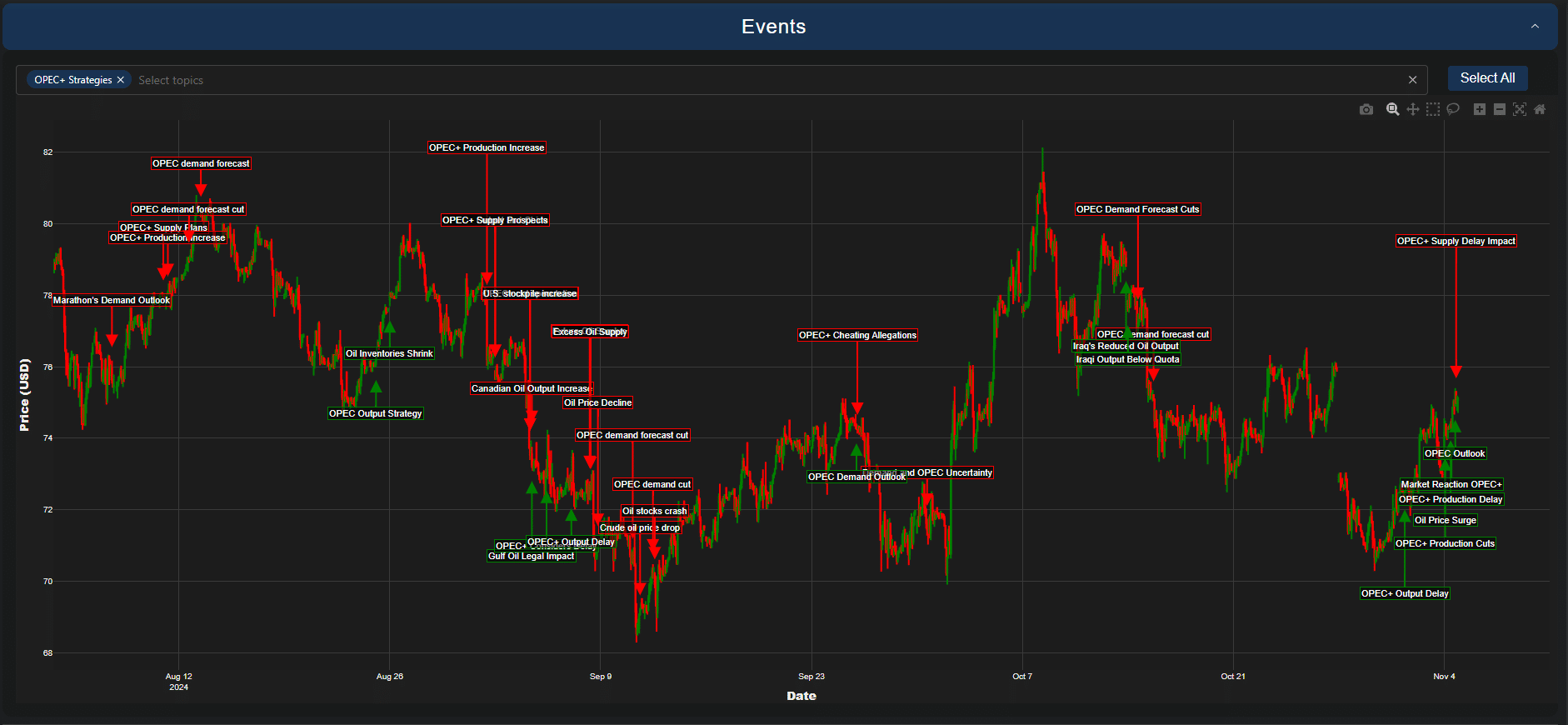
For a long time, we have seen OPEC’s commanding presence in global oil markets, wielding influence through both direct and indirect means. A look at event and announcement data from our Trading Co-Pilot over the selected period of August to November 2024 (see above image) particularly illustrates the way OPEC influenced the price of oil and associated market responses.

Even before the recent price fluctuations, the way OPEC influences the price of oil has been a cornerstone of global energy markets. On closer inspection of the above chart from our Trading Co-Pilot, we can observe multiple instances where OPEC’s announcements regarding production strategies triggered immediate price movements.

Sketching out OPEC’s primary mechanisms for influencing oil prices, we can identify several key drivers. Let’s take a closer look at 8 ways OPEC influences the price of oil below, with insights taken from our Trading Co-Pilot:

5 ways OPEC influences the price of oil

1. Production quota management

OPEC’s quota system is the first major factor to mention here. The chart clearly shows how OPEC+ production increases and cuts directly correlate with price movements. There have been concerns that this level of market control could be challenged, but historically, OPEC’s ability to influence the price of oil through quota management has remained robust.

2. Market psychology and announcements 

So how is OPEC seemingly able to move markets with mere words? The idea is to understand that oil markets are highly responsive to signals, and this is one of the primary ways OPEC influences the price of oil. Today, it’s evident from the trading data that OPEC demand forecasts and supply prospects can trigger substantial price movements even before actual production changes occur.

3. Strategic supply delays 

In recent weeks, we’ve observed how OPEC’s supply delay impact has affected market dynamics. Supporters of this strategy argue it helps maintain market stability, while critics contending that it leads to artificially inflated prices, which may strain energy-dependent industries and consumers. Meanwhile, optimists believe that such measures are necessary for long-term market health.

4. Member compliance

But, fundamentally, OPEC’s influence on oil prices depends heavily on member compliance. Building that back up will take consistent effort, as highlighted by the “OPEC+ Cheating Allegations” marker in our Trading Co-Pilot chart, which highlights the challenges associated with compliance monitoring in order to maintain trust and the system’s credibility.  

5. Demand forecasting

There may sometimes be exceptions to the rule, but predominantly, OPEC’s demand forecasts significantly influence market sentiment – although some may argue that they are losing their influence in the global oil market. However, our Trading Co-Pilot tells a different story, with the image above highlighting that  OPEC’s announcements have become increasingly impactful on price movements.

Amid global shifts in energy, for the time being at least, OPEC’s influence on oil prices remains substantial. Perhaps this shouldn’t be attributed to market power alone, but rather to the organisation’s unique position in global energy markets. Though skeptics will say that OPEC’s power is finally failing – and perhaps this argument holds water to a certain extent, insights from our Trading Co-Pilot show that OPEC is still able to shape market narratives. In fact, the our analysis shows multiple instances where OPEC’s strategic communications led to significant price movements.

Of course, it is expected that OPEC’s influence on oil prices will diminish as energy markets transform. Until then, the data suggests that while the mechanisms of influence may change, OPEC’s ability to impact oil prices remains significant. Looking at the recent price surge following OPEC+ production cuts, it’s clear that the organisation continues to wield substantial market power.

Track OPEC’s market impact in real time with our Trading Co-Pilot

The relationship between OPEC announcements and oil price movements requires sophisticated real-time monitoring to capture trading opportunities in an increasingly volatile market. Our Trading Co-Pilot platform helps you do exactly that.

As our analysis demonstrates, timing and insight are everything when it comes to trading around OPEC events. With our Trading Co-Pilot, you’ll get access to:

Don’t let critical OPEC-driven trading opportunities slip by. Experience how our Trading Co-Pilot can enhance your market intelligence and trading decisions by requesting a free trial or demo. Simply fill in the form below to speak to a member of our team.

Start your Trading Co-Pilot trial/request demo