This article explains Permutable AI’s Global Macroeconomic Data API, providing institutional investors and quantitative traders with real-time insights across 880 indices covering economic, political, and environmental factors – delivering structured intelligence that has demonstrated significant alpha generation in competitive financial markets.
The financial landscape evolves at unprecedented speed, driven by macroeconomic shifts, geopolitical events, and market sentiment. Traditional data sources often lag behind real-world events, creating information asymmetries that disadvantage market participants. Our Global Macroeconomic Data API addresses this critical gap, providing institutional investors, hedge funds, and quantitative traders with timely, structured insights derived from advanced machine learning models applied to global financial data.
Our API delivers 880 proprietary indices (10 regions × 22 topics × 4 cuts) covering everything from economic indicators and political tensions to natural disasters and pandemic trends – all updated in near real-time with historical data spanning up to 10 years. Unlike conventional sentiment indicators, our fixed-weight models identify nuanced correlations between macro events and asset price movements, offering a competitive edge for sophisticated market participants seeking alpha in increasingly volatile markets.
Unlike traditional data vendors who aggregate published economic statistics, we employ proprietary fixed-weight machine learning models trained on pre-2019 data to extract actionable signals from public financial and news sources. Our methodology captures macro trends, geopolitical dynamics, and natural events before they appear in conventional datasets. Each index reflects real-time sentiment surrounding specific macro topics, including inflation, employment, fiscal policies, and geopolitical tensions – all validated through correlation analysis with major market movements and live trading tests showing 31% annualised returns with 7% volatility.
Above: Political Tension Sentiment vs. 30-Year US Treasury Yield (2024-2025): This chart from Permutable’s Global Macro Indices showcases the relationship between Political Tension Z-Score (red histogram) and 30-Year US Treasury yields (black line).
Our Global Macroeconomic Data API delivers updates with extraction latency between 5-20 minutes depending on subscription tier. We maintain historical data reaching back 10 years for most indices, enabling sophisticated backtesting and time-series analysis. All data points include UTC timestamps and are delivered via our high-concurrency API with materialised view architecture to ensure minimal query latency even during market volatility events.
Our Global Macro Indices cover 22 distinct topics across 10 major global regions. Topics include granular economic indicators (GDP, inflation, employment, housing, manufacturing, retail sales, consumer spending), policy measures (fiscal policy, stimulus packages, monetary policy, interest rates, quantitative easing), geopolitical events (wars, political tensions, elections, terrorist attacks), and natural phenomena (extreme weather, droughts, natural disasters, pandemics). This comprehensive coverage enables cross-thematic correlation analysis and regime-specific trading strategies.
Above: Alignment Checks: Media Volume Shocks (2018-2023): This comprehensive heatmap visualises our validation methodology, displaying how our Global Macro Indices accurately captured major world events through media volume shock analysis. The matrix shows rolling z-scores of weekly media impressions across 20+ distinct macro categories (rows) over time (columns), with higher values (darker blue) indicating significant media activity spikes.
Data is accessible through a RESTful API delivering JSON-formatted responses with high concurrency support and model version control capabilities. We provide both raw index values and text data upon request, with complete taxonomies and documentation available in the developer portal. The API supports multiple authentication methods, rate-limiting appropriate to subscription tiers, and option to enable materialised view access for highest-performance applications. Implementation typically requires 1-2 developer days with comprehensive SDK support for Python, R, and JavaScript environments.
Our live trading audit across 600 trades in energy, agriculture, and metals markets has demonstrated compelling performance: 31% annualised returns with 7% volatility (unleveraged), maximum drawdown of only 4%, and transaction costs (fees + slippage) averaging 3-4 basis points. Notably, these results show low correlation to both S&P 500 and GSCI commodity indices, particularly evident during recent market stress periods as shown in our comparative performance analytics. Client-run correlation analysis consistently reveals statistically significant relationships between our indices and subsequent asset price movements across multiple timeframes.
We offer tiered subscription models based on data frequency, historical depth, and regional coverage needs. Importantly, our licensing terms prohibit usage where signal deployment could influence more than 20% of trading volume during liquid market hours. Current client base includes quantitative hedge funds with AUM ranging from $100M to $10B and a major oil trading desk.
We employ rigorous alignment checks against known historical events (COVID-19, Ukrainian conflict, Fed rate hikes, etc.) to validate index accuracy. Our models are fixed-weight (non-LLM) constructions trained on pre-2019 data to ensure consistent methodology and prevent regime drift. Each headline is scored for relevance with a learned threshold filter maintaining high signal-to-noise ratio. Extensive technical documentation on model infrastructure, batch processing techniques, and sentiment aggregation methodologies is available to clients under NDA.
In the rapidly evolving landscape of quantitative finance, obtaining actionable macroeconomic insights before they become priced into markets represents a significant competitive advantage. Our Global Macroeconomic Data API provides institutional investors with structured, machine learning-derived signals capturing the nuanced interplay between economic indicators, policy decisions, geopolitical events, and market sentiment across 880 distinct indices.
Our proven track record in live trading environments, comprehensive topic coverage, and robust technical infrastructure make this an essential tool for sophisticated market participants seeking to enhance alpha generation, improve risk management, or develop novel trading strategies incorporating advanced macro signals.
For a technical demonstration or to discuss integration with your existing analytics framework, contact our team at enquiries@permutable.ai or simply fill in the form below to discover how our quantitative macro insights can transform your investment approach.
This announcement introduces Permutable AI’s new LNG data feed, expanding our data-as-a-service portfolio to help energy traders, portfolio managers, and financial institutions gain real-time insights into liquefied natural gas markets with zero integration requirements – enabling faster, more informed trading decisions during periods of market volatility and geopolitical uncertainty.
We are delighted to announce that we have expanded our data-as-a-service offering with the addition of a comprehensive LNG data feed to our Trading Co-Pilot suite. This expansion represents a significant enhancement to our market coverage, providing energy traders and financial institutions with immediate, actionable data and insights into one of the world’s most dynamic commodity markets.
The new LNG data feed reinforces our commitment to delivering specialist data services that require minimal integration effort whilst providing maximum analytical advantage. By leveraging our proprietary LLM technology to process and analyse thousands of global news sources in real-time, we transform raw information into structured, actionable data that identifies critical market-moving events and provides contextualised interpretation of their potential impact on prices and trading conditions.
As with all our data-as-a-service products, our LNG market intelligence feed requires zero technical integration, delivering immediate value from day one through our plug-and-play data feeds.
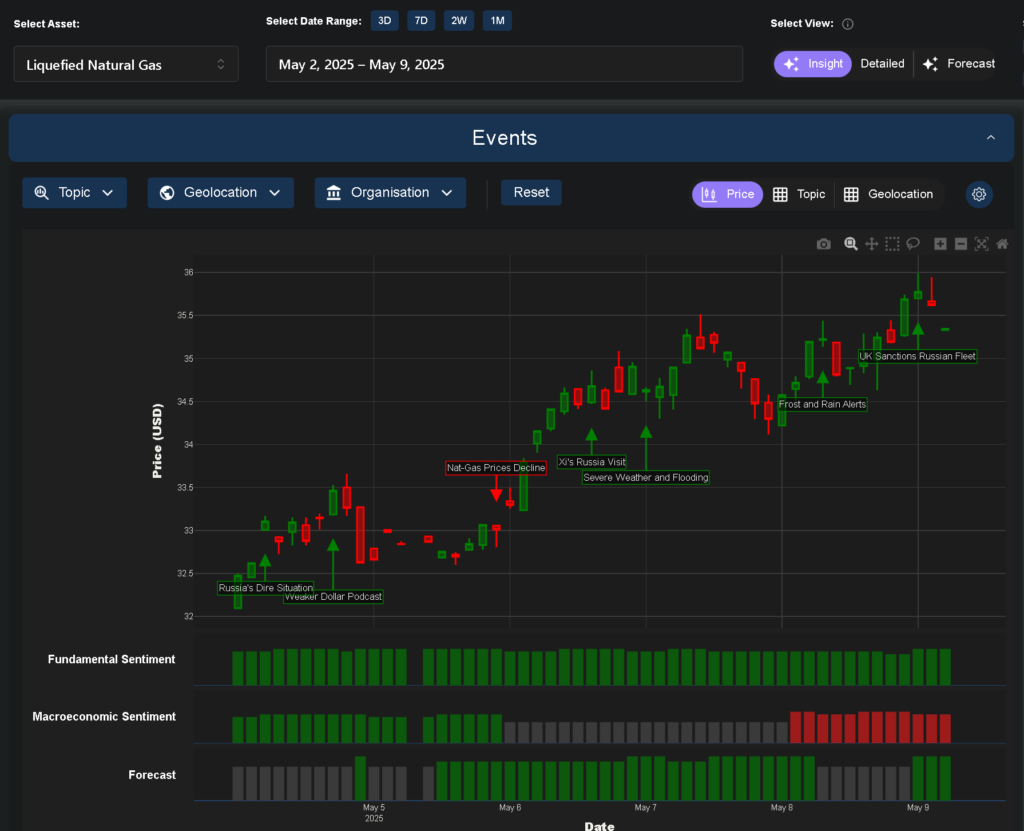
Our LNG data feed has already captured several key market sentiment developments that illustrate its effectiveness in identifying tradable signals. During the past week alone, our data service detected significant price movements driven by a complex interplay of weather concerns, geopolitical tensions, and shifting supply-demand dynamics.
For example, Thursday’s market activity (8 May) revealed growing concerns about weather impacts on energy demand, with our system identifying specific regional factors including hurricane preparations in Florida and reduced precipitation in New Mexico. These localised developments contributed to price movement from $34.58 to $34.96, demonstrating how our data-as-a-service offering can connect seemingly disparate events to identify their collective market impact.
On Wednesday (7 May), our LNG data feed capture important demand signals from Southeast Asia, where surging power requirements amid unsettled weather patterns are prompting a prioritisation of gas in the regional energy mix. This intelligence provided valuable context for the day’s price movement from $34.63 to $34.29, highlighting how profit-taking and market corrections can temporarily overshadow positive demand fundamentals.
Perhaps most significantly, Tuesday’s substantial price rally from $33.29 to $34.90 coincided with our system’s identification of Chinese President Xi Jinping’s upcoming visit to Russia, with energy cooperation featuring prominently on the agenda. This geopolitical development, captured early by our data service, provided traders with crucial advance intelligence on potential shifts in global LNG supply dynamics.
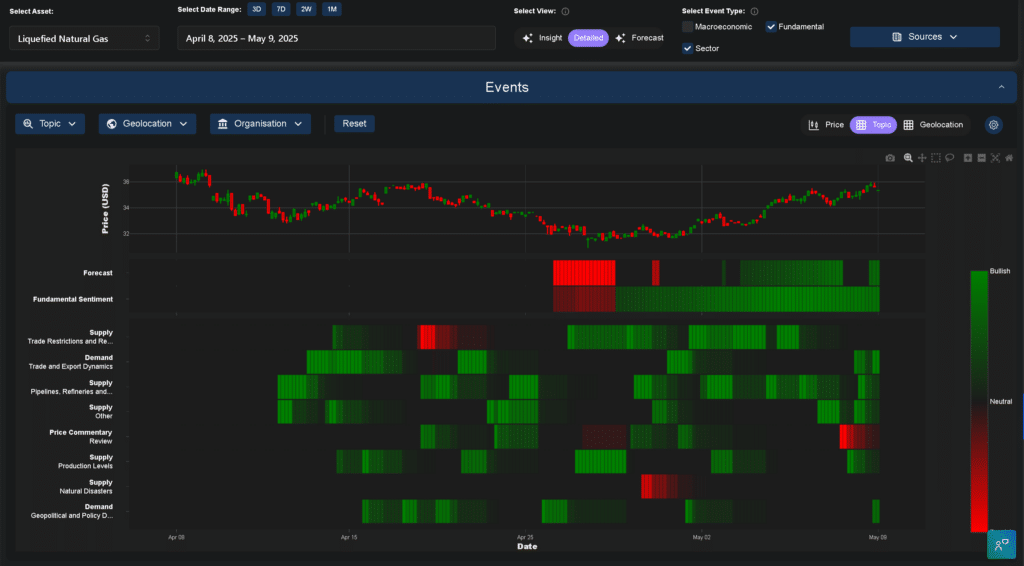
Figure 1: Visualisation of LNG data feeds and price movements (April 8 – May 9, 2025), showing our comprehensive sentiment analysis across multiple market dimensions
What truly distinguishes our LNG data feed is its ability to contextualise price movements within broader market narratives. Rather than simply tracking fluctuations, our data-as-a-service offering identifies the underlying catalysts and potential implications for future market direction.
For instance, our system detected significant supply-side developments including the United States matching its monthly export record, whilst simultaneously capturing demand-side signals such as QatarEnergy’s negotiations with Japan for long-term supply arrangements. This comprehensive data perspective enables traders to develop more nuanced strategies that account for the full spectrum of market influences.
The feed also demonstrates our data service’s ability to monitor corporate developments with potential market implications, such as TotalEnergies’ deprioritisation of Argentine LNG investments and BP’s credit outlook adjustment for Woodside. These corporate signals, when combined with geopolitical and weather-related intelligence, provide an unparalleled view of market dynamics.
Figure 2: Visualisation of LNG data feeds showing key market-moving events identified by our specialist LLM technology
Our LNG data feed is powered by the same specialist LLM technology that has established Permutable AI as a leader in data-as-a-service for financial markets. By combining advanced natural language processing with deep domain expertise in energy markets, we’ve created a solution that goes beyond conventional news aggregation to deliver genuinely actionable trading data.
“The expansion into LNG represents a natural evolution of our data-as-a-service capabilities,” explains Wilson Chan, our founder. “Energy markets are increasingly influenced by complex, interconnected factors ranging from weather patterns to geopolitical developments. Our specialist LLM tools transform this complexity into structured, accessible data that traders can immediately incorporate into their decision-making processes.”
What sets our data service apart is our unwavering focus on practical implementation. Unlike traditional market data providers that require extensive integration work, our LNG feed delivers immediate value through our plug-and-play architecture, allowing traders to incorporate these insights into their workflows without disruption.
The addition of LNG complements our existing energy market data services, providing clients with a comprehensive view across interconnected commodities. This holistic data perspective is particularly valuable given the increasing correlation between LNG and other energy markets, including natural gas, crude oil, and even renewable energy sources.
Our data feed has already identified several instances where developments in one energy sector created ripple effects across others. This cross-commodity perspective is further enhanced by our service’s ability to identify second-order effects that might escape conventional analysis. When Southeast Asian countries prioritise gas for power generation, this has implications not only for LNG prices but also for coal, renewables, and even carbon markets – connections that our data-as-a-service platform is designed to identify and explain.
The LNG data feed is available immediately to both existing clients and new users of our Trading Co-Pilot. For current clients, the data service is accessible through the same intuitive interface they already use, requiring no additional setup or integration work. New clients can begin receiving LNG data insights within hours of engagement, experiencing the same frictionless implementation that defines all our data-as-a-service offerings.
We’re committed to continuously enhancing our data services based on client needs,” adds Chan. The addition of LNG reflects our ongoing dialogue with energy traders seeking more sophisticated data tools to navigate increasingly complex market conditions.
Our early results demonstrate that the LNG feed delivers the same advantages that have made our existing data services indispensable to commodity traders – immediate implementation, actionable insights, and a genuine competitive edge in rapidly changing markets.
As geopolitical tensions, weather concerns, and energy transition dynamics continue to drive volatility in LNG markets, access to sophisticated, real-time data has never been more valuable. Our data-as-a-service offering provides exactly that, enabling traders to identify opportunities and manage risks with unprecedented clarity and confidence.
To experience the transformative impact of our LNG data feed and broader Trading Co-Pilot capabilities, we invite energy traders and financial institutions to request a personalised demonstration. See firsthand how our data feeds can enhance your trading strategies and decision-making processes with immediate, actionable intelligence. Request a demonstration b emailing enquiries@permuable.ai or simply fill in the form below and find out how our data services can give your trading operation a decisive advantage in today’s complex energy markets.
Permutable AI – Specialist data-as-a-service solutions delivering instant market intelligence with zero integration headaches.
*This article explains why partnering with Permutable AI for sophisticated LLM solutions delivers superior results compared to DIY approaches through outsourcing, aimed at financial services companies, trading firms, and enterprises seeking advanced AI implementation for market analytics.
In the rapidly evolving landscape of AI implementation, many companies are finding themselves at a crossroads: partner with specialists like ourselves at Permutable AI or attempt to replicate similar capabilities through outsourcing. Our experience has shown time again that clients who initially chose the latter path often return, having encountered significant challenges and frustrations along the way, and perhaps more worryingly still – having made no real progress at all. We know that building sophisticated LLM solutions requires more than just technical knowledge, and why partnership trumps imitation. In this edition of our LLMs in Action series, we’ll take a closer look at why partnering rather than attempting to copy is the way to truly get ahead.
The first point is probably one that most probably vastly underestimate. Our LLM frameworks aren’t just technically sound – they’re built on deep contextual understanding of global media, trading intelligence, and predictive analytics. This expertise isn’t easily replicated or offshored – especially through a cheap tech outfit based out of India, and especially not by generalist development teams that may be technically competent but lack the specialised knowledge required.
Will they be able to interpret complex financial data and macroeconomic signals in meaningful ways? Can they understand how AI systems can effectively process these signals in real-time? Or recognise the subtle interplay between media sentiment and market movements? In our experience, when clients we’ve spoken to attempt to outsource these specialised requirements, they often discover that technical execution without domain expertise results in systems that function but fail to deliver genuine business value.
Building effective LLM systems requires more than writing code that runs – it demands a holistic approach to AI development that includes sophisticated prompt engineering tailored to specific business contexts, careful consideration of ethical implications and bias mitigation, comprehensive testing frameworks that account for edge cases, and integration strategies that align with existing business systems. These elements require not just technical proficiency but also a strategic vision for how AI integrates with your overall business objectives. Outsourced teams often excel at implementing specifications but struggle with the deeper questions of why and how those specifications serve business goals.
We know what many have been thinking – that they can attempt to replicate our systems through outsourcing, but believe us when we say this is no mean feat. In fact, you’re likely to be left with with code that functions technically but lacks scalability or security measures, solutions that meet specifications but miss the broader vision, systems that generate acceptable outputs but require excessive refinement, and implementations that create technical debt due to poor integration with existing infrastructure. Why does this happen? Quite simply, these issues stem from a fundamental misalignment between technical execution and business strategy – a gap that’s difficult to bridge when working with teams who ultimately don’t have a vested interest in your long-term success.
Perhaps most importantly of all, our systems aren’t simply LLM implementations – they’re strategically designed ecosystems that layer real-time data, user feedback and queries, market understanding, and AI reasoning into cohesive solutions. This approach isn’t easily replicated without close collaboration with your core team, a deep understanding of your product philosophy, and continuous alignment with evolving business objectives. Outsourced development teams, particularly those working on a project basis, rarely have the incentive or capacity to engage at this strategic level, which is likely to result in solutions that might meet basic specifications but miss opportunities for true transformative impact.
While outsourcing to regions with lower hourly rates may seem cost-effective initially, our clients consistently report that the true cost equation is more complex. The hidden expenses include greatly extended timelines due to communication challenges and rework, management overhead required to guide remote teams, integration costs when systems don’t align with existing infrastructure, and opportunity costs from delayed or suboptimal implementation. When these factors are considered, the apparent cost savings seem to evaporate, leaving organisations with solutions that cost more in the long run while delivering far less value.
Perhaps the most significant difference between partnering with us and pursuing a DIY approach through outsourcing is the nature of the relationship. Building effective LLM infrastructure isn’t a one-time project but an ongoing journey that requires continuous refinement and iteration as technologies and business needs evolve, regular tuning to improve performance and accuracy, adaptation to changing regulatory requirements, and integration with new data sources as they become available. This is precisely why this journey demands a partner who views your success as their own – a level of commitment that’s difficult to secure in transactional outsourcing relationships.
To sum up, while the temptation to replicate rather than partner is understandable, our experience has consistently shown that organisations achieve better outcomes when they leverage our specialised expertise rather than attempting to build equivalent systems from scratch. At Permutable AI, we don’t just deliver technology – we bring transformative capabilities backed by deep domain knowledge, strategic insight, and a commitment to your long-term success.
If you enjoyed this edition of our LLMs in Action series and would like to discuss working together on LLM implementation by partnering with us, reach out to our team at enquiries@permutable.ai or fill in the form below to organise an initial call.