Agricultural commodities market sentiment this week: Navigating bearish headwinds

First, the obvious observation in this week’s agricultural commodities market sentiment is the predominance of bearish signals across multiple key products. Our Trading Co-Pilot analysis reveals consistent downward pressure on milling wheat, cotton, soybean oil, and soybeans, while sugar, coffee, wheat, soybean meal, and corn demonstrate more mixed indicators warranting a neutral stance.

There is no doubting that external pressures continue to mount playing out in agricultural commodities market sentiment. Record production forecasts in India have contributed to oversupply concerns for wheat, while health safety issues related to selenium-laden wheat have further dampened sentiment. The hardest part is determining whether these downward trends represent temporary market conditions or signal a more prolonged bearish cycle.
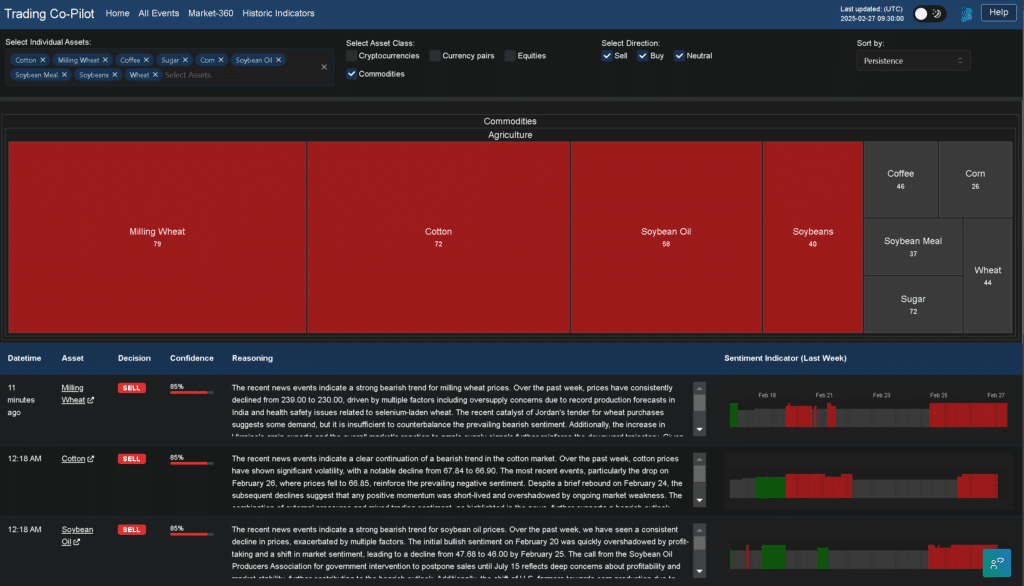
agricultural commodities market sentiment

Above: Agricultural commodities market sentiment from our Market 360 feature of our Trading Co-Pilot, as of 27 Feb 2025.

Grain market sentiment

You can make the argument that Jordan’s recent tender for wheat purchases offers a glimmer of hope amid the bearish landscape. However, this isolated demand signal appears insufficient to counterbalance the prevailing negative sentiment. In a way, the increase in Ukraine’s grain exports further reinforces the downward trajectory for wheat prices, which have declined from 239.00 to 230.00 over the past week.

The question is whether these pressures will persist into the coming months. We can be reasonably confident that supply-side dynamics will continue to dominate near-term price movements, particularly as markets digest the implications of India’s production forecasts.

As for corn, the market presents a more complex picture. The truth is more complicated than a simple bullish or bearish assessment would suggest. Initial positive sentiment quickly gave way to export concerns and declining export inspections. Then there is the challenge of trade tensions and controversies surrounding genetically modified corn, further clouding the outlook.

Oilseed complex market sentiment 

The present outlook for soybeans and their derivatives appears decidedly bearish. We must reject the argument being made that temporary supply disruptions will significantly alter this trajectory. The Soybean Producers Association’s call to delay sales until July 15 reflects significant anxiety among producers, suggesting they anticipate further price drops.

You can’t argue with the fact that U.S. farmers are shifting towards corn production due to unfavorable tariffs on soybeans, indicating a potential long-term structural change in production patterns. This is not to say that occasional price rebounds won’t occur, but the underlying sentiment remains negative.

In addition, the potential strike by the Argentine oilseed union adds another layer of uncertainty to the market. However, this development primarily highlights existing market pressures rather than introducing a genuinely bullish catalyst.

Softs market variations market sentiment

Everywhere you look in the cotton market, bearish signals predominate. The recent volatility, characterised by a decline from 67.84 to 66.90, reinforces the negative sentiment. Despite a brief rebound, subsequent declines suggest any positive momentum was short-lived.

Meanwhile, the sugar market presents a more mixed picture. While supply concerns initially supported price increases, the latest projections of record output in Brazil have introduced significant bearish pressure. We live in an age of highly volatile geopolitics, where production forecasts can change rapidly in response to weather events or policy shifts.

The coffee market similarly demonstrates complex dynamics, with downward pressure from recovering ICE inventories balanced against positive signals like increased demand from Uganda. If experience tells us anything, it’s that coffee prices can be particularly sensitive to weather-related supply disruptions, making the current neutral stance prudent.

Strategic implications of this agricultural commodities market sentiment

Of course, there are things that can be done to mitigate risks in this predominantly bearish environment. Diversification across commodities with different fundamentals may offer some protection, as would careful consideration of hedging strategies.

But the game changer will be how producers and major consuming nations respond to these market conditions. Will we see coordinated shifts in planting decisions? And at least let’s debate it openly: could policy interventions alter the trajectory of these markets?

Our Trading Co-Pilot’s current agricultural commodities market sentiment analysis points toward continued bearish sentiment in the near term for most agricultural commodities, however we must acknowledge that external factors like weather events or geopolitical developments could rapidly alter this outlook.

Navigating agricultural market with real-time market sentiment analysis

In a world where agricultural commodities market sentiment shifts rapidly, making sense of interconnected markets has never been more challenging. The question is: how can you consistently make optimal trading decisions when faced with complex market signals like those we’re seeing across the grain, oilseed, and softs sectors?

Our Trading Co-Pilot cuts through market noise to deliver clear, actionable intelligence and analysis on agricultural commodities market sentiment. Imagine the advantage of having AI-powered analysis that identifies emerging trends before they become obvious to the market, 24/7. What is needed is precisely what our platform delivers – comprehensive market intelligence that processes vast amounts of data to uncover hidden correlations and provide confidence-weighted recommendations.

To find out how our Trading Co-Pilot can help you navigate agricultural commodity markets with greater confidence and precision using the latest LLM-driven technology and AI-driven market sentiment analysis, get in touch with our team to request a personalised demo by emailing enquiries@permutable.ai or simply fill in the form below to apply for an enterprise trial.

Request demo/enterprise trial


Read more AI market sentiment analysis  

Agricultural commodities market sentiment this week

Energy market sentiment 26 Feb 2025

Gold market sentiment this week

Decoding crude oil market sentiment

Trump tariff plan: Impact on US Dollar and global markets

Forex market sentiment this week
 

Energy market sentiment 26 Feb 2025: Mixed signals amid global uncertainties

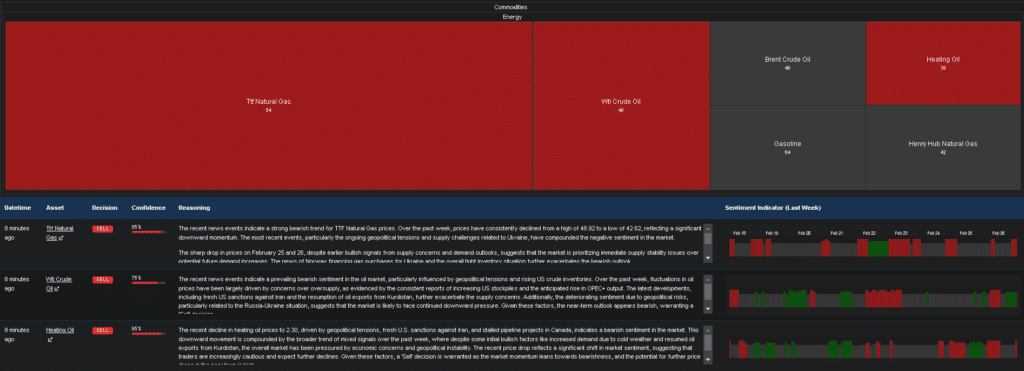
As this hectic month comes and International Energy Week come to an end, our Trading Co-Pilot has captured significant shifts in energy market sentiment this week through its Market 360 thematic analysis. It is a tale of predominantly bearish signals across several key energy commodities, with TTF Natural Gas, WTI Crude Oil, and Heating Oil all displaying strong sell indicators at 85% confidence levels.

Within the current landscape of energy markets, we’re observing a complex interplay of supply concerns, geopolitical tensions, and inventory fluctuations that have collectively shaped trading patterns. This week, the TTF Natural Gas market has shown consistent price declines from 48.92 to 42.62, reflecting substantial downward momentum despite earlier bullish signals from supply concerns.

This backdrop adds layers of complexity, as seemingly contradictory factors influence different segments of the energy complex. The view that immediate supply stability issues are outweighing potential future demand increases appears to be gaining traction among traders, particularly in European gas markets where Norway’s financing of gas purchases for Ukraine has further contributed to the bearish outlook.

energy market sentiment this week

Above: Our Market 360 thematics showing energy market sentiment at time of writing

Crude oil markets: Supply concerns and geopolitical pressures

In fact, WTI crude oil has experienced similar downward pressure, falling from 70.16 to 68.89 in recent trading sessions. The divisive figure Trump looms large over energy markets, with potential tariff risks adding another layer of uncertainty to already volatile conditions. On the face of it, it seems that fresh US sanctions against Iran would typically support prices, but market reactions have been counterintuitive.

The problem, of course, is that rising US crude inventories and concerns over increased OPEC+ output have compounded the bearish sentiment. Optimists may say that geopolitical tensions should provide price support, but this has not materialised as expected. This, doubtless, reflects traders’ lack of confidence in a near-term recovery despite the ongoing conflicts that traditionally boost energy prices.

Meanwhile, heating oil markets are no longer threatened by short-term supply disruptions, as the initial price spike following the drone attack on the Caspian Pipeline Consortium quickly reversed. On one end of the spectrum, increased oil production from Nigeria and resumed exports from Iraq’s Kurdish region have contributed to downward price pressure. At the other end of the spectrum, the consistent decline to a low of 2.30 suggests persistent bearish sentiment that shows little sign of reversing in the immediate future.

Mixed signals in gasoline and brent markets

Embedded in this is a more nuanced picture for gasoline and Brent crude oil, both of which our Trading Co-Pilot has assigned neutral ratings with 65% confidence levels. The energy market sentiment this week for these commodities reflects a balancing act between bullish and bearish factors.

For gasoline, the stabilisation of prices following reports alleviating some supply concerns represents a positive development. However, there is terror in the hearts of traders regarding potential tariff risks and ongoing geopolitical tensions that continue to create uncertainty. Now, even though Brazil’s record oil production might typically pressure prices downward, the mixed inventory reports have left the market in a state of cautious neutrality.

Brent crude oil displays similar characteristics, with the market appearing to be in a wait-and-see mode on the grounds that conflicting signals make directional betting particularly risky. If the chaos will resolve toward a bullish or bearish trend remains unclear, as supply concerns from the Caspian Pipeline incident and Iran sanctions are counterbalanced by inventory builds and potential OPEC+ supply increases.

Natural gas: Weather-driven volatility

Henry Hub natural gas presents perhaps the most weather-dependent narrative in the energy complex this week. The Arctic blast that initially drove prices higher has given way to warmer forecasts, creating significant price volatility. The price journey from 4.35 to 3.89 and back to relative stability around 4.12-4.15 demonstrates how quickly sentiment can shift in this market.

It’s too soon to judge whether stability has been restored to the natural gas market, as the interplay between weather patterns, inventory levels, and production plans from major players like Chevron continues to drive day-to-day fluctuations. Our Market 360 heatmap indicates that this balance between supply and demand factors has immeasurable value for traders looking to navigate the current uncertainty.

Looking forward: Navigating uncertain energy market sentiment

Our Trading Co-Pilot’s energy market sentiment analysis this week suggests that caution remains the prudent approach across the energy market complex. While TTF natural gas, WTI crude, and heating oil display clear bearish signals, the neutral outlook for Gasoline, Brent crude, and Henry Hub natural gas indicates potential for movement in either direction.

Of course, understanding these market dynamics has immeasurable value in today’s volatile environment. Our Market 360 tool continues to monitor real-time developments, providing institutional traders with comprehensive insight into how geopolitical events and supply-demand factors ripple across different energy commodities.

As we look toward March, the cross-asset implications of these energy market movements will be key to watch. In short, the correlation between energy prices and broader market sentiment remains strong, with potential knock-on effects for currencies and other commodity classes.

The energy market sentiment this week reflects a sector very much in transition, balancing immediate supply concerns against longer-term structural changes. Our Trading Co-Pilot will continue to track these developments 24/7, in real-time, providing the analytical edge that institutional investors need to navigate these complex market conditions effectively and confidently.

Experience Market 360 for your institution

If your trading desk or investment team is struggling to make sense of increasingly interconnected energy market sentiment, now is the time to experience how our Market 360 Thematics can transform your decision-making process. This innovative solution from our Trading Co-Pilot platform delivers LLM-driven cross-asset market analysis with unprecedented clarity and depth.

Our enterprise clients tell us that the energy market sentiment insights surfaced by Market 360 has is creating powerful value in their approach to energy trading. On the grounds that market intelligence should be both comprehensive and actionable, we’ve designed Market 360 to deliver insights that translate directly to trading opportunities. And so, we invite you to request a personalised enterprise demonstration, tailored specifically to your institution’s trading focus and analytical requirements. Our team will walk you through how Market 360 can:

  • Visualise complex cross-asset relationships in real-time
  • Track sentiment shifts across energy markets as they develop
  • Identify emerging correlations before they become obvious to the broader market
  • Deliver tailored alerts based on your specific trading parameters
  • Integrate seamlessly with your existing trading infrastructure

To arrange your personalised demon or to apply for your enterprise trial, please contact our team at enquiries@permutable.ai or simply fill in the form below.

Request demo/enterprise trial


Read more AI market sentiment analysis  

Agricultural commodities market sentiment this week

Current forex market sentiment this week

Gold market sentiment this week


Decoding crude oil market sentiment

Trump tariff plan: Impact on US Dollar and global markets


Decoding crude oil market sentiment: 7 use cases of our LLM-driven Trading Co-Pilot

In these early innings of the AI revolution, few sectors stand to benefit as dramatically as commodity trading, particularly in the volatile crude oil markets. One cannot escape the reality that traditional market analysis approaches are rapidly being outpaced by AI-driven alternatives. The impressive capability of these tools such as those that we have been working on for the last three years to process vast quantities of market data and news in real-time is fundamentally changing how traders understand oil market sentiment. In this article, we’ll take a look at seven use cases of our crude oil market sentiment, available through our Trading Co-Pilot subscription. 

Why crude oil market sentiment matters now more than ever

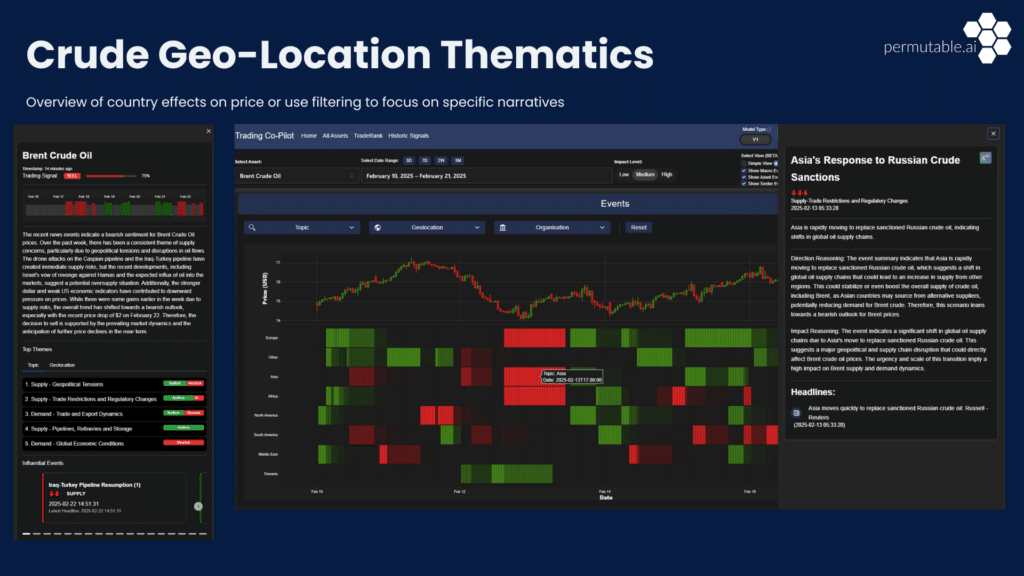
The financial and geopolitical forces shaping today’s oil markets are increasingly complex. After a spell of relative stability, recent events have dramatically shifted global supply chains. This includes the significant impact of Asia’s response to Russian crude sanctions, with markets rapidly adjusting to replace sanctioned Russian crude oil and causing major shifts in global supply dynamics.

One of the really remarkable things over the last year is how quickly these market movements can develop and cascade across different asset classes. As seen in Permutable’s visualisations, events like the Iraq-Turkey pipeline disruptions can trigger immediate supply risks, while US crude inventory reports can send ripples through global markets within minutes.

We’re already seeing how AI is taking centre stage in helping institutional traders navigate this complexity through our own work with our clients. Part of the battle here is simply organising the overwhelming amount of information that influences crude oil prices which AI excels at. And then there’s the very significant upside of its ability to spot emerging trends before they become obvious to the broader market and human eye. 

7 use cases for our AI-driven crude oil market sentiment 

1. Geo-location thematic analysis

The rise of regional market divergences means traders must monitor location-specific factors more closely than ever. Our geo-location thematic analysis provides an overview of country effects on price, filtering to focus on specific narratives. For example, our platform highlights how Asian markets are rapidly moving to replace sanctioned Russian crude oil, indicating shifts in global oil supply chains that could lead to increased supply from other regions. It is a good example of how geopolitical events can be translated into actionable trading insights.

Brent crude oil market sentiment geo-location theme map powered by our proprietary LLMs

2. Theme mapping across supply and demand factors 

Our theme map for Brent Crude market sentiment breaks down the market into colour-coded sentiment indicators across multiple factors. This includes supply considerations such as geopolitical tensions, trade restrictions and regulatory changes, and supply production levels. For demand factors, it tracks global economic conditions and trade and export dynamic. The tactics used by successful traders often involve identifying when these themes diverge, creating potential trading opportunities. But it is almost always the case that these relationships are complex and difficult to spot without advanced visualisation tools such as these.

3. Event driver identification

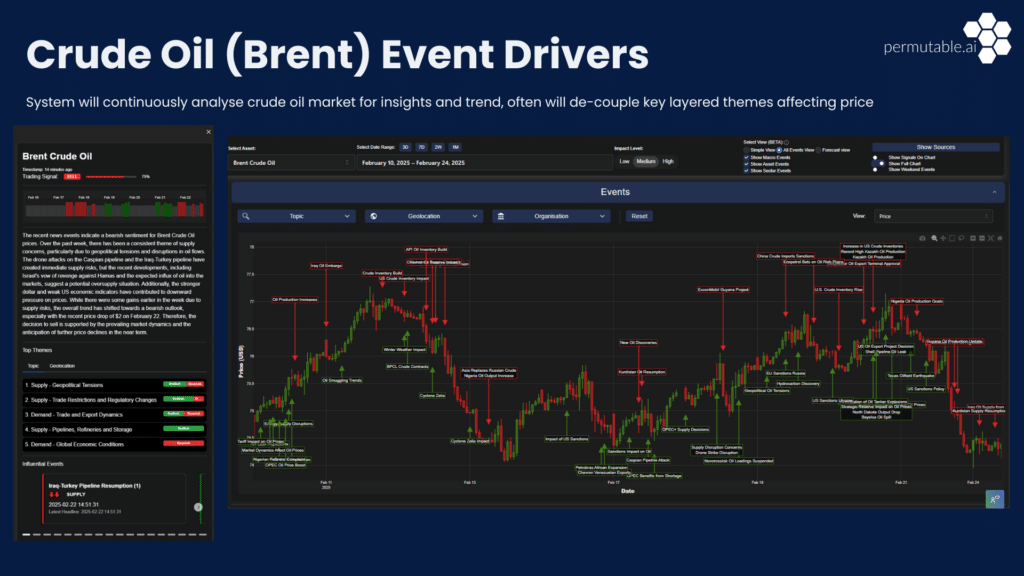
In the previous era, traders were more dependent on manual news monitoring. Now, our event drivers visualisation specific market-moving events directly onto price charts. This includes inventory builds/draws (US, Japan, China), production increases/decreases, pipeline disruptions, geopolitical conflicts, OPEC+ decisions, and refinery outages. Each event is colour-coded (red for bearish, green for bullish) and positioned precisely where it impacts the price chart, creating a comprehensive narrative of market movements.

Brent crude oil market sentiment event drivers powered by our proprietary LLMs

4. Real-time sentiment tracking

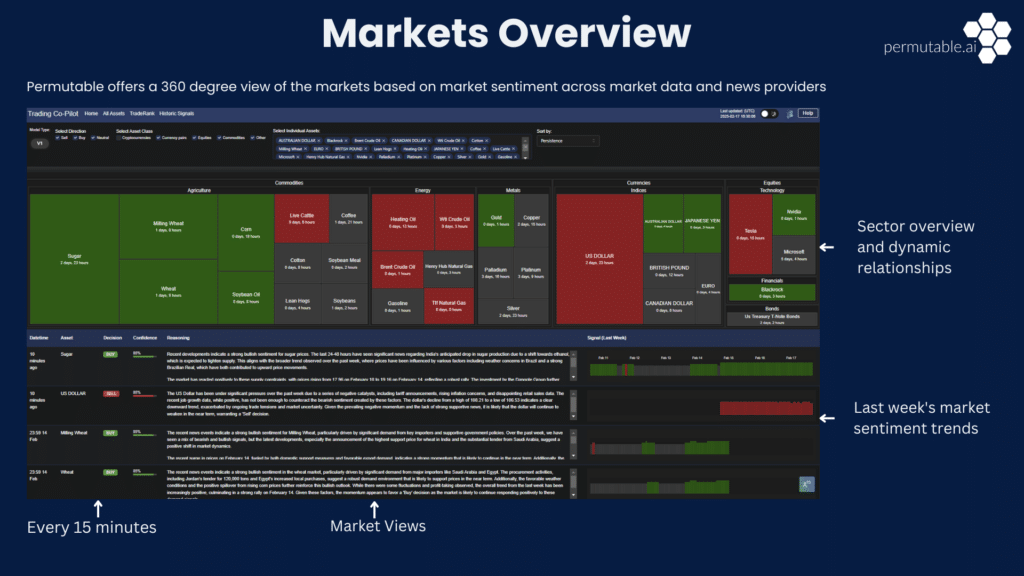
To say that AI’s capabilities are progressing at an incredible speed in the realm of natural language processing is somewhat of an understatement from where we stand. Our in-house trained LLM models analyse thousands of news sources, social media feeds, and market reports to generate real-time crude oil market sentiment. We know that the most frustrating thing about traditional sentiment analysis was its delay – by the time sentiment was identified, the market had often already moved. This is where our 15-minute update cycle comes into play, ensuring traders can identify shifting market sentiment as – or even before –  it develops.

5. Cross-asset correlation visualisation

As oil markets jostle for supremacy with other asset classes, understanding correlations between market, becomes increasingly important. Our cross-asset visualisation demonstrates how crude oil price movements interact with currency pairs (particularly USD strength), other commodities (natural gas, agricultural products), equity markets (especially energy sector stocks), and bond yields. The latter, making connections between seemingly unrelated markets, cam often provides the earliest signals of changing crude oil market sentiment and dynamics.

Market 360 overview market sentiment analysis across asset classes powered by our proprietary LLM models

6. Supply chain disruption alerts

With global supply chains increasingly vulnerable to disruption, our platform identifies potential chokepoints before they impact prices. Our recent data visualisations highlight pipeline attacks and resumptions (Iraq-Turkey), shipping lane disruptions, refinery outages, production capacity constraints, and weather-related disruptions. These early warnings allow traders to position themselves ahead of market-moving supply shocks.

7. Regulatory and policy impact assessment

Finally, our AI-driven market sentiment analysis excels at gauging the impact of regulatory and policy changes on crude oil markets. From sanctions to environmental regulations, our platform quantifies crude oil market sentiment shifts resulting from policy announcements across global markets.

The future of crude oil market sentiment analysis

As Permutable AI, we’re continuing to refine how traders interact with our crude oil market sentiment analysis through our Trading Co-Pilot platform. The latest roll out of our thematic visualisation, including our Market 360 tool, and other planned developments means that the line between market data and actionable intelligence is becoming increasingly blurred. With every 15-minute update, and weekly feedback loops, our system learns and adapts, providing increasingly nuanced views of crude oil market sentiment.

We know that – for institutional traders, portfolio and asset managers – the implications are powerful and that those who embrace our AI-driven tools will gain a potent edge in risk management and alpha generation. For example, by automating cross-asset correlation analysis that typically requires teams of analysts, our Market 360 allows institutions to reallocate human capital to higher-value activities while improving decision speed.

In today’s complex and volatile crude oil markets, understanding sentiment has never been more valuable – or more challenging. Yet, our crude oil market sentiment visualisations are transforming this challenge into an opportunity, giving traders the confidence to act on emerging trends before they become obvious to the broader market.

Experience our crude oil market sentiment analysis for yourself.

Find out how our crude oil market sentiment analysis can be embedding into your trading strategies by scheduling a personalised enterprise demonstration today to see how our Trading Co-Pilot platform can transform your trading decisions with real-time insights and visualisations. Limited complimentary trial access available for qualified institutional traders and asset managers. Contact our team at enquiries@permutable.ai or simply fill in the form below to book your session.

Book a demo/request enterprise trial access


Critical analysis: Why is Uber stock down November 2024

If you’re currently looking for answers to the question “Why is Uber stock down“, then our Trading Co-Pilot has highlighted a concerning pattern which has created this faltering stock performance over the past month, with shares declining significantly despite broader market resilience. The realisation that multiple factors are contributing to this downturn has sparked intense debate across the markets. As this sprawling set of events has unfolded, our AI-driven analysis has identified key drivers behind the decline, from regulatory shifts to operational challenges. What we are seeing is a complex interplay of factors, and in this article, we’ll explore the data-driven insights our Trading Co-Pilot has uncovered offering an answer to the question – why is Uber stock down? – and what it means for investors.

Why is Uber stock down

Why is Uber stock down: Market context 

The prospect of the relaxation of self-driving regulations has materialised following Trump’s recent election victory, leading to an immediate decline in Uber’s stock after Trump’s announcement regarding self-driving car regulations (while Tesla’s stock rose) . This knotty situation highlights the complex interplay between politics and market dynamics. By unhappy coincidence, this came just as the company was navigating other operational challenges.

Regulatory headwinds in the mix

Then came the Massachusetts voter approval for driver unionisation. Speaking of which, this development has created uncertainty around Uber’s labour costs and operational model. This isn’t new – the gig economy has faced ongoing regulatory challenges, but the recent unionisation victories represent a significant shift in the company’s labour relations landscape.

Why is Uber stock down: Multiple pressure points

One explanation is that Uber’s Q3 earnings, whilst beating estimates, revealed disappointing gross bookings growth. But alongside a muted holiday forecast, these factors have contributed to investor concern. Adding insult to injury, hedge funds like Third Point have begun divesting from Uber in favour of competitors, signalling a broader shift in institutional sentiment.

A look at regional challenges

Day by day, the real world consequences of driver protests are becoming apparent. Consider the recent strikes in Newcastle and Nottingham over pay transparency. Though it’s also important to keep things in perspective, these localised issues point to broader operational challenges facing the company’s workforce management strategy.

Why is Uber stock down: Competitive landscape

The question, then, is how Waymo’s rapid expansion impacts Uber’s market position. What we are seeing is intensifying competition in the autonomous vehicle space. The realisation that multiple competitors are making significant strides in self-driving technology has raised questions about Uber’s long-term competitive positioning.

Financial performance analysis

Our Trading Co-Pilot has highlighted several concerning metrics in the latest quarterly results. The Q3 earnings report revealed a peculiar dichotomy: whilst the company achieved record profits, the rate of bookings growth fell short of market expectations, triggering investor anxiety. Moreover, the weekend customer impact has shown troubling patterns in consumer behaviour, suggesting potential shifts in core market dynamics. Perhaps most worryingly, Uber Freight’s widening EBITDA losses point to ongoing challenges in the company’s logistics diversification strategy.

Why is Uber stock down: Market sentiment shift

Still this, along with hedge fund repositioning, suggests a broader shift in market sentiment. There is a case for viewing this as a temporary correction, but the realisation that multiple factors are converging has dampened investor enthusiasm. This, we suspect, could lead to continued pressure on the stock until clear catalysts emerge.

Good news and growth opportunities

The good news is that significant growth potential remains, particularly in markets like India. It has been predicted that Uber’s Auto and Moto services could generate Rs 36,000 crore in economic activity in India for 2024. Optimists like to say that these international expansion opportunities could offset domestic challenges, and our analysis suggests there’s merit to this perspective.

Why is Uber stock down: Technical analysis

Our Trading Co-Pilot paints a concerning picture of market dynamics. We’ve observed a significant breach of key support levels that previously underpinned the stock’s stability. This has coincided with notably weakening momentum indicators across multiple timeframes, suggesting diminishing buying pressure. Furthermore, our institutional flow analysis reveals increased selling pressure from large investors, potentially indicating a shift in long-term positioning strategies.

Uber stock performance: Looking ahead

What this situation requires is an appreciation of the complexity and context. As this set of events play out, several notable themes have emerged. The regulatory environment is becoming increasingly challenging. Simultaneously, competition in the autonomous driving sector has intensified dramatically, with new entrants and established players alike making significant technological advances. Then, the labour relations landscape requires novel approaches as workers increasingly demand better conditions and representation. However, emerging growth markets, particularly in Asia, offer potential counterbalance to these domestic headwinds, providing opportunities for strategic expansion.

History has shown time and again that market leaders can navigate regulatory and competitive challenges. If you think the above is worrying, remember that Uber maintains significant market share and operational advantages. These dips happen whenever there is uncertainty, but the company’s fundamental business model remains intact for the time being, despite the current headwinds.

Transform your trading strategy with AI-driven insights


Uber stock analysis

What this situation clearly demonstrates is the power of AI-driven market analysis. The question, then, is: how many similar opportunities or risks might you be missing in your portfolio right now by not accessing these insights in real-time?

Our Trading Co-Pilot doesn’t just analyse market movements – it transforms complex market dynamics into actionable intelligence, delivered in real-time to your dashboard. From detecting early warning signs to identifying hidden opportunities, our AI works tirelessly like a team of analysts 24/7 to give you the edge in today’s volatile markets. 

Experience the power of AI-driven market analysis for yourself. Email us at enquiries@permutable.ai to request a free trial or complete the form below for a personalised demo. The market isn’t waiting. Neither should you.

Request personalised demo


Explore previous articles in this series

The story behind our Trading Co-Pilot and the AI tool for trading that’s reshaping market analysis

Perhaps it seems like a tall tale to some, but our vision is that artificial intelligence can transform the way we approach trading and market analysis. It started with our mission to build an AI/ML autonomous trading system, which evolved into the development of our Trading Co-Pilot – the AI tool for trading which we believe will reshaping the landscape of financial markets.

Of course, over the past few years, we’ve witnessed a huge surge in the application of AI in financial markets yet many solutions fall short of truly enhancing human capabilities. Our motto is simple: let’s radically improve decision time and quality, leading to increased P&L for trading desks.

The birth of our AI tool for trading: Our Trading Co-Pilot

Internally, we had been toying with the idea of an AI-powered trading assistant for some time. Against the odds, our team of experts with backgrounds in financial services and AI/ML set out to create something truly transformative and it was a long time in the making. Initial attempts provided a boost to our confidence as we knew we were onto something exciting, but we knew we needed to go further to have something that was ready to go-to-market with.

And so, as our startup painstakingly developed an AI tool for trading that uses all global news sources to understand the world’s sentiment about an asset. This little (or not so little) guy can swim through oceans of data, extracting valuable real-time insights that enhance the capabilities of human analysts and traders. Our philosophy here is this: there is an edge in the world’s perception of an asset versus its current price. In many ways, this premise has guided our entire approach to developing our AI tool for trading – and if you are a corporate trader, now it can be in your hands also.

From dashboard to Trading Co-Pilot

The first step in our journey was creating a dashboard to explain how our machine was making its decisions. Which makes this transparency crucial – we believe that for an AI tool for trading to be truly effective, it must work in harmony with human traders, not replace them. As debates rage over the role of AI in finance, we’ve taken a clear stance. Our AI tool for trading, evolved into a Trading Co-Pilot, enabling human traders to make better decisions by providing them with unparalleled market intelligence updated every 30 seconds, right round the clock.

The power of global sentiment analysis

Endless hours of development have gone into ensuring our AI tool for trading can accurately capture and analyse global sentiment. The lessons learnt along the way include the importance of diverse yet high-quality data sources, addressing bias and the need for continuous fine-tuning of our algorithms.

Fundamentally, markets are inherently complex and dynamic. Political and economic crises come and go, but our AI tool for trading is designed to adapt and provide valuable insights regardless of market conditions. We believe that less frenzy and more simplicity is needed in the world of trading, and that’s exactly what we’re striving for with our Trading Co-Pilot.

Enhancing human decision-making

One element is clear: our AI tool for trading is not about replacing human traders but empowering them. By providing comprehensive market analysis and sentiment insights through our Trading Co-Pilot, we’re enabling traders to make more informed decisions faster than ever before.

Some of the present chatter in the industry focuses on fully autonomous trading systems. While we’ve developed capabilities in this area, we believe the real power lies in the synergy between human intuition and machine intelligence. Our AI tool for trading processes vast amounts of global news and market data, providing traders with a clear picture of market sentiment. This capability is particularly crucial in today’s fast-paced markets, where information flows at an unprecedented rate.

Looking to the future

As we continue to refine our AI tool for trading, we’re constantly exploring new ways to enhance our offering, always with the goal of providing more value to our users and this is made possible by our early-stage users who are providing us with a continuous feedback loop. Ultimately, the future of trading is undoubtedly intertwined with AI, and we’re proud to be at the forefront of this transformation. We firmly believe that our team’s expertise in both finance and AI positions us uniquely to develop tools that truly understand and address the needs of traders.

Final thoughts: Empowering traders with AI

In a world where market dynamics can shift in the blink of an eye and trading losses can be eye-watering, tools like our AI-powered Trading Co-Pilot are becoming increasingly crucial. By leveraging the power of global sentiment analysis, our AI tool for trading enables traders to stay ahead of market movements and make more informed decisions.

Experience the power of our AI tool for trading for yourself. Whether you’re trading commodities, equities, or cryptocurrencies, our Trading Co-Pilot can provide you with unparalleled insights and a competitive edge. To learn more about how our AI tool for trading and our newly launched API for commodities can enhance your trading strategies, contact us at enquiries@permutable.ai or fill in the form below.

Get in touch


AI in commodities trading: 6 powerful ways real-time data is changing the game

A shift of historical significance is under way in the world of commodities trading. The integration of artificial intelligence is transforming how market analysis and risk management are approached, and how trading strategies are executed. Many of our readers may remember a time when commodities trading relied heavily on human intuition and manual data analysis. Today, AI in commodities trading is reshaping the landscape, offering unprecedented insights and capabilities. At Permutable, we’re proud to be at the forefront of this transformation with our Trading Co-Pilot. Let’s explore the top 10 ways AI is transforming commodities trading.

How AI in commodities trading is changing the game

1. Enhanced predictive analytics

Why is this significant? The commodities market, known for its volatility and complexity, has always presented unique challenges to traders. Problems arise when traditional methods fail to capture the nuanced interplay of global events, supply chains, and market sentiment in a timely fashion. You can perhaps see the challenge in predicting the impact of a natural disaster on crop yields or anticipating shifts in energy demand here.

What’s remarkable is that AI algorithms, like those powering our Trading Co-Pilot, can now process vast amounts of data from diverse sources, including weather patterns, geopolitical events, and economic indicators, to provide more accurate price forecasts. Even small fluctuations in predictions can lead to significant advantages in trading decisions.

2. AI in commodities trading: Automated risk management

The evidence of AI’s transformative power in risk management is becoming increasingly clear. AI systems, including our Trading Co-Pilot, can continuously monitor market conditions, assess potential risks, and automatically adjust trading strategies to mitigate losses. And you see the same root cause behind many of these advancements: the ability of AI to process vast amounts of data at speeds impossible for human traders.

3. High-frequency trading optimisation

So why are more companies not jumping on this bandwagon? The answer lies in the complexity of implementation and the need for specialised expertise – and then there’s those that prefer to keep to the old way of doing things as opposed to reaping the benefits of new technologies and advancements. Nonetheless, high-frequency trading firms have now for some time been leveraging AI to execute trades at unprecedented speeds, capitalising on minute price discrepancies across different markets

4. Sentiment analysis and news integration

This point offers a deep lesson in the importance of real-time information processing. When seeking to ascertain market sentiment, AI can analyse news articles, social media posts, and other textual data sources to gauge public opinion and predict its impact on commodity prices. Our Trading Co-Pilot’s natural language processing capabilities allow it to sift through vast amounts of textual data, providing traders with timely insights.

5. Algorithmic trading strategies

This is clearly an important moment in the evolution of trading strategies. Many of the traditional approaches are being enhanced or replaced by AI-driven algorithms. The discovery that machine learning models can adapt to changing market conditions in real-time has led to more robust and flexible trading strategies. 

6. AI in commodities trading: Advanced pattern detection 

What’s remarkable is that AI can now detect intricate trading pattern formations that are often imperceptible to the human eye. Even on the most chaotic trading days, AI-powered trading pattern detection can uncover hidden opportunities and risks.

At Permutable AI, we’ve achieved a breakthrough that’s transforming the landscape of commodities trading. The evidence of this is clear: in 2020, we solved a one-shot learning classification problem to recognise trading pattern formations—a capability that remains unmatched by modern charting services. This discovery has led to the development of our R2 system, a powerful solution that deploys real-time, lightweight machine learning models across a cloud-based web server matrix.

Permutable’s Trading Co-Pilot

At Permutable, we’ve developed our Trading Co-Pilot as a response to the growing need for intelligent, AI-driven trading assistance. This tool exemplifies how AI in commodities trading can be harnessed to provide real-time market insights, risk assessments, and trading recommendations across these ten transformative areas.

In turn, this has led to a growing demand for professionals who understand both the intricacies of commodities markets and the potential of AI technologies. What we’re seeing from commodities traders who are already using our Trading Co-Pilot is that our data scientists with domain expertise in commodities who have worked on developing this cutting edge tool are becoming as valuable as traditional traders. What’s incredibly exciting is that our team at Permutable reflects this shift, combining expertise in both AI and commodities trading.

There is a step-change happening and its thanks to the implementation of AI in commodities trading – which is now well underway – offering unprecedented opportunities for those willing to embrace this technology. From enhanced market analysis to sophisticated risk management strategies, AI is transforming every aspect of the trading process..

As we continue to explore the possibilities of AI in commodities trading, one thing is clear: those who adapt to this new paradigm will be best positioned to succeed in the ever-evolving world of commodities trading. With tools like our Trading Co-Pilot and our newly released API for commodities trading, traders can navigate this new landscape with confidence. 

Interested in testing out our Trading Co-Pilot. Email enquiries@permutable.ai or fill in the form below and we’ll get back to you.

Request free trial


Pioneering trading technology: A look at the tech that makes our Trading Co-Pilot

Those seasoned among us already know that trading technology has become the linchpin of successful investment strategies. What we’ve found is that the key to staying ahead lies not just in data accumulation, but in the intelligent interpretation and application of that data. This realisation led us to develop our groundbreaking trading technology Co-Pilot system, a tool that’s reshaping how financial decisions are made in real-time.

The data backbone behind our trading technology 

At least 20,000 global sources form the foundation of our Trading Co-Pilot‘s knowledge base. We’re talking about a system that voraciously consumes information, scraping data via RSS feeds every 30 seconds. This method applies to both freely accessible and paywalled content, ensuring a comprehensive view of the market landscape.

But there is no doubting that raw data alone is insufficient. The hardest part is transforming this torrent of information into actionable insights. Our trading technology employs sophisticated transformers and language models to digest and interpret this vast sea of data. The present outlook for this approach is highly promising, as it allows for a granular understanding of market forces that goes beyond simple price movements.

Custom models: The heart of our trading technology

What about the role of custom models in our Trading Co-Pilot system? We can be reasonably confident that our bespoke macro, sector, and fundamental models are at the cutting edge of financial analysis. These models summarise news and events into topics automatically, creating a machine-generated taxonomy for each asset. You can’t argue with the fact that this approach provides a depth of analysis that was previously unattainable.

Despite this technological prowess, we must acknowledge that the human element remains crucial. The keys to successful implementation of our trading technology lie in the careful design and oversight of these systems by our talented and committed team of machine learning experts and engineers. 

Signals and systematic trading: Our Trading Co-Pilot’s decision engine

Our signal layer recommends buy, sell, or neutral positions based on the aggregated and analysed data. Again and again, we see the power of these signals in guiding trading decisions when using our Trading Co-Pilot in-house to trade our own basket. 

Another big area of opportunity will be to offer these signals via an API to strategic partners. This opens up new avenues for collaboration and innovation in the trading technology space and one which we’re carefully considering. 

Navigating information overload

Where our Trading Co-Pilot really holds court is tacking the challenge of information overload. With data being scraped every 30 seconds and stored for five years, the volume of historical information is staggering. Our Trading Co-Pilot doesn’t just process this data; it makes it accessible, understandable and actionable by curating it and providing directionals. Defining what is classed as relevant information is a crucial task that our system performs with increasing accuracy over time.

If experience tells us anything it’s that the financial markets are constantly evolving. And with that said, our clients can expect our trading technology to adapt and grow, with continued advancements in natural language processing and machine learning further enhancing its capabilities, along with constant fine-tuning in the pursuit of innovation by our dedicated team talented machine learning experts.

The human-machine partnership

For the avoidance of doubt, it’s important to stress that our trading technology is not about replacing human decision-makers. Rather, it’s about augmenting human intelligence with powerful analytical tools. The truth is more complicated than simply letting machines take over; the most effective strategies combine technological prowess with human insight and experience.

In addition, there are several areas where human oversight remains critical. Ethics, risk management, and strategic decision-making are just a few examples where human judgement is irreplaceable. As for the future of trading, we can expect a continued blending of human and machine intelligence, with our co-pilot technology taking on more of the heavy lifting in data analysis and pattern recognition.

Geopolitical awareness in our trading technology

If narratives shape politics which in turn go onto influence the markets, then our Trading Co-Pilot must be adept at interpreting geopolitical events and their potential market impacts. We live in an age of highly volatile geopolitics, but thankfully, our system is designed to parse complex global situations and their financial implications.

We know that geopolitical events often have cascading effects across multiple sectors and asset classes. Our Trading Co-Pilot employs advanced natural language processing to detect subtle shifts in political discourse and turbulence, correlating these changes with real-time and historical market data to predict potential outcomes. This method applies not only to major headline events but also to the nuanced interplay of international relations that might escape human analysts. When using our Trading Co-Pilot in-house to trade our own basket, this has enabled us to stay ahead of the curve when others may be caught out, through the provision of invaluable insights into the complex relationship between global politics and market movements.

The future of our trading technology 

Everywhere you look in the financial world, trading technology is making its mark. In a way, our Trading Co-Pilot is at the forefront of this technological arms race within the space.  It’s true that we’re still in the early stages of this technological revolution in finance with plenty more to come. However, we can be reasonably confident that the trends we’re seeing – towards more data-driven, automated, and intelligent trading systems – will continue to shape the industry for years to come and that this is just the tip of the iceberg.

Fundamentally, what is needed is a balanced approach that leverages the best of what our trading technology has to offer while maintaining a critical human element in the decision-making process. And so, the question is not whether our trading technology will continue to evolve, but how we can harness its power responsibly and effectively. All of which suggests that the future of finance will be shaped by those who can best navigate the intersection of data, technology, and human insight. We believe that the most exciting developments in our trading technology are still to come, as we continue to push the boundaries of what’s possible in financial analysis and decision-making.

Harness the power of our next-generation trading technology

The future of trading is here, and it’s powered by intelligent, data-driven technology. Our Trading Co-Pilot represents the cutting edge of financial analysis and decision-making, offering unparalleled insights into market dynamics and geopolitical impacts. Discover how our trading technology can give you the competitive edge you need to succeed in today’s volatile markets. Register your interest now to learn more about our Trading Co-Pilot and newly launched API for commodities trading by emailing enquiries@permutable.ai or filling in the form below.

Get in touch


Why is Tesla stock dropping? A lookback at Q4 events

Why is Tesla stock dropping? Let’s start with the obvious: Tesla’s stock has been on a wild ride of late. Our Trading Co-Pilot chart paints a vivid picture of over the past month, with several dramatic dips and recoveries. This striking difference hints at a complex interplay of factors influencing investor sentiment. But what’s really driving these fluctuations? Get our latest thinking in this article with insights from our Trading Co-Pilot.

Why is event Tesla stock dropping – insights from our Trading Co-Pilot

Tesla stock dropping

Geopolitical tensions and market jitters

For starters, the chart highlights a significant sell-off in late September, coinciding with an escalation in geopolitical tensions. The Iran-Israel conflict escalation spooked investors, leading to a broader market tumble. You might say that Tesla, being a high-profile and volatile stock, often amplifies broader market movements. Yet here’s the rub: while geopolitical events certainly play a role, they don’t tell the whole story of Tesla stock dropping. There is also evidence that company-specific factors are at play, which we’ll get into in more detail below.

Product launches and market reception

One thing is clear, the problem isn’t a lack of innovation at Tesla including developments in energy storage and of course, the recent Robotaxi unveiling which failed to impress investors. But we must remember the bigger picture here, which is that Tesla is consistently pushing the boundaries of electric vehicle technology and energy solutions. Nonetheless, the market’s reaction to these announcements has been mixed at best with Tesla stock dropping continues to be the prevailing trend at the moment. This suggests that the market believes that these innovations may not translate into immediate revenue growth or profitability  

Corporate shake-ups and internal challenges

Another bone of contention is the recent resignation of Tesla executives – indicated on our Trading Co-Pilot chart as “Tesla Execs Resign” as a significant event. This internal turbulence could be contributing to investor unease. There is broad consensus that leadership stability is crucial for a company as innovative and disruptive as Tesla. The expectation that top talent might be leaving the company could be weighing heavily on investor confidence.

Macroeconomic factors

Again and again, you can see the same pattern: macroeconomic events having a significant impact on Tesla’s stock price. The US Jobs Report exceeding expectations and a potential Fed Rate Cut initially gave the stock a boost. However, this was followed by concerns about a China slowdown, which likely contributed to Tesla stock dropping once more.

It has now emerged that Tesla’s fortunes are closely tied to both US and Chinese economic health. The catalyst for many of the stock’s movements can be traced back to these broader economic indicators.


Permutable AI Trading Co-Pilot

Competition and market saturation

Little wonder that investors are keeping a close eye on Tesla’s market position. The present state of play in the electric vehicle market is one of increasing competition. While our Trading Co-Pilot chart doesn’t explicitly mention competitors, the overall downward trend in Tesla stock dropping could reflect growing concerns about market saturation and rivalry from both established automakers and new EV startups.

Supply chain and delivery challenges

Now look to where our Trading Co-Pilot highlights “Deliveries Miss Estimates” as a significant event. This is at the core of Tesla’s recent struggles. Achieving its ambitious production and delivery goals is crucial for maintaining investor confidence. This requires a finely tuned supply chain and manufacturing process.

By leveraging its world-class production capabilities, Tesla has historically been able to ramp up deliveries quarter after quarter. However, the recent miss suggests that the company may be facing headwinds in this area.

Investor sentiment and future outlook

So much of the past, what of the future? Insights from our Trading Co-Pilot chart shows several events related to future products and innovations, such as the Robotaxi. These announcements are clearly aimed at shaping investor perceptions of Tesla’s long-term potential, despite investors being less than impressed by the recent unveiling.

However, the continued pattern of Tesla stock dropping suggests that investors may be adopting a “show me” attitude. They’re looking for concrete results rather than future promises. In fact, some say the expectation that Tesla can maintain its astronomical growth rates indefinitely may be waning. Nonetheless, it’s important to note that the company still enjoys a significant market cap and brand loyalty that many competitors envy.

Why is Tesla stock dropping: Final thoughts 

Much has changed since Tesla’s early days as an EV pioneer. The company now faces the challenges of being an industry leader in a rapidly evolving market. The good news is there’s a big wheel moving in the right direction in terms of global EV adoption, but Tesla must navigate carefully to maintain its pole position in face of competition that is fiercely hotting up.

In a bizarre twist, the very success that Tesla has had in popularising electric vehicles has created a more competitive landscape that now challenges its market dominance. This trend has ramped up significantly in recent years with the likes of Nio and Lucid hot on Tesla’s heels.

Beyond the fanfare of product launches and ambitious goals, Tesla must grapple with the realities of production scaling, market competition, and delivering on its promises to maintain investor confidence.

Over the past month, Tesla stock dropping has been the prevailing narrative. But in the fast-paced world of tech and automotive innovation, fortunes can change quickly and it is likely this trend will reverse at any given time. For investors and industry observers alike, Tesla remains a company to watch closely, as its trajectory could well indicate the future direction of the entire electric vehicle market.