Trump tariff plan: Impact on US Dollar and global markets
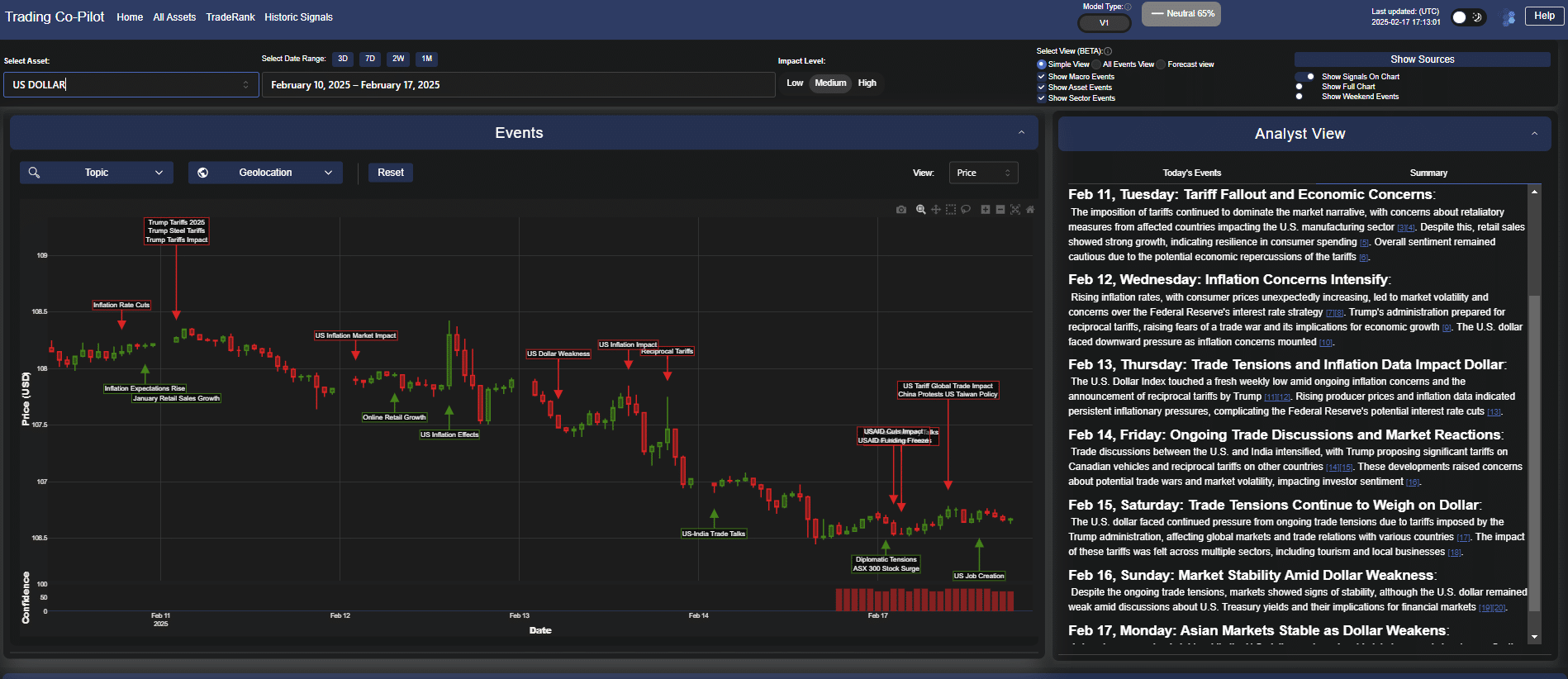
Our Trading Co-Pilot’s analysis of recent market movements reveals a clear correlation between the proposed Trump Tariff Plan and emerging weakness in the US Dollar. The plan, which outlines a sweeping 25% tariff on imports including automobiles, pharmaceuticals, and semiconductor components, has triggered significant market reactions that our AI models have been tracking in real-time.

As a matter of fact, the tariff announcement created immediate ripples across currency markets, with the dollar index showing particular vulnerability during the February 11-17 trading week. Our signals clearly identified increased volatility coinciding precisely with escalating rhetoric around the Trump Tariff Plan.

Inflation concerns: The primary driver of dollar weakness

The market narrative has been dominated by inflation concerns stemming directly from the Trump Tariff Plan. Our sentiment analysis model detected a marked shift in market psychology following the February 11 announcement, with inflation expectations rising significantly.

Furthermore, the data indicates consumer prices reacted unexpectedly to tariff discussions, with particular sensitivity observed in sectors directly targeted by the proposed measures. The correlation between tariff announcements and inflation data strengthened notably mid-week, suggesting traders are pricing in potential supply chain disruptions.

To add to this, the Federal Reserve‘s interest rate strategy now faces additional complications, and as our models suggest, the Trump Tariff Plan creates a challenging policy environment. Rising producer prices and persistent inflationary pressures are complicating potential interest rate adjustments, directly impacting dollar strength.

Global trade tensions and reciprocal measures

Another critical dimension of the Trump Tariff Plan involves potential retaliatory measures from trading partners. Our analysis indicates significant concern about reciprocal tariffs, particularly following the February 13 market reactions. The dollar index tracked lower amid these growing tensions, reflecting investor uncertainty about escalating trade conflicts.

Given the interconnected nature of global markets, the Trump Tariff Plan unsurprisingly appears to be creating feedback loops across multiple economies. Trade discussions between the US and India intensified directly following the tariff proposals, with our sentiment indicators capturing growing concerns about potential trade wars affecting investor positioning.

Speaking more broadly, our Trading Co-Pilot has observed consistent pressure from ongoing trade tensions tied directly to the Trump Tariff Plan. The impact has been felt across multiple sectors, with tourism and local businesses showing particular vulnerability in our cross-asset correlation models.

Market stability and Treasury yield implications

Despite these pressures, there have been periods of surprising market stability amid dollar weakness. Our historical context models suggest this pattern resembles previous tariff-related market reactions, though the current Trump Tariff Plan appears to be creating more pronounced effects on Treasury yields.

In essence, the financial markets are displaying a complex reaction to the Trump Tariff Plan, balancing inflationary concerns against potential economic growth implications. In all of this, our confidence metrics indicate high certainty in the correlation between tariff announcements and subsequent dollar movements throughout the analysed period.

Regional market reactions to the Trump tariff plan

Asian markets demonstrated particular sensitivity to the Trump Tariff Plan, with our macro sentiment analysis detecting significant positioning shifts following the February 17 trading session. The dollar weakened notably against Asian currencies as market participants assessed the regional impact of proposed tariffs.

To put it differently, the Trump Tariff Plan appears to be creating asymmetric effects across different market segments, with our models indicating varying levels of resilience in different economic sectors. Manufacturing has shown particular vulnerability, while consumer spending has demonstrated unexpected resilience despite tariff concerns.

Trade policy uncertainty and investment implications

Our Trading Co-Pilot’s LLM-driven analysis suggests the Trump Tariff Plan is introducing a new layer of policy uncertainty that institutional investors must navigate carefully. Historical confidence metrics indicate similar tariff proposals have typically led to extended periods of dollar weakness as markets adjust to changing trade dynamics.

The potential economic repercussions of the Trump Tariff Plan extend beyond immediate market reactions. Our models indicate growing concerns about long-term growth trajectories, with particular focus on how sustained trade tensions might impact investment decisions and capital flows.

Navigating Dollar weakness amid the Trump tariff plan

The Trump Tariff Plan represents a significant shift in trade policy with direct implications for US Dollar strength. Our AI market sentiment analysis reveals a clear connection between tariff announcements and subsequent currency market reactions, with inflation concerns serving as the primary transmission mechanism.

For institutional investors, these geopolitical and macroeconomic developments require careful positioning given the potential for continued volatility. Our Trading Co-Pilot’s signal confidence remains high regarding the correlation between the Trump Tariff Plan and dollar weakness, though our systems continue to monitor for stabilising factors that might emerge in response to market dislocations.

While the full impact of the Trump Tariff Plan continues to evolve, our AI-driven analysis strongly suggests that dollar weakness remains the primary market reaction to date. Continued monitoring of inflation metrics, trade negotiations, and policy responses will be essential for anticipating future market movements as this situation develops.

Experience our enterprise market intelligence for institutional traders 

Discover how our Trading Co-Pilot platform can help your team navigate complex trade policy implications and currency volatility with confidence. Qualified institutional users can book a personalised demonstration of our platform, featuring real-time tariff impact analysis, cross-asset correlation heatmaps, automated geopolitical sentiment tracking, and historical confidence metrics. Select institutional trading desks and macro hedge funds may qualify for a 14-day trial of our Trading Co-Pilot platform. Simply email enquiries@permutable.ai to experience our AI-driven market analysis capabilities firsthand or fill in the form below.

Request your personalised demo/institutional trial


How proposed Trump Tariffs affect oil prices: Essential market analysis 2024/2025

There has been plenty of talk around how the proposed Trump Tariffs affect oil prices. So, first off, let’s start with the obvious – the Trump administration’s proposal of a 25% tariff on oil imports from Mexico and Canada presents a significant shift in North American energy relations. It’s clear that these proposed tariffs are going to be a wild card for the markets in 2025,  and insights from our Trading Co-Pilot news analysis reinforcing this view with clear volatility in response to this announcement, with cross-border flow analytics highlighting potential supply chain disruptions. The trouble is, this policy arrives at a particularly sensitive time for global energy markets. With U.S. crude oil stockpiles already showing declines and OPEC+ delaying planned production increases, the timing of this will only serve to rub salt on the wound of potential market disruptions already on the horizon.

How proposed Trump Tariffs affect oil prices: Immediate market response 

What is particularly interesting is the extent to which markets have already begun pricing in potential disruptions. Analysts warn that Trump’s threats to Canada could disrupt oil markets and inflate oil prices, potentially raising fuel costs significantly. Meanwhile, word is that commodity traders are adjusting positions, leading to increased market volatility.

Historical context and present implications

Enter the complex historical precedent of trade disputes affecting energy markets. In the wake of previous tariff implementations, markets typically experience multiple phases of adjustment. The problem is, despite historical patterns, this proposal comes amid unique circumstances including record U.S. oil output and shifting global supply chains.

How proposed Trump Tariffs affect oil prices and regional supply chains

Needless to say, North American energy integration has been a cornerstone of regional energy security. But the main reason for this is the efficiency gained through cross-border energy trade. This shift represents potential disruption to well-established supply networks, particularly affecting refineries optimised for specific crude grades.

Market volatility and price predictions

But while immediate oil market reactions show concern through price volatility, and while some analysts predict severe disruptions, it is important to remember that oil markets are able to demonstrate remarkable adaptability. And that’s not all – existing stockpiles and strategic reserves could help buffer immediate price shocks.

How proposed Trump Tariffs affect oil prices: Global market implications

With a wary eye on international reactions, it is hard to argue against the potential ripple effects across global energy trade. It is tempting to overstate the consequences of such policies, but nonetheless, the reality is that U.S. policy shifts often trigger global market realignments. However, perhaps the silver lining in all of this is the potential for an acceleration of industry transformation. In light of recent developments, there will doubtless be significant investments in alternative sources and technologies. 

How proposed Trump Tariffs affect oil prices: Looking forward

So what, if any, implications do these have for long-term market stability? Safe to say, this is a tough environment in which to make predictions, Which means if the tariffs are implemented, we must be prepared for multiple scenarios. The news that Macquarie strategists are predicting significant drops in U.S. crude inventories adds another layer of complexity. All of which points to the same outcome – an era appears to be ending in terms of unfettered North American energy trade. Everywhere one looks in this new status quo, signs point to industry restructuring.

History’s pages are turning as the industry faces these latest challenges. If all of this is deemed to be the new normal, there will almost certainly be a period of significant adjustment ahead, with potential opportunities emerging alongside challenges in this complex interplay of policy, market forces and industry adaptation. 

And so, we’ll likely see heightened volatility as markets adjust to potential new realities. However, the resilience and adaptability of the energy sector suggest that while this latest sequence of events will prove challenging, these changes could very well accelerate positive industry transformation through innovation and efficiency improvements.

Stay ahead of oil market movements with our Trading Co-Pilot and API

Our Trading Co-Pilot gives you real-time market intelligence helping your decision-making with comprehensive analytics that cut through market noise, delivering actionable insights when you need them most.  Transform your trading strategy with an enterprise trial of our Trading Co-Pilot and Commodities API. Contact us at enquiries@permutable.ai or fill in the form below to arrange your personalised platform demonstration. Join leading energy traders and institutions who are already using our Trading Co-Pilot and Commodities API to navigate market complexity with confidence.

Request a demo