
Best global macro sentiment data providers: A guide for institutional investors
10 May 2026
10 May 2026
Global macro sentiment data providers help investors track how economic narratives are changing before those shifts appear in official data, consensus forecasts or asset prices. This guide compares the leading providers for macro sentiment, financial news analytics, event detection and alternative data, with a focus on institutional workflows across macro, FX, rates, sovereign risk and systematic research.
Global macro sentiment data converts unstructured information – including news, policy commentary, local-language reporting, market commentary and public-source signals – into structured indicators that show how sentiment is evolving around macroeconomic themes.
For institutional investors, the most useful macro sentiment datasets do not simply classify news as positive or negative. They map narrative flow to specific economic themes such as inflation, growth, monetary policy, fiscal risk, trade, labour-market pressure, FX vulnerability, sovereign risk and political uncertainty.
The reason this matters is straightforward. Traditional economic data is essential, but it is often delayed, revised and backward-looking. Sentiment data helps investors monitor the information environment as it forms. The San Francisco Fed’s Daily News Sentiment Index, for example, is a high-frequency measure of economic sentiment based on economics-related news articles, while academic research has found that economic sentiment extracted from newspapers can predict economic fundamentals and lead consensus GDP forecasts.
News-based macro indicators are not new. The widely cited Economic Policy Uncertainty index developed by Baker, Bloom and Davis is based partly on newspaper coverage frequency and has been used to track policy-related economic uncertainty around elections, wars, fiscal disputes and major market shocks. What has changed is the scale, speed and granularity of modern macro sentiment datasets.
Macro investors face a timing problem. Inflation pressure, fiscal stress, political uncertainty, policy credibility concerns and FX vulnerability often become visible in information flow before they are confirmed by official releases.
A useful macro sentiment dataset can help teams answer questions such as:
This is why global macro sentiment data is increasingly relevant for discretionary macro teams, FX and rates desks, sovereign-risk analysts, economists, asset allocators and systematic researchers.
The best global macro sentiment data providers usually have six characteristics:
Best for: Purpose-built country-level macro sentiment data
Primary use cases: Macro research, FX and rates monitoring, sovereign-risk analysis, EM risk, systematic macro strategies, inflation and policy tracking
Permutable’s Global Macro Sentiment Indices are designed specifically for institutional macro workflows. The dataset tracks how inflation, growth, monetary policy, fiscal risk, trade, labour-market pressure, FX vulnerability and political uncertainty evolve across global information sources. The indices are structured macro sentiment datasets that convert macro narrative flow into country-level signals for research, trading and risk workflows.
The strongest differentiator is that this offering is not simply generic news sentiment. Our GMSI framework classifies macro themes separately and distinguishes between domestic sentiment, international sentiment and combined views. This matters because local sources may show inflation pressure, household stress or policy credibility concerns before international coverage reacts, while global coverage may become more important once a risk begins to affect FX, rates or sovereign spreads.
Permutable’s Global Macro Sentiment Indices spans more than 90 countries, 70+ macro indicators, 250,000 curated sources and 80+ languages. The product is available through API delivery, Excel integration, enterprise data feeds, historical point-in-time datasets and real-time monitoring capabilities.
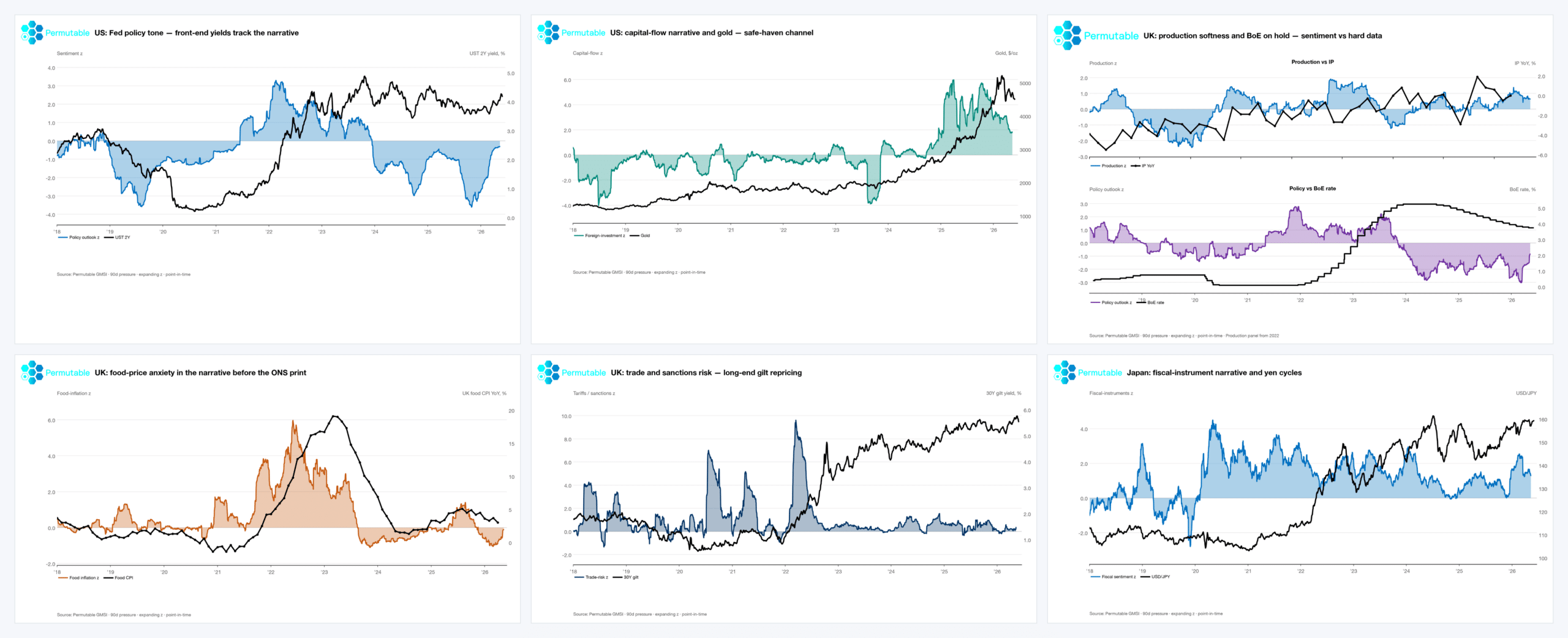
Above: Permutable GMSI charts showing how macro narratives across the US, UK and Japan can be tracked against market pricing, from Fed policy tone and Treasury yields to UK inflation, gilt risk and yen cycles.
Where it fits best: Permutable is strongest for buyers who want macro sentiment data that is already structured around economic themes rather than raw news feeds requiring extensive internal modelling.
Consideration: As with any specialised dataset, buyers should test signal behaviour across their own countries, asset classes and time horizons before production use.
Best for: Established institutional news analytics and event intelligence
Primary use cases: Quantitative research, alpha generation, risk monitoring, event-driven strategies, market news analytics
RavenPack is an established provider of financial news analytics used by institutional investors and data-driven research teams. Its News Analytics product is designed to identify entities, events and relationships across news content, with analytics such as relevance, novelty and impact that can support investment research, risk monitoring and systematic workflows.
For macro investors, RavenPack can be relevant where teams want to analyse how news flow, market events and entity-level developments relate to asset prices, country risk, portfolio exposures or broader market conditions. Its flexibility makes it suitable for firms that want to incorporate news analytics into proprietary macro, multi-asset or event-driven models.
Where it fits best: RavenPack is well suited to quantitative and multi-asset teams looking for mature financial news analytics that can be incorporated into their own research and modelling frameworks.
Buyer consideration: Buyers should assess how RavenPack’s event, entity and news analytics map to their specific macro use case, including any requirements for country-level indicators, theme-level macro taxonomies, historical analysis or backtesting.
Best for: Cross-asset media sentiment within a major market-data ecosystem
Primary use cases: Financial sentiment, asset monitoring, risk management, cross-asset research, systematic models
LSEG MarketPsych Analytics provides sentiment and buzz indicators derived from news and social media sources. It is designed to convert unstructured text into structured time-series signals across financial entities, assets, topics and markets.
For macro investors, MarketPsych can provide a broad view of how media sentiment is changing across economies, sectors, asset classes and market narratives. For institutions already using LSEG infrastructure, it may offer a convenient way to incorporate sentiment data into existing research, trading and risk workflows.
Where it fits best: LSEG MarketPsych is well suited to institutions seeking broad financial sentiment coverage within an established market-data environment.
Buyer consideration: Buyers should review whether the available entities, topics, sentiment indicators, historical coverage and delivery formats align with their macro research, risk or trading requirements.
Best for: Enterprise machine-readable news and data infrastructure
Primary use cases: Real-time trading systems, systematic workflows, event-driven strategies, news analytics, macro data integration
Bloomberg Event-Driven Feeds provide machine-readable access to real-time news, structured financial data, news analytics and global economic indicators. For institutions with existing Bloomberg infrastructure, these feeds can support trading, research, monitoring and risk applications that depend on timely market information.
Bloomberg is particularly relevant for large financial institutions because it sits within a wider ecosystem of terminals, enterprise data feeds, market data, reference data and analytics. This can make it useful for teams that want to integrate market-moving information directly into internal systems and investment workflows.
Where it fits best: Bloomberg is well suited to institutions that already rely on Bloomberg data infrastructure and need machine-readable news, market data and economic information delivered into enterprise workflows.
Buyer consideration: Buyers should determine whether their priority is broad enterprise data infrastructure, machine-readable news delivery, macro data integration, or a more specialised sentiment dataset for country-level and theme-level analysis.
Best for: Real-time event, risk and market-moving alert detection
Primary use cases: Geopolitical risk, crisis monitoring, event alerts, physical risk, ESG risk, market-moving developments
Dataminr is a real-time event detection platform that uses AI to identify emerging developments from public information sources. It is relevant to financial institutions because geopolitical events, policy announcements, supply disruptions, security incidents, extreme weather and other fast-moving developments can have implications for commodities, FX, rates, equities and sovereign risk.
For macro teams, Dataminr can be useful where the priority is early awareness of events that may affect markets, portfolios or operating conditions. This includes geopolitical escalation, infrastructure disruption, social unrest, sanctions, conflict-related developments and other sources of real-world risk.
Where it fits best: Dataminr is well suited to teams that need real-time situational awareness and event alerts across geopolitical, operational and market-risk workflows.
Buyer consideration: Buyers should consider whether their primary requirement is real-time event detection, historical sentiment analysis, macro time-series data, or a combination of these capabilities.
Best for: Geopolitical attention and policy-risk intelligence
Primary use cases: Geopolitical risk, policy monitoring, public affairs intelligence, country-risk analysis
Predata, acquired by FiscalNote, focuses on measuring online attention around narratives, topics and themes across global markets. This can be relevant for investors, policy teams and risk analysts seeking to understand how attention is shifting around geopolitical developments, policy issues, country-level events and emerging areas of concern.
For macro investors, attention-based data can complement traditional news, macroeconomic data and sentiment analysis by helping teams monitor changes in focus around specific countries, themes or events.
Where it fits best: FiscalNote and Predata are well suited to policy, geopolitical and attention-based risk workflows, particularly where users want to monitor shifts in public or institutional focus.
Buyer consideration: Buyers should assess how attention-based indicators fit alongside their existing macro sentiment, economic data, news analytics and risk-monitoring tools.
Best for: Open global media and event-data research
Primary use cases: Academic research, internal data science, global event monitoring, custom macro sentiment model development
GDELT is a large open global media and event database used by researchers, analysts and data science teams to study news coverage, events and narratives across countries and languages. Its breadth and accessibility make it a useful starting point for organisations that want to build their own media-monitoring, geopolitical-risk or macro sentiment models.
For institutions with internal data science and engineering resources, GDELT can provide a flexible foundation for custom research. Teams can use it to explore global media patterns, build proprietary event classifications, analyse country-level news flow or develop bespoke sentiment frameworks.
Where it fits best: GDELT is well suited to research teams that want an open data foundation and have the resources to build, validate and maintain their own analytical layer.
Buyer consideration: Buyers should consider the internal resources required to prepare, structure, validate and maintain any production-grade analytical workflow built using open media data.
Best for: Corporate and sector-level conviction signals
Primary use cases: Equity research, sector monitoring, earnings-cycle analysis, corporate sentiment
AlphaSense Sentiment Indices are designed to quantify shifts in executive language and corporate conviction across earnings calls and company communications. They are particularly relevant for investors looking to track changes in management tone, sector confidence, risk perception and corporate outlook over time.
Although the product is more focused on corporate and sector-level sentiment than country-level macro sentiment, it can still be relevant for macro investors. Corporate language can provide useful read-throughs on demand, inflation pressure, cost pass-through, margin stress, hiring intentions, supply chains and capital expenditure plans.
Where it fits best: AlphaSense is well suited to equity, sector and corporate-intelligence workflows, especially where investors want to connect company-level language with broader market or economic themes.
Buyer consideration: Buyers should assess whether corporate and sector sentiment is the right lens for their macro use case, or whether they require data structured primarily around country-level economic themes.
Best for: Custom NLP and alternative-data workflows
Primary use cases: ESG, SDG, sentiment, private-equity due diligence, corporate studies, custom text analytics
SESAMm provides NLP and alternative-data capabilities for investors, financial institutions and corporates. Its applications include ESG analysis, sentiment monitoring, private-equity due diligence, SDG analysis, controversy detection and custom text analytics.
For macro and multi-asset teams, SESAMm may be relevant where the requirement is a flexible NLP capability that can be adapted to specific research questions, sectors, themes or portfolio-monitoring needs.
Where it fits best: SESAMm is well suited to institutions that want custom text analytics across financial, ESG, corporate and alternative-data workflows.
Buyer consideration: Buyers should review the available taxonomy, country coverage, historical depth, update frequency and delivery options to determine how well they align with the intended macro or investment workflow.
| Provider | Best fit | Strength | Limitation |
|---|---|---|---|
| Permutable | Country-level macro sentiment | Purpose-built macro taxonomy, domestic vs international signals, point-in-time data | Buyers should validate signal fit for their own strategy |
| RavenPack | News analytics and event sentiment | Mature institutional news analytics with relevance, novelty and impact scoring | Requires internal macro aggregation |
| LSEG MarketPsych | Broad financial media sentiment | Cross-asset sentiment and buzz scores from news and social media | Broader financial sentiment, not purely macro |
| Bloomberg Event-Driven Feeds | Enterprise machine-readable news | Deep integration with institutional data workflows | Requires custom macro sentiment modelling |
| Dataminr | Real-time event detection | Early detection of market-relevant events | Alerting focus rather than historical macro indices |
| FiscalNote / Predata | Geopolitical attention | Tracks online attention to narratives across countries | More policy/geopolitical than macroeconomic sentiment |
| GDELT | Open research database | Very broad global media and event archive | Requires significant engineering and model development |
| AlphaSense | Corporate and sector sentiment | Earnings-call and sector conviction signals | Corporate, not country-level macro |
| SESAMm | Custom NLP and alternative data | Flexible NLP and sentiment capabilities | Macro-specific outputs may require custom work |
The right provider depends on whether the buyer needs a finished macro signal, a news analytics feed, an event detection platform or a raw data foundation.
Institutional buyers should ask the following questions before selecting a provider.
Which countries are covered? Does coverage include emerging and frontier markets? How much local-language source coverage is available? Are domestic and international narratives separated?
Which macro themes are classified? Does the taxonomy distinguish inflation, growth, monetary policy, fiscal risk, trade, labour markets, FX vulnerability, sovereign risk and political uncertainty?
How much point-in-time history is available? Was the historical dataset constructed using only information available at the time? Are later corrections or reclassifications excluded from backtests?
How often are signals updated? Are they intraday, hourly, daily or weekly? Does the update frequency match the trading or risk workflow?
Can users see why a signal moved? Are source-level, headline-level or theme-level explanations available? Can the data be audited?
Is the data available through API, data feed, Excel, dashboard, cloud storage or on-premise deployment? Can it integrate with existing research and trading infrastructure?
Has the provider tested the data against macro events, asset prices or economic releases? Can the buyer conduct an independent trial with historical data?
Are sources licensed appropriately? Are social, web and alternative-data inputs compliant with internal data policies? Does the provider support enterprise procurement and governance requirements?
Permutable is the strongest fit where the requirement is country-level macro sentiment mapped to inflation, growth, policy, fiscal, FX and political-risk themes.
Permutable is well suited to FX and rates workflows because its macro themes include monetary policy, inflation, fiscal risk and FX vulnerability. Bloomberg and LSEG are also strong where the team already relies on existing enterprise market-data infrastructure.
Permutable, FiscalNote / Predata and Dataminr are all relevant, but for different reasons. Permutable supports macro and country-level sentiment. FiscalNote / Predata supports geopolitical attention and policy-risk monitoring. Dataminr supports real-time event detection.
Permutable, Bloomberg and GDELT are the best options. The best choice depends on whether the team wants a ready-made macro sentiment index, a broad news analytics feed or a raw research database.
Permutable. Dataminr and Bloomberg are strong choices for real-time event detection and machine-readable news workflows. They can be complemented by macro sentiment datasets where the investor also wants to understand whether event flow is changing broader economic narratives.
A generic positive or negative score is rarely sufficient for macro work. A negative article about inflation may be bearish for growth, hawkish for monetary policy, supportive for a currency under certain conditions and adverse for sovereign spreads. Macro sentiment needs economic interpretation, not just emotional tone.
International news often reflects what global investors are already discussing. Domestic sources can reveal earlier pressure in wages, food prices, household stress, policy credibility or political risk. This is especially important in emerging markets.
If a dataset has been corrected, reclassified or enriched after the fact, historical performance may look stronger than it would have been in live use. Point-in-time construction is essential for systematic research.
Event alerts and sentiment indices solve different problems. Alerts tell investors that something has happened. Macro sentiment data helps investors measure whether the information environment around a country or theme is changing.
A provider may cover millions of articles or thousands of sources, but coverage alone is not enough. The important question is whether the dataset captures the macro relationship the buyer is trying to monitor.
The best global macro sentiment data provider depends on the workflow.
For investors seeking a purpose-built macro sentiment layer, Permutable Global Macro Sentiment Indices are the most directly aligned option because they structure narrative flow into country-level macro themes, separate domestic and international signals and support institutional delivery through APIs, Excel, enterprise feeds and point-in-time datasets.
For firms that want broader financial news analytics, RavenPack and LSEG MarketPsych are established choices. For institutions embedded in enterprise market-data infrastructure, Bloomberg Event-Driven Feeds is highly relevant. For real-time event risk, Dataminr is a strong complement. For geopolitical attention, FiscalNote / Predata is useful. For open research and custom model development, GDELT remains one of the most important global media datasets.
The central buyer question is not simply “which provider has the most news?” It is: which provider turns information flow into the macro signal your team can actually use?
Global macro sentiment data providers convert news, policy commentary, local-language reporting and other information sources into structured indicators that track changing sentiment around macroeconomic themes such as inflation, growth, monetary policy, fiscal risk, trade, labour markets, FX vulnerability and political uncertainty.
Global macro sentiment data is used by macro hedge funds, FX and rates desks, sovereign-risk analysts, economists, asset allocators, systematic researchers, risk teams and institutional investors who need earlier visibility into changing macro narratives.
Economic data usually measures what has already happened. Macro sentiment data measures how the information environment is changing around economic conditions in real time. It can help investors identify shifts before official releases, consensus forecasts or market pricing fully adjust.
Generic news sentiment usually classifies language as positive, negative or neutral. Macro sentiment data maps information to economic themes and country-level signals. For example, inflation sentiment, monetary-policy sentiment and fiscal-risk sentiment may all move differently and have different implications for FX, rates or sovereign risk.
Domestic sentiment can show what local sources are seeing inside an economy, while international sentiment shows how global observers are interpreting that economy. The gap between the two can be important for macro investors, especially in emerging markets where local stress may appear before global repricing.
Point-in-time macro sentiment data preserves what would have been known at each historical point. This is important for backtesting because it avoids using information that was only added, corrected or reclassified later.
For macro hedge funds seeking ready-made country-level macro sentiment indicators, Permutable is a strong fit. For funds with large internal quant teams that want to build proprietary models from broader news analytics, RavenPack, LSEG MarketPsych, Bloomberg and GDELT may also be relevant.
Yes. Macro sentiment data can be used in systematic strategies when it is structured, timestamped, historically available and delivered in machine-readable form. Point-in-time construction, stable taxonomy and clean delivery are essential for systematic use.
Investors should test country coverage, macro theme accuracy, local-language depth, point-in-time integrity, update frequency, explainability, delivery format and historical relationship to their target assets or risk indicators.