Aluminium and copper outlook 2026: Separating scarcity from demand risk

This article examines the aluminium and copper outlook 2026 as elevated oil prices, Gulf logistics disruption and China’s manufacturing cycle are now cutting through the base metals complex, but the pressure points are not the same.

Copper remains caught between structural scarcity and demand confirmation. Aluminium is more directly exposed to energy costs, input availability and shipping disruption.

Using Permutable’s industrial metals intelligence across supply, demand, geopolitical risk, macro conditions and price discovery, we separate the headline move from the underlying driver, showing where stress is building, where conviction is justified, and where the market may be misreading the signal.

Same shock, different transmission channels

Copper still has the stronger long-term scarcity case. Mine supply growth is slow, concentrate tightness persists, smelting constraints remain important, and electrification, grids, EVs, data centres and AI infrastructure continue to support the structural thesis.

But copper is also an industrial barometer. It responds to factories, Chinese procurement, construction cycles and manufacturer margins. Higher oil therefore matters not only because it raises transport costs, but because it raises the cost of using copper.

Aluminium is more directly exposed. Power costs, alumina flows, carbon inputs and Gulf shipping lanes are part of the production system. For aluminium, the oil shock is not just a macro risk. It is an operating risk.

That is the asymmetry. The same oil shock can challenge copper’s demand premium while reinforcing aluminium’s cost floor. The useful signal is sequencing: which channel moved first, which confirmed, and which is still holding.

Copper: Structurally Tight, Tactically Exposed

The copper bull case is intact. The near-term proof is less secure. Copper still has the strongest long-cycle story in base metals. New mine supply is difficult, concentrate availability remains tight and the energy transition continues to absorb more copper into grids, EVs, renewables, data centres and industrial electrification.

But long-term scarcity does not remove near-term cyclical risk. Copper can be structurally tight and still soften if higher energy costs, weaker manufacturing margins and slower Chinese demand weigh on procurement.
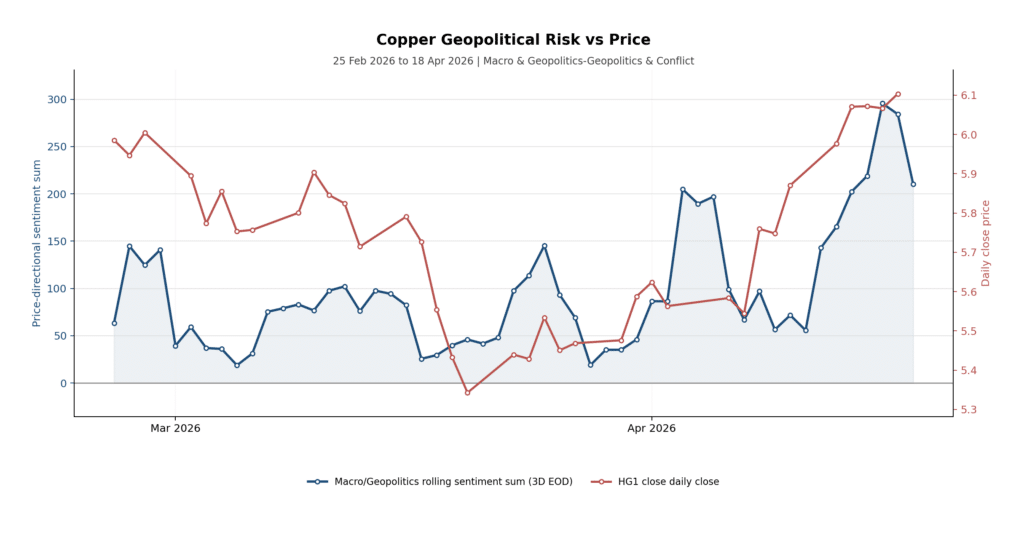
copper outlook geopolitical risk
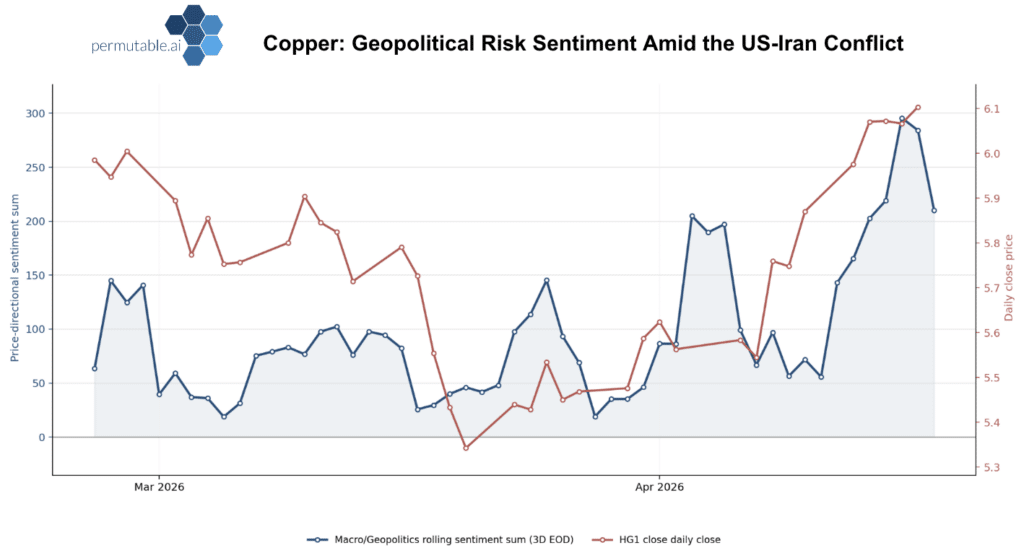
Caption: Copper geopolitical conflict sentiment rose sharply into the April price move, showing that the first leg of the rally was not purely about demand. The market was paying for a wider risk premium around energy, trade, logistics and supply security.

The chart shows where the first impulse came from. Copper was not initially moving on a clean demand story. It was being lifted by a broader macro and geopolitical risk premium. That is useful, but not enough. A geopolitical premium can lift copper. Demand has to defend it.

Demand Sentiment Is The Confirmation Channel

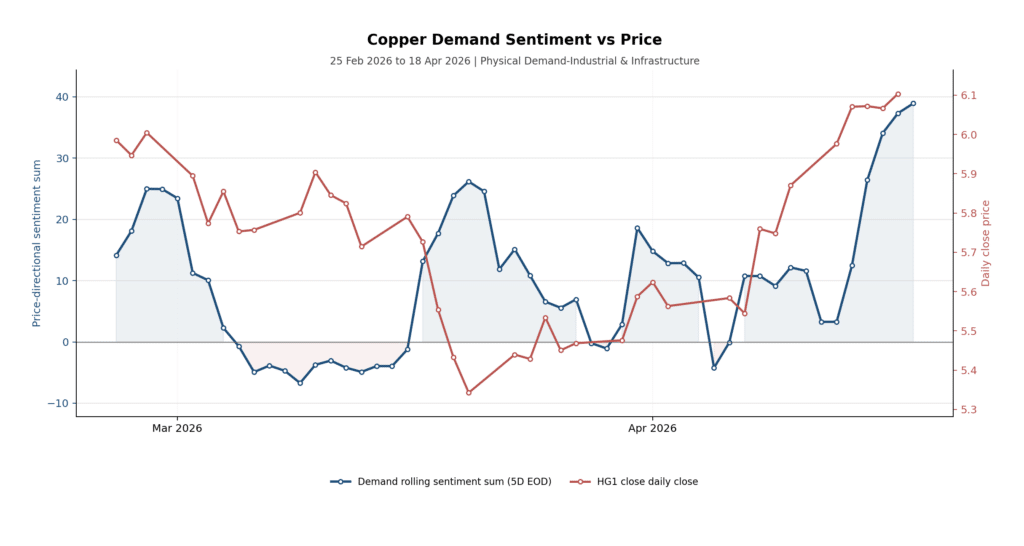
The key copper signal is industrial and infrastructure demand. Demand sentiment weakened in early March, recovered later in the month, and then rose sharply into mid-April as copper pushed higher. Demand was not the first mover. It was the confirmation channel.
copper outlook demand sentiment
Caption: Copper demand sentiment improved after the initial geopolitical repricing, helping validate the rally. If demand sentiment keeps rising behind price, the move looks better supported. If it fades, the rally becomes more exposed to a risk-premium unwind.

China is central to that test. March manufacturing PMI returned to expansion at 50.4, with production at 51.4 and new orders at 51.6. That gives copper some support. But export orders remained below 50, supplier delivery times were stretched and raw-material purchase prices surged to 63.9.

China is helping copper, but not cleanly. It is supporting demand inside a more expensive industrial system. If manufacturers can pass costs forward, demand can hold. If they cannot, the pressure moves into margins, inventory discipline and weaker procurement.

Copper Supply Risk: Real, But Less Immediate

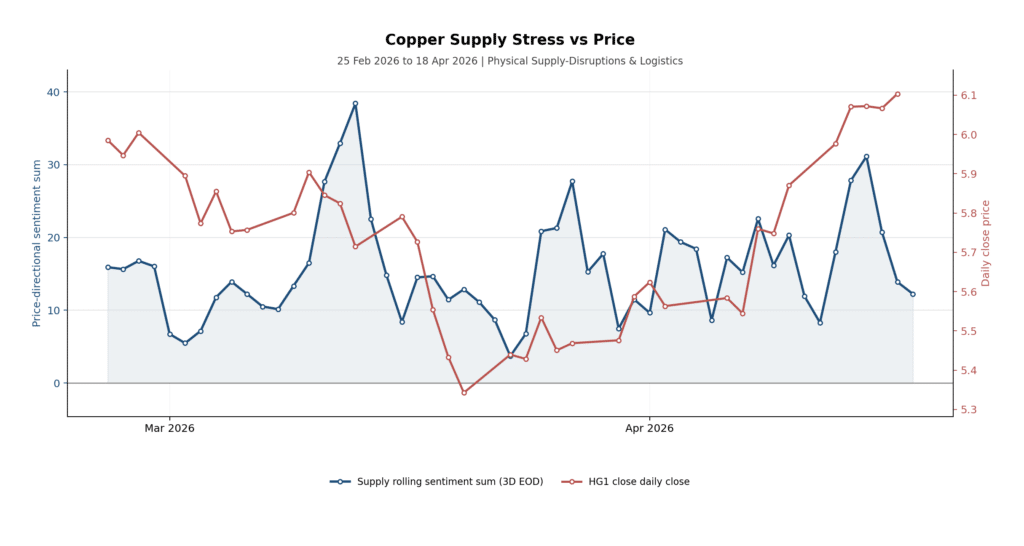
Copper supply risk is present, but it is less direct than aluminium’s. The supply and logistics signal was choppier than the geopolitical line, but the mid-April lift mattered. It arrived as copper was already recovering, adding physical credibility to a move that began with macro risk.
copper outlook supply stress

Visible inventories complicate the story. Global exchange stocks above 1.4 million tonnes at the end of March challenged the near-term shortage narrative, even as the longer-term structural case remained intact. The market can believe in electrification and still punish weak manufacturing data.

The Acid Chain: Copper’s Hidden Constraint

There is also a quieter supply risk beneath the electrification story: sulphuric acid. Acid is not ancillary to leached copper output. It is part of the production process. Sulphur is extracted inside the oil and gas system. Sulphuric acid is produced from it and used in copper leaching through solvent extraction and electrowinning. Nearly 15% of global copper production depends directly on acid-based leaching.

Oil and Middle East disruption can alter sulphur economics and transport. If acid availability tightens, leached copper output becomes vulnerable, even if the electrification thesis remains intact.

China controls roughly 40% of global sulphuric acid output and has moved to restrict exports from May to protect domestic fertiliser supply owing to spillover effects of the US Iran conflict. Shipments to Chile reportedly dropped to zero in March, compared with more than 150,000 tonnes in the same month last year. Chile is the world’s largest copper producer. The Democratic Republic of Congo faces similar exposure through thin acid inventories and process dependency.

Copper does not need its structural thesis to fail for prices to soften. It only needs the near-term demand premium to look too expensive relative to current order books.

Aluminium: The Supply Shock Is Already Physical

Copper is still debating the balance between future scarcity and near-term demand. Aluminium is dealing with a more immediate constraint. Its exposure to a Gulf logistics shock is direct, physical and visible. The question is not whether demand holds. It is whether the shock is arriving through cost, supply or availability. The answer is all three.
Aluminium geopolitical conflict sentiment
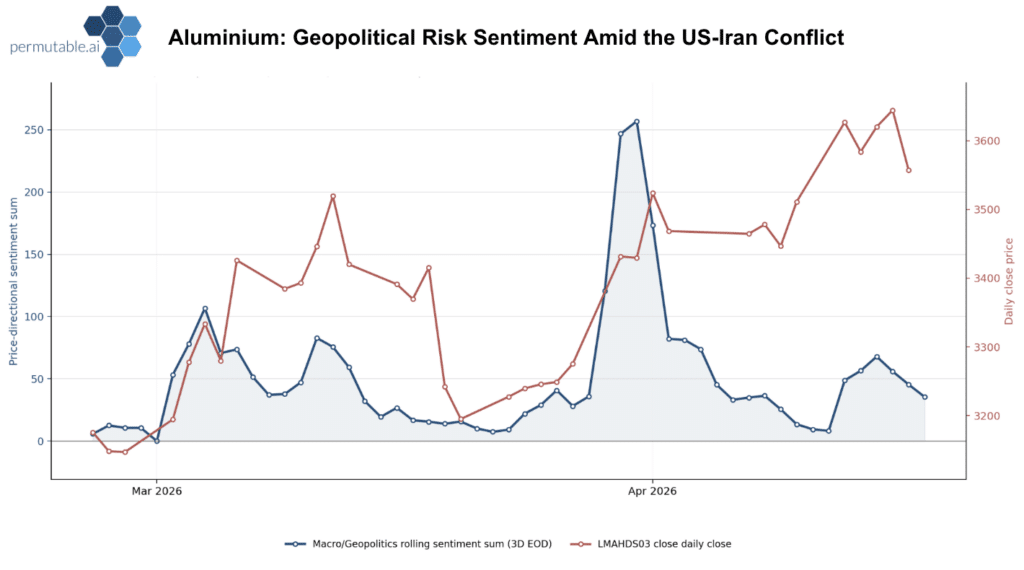
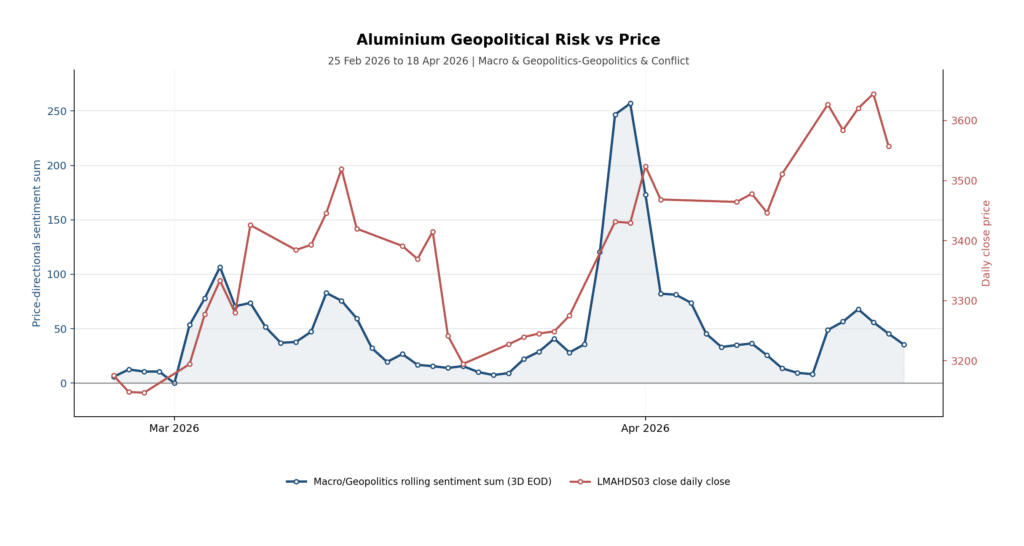
Caption: Aluminium geopolitical conflict sentiment spiked into the late-March and early-April price move, showing that the first repricing was driven by heightened regional risk rather than broad base-metals momentum.

This was not a generic base-metals rally. Aluminium was repriced because the market began to worry about a region that produces, powers and ships a meaningful share of global seaborne supply.

The Logistics Signal Shows The Squeeze

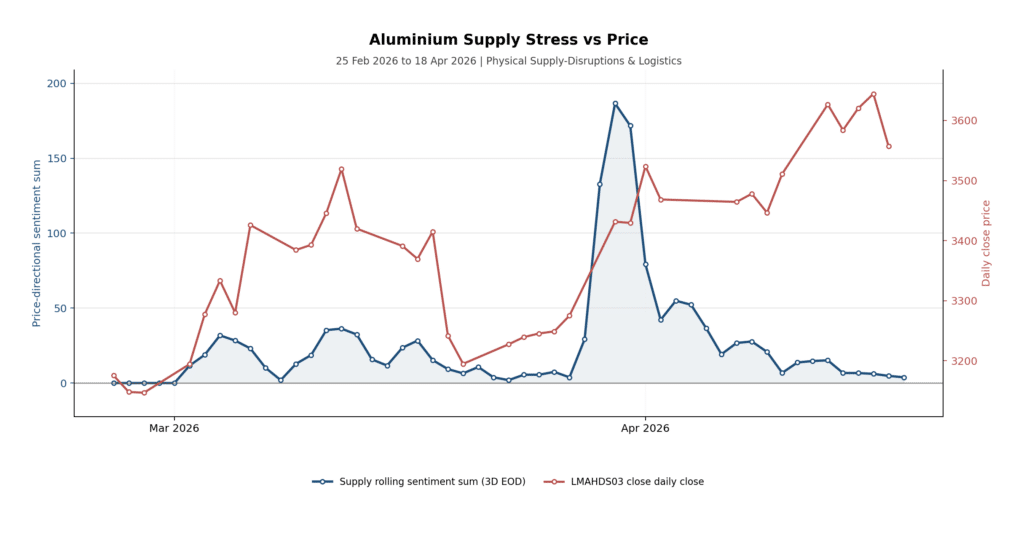
The more important aluminium signal is supply disruption and logistics sentiment. It surged into the same window as the price breakout, then cooled while price remained firm. That is the key detail: aluminium did not fully give back the move once the first logistics impulse fade. The market retained an availability premium.
aluminium supply stress

That is how physical markets often behave. The headline moves first. Procurement behaviour changes next. Buyers become defensive, regional premiums rise and traders stop asking only where the LME price is. They start asking where metal can be sourced, financed, shipped and delivered.

Hormuz Is A Two-Way Corridor

The Gulf accounts for roughly 10% of global aluminium production and a larger share of seaborne exports outside China. But Hormuz is not just an exit point for finished metal. It is a two-way industrial corridor.

Bauxite must become alumina. Alumina must reach the smelter. Carbon anodes must be produced and delivered. Power must remain reliable and affordable. Finished aluminium then has to move from smelter to consumer. Hormuz touches several of those links at once.

In April, LME aluminium hit a four-year high and the cash market moved into premium as the supply chain repriced. Physical premiums tightened across Rotterdam, the Midwest and Japan. Gulf deliveries were hindered, some volumes were effectively trapped in the region, and smelters began rerouting metal overland to ports outside Hormuz.

This is why aluminium has developed an availability premium above the LME price. The market is not only pricing demand. It is pricing confidence that metal can be produced, financed, shipped and delivered through a stressed logistics system. Diplomatic talks do not repair that overnight.

Downstream Pressure Is Already Forming

Secondary aluminium producers in key markets have faced disruption to scrap flows from the Middle East, a major source of recycled feedstock. Scrap prices have risen sharply and some producers have cut operating rates. Recycled aluminium feeds autos, construction, packaging and consumer goods. The route from freight disruption to factory utilisation and end-product prices is already in motion.

If copper is mainly asking whether growth can support the price, aluminium is asking whether the supply chain can keep operating.

What Metals Desks Should Watch

Copper

If demand sentiment catches up with price, the rally is better supported. If it rolls over while geopolitical risk stays elevated, the premium becomes vulnerable.

  • Industrial and infrastructure demand sentiment keeps rising behind price.
  • China export orders recover above 50.
  • Visible inventories draw down from the 1.4 million tonne level.
  • Copper spreads tighten into nearby conditions.
  • Sulphuric acid availability tightens in Chile and the DRC.

Aluminium

If supply and logistics sentiment reaccelerates while price remains firm, the market is pricing a deeper operational constraint, not just a news cycle.

  • Supply and logistics sentiment holds elevated after the geopolitical impulse fades.
  • Regional physical premiums stay firm in Rotterdam, the Midwest and Japan.
  • Gulf smelter operating rates remain constrained.
  • Alumina and carbon input flows remain disrupted.
  • Scrap prices rise as a real-time downstream signal.

From Event Risk To Behavioural Shift

This is where geopolitical disruption stops being a market event and starts changing how the market operates. An event moves prices quickly. The behavioural shift that follows is slower and steers the course for the outlook. Buyers stop treating supply stress as noise. Procurement teams rebuild inventories defensively. Smelters focus on operating continuity over price optimisation. Downstream fabricators protect supply before protecting margin.

When that shift takes hold, the market stops pricing only the event and starts pricing the physical system behind it.

The shock is the same. The transmission is not.

Copper is asking whether demand can defend the scarcity premium. Aluminium is asking whether the supply chain can keep operating smoothly enough to remove the availability premium.

Knowing which channel has taken hold is the edge.

Gaining Edge Through Real-Time Metals Sentiment

For commodity desks, macro investors and systematic teams, the challenge is no longer simply tracking whether metals are rising or falling on geopolitics. It is identifying which part of the market is doing the work: physical tightness, demand resilience, logistics stress or macro deterioration.

Tracking supply, demand and macro themes separately helps teams manage and mitigate risk. It provides the ability to distinguish concentrate tightness from demand weakness, and smelter disruption from diplomatic noise.

In a market where the same oil shock can test copper’s demand premium while reinforcing aluminium’s cost floor, gaining greater clarity on real time driver attribution is the edge.

For institutional access to metals sentiment intelligence, data feeds and API, contact enquiries@permutable.ai

Commodity shock transmission: How real-time sentiment signals reveal market moves before price adjusts

This article explains how commodity shocks transmit across markets and how Permutable’s real-time sentiment signals reveal these shifts before they appear in price. It is aimed at institutional investors, hedge funds and trading desks seeking to identify early drivers of commodity and macro movements, improve signal detection and integrate narrative-based intelligence into discretionary and systematic workflows.

In commodity markets, the initial shock is rarely the full story. What matters is how that shock moves through the system. Oil prices above $110, disruption in key shipping routes and fractures within OPEC are the visible triggers. But for institutional investors, the real signal lies in how these events transmit into metals, agriculture and broader cost structures.

This process is not uniform. It is layered, nonlinear and often misread when relying solely on price or traditional data.

At Permutable AI, our real-time sentiment intelligence is designed to track this transmission as it unfolds, capturing how narratives evolve across supply, demand, macro conditions and logistics before those changes are fully reflected in markets.


What is commodity shock transmission?

Commodity shock transmission refers to the way a primary market disruption, such as an energy price spike, propagates through interconnected markets via input costs, production dynamics and supply chains.

An oil shock does not remain confined to oil.

It feeds into:

  • freight and shipping costs
  • industrial energy usage
  • agricultural inputs such as fertiliser and fuel

As these pressures move through the system, different markets respond in different ways. Some absorb the shock through demand adjustments. Others through supply constraints or margin compression. Understanding this distinction is key. It determines not only where risk is building, but how and when it is likely to appear in price.


How real-time sentiment reveals transmission earlier

Traditional data sources tend to lag these shifts. By the time changes are visible in price, inventory or macro releases, a significant portion of the move may already be priced in. This is where sentiment becomes valuable.

At Permutable, our models analyse over 250,000 global sources and millions of narratives to detect how market perception is evolving in real time. Rather than focusing on keywords alone, the system captures how themes such as supply disruption, demand resilience or logistics stress are gaining or losing traction across markets.

This provides an early-read layer that sits between raw information and price action. In practice, it allows institutional teams to identify which drivers are becoming dominant before those dynamics are fully expressed in markets.


Commodity transmission framework

To make this process actionable, we break commodity shock transmission into three core channels:

1. Demand transmission

This occurs when rising costs begin to influence end-user behaviour. Copper is a clear example. The long-term structural drivers, including electrification and grid expansion, remain intact. However, higher energy prices increase the cost of using copper, not just producing it.

Freight, power and financing costs rise simultaneously. Industrial buyers become more selective. The question becomes whether demand can absorb these pressures without weakening.

2. Supply transmission

In other markets, the constraint appears on the production side. For example, aluminium is currently exhibiting this dynamic. Power, alumina and logistics costs are tightening together, shifting the market from price discovery to physical availability.

Disruption in scrap flows and rising input costs are already forcing some producers to reduce output. In this regime, the key variable is not demand, but whether supply can be maintained under tighter operating conditions.

3. Cost transmission

Agricultural markets often sit in a third category, where the primary impact is on margins. Input costs such as fertiliser, fuel and transportation rise, while crop prices adjust more slowly. This creates a structural imbalance for producers.

Over time, this imbalance feeds back into supply decisions, but the initial signal appears as pressure on profitability rather than immediate changes in output.


Case study: Agriculture supply stress

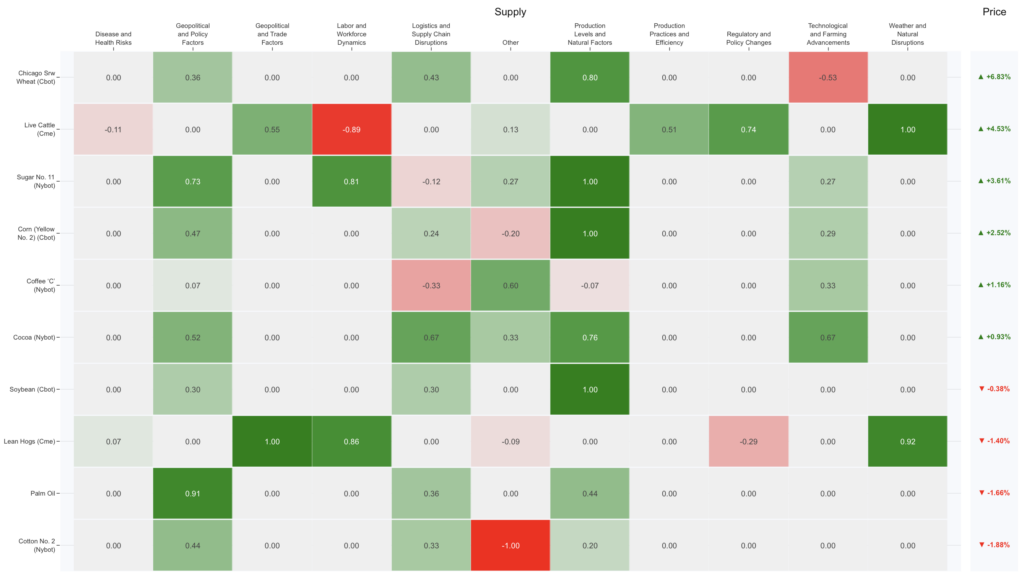
Permutable’s recent sentiment data highlights a clear concentration of supply-side risk across agricultural markets. Signals are clustering around production constraints, logistics pressure and energy-linked inputs. The move is not broad based. It is directional and increasingly coherent. The underlying issue is margin compression.

Input costs remain elevated and priced for disruption, while crop returns have not adjusted sufficiently to offset those pressures. This creates a “scissor” effect, where producer economics deteriorate despite stable or rising prices.

From a market perspective, this is significant because it often precedes more visible supply adjustments. Here, Permutable’s sentiment intelligence allows this process to be tracked in real time, identifying where stress is building before it is fully reflected in price.

Heatmap showing supply-side sentiment drivers across agricultural commodities including wheat, corn, sugar, cattle, and coffee, with green indicating positive price impact and red indicating negative, alongside percentage price changes | Permutable AI

Above: Permutable AI’s Agriculture sentiment heat map showing supply-side drivers across key commodities, with bullish signals clustering around production risk, logistics disruption and energy-linked inputs. The concentration of green across production and supply chain factors highlights a developing margin squeeze, where input costs remain elevated while crop returns lag, signalling early-stage supply stress before full price adjustment.

Line chart comparing copper price (HG1) with macro and geopolitical sentiment scores, showing correlation between rising sentiment and increasing prices during March–April 2026 | Permutable AI

Above: Permutable AI’s copper geopolitical and macro sentiment versus price, illustrating how sentiment has strengthened ahead of the recent price move. The divergence reflects a market increasingly driven by demand resilience and geopolitical risk premium, with sentiment capturing the shift in narrative before it becomes fully embedded in price action.

Aluminium, by contrast, is increasingly defined by supply constraints. Rising power and input costs are tightening production capacity, shifting the focus toward availability rather than pricing.

Line chart showing aluminium prices alongside macro and geopolitical sentiment indicators, illustrating volatility and price response to sentiment spikes in early April 2026 | Permutable AI

Above: Permutable AI’s aluminium geopolitical and macro sentiment versus price, highlighting a sharp spike in sentiment aligned with tightening production conditions. Unlike copper, the signal reflects supply-side constraint, where rising energy, input and logistics pressures are shifting the market from price discovery to availability, with sentiment identifying the tightening regime ahead of sustained price impact.

This distinction is important. Markets rarely move in a uniform way. Identifying whether a commodity is trading demand, supply or cost dynamics is essential to understanding where the next move is likely to emerge.

Why this matters for institutional investors

In modern commodity markets, the gap between narrative and price has become a key source of alpha. Markets do not wait for confirmation. They move as expectations shift.

Sentiment captures that shift at the point where narratives begin to consolidate. This provides a forward-looking signal that complements traditional data rather than replacing it.

For discretionary teams, this improves clarity around what is actually driving the market. For systematic strategies, it introduces a new layer of structured inputs that can enhance regime detection, timing and risk calibration. The objective here is not to react faster. It is to see earlier.


From signal to application

Permutable’s commodity signal layer translates real-time narrative flow into structured indicators that can be integrated into both discretionary and systematic workflows.

These signals can be used to:

  • identify regime shifts across commodities
  • track spillovers between energy, metals and agriculture
  • distinguish persistent structural changes from short-term noise

Because the data is structured and consistent, it can be incorporated directly into research, backtesting and live trading environments.


Final thought

Commodity markets are no longer trading isolated events. They are trading how those events move through the system. Consequently, the initial shock sets the direction, but the transmission determines the outcome.

For institutional investors, the edge lies in identifying that process early, when narratives are forming and before price fully adjusts. This is where Permutable’s real-time sentiment signals provide a meaningful advantage.


Explore Permutable’s real-time commodity and industrial metals sentiment intelligence, designed for institutional workflows. Request access: enquiries@permutable.ai

Q&A

What is commodity shock transmission?

Commodity shock transmission describes how a primary market disruption, such as an energy price spike, spreads across related markets including metals and agriculture through supply chains, input costs and logistics.


How do real-time sentiment signals help in commodity markets?

Real-time sentiment signals capture how market narratives are evolving across supply, demand and macro conditions before those changes are fully reflected in price. This allows institutional investors to identify emerging trends earlier than traditional data sources.


Why does oil impact metals and agriculture?

Oil influences commodities through input costs such as energy, fertiliser and transport. As these costs rise, they affect production decisions, supply availability and demand behaviour across metals and agricultural markets.


What is the difference between demand, supply and cost transmission?

Demand transmission occurs when rising costs affect consumption behaviour, supply transmission when production becomes constrained, and cost transmission when input pressures impact margins before output adjusts.


How does Permutable AI generate commodity sentiment signals?

Permutable AI analyses over 250,000 global sources and millions of narratives to detect shifts in sentiment across macro and fundamental drivers, transforming unstructured data into structured, model-ready signals


Can sentiment signals be used in systematic trading models?

Yes. Sentiment signals can be integrated into systematic strategies as regime indicators, feature inputs or cross-asset signals, helping improve timing, risk calibration and model performance.


What macro data does Permutable track?

Permutable tracks sentiment across 25+ economic indicators for over 50 countries, including inflation, interest rates, employment and geopolitical risk, using local and international sources in multiple languages


Why do sentiment signals lead price in markets?

Markets react to expectations before confirmed data. Sentiment captures these expectations as they form, allowing investors to identify shifts in market direction before they are fully reflected in price action.

Weekly current precious and industrial metals sentiment: Is bullish momentum returning or fragmenting across markets?

This weekly precious and industrial metals sentiment report, based on Permutable AI metals market intelligence, assesses how narrative momentum is evolving across precious and industrial metals. It is designed for institutional investors, commodities traders and macro analysts seeking early insight into shifting market regimes. All observations reflect conditions at the time of writing and may change rapidly as new macro, supply and policy signals emerge.


Welcome to our weekly precious and industrial metals market sentiment roundup | 30.04.2026

This is our weekly analysis of precious and industrial metals market sentiment, built for commodities traders, macro desks, portfolio managers and institutional strategists.

This report provides a structured view of sentiment across global metals markets using real-time data from Permutable AI. The system processes tens of thousands of headlines across hundreds of sources, converting narrative flow into directional indicators across COMEX, LME and ICE contracts.

All sentiment readings reflect conditions at the time of writing. In current markets, narrative shifts can occur quickly, particularly in response to macro policy, geopolitical developments and supply chain signals.

The defining feature of this week is not uniform direction but divergence. While parts of the complex are stabilising or consolidating, selective strength has re-emerged in key areas, particularly gold and US steel.


Precious and Industrial Metals: Executive view

At the time of writing, sentiment across metals markets is mixed rather than synchronised.

  • Gold has re-established bullish momentum, supported by macro policy signals and safe-haven demand.
  • US steel markets are also exhibiting renewed strength, driven by supply disruption and policy support.
  • Most industrial metals, including copper and aluminium, remain neutral, reflecting a balance between demand resilience and supply expansion.
  • Lead stands out as a clear bearish outlier, driven by structural oversupply.
  • The broader complex is characterised by fragmentation rather than a single dominant regime.

Precious metals: divergence emerges within the complex

Gold (COMEX)

Gold sentiment has shifted back into a bullish regime at the time of writing. The primary catalyst has been the Federal Reserve decision to hold rates unchanged. This has supported renewed demand, particularly through dip-buying behaviour and continued central bank accumulation. Safe-haven demand remains a consistent underlying driver.

At the same time, countervailing forces remain present. A stronger US dollar and persistent inflation concerns introduce constraints on upside momentum. In addition, recent large-scale selling activity suggests that gains may be capped in the near term.

Permutable AI’s sentiment intelligence indicates that bullish momentum is re-emerging, but within a constrained environment where macro variables remain decisive.


Silver (COMEX) 

Silver sentiment remains balanced despite recent volatility. The market has experienced sharp swings driven by macroeconomic uncertainty, particularly interest rate expectations and US dollar strength. A recent rebound attempt has been supported by geopolitical risk and physical demand, particularly from Asia.

However, these positive signals are offset by persistent macro headwinds. The result is a market oscillating between supportive structural demand and short-term pressure from financial conditions.

At the time of writing, sentiment reflects indecision rather than direction.


Platinum (NYMEX) 

Platinum remains in a fragile consolidation phase. Recent price behaviour shows a technical recovery supported by short-covering and producer activity. However, this movement appears driven more by positioning than by underlying fundamentals.

Earlier bearish pressure, linked to broker downgrades and macro uncertainty, continues to weigh on sentiment. Supply-side developments add further complexity, limiting conviction.

Permutable AI’s sentiment intelligence suggests that platinum lacks a clear catalyst and remains sensitive to external developments.


Palladium (NYMEX) 

Palladium continues to exhibit high volatility without sustained direction. Recent price action includes a sharp rebound, indicating episodic buying interest. However, this is offset by broader uncertainty around demand and macro conditions.

Supportive narratives include supply constraints and potential new industrial applications. These are counterbalanced by economic uncertainty and recent sell-offs across related markets. The result is a market in consolidation, with no dominant narrative at the time of writing.


Industrial metals: balance persists despite volatility

Copper (COMEX) 

Copper sentiment reflects a transition from momentum to equilibrium. Earlier rallies were driven by supply concerns and strong producer performance. However, recent sessions show a shift toward profit-taking and consolidation.

Positive signals include improving Chinese manufacturing data and restocking activity. These are offset by concerns around elevated production levels and potential oversupply. Permutable AI’s data indicates that copper is currently balancing demand resilience against supply expansion expectations.


Aluminium (COMEX) 

Aluminium sentiment remains mixed following a period of volatility. Geopolitical tensions and supply disruptions initially supported prices. More recent developments, including a stronger US dollar and easing supply concerns, have introduced downward pressure.

At the same time, speculative buying and ongoing cost pressures provide partial support. The market is currently range-bound, with no clear directional bias emerging.


Lead (LME) 

Lead stands out as the clearest directional signal across metals markets. Permutable AI’s sentiment intelligence indicates strong bearish sentiment driven by structural oversupply. Increasing production capacity and surplus projections are reinforcing downward pressure on prices.

Recent price declines reflect a lack of buyer support. Additional risks include environmental and regulatory factors, which may further impact demand. At the time of writing, the market is characterised by sustained downside momentum.


Tin (LME) 

Tin remains in a consolidation phase following recent volatility. Supply-side developments, including increased production and export flows, are weighing on sentiment. These are partially offset by positive corporate performance and investment signals.

Geopolitical risk remains a background factor but has not translated into sustained price support. The market is currently stabilising as participants reassess supply durability.


Steel markets: policy and supply disruption drive divergence

US Hot Rolled Coil (COMEX) 

US steel markets are exhibiting strong upward momentum at the time of writing. Recent price action has been driven by a combination of supply disruption and policy support. Export constraints linked to geopolitical developments have tightened global supply, while domestic pricing has been reinforced by coordinated producer increases.

Additional support is coming from fiscal policy measures, particularly in North America, which are sustaining demand. While structural headwinds remain, including global oversupply concerns, current momentum remains positive.


European Hot Rolled Coil (ICE) 

European steel markets present a more complex picture. Policy support, including tariffs and import controls, is providing a structural floor. However, this is offset by continued import flows, weak demand signals and cost pressures.

Recent trading behaviour reflects volatility rather than direction, with markets struggling to reconcile policy support with underlying weakness. Permutable AI’s sentiment intelligence indicates a neutral stance as these competing forces remain unresolved.


Bulk commodities: equilibrium dominates

Iron ore (COMEX)

Iron ore sentiment remains balanced. Support comes from continued demand in China and policy measures supporting infrastructure activity. However, increasing supply from major producers is offsetting these positive signals.

The market is currently range-bound, with no dominant narrative at the time of writing.


Cross-market interpretation

The defining feature of this week is fragmentation.

  • Precious metals are diverging, with gold strengthening while others consolidate.
  • Industrial metals remain balanced, reflecting competing supply and demand narratives.
  • Steel markets show regional divergence driven by policy and supply dynamics.
  • Lead stands out as a clear bearish outlier.

Cross-market correlation has weakened. Markets are increasingly trading on asset-specific narratives rather than broad macro alignment.


Strategic outlook

The current environment is defined by selective conviction rather than broad trends.

Key variables to monitor include:

  • US monetary policy and interest rate expectations
  • US dollar direction
  • geopolitical developments impacting supply chains
  • trade policy and tariff implementation
  • supply expansion across mining and refining

At the time of writing, metals markets are in a transitional phase. Some assets are regaining momentum, while others remain in consolidation.


Conclusion

Metals markets are no longer moving as a single complex. Instead, they are responding to a combination of macro policy, supply dynamics and regional factors.

Permutable AI’s sentiment intelligence indicates that while structural drivers remain intact, short-term direction is increasingly shaped by how competing narratives evolve.

All observations in this precious and industrial metals report reflect conditions at the time of writing. In fast-moving markets, sentiment and price dynamics can shift quickly. For institutional investors, the advantage lies in continuously tracking these changes as they develop, rather than relying on static positioning.


Gold price drivers and quant strategies – a data-driven breakdown of what really moves the market

This article explores data-driven gold price drivers using Permutable’s sentiment analysis, revealing how central banking, physical supply, and geopolitics influence gold markets across different time horizons and regimes. It is aimed at institutional investors, macro traders, and analysts seeking evidence-based insights to enhance trading strategies using alternative data and predictive signals.

Understanding gold price drivers has long been a priority for institutional investors, macro traders, and policymakers alike. Traditionally, narratives around inflation, interest rates, and geopolitical risk have dominated the conversation. However, new advances in large-scale sentiment analysis are reshaping how we quantify these relationships.

At Permutable, our latest systematic research into headline sentiment and news flow provides a data-driven framework for identifying the most persistent and predictive gold price drivers across market regimes. Drawing on over a decade of global news data and rigorous statistical validation, the findings offer a more nuanced and actionable view of what truly moves gold.

A data-driven approach to gold price drivers

This analysis is built on a robust dataset spanning 2015 to 2026, incorporating millions of global news articles and thousands of statistically significant signals. Using walk-forward validation and strict multiple-testing controls, we assessed which narrative themes consistently predict gold returns out-of-sample.

The result is clear – not all gold price drivers are equal. Some signals demonstrate strong persistence and predictive power, while others are highly regime-dependent and require contextual interpretation.


Physical supply – the most consistent gold price driver

Among all categories analysed, physical supply emerges as the most consistent and structurally important of the gold price drivers.

News related to:

  • mine production
  • inventory flows
  • physical supply constraints

shows strong predictive relationships with gold prices across all market conditions. Importantly, this signal is not just statistically significant in-sample but maintains its strength out-of-sample – a critical benchmark for real-world applicability.

From a market perspective, this reflects a fundamental truth – supply-side dynamics are slower-moving, less speculative, and therefore more stable as predictors of price behaviour.

For institutional investors, this suggests that monitoring supply-related news flow can provide a reliable baseline signal, particularly when combined with other macro indicators.

Central banking and interest rates – the highest fidelity signal

If physical supply is the most consistent driver, central banking sentiment is the most powerful.

Our analysis shows that news relating to:

  • interest rate expectations
  • monetary policy shifts
  • central bank communications

produces the strongest out-of-sample correlations of all gold price drivers, with high directional stability across short, medium, and long-term horizons.

This aligns with established macroeconomic theory. Gold, as a non-yielding asset, is highly sensitive to real interest rates and monetary conditions. However, what is new here is the ability to quantify this relationship through sentiment – capturing not just policy actions, but expectations and narrative shifts before they are fully priced in.

For institutional investors, this reinforces the importance of tracking forward-looking central bank sentiment rather than relying solely on lagging economic indicators.


Demand signals – powerful but regime-dependent

Jewellery and retail demand represent another key category of gold price drivers, but with an important caveat – their directional impact is not stable across market regimes.

Our findings show that:

  • demand signals are strong in magnitude
  • but frequently change sign between rising and falling markets

In practical terms, this means that while demand-related news is informative, it cannot be interpreted in isolation. The same signal may imply bullish momentum in one regime and bearish pressure in another.

This highlights a broader principle in quantitative macro trading – context matters as much as signal strength.

Geopolitics – a medium-term safe-haven driver

Geopolitical risk remains one of the most widely cited gold price drivers, and our analysis confirms its relevance – but with important nuances.

News related to:

  • conflict
  • sanctions
  • global instability

demonstrates strong predictive power at medium-term horizons, particularly over one to three months. This reflects gold’s role as a safe-haven asset, where capital flows respond to sustained uncertainty rather than short-term headlines.

However, geopolitical signals are less effective at very short horizons, suggesting that immediate reactions may be noisy or already priced in.

For portfolio managers, this implies that geopolitical sentiment should be treated as a trend signal, rather than a tactical trading indicator.

The role of market regimes

One of the most important insights from this research is the distinction between signal magnitude and direction.

While many gold price drivers exhibit strong and persistent correlations, their directional consistency is relatively low. In other words:

  • signals reliably indicate that a move is likely
  • but not always whether that move will be up or down

This is particularly evident in demand and macro signals, where correlations can reverse depending on whether the market is in an uptrend or downtrend.

As a result, regime detection becomes essential. Without accounting for broader market conditions, even high-quality signals can lead to incorrect positioning.

This finding reinforces a key principle of institutional quantitative trading – signals must be interpreted within a dynamic framework, not as static indicators.

Time horizon matters – short vs long-term drivers

Another important dimension of gold price drivers is how their effectiveness varies across time horizons.

Our analysis shows a clear pattern:

  • short-term (7 days) – headline volume dominates, capturing attention and news intensity
  • medium-term (1 month) – sentiment becomes the primary driver
  • long-term (3 months) – structural sentiment trends take over

This distinction is critical for strategy design. High-frequency traders may prioritise news flow and volume, while macro investors should focus on sentiment persistence and trend development.

Gold vs other assets – a unique sensitivity to news

A striking outcome of this research is how gold compares to other asset classes.

Gold exhibits significantly higher out-of-sample signal persistence than:

  • energy commodities
  • agricultural markets
  • FX proxies

This suggests that gold is uniquely sensitive to global narratives and macro sentiment, making it particularly well-suited to sentiment-driven strategies.

For systematic investors, this positions gold as one of the most attractive assets for integrating alternative data sources such as news analytics.

A new framework for gold price drivers

The traditional view of gold price drivers remains broadly valid – central banks, supply dynamics, and geopolitical risk all play critical roles. However, what this research adds is precision.

By quantifying these relationships through large-scale sentiment analysis, we can:

  • identify which signals truly persist out-of-sample
  • understand how they behave across different market regimes
  • align them with appropriate trading horizons

The key takeaway is not just that news matters, but that how we measure and interpret news matters even more.

For institutional investors this represents a shift from narrative-driven decision-making to evidence-based strategy design. And in an increasingly complex macro environment, that shift is not just valuable – it is essential.

Unlock deeper gold price drivers insights with institutional-grade sentiment intelligence

Explore our precious metals intelligence or request the full gold quant research summary by contacting enquiries@permutable.ai to access deeper, data-driven insights.


Gold prices fall as safe-haven demand fades amid policy and FX pressure

This analysis examines why gold prices falls despite escalating geopolitical tensions, highlighting the dominant influence of monetary policy, real yields, and FX sentiment. Using Permutable AI’s sentiment intelligence, it identifies early signals of repositioning across macro markets. Aimed at institutional investors and commodities traders, it provides forward-looking insights into gold’s shifting drivers and near-term directional risks.

Gold had every reason to rally. Yet, as gold prices fall, the market is signalling a decisive shift in macro drivers.

Escalating tensions between the United States and Iran, alongside broader instability across the Middle East, would traditionally reinforce gold’s safe-haven appeal. Historically, such geopolitical stress has provided a strong bid for gold.

However, this time the reaction function has changed. Instead of responding to geopolitical risk, markets have repriced around monetary policy and currency dynamics – leaving gold exposed.


Gold prices fall: Policy and FX repricing drivers 

The primary catalyst behind why the fall lies in the repricing of interest rate expectations and US dollar strength.

The Federal Reserve held rates steady, but more importantly, revised its 2026 inflation forecast higher to 2.7%. Chair Jerome Powell explicitly flagged energy price spillover as justification for maintaining a restrictive policy stance.

The implication is clear: higher-for-longer has extended firmly into 2026. For gold, this is structurally bearish. As a non-yielding asset, gold becomes less attractive in an environment where real yields are rising and expected to remain elevated. At the same time, the US dollar has strengthened, further increasing the opportunity cost of holding gold.

The result: gold prices fall as macro capital rotates toward yield-bearing assets.


Our sentiment data flagged the move early

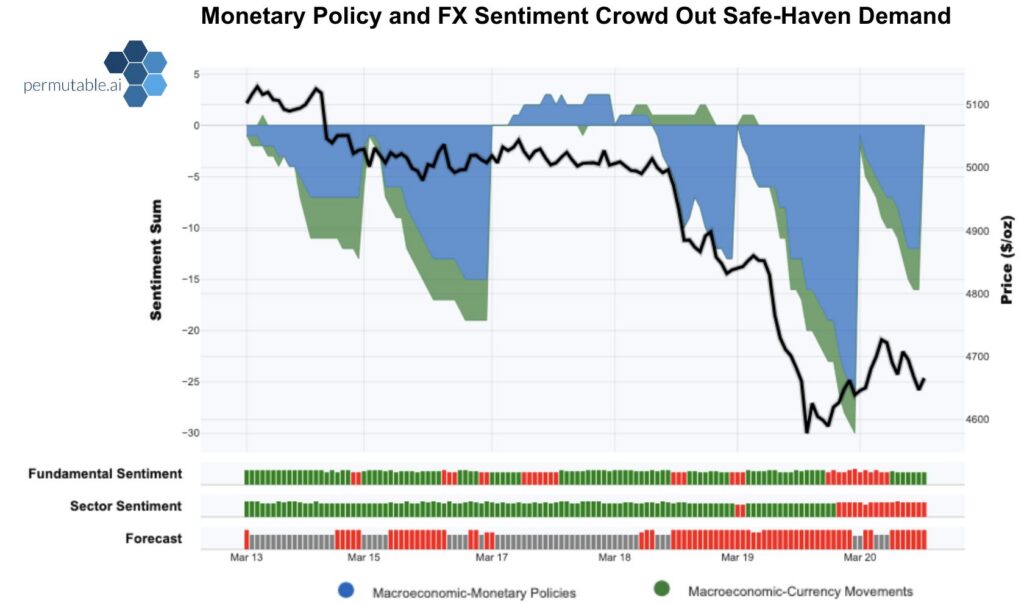
Our real-time sentiment indicators captured this shift before it was fully reflected in price action. Ahead of the recent breakdown –  with gold moving from above $5,000 to approximately $4,660 – our asset sentiment indices were already signalling a coordinated macro repositioning.

Chart showing gold prices falling alongside bearish monetary policy and USD sentiment, highlighting macro drivers outweighing safe haven demand

Monetary policy sentiment

Turned decisively bearish through mid-March, indicating that markets were already internalising a higher-for-longer rate environment well ahead of the Fed’s confirmation.

Currency movement sentiment

Shifted strongly in favour of the US dollar, creating sustained downward pressure on gold as FX dynamics became the dominant driver.

Fundamental and sector sentiment

Rolled over into bearish territory into March 19th, signalling a broad-based narrative shift across commodities – one that forced repositioning across institutional portfolios.

This alignment of sentiment factors explains why gold prices have fallen even in the presence of supportive geopolitical conditions.


Gold prices fall signifying a breakdown in the traditional safe-haven playbook

As gold prices fall, it’s not just the move that it notable, but why.  Historically, gold’s safe-haven status would dominate in periods of geopolitical stress. However, the current environment reflects a hierarchy of macro drivers:

  1. Real yields

  2. US dollar strength

  3. Monetary policy expectations

  4. Geopolitical risk

Right now, the first three are outweighing the fourth. The geopolitical premium that had been building in gold over recent months has rapidly unwound as markets re-anchor around rates and FX.


What institutional investors should watch

As gold prices fall, the forward path will depend on whether current macro drivers persist or begin to shift.

1. US data and dollar dynamics

Any softening in US economic data could weaken the dollar, providing gold with room to stabilise or recover.

2. Inflation and energy spillover

If energy-driven inflation persists, it strengthens the case for restrictive policy – keeping downward pressure on gold.

3. Real yield trajectory

Sustained elevated real yields remain the most critical headwind. A reversal here would be the clearest signal for a change in gold’s direction.


Gold prices fall: Why this matters now 

Gold has not lost its safe-haven credentials. Rather, the current environment shows that macro hierarchy matters. When yields and the dollar move decisively, they can override geopolitical support – at least in the short term.

When gold prices fall despite heightened geopolitical risk is itself a signal: markets are prioritising policy and FX over traditional hedging behaviour. At Permutable, this is precisely the type of shift our sentiment intelligence is designed to capture early.

By identifying changes in narrative across monetary policy, FX, and commodities, our models provide institutional investors with a forward-looking edge – enabling them to reposition before these dynamics are fully priced in.

See how this fits into your workflow

Discover how our real-time sentiment intelligence can integrate directly into your macro and commodities workflow – helping you identify shifts in gold, FX, and policy narratives before they show up in price.

For institutional investors, get in touch for a personalised walkthrough by emailing enquiries@permutable.ai

Turning commodity volatility into opportunity in 2026

This article examines how commodity volatility has become structural in 2026, driven by geopolitics, resource security, and climate risk. It explains how institutional investors, commodity funds, and trading desks can turn volatility into opportunity by using macro intelligence and narrative-aware signals, drawing on Permutable AI’s live trading strategy.

Commodity volatility has entered a new phase. What was once largely driven by cyclical supply and demand dynamics is now shaped by geopolitics, energy transition policies, climate disruption, and national security priorities. These forces have fundamentally altered how commodity markets behave, introducing persistent uncertainty and frequent regime shifts.

For institutional investors, commodity volatility is no longer an episodic feature that spikes during isolated crises and then fades. It is structural, narrative-driven, and deeply connected to macro forces operating across regions, asset classes, and time horizons.

At Permutable AI, we view this environment not as a constraint, but as a source of opportunity for investors equipped with the right intelligence.


Resource security has repriced commodity risk

Resource security has become a defining macro theme. Governments are reshaping energy systems, securing access to critical minerals, protecting food supply chains, and reducing exposure to geopolitically sensitive trade routes. These priorities are reflected in commodity markets well before physical supply constraints emerge.

Commodity volatility increasingly reflects expectations rather than realised shortages. Markets move on policy signals, regulatory changes, diplomatic language, and climate developments long before inventory data confirms the shift. This anticipation-driven repricing creates sharper moves and longer-lasting volatility regimes.

Traditional models, which were built for slower-moving fundamental cycles, struggle to adapt to this reality.

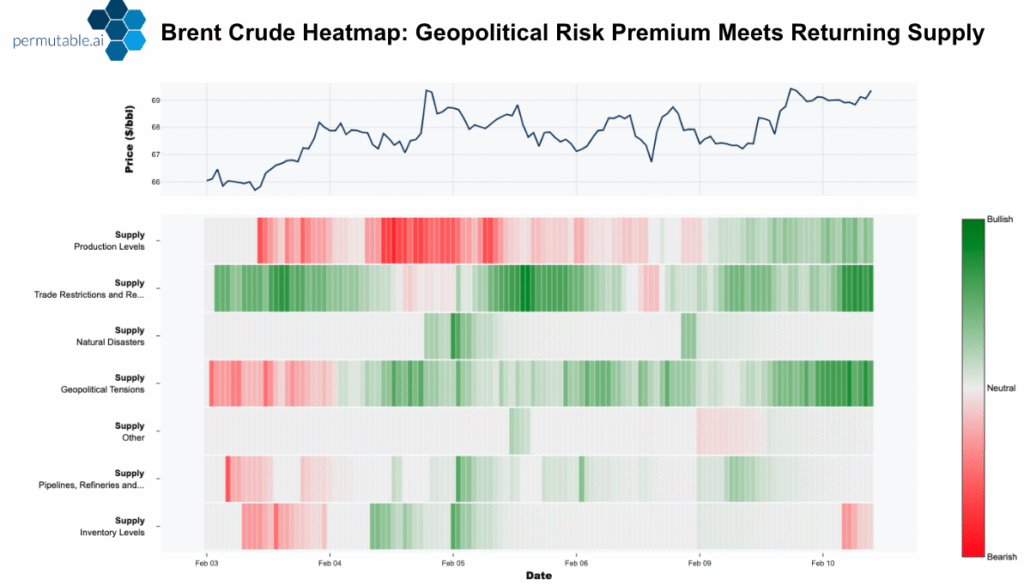
Example: Brent crude

Recent Brent crude price action illustrates this anticipation-driven repricing clearly. In early February, our sentiment engine identified a rebuilt geopolitical risk premium linked to Hormuz transit tensions, winter storm outages and OPEC+ supply discipline, lifting Brent from the low $60s to $69 before inventory data confirmed tighter balances. At the same time, returning Venezuelan output capped upside risk. By mapping these competing narratives in real time, clients could see which themes were strengthening and which were fading – enabling earlier positioning than price-only indicators allow.

Market signals: Brent crude oil price chart with sentiment heatmap showing geopolitical risk, production, inventory and supply drivers, highlighting bullish risk premium from Middle East tensions offset by returning supply pressures

How to read this heatmap: This Brent crude heatmap provides a real-time view of the underlying supply and geopolitical forces driving price movements, helping traders understand not just what the market is doing, but why. The top panel shows price action, while each row beneath tracks sentiment across distinct supply drivers – including production discipline, trade restrictions, natural disasters, inventories and geopolitical tensions – colour-coded from bearish (red) to bullish (green). When multiple rows shift green together, it signals tightening conditions and a rebuilding risk premium; when red dominates, easing supply pressures cap upside. By mapping these narratives over time, the heatmap highlights emerging regime shifts before they fully express in price, enabling investors to anticipate volatility, manage risk more proactively and position with greater conviction rather than reacting after the move has already occurred.

Why commodity volatility rewards intelligence over reaction

In 2026, commodity volatility does not reward those who react fastest to price moves alone. It rewards those who understand why markets are moving, which narratives are gaining traction, and how long those dynamics are likely to persist.

Price-based indicators remain important, but they are no longer sufficient in isolation. When volatility is driven by policy risk, geopolitical escalation, or coordinated narrative shifts, the informational edge lies outside the price series.

We believe successful commodity strategies increasingly depend on macro awareness, narrative interpretation, and early identification of regime change.

Example: Precious metals 

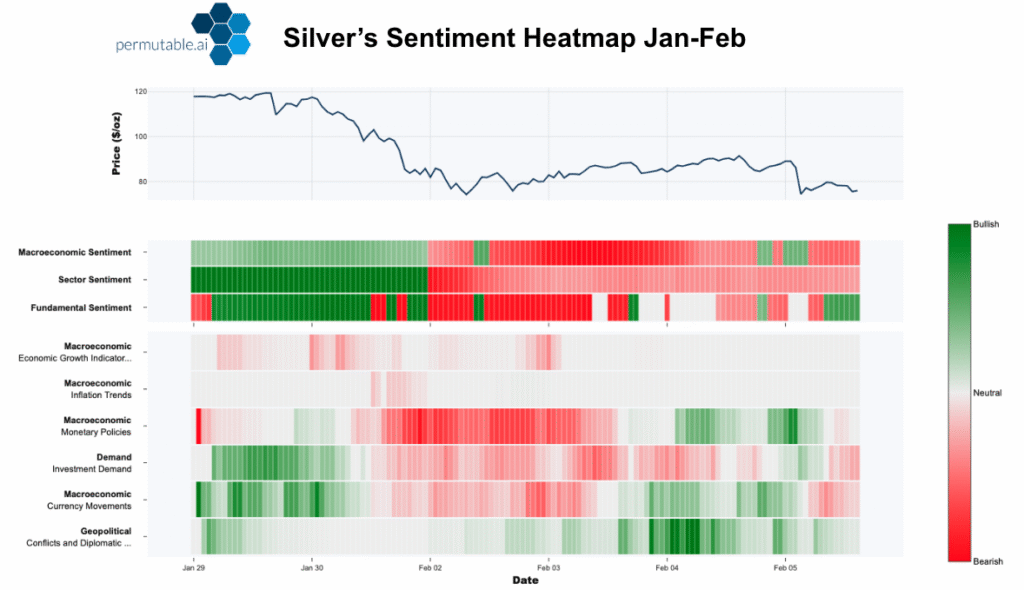
Precious metals offers a recent clear example of why understanding causality matters more than reacting to price alone. In late January, gold and silver rallied on tightness and inflows before reversing sharply as policy expectations shifted. A firmer dollar, rising real yields and tighter exchange margins triggered forced de-risking, turning what began as a wobble into a rout. Our sentiment signals flagged the macro spark early, separating policy-driven repricing from noise and helping traders anticipate the regime shift before it fully expressed in price.

Silver price chart with sentiment heatmap showing macro, sector and monetary policy drivers turning sharply bearish in early February, highlighting liquidation, weaker positioning and higher volatility in the silver market

How to read this heatmap: The silver sentiment heatmap illustrates how precious metals volatility is driven less by physical supply and more by macro policy, currency and positioning dynamics. The top panel tracks price, while each row beneath shows sentiment across key drivers such as monetary policy expectations, dollar strength, investment flows and geopolitical risk, colour-coded from bullish (green) to bearish (red). In this example, a coordinated shift toward red across policy indicators signalled a “higher-for-longer” rate repricing and stronger dollar before the sell-off fully unfolded, helping distinguish a structural macro headwind from short-term noise. By mapping these causal forces in real time, the heatmap enables traders to anticipate regime changes and manage risk proactively rather than reacting after volatility has already expanded.

Applying Intelligence in live trading environments

Our perspective on commodity volatility is informed not only by research, but by application. We run a live trading strategy that actively uses our intelligence framework to navigate volatile commodity markets. This strategy is designed to test how macro narratives, policy developments, and sentiment shifts translate into real trading outcomes.

The performance of this live strategy reinforces a consistent insight: the most meaningful opportunities tend to emerge when markets underreact to early macro signals or misprice the persistence of new regimes. By incorporating narrative-aware intelligence, we are able to improve timing, manage risk dynamically, and avoid relying solely on lagging indicators.

While every fund and trading desk operates under different constraints, the underlying principle is transferable. Commodity volatility becomes more navigable when decision-making is anchored in causality rather than hindsight.

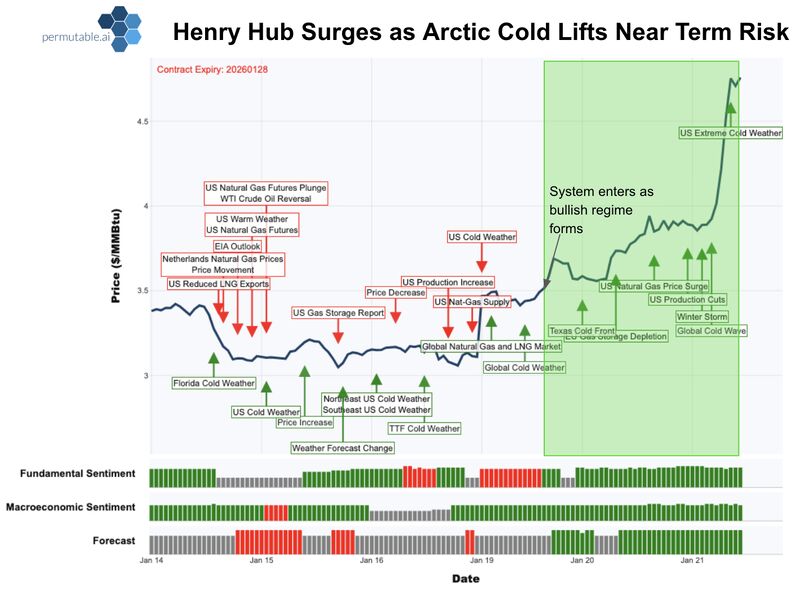
Example: Henry Hub natural gas

A recent Henry Hub natural gas rally illustrates this in practice. As an Arctic storm began forming across more than 30 U.S. states, our sentiment signals turned decisively bullish across demand and near-term supply risk themes days before the breakout. Storage assumptions proved too optimistic, positioning was short and heating demand accelerated simultaneously. This convergence of narratives triggered a rapid repricing, with Henry Hub rising nearly 30% in 48 hours. By identifying the regime shift early, our live strategy positioned ahead of the move rather than chasing it after the spike.

Henry Hub natural gas price chart with annotated weather and supply events, overlaid with green and red sentiment bars showing fundamental, macroeconomic and forecast signals turning bullish ahead of a sharp rally during an Arctic cold weather regime.

Chart above: Our sentiment indicators sit beneath the price chart and are designed to show the underlying pressure building in the market before it fully appears in price. Each row captures a different layer of influence: Fundamental Sentiment reflects real supply-demand dynamics such as storage, production and weather-driven consumption; Macroeconomic Sentiment tracks broader risk conditions and cross-asset forces; and Forecast provides a forward-looking signal that identifies emerging narrative shifts early. Colours indicate direction and conviction – green for bullish pressure, red for bearish and grey for neutral. Rather than focusing on individual bars, the key is to watch for alignment and persistence across rows: when multiple indicators turn green together and stay green, it signals strengthening momentum and a developing bullish regime; when they cluster red, downside pressure is building. In this example, the forecast and fundamental indicators flipped decisively bullish ahead of the breakout, creating a sustained block of green that highlighted tightening conditions and enabled positioning before the 30% rally unfolded.

How commodity funds and traders can harness similar outcomes

Proven in live performance, commodity funds and trading desks can use our intelligence to enhance their own strategies without replicating our approach verbatim. Our role is not to prescribe trades, but to provide the macro context and signals that improve decision quality.

By integrating our intelligence into their workflows, traders can identify emerging volatility regimes earlier, understand which commodities are most exposed to policy or geopolitical shifts, and assess whether price moves are likely to be transient or structural. This supports better position sizing, improved entry and exit timing, and more robust scenario analysis.

For discretionary traders, this intelligence strengthens conviction. For systematic strategies, it provides an additional explanatory layer that helps avoid false signals during macro-driven dislocations.


From macro complexity to actionable signals

The challenge facing institutional investors is not a lack of data, but an excess of unstructured information. Global news flows, policy announcements, and geopolitical developments arrive continuously, often with ambiguous implications for commodity markets.

Our platform transforms this complexity into structured, actionable insight. We analyse global narratives, track sentiment across key entities, and map macro developments directly to commodity exposure. This allows investors to move beyond headline-driven reactions and towards systematic understanding.

Example: Industrial metals 

The Industrial metals complex demonstrates how our intelligence translates into day-to-day decision support, not just event-driven trades. In aluminium, for example, prices strengthened even as inventory data appeared mixed because the real constraint lay elsewhere – in power availability, policy limits on Chinese capacity, tighter scrap flows and reduced trade elasticity. By tracking these structural pressures in real time, our Trading Co-Pilot intelligence layer helped clients focus on the drivers that mattered and avoid being misled by noisy stock prints. The result was earlier recognition of tightening conditions and clearer conviction as the market repriced higher. In complex markets, separating signal from distraction is often the difference between reacting late and positioning with intent.
Aluminium rally

Chart above: Our sentiment indicators sit beneath the price chart and translate complex supply, policy and demand developments into clear directional signals. Each row reflects a different layer of pressure – Fundamental Sentiment captures physical tightness across production, power availability and inventories, Sector Sentiment tracks flows and positioning within the broader metals complex, and Forecast provides an early, forward-looking read on emerging regime shifts. Green bars indicate bullish pressure, red bearish and grey neutral. Rather than focusing on isolated signals, the key is alignment and persistence: when multiple rows turn green together and remain green, it signals strengthening conviction and a structural tightening backdrop. In this example, sustained green across fundamentals and forecast highlights a developing bullish regime before and during the price advance, showing how sentiment leads price and helps identify durable moves rather than reacting after they are underway.

Commodity volatility as a portfolio feature in 2026

In an environment defined by persistent uncertainty, commodity volatility is increasingly viewed as a portfolio feature rather than a risk to be avoided. When properly understood, it offers diversification, inflation sensitivity, and uncorrelated return potential.

However, these benefits only materialise when volatility is navigated with clarity. Poorly understood volatility amplifies drawdowns. Well-understood volatility creates opportunity. Our Trading Co-Pilot intelligence layer and macro intelligence solutions are built to provide that clarity, embedding narrative-aware insight directly into institutional workflows.


The future of commodity investing

Commodity markets are now inseparable from geopolitics, climate systems, and industrial policy. As these forces intensify, elevated commodity volatility will remain a defining feature of markets in 2026 and beyond. The investors who succeed will be those who treat volatility as a signal, not a surprise. They will anticipate change rather than react to it, using intelligence to stay ahead of consensus.

From our perspective, turning commodity volatility into opportunity requires more than speed. It requires understanding. At Permutable AI, we provide the intelligence layer that enables institutional investors to do exactly that.

See the signals before the market moves

If you’re looking to navigate today’s structurally volatile commodity markets with greater clarity and confidence, see how narrative-aware intelligence can fit directly into your workflow. Permutable AI’s Trading Co-Pilot intelligence layer and feeds transform global macro, policy and sentiment signals into actionable insights across energy, metals and commodities – helping institutional teams anticipate regime shifts, refine timing and manage risk proactively.

Request a personalised demo to explore the platform in action and access real-time signals, live dashboards and API integrations or email us at enquiries@permutable.ai to discover how our intelligence can become your edge. 


Precious metals market outlook Q1 2026: From panic to patch-up

In this article, we unpack gold and silver’s late-January surge and abrupt early-February reversal, with the precious metals market outlook for 2026 in view. The spark came from a repricing of Fed expectations, firmer real yields and a stronger dollar, but the more revealing story sat in the market’s plumbing. Margin pressure, limits and forced de-risking did much of the heavy lifting which caused the sell-off to gain traction. This insight is aimed at commodity traders and systematic teams.

Precious metals market outlook Q1: From crowded trade to market reshuffle

The precious metals complex spent the past week reminding investors how quickly an overheated trade can cool, recover then cool again. Gold and silver sprinted into late-January highs, gold above $5,500/oz and silver near $120/oz, on tightness, strong inflows and rising conviction, before having a cold bucket of water thrown over them as the policy path shifted and the dollar appreciated.

Gold and silver have since rebounded sharply and then slipped again into the first week of February. The open question is whether conviction has returned, or whether this is simply positioning repair in a market that still lacks a genuine foothold. That distinction matters for the precious metals outlook 2026, because it tells you whether the regime is rebuilding or merely stabilising.

What happened?

The immediate trigger was the market’s repricing of US policy expectations following President Donald Trump’s nomination of Kevin Warsh as the next Federal Reserve Chair.

The first read was hawkish. Investors interpreted the nomination as reinforcing institutional credibility and balance-sheet discipline, tightening financial conditions and pushing the dollar higher. For precious metals, that was enough to tip a crowded trade firmly into risk-off.

What makes the signal less stable is the cross-current. Warsh has at times been in favour of lower rates and policy easing. The nomination is not so one dimensional, a clean policy path looks in sight, but a wider distribution of outcomes and fence sitting is possible as the political agenda still weighs in. That uncertainty keeps gold and silver highly sensitive to moves and narrative driven shocks, especially in front-end pricing, real yields and the greenback, rather than allowing the market to settle back into a smooth trend.

The transmission channel ran straight through fixed income. A repricing of Fed expectations lifted real yields, tightened financial conditions and raised the opportunity cost of holding non-yielding assets. What followed was not a tidy pullback, but a forced reset.

The de-risking unfolded like dominoes falling in real time. Silver broke first, being more volatile of the pair, as risk appetite pivoted. With thinner liquidity and more reactive positioning, it moved quickly once leverage was forced out. Gold usually holds up better, but the tide of selling pressure still dragged it down.

On the exchanges front, margin pressure rose. Risk limits tightened. Leverage and speculative positions have been flushed. Price single handedly did not become the mechanism that cleared the market. The emphasis also arises from the changes in the plumbing and rules, not breaking of the structural drivers doing the work.

Reading the repricing through sentiment

Since then, the market has shifted from panic to patch-up, but it is still walking a tightrope. Monday was the hangover session: prices absorbed higher margins and bruised positioning, while residual Asia-linked stress kept risk appetite clipped. By Tuesday, short covering and dip buying returned as the dollar paused, with India-US trade headlines offering a modest lift to sentiment. Wednesday extended the rebound, with US-Iran tensions reintroducing a safety bid but was caught out by US services and macro data siding with a more supportive dollar backdrop. Markets on Thursday have shown how the pillars of support can give way, with gold and silver tumbling back to $4,896 and $78 as speculative positions unwind and the liquidity pinch comes to the forefront.

This is where sentiment helps. The price shows you the move. The sentiment signal alongside the visual heatmaps show you what is driving the market: whether the trading is centred around macro (rates, the dollar), geopolitical or simply supply and demand, through clearing positioning, liquidation and short covering. This week’s activity proves that investors need a practical toolkit for navigating the precious metals market outlook throughout 2026.

How to read the sentiment heatmaps

Think of the heatmaps as a quick snapshot of what is actually driving the trade.

Green shows a bullish impulse, red shows a bearish one, and grey means the signal has faded back towards neutral. Each row is a different thematic driver: positioning and flows (Sector Sentiment), rates pricing (Monetary Policy), the dollar (Currency Movements), plus fundamentals, geopolitics, and other themes.

The key tell is when multiple rows start turning at the same time. That clustering is usually the first sign the market is moving into a new regime, most clearly in the higher-level Fundamental, Sector and Macroeconomic rows that pull together the underlying sub-themes.

When momentum turns

The sell-off followed a three-month rally that left positioning stretched. As volatility rose, margin pressure followed, and crowded longs became vulnerable.

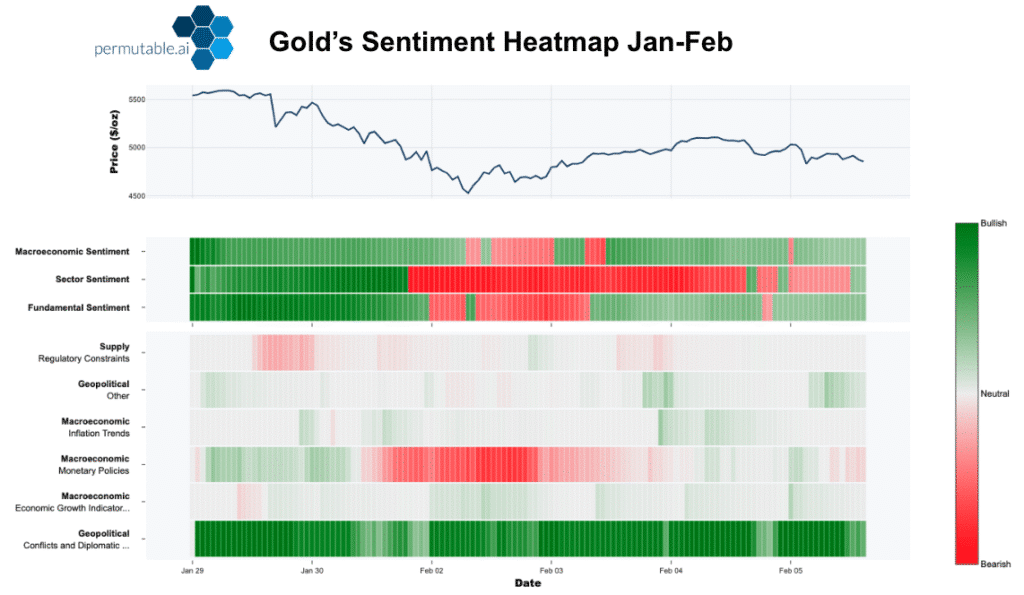
Late January shows a firmly bullish set-up, with Sector Sentiment deep green across both metals. The break came when Monetary Policy sentiment flipped decisively bearish and forecast signals turned alongside narrative. That mix is usually what you see when momentum hands over to forced de-risking: price leads, and the story catches up later.

Silver: leverage out, conviction gone

Silver heatmap 2026

Silver shows the cleanest liquidation signature. Late January is a classic crowded build, with Sector Sentiment deep green into stretched highs. The tell came when that pattern snapped: Monetary Policy flipped bearish, forecast signals turned red, and the driver stack shifted from trend to mechanical risk.

That regime change aligned with the move lower. A timely short signal captured the slide from roughly $104 to $85 as leverage was forced out. Even as price stabilised, sector and fundamental sentiment stayed bearish, which is typical of liquidation events where positioning clears first and conviction repairs later.

Silver remains the higher-beta expression. Its thinner liquidity and more flow-driven holder base amplify both drawdowns and rebounds, so it usually needs stabilising flows before a bounce becomes a durable trend.

Gold: Mapping the sentiment drivers

Gold heatmap 2026

Gold shows a cleaner and more orderly reset. Sector sentiment also turned bearish during the drawdown, but the underlying narrative stabilised more quickly. Fundamental Sentiment faded back towards neutral sooner, and geopolitical themes remained more consistently supportive.

This reflects gold’s deeper liquidity and stronger structural base. While it is not immune during indiscriminate de-risking, it tends to recover narrative support more quickly once forced selling subsidies.

The short lived rebound

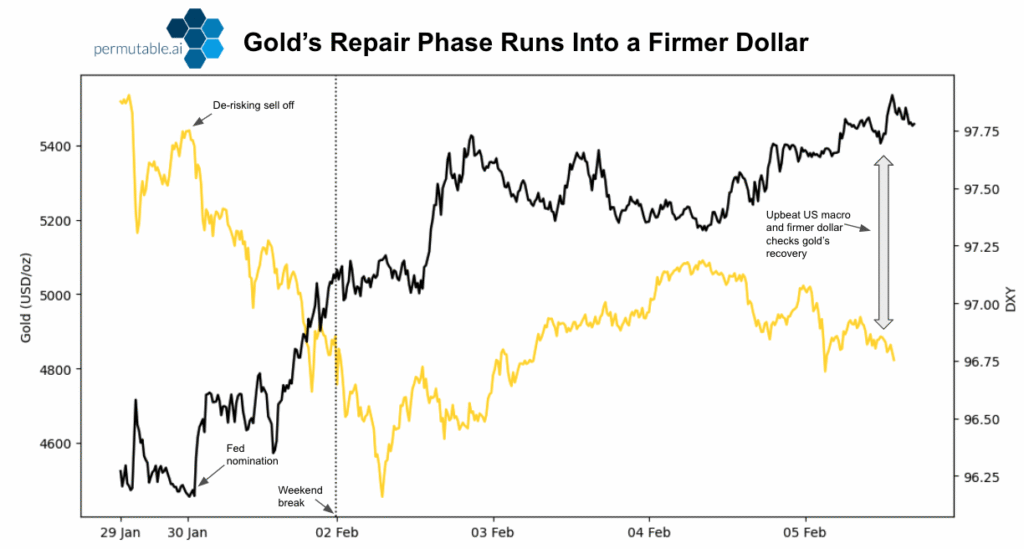
As of 5 February 2026, the rebound has already started to leak. Gold is back around $4,896/oz and silver has slipped to roughly $78/oz. The driver is familiar: the dollar has firmed again and real yields have edged higher, which is a clean headwind for non-yielding metals. Rates markets have also dialled back the punchiest 2026 Fed-cut pricing, so the “easy Fed” tailwind that carried January’s surge looks less dependable in the near term.

That matters for how we read the bounce. The 2 to 4 February move was violent in speed, gold from roughly $4,500 to about $5,100, silver from around $72 to $90, but it never quite felt like a new wave of conviction. It looked like a plumbing-led snapback: short covering, dip buying, and relief once liquidation pressure cleared, rather than a fresh regime that could survive a renewed push in the dollar and real yields. Today’s giveback is the market telling you as much.

The heatmaps are consistent with that sequencing. During the rebound, the heavy bearish blocks in policy and sector themes faded towards neutral, with a few pockets turning light green. That is repair and consolidation, not a fully rebuilt bullish regime. The worst of the bearish phase now sits in the rear-view mirror but has not yet dissipated. The next leg hinges on whether metals can re-anchor to the structural drivers that powered the rally, or whether we slip into headline-driven churn where front-end repricing keeps tightening the screws.

For now, our sentiment intelligence points to a clearing of positioning rather than a break in the macro regime, with the heatmaps showing repair in the underlying drivers that fed the rally, even if confidence has yet to fully return. That is the central tension in the precious metals outlook.

What still matters

For gold, the correction does not read as a break in the core macro story.

Safe-haven demand remains relevant in a noisy policy environment and strained geopolitics. A key structural pillar also remains in place: sustained central bank accumulation. Since 2021-22, reserve buying has helped anchor the market, driven by hedging, reserve diversification and security considerations.

Those flows tend to be strategic rather than price-sensitive, providing a medium-term floor even when speculative positioning turns.

Gold now trades on two clocks. The slow clock is structural: central bank buying, geopolitical hedging, portfolio diversification. The fast clock is mechanical: margin requirements, real yields, dollar sensitivity, and positioning flows. When the fast clock runs hot, the structural story can get drowned out. But it does not mean it has disappeared.

US Macro and the dollar regain control

The inverse relationship between precious metals and the US dollar has reasserted itself, but the more direct lever is real yields.

When front-end rates are repriced higher, real yields rise and the carry disadvantage of holding gold becomes more acute. When rate expectations soften, that pressure eases, the dollar often follows, and precious metals regain breathing room.

Until the rates channel stabilises, rallies are likely to remain sharp but fragile. That is a key operating constraint for the precious metals outlook 2026.

Precious metals market outlook 2026: What to watch

Volatility is likely to remain elevated as markets digest the positioning reset. Absent a genuine macro break, the move still looks corrective rather than structural.

Assuming the dollar pauses and volatility compresses over the coming sessions, the next leg will hinge on three signals. First, the direction of the U.S. dollar, closely tied to front-end repricing. Real yields remain the primary lever. If rate expectations stabilise, pressure on non-yielding assets eases; if they drift higher, the carry disadvantage quickly reasserts itself.

Key event risk

The U.S.-Iran meeting on 5-6 February is the main geopolitical catalyst. A credible de-escalation would ease the risk premium and trim the haven bid in gold. A breakdown would do the opposite, pulling haven demand back in and lifting volatility.

The base case remains rebuilding, not resumption. Gold looks closer to stabilisation. Silver remains in repair mode and is likely to stay the more tactical, higher-beta expression until sentiment and flows catch up with price.

Gaining edge through real-time market sentiment

For clients navigating a headline-driven precious metals regime, the edge comes from measuring narrative shifts early and consistently. Our real-time market sentiment signals track monetary policy, FX, positioning and deliverability narratives across gold and silver, helping distinguish when a move is being carried by macro, when it is being carried by flow, and when mechanical stress begins to dominate.

They separate stabilisation from genuine improvement by showing whether conviction is strengthening ahead of price action or slipping behind it. For asset allocation, they act as an early warning for regime shifts: is precious metals still a structural story, or now a tactical, positioning-driven trade?

Explore our precious metals market sentiment intelligence and request institutional access to our real-time intelligence feeds and API at enquiries@permutable.ai

Industrial metals industry trends: what sentiment intelligence is signalling for global markets in 2026

This article analyses industrial metals industry trends using Permutable AI’s sentiment intelligence, highlighting how supply risk, policy costs, China-led narratives and volatility are reshaping global metals markets in 2026. It is aimed at executives, analysts, strategists and procurement leaders seeking data-driven insight into market dynamics beyond traditional supply-demand models.

Industrial metals markets are entering 2026 with a familiar but intensified pattern: broadly constructive pricing, frequent volatility, and rapid re-pricing driven by headlines rather than slow-moving fundamentals. Using our sentiment intelligence across lead, aluminium, iron ore, steel, copper and tin, this article outlines the industrial metals industry trends shaping global markets – and what they reveal about risk, opportunity and market structure across sectors.

The core insight from our recent industrial metals sentiment signals is clear. Price direction alone is no longer the most important variable. Instead, how quickly markets react to new information – and how fast sentiment flips from risk-on to risk-off – defines current industrial metals industry trends.

A market shaped by risk narratives, not smooth cycles

One of the defining industrial metals industry trends is the dominance of event-driven pricing. Across nearly every major metal, sentiment has been repeatedly influenced by clustered disruption narratives: operational suspensions, permit reviews, export restrictions, weather impacts, logistics breakdowns and geopolitical escalation. These events do not need to permanently alter supply to move markets. The risk that supply could be disrupted is often enough to trigger aggressive buying, short covering and technical breakouts.

What follows is just as important. Once the immediate headline impulse fades, markets often shift rapidly into profit-taking and consolidation. This pattern – fast repricing, followed by retracement – has become structural. It reflects a market environment where market participants are highly sensitive to downside risk and reluctant to carry large unhedged exposure.

From a sentiment perspective, this tells us that volatility is not an anomaly within current industrial metals industry trends. It is the operating condition.

China’s role as a sentiment accelerator

Another recurring feature across iron ore, aluminium, copper and tin is the outsized influence of China-related narratives. Even when underlying demand indicators are mixed, sentiment often turns sharply more bullish when headlines reference stimulus, restocking, supportive policy signals or stronger onshore futures performance.

This does not always reflect immediate physical demand. Instead, it reflects expectation formation. Market participants price in future consumption, tighter balances or improved liquidity conditions long before those changes are visible in trade data.

Within current industrial metals industry trends, China functions less as a single demand centre and more as a sentiment transmission mechanism. Moves in Chinese futures or policy commentary can quickly ripple through global benchmarks, reinforcing rallies or stabilising pullbacks across the entire complex.

Steel and iron ore: cost floors and structural friction

Steel-related sentiment highlights the growing complexity of industrial metals pricing. While demand signals remain mixed, prices have been repeatedly supported by upstream input costs, regulatory uncertainty and energy dynamics. Iron ore sentiment has remained relatively balanced, but persistent restocking narratives and episodic supply risk have helped maintain a price floor.

A key industrial metals industry trends insight here is the decoupling between demand softness and price collapse. Even when end-market indicators weaken, structural cost pressures – energy pricing, emissions costs, logistics constraints and trade policy – can prevent rapid downside adjustment.

This suggests that industrial metals markets are increasingly cost-anchored rather than demand-led. For market  participants, this changes how downside risk should be assessed: falling consumption does not automatically translate into falling prices if supply economics remain constrained.

industrial metals trends 2026 - steel

Aluminium: policy premia meet supply uncertainty

Aluminium sentiment over the past month has reflected a persistent tension between near-term tightness and longer-term capacity expansion. Outages, geopolitical risk and compliance-related costs have repeatedly pushed sentiment higher, while announcements of rising output and regional demand softness have capped momentum.

This balance is emblematic of current industrial metals industry trends. Markets are simultaneously pricing scarcity risk and future abundance. The result is narrow but elevated trading ranges, with sharp intraday moves driven by news flow rather than structural rebalancing.

Importantly, aluminium highlights how policy and energy considerations are now embedded in metals pricing. Compliance costs, carbon frameworks and power market volatility are no longer peripheral – they are active sentiment drivers that influence how supply risk is perceived.

Copper: structural tightness and the scarcity narrative

Copper sentiment has increasingly coalesced around a structural tightness theme. Mine disruptions, labour actions, low visible inventories and constrained physical flows have reinforced a scarcity narrative that repeatedly attracts buying interest. While macro uncertainty and rate sensitivity still generate corrections, these pullbacks tend to be shallow when supply concerns remain unresolved.

Among current industrial metals industry trends, copper stands out as the clearest example of how long-term structural stories coexist with short-term volatility. Sentiment oscillates, but the underlying narrative of constrained supply and strategic importance remains intact.

This dynamic is instructive beyond copper itself. It shows how markets can tolerate near-term demand uncertainty when longer-term supply risk is perceived as credible and persistent.

industrial metals trends 2026 - copper

Lead and tin: volatility at different scales

Lead and tin illustrate how industrial metals industry trends play out across both mature and niche markets.

Lead sentiment has been driven by supply disruption narratives and cross-metal momentum, while also carrying forward-looking concerns about potential oversupply from new projects. This creates a market that is constructive in the short term but cautious in its medium-term outlook – another example of sentiment balancing immediate risk against future supply responses.

Tin, by contrast, has been dominated by extreme volatility. Regulatory enforcement risk, permit uncertainty and sharp moves in Asian futures markets have repeatedly driven outsized price swings. While tin represents a smaller volume market, its behaviour underscores a broader industrial metals industry trends lesson: thin liquidity plus policy uncertainty equals amplified moves.

What these industrial metals industry trends reveal about market structure

Taken together, the sentiment signals across metals point to three structural characteristics shaping global markets:

  1. Headline sensitivity is high. Markets react quickly to new information, even when the fundamental impact is uncertain.

  2. Positioning matters more than conviction. Short covering, fund flows and futures dynamics amplify moves in both directions.

  3. Policy and cost frameworks are structural drivers. Energy, carbon and trade regulation are now core components of price discovery.

These industrial metals industry trends suggest a shift away from slow, inventory-driven cycles toward a more reflexive market, where perception of risk often moves faster than physical balances.

Looking ahead: managing uncertainty, not predicting direction

The most important insight from Permutable AI’s sentiment intelligence is not a single price forecast. It is the recognition that volatility itself is the signal. Industrial metals industry trends in 2026 are defined by rapid sentiment shifts, layered risk premia and the constant interaction between supply narratives, policy frameworks and global macro signals.

For market participants across sectors, success will depend less on calling tops or bottoms, and more on understanding why markets move when they do—and how quickly sentiment can change. In a world where industrial metals industry trends are shaped by risk perception as much as reality, intelligence and adaptability have become the most valuable inputs of all.

Permutable AI’s sentiment intelligence tracks industrial metals narratives in real time – surfacing supply risk, policy shifts and demand signals as they emerge. 

Turn market noise into actionable metals intelligence

 If you’d like to test how this intelligence can sharpen your market awareness and decision-making, get in touch with our team at enquiries@permutable.ai to arrange a walkthrough.

Silver market outlook 2026: December’s squeeze and the silver lining

In this article, we look at silver’s early December breakout and what truly carried prices to fresh highs, with the silver market outlook 2026 firmly in view. A softer dollar and easing rate expectations helped light the fuse, but the more revealing story sat in the market’s plumbing. Deliverability, margin discipline and a rapid repricing of risk set the pace, while lease rates and physical tightness did much of the heavy lifting behind the scenes.

Through late autumn, silver mostly traded as higher beta gold. Same direction, bigger swings. The break above $60 changed that framing. Spot jumped more than 4% to $60.74 on 9 December, then pressed towards $66 by 17 December. Year to date gains moved into triple digits, north of 110%, alongside a run of record intraday highs.

What shifted was not only the price, but the crowd around it. Sentiment built into late November across macro, supply and demand narratives. Price action had been choppy, then the tone turned decisively constructive in recent weeks. Fundamental and sector sentiment held a consistent bullish bias, and price followed, accelerating as conviction tightened around the themes that pushed the market through $60 and into the mid-$60s.

Silver sentiment
Bullish sentiment in demand, supply, and macro themes clustered into early December, lifting silver through $60 as fundamentals, sector, and forecast signals stayed firmly supportive.
Key sentiment drivers: 

Macro tailwinds: A softer dollar and easing rate expectations lowered the hurdle for holding metals and pulled capital back into the precious metals complex.

Demand- led investment flows: Repeated surges in investment demand created a self-reinforcing bid, where a supportive backdrop attracted positioning, and positioning reinforced the move.

Microstructure and physical constraints: Sharp sentiment spikes aligned with a market increasingly priced on deliverability and risk controls, where access and margin constraints mattered as much as direction.

Macro backdrop and regime change

For much of the year, silver played second fiddle to gold. The break above $60 ended that relationship and marked a shift from range-bound trading to clear directional conviction. One useful measure of that change: the gold-to-silver ratio, which compressed materially through the year, falling back toward levels last seen earlier in the cycle after peaking above 100.

The ratio rose into April-May as gold outperformed, then trended steadily lower through the second half of 2025. By mid-December it had fallen to the mid-60s, signaling a sharp late-year phase of silver outperformance. Silver stopped being in the passenger seat and started steering the wheel.

gold silver ratio
The gold-to-silver ratio rose into April-May (gold outperforming silver), then trended steadily lower through the second half of 2025. By mid-December it had fallen to the mid-60s, signalling a sharp late-year phase of silver outperformance versus gold.

Macro support and the cost of carry

December was the point where the macro backdrop stopped being background noise and started carrying the trade. The setup did not manufacture the rally, it loosened the risk brakes and gave traders room to press on.

The Federal Reserve’s quarter-point cut on 10 December lowered the opportunity cost of holding bullion and pressured the dollar. The baseline support eases and flows into precious metals to get breathing room. The labour data then tightened the narrative

US unemployment rising to 4.6% in November was not a recession signal, but it was enough to shift probabilities. It nudged markets towards a gentler policy regime, kept the dollar under pressure, and revived the appeal of hedges. A dollar index hovering near a two month low mattered because it improved the economics of dollar priced metal for non US buyers and reinforced the perception that the macro tide was turning, a key ingredient for the silver market outlook 2026. 

Silver’s outperformance versus gold also mattered, because a falling gold silver ratio became a visible signal of leadership, and leadership tends to attract incremental allocation.

Investment flows and reflexivity

With macro conditions supportive, flows dictated the next leg. Silver-backed ETFs added about 590 tonnes in a short window, lifting total known holdings to roughly 845 million ounces by 10 December. In a market where annual mine supply runs around 800 million ounces, that matters. It tightens the balance and can turn a rally into a squeeze.

In tight markets, the dynamic becomes reflexive. Inflows lift prices, higher prices draw more participation, and pullbacks become harder to sustain. Options markets tell a similar story. Upside interest has strengthened, protection has become more dear, and positioning looks increasingly crowded, consistent with a market being squeezed whilst still paying up for immediacy.

Industrial demand provides a floor

Short-term price action can be volatile, but it rests on an industrial foundation that’s increasingly difficult to dismiss. Solar remains one of the strongest pillars, with photovoltaics accounting for roughly 30% of industrial silver demand today, up from about 10% a decade ago. Installed solar capacity has grown more than tenfold, yet solar-related silver demand has only tripled, reflecting efficiency gains rather than declining end use. The growth rate in installations is expected to moderate as China’s build cycle matures, but the floor remains intact.

Additionally, green tech and electrification continue adding layers of durable demand. EV production rose from about 3% of global light vehicle output in 2019 to around 20% in 2024, with EVs using materially more silver than combustion vehicles. The buildout of data centers also continues lifting demand for power infrastructure and high-conductivity components, with global capacity rising from roughly 1GW at the turn of the century to around 50GW today.

On the supply side, the constraint is time. The market is running a fifth consecutive year of deficit, with the 2025 shortfall projected around 117 million ounces. Around 70% of silver output comes as a byproduct of copper, lead, and zinc mining, which limits the speed of any price-led response. Even at high prices, mined output tends to drift rather than surge, constrained by declining ore grades and a thin pipeline of new projects. This slow supply response remains a defining factor heading into 2026.

Exchange margins and the repricing of risk

The mid-month pullback was largely mechanical. Exchanges raised the cost of carrying risk.

Shanghai widened the daily price limit to 15% for its February 2026 silver contract and lifted margins to 16-17%, effective 12 December. COMEX raised initial margins from $20,000 to $22,000 per 5,000-ounce contract. These changes don’t alter supply or demand, but they force traders to post more cash to maintain exposure.

In a crowded rally, that acts like a leverage squeeze. Higher margins prompt deleveraging, and stretched positions cut risk quickly. Silver fell from around $64.64 to roughly $61.70 before steadying. What mattered next was the rebound. By 17 December, futures were back around $66. The market absorbed a higher cost of risk and still held the new range.

Physical tightness and the  access issue

The most significant shift in December was the market’s move from trading direction to trading availability. When that happens, the relevant question isn’t only where price clears, but whether physical bullion can actually be sourced.

This year’s tightness carried a geographic signature. Tariff uncertainty and precautionary positioning pulled metal toward the US, and for extended periods COMEX futures traded at a premium to London benchmarks. When that spread persists, it incentivizes movement, drains accessible pools of inventory, and leaves remaining stock more encumbered. London, still the central hub for clearing and custody, felt that pressure most directly.

The effects travelled. As metal was redirected to relieve pressure points, inventories in other hubs tightened too. Chinese exchange warehouse stocks fell to their lowest levels in years, with a surge in exports in late autumn helping rebalance flows. When tariffs and physical shortages become even a plausible risk, the market starts pulling forward logistics, and the tightness becomes self-reinforcing.

That’s why lease rates matter. Widely circulated figures suggested millions of ounces were claimed for delivery in early December. One-month silver lease rates pushed towards 6.70% in mid-December, from typical levels near 1-2%. That’s the market putting a premium on access to metal now, not later.

Deliverability stress tends to amplify volatility. Big tech and industrial giants are now looking to bypass exchanges and go straight to the mines in order to acquire silver as participants want to avoid paying a premium for physical availability. The premium can compress quickly when conditions normalize, but while it persists it embeds a tightness into the front end and reinforces a higher volatility regime.

Policy shifts and a widening demand base

Policy matters here less as a daily driver and more as a structural long-term force. India’s pension framework now permits exposure to gold and silver ETFs within National Pension System schemes, up to 5% of scheme assets as of 10 December. Allocations will be gradual, but the pool of long-duration holders expands meaningfully.

The US decision to add silver to its list of critical minerals in November also contributes to a reframing of silver’s role in technology and defense supply chains. It encourages investors to see silver not only as a cyclical metal but as a strategic input. When a metal is treated as critical, policy can shift from neutral to interventionist faster than the market expects, and that alone can change inventory behavior.

Silver market outlook: Key signposts for 2026

Silver now trades with two clocks. The slow clock represents long-term support from industrial demand and constrained supply. The fast clock is microstructure, positioning, and deliverability.

Three signposts matter most heading into 2026. The Fed’s path and the dollar, whether deliverability signals persist, and whether the market can keep absorbing higher costs of risk without breaking the new range. A fourth is straightforward. Watch the gold-to-silver ratio. When it compresses, silver isn’t just following, it’s leading precious metal conversation.

Volatility will persist

Silver looks supported, but the path won’t be smooth. Macro tailwinds remain constructive and industrial demand provides a floor. Yet tighter margin conditions, policy uncertainty, and periodic deliverability stress mean pullbacks will be sharp when they arrive.

The market has moved into a higher volatility equilibrium where direction and access are repriced simultaneously. The practical question isn’t whether silver can trade higher – it’s the path it takes, and how much is driven by macro conditions, flows, or physical availability.

The primary risk sits on the industrial side. A sharper global slowdown, particularly in electronics and manufacturing, would cool momentum and test how much of the bid is truly structural. At elevated price levels, demand destruction isn’t theoretical, it’s the mechanism that ends the most confident narratives.

Whilst the pace of gains seen this year may not be sustainable, overall we expect silver prices to remain well-supported amid resilient industrial demand, constrained supply growth, and a more favourable macro environment.

Gaining edge through real-time market sentiment

For clients looking to navigate this regime with more discipline, the edge comes from measuring narrative shifts early and consistently. Our real-time market sentiment signals track the policy, supply-chain and industrial-demand narratives across metals, helping distinguish when a move is being carried by macro, when it’s being carried by flow, and when it begins pricing deliverability stress.

Explore our precious metals market sentiment intelligence and request institutional access to our real-time intelligence feeds and API at enquiries@permutable.ai

7 reasons we’re the best AI data analytics platform for commodity trading

This article shows how our real-time AI turns global news flow into tradable insight across energy, metals, and agricultural markets – designed for institutional desks looking to enhance decision-making and timing.

In today’s volatile commodity markets, speed, context and foresight define success. Traditional data models and delayed indicators struggle when Brent reprices on sanctions within hours, grain markets swing on trade détente, or Henry Hub reacts to a single storage print. At Permutable AI, we’ve built an AI data analytics platform for commodity trading that connects global narrative data to real trading decisions – the same intelligence behind our work on Brent, grains, gas, precious and industrial metals.

Here are seven ways that intelligence shows up in practice, using recent market regimes as concrete examples.


1. Turning unstructured global data into actionable market intelligence

Every day, billions of data points emerge across news wires, policy documents, local-language media and specialist sources. Our platform ingests this unstructured flow and converts it into structured, time-stamped, asset-aware intelligence.

In Brent crude, the system picked up the tightening effect of new sanctions on Russian majors, shipping and insurance constraints, and longer trade routes well before those concerns were fully reflected in consensus balances. That is why our Trading Co-Pilot flagged a bullish turn as sanctions pushed immediacy premia higher, even while aggregate supply still looked comfortable on paper.

In agricultural markets, the same framework tracked the October soybean and wheat rally. It detected early relief in Washington-Beijing trade rhetoric, renewed Chinese liftings and improving tender activity, allowing the platform to recognise a genuine demand and policy shift before the price move was fully visible on the screen.

By transforming narrative “noise” into structured commodity intelligence, traders gain a clearer real-time view of what is actually driving each market.

Market Sentiment In Action: Brent Crude Oil Rallies Following US Sanctions on Russia

2. Multi-entity sentiment for deeper market understanding

Commodities move on context, not just headlines. Our multi-entity sentiment engine measures who is speaking, what they are speaking about and which asset is affected.

During the grain rally, the models distinguished between improving sentiment around US-China trade policy, more cautious sentiment on global demand, and still-benign supply conditions. That allowed the system to categorise the move as a demand and policy-led repricing rather than a classic supply shock.

In precious metals, our analytics separated safe-haven narratives – US fiscal risk, geopolitics, central-bank buying – from risk-on narratives tied to an improving macro tone and tentative US–China thaw. That split is why the system could interpret October’s pullback in gold and silver as cooling risk appetite and profit-taking at elevated levels, rather than a collapse in the longer-term thesis.

This level of entity and topic awareness is central to AI for commodity trading: traders see which narrative is moving and how it relates to specific assets, not just a single aggregated score.


3. Real-time event detection across oil, gas, metals and ags

Timing is critical. Our event-detection engine looks for narrative patterns that historically precede price moves, rather than reacting to isolated headlines.

In Brent, the platform detected the accumulation of sanctions announcements, insurer comments, tanker route changes and shadow-fleet scrutiny that together signalled a logistics-driven tightening at the front of the curve. As these references built up, our Trading Co-Pilot turned bullish before the rally accelerated and time spreads fully reflected the shift in risk premia.

In gas and LNG, the system tracked stronger US export loadings, smaller-than-expected storage builds and colder early-season forecasts that supported Henry Hub, while at the same time it observed comfortable European inventories, reliable Norwegian pipeline flows and strong wind generation weighing on TTF. That combination led to a bullish bias in Henry Hub and a cautious, well-supplied tone in TTF, with storms and political headlines treated as short-lived noise rather than a structural change.

In the aluminium market, the event layer picked up signals around power constraints, policy caps on Chinese capacity, cancelled LME warrants and rising scrap tightness. Together, these pointed to a quiet but genuine physical squeeze which later expressed itself in firmer prices and stickier premia.

These are examples of how AI-driven event detection can surface regime change early across sectors and geographies.

Market sentiment in action: Henry Hub rally

4. Built to enhance – not replace – human expertise

We see AI as an augmentation layer for human decision-making, not a substitute for it. Our platform is designed to slot directly into the workflows institutional teams already use – whether that’s a trader watching intraday conditions in the UI, an analyst receiving narrative-shift alerts in real time, or a quant pulling structured sentiment data through the API into models and dashboards. 

The goal is not to automate judgment, but to strengthen it: giving users earlier context, clearer explanations and cleaner signals so they can validate house views, challenge assumptions, and act with greater confidence. By integrating seamlessly across research, execution, and risk processes, our intelligence becomes part of the workflow rather than an external tool to consult – enhancing conviction without ever dictating decisions.


5. Transparent, explainable AI

Explainability is essential, especially where model risk and governance matter. Every sentiment reading and forecast in our system can be traced back to topics, sources and time windows.

For Brent, clients could see a clear chain: sanctions headlines, shipping and insurance stress, a shift in topic-level sentiment, alignment across Fundamental and Macro layers, and finally the Forecast turning bullish. The narrative made sense: prompt tightness driven by logistics and compliance rather than an unexpected collapse in global supply.

In precious metals, the system showed Fundamental, Macro and Sector sentiment remaining broadly constructive, reflecting policy and structural demand, while the Forecast layer flipped bearish as risk appetite improved and the dollar firmed. This helped clients distinguish a tactical correction from a break in the long-term regime.

For aluminium, the explainable layers showed why prices were firming even as headline inventories rose: cancelled warrants, resilient regional premia, power-policy enforcement and stressed scrap markets provided a more accurate picture of physical tightness than the surface-level stock data.

Ultimately it is this level of explainable AI for commodity trading that builds the trust desks need to use these tools in real size and across governance-sensitive processes.

Market sentiment in action: Golds ascent

6. Cross-commodity insights and predictive patterns

Commodity desks rarely operate in silos. Our AI engine links narratives and sentiment across oil, gas, metals and agriculture, mapping how shocks propagate and where they might surface next.

When sanctions tightened Russian crude flows, the system highlighted knock-on effects into freight and VLCC rates, refined products such as gasoil and gasoline, and broader inflation and policy narratives that later supported gold. As Washington-Beijing trade risks eased, it picked up improving sentiment in soybeans and wheat, a moderation of safe-haven demand in precious metals, and shifting macro narratives around tariffs and growth.

In gas and LNG, the balance between strong US exports and comfortable European storage informed our broader view on energy-linked inflation and industrial power costs – a critical backdrop for power-intensive metals such as aluminium. The same intelligence that tracked the Henry Hub versus TTF divergence also helped frame the Q4 aluminium squeeze and the evolving cost floor for smelting.

By running a unified AI data analytics platform for commodity trading, we help clients connect these cross-market signals in a systematic way, instead of relying solely on fragmented anecdotal insights.


7. Proven impact in live trading, not just theory

We deploy our own models in live markets. Our AI data analytics platform underpins a systematic commodities strategy that has completed its first full year of trading, returning 20.6% with 7.3% volatility, a 4.4% max drawdown and a Sharpe ratio of 2.85, with low correlation to the S&P 500. The goal is not to make performance the story, but to demonstrate that these signals stand up when exposed to real risk, not just backtests.

The same building blocks that powered our calls on the sanctions-driven Brent rally, the October grain move linked to trade détente, the Henry Hub versus TTF split, the precious-metals correction at elevated levels and the aluminium Q4 squeeze are the inputs behind that strategy. Live trading creates a continuous feedback loop, allowing us to refine where reality diverges from backtest and to strengthen the robustness of our AI for commodity trading over time.


Experience, expertise and trust

We do not just ship models; we curate data, stress-test signals and work with practitioners across oil, gas, metals and ags to ensure the output is genuinely usable. Our datasets are version-controlled and auditable, our signals are explainable, and our use cases are grounded in real markets – from Brent and grains to gas, precious metals and aluminium.

Commodity markets move quickly, but with the right intelligence, traders can move faster and with more conviction. At Permutable AI, we are redefining what is possible in AI for commodities by turning real-time narrative flow into decision-ready insight. Whether you are managing risk, seeking opportunity or refining systematic workflows, our platform is built to give you a clearer view of the regimes you are trading.

To see how our AI data analytics platform for commodity trading can support your strategies, you can request a short demo or contact the team at enquiries@permutable.ai.