In a world where market-moving information travels at the speed of light, the difference between profit and loss often comes down to having the right intelligence at precisely the right moment. That’s where our Permutable Insights Weekly macro newsletter comes in – a weekly briefing of our real-time intelligence for institutional investors who refuse to let alpha decay cost them profitable opportunities.
Traditional macro newsletters follow a predictable pattern: they analyse what happened last week, offer commentary on established trends, and provide educated guesses about what might come next. But in today’s hyperconnected markets, by the time conventional analysis reaches your inbox, the primary positioning opportunities have often passed. Our redesigned macro newsletter operates on an entirely different paradigm – we reveal how our market intelligence surfaced the signals before they became consensus.
Over the past year, our 3000+ and growing subscriber base has had a ringside seat, being walked through how our live market intelligence called Bitcoin’s surge to record heights at $123,000 to the Iran-Israel conflict that drove Brent crude from $69 to $74 ahead of time. This has all been through our macro newsletter which has provided a lens into how our market sentiment intelligence has consistently identified inflection points hours – sometimes days – before traditional indicators caught up.
This was a key theme we explored in our recent newsletter editions, examining how oil and gas markets have begun moving not on inventory or consumption data, but on diplomatic signals, sanctions rhetoric, and regulatory alignment. As we highlighted to our subscribers, this represents a new regime shift where political risk now trumps traditional supply-demand narratives.
In our recent coverage, we walked subscribers through how our Trading Co-Pilot identified bullish momentum signals across WTI, Brent, and TTF, aligned with sudden changes in sentiment around sanctions, tariffs, and cross-border energy flows.
As we detailed in our recent newsletter analysis, geopolitical instability isn’t cyclical anymore – it’s systemic. Our 12-month Political Tension Index, which was featured in Trader’s Magazine, reveals deepening negative sentiment across global leadership narratives, trade policies, and regional unrest. Through our newsletter, we’ve shown subscribers how our real-time AI signals help front-run political shocks before they price in.
Our newsletter featured analysis of our Political Tension Index over the past 12 months, highlighting key global political flashpoints including US shutdown risks, tariff disputes, and high-profile leadership conflicts. As we explained to subscribers, this type of structured intelligence enables institutional investors to quantify political risk in real time and adapt strategies proactively.
The engine behind our macro newsletter is our proprietary AI-driven intelligence platform, powered by 22 distinct macro indices including our War Sentiment Index, Trade Sentiment Index, and Political Tension Index. These aren’t simple keyword-matching tools – they represent sophisticated LLM-driven systems that process thousands of articles daily, understanding context, evaluating source credibility, and weighing geopolitical significance with analyst-grade precision.
Consider our recent coverage of Sterling’s rally to 1.3740 against the dollar. While traditional FX analysis focused on interest rate differentials and economic data, our macro newsletter identified the narrative shift weeks earlier – processing divergent central bank communications and cross-referencing macro sentiment patterns that conventional analysis completely missed.

Our Insights Weekly operates on three core principles that distinguish it from every other macro newsletter in the institutional investment space:
Through The Lens of Our Intelligence: In every issue, we walk our readers through exactly how our Trading Co-Pilot saw what was happening in real-time, and more importantly, what was coming next – a perfect example here looking at the correlation between Fed rate cuts and Market Sentiment Volume which will be going out in next week’s newsletter.
Cross-Asset Signal Correlation: Modern markets don’t respect traditional sector boundaries. A supply chain disruption in Southeast Asia impacts European automotive stocks, copper futures, emerging market currencies, and high-yield credit spreads simultaneously. In our macro newsletter, we make light of these these interconnected signals, ensuring subscribers receive comprehensive intelligence rather than fragmented sector-specific alerts.
Actionable Implementation Guidance: In our macro newsletter, we also explore implementation pathways. Whether you’re managing systematic strategies, discretionary portfolios, or risk management frameworks, we provide the specific intelligence you need to translate signals into profitable positioning.
Our macro newsletter is fast becoming essential reading for portfolio managers at multi-billion dollar systematic funds, commodities traders at Tier 1 investment banks, and CIOs managing multi-strategy operations. Every edition of delivers comprehensive coverage across the themes that matter most to institutional investors. Recent issues have explored Bitcoin’s transformation from speculative asset to institutional treasury holding, Japan’s economic crossroads as political instability challenges its safe-haven status, and the systematic impact of trade sentiment on multi-asset portfolio performance.
But beyond individual market calls, our macro newsletter provides strategic intelligence on the evolving landscape of institutional investment management itself. From avoiding multi-asset alpha decay through real-time intelligence integration to understanding how AI-driven sentiment analysis is becoming standard practice for professional trading operations.
The financial markets of 2025 demand far more than traditional analysis can provide. Geopolitical tensions drive commodity volatility, central bank communications move currencies before policy changes, and narrative shifts determine asset allocation flows across global portfolios. Our macro newsletter provides the real-time intelligence infrastructure necessary to navigate this complexity successfully.
With 3000+ followers already relying on our market intelligence across LinkedIn, and institutional clients showing consistently growing appetite for our market events intelligence, our Insights Weekly is establishing itself as the essential macro newsletter for serious institutional investors.
Now the question isn’t whether AI-driven market intelligence will become standard practice – it’s how quickly you’ll integrate these capabilities into your investment process before your competitors do. Subscribe to Permutable Insights Weekly and discover how to transform uncertainty into actionable opportunity.

This article by Wilson Chan, Founder and CEO at Permutable AI explores LLM trading applications and specifically whether large language models can effectively simulate historical market conditions for trading strategies, aimed at quantitative analysts, macro strategists, and systematic trading teams considering AI integration in their workflows.
There’s a lot of noise out there about the power of large language models. Some say they’re set to reinvent everything from research to reasoning. Others believe they’re black boxes that have no place in trading or investment workflows. But there’s one question we’ve been discussing a lot here at Permutable HQ recently and it’s one I am sure has also been discussed equally by quants, macro strategists and systematic trading teams:
Can LLMs simulate the past — and should we be using them to do so?
As someone building LLM-trading applications for institutional use, I think the question is both the right one and the wrong one. Let me explain.
The core appeal of an LLM isn’t that it stores facts like a database. It’s that it learns the structure and relationships between ideas, entities, and events. That makes it incredibly useful for LLM trading applications such as surfacing patterns in how markets respond to macroeconomic events, geopolitical risks or even extreme weather.
But when it comes to simulating the past – for example, recreating sentiment dynamics during the 2008 financial crisis – we need to be cautious.
If your LLM has been trained on post-2008 commentary and news, and you ask it to simulate 2008 sentiment, what you may get is hindsight – not history. That’s not simulation. That’s leakage.
In systematic trading and macro analysis, we don’t just want to know what happened – we want to understand why it moved the way it did. This is where I believe LLM trading applications are extremely powerful, but underutilised.
At Permutable, we don’t use LLMs to reconstruct old data. We use them to extract dynamic relationships across thousands of entities in real time – currencies, commodities, macro indicators, regions – and track the sentiment landscape as it evolves. That way, we’re not guessing. We’re building explainable context around what’s moving and what it might signal.
Perhaps some think they can plug LLMs into their backtesting engines. It seems smart on the surface of things – until you realise the model “knows” things it shouldn’t. The results look good, but they’re meaningless. You’re not testing your strategy. You’re testing the model’s memory.
And while public LLMs are great for general research, in terms of LLM trading applications, they’re often unsuitable for financial simulation or decision support. Fundamentally this is because of four key reasons which are:
Their context window is limited
They lack market-specific grounding
Their output is variable, not deterministic
They hallucinate — especially on unfamiliar or niche domains
For regulated, high-stakes environments, that’s not just a limitation – it’s a liability.
Another decision many teams face when considering LLM trading applications is: do you build your own internal model, or work with a trusted partner?
Of course, building internally offers control – but it’s resource-intensive. You need data pipelines, prompt engineering expertise, monitoring systems, and constant tuning. And that’s before even addressing governance or explainability. By contrast, buying off-the-shelf tools can be faster, but often comes with trade-offs in customisation and trust.
At Permutable, we’ve built a middle path for LLM trading applications. We offer LLM-powered insights and multi-entity sentiment intelligence that’s ready for real use via our plug and play solutions — but with full transparency and customisation where needed. It’s the “build-quality” edge, delivered as a service.
Don’t try to use an LLM to re-run the past. Use it to help you interpret what you’re seeing now — and where the signal might lead.
That’s where the edge is. Not in recreating a news feed from ten years ago. But in understanding, in real time, how today’s news fits into the wider economic and market structure – and how that’s evolving. LLMs, when applied responsibly, are exceptional at mapping sentiment shifts, surfacing hidden correlations, and giving context to volatility. But only when you trust the source, the data, and the reasoning.
The world of finance doesn’t need more noise. It needs clarity. As we move deeper into this era of machine-led intelligence and LLM trading applications, the challenge for every institutional team is the same – how do we harness new technologies like LLMs without compromising on rigour, transparency, or performance?
That’s the question we’re building for every day at Permutable. And if you’re asking it too – let’s talk. Feel free to connect with me on LinkedIn and reach out via DM.
This article is a comprehensive comparison guide of leading sentiment analytics companies in the financial markets, aimed at institutional investors, traders, asset managers, and fintech professionals who are evaluating different sentiment analysis platforms to enhance their trading strategies and investment decision-making processes.
As markets become increasingly data-driven, sentiment companies are playing a central role in helping institutional investors, traders, and analysts extract timely insight from unstructured information. Whether it’s gauging reactions to central bank announcements or spotting early shifts in commodity prices, the best sentiment companies offer more than just a trend – they provide a critical edge.
But with a variety of platforms claiming to offer “AI-powered sentiment,” how do you know which solution is right for you?
At Permutable, we’re often compared to other leading sentiment companies. So we’ve compiled this guide to show how we — and they — stack up, using clear, honest comparisons to help you choose the best fit for your needs.
When evaluating sentiment companies for institutional use, several key factors separate the leaders from the pretenders. Here’s what serious buyers should prioritise:
Real-time, high-quality data feeds are non-negotiable for institutional traders and asset managers. Look for providers that offer comprehensive coverage across multiple asset classes, geographic regions, and data sources. The best sentiment analytics platforms process thousands of news sources, social media feeds, regulatory filings, and alternative data streams simultaneously, ensuring you never miss market-moving information.
Transparency in scoring methodology builds trust and enables proper risk management. Serious institutional buyers need to understand exactly how sentiment scores are calculated, what data sources contribute to each signal, and how the models handle edge cases or conflicting information. Avoid “black box” solutions that can’t explain their reasoning – regulatory requirements and internal risk frameworks demand explainable AI.
Different asset classes require specialised multi-entity sentiment approaches. Equity sentiment differs significantly from commodity sentiment, which in turn varies from FX or fixed income analysis. Leading sentiment companies develop distinct models for each asset class, accounting for unique market dynamics, participant behaviour, and information flows specific to that market.
Modern institutional workflows require seamless integration capabilities. Look for sentiment providers offering robust sentiment APIs, flexible data formats, and compatibility with existing trading systems, portfolio management platforms, and research tools. The best solutions integrate directly into your existing workflow rather than requiring analysts to switch between multiple platforms.
In today’s markets, milliseconds matter. Top-tier sentiment analytics platforms identify and score market-moving events within minutes – or even seconds – of occurrence. This speed advantage is crucial for systematic trading strategies, risk management, and capitalising on short-term market inefficiencies before they’re arbitraged away.
Institutional requirements vary significantly across firms, strategies, and use cases. The most valuable sentiment providers offer customisable models, adjustable sensitivity parameters, and the ability to create bespoke sentiment indices for specific investment mandates or trading strategies.
Here’s a breakdown of the sentiment companies that often come up in conversations with clients and prospects, including our own.
Best for: Institutional teams who need real-time, multi-entity sentiment tracking from news, macro events, and global data sources.
Why it works: At Permutable, we offer real-time data intelligence across thousands of entities – from commodities to equities and currencies – layered with contextual sentiment powered by proprietary LLM models. We don’t just say a news story is “positive” or “negative.” We identify the exact economic, geopolitical or environmental event, track its trajectory, and show you what’s shifting – and why.
Built for: Traders, asset managers, macroeconomic analysts, and fintech platforms who need speed, accuracy, and explainability.
Why people switch to us: Faster reaction time, richer context, and fully transparent scoring – all in a customisable, analyst-ready format.
Best for: Asset managers and financial services firms looking for thematic sentiment summaries.
Why it works: Alexandria uses natural language processing (NLP) to surface thematic trends across economic and financial narratives. They’re known for strong design and dashboard-based insights, with some ESG and macro overlays.
What’s the difference? Unlike Permutable, Alexandria tends to update sentiment in batches and has less focus on multi-entity correlation (e.g., how trade tensions in China affect copper, FX, and oil simultaneously).
Why companies switch to us: More detailed granularity, real-time responsiveness, multi-entity sentiment insights, and a broader range of event tagging.
Best for: Finserv teams who want NLP insights from financial news and social media.
Strengths: Good for surface-level signals and keyword trend detection, especially when integrated with traditional finance workflows.
Limitations: Typically lacks advanced contextualisation (multi-entity, macro linking), and leans more toward alerting than decision-making.
Why people consider Permutable instead: We offer more explainability, signal strength scoring, and use-case-ready insights for commodities, equities, FX, and global risk.
Best for: ESG and reputational sentiment analytics at the enterprise level.
Strengths: Strong reputation analysis across media sources, including litigation and controversy tracking.
Limitations: Less emphasis on real-time financial market movement, and limited in terms of intraday use by traders or quants.
Why Permutable appeals to traders: We focus directly on market-shifting data for commodities, equities, FX, macro indicators, and economic regimes — with explainable LLM-driven scoring.
Best for: Event extraction from earnings calls and corporate filings.
Strengths: Earnings-specific sentiment, risk flags, and KPI tracking from structured corporate data.
Limitations: Primarily focused on equities and structured disclosures, not broader market news or geopolitical developments.
Why Permutable is different: We cover macro shifts, economic sentiment, global crises, and their direct impact across sectors — not just earnings.
Best for: Quant desks and hedge funds integrating news sentiment into models.
Strengths: Long-standing credibility in quant finance, structured feeds for systematic strategy development.
Limitations: Less transparency around scoring, slower updates in volatile news scenarios, and less flexibility around customisation.
Why people are choosing Permutable instead: Our explainability, next generation technology stack, cross-entity analysis, and real-time signal sensitivity deliver a clearer, more accessible and less crowded edge.
| Company | Best For | Why It Works | Limitations | Why Companies Switch to Permutable AI |
|---|---|---|---|---|
| Permutable AI | Institutional teams needing real-time, multi-asset sentiment across equities, macro, commodities, and FX | Contextual, explainable sentiment across thousands of entities, powered by proprietary LLMs. Real-time updates, analyst-ready scoring, and cross-asset relationships — including equities, commodities, currencies, and global macro themes. | Not designed for traditional earnings call parsing; instead, focused on broader market dynamics and real-time multi-entity sentiment. | Clients switch for faster signal speeds, transparent scoring, and real-time event-based insights that integrate directly into macro, trading, and investment workflows. |
| Alexandria | Asset managers and financial services looking for thematic dashboards | Thematic sentiment analysis with ESG overlays and well-designed UI | Sentiment updates in batches, less correlation tracking across entities and slower responsiveness | Permutable offers more granular, real-time, and multi-asset sentiment with broader event tagging and macro mapping. |
| Accern | Financial services teams wanting basic NLP alerts from financial news and social media | Good for surface-level alerts and keyword trends across traditional finance content | Limited contextualisation, weak macro integration, and not ideal for actionable signals | Permutable provides deeper signal explainability, real-time sentiment strength, and use-case-ready insights across markets. |
| SESAMm | Large enterprises monitoring ESG, litigation, and reputational sentiment | Reputation analytics across media sources; strong in controversy tracking | Not tailored for traders or real-time market monitoring | Permutable appeals to financial teams seeking real-time sentiment that moves markets — not just reputational signals. |
| Amenity Analytics | Equity analysts extracting KPIs from earnings calls and filings | Corporate disclosure parsing with a focus on equity and KPI risk flagging | Limited macro, geopolitical, or cross-sector event tracking | Permutable enables broader economic sentiment mapping and market signal correlation across sectors — including equity news and market-moving themes. |
| RavenPack | Quant desks and hedge funds using structured feeds for model building | Structured news sentiment data for quant integration with long-standing industry presence | Lower transparency in scoring, slower to adapt to volatile events, limited flexibility | Clients choose Permutable for its modern architecture, transparent logic, and real-time multi-entity signal mapping across equities, commodities, currencies, and macro. |
Any sentiment company can put a “positive” or “negative” label on a headline. The real question is — does the signal come in time, and does it help you act? At Permutable, we have built and our continuously refining our technology with institutional decision-making in mind. Our LLMs decode relationships in real time between events, entities, and asset classes. Whether it’s interest rate divergence in Asia, LNG supply shocks in Europe, or droughts impacting commodity prices in Argentina, our models deliver insight that’s immediate, specific, and actionable.
We’re not a one-size-fits-all vendor. We’re a market sentiment partner – designed for teams who want to move faster, with confidence.
Explore some real-world applications of our market sentiment intelligence below:
Our narrative-driven energy indices have been used by commodity desks to detect sentiment-led shifts in oil and gas markets. For example, changes in OPEC-related narratives and geopolitical tensions in our indices aligned with subsequent crude oil price moves, providing traders with early warning signals to test alongside their existing models
Our Monetary Policy Sentiment Index has highlighted how dovish and hawkish narratives often precede Federal Reserve rate decisions. Institutional clients use this to anticipate potential pivots before they are priced into yields, improving their positioning around FOMC announcements.
Our Political Tension Index has shown that political volatility is no longer episodic but systemic, with trade disputes, elections, and leadership events triggering market stress. Hedge funds and risk managers use the index as an early-warning system to adjust exposure ahead of headline-driven shocks.
Our agriculture sentiment has been be applied to wheat and soybean markets, where drought and trade policy headlines shifted sentiment before supply-demand data caught up. For commodity traders, this has provided a forward-looking lens into pricing pressure.
Through our Trading Co-Pilot’s cross-asset sentiment, clients track how currency weakness (like the yen) or yield curve stress (like UK gilts) links directly to political or macro sentiment shifts. This offers quant researchers and risk managers structural context beyond price action alone.
Our clients have been switching to us because we offer what many sentiment companies can’t: real-time, explainable market intelligence tailored for today’s fast-moving, cross-asset trading environment and ultimately proven alpha. Unlike tools built for batch updates, equities earnings, or basic media alerts, at Permutable we deliver high-frequency, multi-entity sentiment insights mapped directly to macroeconomic trends, commodities and currencies, equities and geopolitical events. Our transparent scoring and domain-specific LLMs ensure that the institutional teams we work with – from macro strategists to commodities traders – get not only speed and scale, but also clarity and confidence in their decision-making. Simply put, we help you act faster and smarter, when it matters most.
Choosing the right sentiment company is about clarity, not features. It’s about who helps you see the signal, not the noise. At Permutable, we’re leading the next generation of sentiment companies by offering true data intelligence – and this is what alpha looks like.
Thinking of trying a new sentiment provider? Contact our team at enquiries@permutable.ai to discuss a demo or trial and experience first-hand how our sentiment data compares and discover why more trading desks are choosing data intelligence they can trust.
A: The best approach is to request historical backtesting data and pilot programmes that allow you to test sentiment signals against your specific use cases and trading strategies.
A: Implementation timelines vary significantly based on your technical requirements and integration complexity. At Permutable, basic API integrations can be operational within a matter of days. The most successful implementations involve close collaboration between your quantitative team and our technical specialists to ensure optimal configuration for your specific use cases.
A: Quality assurance should include multiple validation layers: source credibility weighting, cross-verification with market data, sentiment confidence scoring, and historical accuracy tracking. The best sentiment providers offer transparency into their data sources, allow you to adjust sensitivity parameters, and provide detailed attribution for each sentiment signal so you can understand exactly what’s driving the score.
Sentiment analysis can be particularly effective for commodities due to the significant impact of geopolitical events, weather patterns, and supply disruption news on commodity prices. The key is using providers with specialised commodity expertise who understand the unique drivers affecting different commodity markets.
The best providers use native language models rather than translation-based approaches, ensuring cultural nuances and market-specific terminology are properly captured. Look for providers with proven expertise in your target markets and languages, particularly for emerging market analysis.
The industry is moving toward more sophisticated contextual analysis, multi-modal data fusion and real-time explanation capabilities. Generative AI and large language models are enabling more nuanced understanding of complex financial narratives and cross-asset correlations.
Track metrics including alpha generation, risk-adjusted returns improvement, early warning system effectiveness, and operational efficiency gains. Many successful implementations show measurable improvements in Sharpe ratios, reduced drawdowns during volatile periods, and faster reaction times to market-moving events.
This article provides a comprehensive guide to leveraging structured newsflow intelligence for trading and investment decisions across multiple asset classes. It is aimed at institutional traders, portfolio managers, quantitative analysts, and financial institutions seeking to enhance their market intelligence capabilities.
Today’s institutional traders must navigate an avalanche of global newsflow that arrives at light speed from thousands of sources simultaneously. Every political tweet, central bank whisper, weather report, and economic data point now carries the potential to shift billions in market capitalisation within minutes. This information revolution has created a paradox: whilst traders have access to more data than ever before, their ability to process and act upon it has become the defining factor in competitive performance.
The central challenge facing today’s traders is not merely accessing information, but rather distinguishing actionable signals from the overwhelming noise that characterises contemporary newsflow. Political tensions escalate and de-escalate within hours, central bank communications shift market expectations in minutes, and natural disasters can trigger commodity price movements before traditional data sources even register the events. This information overload requires sophisticated analytical frameworks capable of processing, contextualising, and prioritising newsflow in real-time.
At Permutable, we address this challenge through structured newsflow intelligence that transforms market disruption into systematic advantage. In applying advanced natural language processing and machine learning algorithms to global market events, our clients are able to convert narrative developments into quantifiable risk metrics thanks to our suite of sentiment indicators and predictive signals.
Geopolitical events remain among the most challenging factors for systematic trading strategies, yet structured newsflow analysis has created new opportunities for professionals approaching these complex scenarios. Rather than relying on subjective interpretations of political developments, modern traders can now process vast streams of geopolitical newsflow through AI-powered sentiment analysis and risk quantification frameworks – which is the core of what we do at Permutable.
Consider the impact of evolving sanctions regimes on crude oil pricing. Traditional approaches might involve monitoring select news sources and making subjective assessments about escalation probabilities. However, structured newsflow intelligence enables traders to process thousands of relevant articles, official statements, and diplomatic communications simultaneously, extracting sentiment trends and risk indicators that provide quantifiable measures of geopolitical tension.
The sophistication of contemporary newsflow analysis extends beyond simple keyword detection to encompass contextual understanding, source credibility weighting, and temporal pattern recognition. When monitoring trade disputes, for instance, our system can distinguish between routine diplomatic rhetoric and genuinely escalatory language, providing traders with graduated risk assessments rather than binary threat indicators.
Central bank communications and fiscal policy announcements represent another key domain where structured news intelligence delivers substantial competitive advantages. The era of predictable policy cycles has given way to increasingly dynamic monetary environments where central bank surprises can trigger significant market movements within minutes of news announcement.
The professional traders we work with increasingly rely on newsflow overlays to enhance their interest rate and foreign exchange positioning strategies. When the Federal Reserve, European Central Bank, or Bank of England releases unexpected communications, structured newsflow analysis can immediately quantify the sentiment shift, assess the divergence from consensus expectations, and provide probability-weighted scenarios for subsequent policy actions.
The sophistication of modern newsflow processing extends to parsing the nuanced language of central bank communications, where subtle shifts in terminology can signal major policy pivots. Rather than requiring manual interpretation of complex policy statements, AI-powered newsflow analysis can detect these linguistic changes and translate them into actionable trading signals within seconds of publication.
Natural disasters present unique challenges for commodity traders, as their impacts often materialise faster than traditional data sources can capture. Structured newsflow intelligence has emerged as a vital tool for detecting early warning signals about hurricanes, droughts, floods, and other weather-related events that can significantly impact agricultural and energy markets.
For instance, the development of tropical cyclones affecting liquefied natural gas production facilities exemplifies how newsflow analysis can provide advantageous early warning capabilities. By processing meteorological reports, government communications, and industry updates in real-time, traders can anticipate supply disruptions before they impact pricing, enabling proactive rather than reactive positioning strategies.
This capability extends beyond simple event detection to encompass impact assessment and duration forecasting. When processing drought-related newsflow affecting agricultural regions, the system can evaluate historical precedents, assess severity indicators, and provide probability-weighted impact scenarios for affected commodity markets.
Macroeconomic data releases continue to drive significant market movements, yet the traditional approach of waiting for official statistics publication overlooks the substantial newsflow that precedes and contextualises these releases. Structured newsflow analysis enables traders to process employment reports, GDP announcements, and inflation data within broader narrative frameworks that enhance their interpretive value.
The monthly U.S. Non-Farm Payrolls release illustrates how newsflow intelligence can improve traditional economic analysis. Rather than simply reacting to the headline figure, traders can now process the weeks of preceding newsflow regarding labour market conditions, policy maker expectations, and economic commentary to better understand the release’s implications for monetary policy and market positioning.
This comprehensive approach to newsflow processing enables faster reactions than traditional data feeds whilst providing richer contextual understanding. When processing Consumer Price Index releases, for instance, the system can simultaneously evaluate the headline figures, underlying trends, policy maker responses, and market participant reactions to provide holistic assessment frameworks.
Rare synchronicity in contemporary markets where seemingly disparate asset classes move in unexpected harmony can create opportunities for sophisticated correlation analysis through structured newsflow intelligence. These periods of cross-asset alignment often emerge from shared underlying narratives that traditional statistical models struggle to capture in real-time.
The recent convergence observed across US Treasuries, high-growth technology equities, and institutional cryptocurrency flows exemplifies how newsflow analysis can identify emerging cross-asset relationships before they become apparent through price action alone. Federal Reserve policy newsflow doesn’t merely influence fixed income markets; it simultaneously affects technology valuations through discount rate implications whilst driving institutional crypto adoption as portfolio diversification strategies evolve in response to monetary policy shifts.
Advanced newsflow intelligence systems like our Trading Co-Pilot can detect these thematic connections by processing policy communications, institutional flow data, and sentiment indicators simultaneously across multiple asset classes. When central bank dovish rhetoric emerges, our system can immediately assess its implications for Treasury yields, technology growth multiples, and crypto institutional adoption rates, providing traders with comprehensive cross-asset positioning frameworks that transcend traditional correlation-based approaches.
The availability of extensive historical newsflow databases has opened new opportunities for systematic trading strategy development. Rather than limiting backtesting to traditional price and volume data, we now work with quantitative analysts who are incorporating years of structured newsflow to identify recurring patterns and develop predictive models based on narrative developments.
For example, historical analysis of fiscal policy newsflow can reveal consistent patterns where government spending announcements precede equity market volatility spikes. By incorporating these narrative-based signals into systematic strategies, traders can develop more robust predictive models that account for both quantitative and qualitative market drivers.
It is important to recognise that the sophistication of historical newsflow analysis extends beyond simple pattern recognition to encompass regime change detection and structural break identification. When macroeconomic policy frameworks shift, the relationship between newsflow and market reactions can change dramatically, requiring adaptive models that can identify and adjust to these transitions.
The five applications outlined demonstrate how institutional traders can leverage our newsflow intelligence to enhance their competitive positioning, whether through early warning systems for natural disasters, sophisticated analysis of monetary policy communications, or systematic exploitation of cross-asset correlation patterns. As financial markets continue to accelerate and information flows become increasingly complex, the ability to process and interpret news intelligence efficiently will increasingly determine trading success.
Ready to harness the power of newsflow? Request a demo of Permutable AI’s Market Events Intelligence Suite. Simply email enquiries@permutable.ai.
This article explores seven transformative AI applications in commodity pricing, aimed at energy traders, commodity analysts, and trading desk professionals and heads of trading innovation seeking competitive advantages through advanced market intelligence.
In today’s volatile global markets, commodity pricing has never been more unpredictable or challenging to navigate. The convergence of geopolitical tensions, supply chain disruptions, and accelerating energy transition policies demands sophisticated analytical tools that can process vast information streams and translate complex data patterns into actionable trading intelligence. Traditional approaches to commodity pricing analysis – whilst historically reliable – are proving increasingly insufficient against the velocity and complexity characterising modern energy markets.
For institutional traders operating across metals, energy, and agricultural commodities, the margin for error has narrowed considerably. Market movements that once developed over days now unfold within minutes, whilst interconnected global supply chains create cascading effects that traditional models struggle to anticipate. This environment necessitates artificial intelligence systems capable of detecting subtle patterns, processing geopolitical developments, and delivering real-time insights that enable proactive rather than reactive commodity pricing strategies.
In this article we’ll explore seven high-impact AI use cases reshaping commodity pricing and energy trading, with examples taken from our own technology and applications amongst our current clients.
The most critical advantage in commodity pricing lies in identifying market movements before they fully materialise. Recent market analysis demonstrates this principle effectively, with LNG markets experiencing dramatic shifts that rewarded early detection capabilities. Between June 10th and June 23rd, TTF benchmark prices surged from €34.85/MWh to exceed €42.02/MWh – a movement that AI-driven systems identified at optimal entry points around €36.16/MWh on June 12th.
This precision in commodity pricing signal detection stemmed from our advanced algorithms processing multiple data streams simultaneously, including government announcements supporting TotalEnergies’ LNG ambitions and Japanese backing for JERA’s strategic initiatives. Such developments conveyed lasting commitment from major consuming nations, providing the fundamental catalyst for sustained upward momentum in commodity pricing that traditional analysis might have missed until well after optimal positioning opportunities had passed.
Above: Our commodity pricing intelligence in action. Our AI detected optimal LNG entry at €36.16/MWh on 12th June, capturing the surge to over €42/MWh by processing real-time geopolitical developments and sentiment shifts that traditional commodity pricing models missed entirely.
Modern commodity pricing increasingly reflects geopolitical developments, with supply disruptions and regional conflicts creating immediate market impacts. The recent Iran-Israel tensions exemplify how AI systems like ours excel at processing political intelligence and diplomatic communications to assess potential commodity pricing implications before they manifest in market movements.
During the June escalation, energy sector sentiment scores registered between 0.9-1.0 across the board, reflecting pervasive market apprehension that translated into commodity pricing volatility. When ceasefire agreements emerged, LNG prices fell sharply – dropping over 10% to €36.14/MWh – demonstrating how geopolitical risk premiums directly influence commodity pricing mechanisms. Our AI systems processed diplomatic communications and conflict assessments enabling traders to position portfolios appropriately for both escalation and de-escalation scenarios.
Above: Brent crude oil sentiment analysis reveals optimal trading opportunities during geopolitical volatility. The chart demonstrates how AI-driven sentiment detection (blue bars) identified a crucial “Possible Entry” point ahead of significant price movements, with Brent prices (red line) surging during the Iran-Israel conflict period highlighted in the red-shaded area. This exemplifies how real-time sentiment intelligence enables traders to position ahead of geopolitical commodity pricing shifts.
Sophisticated commodity pricing strategies require understanding dynamic correlations between different benchmarks that shift based on macroeconomic conditions and geopolitical developments. The relationship between Brent crude, WTI, TTF gas, and Henry Hub natural gas creates complex arbitrage opportunities that AI systems such as ours can identify more effectively than traditional statistical methods.
Our recent AI-driven analysis reveals how these correlations evolved during energy supply disruptions, with traditionally independent commodity pricing mechanisms becoming increasingly interdependent. The Strait of Hormuz tensions, for instance, affected not only oil markets but created ripple effects across LNG flows and freight rates, demonstrating the interconnected nature of modern commodity pricing that AI systems capture through continuous correlation monitoring.
Market sentiment increasingly precedes fundamental supply-demand shifts in commodity pricing, making sentiment analysis a key component of modern trading strategies. The wheat market’s recent performance illustrates this dynamic perfectly, with wheat prices surging from below $560/Bu to $590/Bu – a 9.16% gain driven primarily by short-covering rather than fundamental supply changes.
Our AI systems identified this opportunity by detecting extensive short positioning alongside improving sectoral sentiment, including favourable renewable fuel proposals and increased wheat utilisation by beverage brands. These subtle signals, processed through large language models and machine learning algorithms, provided early warning of the impending short squeeze that traditional commodity pricing analysis might have overlooked until after significant price movements had occurred.
Above: Our advanced commodity pricing sentiment analytics in action. Our system identified the wheat short squeeze through sentiment analysis and positioning data, delivering 9.16% gains from $560/Bu to $590/Bu.
Agricultural commodities present unique challenges for commodity pricing due to weather dependencies, seasonal patterns, and complex supply chain dynamics. Taking again the example of our recent wheat market analysis, this demonstrates how AI-driven volatility models incorporate diverse data sources – from weather patterns to speculative positioning – to generate predictive insights that inform commodity pricing strategies.
The convergence of supply constraints, weather-related concerns across key producing regions, and renewed export dynamics created the conditions for the wheat rally. Our AI systems processed these multiple variables simultaneously, identifying the bullish setup before traditional analysis might have recognised the developing squeeze in commodity pricing that ultimately drove substantial gains for positioned traders.
The copper market exemplifies how our AI systems excelled at identifying structural supply constraints that traditional commodity pricing models might underestimate. Our recent AI-driven analysis revealed the drivers behind copper prices climbing from $4.82 to $4.91, including acute supply shortages and plummeting warehouse inventories that fell 80% year-over-year.
Here, our AI-driven analysis captured this dynamic by processing multiple supply-side indicators simultaneously: LME inventory declines, smelting bottlenecks reflected in collapsing treatment charges, and geopolitical developments affecting key producing regions. This comprehensive approach to commodity pricing analysis identified the structural nature of supply constraints that position copper favourably amongst industrial commodities for sustained upward pressure.
Above: Copper market tightness analysis showcasing our AI-powered commodity pricing intelligence in action. Our Trading Co-Pilot identified a sustained bullish regime supported by robust fundamental and sectoral sentiment indicators (green sentiment bars at bottom), with copper prices climbing from $4.82 to $4.91 amid supply crunch conditions. Key market events – from Bolivia protests to Chinese port activity surges – demonstrate how comprehensive sentiment analysis captures the complex drivers behind structural commodity pricing movements.
Ultimately, the effectiveness of AI-driven commodity pricing intelligence depends on seamless integration with existing trading infrastructure. Our enterprise grade API connectivity enables direct integration with trading desks, risk management platforms, and portfolio monitoring systems without manual intervention or data transfer delays.
This integration ensures commodity pricing intelligence flows directly into decision-making processes within familiar working environments. When geopolitical tensions spike or supply constraints emerge, trading teams receive instant value with our real-time updates on price signals, risk assessments, and market correlations through their established workflows, maximising the practical utility of our AI-driven insights for immediate trading decisions.
The integration of artificial intelligence into commodity pricing represents more than technological enhancement – it signifies fundamental evolution in how energy and commodity markets operate. As demonstrated through recent market examples across LNG, copper, wheat, and broader energy complexes, our AI systems consistently identify opportunities and risks before they become apparent through traditional analysis methods.
Consequently, energy and commodity trading professionals leveraging these capabilities position themselves advantageously in an increasingly dynamic commodity pricing environment. The question has evolved beyond whether AI will transform commodity trading to how quickly organisations can adapt their operational frameworks to harness these analytical tools effectively. Our clients who are already embracing this technological evolution are already reaping the benefits of superior performance in capturing commodity pricing opportunities whilst managing associated risks.
The evidence across recent market movements – from LNG’s geopolitical sensitivity to copper’s structural supply constraints – validates the transformative potential of AI-driven commodity pricing analysis. As markets continue increasing in complexity and information volumes expand exponentially, these analytical capabilities will doubtlessly transition from competitive advantage to essential infrastructure for successful commodity trading operations.
The world’s best commodity and energy trading desks are already capturing tomorrow’s opportunities with our AI-powered commodity pricing intelligence. The systematic advantages outlined above are available only to traders equipped with our next-generation market intelligence. Contact our team at enquiries@permutable.ai to see our AI-driven energy and commodity intelligence in action.
The story behind the copper market outlook in recent weeks has transformed dramatically, driven by escalating supply shortages and persistent demand that show no signs of abating. This supply crunch has propelled prices higher and created a distinctly bullish environment that our Trading Co-Pilot’s AI-driven analysis has accurately captured in real-time.
Copper prices have surged throughout June, propelled by an acute supply shortage with no signs of abating. The red metal’s upward trajectory has been pronounced, climbing from $4.82 on June 23rd to $4.91 the following day, before settling at $4.89 on June 25th. This rally reflects deepening market tightness caused by dwindling inventories and persistent structural supply constraints. The supply-demand imbalance has intensified over the past week , with rising demand forecasts amplifying the squeeze on available copper stocks. Our Trading Co-Pilot’s analysis confirms strong bullish sentiment underpinning these price movements, with the sustained upward pressure validating expectations of continued market momentum. The convergence of supply shortfalls and robust demand signals suggests this bullish trend may persist as the copper market remains stretched.

The most drastic evidence of copper’s supply crisis has emerged through collapsing warehouse inventories, creating scarcity that’s pushing the market into backwardation. This is by no means a temporary dip, but represents a fundamental shift toward critical shortage levels that are reshaping global copper market dynamics. The clearest sign of copper’s supply crisis emerged on June 23rd when London Metal Exchange (LME) inventories posted another sharp decline. Key indicators include:

The price spike reflects more than speculative trader interest and has had a compounding effect on an already tight supply situation:
Beyond the immediate inventory crisis, copper faces deeper structural fractures in its supply chain that threaten medium-term availability. The smelting sector, the crucial bridge between raw ore and refined metal, is experiencing unprecedented stress at treatment level as smelting fees collapse and capacity mismatches create systemic bottlenecks.
Beyond falling inventories, copper supply chain faces deeper structural headwinds:
While Chinese smelters show some positive developments it has amplified the supply bottleneck as mining output shortages persist causing a mismatch between smelting capacity and raw material output.
Global political developments continue to influence supply chains and the copper price outlook:
While supply constraints dominate headlines, copper demand continues to demonstrate remarkable resilience in the face of higher prices. This sustained appetite, particularly from key consuming nations, suggests the market’s tightness reflects genuine consumption strength to absorb the available metal at elevated price levels.
Copper demand has remained surprisingly resolute despite higher copper price outlook:
The copper market faces a deepening supply crisis that underpins a compelling bullish outlook. Rapidly depleting LME stocks, persistent smelting bottlenecks, and mining constraints have created acute market tightness, while global demand, driven by electrification and renewable energy transitions, remains robust despite geopolitical headwinds. Our Trading Co-Pilot captured this dynamic with strong bullish forecast and a “Buy” signal issued on June 24th, accurately reflecting positive sentiment across fundamental and sectoral indicators. Recent smelter disruptions and continued inventory drawdowns reinforce the structural nature of current supply constraints. While new mining projects promise eventual relief, their impact remains years away, leaving the market vulnerable to sustained tightness. With copper’s critical role in the global energy transition and limited near-term supply solutions, the fundamentals rank among the strongest in industrial commodities. The whirlwind of structural supply deficits and resilient demand creates a foundation for continued upward price pressure, positioning copper favourably amongst commodity market traders.
To explore how real-time commodity market sentiment data can enhance your trading strategies and risk models, contact us at enquiries@permutable.ai to request a tailored demonstration.
This article explores how Permutable is revolutionising market intelligence for elite trading desks through advanced AI and comprehensive macro trends analysis. Written for institutional traders, fund managers, and financial professionals seeking competitive advantages in energy markets and beyond.
By Wilson Chan, CEO and Founder, Permutable AI
It is perhaps stating the obvious that the financial markets have never been more complex, interconnected, or driven by the intricate web of macro trends that we’re seeing shape global economics. As the founder and CEO of Permutable, I’ve seen and heard firsthand how traditional market intelligence providers fall short when it comes to delivering the sophisticated, actionable insights that today’s elite trading desks demand. This gap in the market led me to build Permutable – a far cry from the legacy systems other market providers operate out of. We’re a next-generation market intelligence platform that doesn’t just track the news, but transforms it into actional trading advantages for systematic, energy and commodity traders.
In my view, most market intelligence providers operate in the stone age of data analysis. They offer basic article aggregation and rudimentary sentiment scoring, treating complex market dynamics as simple binary outcomes. This approach fundamentally misunderstands how macro trends actually influence trading decisions. Real market intelligence requires understanding the cascading effects of geopolitical tensions, monetary policy shifts, and supply chain disruptions – not just whether a news story is “positive” or “negative.”
At Permutable, we’ve architected our platform around three core pillars that set us apart from legacy providers. First, our News Intelligence engine doesn’t just aggregate stories – it identifies the precise moment of story breakout, provides sophisticated summarisation, and calculates genuine market impact on specific assets. Second, our Automated Market Insights generate comprehensive weekly roundups, perform deep price causation analysis, and deliver 24-hour forecasting that actually moves the needle for traders. Third, our Systematic Trading Support goes beyond basic backtesting to offer granular, hour-by-hour analysis across up to 10 years of historical data.
Understanding macro trends requires unprecedented breadth of information sources. While competitors rely on mainstream financial publications, Permutable monitors over 20,000 sources across global markets. This comprehensive coverage ensures we capture emerging macro trends before they become obvious to the broader market – providing our clients with the critical advantage of early detection across macro themes.
Our approach to data tagging exemplifies this sophistication. Rather than applying generic categories, we’ve developed specialised taxonomies for different asset classes. For our energy trading clients, this means fundamental tags that cover everything from price commentary and production levels to pipeline infrastructure and inventory dynamics. Our macro trends tagging system captures the broader forces that drive markets: export trade patterns, geopolitical tensions, sanctions regimes, Federal Reserve decisions, and currency fluctuations. Our regional analysis is equally crucial for understanding how macro themes manifest differently across geographies.
But the real differentiator for Permutable lies in our advanced application of artificial intelligence. We’re not just using AI as a buzzword – though many do. We’re serious practitioners of transformer models and large language model architectures. Our multi-LLM agent framework represents a fundamental advancement in how market intelligence is generated, combining the strengths of multiple reasoning models to produce insights that surpass what any single system could achieve.
To add to this, our technical infrastructure leverages the best capabilities from leading AI providers. We deploy Phi4-4 from Microsoft for complex reasoning tasks, Claude Sonnet from Anthropic for nuanced analysis, Gemini Pro from Google for comprehensive understanding, and o4-Mini from OpenAI for rapid processing. This diversified approach ensures our platform can adapt to the specific requirements of different analytical tasks while maintaining the highest quality standards.
Above all, what sets our AI implementation apart is our commitment to continuous improvement. Our research and technical teams constantly evaluate, test, and deploy new models as they become available. This ensures that our clients always benefit from the most sophisticated AI capabilities in the market, translating cutting-edge technology into tangible trading advantages.
The market reception since the launch of our data feeds this year has validated our approach to macro trends analysis. Leading industry publications have recognised our innovation and impact including Hedgeweek and Disruption Banking which have highlighted how we’re transforming market analysis capabilities.
This recognition reflects the real value we deliver to trading desks. By providing deeper insights into macro trends, more comprehensive data coverage, and more sophisticated analytical capabilities, we’re enabling traders to make better decisions with greater confidence. Our clients are getting instant value through our leading AI-driven insights helping them to understand the complex relationships between global events and market movements.
As markets continue to evolve and macro trends become increasingly complex, the demand for sophisticated market intelligence will only continue to grow. At Permutable, we’re creating the future of market intelligence by combining comprehensive data coverage, advanced AI capabilities, and deep understanding of how macro trends actually impact markets. For the elite trading desks that depend on superior information to generate alpha, what we’re offering at Permutable represents more than just another data provider – we’re their competitive advantage in an increasingly complex global marketplace.
Don’t let outdated market intelligence hold back your trading performance. Discover how Permutable’s next-generation platform can give your desk the competitive edge it needs to navigate today’s complex macro trends and market dynamics. Contact our team today to schedule a personalised demonstration and see firsthand how our advanced AI-powered insights can enhance your trading strategies. Join the growing number of elite trading desks that trust Permutable to decode the markets’ most complex signals.
Transform data into alpha. Transform insights into profits. Transform your trading with Permutable.
This article explores how advanced narrative intelligence and real-time AI-driven sentiment analysis are transforming the way professional traders and systematic investors approach predicting market movements.
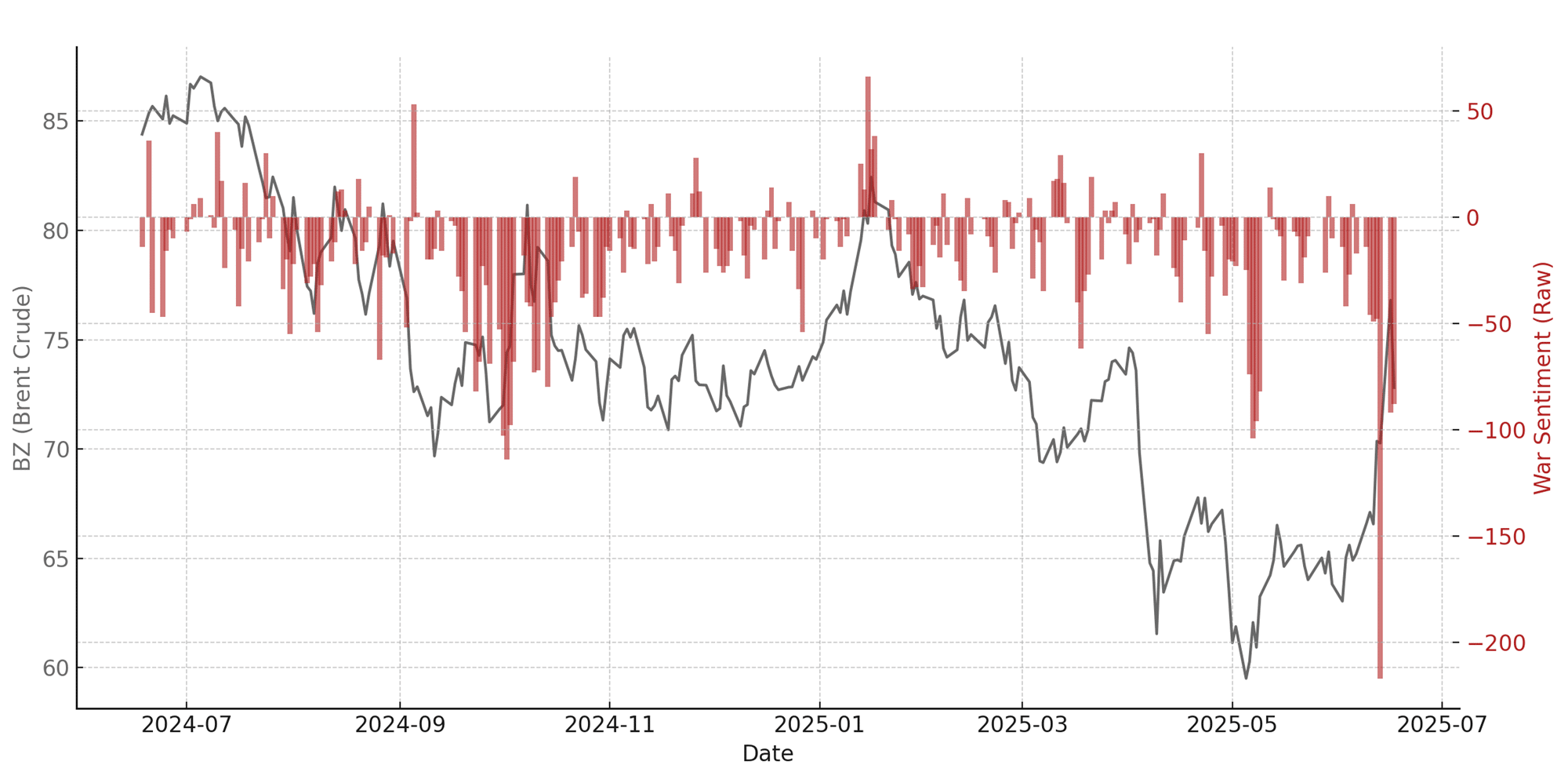
When Brent crude spiked from $69 to $74 in June 2025, traditional analysts were still parsing Middle Eastern headlines whilst our War Sentiment Index had already flagged the narrative shift hours earlier. This isn’t an isolated incident – story signals have fundamentally changed the game, enabling systematic traders to position ahead of market consensus rather than react to price action that’s already occurred.
Story signals essentially capture the narrative momentum that drives market behaviour through our sophisticated proprietary algorithms that process vast amounts of unstructured data across thousands of media sources simultaneously. Unlike traditional analysis that relies on historical price data, our story signals identify the underlying narrative forces that eventually translate into trading decisions by market participants.
The power of our approach lies in capturing the informational edge that exists in the temporal gap between when news breaks and when markets fully digest its implications. Our systematic framework processes linguistic patterns, source credibility, and cross-reference validation at speeds impossible for human analysts, transforming market prediction from reactive analysis to proactive strategy implementation.
Effective market prediction through story signals relies on understanding four distinct signal categories that our algorithms continuously monitor across global media sources.
Breakout Signals occur when previously dormant stories suddenly capture widespread media attention, often indicating the beginning of significant price movements as market awareness shifts dramatically. The recent platinum surge above $1,268 in June 2025 exemplifies this pattern perfectly. Our Trading Co-Pilot detected unusual narrative momentum building around platinum supply constraints and geopolitical risks hours before the metal broke through resistance at $1,089.50. Our system issued a “strong bullish” sentiment alert during early Asian trading, providing our subscribers with critical positioning advantages before prices accelerated from $1,127.20 to $1,222.50.
Volume Build-up Signals represent the gradual accumulation of narrative momentum around particular themes or asset classes. Unlike sudden breakout spikes, volume build-up creates sustained pressure that enables long-term trend prediction. The euro’s strengthening trend demonstrated this signal type in action. As ECB officials maintained hawkish tones while the Federal Reserve showed dovish tendencies, our Trading Co-Pilot systems tracked the building narrative around monetary policy divergence. This volume build-up preceded EUR/USD’s surge above $1.1570 to levels not seen since late 2021, with the single currency benefiting from systematic capital flows as investors repositioned for central bank policy differences.
Above: Tracking macroeconomic sentiment: The EUR/GBP rally in June 2025 was preceded by sustained positive sentiment and narrative signals – enabling traders to anticipate the euro’s climb amid UK economic weakness and ECB policy updates.
Direction Shift Signals identify when established narratives begin changing course, providing critical intelligence for anticipating price reversals before technical indicators suggest trend changes. The recent shift in oil market sentiment surrounding Middle Eastern tensions illustrates this pattern. Initially, markets had become somewhat complacent about regional risks, but our War Sentiment Index detected early signals of changing narrative tone. On June 12th, our algorithms began detecting unusual patterns in media coverage of Iran-Israel tensions, with sentiment scores showing significant negative spikes hours before Brent crude moved from $69 to $74 following escalating strike warnings.
Persistence Signals measure the staying power of existing narratives, helping traders distinguish between temporary noise and stories with genuine long-term market impact. The sustained euro strength against sterling demonstrates our persistence signal effectiveness. EUR/GBP’s ascent to 0.85 was driven by persistent negative narratives around UK economic performance, with our Trading Co-Pilot tracking consistent bearish sentiment following Britain’s -0.3% GDP contraction in April 2025. The persistence of negative UK economic stories, combined with eurozone resilience narratives, created sustained pressure that traditional technical analysis struggled to quantify.
The effectiveness of our story signal technology extends across multiple asset classes and market conditions, with documented success providing systematic traders with measurable competitive advantages.
Precious Metals Intelligence: The platinum market surge in June 2025 showcases our story signals’ precision in commodity markets. Our Trading Co-Pilot identified the two-stage rally before price action confirmed the moves, capturing demand surge narratives in May and squeeze dynamics in June. When platinum opened sharply higher at $1,268.90 following intensified Russian drone attacks on Kyiv, our system had already signalled bullish sentiment shifts, enabling our subscribers to position ahead of safe-haven buying flows.
Currency Market Prediction: The euro’s remarkable strength against major currencies demonstrates our story signals’ effectiveness in foreign exchange markets. Our Trading Co-Pilot‘s sentiment analysis captured the shift from bearish to bullish conditions across EUR/USD and EUR/GBP, identifying macro data impacts and central bank rhetoric changes before markets moved. Our system correctly anticipated EUR/USD’s sustained upward trajectory past 1.16, whilst simultaneously tracking the narrative divergence that drove EUR/GBP higher as UK growth fears intensified.
Energy Market Intelligence: Oil markets provided perhaps the most dramatic demonstration of our story signals’ predictive power. Our War Sentiment Index, one of 22 proprietary macro indices we’ve developed, detected escalating Middle Eastern tensions hours before Brent crude spiked from $69 to $74. Our system processed thousands of articles in real-time, assigning sentiment scores and evaluating source credibility to create high-confidence signals that traditional geopolitical analysis could never match for speed and accuracy.
Above: Early warning in action: Our War Sentiment Index flagged negative sentiment spikes hours before Brent crude surged from $69 to over $74 on June 13, 2025 – providing a clear possible entry point well ahead of market consensus.
The competitive advantage in modern systematic trading increasingly depends on information processing speed and accuracy, precisely where our story signals excel. Our algorithms can detect narrative shifts within minutes of emergence, providing systematic traders with significantly improved entry and exit timing capabilities.
The quantitative nature of our signals integrates seamlessly with existing algorithmic trading systems, providing an additional intelligence layer that enhances rather than replaces traditional technical and fundamental analysis approaches. This allows for positioning ahead of market consensus rather than following it, providing edge in trading operations
During volatile periods, such as the recent Iran-Israel escalation, our story signals provided our clients with actionable intelligence hours before markets fully priced in geopolitical risks. Traditional analysis would have required manual processing of news flows, expert interpretation, and risk assessment – processes that consume valuable time whilst opportunities disappear.
Macro strategists face unique challenges in connecting global narratives with specific asset class implications across interconnected markets. Our story signals excel in this environment through multi-asset correlation analysis that helps strategists understand how geopolitical tensions, central bank communications, or economic policy shifts create ripple effects across different instruments and regions.
The recent convergence of multiple macro themes demonstrates this capability. European monetary policy divergence, Middle Eastern geopolitical tensions, and commodity supply constraints created complex cross-asset relationships that traditional analysis struggled to quantify systematically. Our story signals provide the framework for identifying which narratives deserved immediate attention versus those representing temporary noise, enabling more efficient allocation of analytical resources.
Meanwhile, the correlation between our War Sentiment Index and Brent crude over the past year reveals patterns impossible to detect through manual analysis, with major sentiment spikes consistently preceding significant oil price movements.
Financial markets have fundamentally changed, with information velocity and complexity reaching levels that traditional analysis cannot adequately address. Our story signals represent the natural evolution of market intelligence, combining artificial intelligence capabilities with deep understanding of market psychology and behaviour patterns.
What we are seeing is that this transformation is becoming indispensable to our clients as markets grow increasingly efficient and competitive, with early adopters of our story signal technology are already seeing significant advantages.
The question facing professional traders and institutions is not whether AI-driven sentiment analysis will become standard practice, but how quickly these capabilities can be integrated before competitors gain systematic advantages. Every day, commodity and currency markets experience inflection points that separate profitable positions from missed opportunities, and without real-time sentiment detection, significant alpha potential remains uncaptured.
As the sophistication of modern markets continues evolving, the demand for equally sophisticated analytical tools grows correspondingly. At Permutable, we’re building tools for today’s markets – are preparing traders for tomorrow’s complexity. We believe that the integration of real-time narrative intelligence with systematic trading strategies represents the next evolutionary step in professional market analysis.
Discover how our narrative intelligence and Sentiment Analysis API can enhance your ability to predict market movements and gain the competitive edge that separates successful systematic traders from the rest. Email us at enquiries@permutable.ai to request a demo.
This article looks at the significant movements in the Liquefied Natural Gas (LNG) market over the past fortnight, driven by a combination of geopolitical volatility and strong demand-side fundamentals. Our proprietary Trading Co-Pilot, leveraging advanced Artificial Intelligence and Large Language Model (LLM) sentiment analysis, precisely detected this volatile energy market landscape, identifying optimal positions and generating demonstrative gains amidst market uncertainty.
The Liquefied Natural Gas (LNG) market has recently witnessed a remarkable two-week LNG price surge in the TTF benchmark, climbing sharply from €34.85/MWh on June 10th to surpass €42.02/MWh by June 23rd. This robust bullish momentum, was capitalised upon by our Trading Co-Pilot, was fundamentally driven by a mixture of renewed global demand, strategic global infrastructure developments, and increasingly pronounced geopolitical risk premiums, all buoyed by highly favourable fundamental and macroeconomic sentiment dynamics.
The LNG price ascent occurred against a backdrop of escalating tensions in the Middle East and ongoing concerns over global energy supply that continued to stir markets. However, in a significant recent development, prices across the energy market have seen a tumble following a ceasefire agreement. LNG price has fallen sharply this morning, dropping over 10% to €36.14/MWh on Tuesday, hitting its lowest level in more than a week, after Trump reached a ceasefire agreement between Iran and Israel. If this truce proves lasting, the tension will officially end after 24 hours, concluding 12 days of hostilities. Crucially, this truce has eased concerns of a broader regional spillover of the conflict that could disrupt energy flows through the Strait of Hormuz.
The analytical capabilities of our Trading Co-Pilot were paramount in navigating geopolitical volatility throughout this fortnight. Its ability to discern subtle shifts in market sentiment allowed for the identification of an optimal entry point around June 12th at €36.16/MWh, preceding the most substantial part of this sustained upward trajectory. The initial impetus for this high-conviction ‘buy’ call stemmed from a robust bullish outlook, significantly bolstered by key announcements. Our Trading Co-Pilots buy decision was detected by firm demand signals, with the French government’s endorsement of TotalEnergies’ LNG ambitions and, crucially, the Japanese government’s explicit backing for JERA’s future LNG strategy. These signals conveyed a lasting commitment from major consuming nations towards long-term energy utilisation, involving expanding LNG imports and ramping up receiving and regasification capacity. Such detection of sentiment from government backed support by the Trading Co-Pilot’s analysis, acted as a powerful positive catalyst, reinforcing underlying market fundamentals and validating the system’s early bullish signal. The accompanying chart accurately illustrates this decisive period of bullish regime momentum, showcasing the Trading Co-Pilot’s foresight.

The market’s remarkable resilience during this fortnight further underpins the strength of the bullish sentiment, particularly in the wake of significant geopolitical shocks. Indeed, a brief pullback over the recent weekend was triggered by news of US airstrikes on Iranian nuclear facilities, stoking energy-linked geopolitical volatility and momentarily offering thermal coal an appealing competitive edge. US officials lauded the strikes as a victory. Despite this immediate uncertainty, the market’s recovery was swift and resolute. This rapid rebound was largely a reflection of escalating concerns surrounding the stability and capabilities of Qatar’s LNG exports and supply. This concern was amplified by the uncertainty surrounding Iran’s broader response having launched strikes on US bases in Qatar.
The heating up of tension had significantly increased the likelihood of our scenario, whereby disruptions in shipping through the Strait of Hormuz would spillover into all of the energy markets. This is a crucial choke point for global oil and LNG flows, with a quarter of seaborne oil trade and roughly 20% of global LNG trade moving through its narrow sea lanes. Even with scope for some flow diversion, an effective blocking of Hormuz would have dramatically altered the outlook of LNG, pushing the market into a deep supply deficit. However the truce has eased market concerns of a broader war that could disrupt energy flows through the Strait of Hormuz.
Beyond the immediate geopolitical concerns, the bullish trajectory was firmly supported by compelling fundamental sentiment across key demand centres:
Diverse demand growth: While China’s LNG imports are notably set to slump for the first time in three years, a consequence of flagging industrial output and robust domestic gas pipeline supply. Such a regional softening has been limited by surging demand elsewhere as Europe and US are forecast to experience severe heatwaves, spurring cooling demand which is poised to significantly spike usage for air conditioning, directly increasing LNG consumption. Concurrently, Japan’s proactive long-term strategy for ensuring winter power needs is driving significant forward contracting and import demand.
Project advancements: The market is demonstrating a healthy absorption capacity for new supply. Significant milestones in new export facilities and liquefaction projects, particularly those emerging from North America (e.g., Canada), are being effectively integrated. This indicates that despite increasing supply, underlying demand remains prevalent, hinting towards strong future market absorption.
Strategic partnerships: The proliferation of long-term agreements between major industry players – such as Woodside, JERA, and Petronas – underpins a profound and sustained commitment to LNG as a crucial component of the global energy mix. These multi-year commitments provide a stable demand base that underpins investment and trading confidence.
The macroeconomic backdrop further reinforces the bullish outlook, particularly concerning the escalating geopolitical risk premium and its broader economic implications:
Geopolitical risk premium: The instability in the Middle East, stirred concerns surrounding the Strait of Hormuz and Qatar’s export vulnerability. This injected a considerable and growing risk premium into LNG prices. This elevated risk was starkly reflected in TTF gas prices hitting a recent multi-month high, alongside surging freight rates for LNG carriers across key routes. Our Trading Co-Pilot’s continuous monitoring of these macro-level geopolitical tensions allows it to factor these crucial elements into its sentiment and forecast models, providing a comprehensive market view.
The overarching outlook had been profoundly bolstered by the compounding positive signals and prevailing market momentum. This robust assessment is rigorously validated by our fundamental and macroeconomic sentiment indicators, which have consistently provided strong support for a ‘Buy’ decision for LNG since June 12th. We held a high degree of confidence in this sustained bullish signal until June 23rd. Based on current dynamics and the comprehensive insights provided by our Trading Co-Pilot, the near-term outlook as of the 24th appears to see a pullback from the markets. The recent truce has indeed calmed market fears of supply-side bottlenecks, proving favourable for dependent European energy markets as the price within the LNG market reconsolidates, even as the global geopolitical climate simmers down, as the degree of uncertainty in markets abating.
Stay ahead of geopolitical volatility in energy markets with real-time sentiment intelligence from our Trading Co-Pilot. Transform uncertainty into opportunity with data-driven insights. Simply email enquiries@permtuable.ai to request a demo.
We are pleased to announce that we have officially launched our War Sentiment Index, an advanced real-time geopolitical risk analytics feed that measures worldwide conflict sentiment, delivering institutional investors critical intelligence on geopolitical factors driving market instability.
As current Middle East tensions from the Iran-Israel situation, broader regional conflicts, and persistent Russia-Ukraine hostilities fuel substantial market turbulence – impacting commodity pricing, exchange rates, and sectoral shifts – our War Sentiment Index provides the essential geopolitical risk analytics that investors need to successfully navigate geopolitical uncertainty while maximizing sentiment-based trading opportunities.
Our War Sentiment Index converts intricate international developments into practical investment guidance through sophisticated geopolitical risk analytics. Dating back to 2015, our advanced AI-powered platform has monitored all significant conflicts and geopolitical developments, equipping institutional partners with crucial data infrastructure for strategic decision-making during heightened market volatility periods.
“Our War Index represents the most straightforward global conflict tension indicator available, providing clear sentiment aggregation from worldwide news sources,” explained Wilson Chan, our Founder and Chief Executive. “The system accurately identified Israel’s initial strike timing and detected Iran’s nuclear response anxiety 24 hours in advance. This capability allows fund managers to strategically position portfolios during critical and unstable timeframes.”
Our War Sentiment Index operates within our extensive 22-feed macro intelligence ecosystem, offering institutional clients comprehensive oversight of all market-influencing worldwide developments:
Our War Sentiment Index targets hedge funds, investment managers, pension schemes, and institutional dealing rooms, seamlessly incorporating into current risk oversight and profit-generation frameworks.
Key applications include:
As the premier supplier of live sentiment and event analytics for institutional markets, our proprietary AI technology converts international news streams into targeted, executable investment data, supporting hedge funds, investment houses, and institutional trading operations globally. Our analytical tools have established themselves as fundamental infrastructure for advanced investment methodologies in today’s increasingly volatile international landscape.
Interested in incorporating our War Sentiment Index into your trading operations? Contact our team at enquiries@permutable.ai to learn more and to discuss detailed specifications.