Crude oil market watch: 5 global events that moved oil markets last month

*This article provides a detailed analysis of the key geopolitical and economic events that shaped crude oil markets in April 2025, aimed at traders, investors, and energy analysts seeking insights to navigate a rapidly evolving landscape.

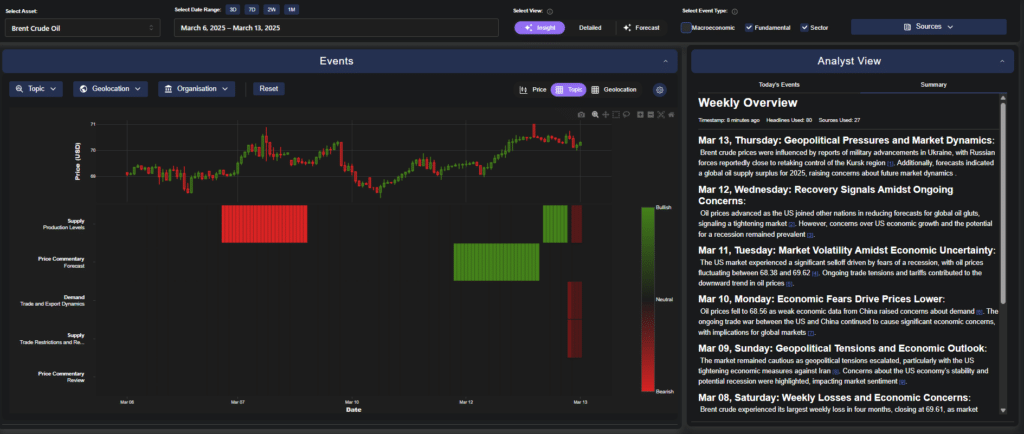
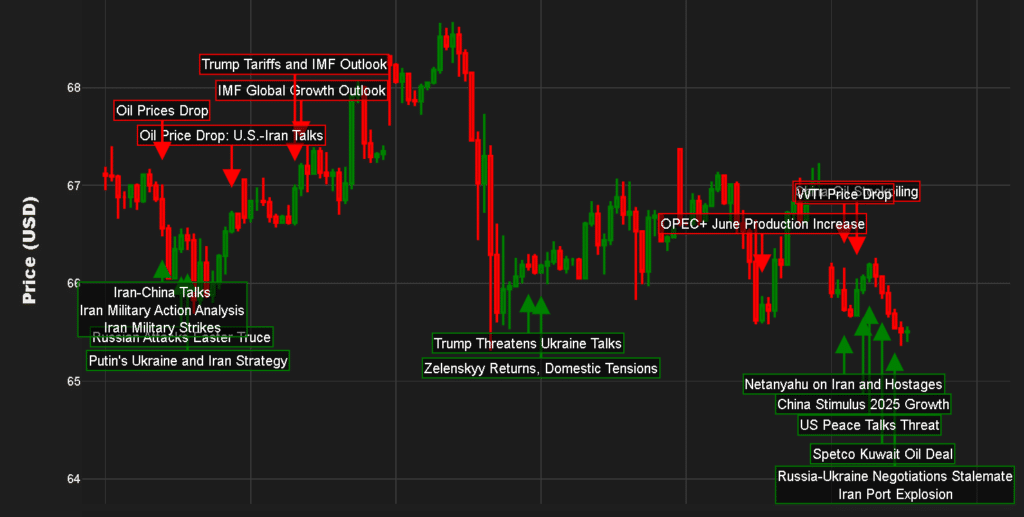
In the throes of what some have dubbed the Great Tariff Crisis, global oil markets experienced unprecedented turbulence throughout April 2025. WTI crude oil prices oscillated dramatically, falling near $62.50 by month-end as multiple forces converged to create what many analysts have called “uncertainty on steroids” in energy markets. The destruction of predictable trade patterns and diplomatic norms has left investors scrambling to position themselves amidst rapidly evolving scenarios. One thing is certain: the collective crude oil market watch has rarely been more challenging. Let’s examine the five most significant events that moved oil markets last month through the lens of our Trading Co-Pilot.

1. Trump’s tariff implementation and global economic reverberations

The upending of world economic order began when Trump imposed his 10% baseline global tariff in early April. The turbulence has been caused by both the direct impact on energy prices and the secondary effects on global growth projections. The International Monetary Fund responded by cutting global growth forecasts by 0.5%, specifically citing US tariffs as the primary factor.

China’s response was particularly noteworthy for crude oil market watch observers. By the end of April, China had significantly increased its crude oil stockpiles, reversing previous declines. This strategic move came as a direct response to tariff impacts on crude prices, with China taking advantage of temporarily depressed prices to build reserves. Overall, the general mood is for now gloomy with a great deal of fear that continued trade tensions will further depress global economic activity.

2. U.S.-Iran nuclear negotiations and supply concerns

The unpredictability of U.S.-Iran relations added another layer of complexity for those on the crude oil market watch in April. Oil prices experienced a sharp pullback following reports indicating progress in negotiations between the two nations. As well as these diplomatic developments, there were mounting concerns about potential military action against Iran’s nuclear programme.

Those who ask whether military strikes are a realistic possibility need only look at recent statements from Trump threatening action if Iran doesn’t agree to a nuclear deal. Conversely, any diplomatic breakthrough could quickly bring additional Iranian crude to market.

The question is whether these negotiations will ultimately result in de-escalation or further confrontation. Israeli Prime Minister Netanyahu’s statement that Iran’s nuclear programme must be dismantled added further pressure, as did Senator Marco Rubio’s warning that a potential war with Iran would be significantly more complicated than previous conflicts.
crude oil market watch

3. OPEC+ production increase considerations

For better or worse, OPEC+ is contemplating a significant increase in oil production for June. This brings us back to the perennial crude oil market watch focus on supply management.

The global economic tremors from tariffs have complicated OPEC+’s calculus. The era of careful market balance through production adjustments may be challenged if demand forecasts continue to deteriorate. Specifically, the cartel must weigh potential revenue increases from higher volumes against price declines from oversupply.

By month-end, WTI crude oil prices had fallen to near $62.50, influenced by this potential OPEC+ production hike alongside other factors. Market analysts remain divided on whether the production increase will materialise given the uncertain demand outlook.

4. Russia-Ukraine conflict and peace talk stalemate

As the reality of continued hostilities in Ukraine persists, those keeping a crude oil market watch will have been closely monitoring diplomatic developments. Negotiations between Russia and Ukraine remain at a stalemate as both sides await a breakthrough. But that outcome seems increasingly distant with the U.S. threatening to abandon Russia-Ukraine peace talks.

President Putin’s strategic moves regarding both Ukraine and Iran further complicate matters. Putin signed a law ratifying a strategic partnership treaty with Iran, solidifying ties between the two nations. And even then, Russian attacks have persisted through declared truces, including during the Easter period.

It seems likely that protracted conflict will continue to introduce risk premiums in crude oil markets, especially as U.S. diplomatic engagement appears to be waning. The former head of the British army stated that Donald Trump’s actions have undermined peace prospects for Ukraine, signalling continued instability.

5. China’s economic stimulus and demand outlook

China plans to implement additional stimulus measures and has expressed confidence in achieving its growth target for 2025. This announcement provided a rare bright spot in our crude oil market watch, partially offsetting negative sentiment from tariff impacts.

The prospect of Chinese demand growth offers some counterbalance to the broader economic concerns. However, IMF downgrade of China’s growth expectations as the trade war escalates suggests caution is warranted.

China remains the world’s largest crude oil importer, making its economic trajectory key for global energy markets. Its strategic decision to increase stockpiles demonstrates both the opportunity presented by lower prices and concerns about future market access amid deteriorating trade relations.

Crude oil market watch April 2025 – final thoughts

The confluence of tariff impacts, geopolitical tensions, and supply-demand recalibration has created one of the most challenging environments for crude oil traders in recent memory.  For traders and investors, adapting to this new reality requires heightened attention to both macroeconomic indicators and geopolitical developments. The interplay between trade tensions and traditional supply-demand dynamics has created a multi-dimensional challenge that demands sophisticated analysis and nimble positioning.

Stay ahead with our crude oil market sentiment data

In a market defined by volatility and rapid change, having access to real-time intelligence is no longer optional – it’s essential. Our Trading Co-Pilot Terminal delivers crucial market-moving events directly to your workflow, ensuring you never miss a development that could impact your positions. Don’t let critical information reach you after markets have already reacted. Access our comprehensive data via API integration into your existing systems or through our intuitive Trading Co-Pilot Terminal. Our platform not only aggregates news but contextualises events with expert analysis and sentiment scoring, helping you distinguish signal from noise.

Ready to transform how you monitor the crude oil markets? Request a demonstration of our Trading Co-Pilot terminal or speak with team about  integration via API access. Simply email enquiries@permutable.ai or fill in the form below. In markets where minutes matter, we ensure you constantly stay ahead.

Request demo/access

Natural gas prices now: What key factors are driving market volatility 24 Apr 25

This article provides an in-depth analysis of the complex factors currently driving natural gas price volatility with insights taken from Permutable AI’s data insights, aimed at energy traders, portfolio managers, risk analysts and commodities professionals seeking to understand the intersection of weather patterns, geopolitical tensions, and market fundamentals affecting the gas markets.

The volatile nature of natural gas markets

The unpredictability of natural gas prices has reached new heights as multiple forces converge to create an increasingly complex market landscape. Our recent market sentiment data across both Henry Hub and European TTF markets reveals an intricate interplay of weather patterns, geopolitical tensions, and supply-demand dynamics that are collectively shaping natural gas prices now. Our analysis of these trends through the lens of our latest data insights highlights several important factors that traders and energy stakeholders should monitor closely.

Weather patterns: The persistent market mover

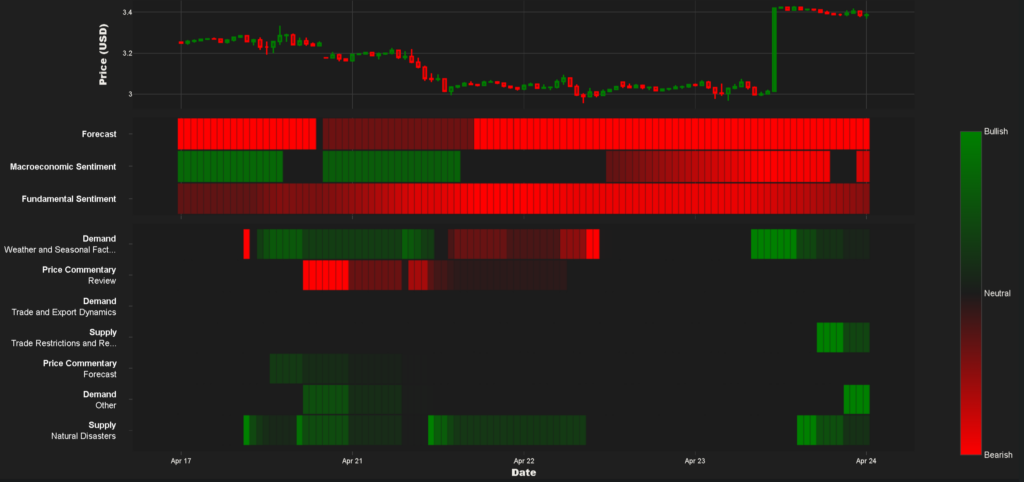
Looking at Henry Hub natural gas over the past week reveals weather as perhaps the most immediate driver of natural gas prices now, with volatility evident in the latest data showing prices ranging from $3.39 to $3.42 on April 24, following a slight recovery the previous day when prices opened at $3.43 and closed at $3.42, supported by forecasts for cooler temperatures across the U.S.

This continues the pattern observed in earlier market activity, where severe weather systems moving across key consumption regions directly influenced both supply and demand. The deadly storms over the Easter weekend across Oklahoma and Texas created significant market uncertainty, with prices opening at $3.66 on April 21 and closing significantly lower at $3.49, driven by ongoing severe weather forecasts.

What’s extremely apparent is that these weather-driven fluctuations aren’t merely seasonal anomalies but are becoming more pronounced and less predictable, creating additional challenges for market forecasting. The situation has been exacerbated by increasing climate variability, making traditional weather-based trading models less reliable for natural gas prices.

Henry Hub Natural gas prices now - market sentiment heatmap

Above: Market sentiment indicators affecting natural gas prices now

Geopolitical tensions: The European dimension

The European TTF market continues to respond dramatically to ongoing geopolitical developments. Our latest analysis shows that European natural gas prices are continuing to be particularly sensitive to events in Ukraine and Russia’s strategic energy decisions.

On April 24, prices opened at €34.33 but declined to €33.38 amid reports of a decrease in Norway’s gas output. More significantly, the Kremlin’s announcement of a standstill in gas supply talks with Europe further contributed to bearish sentiment. This follows a pattern of volatility where on April 22, TTF prices opened at €35.54, initially rising to €35.84 before dropping significantly to €34.25 as the market reacted to escalating conflict.

The era of energy security being taken for granted has clearly and categorically ended. The resumption of hostilities following the Easter ceasefire has amplified market anxiety about gas supply stability in Europe, with reports indicating numerous Russian drone attacks and military actions. The deadly Russian drone attack on Marhanets on April 23, which resulted in civilian casualties, further complicated the geopolitical landscape. The blowback could extend to global LNG markets as Europe seeks alternative supplies, potentially redirecting cargoes from Asia and affecting global natural gas prices.

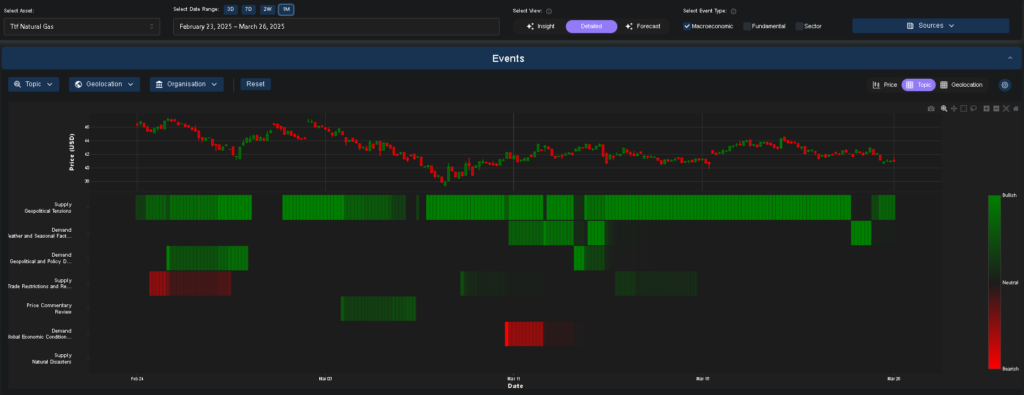
European TTF Natural gas prices now - market sentiment heatmap

Above: Market sentiment indicators affecting European TTF natural gas prices now 

Supply-demand balancing act

Across all these fronts, the fundamental supply-demand equation continues to underpin natural gas prices. The latest data shows that on April 22, prices ranged from $3.41 to $3.50, closing at $3.43, as the market faced pressure from reports of significant builds in U.S. natural gas inventories, attributed to warm spring temperatures.

This brings us back to a crucial market dynamic: natural gas prices reflect not just current consumption patterns but expectations about future storage adequacy. The April 24 data indicates that rising LNG demand and ongoing maintenance activities affecting supply influenced price declines, with prices dropping to $3.39 early in the day. Additionally, an emergency order to accelerate permitting for oil and gas projects was enacted, which may have contributed to market volatility.

The question remains whether current inventory build rates will be sufficient to meet potential future demand spikes. Those who ask whether the market is adequately pricing in potential supply disruptions might find the answer uncertain, particularly when examining the Henry Hub Weekly Overview where prices have ranged significantly in a single week.

Interconnected global markets

Natural gas prices increasingly reflect the globalization of gas markets. The latest TTF data shows how European concerns about supply have kept markets on edge, with prices responding to reports of a decrease in Norway’s gas output and the Kremlin’s announcement regarding gas supply talks.

It’s notable that Henry Hub natural gas prices now show increasing correlation with international events that previously would have had minimal impact. Our data indicates that rising LNG demand influenced price movements in the U.S. market, highlighting the interconnected nature of global energy markets. This puts the onus on market participants to broaden their analytical scope beyond regional fundamentals.

Market sentiment and trading patterns

Natural gas prices also reflect shifts in market sentiment that can sometimes override purely fundamental analysis. The recent price movements at Henry Hub on April 23-24 suggest traders may be recalibrating their positions in response to cooler forecasts and supply concerns.

As the reality of changing market dynamics sets in, we’re observing more cautious trading patterns overall. But that outcome isn’t guaranteed to persist, especially with weather uncertainties and geopolitical tensions remaining high. The recent emergency order to accelerate permitting for oil and gas projects may introduce new variables into the market equation, potentially shifting natural gas prices in either direction.

Navigating this complex landscape

Clearly, natural gas prices represent a culmination of multiple factors that require sophisticated analysis to navigate effectively. Over the last week, we can see just how quickly prices can shift. Ultimately, the unpredictability of natural gas prices demands a multifaceted analytical approach that can integrate weather forecasting, geopolitical intelligence, supply-demand fundamentals, and trading pattern analysis. Given the complex interrelationships between these factors, isolated analysis of any single variable is becoming increasingly insufficient.

What’s painfully apparent is that market participants require more comprehensive analytical tools that can process these various inputs simultaneously. The era of simple price forecasting based on historical patterns has given way to a more dynamic approach that accounts for the increasing volatility and interconnectedness of global energy markets.

Take action now

Access our real-time market sentiment data to gain the competitive edge needed to understand natural gas prices now in today’s volatile markets. Our comprehensive market sentiment data integrates multi-dimensional analysis of weather patterns, geopolitical developments, and supply-demand dynamics to provide actionable insights for your trading decisions. Request a demo to see how our cutting-edge sentiment analysis tools and feeds can help you stay ahead of market shifts and uncover opportunities to inform your trading strategy. Simply email us at enquiries@permutable.ai or fill in the form below.

Request demo


5 key geopolitical factors affecting energy market sentiment April 2025

*This article summarises the five most significant geopolitical factors affecting energy market sentiment in April 2025, providing traders, portfolio managers and risk analysts with valuable insights into how regional conflicts, diplomatic negotiations, and economic developments are currently influencing price movements across crude oil, natural gas, and refined products.

As the month of April continues to unfold, energy markets continue to demonstrate notable sensitivity to global political developments. Our Trading Co-Pilot has identified several key geopolitical factors affecting energy market sentiment across the sector this month, with implications stretching across crude oil, natural gas, and refined products. This analysis examines the five most significant drivers behind recent price movements and offers insights into what traders might expect moving forward into the year.

1. US airstrikes in Yemen escalate regional tensions

At the time this article went to print, oil prices had edged higher following US airstrikes on Yemen’s Ras Isa fuel port, which reportedly resulted in over 80 fatalities. This military action marked a significant escalation in the ongoing conflict and has raised immediate concerns about potential supply disruptions in the region.

Brent crude extended gains after the strikes, rallying from $66.14 to $68.05 on April 17th, while WTI crude similarly jumped to $63.75. As geopolitical tensions flared in the region, heating oil prices also reflected this anxiety, rising from $2.08 to $2.12 during the same period. The Yemen situation highlights how quickly regional conflicts can impact global energy prices, particularly when critical infrastructure comes under threat. According to data from our sentiment analysis, this is one of the most significant geopolitical factors affecting energy market prices this month

2. US-Iran nuclear negotiations heighten market uncertainty

The second round of nuclear negotiations between the US and Iran which at time of writing had just concluded in Rome has created notable market volatility as traders attempt to gauge potential outcomes and their impact on Iranian oil exports. This well-warranted yet hardline stance, coupled with hints of potential military action, created significant uncertainty in energy markets throughout the week.

Driven by concerns over supply disruptions if negotiations were to fail and sanctions intensified, gasoline prices opened at 2.01 and reached a high of 2.03 on April 14th before retreating. Traders cited the possibility of Iranian oil returning to markets in meaningful volumes – or being further restricted – as a key factor affecting their positioning.

3. Escalating military actions in Ukraine

In contrast to the Middle East developments, the Ukraine conflict continued to more significantly impact European natural gas prices, demonstrating how geopolitical factors affecting energy market dynamics can vary by region. TTF natural gas prices rallied from €34.30 to €35.57 on April 16th following reports of a major drone assault on Ukraine infrastructure.

As Russia reportedly downed dozens of Ukrainian drones while Ukraine continued strikes on Russian territory, the markets grew increasingly edgy about potential disruptions to natural gas flows through the remaining operational transit routes.

Market analysts pointed to the recent extension of Ukraine’s martial law and mobilisation for another 90 days as evidence that the conflict shows no signs of resolution. With European gas storage levels generally declining toward the end of the withdrawal season, this geopolitical uncertainty adds a risk premium that’s particularly visible in forward contracts.

Geopolitical factors affecting energy market sentiment

Above: Energy market sentiment taken from our Trading Co-Pilot’s Sector Analysis feature – an analysis of sector sentiment across geopolitical and policy developments, geopolitical tensions as well as other influencing factors

4. US–China trade relations

Amid otherwise bearish sentiment, WTI crude prices rose significantly mid-month, opening at $60.89 and closing at $62.23 on April 16th, as optimism grew around renewed trade “negotiations” between US and China.

This more positive sentiment was reinforced by China’s better-than-expected Q1 economic growth of 5.4%, which occurred even before the anticipated impacts of potential Trump tariff waivers. Following unexpected inventory builds in the US, this news provided welcomed support for energy markets that had been struggling with demand concerns.

Traders cited uncertainty over China’s demand recovery as a persistent theme, but the prospect of reduced trade tensions between the world’s two largest economies gave market participants reason for cautious optimism about future consumption patterns.

5. OPEC+ policy adjustments and market response

In response to OPEC+ output decisions and policy signals, oil markets demonstrated measured reactions throughout April. Among the geopolitical factors affecting energy market sentiment, OPEC+ policy adjustments remain particularly influential despite receiving less headline attention than military conflicts

Some analysts anticipate a rebound in crude prices if OPEC+ maintains production discipline amid the geopolitical uncertainties. With inventories running low in certain regions, further upside cannot be ruled out if the producer group responds assertively to price weakness.

Reflecting seasonal demand trends that typically strengthen heading into summer driving season, refined products showed more resilience than crude oil in certain trading sessions. This pattern suggests market participants are weighing short-term geopolitical risks against longer-term seasonal patterns.

Inform your energy trading decisions with our real-time geopolitical insights 

Request a demo of our Trading Co-Pilot platform today and discover how our advanced sentiment analysis can help you navigate market volatility with confidence – also available via API and spreadsheet integration. Contact us at enquiries@permutable.ai to apply for a subscription or simply fill in the form below.

Request subscription 


Macroeconomic factors affecting oil and gas industry: Navigating volatility in 2025

The oil and gas industry continues to operate within a complex macroeconomic environment characterised by geopolitical uncertainties, evolving supply-demand dynamics, and shifting policy landscapes. Understanding the macroeconomic factors affecting oil and gas industry performance has become increasingly key for investors, traders, and industry stakeholders navigating the volatile energy markets of 2025. In this article, we’ll break down macroeconomic factors affecting the oil and gas industry, with insights taking from our Trading Co-Pilot.

Geopolitical tensions: The persistent price driver

The vast majority of recent price movements in oil and gas markets can be traced to geopolitical developments. As our Trading Co-Pilot data indicates, oil prices climbed to a three-week high in late March 2025, driven by escalating tensions in multiple regions. Military operations in Gaza and Ukraine have created persistent supply concerns, while diplomatic developments such as the Russia-Ukraine ceasefire agreement regarding Black Sea navigation have introduced moments of market stabilisation.

Perhaps the key is understanding how these geopolitical events create cascading effects across the energy ecosystem. For example, on March 21, natural gas prices peaked at 44.31 but dropped retreated to 42.62, influenced by military actions in Ukraine, including a strike on the Sudzha gas metering station, which significantly impacted supply dynamics. This is a recognition that energy markets remain highly sensitive to geopolitical developments, particularly in key production and transit regions, and this is entirely correct.

Trade policies and tariffs: A new macroeconomic factor

It is an irrefutable fact that trade policies have emerged as a significant macroeconomic factor affecting oil and gas industry performance. Recently, Trump’s announcement of a 25% tariff on countries purchasing oil from Venezuela introduced significant volatility in late March.

At this point, it’s worth noting that tariffs represent a relatively new macroeconomic force in energy markets (at least, that is, in their current iteration in recent times). Traditionally, the oil and gas industry has operated within a relatively free-trade environment, with prices primarily determined by supply-demand dynamics and production costs. However, the increasing use of energy as a geopolitical tool has introduced trade policies as a significant macroeconomic factor affecting oil and gas industry operations.

Many fear that such protectionist measures could lead to retaliatory actions, creating a complex web of trade barriers that further segment global energy markets. And so here, it’s about recognising that energy markets are increasingly influenced by broader macroeconomic trade policies rather than purely energy-specific factors.

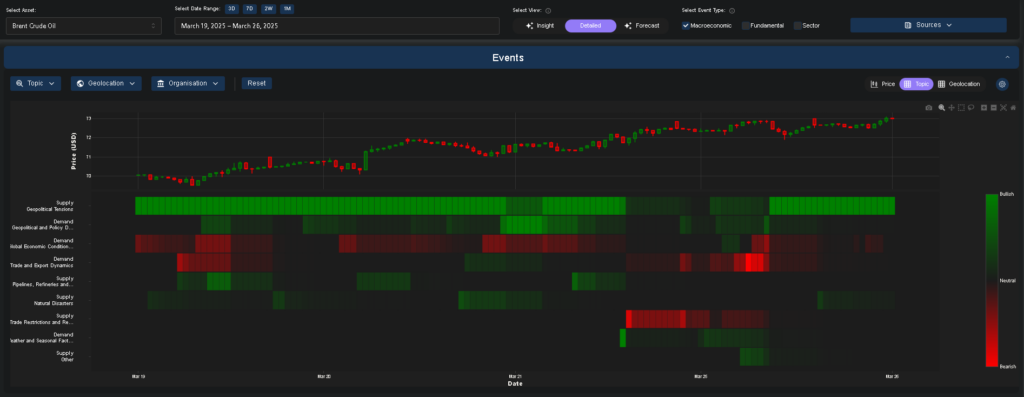
Macroeconomic factors affecting oil and gas industry - Brent crude oil market sentiment

Above: Macroeconomic factors affecting oil and gas industry – Brent crude oil market sentiment taking from our Trading Co-Pilot – one week view

OPEC+ dynamics and supply management

Coming back to supply factors, OPEC+ continues to play a pivotal role in the macroeconomic factors affecting oil and gas industry pricing. Even though we know that OPEC+ influence has diminished somewhat with the rise of non-OPEC production, particularly U.S. shale, the cartel’s decisions still create significant price movements. For example, on March 21, prices were influenced by new US sanctions on Iran and OPEC+ plans to cut production, highlighting the continued importance of coordinated supply management as a macroeconomic factor affecting oil and gas industry dynamics.

However, despite these difficulties in managing global supply, OPEC+ has demonstrated remarkable resilience in adapting to changing market conditions. The key principle governing their actions remains balancing market stability with revenue maximisation for member states, a delicate equilibrium that continues to influence global energy markets.

Weather patterns and climate events

Some might say that weather patterns represent a microeconomic rather than macroeconomic factor, but the increasing frequency and severity of extreme weather events have elevated their importance to a macroeconomic level with severe weather events continuing to disrupt energy infrastructure, causing power outages and raising concerns about energy supply stability.

Indeed, even as recently as March 26, extreme weather conditions, including heavy rains and strong winds, affected production in various sectors, notably in energy and agriculture. This consistent pattern of weather-related disruptions represents a structural macroeconomic factor affecting oil and gas industry operations worldwide.

At the same time, these weather events influence both supply and demand sides of the equation. For instance, on March 25, ongoing extreme heat led to concerns over agricultural productivity and energy consumption  highlighting how climate events create complex feedback loops in energy markets.

Macroeconomic factors affecting oil and gas industry – European natural gas market sentiment – one month view

Global economic growth and demand trends

Perhaps now, we had better move on to the most fundamental macroeconomic factor affecting oil and gas industry performance: global economic growth. The hard truth is that energy demand remains tightly coupled with economic activity, despite ongoing efforts to decouple growth from carbon emissions.

Our Trading Co-Pilot data shows that positive economic indicators continue to support price rallies. For example, on March 20, the market reacted positively to a strong outlook for demand in the US, supported by positive economic data, driving petrol prices higher.

Nevertheless, it’s important to note that regional economic variations create complex patterns in global energy demand. Thus, while some regions experience robust growth supporting higher energy consumption, others face economic headwinds that constrain demand growth.

Technological disruption and energy transition

You may have been aware that the Texas Senate recently passed legislation aimed at restructuring the energy market to favour gas over renewable sources, highlighting the ongoing tensions between traditional and emerging energy sources. This is a curious state of affairs for many industry observers, as technological and economic factors increasingly favour renewable energy, while policy measures attempt to maintain support for fossil fuels.

The explanation is ultimately quite simple: the energy transition represents one of the most significant macroeconomic factors affecting oil and gas industry long-term prospects, creating complex political and economic responses across different regions.

There are, of course, significant variations in how this transition is unfolding globally. Some regions are accelerating their shift away from fossil fuels, while others are doubling down on oil and gas development. In consequence, the global energy landscape is becoming increasingly fragmented, with different regions following divergent paths determined by their unique resource endowments, policy preferences, and economic structures.

Market sentiment and investor behaviour

No doubt, sentiment plays a key role in short-term price movements in energy markets. With hedge funds recently and significantly reducing their bullish positions on natural gas, this marks a notable shift in market sentiment. This type of positioning can amplify price movements independent of fundamental supply-demand dynamics.

After all, what do these sentiment shifts tell us about the broader macroeconomic factors affecting oil and gas industry performance? They often reflect evolving perceptions of risk, growth prospects, and policy direction, serving as a leading indicator of market trends.

If all that is not enough to complicate the analysis, consider that sentiment can shift rapidly based on news headlines or unexpected events. For instance, the Russia-Ukraine ceasefire agreement regarding Black Sea navigation immediately influenced market sentiment, despite having limited immediate impact on physical supply routes.

Navigating a complex interplay of factors

To sum up, the macroeconomic factors affecting oil and gas industry performance in 2025 represent a complex and evolving landscape. Geopolitical tensions, trade policies, OPEC+ dynamics, weather patterns, economic growth, energy transition, and market sentiment all interact to create a challenging environment for industry stakeholders.

Worse still, these factors don’t operate in isolation but create feedback loops and cascading effects across the energy ecosystem. Thus, a comprehensive understanding requires monitoring multiple indicators simultaneously, recognising both immediate impacts and longer-term structural shifts.

For investors and industry participants, this complexity highlights the value of sophisticated analytical tools like our Trading Co-Pilot, which processes multiple data streams to identify emerging trends and potential market movements. In the struggle against uncertainty, tools like ours provide valuable insights that can inform more effective risk management and strategic decision-making.

Harness the power of AI-driven market intelligence to navigate the complexities of today’s energy markets

Our Trading Co-Pilot delivers real-time analysis of macroeconomic factors affecting the oil and gas industry, helping you identify emerging trends and potential market movements before they become obvious. Experience how our sophisticated analytical tools can transform your approach to risk management and strategic decision-making. Simply email our team at enquiries@permutable.ai today to arrange your personalised demonstration or fill in the form below to begin your complimentary trial.

Request demo/trial


Will the price of crude oil go up? A look at current market sentiment 25 Mar 2025

*This article is aimed at energy traders and market analysts, offering a deep dive into the complex interplay of geopolitical tensions, supply dynamics, and demand trends that influence whether crude oil prices are likely to rise in the coming months.

The question on every energy trader’s mind is deceptively simple yet profoundly complex: will the price of crude oil go up in the coming months? As global markets navigate a web of geopolitical tensions, supply disruptions, and shifting demand patterns, the answer requires careful analysis of multiple intersecting factors. Let us warn you this can be a challenging landscape to interpret, even for seasoned market observers. In this article, we’ll unpack the complex interplay of factors, using insights from our Analyst Insight mode on our Trading Co-Pilot. 

Recent market dynamics: A foundation for understanding

As you can see, everything starts with understanding the current price movements. Brent crude has experienced notable movements in a week of significant price action, with crude experiencing new monthly March highs.

Here, the reality of crude oil pricing is that it reflects a complex interplay of supply concerns, geopolitical developments, and market sentiment. For example, the announcement of US sanctions on Iran has tightened supply expectations, while escalating military operations in Gaza have raised fears about regional stability. At the same time, the recent US-Russia agreement on a 30-day energy ceasefire briefly calmed markets, demonstrating how quickly sentiment can shift.

Geopolitical tensions: The persistent price driver

There is something fascinating about how geopolitical events continue to exert outsized influence on crude oil markets. The vast majority of recent price movements can be traced to developments in the Middle East and Eastern Europe. It is our strong belief that these tensions will remain a key factor in determining whether crude oil prices go up or down in the coming months.

Trump’s recent threat of a 25% tariff on countries buying oil from Venezuela has introduced a new dynamic to consider. This latest instalment in a slew of madcap policy shifts could potentially redirect global oil flows and alter trading patterns, adding another layer of complexity to price forecasting. Of course, many fear that such measures could lead to retaliatory actions, further complicating international energy trade.

However, despite these challenges, markets have shown remarkable resilience. Some might say that this resilience suggests underlying strength in the oil market, possibly indicating that crude prices may trend upward if geopolitical tensions continue to escalate. Nevertheless, it’s prudent an air of caution is retained,  as market sentiment can rapidly shift based on diplomatic developments.

Supply dynamics: OPEC+ and production capacity

Coming back to supply factors, OPEC+ continues to play a pivotal role in answering the question of whether crude oil prices will go up. The group’s plans to address overproduction issues through output cuts have provided some support to prices. The key principle is to maintain market equilibrium through coordinated production adjustments, though compliance remains a persistent challenge.

At this point, it’s worth noting that reports of increased production capacity in Iraq and the potential for increased output from non-OPEC producers could offset some of these supply constraints. The biggest flaw in many bullish oil price forecasts is underestimating the resilience of global production capacity, particularly in the US shale sector.

And you’ll hear lots of talk about how supply disruptions in Nigeria, where a recent pipeline explosion has raised concerns, could drive prices higher. True, there are still notable supply risks in several key producing regions. Yet appreciating the global nature of oil markets means understanding that regional disruptions often have muted effects on global prices unless they persist or spread.

Demand outlook: Economic indicators and global growth

Let’s start by exploring the root causes of recent demand optimism. The latest economic indicators from the US have been relatively positive, suggesting resilient energy demand in the world’s largest economy. This positive sentiment contributed to the recent rally.

But here’s the inconvenient truth: global economic growth remains uneven, with various regions facing different challenges. Even more importantly, the transition to renewable energy sources continues to accelerate, potentially capping long-term demand growth for crude oil.

It’s no surprise that market analysts, including Goldman Sachs, have expressed caution about crude oil price prospects, citing risks associated with tariffs and excess production capacity. The starting point for this is recognising that crude oil markets are influenced by both cyclical and structural factors, making predictions about whether prices will go up particularly challenging.

Will the price of crude oil go up? A measured perspective

So while we cannot be certain that crude oil prices will follow a clear upward trajectory, there are several factors that suggest continued volatility with potential for modest gains. For those that succeed in navigating this complex market, understanding the interplay between geopolitical tensions, supply dynamics, and demand trends will be essential.

There is no guarantee, of course, that crude oil prices will continue their recent upward momentum. In consequence, a neutral stance appears warranted as traders assess the implications of recent events on future price movements. The latest developments, including escalating tensions in Gaza and Ukraine, suggest that geopolitical risk premiums may continue to support prices in the near term.

Perhaps then, we had better end with the recognition that crude oil markets are inherently unpredictable. If all that is not enough to complicate the analysis, consider that market sentiment can shift rapidly based on news headlines, economic data releases, or unexpected supply disruptions.

In the struggle against uncertainty, sophisticated AI-driven market analysis tools like our Trading Co-Pilot can help to delayer the current conditions and provide valuable insights into emerging trends and sentiment shifts. 

Spot opportunities and navigate volatility with our Trading Co-Pilot

To receive real-time insights like these, directly linked to geopolitical shifts, supply dynamics, and market sentiment, try our Trading Co-Pilot – your intelligent companion for navigating volatile energy markets.  Simply email our team at enquiries@permutable.ai to request a demo or trial of our Trading Co-Pilot. 
 

Request demo/trial


Crude oil technical analysis: Key insights from our sentiment data

In this brief article, we’ll share how our Trading Co-Pilot data has uncovered valuable insights through advanced crude oil technical analysis using sentiment data from 2022 to present. These findings reveal distinctive patterns that traditional crude oil technical analysis often misses when relying solely on price and volume indicators.

Crude oil technical analysis – key findings

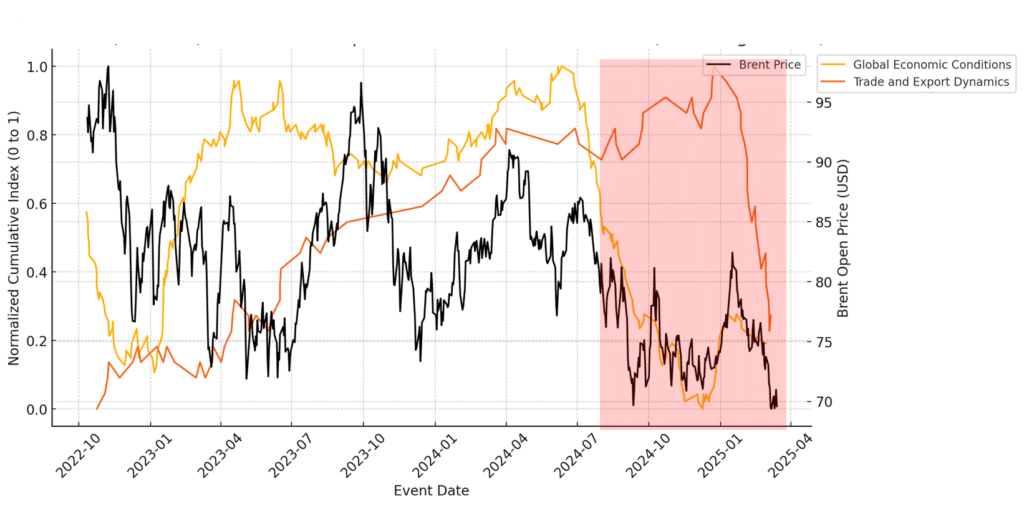
Downside risk 

Our data shows that weakening global economic sentiment and trade dynamics are strongly correlated with price declines in crude oil markets. These macroeconomic indicators have consistently preceded downward price movements, providing valuable early warning signals that conventional crude oil technical analysis might overlook.


crude oil technical analysis downside risk

Source: Permutable Trading Co-Pilot data 2022 – present

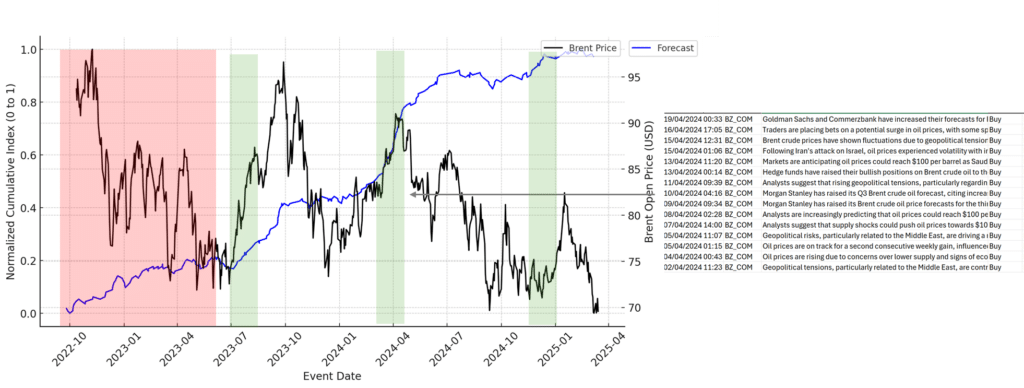
Upside signal 

Price forecast momentum has proven to be a reliable indicator for upward movements in crude oil prices. Our Trading Co-Pilot’s sentiment analysis demonstrates that incorporating these forecast trends into crude oil technical analysis can effectively signal potential upside opportunities before they fully materialise in the market.

crude oil technical analysis upside risk

Source: Permutable Trading Co-Pilot data 2022 – present

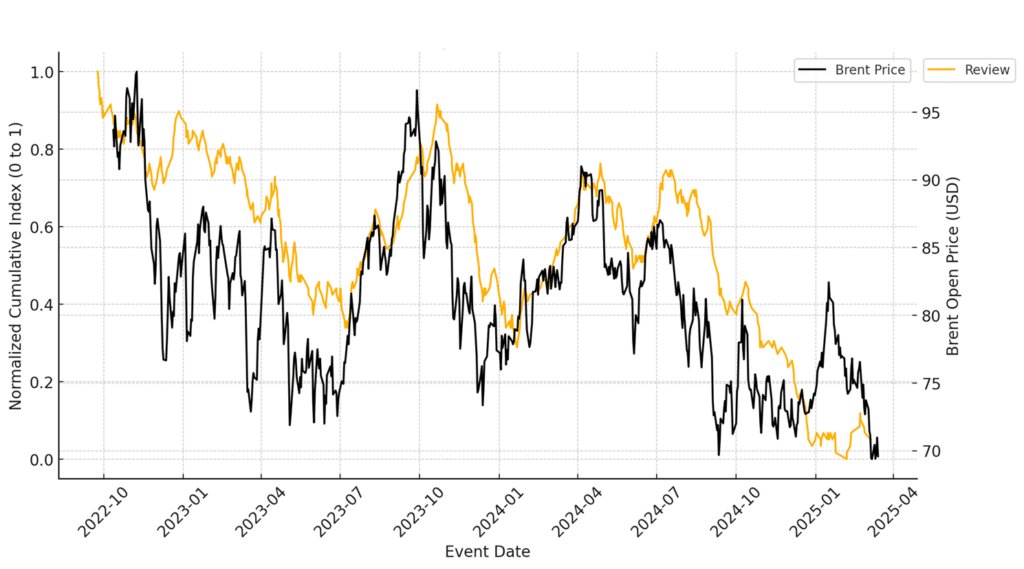
Confirmation that price commentary only lags

Our insights conclusively shows that price commentary is a persistent lagging indicator in both directions, containing no inherent biases that would provide predictive value. This confirms what many traders suspect but haven’t been able to quantify – commentary follows rather than leads market movements, making it a poor foundation for serious crude oil technical analysis.

crude oil technical analysis pricing commentary lags

Implications for crude oil technical analysis and trading strategies

These insights from our Trading Co-Pilot data offer significant value for positioning within crude oil markets for both manual and systematic trading. By understanding which sentiment indicators provide genuine predictive value and which merely follow price action, traders can develop more effective strategies that go beyond conventional crude oil technical analysis methods.

Our Trading Co-Pilot continues to refine these models, providing our partners with increasingly accurate sentiment-enhanced crude oil technical analysis across commodity markets.

For more detailed analysis or to discuss how these insights might enhance your trading strategy, please contact us at enquiries@permutable.ai. To request a demo or enterprise trial of our Trading Co-Pilot simply fill in the form below.

Request enterprise trial/demo


Oil market analysis: Market sentiment indicators precede Brent crude and gasoline rebound

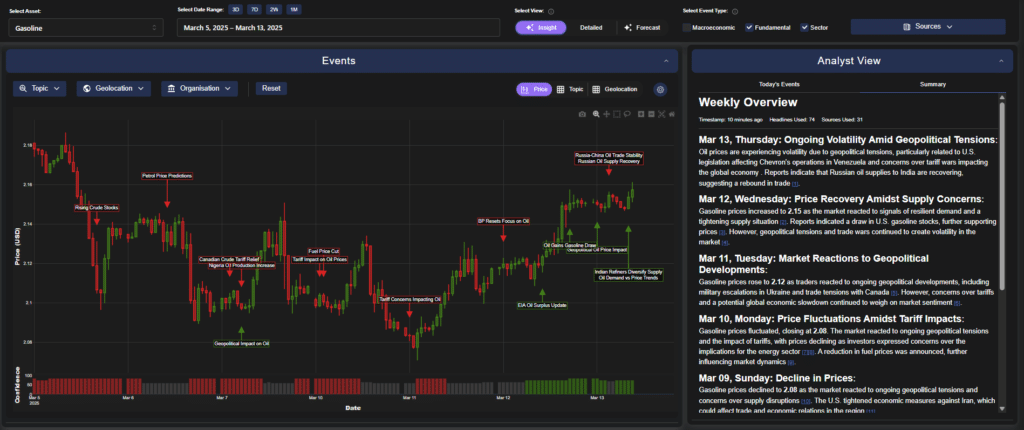
Yesterday, our Trading Co-Pilot identified an important shift in media sentiment surrounding crude oil fundamentals that successfully anticipated the subsequent rebound in Brent and gasoline contracts. In its LLM-driven oil market analysis, it predicted the moves that caused both to return to the upper boundary of last week’s trading range, validating our sentiment-based approach to market timing.

Market sentiment indicators as leading price predictors

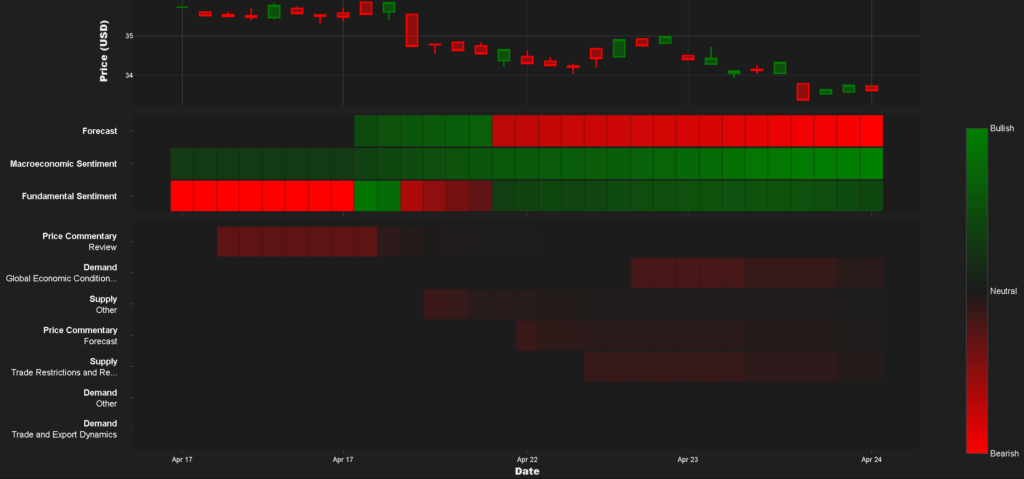
Our proprietary sentiment indicators within our Trading Co-Pilot demonstrated a marked transition from bearish to bullish across multiple factors between March 11-12. This transition preceded the price action by approximately 24 hours, providing traders using our tool with a significant timing advantage. Our oil market analysis clearly shows the sentiment heat map displaying clustering of green sentiment bars forming after a sustained period of red, with particular strength in the Supply Inventory Levels and Technical categories (see chart above). 

What makes this shift particularly noteworthy is the breadth of the sentiment change. Unlike isolated sentiment indicators that often produce false signals, we observed coordinated shifts across fundamentals, technicals, and geopolitical factors through our Trading Co-Pilot – a powerful combination that has historically preceded sustainable price movements.

oil market analysis rebound Analyst Insight mode

Above: Oil market analysis rebound by topic: Analyst Insight mode

Technical structure analysis

From a market structure perspective, Brent crude displayed clear evidence of accumulation following the March 10 decline. The price action formed a classic “spring” pattern at the 68.36 level, violating previous support before rapidly recovering – a textbook indicator of institutional buying interest.

The volume profile during this period reveals steadily increasing participation on up-days compared to diminishing volume on down-days, creating a bullish divergence that sophisticated traders recognise as accumulation. Thorough oil market analysis of the technical oversold condition, as highlighted in our Articles Detected panel, created the necessary conditions for this reversal pattern to manifest.

Fundamental catalysts triggering the reversal

Several fundamental catalysts coincided with the sentiment shift, as our oil market analysis reveals:

Geopolitical premium reassessment

Reports of military advancements in Ukraine, specifically Russian forces approaching the Kursk region, introduced a risk premium that was initially under-priced.

Supply constraints emerging

Gasoline prices responded sharply to reports indicating a draw in U.S. stocks, with our dashboard showing prices increased to 2.15 as market participants reacted to tightening supply conditions. 

Trade flow recalibration

As Canada threatened US with oil export cuts this introduced a fresh supply variable previously not factored into prices as a sentiment driver. Simultaneously, reports of Russian oil supplies to India recovering suggested trade flow adjustments that could tighten Atlantic Basin balances.

oil market analysis rebound Analyst Insight mode

Above: Oil market analysis rebound by event: Analyst Insight mode

Demand variables in flux

Our Trading Co-Pilot’s comprehensive oil market analysis showed that while supply factors dominated the sentiment shift, demand indicators presented a more nuanced picture. Our system flagged economic fears driving prices lower, with Chinese demand concerns remaining at the forefront. However, this was then offset by the price rebound when our sentiment indicator turning positive on March 12.

This dynamic tension between supply bullishness and demand uncertainty explains the measured nature of the rally – strong enough to return prices to the upper trading range but insufficient to trigger a breakout above established resistance.

Temporal analysis and path dependency

The sequencing of sentiment shifts proved key in our Trading Co-Pilot’s oil market analysis. Our temporal analysis shows the initial weaker dollar sentiment shift that preceded and likely catalysed the subsequent bullish weekly EIA inventory report response. This path dependency of sentiment factors demonstrates how initial catalysts can create cascading sentiment effects that ultimately drive prices.

Our Trading Co-Pilot system’s success in detecting this sentiment shift before price action materialised perfectly highlights the advantage of using our technology in increasingly volatile  energy trading. Its advantage lies in being able to process vast quantities of unstructured sentiment data, which is becoming as key as traditional oil market analysis methodologies.

Experience the Trading Co-Pilot advantage

Don’t just take our word for it – see the power of predictive sentiment analysis in your own trading strategies. Our complimentary 14-day enterprise trial gives your trading desk full access to the Trading Co-Pilot dashboard, including real-time sentiment heat maps across 42 energy market factors, predictive alerts 12-24 hours before major price movements, custom sentiment threshold configurations for your specific trading parameters, direct API integration with your existing trading systems, and historical backtesting against your previous trading positions. 

Arrange a 39-minute personalised demonstration where we will apply our Trading Co-Pilot to your specific trading instruments and show how recent trades could have been optimised using our sentiment indicators. Simply email us at enquiries@permutable.ai or fill in the form below.

Request demo/enterprise trial


Energy sector sentiment: Navigating turbulence in a fragmented market caused by Trump 2.0

uIn the blur of the last few weeks, energy sector sentiment has shifted dramatically as global markets grapple with intensifying pressures. Our Trading Co-Pilot’s latest insights reveal a market approaching critical inflection points across key commodities, with bearish trends dominating petroleum products while natural gas presents a more nuanced picture. As we navigate this landscape, one thing becomes increasingly clear: global trust is now under great duress, creating market fragmentation that is causing market volatility and challenges for existing energy trading strategies.

First, the context: A market under pressure

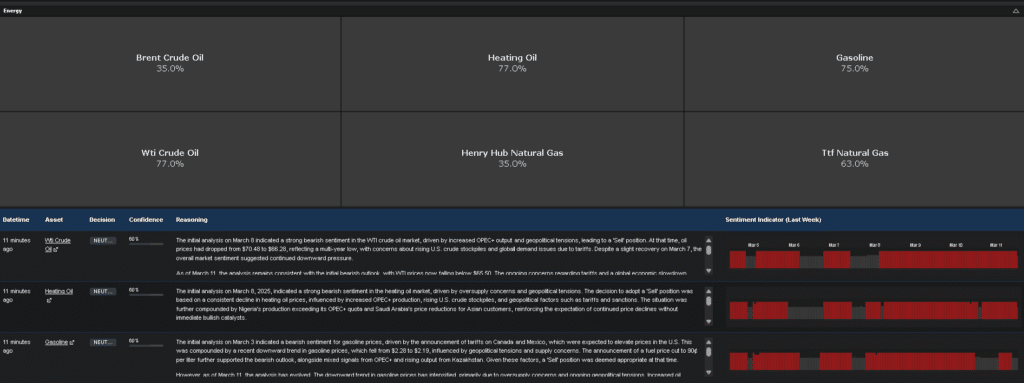
When you consider the current state of energy markets, the data tells a compelling story. Heating oil and crude oil benchmarks are approaching three-year lows, with WTI falling below $65.50 and Brent closing at $68.56. This pronounced bearish sentiment stems from a confluence of factors that our LLM-driven Trading Co- has been meticulously tracking.

The most glaring prospect facing energy traders is that of oversupply. OPEC+ production increases continue unabated, whilst US crude stockpiles rise unexpectedly, creating a perfect storm for petroleum prices. And this is precisely why the question of demand destruction has moved to the forefront of market discussions, particularly as weak economic data from China compounds existing concerns.

Let us not forget that these market dynamics are unfolding against a backdrop of geopolitical upheaval. In this new world order, the Trumpian backlash against global trade norms has introduced tariffs affecting Canada and Mexico, with ripple effects across energy supply chains. We can’t help wondering whether the Whitehouse has any idea (or indeed, cares) what it’s currently unleashing on global energy markets (along with other markets too). All of which has sent shockwaves through traditional trading patterns, creating new inefficiencies and price distortions.

energy sector sentiment march 2025

Above: Energy market sentiment according to our Trading Co-Pilot as of 13:00 on 11th March 2025

The shifting tides of energy market sentiment

Our Trading Co-Pilot’s energy market sentiment analysis reveals that previously strong ‘Sell’ positions across petroleum products now warrant a more measured approach. The hosepipe of negative indicators has hit so intensely that markets may be approaching oversold territory. Energy sector sentiment indicators suggest we’ve reached a critical junction where caution unsurprisingly becomes the watchword.

Now, this rightly causes worries about market stability and predictability. When market fundamentals become subordinate to geopolitical manoeuvring, traditional forecasting models lose efficacy. Experts say this decoupling creates a dangerous precedent for energy traders who rely on historical correlations and established patterns, which by the way, is where our Trading Co-Pilot‘s ability to help traders delayer themes really comes into its own.

The fact of the matter is that this dangerous shift is particularly acute for institutional investors with significant exposure to energy commodities. As Trump 2.0 policies begin to materialise, markets will need to work quickly to recalibrate expectations around global trade flows and energy diplomacy. Meanwhile, the IEA Chief’s recent comments regarding the need for increased investments in oil and gas fields highlight e the complex interplay between short-term price movements and long-term supply security.

Natural gas: A different narrative

While petroleum products languish under bearish pressure, natural gas markets tell a more complex story. Henry Hub prices spiked to $4.69 before stabilising around $4.44, while TTF Natural Gas exhibits significant volatility driven by supply concerns. The contrast between these commodities and their liquid counterparts highlights the fragmented nature of today’s energy landscape.

Here, supply disruptions, particularly the severe drop in Nigeria’s LNG output and operational delays at TotalEnergies’ North Sea gas hub, have introduced new uncertainties. This is a difficult truth for traders seeking clarity: the traditional correlations between energy commodities has gone up in smoke, requiring more nuanced and segmented trading strategies.

We must acknowledge that energy sector sentiment around natural gas is being shaped by both immediate supply concerns and longer-term questions about policy direction. As climate policies evolve and gas-fired power generation faces competing pressures, the market struggles to price these competing narratives effectively.

Navigating forward: Neutral positioning

You may say that markets eventually self-correct, and while we’d like to agree, there is a sense of danger posed by current levels of uncertainty which suggests a strategic retreat may be prudent. Our Trading Co-Pilot has shifted recommendations from definitive ‘Sell’ positions to ‘Neutral’ across the petroleum complex, recognising that cracks are appearing in the bearish narrative that could presage stabilisation.

This neutral stance represents neither capitulation nor conviction, but rather a tactical pause to reassess as new data emerges during this highly unpredictable time. Energy sector sentiment indicators are flashing warning signals, with multiple commodities approaching multi-year lows simultaneously, and the risk of sharp mean reversion increasing.

For traders who have benefited from the downtrend, this represents an opportunity to lock in gains and reset positioning. For those awaiting entry points, patience remains virtuous as markets search for equilibrium amid conflicting signals.

Navigating uncertainty in energy sector sentiment

As we look ahead, energy sector sentiment will likely remain hostage to both macroeconomic forces and escalating geopolitical tensions. The coming weeks will be critical in determining whether petroleum markets can pull back from the brink of further selloffs or whether additional downside pressure materialises. For energy traders and institutional investors, the watchword remains vigilance. While neutrality may feel unsatisfying in a market that rewards conviction, sometimes the wisest position is to acknowledge uncertainty rather than force a narrative that data doesn’t yet support. 

Experience Our Trading Co-Pilot Today

Ready to navigate market volatility with the latest LLM-driven technology? For enterprise clients, take advantage of our free trial offer and discover how our Trading Co-Pilot’s real-time market sentiment analysis can help you navigate market volatility during these uncertain times. Our AI-driven platform delivers key insights on shifting asset correlations and geopolitical impacts – updated every 15 minutes—giving you the edge when markets are at their most unpredictable.

Simply drop us a line to enquiries@permutable.ai or fill in the form below to arrange a complimentary enterprise trial where you can explore the full suite of Trading Co-Pilot features for 14 days and see firsthand how institutional investors are using our technology to identify emerging opportunities and mitigate risks in today’s fragmented markets.

Request enterprise trial/demo


Energy market sentiment 26 Feb 2025: Mixed signals amid global uncertainties

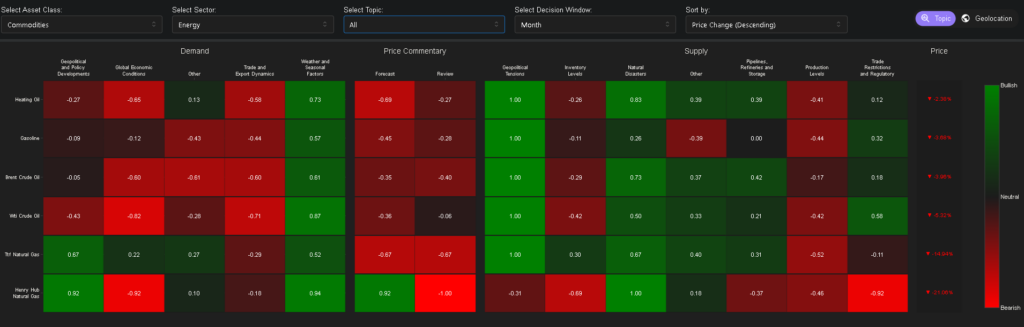
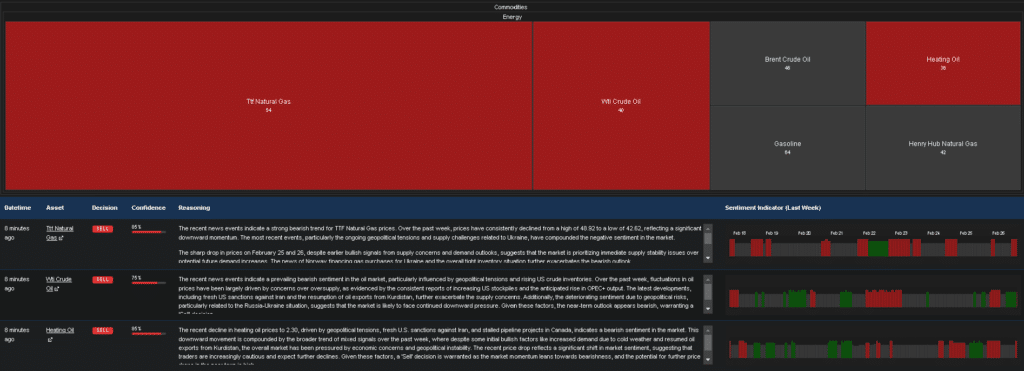
As this hectic month comes and International Energy Week come to an end, our Trading Co-Pilot has captured significant shifts in energy market sentiment this week through its Market 360 thematic analysis. It is a tale of predominantly bearish signals across several key energy commodities, with TTF Natural Gas, WTI Crude Oil, and Heating Oil all displaying strong sell indicators at 85% confidence levels.

Within the current landscape of energy markets, we’re observing a complex interplay of supply concerns, geopolitical tensions, and inventory fluctuations that have collectively shaped trading patterns. This week, the TTF Natural Gas market has shown consistent price declines from 48.92 to 42.62, reflecting substantial downward momentum despite earlier bullish signals from supply concerns.

This backdrop adds layers of complexity, as seemingly contradictory factors influence different segments of the energy complex. The view that immediate supply stability issues are outweighing potential future demand increases appears to be gaining traction among traders, particularly in European gas markets where Norway’s financing of gas purchases for Ukraine has further contributed to the bearish outlook.

energy market sentiment this week

Above: Our Market 360 thematics showing energy market sentiment at time of writing

Crude oil markets: Supply concerns and geopolitical pressures

In fact, WTI crude oil has experienced similar downward pressure, falling from 70.16 to 68.89 in recent trading sessions. The divisive figure Trump looms large over energy markets, with potential tariff risks adding another layer of uncertainty to already volatile conditions. On the face of it, it seems that fresh US sanctions against Iran would typically support prices, but market reactions have been counterintuitive.

The problem, of course, is that rising US crude inventories and concerns over increased OPEC+ output have compounded the bearish sentiment. Optimists may say that geopolitical tensions should provide price support, but this has not materialised as expected. This, doubtless, reflects traders’ lack of confidence in a near-term recovery despite the ongoing conflicts that traditionally boost energy prices.

Meanwhile, heating oil markets are no longer threatened by short-term supply disruptions, as the initial price spike following the drone attack on the Caspian Pipeline Consortium quickly reversed. On one end of the spectrum, increased oil production from Nigeria and resumed exports from Iraq’s Kurdish region have contributed to downward price pressure. At the other end of the spectrum, the consistent decline to a low of 2.30 suggests persistent bearish sentiment that shows little sign of reversing in the immediate future.

Mixed signals in gasoline and brent markets

Embedded in this is a more nuanced picture for gasoline and Brent crude oil, both of which our Trading Co-Pilot has assigned neutral ratings with 65% confidence levels. The energy market sentiment this week for these commodities reflects a balancing act between bullish and bearish factors.

For gasoline, the stabilisation of prices following reports alleviating some supply concerns represents a positive development. However, there is terror in the hearts of traders regarding potential tariff risks and ongoing geopolitical tensions that continue to create uncertainty. Now, even though Brazil’s record oil production might typically pressure prices downward, the mixed inventory reports have left the market in a state of cautious neutrality.

Brent crude oil displays similar characteristics, with the market appearing to be in a wait-and-see mode on the grounds that conflicting signals make directional betting particularly risky. If the chaos will resolve toward a bullish or bearish trend remains unclear, as supply concerns from the Caspian Pipeline incident and Iran sanctions are counterbalanced by inventory builds and potential OPEC+ supply increases.

Natural gas: Weather-driven volatility

Henry Hub natural gas presents perhaps the most weather-dependent narrative in the energy complex this week. The Arctic blast that initially drove prices higher has given way to warmer forecasts, creating significant price volatility. The price journey from 4.35 to 3.89 and back to relative stability around 4.12-4.15 demonstrates how quickly sentiment can shift in this market.

It’s too soon to judge whether stability has been restored to the natural gas market, as the interplay between weather patterns, inventory levels, and production plans from major players like Chevron continues to drive day-to-day fluctuations. Our Market 360 heatmap indicates that this balance between supply and demand factors has immeasurable value for traders looking to navigate the current uncertainty.

Looking forward: Navigating uncertain energy market sentiment

Our Trading Co-Pilot’s energy market sentiment analysis this week suggests that caution remains the prudent approach across the energy market complex. While TTF natural gas, WTI crude, and heating oil display clear bearish signals, the neutral outlook for Gasoline, Brent crude, and Henry Hub natural gas indicates potential for movement in either direction.

Of course, understanding these market dynamics has immeasurable value in today’s volatile environment. Our Market 360 tool continues to monitor real-time developments, providing institutional traders with comprehensive insight into how geopolitical events and supply-demand factors ripple across different energy commodities.

As we look toward March, the cross-asset implications of these energy market movements will be key to watch. In short, the correlation between energy prices and broader market sentiment remains strong, with potential knock-on effects for currencies and other commodity classes.

The energy market sentiment this week reflects a sector very much in transition, balancing immediate supply concerns against longer-term structural changes. Our Trading Co-Pilot will continue to track these developments 24/7, in real-time, providing the analytical edge that institutional investors need to navigate these complex market conditions effectively and confidently.

Experience Market 360 for your institution

If your trading desk or investment team is struggling to make sense of increasingly interconnected energy market sentiment, now is the time to experience how our Market 360 Thematics can transform your decision-making process. This innovative solution from our Trading Co-Pilot platform delivers LLM-driven cross-asset market analysis with unprecedented clarity and depth.

Our enterprise clients tell us that the energy market sentiment insights surfaced by Market 360 has is creating powerful value in their approach to energy trading. On the grounds that market intelligence should be both comprehensive and actionable, we’ve designed Market 360 to deliver insights that translate directly to trading opportunities. And so, we invite you to request a personalised enterprise demonstration, tailored specifically to your institution’s trading focus and analytical requirements. Our team will walk you through how Market 360 can:

  • Visualise complex cross-asset relationships in real-time
  • Track sentiment shifts across energy markets as they develop
  • Identify emerging correlations before they become obvious to the broader market
  • Deliver tailored alerts based on your specific trading parameters
  • Integrate seamlessly with your existing trading infrastructure

To arrange your personalised demon or to apply for your enterprise trial, please contact our team at enquiries@permutable.ai or simply fill in the form below.

Request demo/enterprise trial


Read more AI market sentiment analysis  

Agricultural commodities market sentiment this week

Current forex market sentiment this week

Gold market sentiment this week


Decoding crude oil market sentiment

Trump tariff plan: Impact on US Dollar and global markets


Decoding crude oil market sentiment: 7 use cases of our LLM-driven Trading Co-Pilot

In these early innings of the AI revolution, few sectors stand to benefit as dramatically as commodity trading, particularly in the volatile crude oil markets. One cannot escape the reality that traditional market analysis approaches are rapidly being outpaced by AI-driven alternatives. The impressive capability of these tools such as those that we have been working on for the last three years to process vast quantities of market data and news in real-time is fundamentally changing how traders understand oil market sentiment. In this article, we’ll take a look at seven use cases of our crude oil market sentiment, available through our Trading Co-Pilot subscription. 

Why crude oil market sentiment matters now more than ever

The financial and geopolitical forces shaping today’s oil markets are increasingly complex. After a spell of relative stability, recent events have dramatically shifted global supply chains. This includes the significant impact of Asia’s response to Russian crude sanctions, with markets rapidly adjusting to replace sanctioned Russian crude oil and causing major shifts in global supply dynamics.

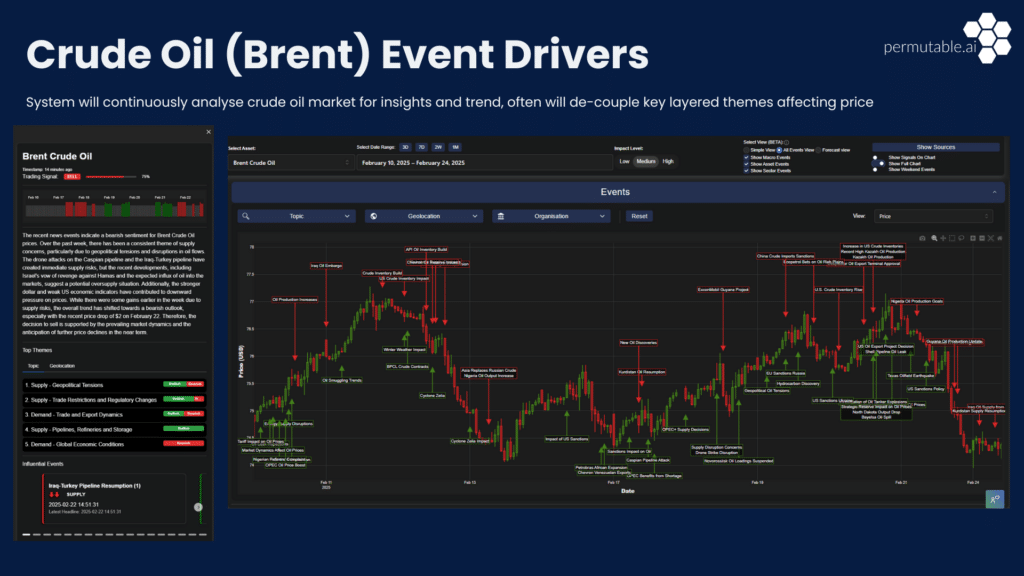
One of the really remarkable things over the last year is how quickly these market movements can develop and cascade across different asset classes. As seen in Permutable’s visualisations, events like the Iraq-Turkey pipeline disruptions can trigger immediate supply risks, while US crude inventory reports can send ripples through global markets within minutes.

We’re already seeing how AI is taking centre stage in helping institutional traders navigate this complexity through our own work with our clients. Part of the battle here is simply organising the overwhelming amount of information that influences crude oil prices which AI excels at. And then there’s the very significant upside of its ability to spot emerging trends before they become obvious to the broader market and human eye. 

7 use cases for our AI-driven crude oil market sentiment 

1. Geo-location thematic analysis

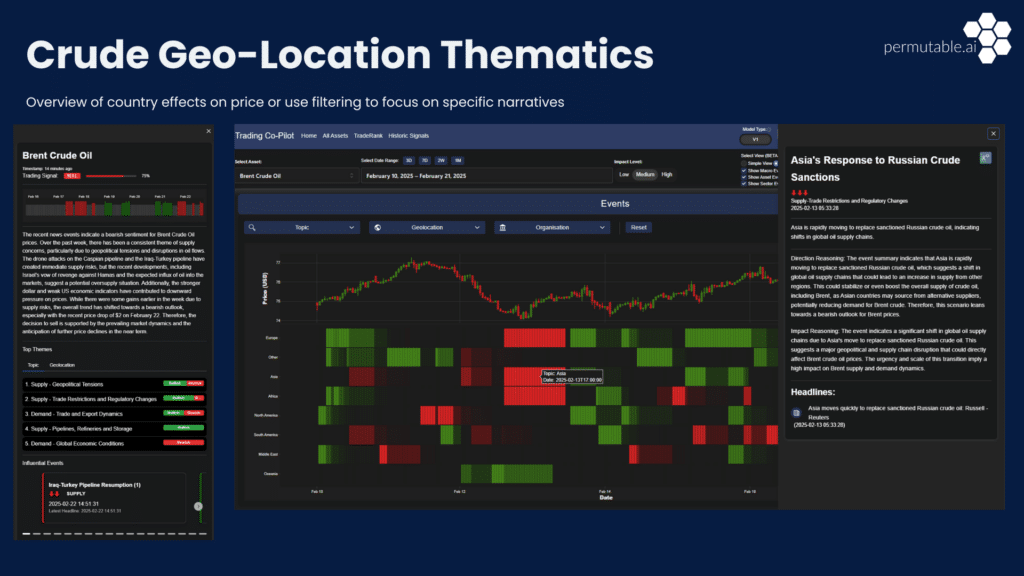
The rise of regional market divergences means traders must monitor location-specific factors more closely than ever. Our geo-location thematic analysis provides an overview of country effects on price, filtering to focus on specific narratives. For example, our platform highlights how Asian markets are rapidly moving to replace sanctioned Russian crude oil, indicating shifts in global oil supply chains that could lead to increased supply from other regions. It is a good example of how geopolitical events can be translated into actionable trading insights.

Brent crude oil market sentiment geo-location theme map powered by our proprietary LLMs

2. Theme mapping across supply and demand factors 

Our theme map for Brent Crude market sentiment breaks down the market into colour-coded sentiment indicators across multiple factors. This includes supply considerations such as geopolitical tensions, trade restrictions and regulatory changes, and supply production levels. For demand factors, it tracks global economic conditions and trade and export dynamic. The tactics used by successful traders often involve identifying when these themes diverge, creating potential trading opportunities. But it is almost always the case that these relationships are complex and difficult to spot without advanced visualisation tools such as these.

3. Event driver identification

In the previous era, traders were more dependent on manual news monitoring. Now, our event drivers visualisation specific market-moving events directly onto price charts. This includes inventory builds/draws (US, Japan, China), production increases/decreases, pipeline disruptions, geopolitical conflicts, OPEC+ decisions, and refinery outages. Each event is colour-coded (red for bearish, green for bullish) and positioned precisely where it impacts the price chart, creating a comprehensive narrative of market movements.

Brent crude oil market sentiment event drivers powered by our proprietary LLMs

4. Real-time sentiment tracking

To say that AI’s capabilities are progressing at an incredible speed in the realm of natural language processing is somewhat of an understatement from where we stand. Our in-house trained LLM models analyse thousands of news sources, social media feeds, and market reports to generate real-time crude oil market sentiment. We know that the most frustrating thing about traditional sentiment analysis was its delay – by the time sentiment was identified, the market had often already moved. This is where our 15-minute update cycle comes into play, ensuring traders can identify shifting market sentiment as – or even before –  it develops.

5. Cross-asset correlation visualisation

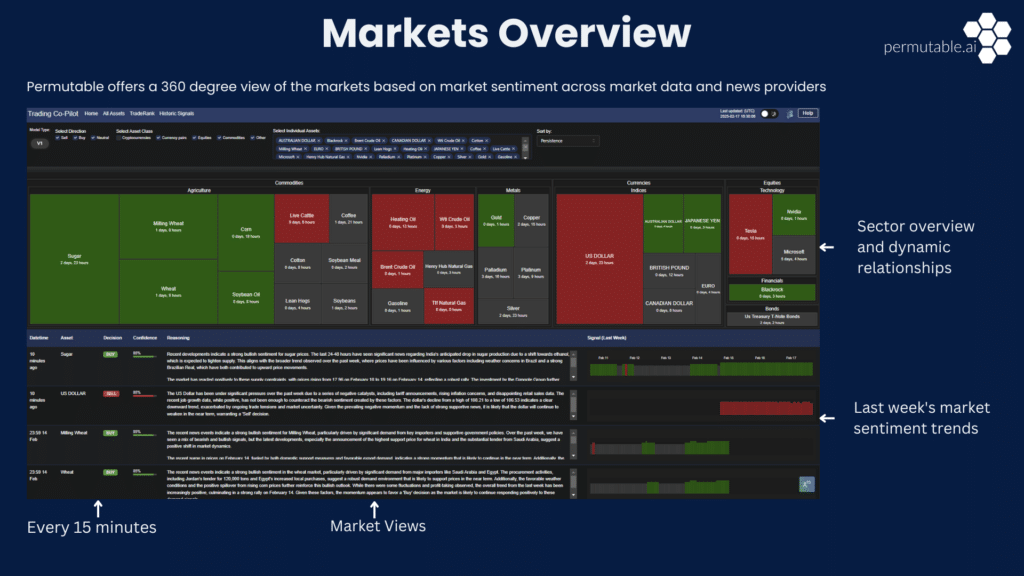
As oil markets jostle for supremacy with other asset classes, understanding correlations between market, becomes increasingly important. Our cross-asset visualisation demonstrates how crude oil price movements interact with currency pairs (particularly USD strength), other commodities (natural gas, agricultural products), equity markets (especially energy sector stocks), and bond yields. The latter, making connections between seemingly unrelated markets, cam often provides the earliest signals of changing crude oil market sentiment and dynamics.

Market 360 overview market sentiment analysis across asset classes powered by our proprietary LLM models

6. Supply chain disruption alerts

With global supply chains increasingly vulnerable to disruption, our platform identifies potential chokepoints before they impact prices. Our recent data visualisations highlight pipeline attacks and resumptions (Iraq-Turkey), shipping lane disruptions, refinery outages, production capacity constraints, and weather-related disruptions. These early warnings allow traders to position themselves ahead of market-moving supply shocks.

7. Regulatory and policy impact assessment

Finally, our AI-driven market sentiment analysis excels at gauging the impact of regulatory and policy changes on crude oil markets. From sanctions to environmental regulations, our platform quantifies crude oil market sentiment shifts resulting from policy announcements across global markets.

The future of crude oil market sentiment analysis

As Permutable AI, we’re continuing to refine how traders interact with our crude oil market sentiment analysis through our Trading Co-Pilot platform. The latest roll out of our thematic visualisation, including our Market 360 tool, and other planned developments means that the line between market data and actionable intelligence is becoming increasingly blurred. With every 15-minute update, and weekly feedback loops, our system learns and adapts, providing increasingly nuanced views of crude oil market sentiment.

We know that – for institutional traders, portfolio and asset managers – the implications are powerful and that those who embrace our AI-driven tools will gain a potent edge in risk management and alpha generation. For example, by automating cross-asset correlation analysis that typically requires teams of analysts, our Market 360 allows institutions to reallocate human capital to higher-value activities while improving decision speed.

In today’s complex and volatile crude oil markets, understanding sentiment has never been more valuable – or more challenging. Yet, our crude oil market sentiment visualisations are transforming this challenge into an opportunity, giving traders the confidence to act on emerging trends before they become obvious to the broader market.

Experience our crude oil market sentiment analysis for yourself.

Find out how our crude oil market sentiment analysis can be embedding into your trading strategies by scheduling a personalised enterprise demonstration today to see how our Trading Co-Pilot platform can transform your trading decisions with real-time insights and visualisations. Limited complimentary trial access available for qualified institutional traders and asset managers. Contact our team at enquiries@permutable.ai or simply fill in the form below to book your session.

Book a demo/request enterprise trial access